cooling CHEVROLET SUBURBAN 1997 Owners Manual
[x] Cancel search | Manufacturer: CHEVROLET, Model Year: 1997, Model line: SUBURBAN, Model: CHEVROLET SUBURBAN 1997Pages: 433, PDF Size: 21.49 MB
Page 80 of 433
It can be dangerous to drive with the tailgate
glass, tailgate or rear doors open because carbon
monoxide (CO) gas can come into your vehicle.
You can’t see or smell CO. It can cause
unconsciousness and even death.
If you must drive with the tailgate glass, tailgate
or rear doors open or if electrical wiring or other
cable connections must pass through the seal
between the body and the tailgate glass, tailgate
or rear doors:
Make sure all windows are shut.
firn the fan on your heating or cooling
system to its highest speed with the setting
on VENT. That will force outside air into
your vehicle. See “Comfort Controls” in
the Index.
instrument panel, open them all the
way.
If you have air outlets on or under the
See “Engine Exhaust” in the Index.
Tailgate Glass and Tailgate
If your vehicle has a tailgate, you must raise the rear
glass before lowering the tailgate.
To open the glass from the outside, use your key. With
the key
in the lock, turn the key clockwise to release the
glass, then lift it up.
To release the glass from the inside, use the electric
tailgate glass release switch on the instrument panel. For
more information, see “Tailgate
-- Electric Glass
Release” in the Index.
To open the tailgate, lift up on the handle while pulling
the tailgate toward you.
Close the tailgate before closing the rear glass. After
closing the tailgate, make sure the tailgate is securely
latched by pulling it toward
you. After closing the rear
glass, pull up on its handle to make sure it is locked.
2-9
ProCarManuals.com
Page 139 of 433
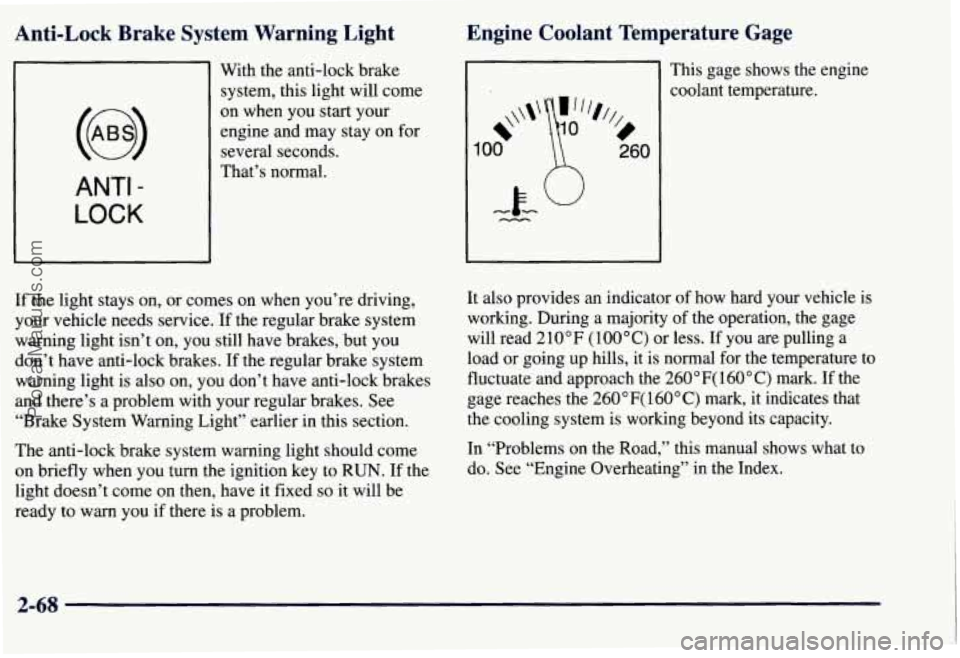
Anti-Lock Brake System Warning Light
With the anti-lock brake
system, this light will come
ANTI -
LOCK
on when you start your
engine and may stay on for
several seconds.
That’s normal.
Engine Coolant Temperature Gage
This gage shows the engine
coolant temperature.
If the light stays on, or comes on when you’re driving,
your vehicle needs service. If the regular brake system
warning light isn’t on, you still have brakes, but you
don’t have anti-lock brakes. If the regular brake system
warning light is also on, you don’t have anti-lock brakes
and there’s a problem with your regular brakes. See
“Brake System Warning Light” earlier in this section.
The anti-lock brake system warning light should come
on briefly when you turn the ignition key to
RUN. If the
light doesn’t come on then, have it fixed
so it will be
ready to warn you if there is a problem.
It also provides an indicator of how hard your vehicle is
working. During a majority of the operation, the gage
will read
2 10 OF ( 100 ” C) or less. If you are pulling a
load or going up hills, it is normal for the temperature
to
fluctuate and approach the 260 OF( 160” C) mark. If the
gage reaches the
260”F( 160°C) mark, it indicates that
the cooling system
is working beyond its capacity.
In “Problems on the Road,” this manual shows what to
do. See “Engine Overheating” in the Index.
2-68
ProCarManuals.com
Page 154 of 433
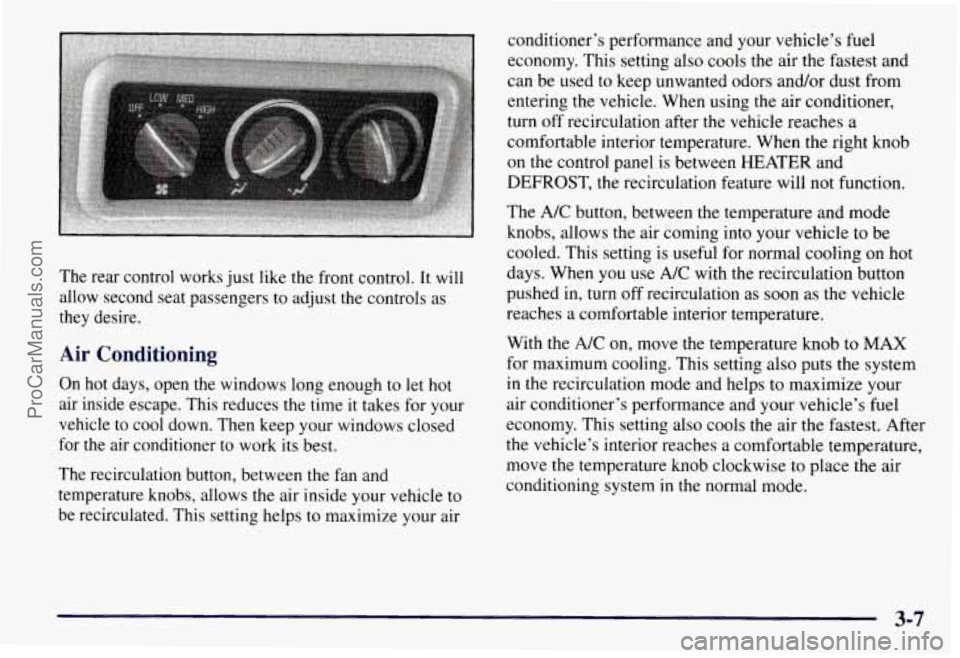
The rear control works just like the front control. It will
allow second seat passengers to adjust the controls as
they desire.
Air Conditioning
On hot days, open the windows long enough to let hot
air inside escape. This reduces the time it takes for your
vehicle to cool down. Then keep your windows closed
for the air conditioner to work its best.
The recirculation button, between the fan and
temperature knobs, allows the air inside your vehicle to
be recirculated. This setting helps to maximize your air conditioner’s performance and your vehicle’s
fuel
economy. This setting also cools the air the fastest and
can be used to keep unwanted odors and/or dust from
entering the vehicle. When using the air conditioner,
turn off recirculation after the vehicle reaches a
comfortable interior temperature. When the right knob
on the control panel is between HEATER and
DEFROST, the recirculation feature will not function.
The A/C button, between the temperature and mode
knobs, allows the air coming into your vehicle to
be
cooled. This setting is useful for normal cooling on hot
days. When
you use A/C with the recirculation button
pushed in, turn off recirculation as soon as the vehicle
reaches a comfortable interior temperature.
With the A/C on, move the temperature knob to MAX
for maximum cooling. This setting also puts the system
in the recirculation mode and helps to maximize your
air conditioner’s performance and your vehicle’s fuel
economy. This setting also cools the air the fastest. After
the vehicle’s interior reaches a comfortable temperature,
move the temperature knob clockwise to place the air
conditioning system in the normal mode.
3-7
ProCarManuals.com
Page 155 of 433
Heating Ventilation System
The heater works best if you keep your windows closed
while using it. On cold days, use the HEATER or
VENT/HEAT setting with the temperature knob in
the
red area.
If you use the engine coolant heater before starting your
engine in cold weather,
20°F (-8 O C) or lower, your
heating system will produce warmer air faster, to heat
the passenger compartment in cold weather.
The use
of an engine coolant heater also reduces the
time it takes for the engine to reach normal operating
temperature, and shortens the time it takes the heater to
reach full output. For more information, see “Engine
Coolant Heater” in the Index. For
mild outside temperatures when little heating or
cooling is needed, use VENT to direct outside air
through your vehicle. Air will flow through the
instrument panel outlets.
Your vehicle’s ventilation system supplies outside air
to the inside of your vehicle when it is moving. With
the side windows closed, air will flow into the front
air inlet grilles, through the vehicle, and out the air
exhaust valves.
Outside air will also enter the vehicle when the heater or
the air conditioning fan
is running, unless you have the
recirculation button pushed
in. For more information on
the recirculation button, see
“Air Conditioning” earlier
in this section.
ProCarManuals.com
Page 207 of 433
After Off-Road Driving
Remove any brush or debris that has collected on the
underbody, chassis or under the hood. These
accumulations can be a fire hazard.
After operation in mud or sand, have the brake linings
cleaned and checked. These substances can cause
glazing and uneven braking. Check the body structure,
steering, suspension, wheels, tires and exhaust system
for damage. Also, check the fuel lines and cooling
system for any leakage.
Your vehicle will require more frequent service due to
off-road use. Refer to the Maintenance Schedule for
additional information.
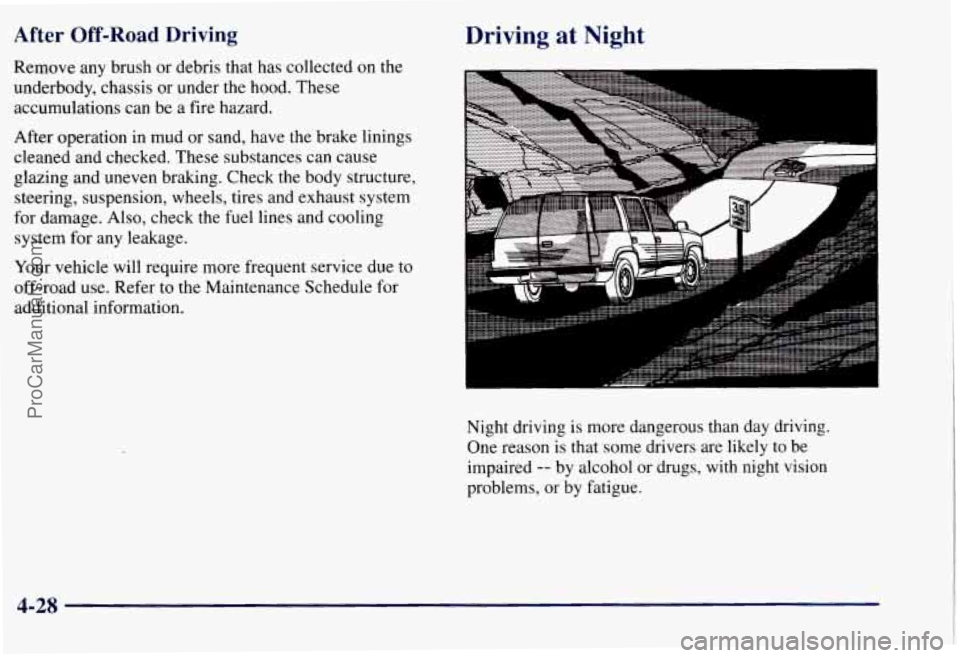
Driving at Night
Night driving is more dangerous than day driving.
One reason is that some drivers are likely to be
impaired
-- by alcohol or drugs, with night vision
problems,
or by fatigue.
4-28
ProCarManuals.com
Page 215 of 433
Hill and Mountain Roads If you drive regularly in steep country, or if you’re
planning to visit there, here are some tips that can make
your trips safer and more enjoyable. (See “Off-Road
Driving” in the Index for information about driving
off-road.)
Keep your vehicle in good shape. Check all fluid
levels and also the brakes, tires, cooling system and
transmission. These parts can work hard on
mountain roads.
Know how to go down hills. The most important
thing to know is this: let your engine do some of the
slowing down. Shift to a lower gear when you go
down a steep or long hill.
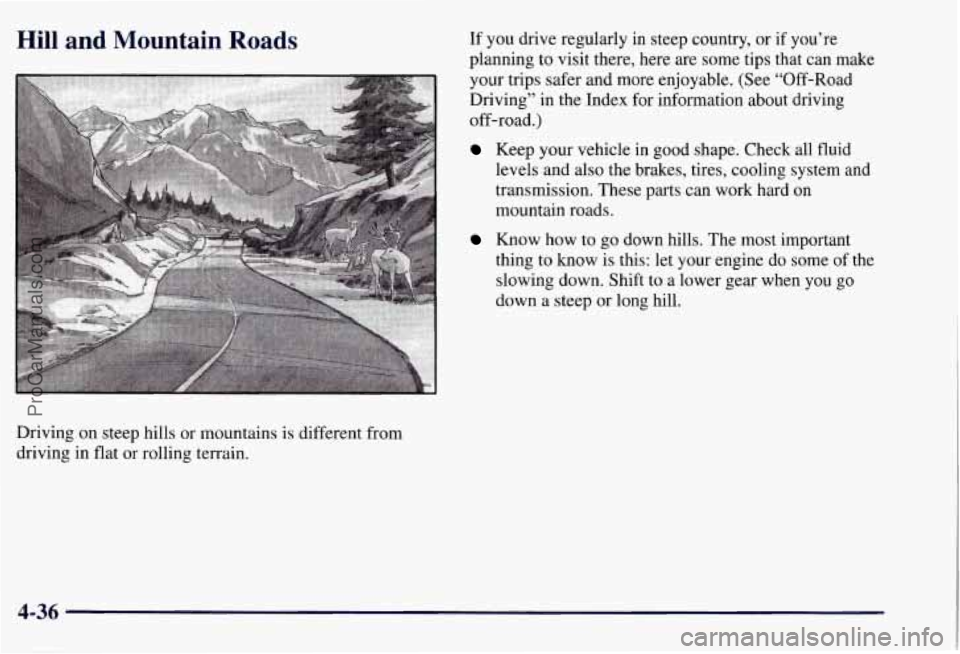
Driving on steep hills or mountains is different from
driving in flat or rolling terrain.
4-36
ProCarManuals.com
Page 229 of 433
Trailer Brakes
If your trailer weighs more than 1,000 Ibs. (450 kg)
loaded, then it needs its own brakes -- and they must be
adequate. Be sure to read and follow
the instructions for
the trailer brakes
so you’ll be able to install, adjust and
maintain them properly.
Your trailer brake system can tap into the vehicle’s
hydraulic brake system only if:
The trailer parts can withstand 3,000 psi
(20 650 kPa) of pressure.
0.02 cubic inch (0.3 cc) of fluid from your vehicle’s
master cylinder. Otherwise, both braking systems
won’t work well. You could even lose your brakes.
The trailer’s brake system will use less than
If everything checks out this far, make the brake tap at
the
port on the master cylinder that sends the fluid to the
rear brakes. But don’t use copper tubing for this. If you
do, it will bend and finally break off. Use steel
brake tubing.
Driving with a Trailer
If you have a rear-most window open and you
pull
a trailer with your vehicle, carbon monoxide
(CO) could come into your vehicle.
You can’t see
or smell
CO. It can cause unconsciousness or
death. (See “Engine Exhaust” in the Index.)
To
maximize your safety when towing a trailer:
0
0
0
Have your exhaust system inspected for
leaks, and make necessary repairs before
starting
on your trip.
Keep the rear-most windows closed.
If exhaust does come into your vehicle
through
a window in the rear or another
opening, drive with your front, main
heating or cooling system on and with the
fan on any speed. This will bring fresh,
outside air into your vehicle.
Do not use the
recirculation button
or MAX because it
only recirculates the air inside your vehicle.
(See “Comfort Controls”
in the Index.)
4-50
ProCarManuals.com
Page 233 of 433
When You Are Ready to Leave After
Parking
on a Hill
1. Apply your regular brakes and hold the pedal down
while you:
Start your engine;
0 Shift into a gear; and
0 Release the parking brake.
2. Let up on the brake pedal.
3. Drive slowly until the trailer is clear of the chocks.
4. Stop and have someone pick up and store the chocks.
Maintenance When Trailer Towing
Your vehicle will need service more often when you’re
pulling a trailer. See the Maintenance Schedule for more
on this. Things that are especially important in trailer
operation are automatic transmission fluid (don’t
overfill), engine oil, axle lubricant, belt, cooling system
and brake adjustment. Each
of these is covered in this
manual, and the Index will help you find them quickly.
If you’re trailering, it’s a good idea to review these
sections before you start your trip.
Check periodically to see that all hitch nuts and bolts
are tight.
Trailer Wiring Harness
A seven-wire harness is stored under the rear of your
vehicle, between the frame rails. An electrical connector
will need to be added at the trailer end
of the harness, by
a qualified electrical technician. For additional trailer
wiring and towing information, please consult your
dealer. Securely attach the harness to the trailer, then
tape or strap it to your vehicle’s frame rail. Be sure you
leave it loose enough
so the wiring won’t bind or break
when turning with the trailer, but not
so loose that it
drags on the ground. Store the harness in its original
position. Wrap the harness together and tie it neatly
so it
won’t be damaged. If you tow a trailer, your Center
High-Mounted Stoplamp (CHMSL) may not be
properly visible from behind. You should select a trailer
with a CHMSL
on it or, if one is not available, have one
installed. See your GM dealer about how to connect
your vehicle’s wiring to
a trailer CHMSL.
4-54
ProCarManuals.com
Page 238 of 433
Section 5 Problems On The Road
Here you’ll find what to do about some problems that can occur on the road.
5-2
5-3
5-3
5-8
5-11 Hazard
Warning Flashers
Other Warning Devices
Jump Starting
Towing Your Vehicle
Engine Overheating (Gasoline Engines) Cooling System
-- Gasoline Engines
Engine Fan Noise
If a Tire Goes Flat
Changing
a Flat Tire
If You’re Stuck: In Sand, Mud, Ice or
Snow
5-13
5-2 1
5-21
5-22
5-39
5-1
ProCarManuals.com
Page 250 of 433
Cooling System -- Gasoline Engines
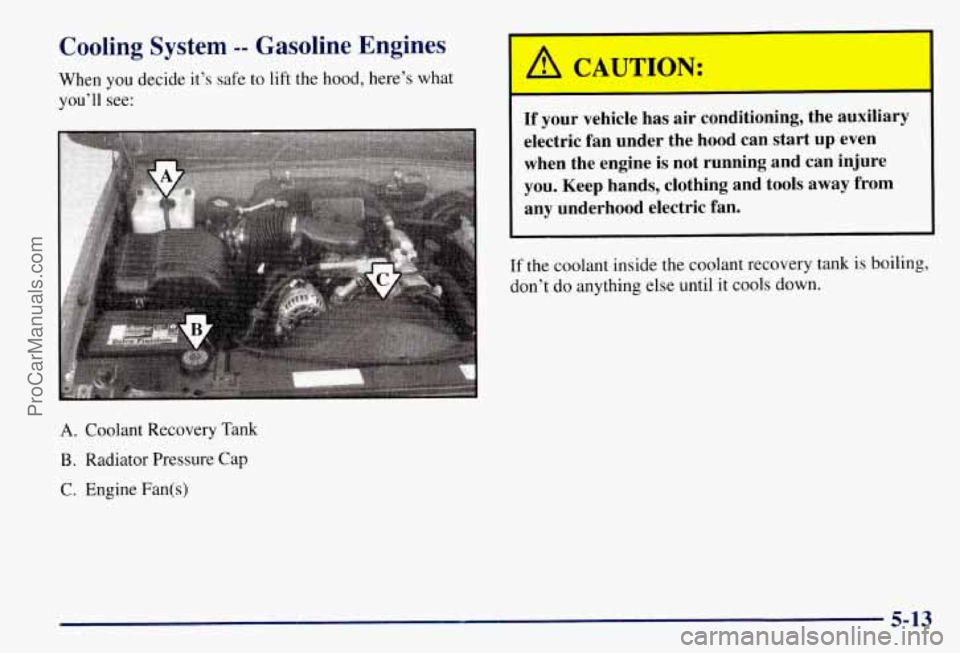
When you decide it’s safe to lift the hood, here’s what
you’ll see:
A. Coolant Recovery Tank
B. Radiator Pressure Cap
C. Engine Fan(s)
LA
CAUTION:
I
If your vehicle has air conditioning, the auxiliary
electric fan under the hood can start up even
when the engine is not running and can injure
you. Keep hands, clothing and tools away from
any underhood electric fan.
If the coolant inside the coolant recovery tank is boiling,
don’t do anything else until it cools
down.
5-13
ProCarManuals.com