check engine CHEVROLET TAHOE 2008 3.G Owner's Guide
[x] Cancel search | Manufacturer: CHEVROLET, Model Year: 2008, Model line: TAHOE, Model: CHEVROLET TAHOE 2008 3.GPages: 538, PDF Size: 2.86 MB
Page 364 of 538
Gasoline Octane
If your vehicle has the 6.2L V8 engine (VIN Code 8),
use premium unleaded gasoline with a posted octane
rating of 91 or higher. You can also use regular unleaded
gasoline rated at 87 octane or higher, but your vehicle’s
acceleration could be slightly reduced, and you might
notice a slight audible knocking noise, commonly referred
to as spark knock. If the octane is less than 87, you might
notice a heavy knocking noise when you drive. If this
occurs, use a gasoline rated at 87 octane or higher as
soon as possible. Otherwise, you could damage the
engine. If you are using gasoline rated at 87 octane or
higher and you hear heavy knocking, the engine needs
service.
For all engines except the 6.2L V8 engine (VIN Code 8),
use regular unleaded gasoline with a posted octane
rating of 87 or higher. If the octane rating is less than 87,
you might notice an audible knocking noise when you
drive, commonly referred to as spark knock. If this occurs,
use a gasoline rated at 87 octane or higher as soon as
possible. If you are using gasoline rated at 87 octane or
higher and you hear heavy knocking, the engine needs
service.
Gasoline Specications
At a minimum, gasoline should meet ASTM specication
D 4814 in the United States or CAN/CGSB-3.5 or 3.511 in
Canada. Some gasolines contain an octane-enhancing
additive called methylcyclopentadienyl manganese
tricarbonyl (MMT). We recommend against the use of
gasolines containing MMT. SeeAdditives on page 5-6
for additional information.
California Fuel
If your vehicle is certied to meet California Emissions
Standards, it is designed to operate on fuels that meet
California specications. See the underhood emission
control label. If this fuel is not available in states adopting
California emissions standards, your vehicle will operate
satisfactorily on fuels meeting federal specications, but
emission control system performance might be affected.
The malfunction indicator lamp could turn on and your
vehicle might fail a smog-check test. SeeMalfunction
Indicator Lamp on page 3-44. If this occurs, return to your
authorized dealer/retailer for diagnosis. If it is determined
that the condition is caused by the type of fuel used,
repairs might not be covered by the vehicle warranty.
5-6
Page 372 of 538
Checking Things Under
the Hood
{CAUTION:
An electric fan under the hood can start up
and injure you even when the engine is not
running. Keep hands, clothing, and tools away
from any underhood electric fan.
{CAUTION:
Things that burn can get on hot engine parts
and start a re. These include liquids like fuel,
oil, coolant, brake uid, windshield washer and
other uids, and plastic or rubber. You or
others could be burned. Be careful not to drop
or spill things that will burn onto a hot engine.
Hood Release
To open the hood do the following:
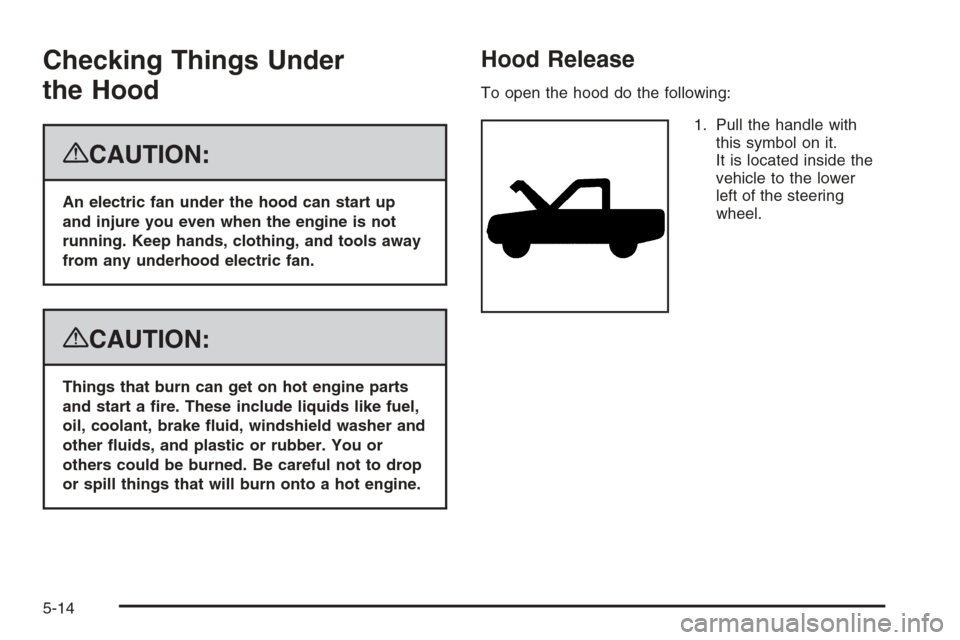
1. Pull the handle with
this symbol on it.
It is located inside the
vehicle to the lower
left of the steering
wheel.
5-14
Page 375 of 538
A. Engine Air Cleaner/Filter. SeeEngine Air
Cleaner/Filter on page 5-22.
B. Air Filter Restriction Indicator (If Equipped).
SeeEngine Air Cleaner/Filter on page 5-22.
C. Coolant Surge Tank and Pressure Cap. SeeCooling
System on page 5-37andCoolant Surge Tank
Pressure Cap on page 5-34.
D. Remote Positive (+) Terminal. SeeJump Starting on
page 5-48.
E. Battery. SeeBattery on page 5-47.
F. Engine Oil Fill Cap. See “When to Add Engine Oil”
underEngine Oil on page 5-17.
G. Automatic Transmission Dipstick. See “Checking the
Fluid Level” underAutomatic Transmission Fluid
(4-Speed Transmission) on page 5-24orAutomatic
Transmission Fluid (6-Speed Transmission) on
page 5-27.
H. Remote Negative (−) Terminal (Out of View).
SeeJump Starting on page 5-48.
I. Engine Oil Dipstick (Out of View). See “Checking
Engine Oil” underEngine Oil on page 5-17.
J. Engine Cooling Fan. SeeCooling System on
page 5-37.
K. Power Steering Fluid Reservoir. SeePower Steering
Fluid on page 5-42.L. Brake Master Cylinder Reservoir. See “Brake Fluid”
underBrakes on page 5-44.
M. Underhood Fuse Block. SeeUnderhood Fuse Block
on page 5-122.
N. Windshield Washer Fluid Reservoir. See “Adding
Washer Fluid” underWindshield Washer Fluid
on page 5-43.
Engine Oil
Checking Engine Oil
It is a good idea to check the engine oil every time you
get fuel. In order to get an accurate reading, the oil
must be warm and the vehicle must be on level ground.
The engine oil dipstick handle is a yellow loop. See
Engine Compartment Overview on page 5-16for
the location of the engine oil dipstick.
1. Turn off the engine and give the oil several minutes
to drain back into the oil pan. If you do not do this,
the oil dipstick might not show the actual level.
2. Pull out the dipstick and clean it with a paper towel
or cloth, then push it back in all the way. Remove it
again, keeping the tip down, and check the level.
5-17
Page 378 of 538
If you are in an area of extreme cold, where the
temperature falls below−20°F (−29°C), it is
recommended that you use either an SAE 5W-30
synthetic oil or an SAE 0W-30 oil. Both provide easier
cold starting and better protection for the engine at
extremely low temperatures.
Engine Oil Additives
Do not add anything to the oil. The recommended oils
with the starburst symbol that meet GM Standard
GM6094M are all you need for good performance
and engine protection.
Engine Oil Life System
When to Change Engine Oil
Your vehicle has a computer system that lets you know
when to change the engine oil and lter. This is based
on engine revolutions and engine temperature, and not
on mileage. Based on driving conditions, the mileage
at which an oil change will be indicated can vary
considerably. For the oil life system to work properly,
you must reset the system every time the oil is changed.When the system has calculated that oil life has been
diminished, it will indicate that an oil change is necessary.
A CHANGE ENGINE OIL SOON message will come on.
SeeDIC Warnings and Messages on page 3-59. Change
the oil as soon as possible within the next 600 miles
(1 000 km). It is possible that, if you are driving under the
best conditions, the oil life system might not indicate that
an oil change is necessary for over a year. However, the
engine oil and lter must be changed at least once a year
and at this time the system must be reset. Your dealer/
retailer has trained service people who will perform this
work using genuine parts and reset the system. It is also
important to check the oil regularly and keep it at the
proper level.
If the system is ever reset accidentally, you must
change the oil at 3,000 miles (5 000 km) since your
last oil change. Remember to reset the oil life system
whenever the oil is changed.
5-20
Page 382 of 538
5. Inspect or replace the engine air cleaner/lter.
6. Reinstall the cover and tighten the screws.
7. Reset the air lter restriction indicator, if the vehicle
has one, by pressing the top button on the indicator.
{CAUTION:
Operating the engine with the air cleaner/lter
off can cause you or others to be burned.
The air cleaner not only cleans the air; it helps
to stop ames if the engine backres. If it is
not there and the engine backres, you could
be burned. Do not drive with it off, and be
careful working on the engine with the air
cleaner/lter off.
Automatic Transmission Fluid
(4-Speed Transmission)
When to Check and Change Automatic
Transmission Fluid
A good time to check your automatic transmission uid
level is when the engine oil is changed.
Change the uid and lter at the intervals listed in
Additional Required Services on page 6-6, and be sure
to use the transmission uid listed inRecommended
Fluids and Lubricants on page 6-13.
5-24
Page 383 of 538
How to Check Automatic Transmission
Fluid
Because this operation can be a little difficult, you may
choose to have this done at the dealer/retailer service
department.
If you do it yourself, be sure to follow all the instructions
here, or you could get a false reading on the dipstick.
Notice:Too much or too little uid can damage
your transmission. Too much can mean that some
of the uid could come out and fall on hot engine
parts or exhaust system parts, starting a re.
Too little uid could cause the transmission
to overheat. Be sure to get an accurate reading
if you check your transmission uid.
Wait at least 30 minutes before checking the
transmission uid level if you have been driving:
When outside temperatures are above 90°F (32°C).
At high speed for quite a while.
In heavy traffic — especially in hot weather.
While pulling a trailer.
To get the right reading, the uid should be at normal
operating temperature, which is 180°F to 200°F
(82°C to 93°C).Get the vehicle warmed up by driving about 15 miles
(24 km) when outside temperatures are above 50°F
(10°C). If it is colder than 50°F (10°C), drive the vehicle
in 3 (Third) until the engine temperature gage moves
and then remains steady for 10 minutes.
A cold uid check can be made after the vehicle has
been sitting for eight hours or more with the engine off,
but this is used only as a reference. Let the engine
run at idle for ve minutes if outside temperatures are
50°F (10°C) or more. If it is colder than 50°F (10°C),
you may have to idle the engine longer. Should the uid
level be low during this cold check, you must check
the uid hot before adding uid. Checking the uid hot
will give you a more accurate reading of the uid level.
Checking the Fluid Level
Prepare your vehicle as follows:
1. Park your vehicle on a level place. Keep the engine
running.
2. With the parking brake applied, place the shift lever
in P (Park).
3. With your foot on the brake pedal, move the shift
lever through each gear range, pausing for about
three seconds in each range. Then, position
the shift lever in P (Park).
4. Let the engine run at idle for three minutes or more.
5-25
Page 384 of 538
Then, without shutting off the engine, follow these steps:
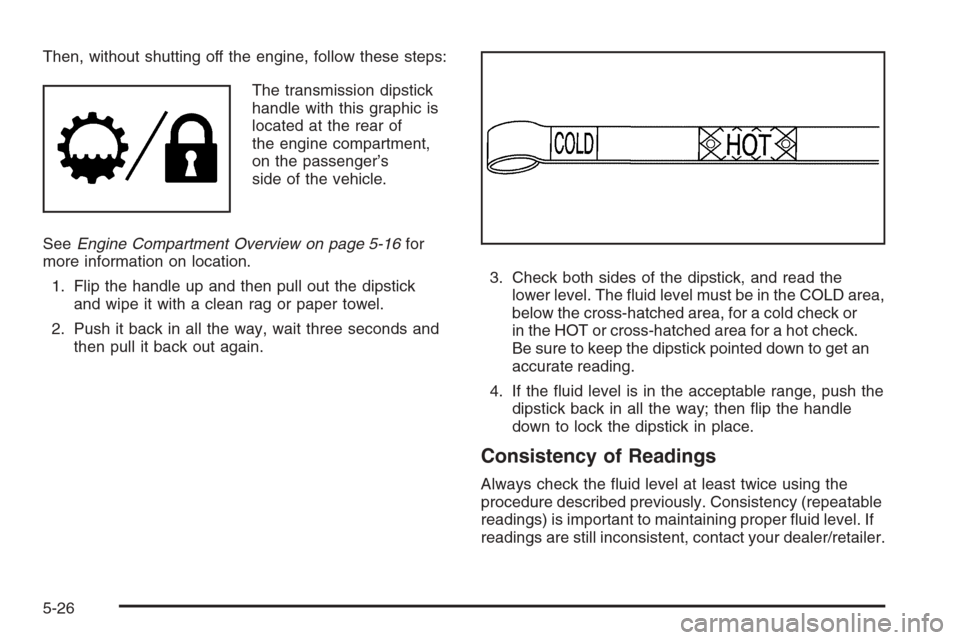
The transmission dipstick
handle with this graphic is
located at the rear of
the engine compartment,
on the passenger’s
side of the vehicle.
SeeEngine Compartment Overview on page 5-16for
more information on location.
1. Flip the handle up and then pull out the dipstick
and wipe it with a clean rag or paper towel.
2. Push it back in all the way, wait three seconds and
then pull it back out again.3. Check both sides of the dipstick, and read the
lower level. The uid level must be in the COLD area,
below the cross-hatched area, for a cold check or
in the HOT or cross-hatched area for a hot check.
Be sure to keep the dipstick pointed down to get an
accurate reading.
4. If the uid level is in the acceptable range, push the
dipstick back in all the way; then ip the handle
down to lock the dipstick in place.
Consistency of Readings
Always check the uid level at least twice using the
procedure described previously. Consistency (repeatable
readings) is important to maintaining proper uid level. If
readings are still inconsistent, contact your dealer/retailer.
5-26
Page 386 of 538
How to Check Automatic Transmission
Fluid
Notice:Too much or too little uid can damage
your transmission. Too much can mean that some
of the uid could come out and fall on hot engine
parts or exhaust system parts, starting a re.
Too little uid could cause the transmission
to overheat. Be sure to get an accurate reading
if you check your transmission uid.
Before checking the uid level, prepare your vehicle as
follows:
1. Start the engine and park your vehicle on a level
surface. Keep the engine running.
2. Apply the parking brake and place the shift lever in
P (PARK).3. With your foot on the brake pedal, move the shift
lever through each gear range, pausing for about
three seconds in each range. Then, move the
shift lever back to P (PARK).
4. Allow the engine to idle (500 – 800 rpm) for at least
one minute. Slowly release the brake pedal.
5. Keep the engine running and press the Trip/Fuel
button or trip odometer reset stem until TRANS
TEMP (Transmission Temperature) displays on
the Driver Information Center (DIC).
6. Using the TRANS TEMP reading, determine and
perform the appropriate check procedure. If the
TRANS TEMP reading is not within the required
temperature ranges, allow the vehicle to cool,
or operate the vehicle until the appropriate
transmission uid temperature is reached.
5-28
Page 387 of 538
Cold Check Procedure
Use this procedure only as a reference to determine if
the transmission has enough uid to be operated safely
until a hot check procedure can be made. The hot check
procedure is the most accurate method to check the
uid level. Perform the hot check procedure at the rst
opportunity. Use this cold check procedure to check uid
level when the transmission temperature is between
80°F and 90°F (27°C and 32°C).
1. Locate the transmission dipstick at the rear of the
engine compartment, on the passenger side of the
vehicle.
The dipstick handle has
this graphic. SeeEngine
Compartment Overview
on page 5-16for more
information.
2. Flip the handle up, and then pull out the dipstick
and wipe it with a clean rag or paper towel.
3. Install the dipstick by pushing it back in all the way,
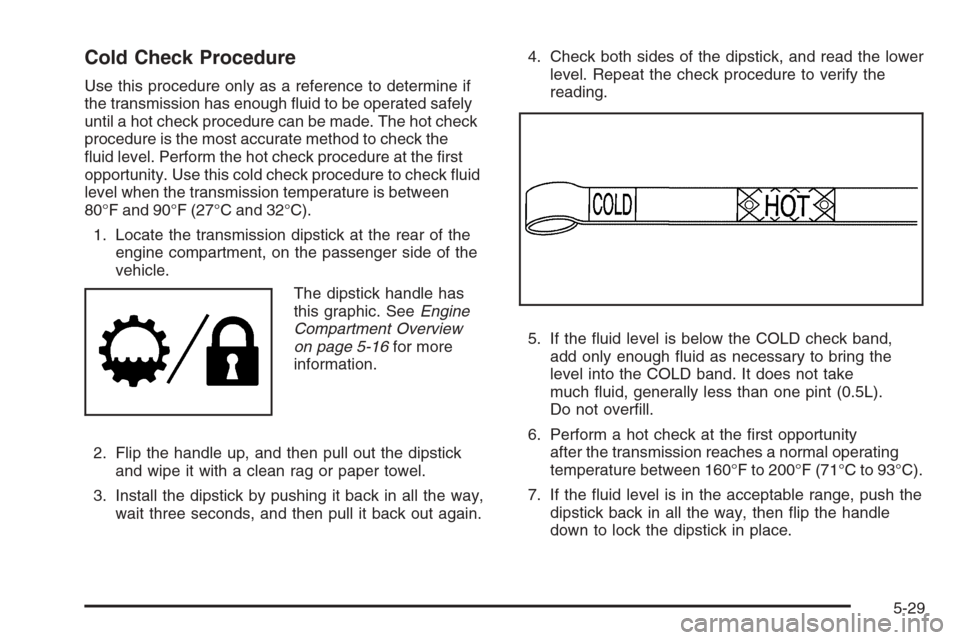
wait three seconds, and then pull it back out again.4. Check both sides of the dipstick, and read the lower
level. Repeat the check procedure to verify the
reading.
5. If the uid level is below the COLD check band,
add only enough uid as necessary to bring the
level into the COLD band. It does not take
much uid, generally less than one pint (0.5L).
Do not overll.
6. Perform a hot check at the rst opportunity
after the transmission reaches a normal operating
temperature between 160°F to 200°F (71°C to 93°C).
7. If the uid level is in the acceptable range, push the
dipstick back in all the way, then ip the handle
down to lock the dipstick in place.
5-29
Page 388 of 538
Hot Check Procedure
Use this procedure to check the transmission uid level
when the transmission uid temperature is between
160°F and 200°F (71°C and 93°C).
The hot check is the most accurate method to check the
uid level. The hot check should be performed at the rst
opportunity in order to verify the cold check. The uid
level rises as uid temperature increases, so it is
important to ensure the transmission temperature is
within range.
1. Locate the transmission dipstick at the rear of the
engine compartment, on the passenger side of the
vehicle.
The dipstick handle has
this graphic. SeeEngine
Compartment Overview
on page 5-16for more
information.
2. Flip the handle up, and then pull out the dipstick
and wipe it with a clean rag or paper towel.
3. Install the dipstick by pushing it back in all the way,
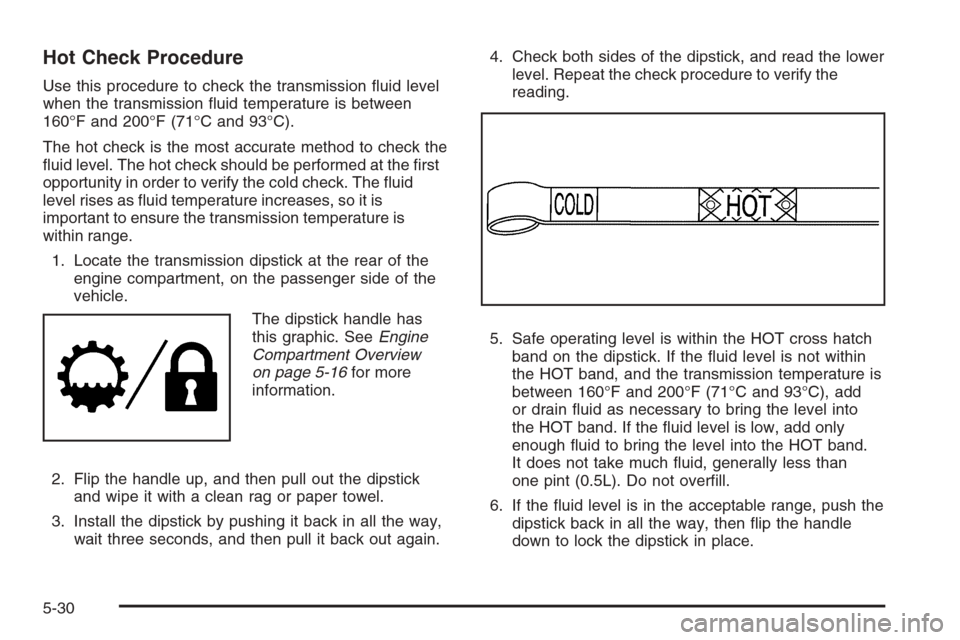
wait three seconds, and then pull it back out again.4. Check both sides of the dipstick, and read the lower
level. Repeat the check procedure to verify the
reading.
5. Safe operating level is within the HOT cross hatch
band on the dipstick. If the uid level is not within
the HOT band, and the transmission temperature is
between 160°F and 200°F (71°C and 93°C), add
or drain uid as necessary to bring the level into
the HOT band. If the uid level is low, add only
enough uid to bring the level into the HOT band.
It does not take much uid, generally less than
one pint (0.5L). Do not overll.
6. If the uid level is in the acceptable range, push the
dipstick back in all the way, then ip the handle
down to lock the dipstick in place.
5-30