roof CHEVROLET TAHOE 2013 3.G Owners Manual
[x] Cancel search | Manufacturer: CHEVROLET, Model Year: 2013, Model line: TAHOE, Model: CHEVROLET TAHOE 2013 3.GPages: 60, PDF Size: 1.12 MB
Page 9 of 60
Black plate (3,1)Chevrolet Tahoe Police and Special Service Packages - 2013 - CRC - 3/30/12
Seats and Restraints 3-3
Notices for Customer
Installed Equipment
Read the following notices before
installing equipment on your
specialty vehicle.
Notice:GM-approved service
procedures must be followed
to remove and reinstall the
instrument panel to the pad in
order to ensure proper airbag
deployment.
Notice: Do not mount equipment
on the passenger side of the
instrument panel top pad
deployment zone. Equipment
should not be mounted on or
around the passenger airbag
opening because of a deploying
airbag. To allow the airbag to
perform as it was designed, do
not mount equipment inside the
airbag deployment zone. Notice:
The police vehicle has
roof-rail airbags. Do not mount a
security barrier such that the
ends of the barrier or brackets
are within the roof-rail
deployment zones.
Notice: The police vehicle has
roof-rail airbags and a rollover
sensor. The rollover sensor is
mounted on the centerline of the
vehicle between the driver and
right front passenger positions.
If the vehicle has bucket seats,
the rollover sensor will be
exposed. Do not mount
equipment within 25 mm (1 in) of
the rollover sensor. This may
affect the performance of the
airbag system. To allow the
airbags to perform as they are
designed, do not mount
equipment near this area. Notice:
Avoid installing wiring for
roof-rail emergency lighting or
radio antennas that may restrict
the proper deployment of the
roof-rail airbags.
Page 12 of 60
Black plate (6,1)Chevrolet Tahoe Police and Special Service Packages - 2013 - CRC - 3/30/12
3-6 Seats and Restraints
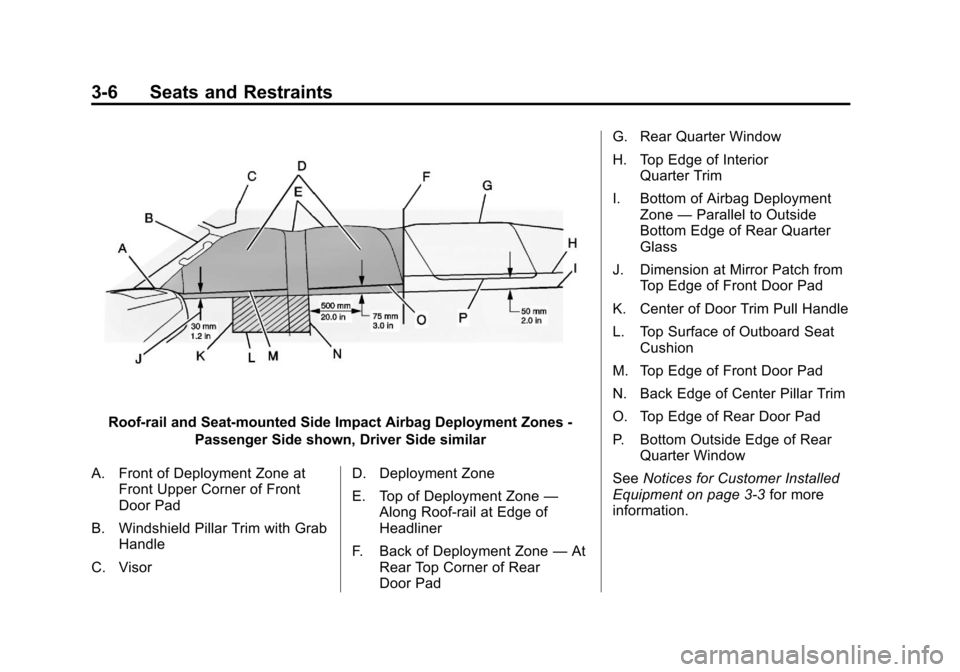
Roof-rail and Seat-mounted Side Impact Airbag Deployment Zones -Passenger Side shown, Driver Side similar
A. Front of Deployment Zone at Front Upper Corner of Front
Door Pad
B. Windshield Pillar Trim with Grab Handle
C. Visor D. Deployment Zone
E. Top of Deployment Zone
—
Along Roof-rail at Edge of
Headliner
F. Back of Deployment Zone —At
Rear Top Corner of Rear
Door Pad G. Rear Quarter Window
H. Top Edge of Interior
Quarter Trim
I. Bottom of Airbag Deployment Zone —Parallel to Outside
Bottom Edge of Rear Quarter
Glass
J. Dimension at Mirror Patch from Top Edge of Front Door Pad
K. Center of Door Trim Pull Handle
L. Top Surface of Outboard Seat Cushion
M. Top Edge of Front Door Pad
N. Back Edge of Center Pillar Trim
O. Top Edge of Rear Door Pad
P. Bottom Outside Edge of Rear Quarter Window
See Notices for Customer Installed
Equipment on page 3‑3 for more
information.
Page 13 of 60
Black plate (7,1)Chevrolet Tahoe Police and Special Service Packages - 2013 - CRC - 3/30/12
Seats and Restraints 3-7
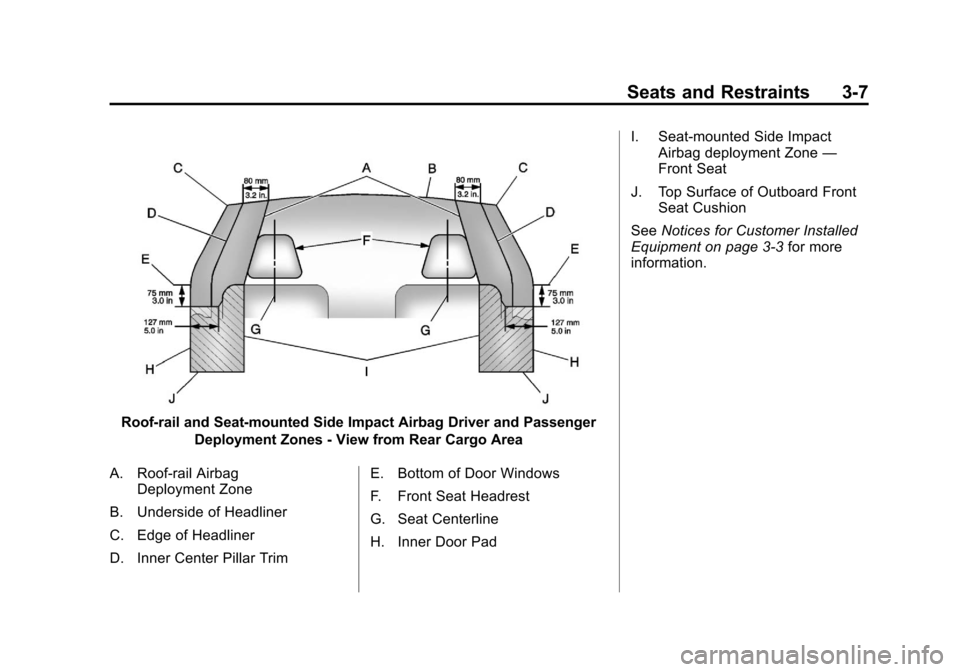
Roof-rail and Seat-mounted Side Impact Airbag Driver and PassengerDeployment Zones - View from Rear Cargo Area
A. Roof-rail Airbag Deployment Zone
B. Underside of Headliner
C. Edge of Headliner
D. Inner Center Pillar Trim E. Bottom of Door Windows
F. Front Seat Headrest
G. Seat Centerline
H. Inner Door PadI. Seat-mounted Side Impact
Airbag deployment Zone —
Front Seat
J. Top Surface of Outboard Front Seat Cushion
See Notices for Customer Installed
Equipment on page 3‑3 for more
information.
Page 22 of 60
Black plate (2,1)Chevrolet Tahoe Police and Special Service Packages - 2013 - CRC - 3/30/12
9-2 Driving and Operating
Adding Equipment to Your
Vehicle
Before adding accessories or
equipment to your police vehicle,
there are some things you need
to know:
.The police vehicle's maximum
capacity weight.
.The weight of your police
vehicle, including a full tank of
fuel but without a driver and
passengers.
.The weight of items you plan on
adding to your police vehicle,
like roof mounted light bar(s),
push bumpers, security
barrier(s), rear storage
organizer, highway flares, fire
extinguishers, weapons,
ammunition, radios, and video
equipment.
.The weight and number of
passengers you intend to carry
in your vehicle.
.The total weight of any
additional cargo you intend to
carry in your vehicle.
When planning your vehicle
equipment installation remember not
to exceed the Gross Vehicle Weight
Rating (GVWR) or the Gross Axle
Weight Rating (GAWR) of the front
or rear axles. To keep the available
load weight less than the vehicle
capacity weight, you may need to
limit the number of passengers you
carry in your vehicle or change your
choice of additional equipment.
Center of Gravity (CG)
A vehicle's center of gravity is an
imaginary location inside the vehicle
and is a balance point for the
vehicle mass as it moves down the
road. The police vehicle's center of
gravity, before you add a load and
passengers, is approximately
midway between the center of the
axles, up from the ground to just
below the front window, and
between the driver and passenger. Equipment location and weight on
the vehicle's center of gravity is
important to keep in mind when
planning an installation. Heavy
equipment should be positioned as
low and as far forward in the rear
load compartment as possible. Try
to mount the equipment below the
bottom of the side windows. Refer
to the Loading Zone chart and
diagram to help with your
installation plan.
A procedure to make the necessary
measurements and formulas to
calculate the vehicle longitudinal,
lateral and vertical position of the
center of gravity can be found in the
GM Coachbuilders Manual.
Equipment required to conduct the
measurements for calculating the
center of gravity are:
.Weight scales of sufficient
capacity to measure the vehicle
weight at each wheel.
Page 23 of 60
Black plate (3,1)Chevrolet Tahoe Police and Special Service Packages - 2013 - CRC - 3/30/12
Driving and Operating 9-3
.A post‐type hoist or other means
to safely elevate the front of the
vehicle to at least an angle of
20 degrees above horizontal.
See your GM dealer to get more
information about this coachbuilder
procedure.
Keeping the center of gravity
midway between the axles is also
important to provide proper braking
performance. About half the total
vehicle weight on each axle is
recommended.
Weigh your vehicle after the
additional equipment has been
installed to determine the actual
weight of your vehicle. Weigh the
vehicle with a full tank of fuel and
without passengers. You may need
to put a limit on how many people or
other equipment you can carry
inside your vehicle after the
additional equipment has been
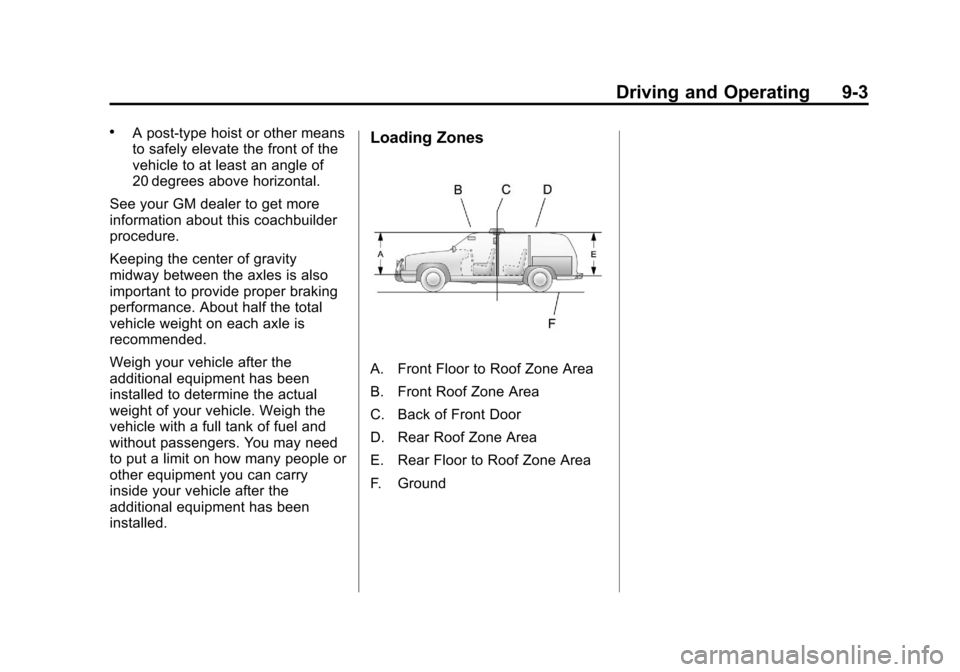
installed.Loading Zones
A. Front Floor to Roof Zone Area
B. Front Roof Zone Area
C. Back of Front Door
D. Rear Roof Zone Area
E. Rear Floor to Roof Zone Area
F. Ground
Page 24 of 60
Black plate (4,1)Chevrolet Tahoe Police and Special Service Packages - 2013 - CRC - 3/30/12
9-4 Driving and Operating
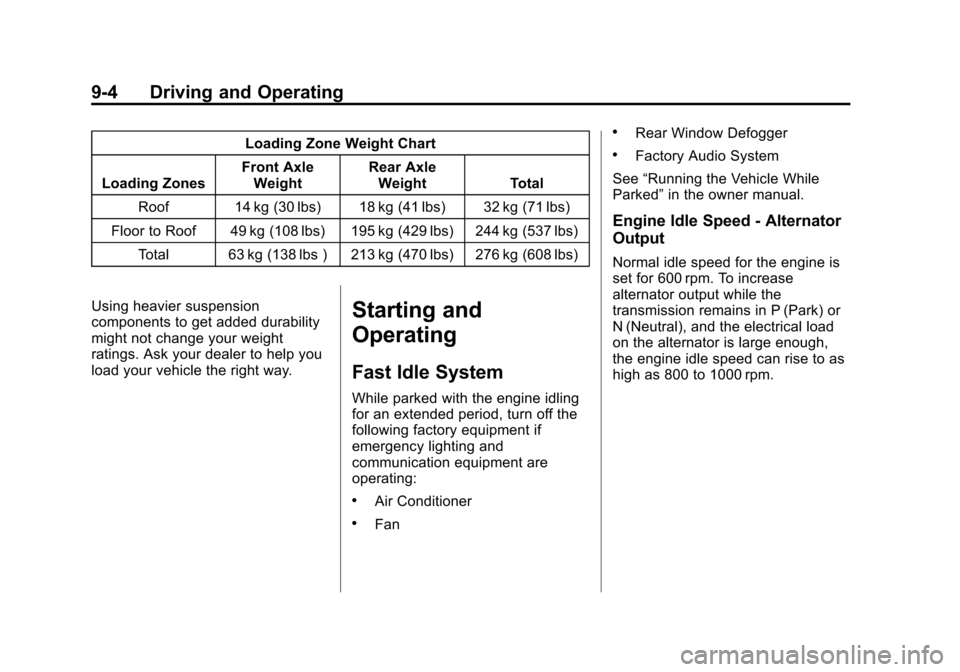
Loading Zone Weight Chart
Loading Zones Front Axle
Weight Rear Axle
Weight Total
Roof 14 kg (30 lbs) 18 kg (41 lbs) 32 kg (71 lbs)
Floor to Roof 49 kg (108 lbs) 195 kg (429 lbs) 244 kg (537 lbs) Total 63 kg (138 lbs ) 213 kg (470 lbs) 276 kg (608 lbs)
Using heavier suspension
components to get added durability
might not change your weight
ratings. Ask your dealer to help you
load your vehicle the right way.
Starting and
Operating
Fast Idle System
While parked with the engine idling
for an extended period, turn off the
following factory equipment if
emergency lighting and
communication equipment are
operating:
.Air Conditioner
.Fan
.Rear Window Defogger
.Factory Audio System
See “Running the Vehicle While
Parked” in the owner manual.
Engine Idle Speed - Alternator
Output
Normal idle speed for the engine is
set for 600 rpm. To increase
alternator output while the
transmission remains in P (Park) or
N (Neutral), and the electrical load
on the alternator is large enough,
the engine idle speed can rise to as
high as 800 to 1000 rpm.
Page 31 of 60
Black plate (1,1)Chevrolet Tahoe Police and Special Service Packages - 2013 - CRC - 3/30/12
Special Equipment Options 15-1
Special Equipment
Options
SEO Standard Options
SEO Standard Options -Police Package and Special
Service Package . . . . . . . . . . . 15-2
Wiring Provisions for 12-Volt Battery Power Supply . . . . . . 15-3
Auxiliary Battery Power Junction Blocks . . . . . . . . . . . . 15-9
Equipment Grounding Studs - Rear Compartment . . . . . . 15-10
Radio Suppression Grounding Straps . . . . . . . . . 15-10
SEO Available Options
Dual Battery System -SEO 6A6 . . . . . . . . . . . . . . . . . . 15-10
Exterior Lamp Emergency Flashing System -
SEO 6J7 . . . . . . . . . . . . . . . . . . 15-11
Inactive Rear Door Handles - SEO 6B2 . . . . . . . . . . . . . . . . . . 15-14
Inactive Rear Door Locks - SEO 6N6 . . . . . . . . . . . . . . . . . 15-14
Inactive Rear Door Windows - SEO 6N5 . . . . . . . . . . . . . . . . 15-14
Spotlamp - SEO 7X6 . . . . . . . 15-14
Spotlamps - SEO 7X7 . . . . . . 15-14
Wiring Provisions for Emergency Vehicle Roof
Light - SEO TRW . . . . . . . . . 15-15 Wiring Provisions for Horn/
Siren Circuit - SEO 6J4 . . . 15-20
Wiring Provisions for Vehicle Grille Lamps and Speaker/
Siren - SEO 6J3 . . . . . . . . . . 15-22
Wiring Provisions Front Speakers - SEO WX7 . . . . . 15-24
Page 45 of 60
Black plate (15,1)Chevrolet Tahoe Police and Special Service Packages - 2013 - CRC - 3/30/12
Special Equipment Options 15-15
Wiring Provisions for
Emergency Vehicle Roof
Light - SEO TRW
Battery power is supplied through a
30 amp fuse to a wiring harness
located in the roof. Power is
controlled with a switch located in
the overhead console. The
customer or vehicle upfitter must
complete the installation to an
added accessory such as an
emergency beacon lamp.
Maximum rated electrical load is
21 amps (250 watts). The added
electrical requirements must not
exceed 21 amps (250 watts).
Running the accessory for long
periods of time with the engine off
may run the battery down.
Installation Instructions–
Emergency Vehicle Roof
Panel Lamp
Wiring to the accessory can be
done by either directly connecting
the wire in the roof to the accessory
(Option A) or by using Wiring Harness Package part number
12150250 obtained from GM
Service Parts (Option B).
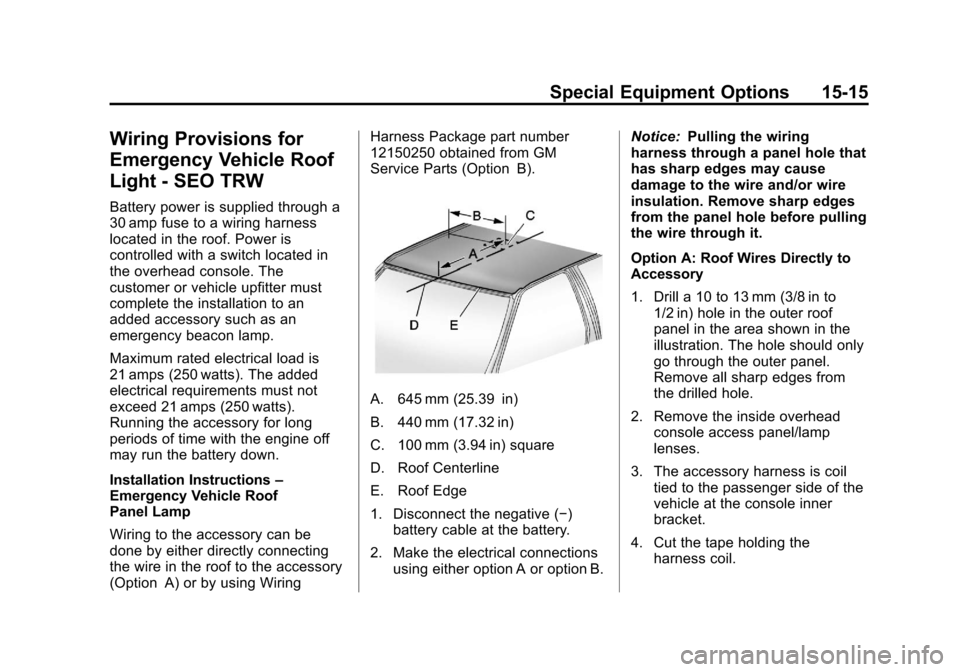
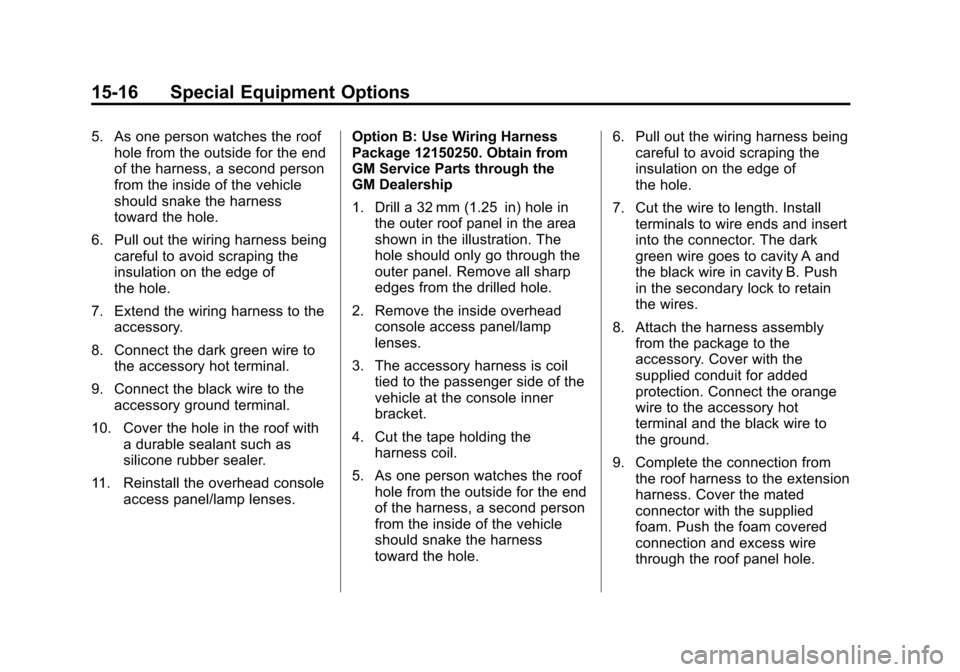
A. 645 mm (25.39 in)
B. 440 mm (17.32 in)
C. 100 mm (3.94 in) square
D. Roof Centerline
E. Roof Edge
1. Disconnect the negative (−)
battery cable at the battery.
2. Make the electrical connections using either option A or option B. Notice:
Pulling the wiring
harness through a panel hole that
has sharp edges may cause
damage to the wire and/or wire
insulation. Remove sharp edges
from the panel hole before pulling
the wire through it.
Option A: Roof Wires Directly to
Accessory
1. Drill a 10 to 13 mm (3/8 in to 1/2 in) hole in the outer roof
panel in the area shown in the
illustration. The hole should only
go through the outer panel.
Remove all sharp edges from
the drilled hole.
2. Remove the inside overhead console access panel/lamp
lenses.
3. The accessory harness is coil tied to the passenger side of the
vehicle at the console inner
bracket.
4. Cut the tape holding the harness coil.
Page 46 of 60
Black plate (16,1)Chevrolet Tahoe Police and Special Service Packages - 2013 - CRC - 3/30/12
15-16 Special Equipment Options
5. As one person watches the roofhole from the outside for the end
of the harness, a second person
from the inside of the vehicle
should snake the harness
toward the hole.
6. Pull out the wiring harness being careful to avoid scraping the
insulation on the edge of
the hole.
7. Extend the wiring harness to the accessory.
8. Connect the dark green wire to the accessory hot terminal.
9. Connect the black wire to the accessory ground terminal.
10. Cover the hole in the roof with a durable sealant such as
silicone rubber sealer.
11. Reinstall the overhead console access panel/lamp lenses. Option B: Use Wiring Harness
Package 12150250. Obtain from
GM Service Parts through the
GM Dealership
1. Drill a 32 mm (1.25 in) hole in
the outer roof panel in the area
shown in the illustration. The
hole should only go through the
outer panel. Remove all sharp
edges from the drilled hole.
2. Remove the inside overhead console access panel/lamp
lenses.
3. The accessory harness is coil tied to the passenger side of the
vehicle at the console inner
bracket.
4. Cut the tape holding the harness coil.
5. As one person watches the roof hole from the outside for the end
of the harness, a second person
from the inside of the vehicle
should snake the harness
toward the hole. 6. Pull out the wiring harness being
careful to avoid scraping the
insulation on the edge of
the hole.
7. Cut the wire to length. Install terminals to wire ends and insert
into the connector. The dark
green wire goes to cavity A and
the black wire in cavity B. Push
in the secondary lock to retain
the wires.
8. Attach the harness assembly from the package to the
accessory. Cover with the
supplied conduit for added
protection. Connect the orange
wire to the accessory hot
terminal and the black wire to
the ground.
9. Complete the connection from the roof harness to the extension
harness. Cover the mated
connector with the supplied
foam. Push the foam covered
connection and excess wire
through the roof panel hole.
Page 47 of 60
Black plate (17,1)Chevrolet Tahoe Police and Special Service Packages - 2013 - CRC - 3/30/12
Special Equipment Options 15-17
10. Reinstall the overhead consoleaccess panel/lamp lenses.
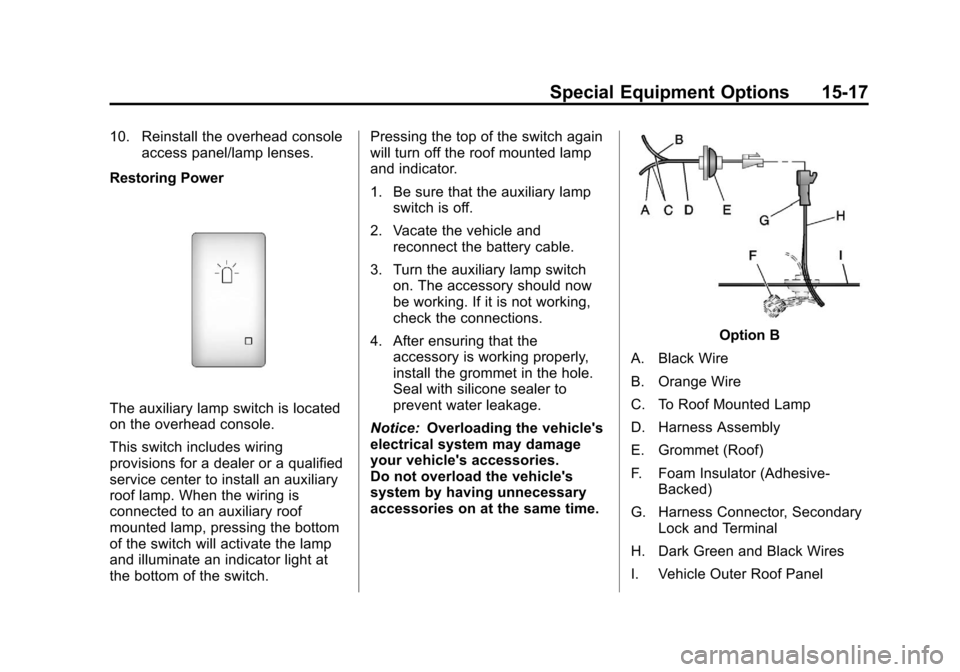
Restoring Power
The auxiliary lamp switch is located
on the overhead console.
This switch includes wiring
provisions for a dealer or a qualified
service center to install an auxiliary
roof lamp. When the wiring is
connected to an auxiliary roof
mounted lamp, pressing the bottom
of the switch will activate the lamp
and illuminate an indicator light at
the bottom of the switch. Pressing the top of the switch again
will turn off the roof mounted lamp
and indicator.
1. Be sure that the auxiliary lamp
switch is off.
2. Vacate the vehicle and reconnect the battery cable.
3. Turn the auxiliary lamp switch on. The accessory should now
be working. If it is not working,
check the connections.
4. After ensuring that the accessory is working properly,
install the grommet in the hole.
Seal with silicone sealer to
prevent water leakage.
Notice: Overloading the vehicle's
electrical system may damage
your vehicle's accessories.
Do not overload the vehicle's
system by having unnecessary
accessories on at the same time.
Option B
A. Black Wire
B. Orange Wire
C. To Roof Mounted Lamp
D. Harness Assembly
E. Grommet (Roof)
F. Foam Insulator (Adhesive‐ Backed)
G. Harness Connector, Secondary Lock and Terminal
H. Dark Green and Black Wires
I. Vehicle Outer Roof Panel