brake light CHEVROLET TRACKER 1993 User Guide
[x] Cancel search | Manufacturer: CHEVROLET, Model Year: 1993, Model line: TRACKER, Model: CHEVROLET TRACKER 1993Pages: 339, PDF Size: 15.75 MB
Page 140 of 339
Your Driving and the Road
you just passed may seem to be
further away from
you than it really
is.)
Try not to pass more than one vehicle
at a time on two-lane roads.
Reconsider before passing the next
vehicle.
vehicle too rapidly. Even though the
brake lights are not flashing, it may
be slowing down or starting to turn.
If you’re being passed, make it easy
for the following driver to get ahead
of you. Perhaps you can ease a little
to the right.
Don’t overtake a slowly moving
Loss of Control
Let’s review what driving experts say
about what happens when the three
control systems (brakes, steering and
acceleration) don’t have enough friction
where the tires meet
the road to do what
the driver has asked.
In any emergency, don’t give up. Keep
trying to steer and constantly seek an
escape route or area of less danger.
Skidding
In a skid, a driver can lose control of
the vehicle. Defensive drivers avoid
most skids by taking reasonable care
suited to existing conditions, and by not
“overdriving” those conditions. But
skids are always possible. The three types
of skids correspond
to
your Geo’s three control systems. In the
braking skid your wheels aren’t rolling.
In the steering or cornering skid,
too
much speed or steering in a curve causes
tires to slip and lose cornering force.
And in the acceleration skid too much
throttle causes the driving wheels to
spin.
A cornering skid and an acceleration
skid are best handled by easing your
foot off the accelerator pedal. If your
vehicle starts to slide (as when you turn
a corner on a wet, snow- or ice-covered
road), ease your foot off the accelerator
ProCarManuals.com
Page 150 of 339
Your Driving and the Road
Ease up on your speed as you
approach the top
of the hill.
Attach a flag to the vehicle to make
you more visible to approaching
traffic on trails or hills.
Sound the horn as you approach the
top of the hill to let opposing traffic
know you’re there.
Use your headlights even during the
day. They make you more visible to
oncoming traffic.
CAUTION
A Driving to the top (crest) of a
hill at full speed can cause an
accident. There could be a
drop-off, embankment, cliff, or
even another vehicle. You could
be seriously injured or killed. As
you near the top of a hill, slow
down and stay alert.
I
Q: What should I do if my vehicle
stalls,
or is about to stall, and I
can’t make it up the hill?
A: If this happens, there are some
things you-should do, and there are
some things you must not do. First,
here’s what you
should do:
Push the brake pedal to stop
the
vehicle and keep it from rolling
backwards. Also, apply the parking
brake.
If your engine is still running, shift
the transmission into reverse, release
the parking brake, and slowly back
down the hill in reverse.
ProCarManuals.com
Page 153 of 339
If you decide you can go down a hill
safely, then try to keep your vehicle
headed straight down, and use a low
gear. This way, engine drag can help
your brakes and they won’t have to do
all the work. Descend slowly, keeping
your vehicle under control at all times.
A
Heavy braking when going
down a hill can cause your
brakes to overheat and fade. This
could cause loss of control and a
serious accident. Apply the brakes
lightly when descending a hill and
use
a low gear to keep vehicle
speed under control.
Q:
A:
0
0
Are there some things I should not
do when driving down a hill?
Yes! These are important because if
you ignore them you could lose
control and have a serious accident.
When driving downhill, avoid turns
that take you across the incline
of
the hill. A hill that’s not too steep to
drive down may be too steep to
drive across. You could roll over if
you don’t drive straight down.
Never go downhill with the
transmission in
Neutral, or with the
clutch pedal depressed in a manual
shift. This is called
ProCarManuals.com
Page 159 of 339
After Off-Road Driving
Remove any brush or debris that has
collected on the underbody, chassis or
under the hood. These accumulations
can be a fire hazard.
After operation in mud or sand, have the
brake linings cleaned and checked.
These substances can cause glazing and
uneven braking. Check the body
structure, steering, suspension, wheels,
tires, and exhaust system for damage.
Also, check the fuel lines and cooling
system for any leakage.
Your vehicle will require more frequent
service due to off-road use. Refer
to the
Maintenance Schedule for additional
information.
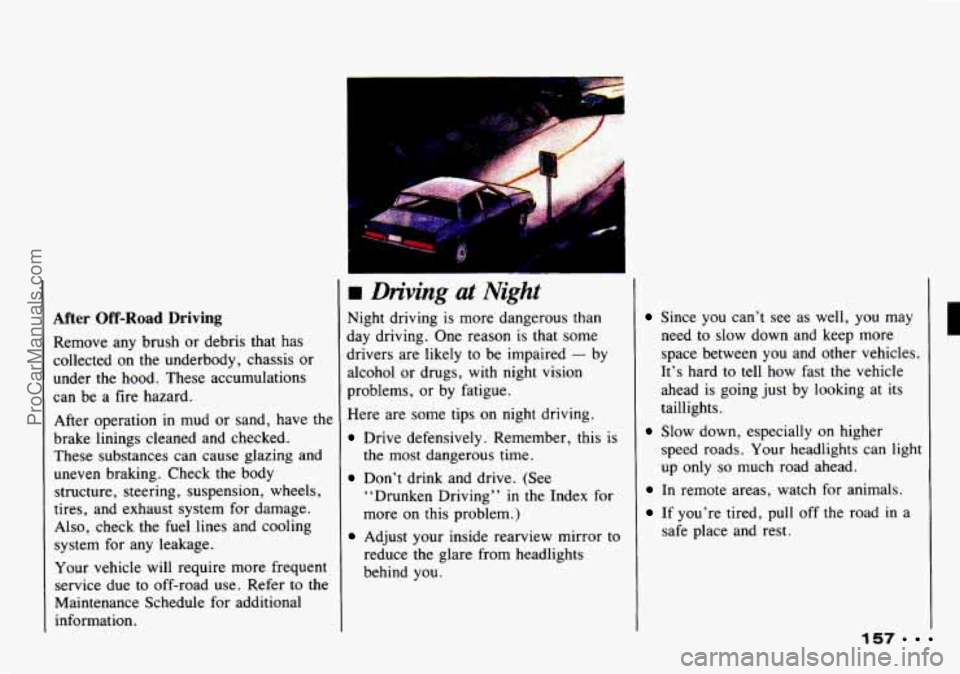
rn Driving at Night
Night driving is more dangerous than
day driving. One reason is that some
drivers are likely to be impaired
- by
alcohol or drugs, with night vision
problems, or by fatigue.
Here are some tips
on night driving.
Drive defensively. Remember, this is
the most dangerous time.
Don’t drink and drive. (See
“Drunken Driving” in the Index for
more on this problem.)
Adjust your inside rearview mirror to
reduce the glare from headlights
behind you.
Since you can’t see as well, you may
need to slow down and keep more
space between you and other vehicles.
It’s hard to tell how fast the vehicle
ahead is going just by looking at its
taillights.
Slow down, especially on higher
speed roads.
Your headlights can light
up only so much road ahead.
In remote areas, watch for animals.
If you’re tired, pull off the road in a
safe place and rest.
157
ProCarManuals.com
Page 162 of 339
Your Driving and the Road
I
*. ’ i
... 160
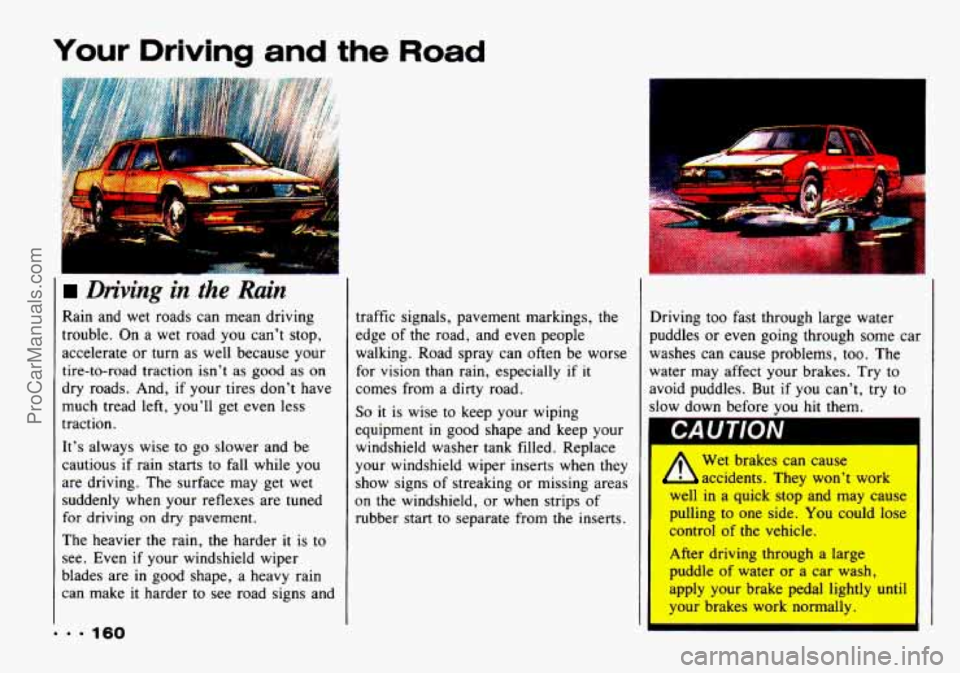
Driving in the Rain
Rain and wet roads can mean driving
trouble. On
a wet road you can’t stop,
accelerate or turn as well because your
tire-to-road traction isn’t as good as on
dry roads. And,
if your tires don’t have
much tread
left, you’ll get even less
traction.
It’s always wise to go slower and be
cautious
if rain starts to fall while you
are driving. The surface may get wet
suddenly when your reflexes are tuned
for driving on dry pavement.
The heavier the rain, the harder
it is to
see. Even if your windshield wiper
blades are
in good shape, a heavy rain
can make it harder to see road signs and traffic signals,
pavement markings, the
edge of the road, and even people
walking. Road spray can often be worse
for vision than rain, especially if
it
comes from a dirty road.
So it is wise to keep your wiping
equipment
in good shape and keep your
windshield washer tank filled. Replace
your windshield wiper inserts when they
show signs of streaking or missing areas
on the windshield, or when strips of
rubber start to separate from the inserts. Driving too
fast through large water
puddles or
even going through some car
washes can cause problems, too. The
water may affect your brakes. Try to
avoid puddles. But if you can’t, try to
slow down before
you hit them.
I A Wet brakes can cause
- accidents. They won’t work
well
in a quick stop and may cause
pulling to one side.
You could lose
control of the vehicle.
After driving through a large
puddle of water or a car wash,
apply your brake pedal lightly until
your brakes work normally.
ProCarManuals.com
Page 168 of 339
Your Driving and the Road
make sure there isn’t another vehicle in
your
‘ ‘blind’ ’ spot.
If you are moving from an outside to a
center lane on a freeway having more
than two lanes, make sure another
vehicle isn’t about to move into the
same spot. Look at the vehicles two
lanes over and watch for telltale signs:
turn signals flashing, an increase
in
speed, or moving toward the edge of the
lane. Be prepared to delay your move.
Once you are moving on the freeway,
make certain you allow a reasonable
following distance. Expect to move
slightly slower at night.
... 166
Leaving the Freeway
When you want to leave the freeway,
move to the proper lane well in
advance. Dashing across lanes at the last
minute is dangerous. If you miss your
exit do not, under any circumstances,
stop and back up. Drive on to the next
exit.
At each exit point is a deceleration lane.
Ideally it should be long enough for you
to enter
it at freeway speed (after
signaling, of course) and
then do your
braking before moving onto
the exit
ramp. Unfortunately, not all deceleration
lanes are long enough
- some are too
short for all the braking. Decide when
to start braking. If
you must brake on the through
lane, and if there is traffic
close behind you, you can allow a little
extra time and flash your brake lights (in
addition
to your turn signal) as extra
warning that you are about
to slow
down and exit.
The exit ramp can be curved, sometimes
quite sharply. The exit speed is usually
posted. Reduce your speed according to
your speedometer, not to your sense of
motion. After driving for any distance at
higher speeds,
you may tend to think
you are going slower than you actually
are. For example,
40 mph (65 km/h)
might seem like only
20 mph (30 km/h).
Obviously, this could lead to serious
trouble
on a ramp designed for
20 mph (30 km/h)!
ProCarManuals.com
Page 171 of 339
What can you do about highway
hypnosis? First, be aware that it can
happen.
Then here are some tips:
Make sure your vehicle is well
ventilated, with a comfortably cool
interior.
Keep your eyes moving. Scan the
road ahead and to the sides. Check
your rearview mirrors frequently and
your instruments from time
to time.
This can help you avoid a fixed stare.
Wear good sunglasses in bright light.
Glare can cause drowsiness. But don’t
wear sunglasses at night. They will drastically reduce your overall
vision
at the very time you need all the
seeing power you have.
If you get sleepy, pull off the road
into a rest, service or parking area
and take a nap, get some exercise, or
both. For safety, treat drowsiness on
the highway as an emergency.
As in any driving situation, keep pace
with traffic and allow adequate
following distances.
--
A
Driving on steep hills or mountains is
different from driving in flat or rolling
terrain. If you drive regularly
in steep
country, or if you’re planning
to visit
there, here are some tips that can make
your trips safer and more enjoyable.
(See “Off-Road Driving’’
in the Index
for information about driving off-road.)
Keep your vehicle in good shape.
Check all fluid levels and also the
brakes, tires, cooling system and
transmission. These ‘parts can work
hard on mountain roads.
ProCarManuals.com
Page 184 of 339
Your Driving and the Road
Will the trailer brake parts take
3,000 psi (20 650 kPa) of pressure? If
not, the trailer brake system must not
be used with your vehicle.
If everything checks out this far, then
make the brake fluid tap at the port
on the master cylinder that sends fluid
to the rear brakes. But don’t use
copper tubing
for this. If you do, it
will bend and finally break off. Use
steel brake tubing.
88. 182
Driving With a Trailer
Towing a trailer requires a certain
amount
of experience. Before setting out
for the open road, you’ll want to get to
know your rig. Acquaint yourself with
the feel of handling and braking with the
added weight
of the trailer. And always
keep in mind that the vehicle you are
driving is now a good deal longer and
not nearly
so responsive as your vehicle
is by itself. Before you
start, check
the trailer hitch
and platform, safety chains, electrical
connector, lights, tires and mirror
adjustment. If the trailer has electric
brakes, start your vehicle and trailer
moving and then apply the trailer brake
controller by hand to be sure the brakes
are working. This lets you check your
electrical connection at the same time.
During your trip, check occasionally to
be sure that the load is secure, and that
the lights and any trailer brakes are still
working.
ProCarManuals.com
Page 278 of 339
Service & Appearance
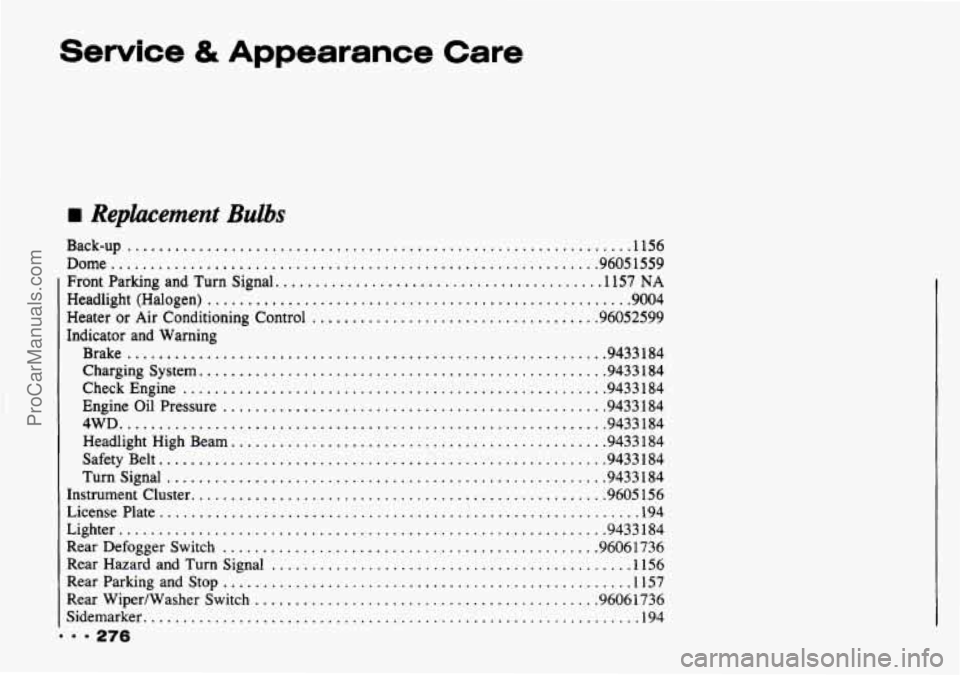
I Replacement Bulbs
Care
Back-up ............................................................. 1156
Dome
............................................................. 9605 1559
Front Parking and Turn Signal
......................................... 1157 NA
Headlight (Halogen) ..................................................... 9004
Heater or Air Conditioning Control
.................................... 96052599
Charging System
................................................... 9433184
Check Engine
..................................................... 9433 184
Engineoil Pressure
................................................ 9433184
Indicator
and Warning
Brake
............................................................ 9433184
4WD
............................................................. 9433184
Headlight HighBeam
............................................... 9433184
Safety Belt
........................................................ 9433184
TurnSignal
....................................................... 9433184
Instrument Cluster
.................................................... 9605 156
License Plate
............................................................ 194
Lighter
............................................................. 9433184
Rear Defogger Switch
............................................. 96061736
Rear Wiper/Washer Switch
........................................... 9606 1736
Rear
Hazard and Turn Signal
........................................... 1156
Rear Parking andstop
................................................... 1157
Sidemarker
................................................. ........ 194
9 - 276
ProCarManuals.com
Page 306 of 339
Maintenance Schedule
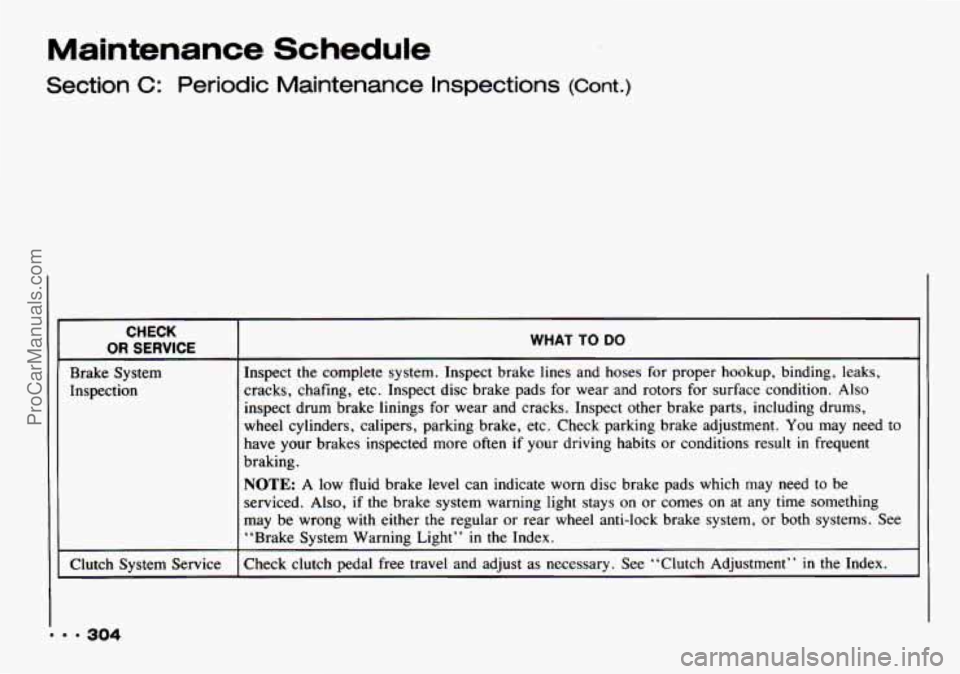
Section C: Periodic Maintenance Inspections (Cont.)
CHECK
OR SERVICE
Brake System
Inspection
Clutch System Service
~
WHAT TO DO
Inspect the complete system. Inspect brake lines and hoses for proper hookup, binding, leaks,
cracks, chafing, etc. Inspect disc brake pads for wear and rotors for surface condition.
Also
inspect drum brake linings for wear and cracks. Inspect other brake parts, including drums,
wheel cylinders, calipers, parking brake, etc. Check parking brake adjustment.
You may need to
have your brakes inspected more often if your driving habits or conditions result in frequent
braking.
NOTE: A low fluid brake level can indicate worn disc brake pads which may need to be
serviced. Also,
if the brake system warning light stays on or comes on at any time something
may be wrong with either the regular or rear wheel anti-lock brake system, or both systems. See
“Brake Svstem Warning Light” in the Index.
Check clutch pedal free travel and adjust as necessary. See “Clutch Adjustment”
in the Index.
ProCarManuals.com