cooling CHEVROLET TRACKER 1993 User Guide
[x] Cancel search | Manufacturer: CHEVROLET, Model Year: 1993, Model line: TRACKER, Model: CHEVROLET TRACKER 1993Pages: 339, PDF Size: 15.75 MB
Page 205 of 339
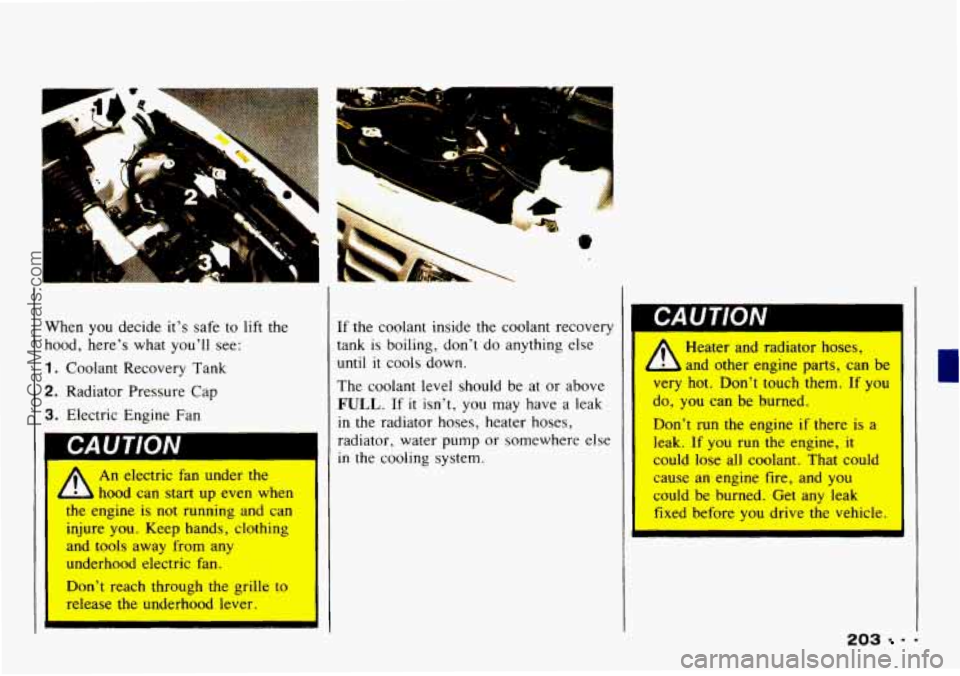
When you decide it’s safe to lift the
hood, here’s what you’ll see:
1. Coolant Recovery Tank
2. Radiator Pressure Cap
3. Electric Engine Fan
A An electric fan under the
hood can start up even when
thL @ne is not running and can
injure you. Keep hands, clothing
and tools away from any
underhood electric fan.
Don’t reach through the grille to
release the underhood lever.
- II E I L
If the coolant inside the coolant recovery
tank
is boiling, don’t do anything else
until it cools down.
The coolant level should be at
or above
FULL. If it isn’t, you may have a leak
in the radiator hoses, heater hoses,
radiator, water pump or somewhere else
in the cooling system.
unu I lVlV
Heater and radiator hoses,
1 L and other engine parts, can be
very hot. Don’t touch them. If you
do, you can be burned.
Don’t run the engine if there is a
leak. If you run the engine, it
could lose all coolant. That could
cause an engine fire, and you
could be burned. Get any leak
fixed before you drive the vehicle.
203 =
r
ProCarManuals.com
Page 206 of 339
Problems on the Road
c
Engine damage from running yollr I
engine without coolant isn’t
covered by your warranty.
I
If there seems to be no leak, check to
see if the electric engine fan
is running.
If
the engine is overheating, the fan
should be running. If it isn’t, your
vehicle needs service.
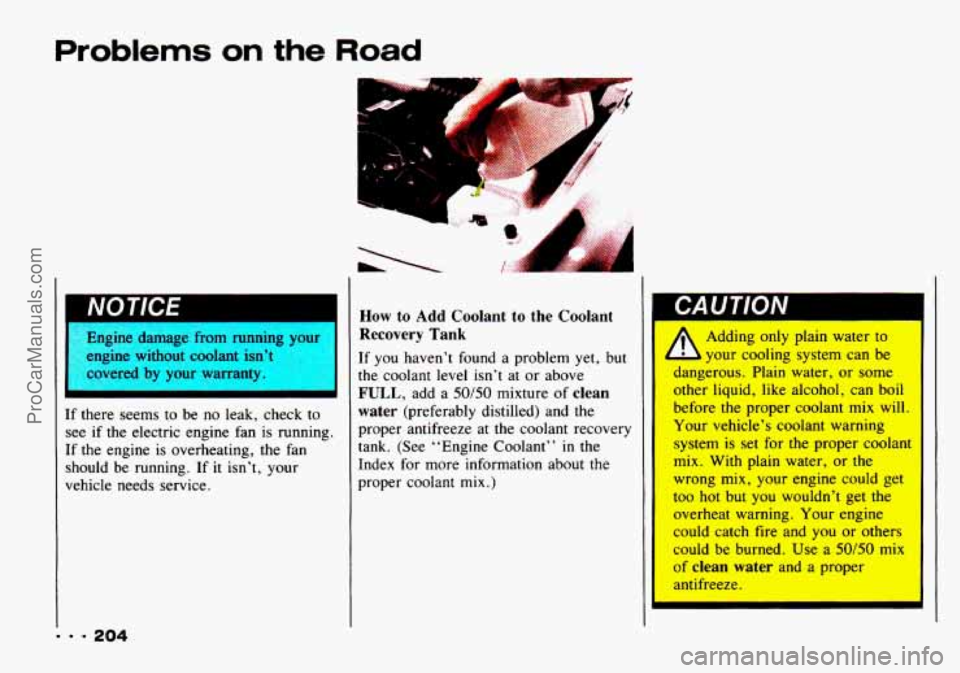
How to Add Coolant to the Coolant
Recovery
Tank
If you haven’t found a problem yet, but
the coolant level isn’t at or above
FULL, add a 50/50 mixture of clean
water
(preferably distilled) and the
proper antifreeze at the coolant recovery
tank. (See “Engine Coolant”
in the
Index for more information about the
proper coolant mix.)
A Adding only plain water to
L your cooling system can be
dangerous. Plain water, or some
other liquid, like alcohol, can boil
before the proper coolant mix will.
Your vehicle’s coolant warning
system is set for the proper coolant
mix. With plain water, or the
wrong mix, your engine could get
too hot but you wouldn’t get the
overheat warning. Your engine
could catch fire and you or others
could be burned. Use a 50/50 mix
of clean water and a proper
antifreeze.
ProCarManuals.com
Page 207 of 339
' In cold weather, water can freeze
and crack the engine, radiator,
\eater core and other parts.
Us
he recommended coolant.
I A You can be burned if you
- b spill coolant on hot engine
parts. Coolant contains ethylene
glycol and it
will burn if the
engine parts are hot enough. Don't
-?ill coolant on a hot engine. When the coolant
in the coolant
recovery tank is at or above
FULL,
start your vehicle.
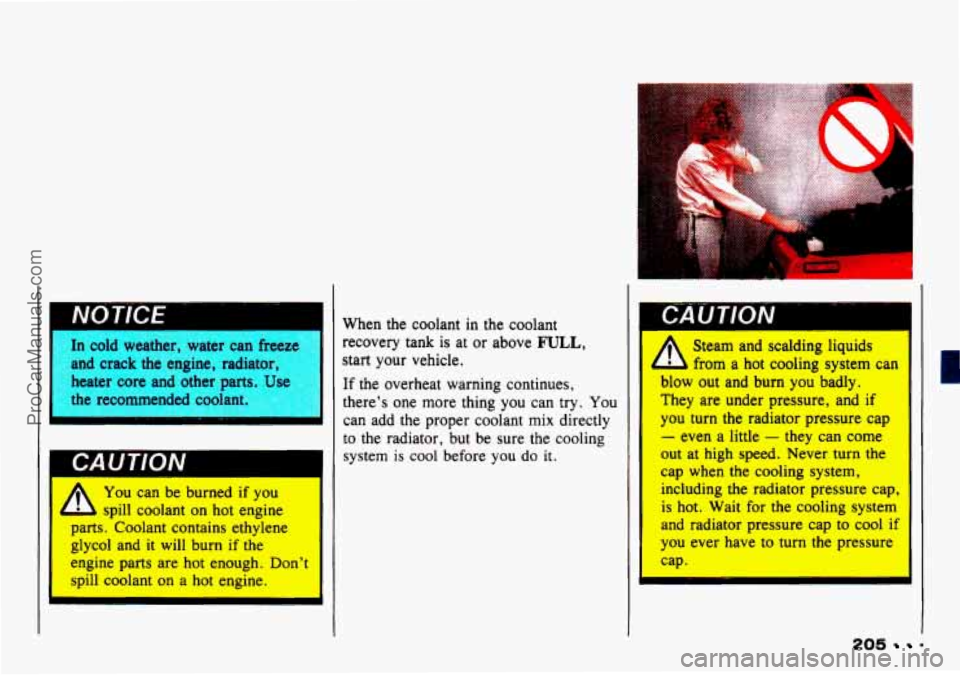
If the overheat warning continues,
there's one more thing you can try. You
can add the proper coolant mix directly
to the radiator, but be sure the cooling
system
is cool before you do it.
I
I
Steam and scalding liquids
- b from a hot cooling system car
blow out and burn you badly. I
They are under pressure, and if
you turn the radiator pressure cap
- even a little - they can come
out at high speed. Never turn
the
cap when the cooling system,
including the radiator pressure cap,
is hot. Wait for the cooling system
and radiator pressure cap to cool
il
you ever have to turn the pressure
cap.
205
ProCarManuals.com
Page 208 of 339
Problems on the Road
I
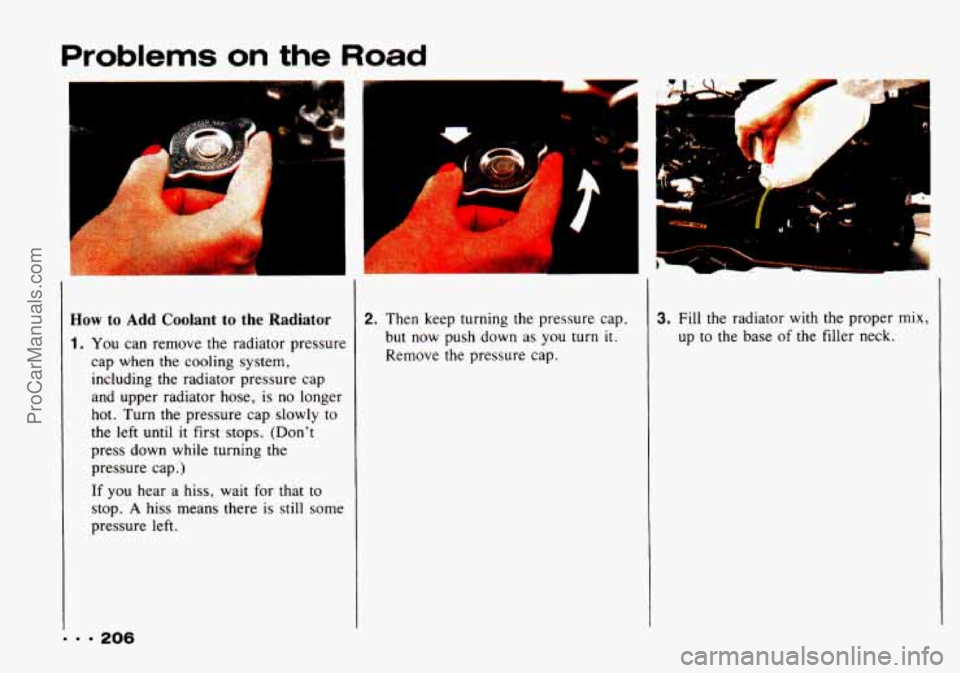
How to Add Coolant to the Radiator
1. You can remove the radiator pressure
cap when the cooling system,
including the radiator pressure cap
and upper radiator hose, is no longer
hot. Turn the pressure cap slowly
to
the left until it first stops. (Don't
press down while turning the
pressure cap.)
If you hear a hiss, wait for that to
stop. A hiss means there is still some
pressure
left.
2. Then keep turning the pressure cap,
but now push down as you turn
it.
Remove the pressure cap.
I A
3. Fill the radiator with the proper mix,
up
to the base of the filler neck.
ProCarManuals.com
Page 242 of 339
Service & Appearance Care
How to Check Lubricant:
If the level is below the bottom of the
filler plug hole, you’ll need to add some
lubricant.
If the differential is at operating
temperature (warm), add enough
lubricant to raise the level to the bottom
of the filler plug hole.
If the differential
is cold, add enough
lubricant to raise the level to
1/2 inch
(12 mm) below the filler plug hole.
What to Use:
Refer to the Maintenance Schedule to
determine what kind of lubricant to use.
See “Recommended Fluids and
Lubricants” in the Index.
Engine Coolant
The following explains your cooling
system and how to add coolant when it
is low. If you have a problem with
engine overheating, see “Engine
Overheating” in the Index.
The proper coolant for your Geo will:
Give freezing protection down to
Give boiling protection up to 258°F
Protect against rust and corrosion.
Help keep the proper engine
Let the warning lights work as they
-34°F (-37°C).
(125°C).
temperature. should.
What to Use:
Use a mixture of one-half clean water
(preferably distilled) and one-half
antifreeze or approved recycled coolant
that meets “GM Specification 6038M,”
which won’t damage aluminum parts.
Also use GM Engine Coolant
Supplement (sealer) with a complete
coolant change. If you use these, you
don’t need to add anything else.
ProCarManuals.com
Page 243 of 339
r
Adding only plain water to
b your cooling system can be
dmgemus. Plaia water, or some
other liquid like alcohol, can boil
before the proper coolant mix will.
Your vehicle’s coolant warning
system is set for the proper coolant
mix, With plain water or the
wrong mix, your engine could get
too hot but you wouldn’t get the
overheat warning. Your engine
could catch fire and you or others
could be burned. Use a 50/50 mix
of clean water and a proper
antifreeve or approved recycled
coolant.
I
Some conditions, such as air trapped in
the cooling system, can affect the
coolant level in the radiator. Check the
coolant level when the engine is cold
and follow the steps under ‘‘Adding Coolant” for
the proper way to add
coolant. If you have to add coolant
more than
four time
a year, have your dealer check
your cooling system.
If
you use the proper coolant, you
don’t have to add extra inhibitors
or additivies which claim to
II
241
ProCarManuals.com
Page 262 of 339
Service & Appearance Care
nuts on your vehicle can be
dangerous. It could affect the
braking and handling of your
vehicle, make your tires lose air
and make you lose control.
You
could have a collision in which
you or others could be injured.
Always use the correct wheel,
wheel bolts, and wheel nuts for
replacement.
NOTlCE
= 260
The wrong wheel can also cause
problems with bearing life, brakc
cooling, speedometer/odometer
calibration, headlight aim, bump
height, vehicle ground cleara
and tire or tire chain clearance
tc
the body and chassis Used
Replacement Wheels
I
Ab
Putting a used wheel on your
vehicle is dangerous. You
can’t
know how it’s been used or
how many miles it’s been driven.
It could fail suddenly and
cause an
accident. If you have to replace a
wheel, use a new GM original
equipment wheel.
ProCarManuals.com
Page 280 of 339
Service & Appearance Care
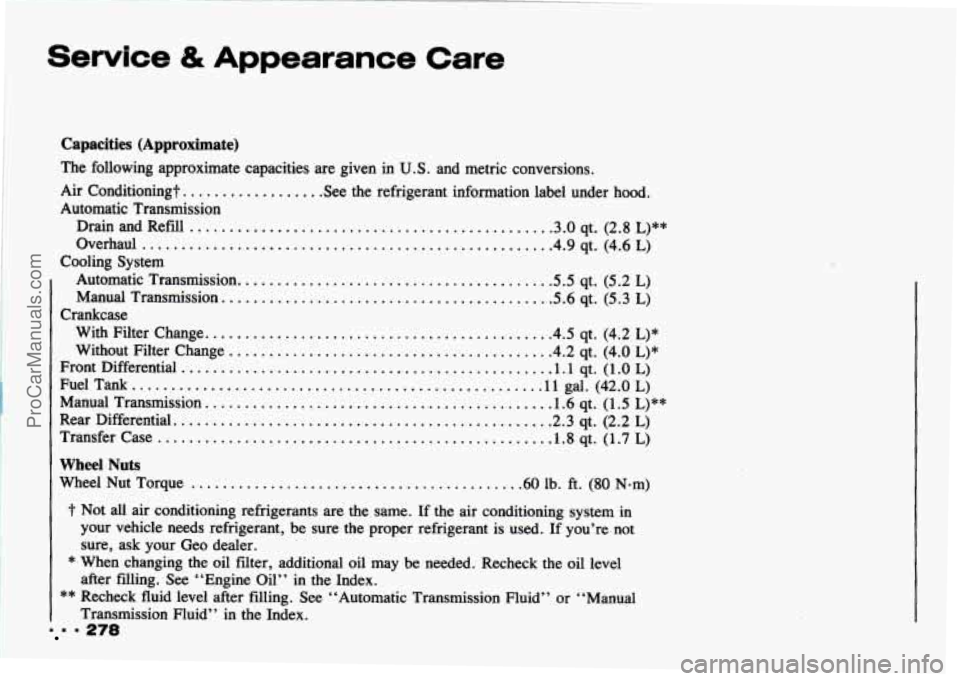
Capacities (Approximate)
The following approximate capacities are given in U.S. and metric conversions.
Automatic Transmission Air
Conditioning?.
................ .See the refrigerant information label under hood.
.............................................
................................................... Drain and Refill .3.0 qt. (2.8 L)**
Overhaul .4.9 qt. (4.6 L)
Cooling System
Automatic Transmission. ...................................... S.5 qt. (5.2 L)
I Manual Transmission. ........................................ S.6 qt. (5.3 L)
FuelT ank....................................................llgal.(42.0L) .
Crankcase
..........................................
........................................
With Filter Change. .4.5 qt. (4.2 L)*
Without Filter Change .4.2 qt. (4.0 L)*
Front Differential ............................................... 1 1 qt. (1 .O L)
Manual Transmission. .1.6 qt. (1.5 L)**
Rear Differential. .2.3 qt. (2.2 L)
Transfer Case .................................................. 1 .8 qt. (1.7 L)
..........................................
..............................................
Wheel Nuts
Wheel Nut Torque .60 lb. ft. (80 N-m)
? Not all air conditioning refrigerants are the same. If the air conditioning system in
your vehicle needs refrigerant, be sure
the proper refrigerant is used. If you’re not
sure, ask your Geo dealer.
after filling.
See “Engine Oil” in the Index.
Transmission Fluid” in the Index.
.........................................
*.When changing the oil filter, additional oil may be needed. Recheck the oil level
** Recheck fluid level after filling. See “Automatic Transmission Fluid” or “Manual
9 278
ProCarManuals.com
Page 292 of 339
Maintenance Schedule
Section A: Scheduled Maintenance Services (Cont.)
Dplanatiun of Scheduled Maintenance Services
Below are explanations of the services listed in Schedules I
and 11.
290
ITEM
NO.
1
2
SERVICE
Engine Oil and Filter Change* - Always use SG
Energy Conserving I1 Oils of proper viscosity. The
SG designation may be shown alone or in
combination with others, such as SG/CC, SG/CD,
or SF, SG, CC, etc. To determine the preferred
viscosity for your vehicle’s engine (e.g., SAE
5W-30 or 1OW-30) see “Engine Oil’’ in the Index.
Engine Idle Speed Check* - Check the idle speed
and adjust it to underhood label specifications.
*An Emission Control Service.
The proper fluids and lubricants to use are listed in Section
D. Make sure whoever services your vehicle uses these. All
parts should be replaced and all necessary repairs done
before
you or anyone else drives the vehicle.
ITEM
NO. SERVICE
3 Cooling System Service* - Drain, flush and refill
the system with new or approved recycled coolant
conforming to
GM Specification 4038M. Keep
coolant at
the proper mixture as specified. See
“Coolant”
in the Index. This provides proper freeze
protection, corrosion inhibitor level, and engine
operating temperature.
Inspect hoses and replace
if they are cracked,
swollen, or deteriorated. Tighten screw-type hose
clamps. Clean the outside of the radiator and air
conditioning condenser. Wash
the pressure cap and
neck.
To help ensure proper operation, we recommend a
pressure test of both
the cooling system and the
pressure cap.
ProCarManuals.com
Page 328 of 339
Index
Children (Safety Belts) ............. 30
Children. Larger (Safety Belts) ...... 37
Cigarette Lighter
................. 77
Circuit Breakers. Fuses and ........ 273
City Driving
.................... 164
Cleaner. Air
.................... 233
Cleaning Aluminum Wheels
............. 269
Canvas Top
................... 268
Fabric. Using Foam-Type
Cleaner on
.................. 263
Fabric. Using Solvent-Type
Cleaner on
.................. 263
Geo. the Iqside of Your
.......... 262
Geo. the Outside of Your
........ 267
Glass
........................ 266
Instrument Panel. the Top of
the . . 266
Special Problems
............... 264
Underbody
.................... 270
Vinyl or Leather
............... 265
Windshield and Wiper Blades
..... 267
AM/FM Stereo
................ 107
AM/FM Stereo with
Cassette Tape Player
.......... 108
Clusters. Instrument Panel and
...... 80
Clutch Adjustment
............... 238
Coinholder and Bin
................ 76
Color
of Road Signs .............. 1 18
Clock.
Setting the Combination Light Bulb
Replacement. Rear
............. 25 1
Comfort Controls and Audio
Systems
...................... 101
Control of a Vehicle
.............. 126
Control.
Loss of ................. 138
Controls
Air Conditioner
................ 104
Brightness ..................... 7 1
Comfort
...................... 102
Features and
................... 43
Heater
....................... 102
Seats and Seat
.................. 12
Convertible Top
.................. 87
Convex Outside Mirror
............ 74
Coolant
Adding
................ .... 242
Engine
....................... 240
Overheating
................... 200
Radiator, How to Add
Coolant to the
................ 206
Recovery Tank, How to Add
Coolant to
.................. 204
Temperature Gage. Engine
........ 85
Cooling (Air Conditioning) ........ 104
Curves, Driving on
............... 132
Customer Assistance for the
Hearing
or Speech Impaired ...... 3 13
Customer Assistance Information
... 3 11
Customer Satisfaction Procedure
.... 3 12 Daytime
Running Lights
........... 70
Defensive Driving
............... 122
Defogger. Rear Window
.......... 105
Defogging and Defrosting
Windows
..................... 104
Dehumidifying (Air Conditioning)
. . 105
Dimensions. Vehicle ............. 279
Disc Brake Wear Indicators
........ 130
Dome Light
...................... 71
Door Locks
......................... 45
Locks. Tailgate
................. 46
Storage Compartments
........... 75
Downhill. Driving
............... 150
Downhill. Parking ............... 172
Drive. Four-wheel
........... .57. 239
Driving
Across an Incline
............... 152
After Off-Road
................ 157
And the Road. Your
............ 117
AtNight
...................... 157
City
......................... 164
Defensive
.................... 122
Downhill
..................... 150
Drunken ...................... 123
Freeway
...................... 165
Guidelines.
Utility Vehicle ....... 140
In
Fog. Mist. and Haze .......... 162
In
Fog. Tips on ................ 163
... 326
ProCarManuals.com