engine CHEVROLET TRACKER 1993 User Guide
[x] Cancel search | Manufacturer: CHEVROLET, Model Year: 1993, Model line: TRACKER, Model: CHEVROLET TRACKER 1993Pages: 339, PDF Size: 15.75 MB
Page 59 of 339
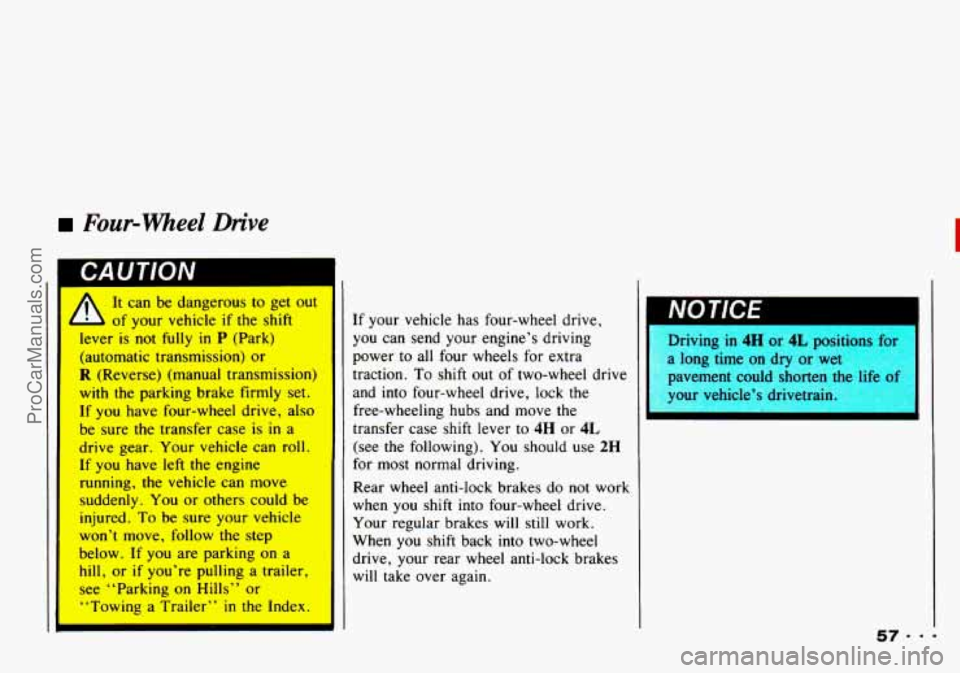
Four-wheel Drive
CAUTION I
It can be dangerous to get out
4 b of your vehicle if the shift
rcyer is not fdly in P (Park)
(automatic transmission) or
R (Reverse) (manual transmission)
with the parking brake firmly set.
If you have four-wheel drive, also
be sure the transfer case is in a
drive gear. Your vehicle can roll.
If you have left the engine
running,
the vehicle can move
suddenly.
You or others could be
injured. To be sure your vehicle
won’t move, follow the step
below. If you are parking on a
hill’, or if you’re pulling a trailer,
see “Parking on Hills” cw
“Towing a Trailer” in the Index.
[f your vehicle has four-wheel drive,
you can send your engine’s driving
power to all four wheels for extra
traction.
To shift out of two-wheel drive
and into four-wheel drive, lock the
free-wheeling hubs and move
the
transfer case shift lever to 4H or 4L
(see the following). You should use 2H
for most normal driving.
Rear wheel anti-lock brakes
do not work
when you shift into four-wheel drive.
Your regular brakes will still work.
When
you shift back into two-wheel
drive, your rear wheel anti-lock brakes
will take over again. Driving
in 4H or 4L positions for
a long time on dry or wet
pavement could shorten
thP 1 nf
your vehicle’s drivetrain.
ProCarManuals.com
Page 63 of 339
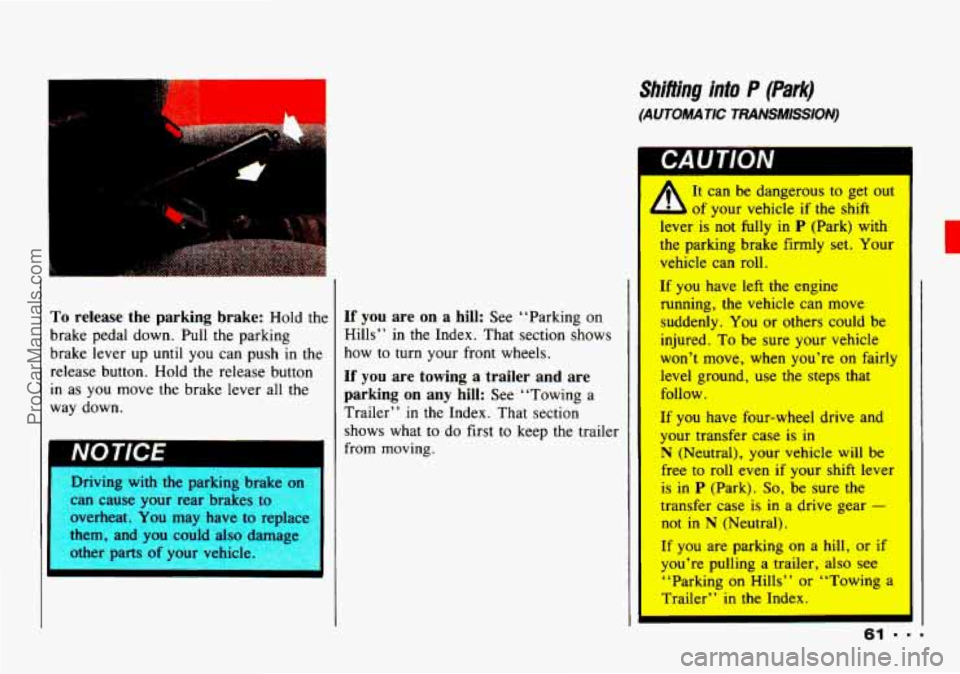
To release the parking brake: Hold the
brake pedal down. Pull the parking
brake lever up
until you can push in the
release button. Hold the release button
in as you move the brake lever all the
way down.
I NOTICE
Driving with the parking brake on
can cause your rear brakes to
overheat.
You may have to replac=
them, and
you could also dvwe
other parts
of your vehicle.
If you are on a hill: See “Parking on
Hills” in
the Index. That section shows
how to turn your front wheels.
If you are towing a trailer and are
parking on any hill:
See “Towing a
Trailer”
in the Index. That section
shows what to
do first to keep the trailer
from moving.
Shifiing into P (Park)
(AUTOMATIC TRANSMlSS/ON)
It can be dangerous to get out
of your vehicle if
the shift
lever is not fully in
P (Park) with
the parking brake firmly set. Your
vehicle can roll,
If you have left the engine
running, the vehicle can move
suddenly. You or others could be
injured. To be sure your vehicle
won’t move, when you’re on fairly
level ground, use the steps that
follow.
If you have four-wheel drive and
your transfer case
is in
N (Neutral), your vehicle will be
free
to roll even if your shift lever
is in
P (Park). So, be sure the
transfer case
is in a drive gear -
not in N (Neutral).
If
you are parking on a hill, or if
you’re pulling a trailer, also see
‘‘Parking on Hills”
or ‘‘Towing a
Trailer” in the Index.
ProCarManuals.com
Page 64 of 339
Features & Controls
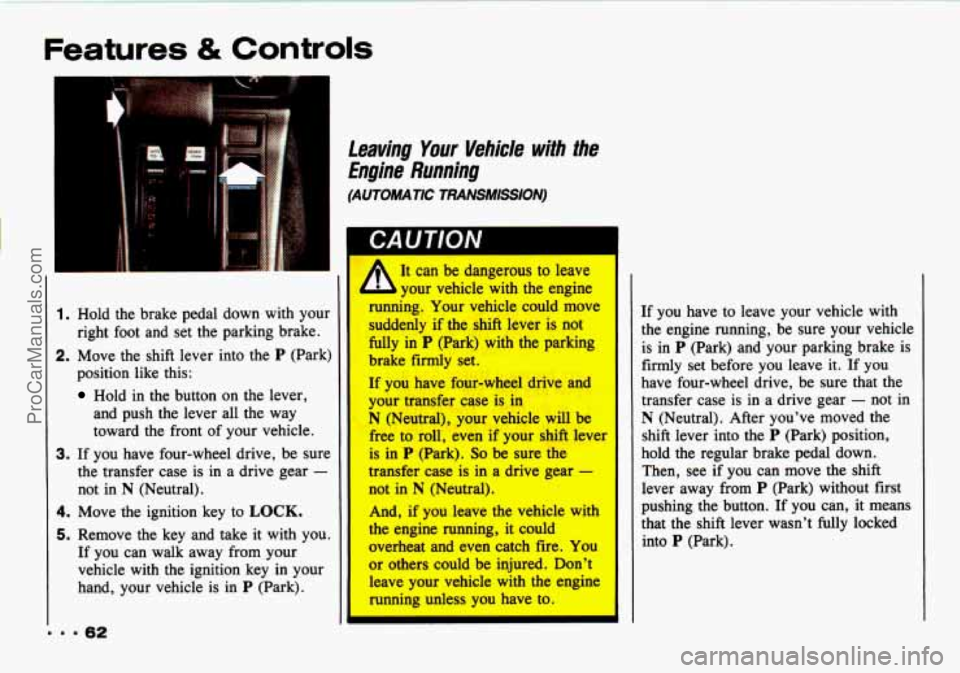
1. Hold the brake pedal down with your
right foot and set the parking brake.
2. Move the shift lever into the P (Park)
position like this:
Hold in the button on the lever,
and push the lever all the way
toward the front of your vehicle.
3. If you have four-wheel drive, be sure
the transfer case is in a drive gear
-
not in N (Neutral).
4. Move the ignition key to LOCK.
5. Remove the key and take it with you.
If you can walk away from your
vehicle with the ignition key in your
hand, your vehicle is
in P (Park).
Leaving Your Vehide with the
Engine Running
(AUTOMATIC TRANSMISSION)
A It can be dangerous to leave
your vehicle with the engine
running. Your vehicle could move
suddenly if the &ifl lever is not
fully in P (Park) with the parking
brake firmly set.
If you have f0.w-wheel drive and
your -fer we is. in
N (Neutral), your vehicle will be
free to roll, even if your shift lever
is in P (Park). So be sure the
transfer case is in a drive gear -
not in N (Neutral).
And, if you leave the vehicle with
the
engine running, it could
overheat and even catch fire. You
or others could be injured. Don't
leave your vehicle with the engine
running unless you have to.
If you have to leave your vehicle with
the engine running, be sure your vehicle
is in
P (Park) and your parking brake is
firmly set before you leave
it. If you
have four-wheel drive, be sure that the
transfer case is in a drive gear
- not in
N (Neutral). After you've moved the
shift lever into the
P (Park) position,
hold the regular brake pedal down.
Then, see if you can move the shift
lever away from
P (Park) without first
pushing the button. If you can, it means
that the shift lever wasn't fully locked
into
P (Park).
ProCarManuals.com
Page 66 of 339
Features & Controls
If you are parking on a hill, or if you’re
vehicle
is equipped to tow a trailer, see
“Parking on Hills” or “Towing a
Trailer’
’ in the Index.
Engine Exhaust #
t
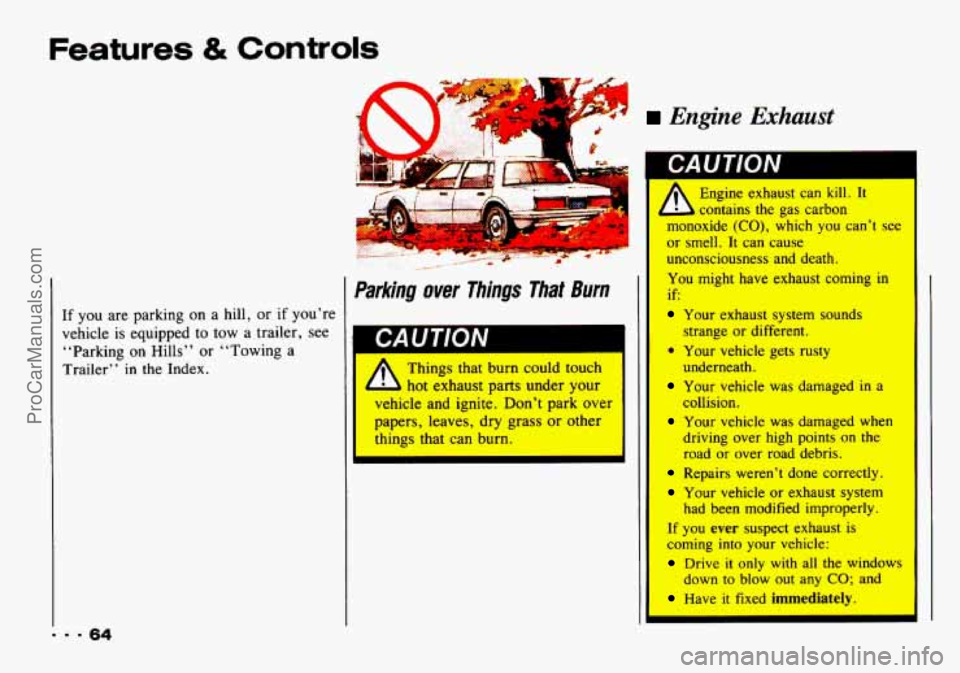
Parking over Things That Burn
uwu I IVIY
Things that burn could touch
L L hot exhaust parts under your
vehicle and ignite. Don’t park over
papers, leaves, dry grass or other
things that can burn.
A
Engine exhaust can kill. It
contains the gas carbon
monoxide
(CO), which you can’t see
or smell. It can cause
unconsciousness and death.
You might have exhaust coming
in
if:
Your exhaust system sounds
strange or different.
Your vehicle gets
rusty
underneath.
Your vehicle was damaged in a
collision.
Your vehicle was damaged when
driving over high points
on the
road or over road debris.
Repairs weren’t done correctly.
Your vehicle or exhaust system
had been modified improperly.
If you ever suspect exhaust is
coming into your
vehicle:
Drive it only with all the windows
down
to blow out any CO; and
Have it fixed immediately.
ProCarManuals.com
Page 67 of 339
Running Your Engine While
You’re Parked
(AUTOMATIC TRANSMISSION)
It’s better not to park with the engine
running. But if
you ever have to, here
are some things to
know.
CAUTION
A
Idling the engine with the air system control off could allow dangerous
exhaust into your vehicle (see
the earlier Caution under “Engine
Exhaust’
’).
Also, idling in a closed-in place can let deadly carbon monoxide (CO) into
your vehicle even if
the fan switch is at the highest setting. One place this
can happen is a garage. Exhaust - with CO - can come in easily. NEVER
park in a garage with
the engine running.
Another closed-in place can be a blizzard. (See “Blizzard”
in the Index.)
It can be dangerous to get out of your vehicle if the shift lever is not
fully in
P (Park) with the parking brake firmly set. Your vehicle can roll. Don’t
leave your vehicle when
the engine is running unless you have to. If you’ve
left the engine running, the vehicle can move suddenly. You or others could
be injured.
To be sure your vehicle won’t move, even when you’re on fairly
level ground, always set your parking brake and move the shift lever
to P
(Park).
If you have four-wheel drive and your transfer case
is in N (Neutral), your
vehicle will be free to roll, even
if your shift lever is in P (Park). So, be sure
the transfer case
is in a drive gear - not in N (Neutral). Follow the proper
steps to be sure your vehicle won’t move. See “Shifting into
P (Park)” in
the Index.
If you are parking on a hill, or if you’re pulling a trailer, also see “Parking
on Hills” or “Towing a Trailer” in the Index.
c
ProCarManuals.com
Page 84 of 339
Features & Conrrols
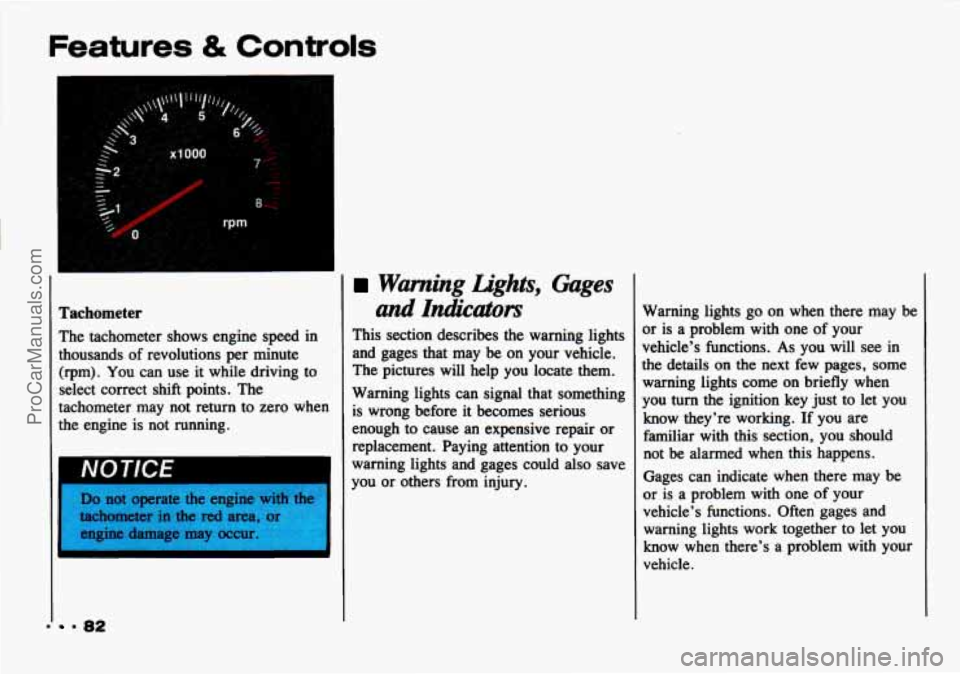
Tachometer
The tachometer shows engine speed in
thousands
of revolutions per minute
(rpm).
You can use it while driving to
select correct shift points. The
tachometer may not return to zero when
the engine is not running.
NOTICE
Do not operate the engine with the
tachometer in the red area
engine damage may occur
9 82
Wanting Lights, Gages
and
Indicators
This section describes the warning lights
and gages that may be on your vehicle.
The pictures will help
you locate them.
Warning lights can signal that something
is wrong before it becomes serious
enough to cause an expensive repair or
replacement. Paying attention to your
warning lights and gages could also save
you or others from injury. Warning
lights go on when there may be
or is a problem with one
of your
vehicle’s functions.
As you will see in
the details on the next few pages, some
warning lights come on briefly when
you turn the ignition key just to let you
know they’re working. If you are
familiar with this section, you should
not be alarmed when this happens.
Gages can indicate when there may be
or is a problem with one of your
vehicle’s functions. Often’ gages
and
warning lights work together to let you
know when there’s a problem with your
vehicle.
ProCarManuals.com
Page 85 of 339
c
When one of the warning lights comes
on and stays on
when you are driving,
or when one of the gages shows there
may be a problem, check the section
that tells you what to do about
it. Please
follow the manual’s advice. Waiting to
do repairs can
be costly - and even
dangerous. So please get to know your
warning lights and gages. They’re a big
help.
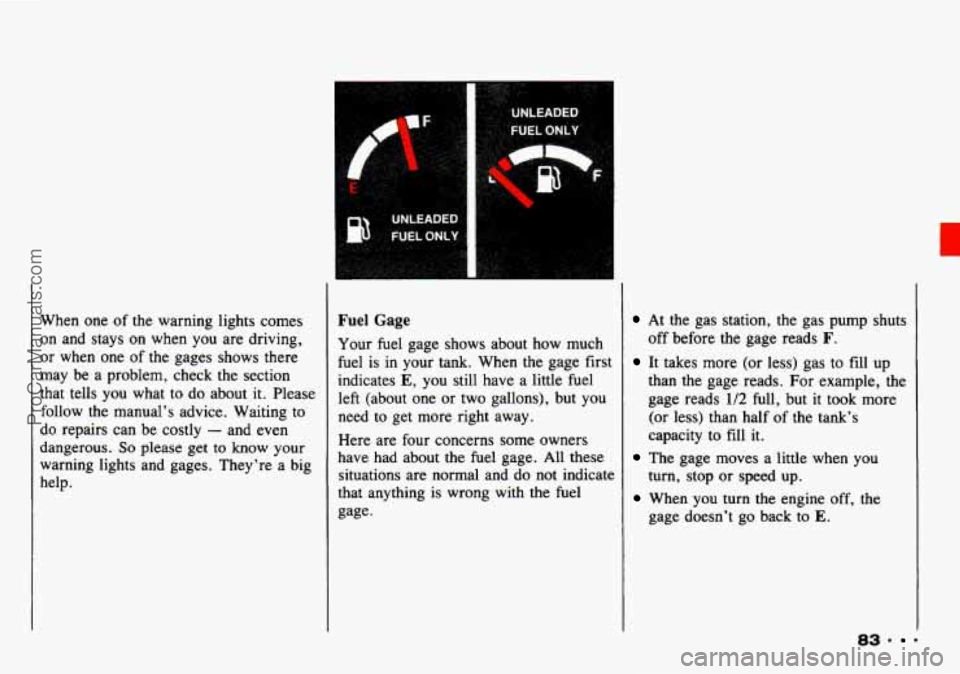
Fuel Gage
Your fuel gage shows about how much
fuel
is in your tank. When the gage first
indicates
E, you still have a little fuel
left (about one
or two gallons), but you
need to get more right away.
Here are four concerns some owners
have had about the fuel gage. All these
situations are normal and do not indicate
that anything is wrong
with the fuel
gage.
At the gas station, the gas pump shuts
It takes more (or less) gas to fill up
off before the
gage reads
F.
than the gage reads. For example, the
gage reads
1/2 full, but it took more
(or less) than half of the tank’s
capacity to fill it.
The gage moves a little when you
turn, stop or speed up.
When you turn the engine off, the
gage doesn’t
go back to E.
83. 9
ProCarManuals.com
Page 87 of 339
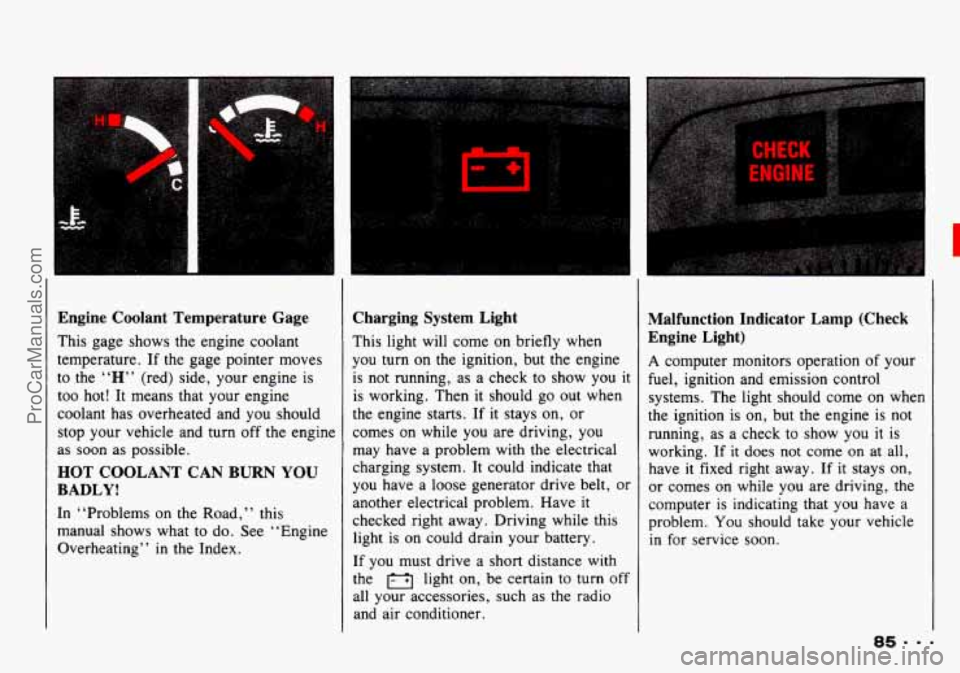
Engine Coolant Temperature Gage
This gage shows the engine coolant
temperature. If the gage pointer moves
to the “H” (red) side, your engine is
too hot! It means that your engine
coolant has overheated and you should
stop your vehicle and turn off the engine
as soon as possible.
HOT
COOLANT CAN BURN YOU
BADLY!
In “Problems on the Road, ” this
manual shows what to do. See “Engine
Overheating’’
in the Index.
-I
I L
Charging System Light
This light will come on briefly when
you turn on
the ignition, but the engine
is not running, as a check to show you it
is working. Then it should go out when
the engine starts. If it stays on, or
comes on while you are driving, you
may
have a problem with the electrical
charging system. It could indicate that
you have a loose generator drive belt, or
another electrical problem. Have
it
checked right away. Driving while this
light
is on could drain your battery.
If you must drive a short distance with
the light
on, be certain to turn off
all your accessories, such as the radio
and air conditioner.
Malfunction Indicator Lamp (Check
Engine Light)
A computer monitors operation of your
fuel, ignition and emission control
systems. The light should come on when
the ignition is on, but the engine is not
running, as a check to show you
it is
working. If
it does not come on at all,
have it fixed right away. If it stays
on,
or comes on while you are driving, the
computer is indicating that you have
a
problem. You should take your vehicle
in for service soon.
85.9.
ProCarManuals.com
Page 88 of 339
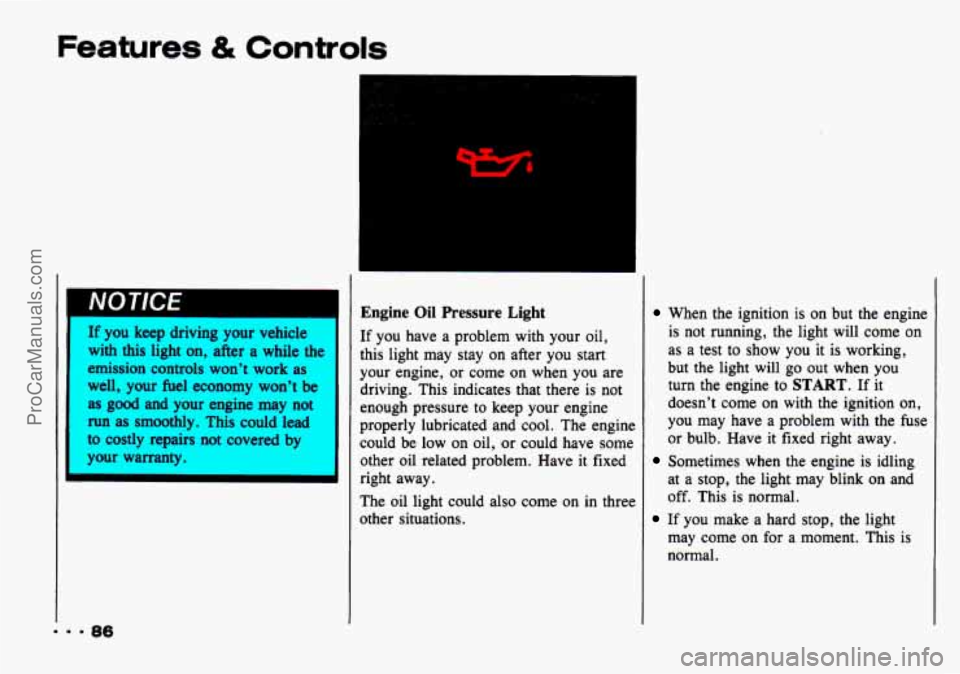
If you keep driving your vehicle
with this light on, after a while the
emission controls won’t work as
well, your fuel economy won’t be
as good and your engine may not
run as smoothly. This could lead
to costly repairs not covered by
your warranty.
-8.86
Engine Oil Pressure Light
If you have a problem with your oil,
this light may stay on after you start
your engine, or come on when you are
driving. This indicates that there is not
enough pressure to keep your engine
properly lubricated and cool. The engine
could be low on oil, or could have some
other oil related problem. Have it fixed
right away.
The oil light could also come on in three
other situations.
When the ignition is on but the engine
is not running, the light will come on
as a test to show you it is working,
but the light will
go out when you
turn the engine
to START. If it
doesn’t come on with the ignition on,
you may have a problem with the fuse
or bulb. Have it fixed right away.
Sometimes when the engine is idling
at a stop, the light may blink on and
off. This is normal.
may come on for a moment. This is
normal.
If you make a hard stop, the light
ProCarManuals.com
Page 89 of 339
IC CA UTlON
A
Don’t keep driving if the oil
pressure is low. If you do,
your engine can become so hot
that it catches
on fire. You or
others could be burned. Check
your oil as soon as possible
and
have your vehicle serviced.
NOTlCE
Damage to your engine from
neglected oil problems can
costly
and is not covered by your
I
Convertible Top (OPTION)
Your convertible top features a sunroof,
a removable rear window and a
removable canvas top.
I- ~-
A Don’t change the center
- pillars or horizontal roof
support. These parts are designed
to help protect you and passengers
in a crash. Don’t
add anything,
like light bars or roll bars, to these
parts, either. If the center pillars
or horizontal roof support
are ever
damaged, be sure to have them
repaired
as soon as possible so
they’ll be able to protect you in a
crash.
ProCarManuals.com