flat tire CHEVROLET TRACKER 1993 User Guide
[x] Cancel search | Manufacturer: CHEVROLET, Model Year: 1993, Model line: TRACKER, Model: CHEVROLET TRACKER 1993Pages: 339, PDF Size: 15.75 MB
Page 218 of 339
Problems on the Road
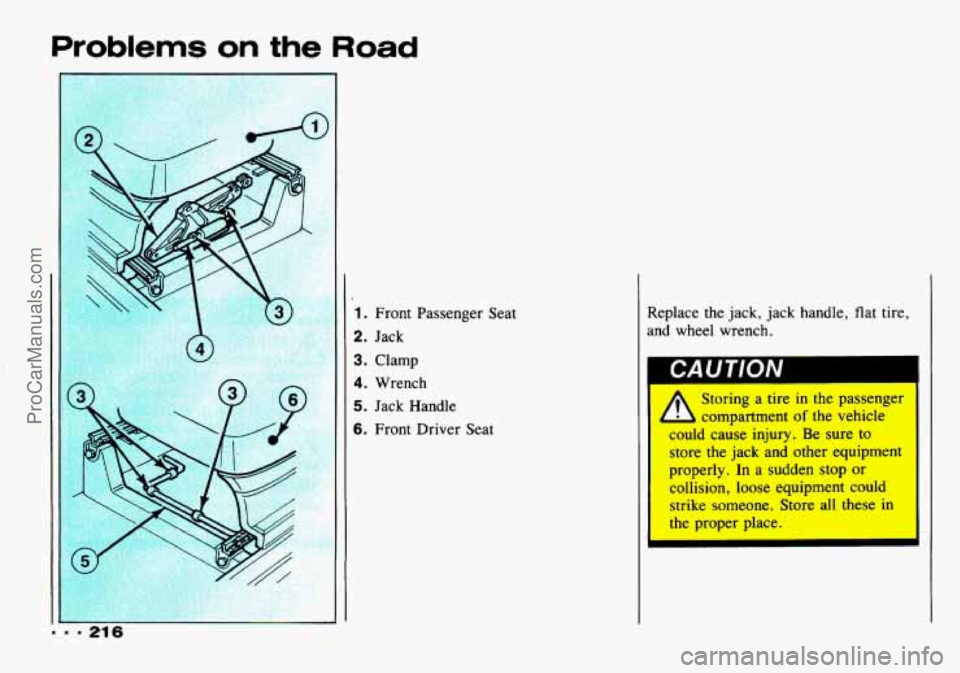
1. Front Passenger Seat
2. Jack
3. Clamp
4. Wrench
5. Jack Handle
6. Front Driver Seat Replace the
jack, jack handle, flat tire,
and wheel wrench.
* Storing a tire in the passenger
- compartment of the vehicle
- ould cause injury. Be sure to
store the jack and other equipment
properly. In a sudden stop or
collision, loose equipment could strike someone. Store all these in
the proper place.
ProCarManuals.com
Page 254 of 339
Service & Appearance Care
Loading Your Vehicle
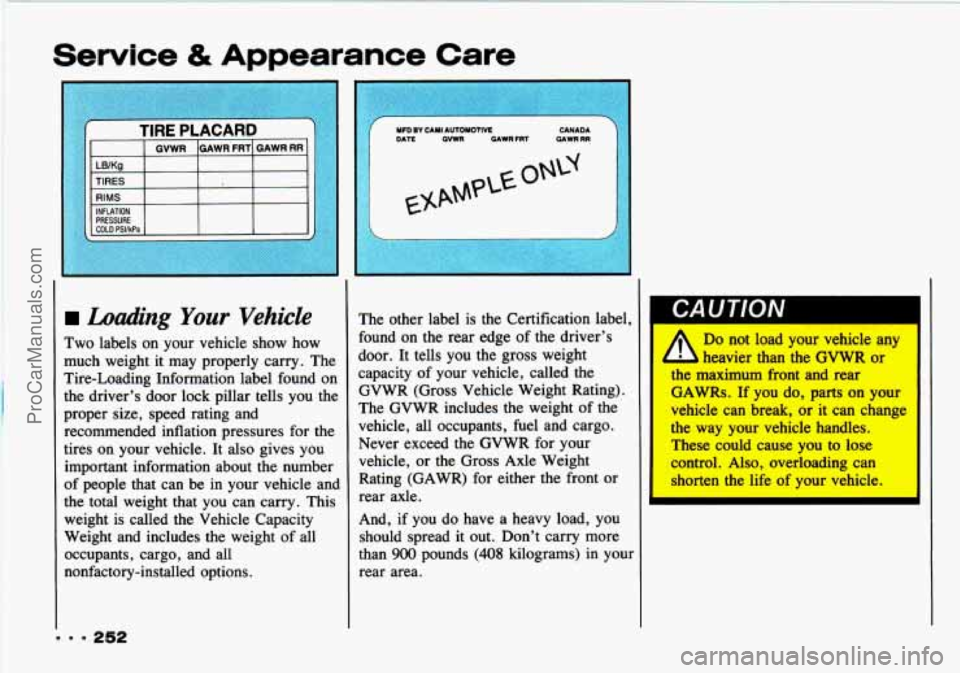
Two labels on your vehicle show how
much weight
it may properly carry. The
Tire-Loading Information label found on
the driver’s door lock pillar tells you the
proper size, speed rating and
recommended inflation pressures for the
tires on your vehicle. It also gives you
important information about the number
of people that can be in your vehicle and
the total weight that you can carry. This
weight is called the Vehicle Capacity
Weight and includes the weight of all
occupants, cargo, and all
nonfactory-installed options. The other
label is the Certification label,
11
found on the rear edge of the driver’s
door. It tells you the gross weight
capacity of your vehicle, called the
GVWR (Gross Vehicle Weight Rating).
The GVWR includes the weight of the
vehicle, all occupants, fuel and cargo.
Never exceed the GVWR for your
vehicle, or the Gross Axle Weight
Rating (GAWR) for either the front or
rear axle.
And, if you do have a heavy load, you
should spread it out. Don’t carry more
than
900 pounds (408 kilograms) in your
rear area.
1
CAUTION
Do not load your vehicle any
heavier than the GVWR or
the
maximum front and rear I
GAWRs. If you do, parts on you]
vehicle can break, or it can chang
the way your vehicle handles.
These could cause you to lose
control. Also, overloading can
shorten the life of your vehicle.
ProCarManuals.com
Page 256 of 339
Service & Appearance Care
A
Poorly maintained and improperly used tires are dangerous.
9 Overloading your tires can cause overheating as a result of too much
friction. You could have an air-out and a serious accident. See “Loading
Your Vehicle” in the Index.
resulting accident could cause serious injury. Check all tires frequently to
maintain the recommended pressure. Tire pressure should be checked
when
the tires are cold.
Overinflated tires are more likely to be cut, punctured, or broken by a
sudden impact, such as when you hit a pothole. Keep tires at the
recommended pressure.
your tires have been damaged, replace them.
the correct high speed rated tires.
* Underinflated tires pose the same danger as overloaded tires. The
Worn, old tires can cause accidents. If your tread is badly worn, or if
Don’t drive over 85 mph (135 kmh) even if it’s legal, unless you have
Inflation - Tire Pressure
The Tire-Loading Information label
which
is on the driver’s door lock pillar
shows the correct inflation pressures for
your tires, when they’re cold. “Cold”
means your vehicle has been sitting
for
at least three hours or driven no more
than a mile.
9 254
ProCarManuals.com
Page 257 of 339
NO TIC€
I Don’t let anyone tell you that
underinflation
or overinflation is
If your tires have too rnllrh air
(overinflation), y
Unusual wear
Bad handling When
to Check: Check your tires once
a month or more.
How to Check: Use a good quality
pocket-type gage to check tire pressure.
Simply looking at the tires will not tell
you
the pressure, especially if you have
radial tires
- which may look properly
inflated even
if they’re underinflated.
If your tires have valve caps, be sure to
put them back on. They help prevent
leaks by keeping out dirt and moisture.
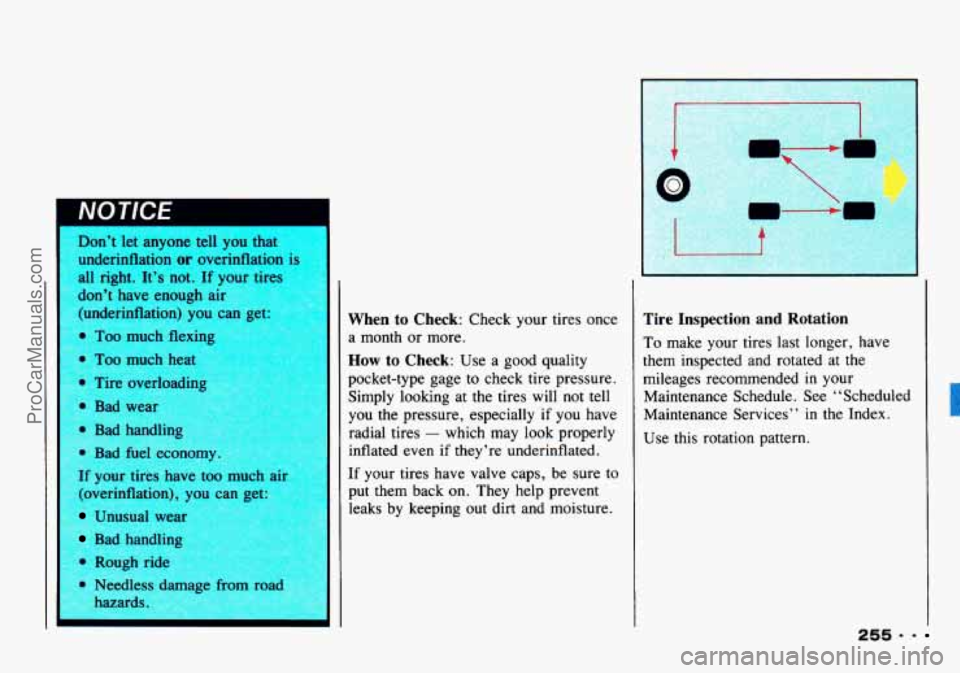
Tire Inspection and Rotation
To make your tires last longer, have
them inspected and rotated at the mileages recommended
in your
Maintenance Schedule. See “Scheduled
Maintenance Services”
in the Index.
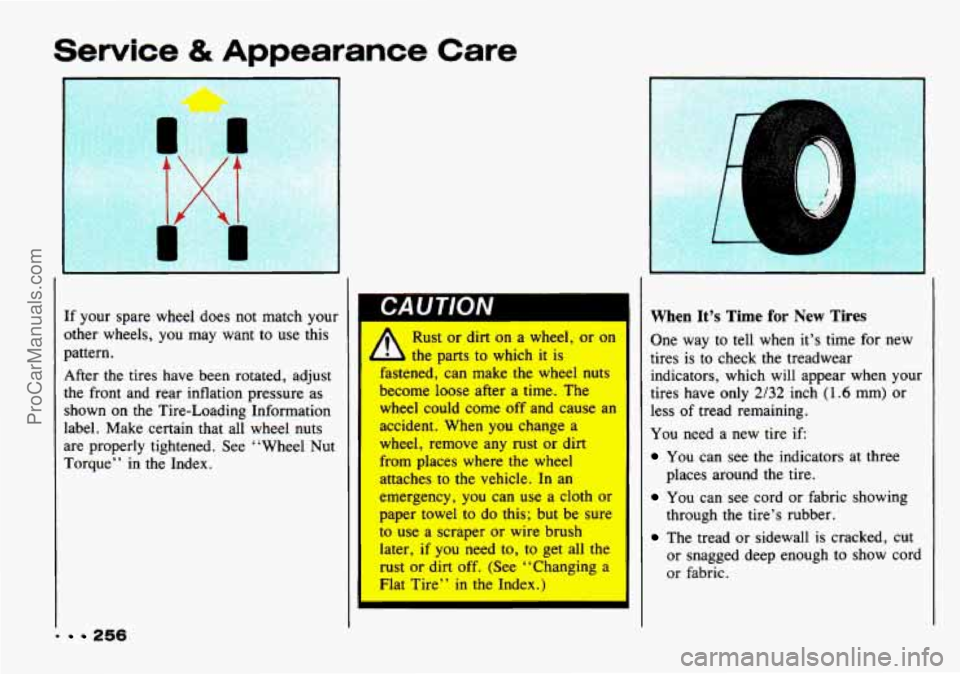
Use this rotation pattern.
255 - -
ProCarManuals.com
Page 258 of 339
Service & Appearance Care
I
- 256
If your spare wheel does not match your
other wheels, you may want to use this
pattern.
After the tires have been rotated, adjust
the front and rear inflation pressure as
shown
on the Tire-Loading Information
label. Make certain that all wheel nuts
are properly tightened. See “Wheel Nut
Torque’’ in the Index.
CA U TION
A
Rust or dirt on a wheel, or on
the parts
to which it is
fastened, can make the wheel nuts
become loose after a time. The
wheel could come off and cause an
accident. When you change a
wheel, remove any rust or dirt
from places where the wheel
attaches to the vehicle. In an
emergency, you can use
a cloth or
paper towel to
do this; but be sure
to use a scraper or wire brush
later,
if you need to, to get all the
rust or dirt
off. (See “Changing a
Flat Tire” in the Index.)
I
When It’s Time for New Tires
One way to tell when it’s time for new
tires is to check the treadwear
indicators, which will appear when your
tires have only
2/32 inch (1.6 mm) or
less of tread remaining.
You need a new tire if
You can see the indicators at three
You can see cord or fabric showing
The tread or sidewall is cracked, cut
places around
the tire.
through the tire’s rubber.
or snagged deep enough to show cord
or fabric.
ProCarManuals.com
Page 261 of 339
properly inflated and not overloaded.
Excessive speed, underinflation, or
excessive loading, either separately or in
combination, can cause heat buildup and
possible tire failure.
Those grades are molded on the
sidewalls of passenger car tires.
While the tires available as standard or
optional equipment on General Motors
vehicles may vary with respect to these
grades, all such tires meet General
Motors performance standards and have
been approved for use on General
Motors vehicles. All passenger type
(P metric) tires must conform to Federal
safety requirements in addition to these
grades.
Wheel Alignment and Tire Balance
The wheels on your vehicle were
aligned and balanced carefully at the
factory to give you the longest tire life
and best overall performance.
In most cases, you will not need to have
your wheels aligned again. However, if
you notice unusual tire wear
or your
vehicle pulling one way or the other, the
alignment may need to be reset. If you
notice your vehicle vibrating when
driving on a smooth road, your wheels
may need to be rebalanced.
Wheel Replacement
Replace any wheel that is bent, cracked
or badly rusted. If wheel nuts keep coming
loose, the wheel, wheel bolts,
and wheel nuts should be replaced.
If
the wheel leaks air out, replace it
(except some aluminum wheels, which
can sometimes be repaired). See your
Geo dealer if
any of these conditions
exist.
Your dealer will know the kind of wheel
you need.
If you need to replace any of your
wheels, wheel bolts, or wheel nuts,
replace them only with
new GM original
equipment parts. This way, you will be
sure to have the right wheel, wheel
bolts, and wheel nuts for your Tracker.
ProCarManuals.com
Page 284 of 339
Maintenance Schedule
Introduction: A Word about Maintenance
We at General Motors want to help you keep your vehicle in
good working condition. But we don’t know exactly how
you’ll drive it. You may drive very short distances only a
few times a week. Or you may drive long distances all the
time
in very hot, dusty weather. You may use your vehicle
in making deliveries. Or you may drive it to work, to do
errands,
or in many other ways.
Because of all the different ways people use their GM
vehicles, maintenance needs vary. You may even need more
frequent checks and replacements than you will find in the
schedules
in this part. So please read this part and note how
you drive. If you have any questions on how to keep your
vehicle
in good condition, see your Geo dealer, the place
many GM owners choose
to have their maintenance work
done. Your dealer can be relied
upon to use proper parts
and practices.
Your Vehicle and the Envitvnment
Proper vehicle maintenance not only helps keep your vehicle
in good working condition, but it also helps the
environment.
All recommended maintenance procedures are
important. Improper vehicle maintenance
or the removal of
important components can significantly affect the quality of
the air we breathe. Improper fluid levels or even the wrong
tire inflation can increase the level of emissions from your
vehicle.
To help protect our environment, and to help keep
your vehicle
in good condition, please maintain your vehicle
properly.
9 282
ProCarManuals.com
Page 301 of 339
At Least Once a Month
CHECK
OR SERVICE “‘HAT TO DO
Tires
Inflation
Check tire inflation. Make sure they are inflated to the pressures specified on the Tire-Loading
Information label located
on driver’s door. See “Tires” in the Index for further details.
l At least Twice a Year
CHECK
I OR SERVICE I WHAT TO DO
Fluid Level
Check Check
the transfer case, axle differential(s) and automatic or manual transmission fluid levels and
add as needed. See “Transfer Case,
” ‘‘Axle, Rear,” “Axle, Front” and “Automatic
I Transmission” or “Manual Transmission” in the Index. A fluid loss in these systems could I
I indicate a problem. Have the system inspected and repaired at once. I
299 9 =
ProCarManuals.com
Page 327 of 339
Index
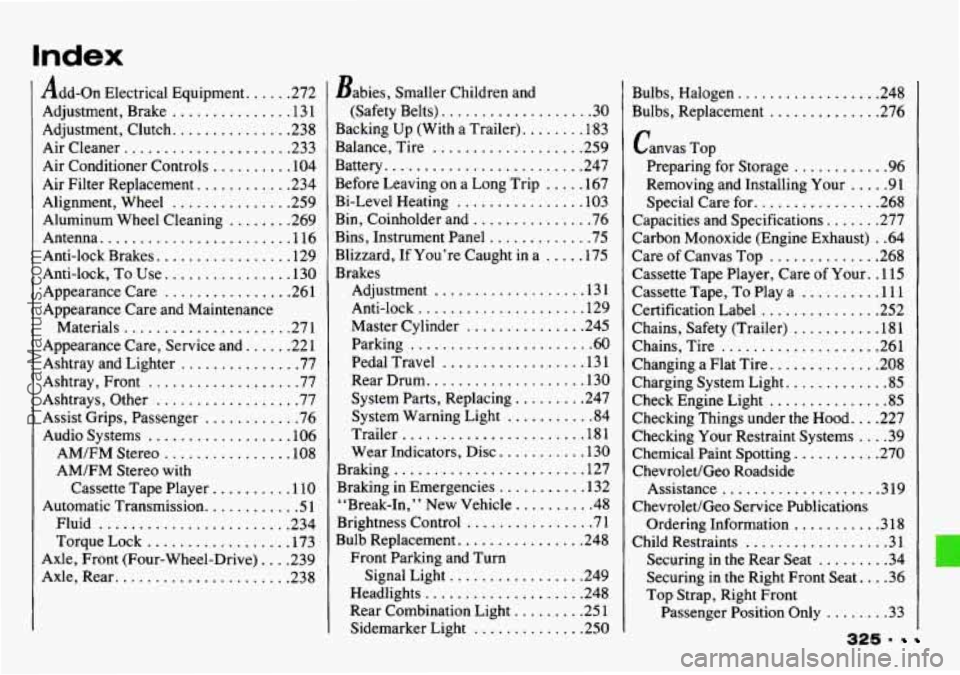
Add-on Electrical Equipment ...... 272
Adjustment. Brake
............... 13 1
Adjustment. Clutch
............... 238
Air Cleaner
..................... 233
Air Conditioner Controls
.......... 104
Air Filter Replacement
............ 234
Alignment. Wheel
............... 259
Aluminum Wheel Cleaning
........ 269
Antenna
........................ 116
Anti-lock Brakes
................. 129
Anti-lock. To Use
................ 130
Appearance Care
................ 26 1
Appearance Care and Maintenance
Materials
..................... 27 1
Appearance Care. Service and
...... 22 1
Ashtray. Front ................... 77
Assist Grips. Passenger
............ 76
Audio Systems
.................. 106
AM/FM Stereo
................ 108
AM/FM Stereo with
Cassette Tape Player
.......... 110
Automatic Transmission
............ 5 1
Fluid ........................ 234
TorqueLock
.................. 173
Axle. Front (Four-Wheel-Drive)
.... 239
Axle, Rear
...................... 238
Ashtray and
Lighter
............... 77
Ashtrays, Other
.................. 77
Babies. Smaller Children and
(Safety Belts)
................... 30
Backing Up (With a Trailer)
........ 183
Balance. Tire
................... 259
Battery
......................... 247
Bi-Level Heating
................ 103
Bin. Coinholder and
............... 76
Bins. Instrument Panel
............. 75
Brakes
Before Leaving on a Long
Trip
..... 167
Blizzard. If You’re Caught
in a ..... 175
Adjustment
.................. -13 1
Anti-lock
..................... 129
Master Cylinder
............... 245
Parking
....................... 60
PedalTravel
.................. 131
Rear Drum
.................... 130
System Parts. Replacing
......... 247
System Warning Light
........... 84
Trailer
....................... 18 1
Wear Indicators. Disc
........... 130
Braking ........................ 127
Braking in Emergencies
........... 132
“Break-In.
.. New Vehicle .......... 48
Brightness Control
................ 7 1
Bulb Replacement ................ 248
Front Parking and Turn
Signal Light
................. 249
Headlights
.................... 248
Sidemarker Light
.............. 250
Rear Combination Light
......... 25
1 Bulbs. Halogen
.................. 248
Bulbs. Replacement
.............. 276
Canvas TOP
Preparing for Storage
............ 96
Removing and Installing Your
..... 91
Special Care
for ................ 268
Carbon Monoxide (Engine Exhaust)
. . 64
Care of Canvas Top
.............. 268
Cassette Tape Player. Care of Your
. . 115
Cassette Tape. To Play a
.......... 111
Certification Label
............... 252
Chains. Safety (Trailer)
........... 181
Chains. Tire
.................... 261
Changing a Flat Tire
.............. 208
Charging System Light
............. 85
Check Engine Light
............... 85
Capacities
and Specifications
....... 277
Checking Things under the Hood
.... 227
Checking Your Restraint Systems
.... 39
Chemical Paint Spotting ........... 270
Chevrolet/Geo Roadside
Assistance
.................... 319
Chevrolet/Geo Service Publications
Ordering Information
........... 318
Child Restraints
.................. 31
Securing in the Rear Seat
......... 34
Securing in the Right Front Seat .... 36
Top Strap. Right Front
Passenger Position Only
........ 33
325 .
ProCarManuals.com
Page 329 of 339
In Mud. Sand. Snow. or Ice ...... 155
In the Rain
.................... 160
In Water ...................... 156
Long Distance
................. 167
On Curves
.................... 132
On Grades (With a Trailer)
....... 184
On Off-Road Hills.
............. 145
On Snow or Ice
................ 174
On the Freeway
................ 165
Suggestions.
A Few More Night . . 159
Uphill
........................ 147
Winter
....................... 173
With a Trailer
................. 182
Drunken Driving
................ 123
Easy Entry Seats
................. 14
Electrical Equipment. Add-on
...... 272
Emergencies. Braking
in .......... 132
Emergencies. Steering
in ......... -134
Engine
Coolant
...................... 240
Coolant Temperature Gage
........ 85
Exhaust
....................... 64
Identification
.................. 272
Oil
.......................... 229
Oil Pressure Light
............... 86
Overheating
................... 200
Specifications
................. 277
Starting Your
................... 49
Through
Deep Standing Water
..... 50 Environment.
Your Vehicle and the
. 282
Exhaust. Engine
.................. 64
Extender. Safety Belt
.............. 39
Fabric Protection
.................... 264
Using Solvent-Type Cleaner on
... 263
Features and Controls
.............. 43
Filling Your Tank (Fuel)
.......... 226
Filter Replacement. Air
........... 234
Flashers. Hazard Warning
......... 190
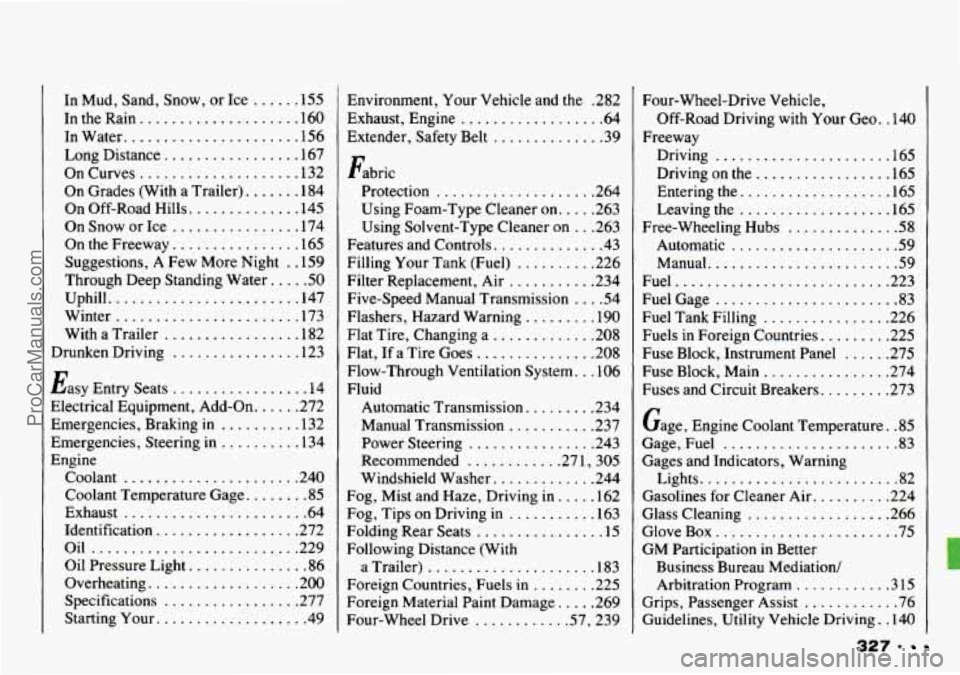
Flat Tire. Changing a
............. 208
Flat. If a Tire Goes
............... 208
Fluid Using Foam-Type
Cleaner on
..... 263
Five-Speed Manual Transmission
.... 54
Flow-Through Ventilation System
... 106
Automatic Transmission
......... 234
Manual Transmission
........... 237
Recommended
............ 27 1. 305
Windshield Washer
............. 244
Fog. Tips
on Driving in ........... 163
Folding Rear Seats
................ 15
Following Distance (With
a Trailer)
..................... 183
Foreign Countries. Fuels
in ........ 225
Four-wheel Drive
........... .57. 239
Power
Steering
................ 243
Fog. Mist and Haze. Driving
in ..... 162
Foreign Material Paint Damage
..... 269 Four-Wheel-Drive
Vehicle.
Freeway Off-Road
Driving with Your Geo
. . 140
Driving
...................... 165
Driving on the
................. 165
Entering the
................... 165
Leaving the
................... 165
Free-Wheeling Hubs
.............. 58
Automatic
..................... 59
Manual
........................ 59
Fuel
........................... 223
FuelGage
....................... 83
Fuel Tank Filling
................ 226
Fuels
in Foreign Countries ......... 225
Fuse Block. Instrument Panel
...... 275
Fuse Block. Main
................ 274
Fuses and Circuit Breakers
......... 273
Gage. Engine Coolant Temperature
. . 85
Gage. Fuel
...................... 83
Gages and Indicators. Warning
Lights
......................... 82
Gasolines for Cleaner Air
.......... 224
Glass Cleaning
.................. 266
GloveBox
....................... 75
GM Participation
in Better
Business Bureau Mediation/
Arbitration Program
............ 315
Grips. Passenger Assist
............ 76
Guidelines. Utility Vehicle Driving
. . 140
327 9
ProCarManuals.com