warning light CHEVROLET TRACKER 1993 User Guide
[x] Cancel search | Manufacturer: CHEVROLET, Model Year: 1993, Model line: TRACKER, Model: CHEVROLET TRACKER 1993Pages: 339, PDF Size: 15.75 MB
Page 165 of 339
thick, wet haze that may even coat your
windshield. You can often spot these fog
patches or mist layers with your
headlights. But sometimes they can be
waiting for you as you come over a hill
or dip into a shallow valley. Start your
windshield wipers and washer, to help
clear accumulated road dirt. Slow down
carefully.
Tips on Driving in Fog
If you get caught in fog, turn your
headlights on low beam, even in
daytime. You’ll see
- and be seen -
better. Don’t use your high beams.
The light
will bounce off the water droplets that
make up fog and reflect back at you.
Use your defogger. In high humidity,
even a light buildup of moisture on the
inside
of the glass will cut down on your
already limited visibility. Run your
windshield wipers and washer
occasionally. Moisture can build up on
the outside glass, and what seems to be
fog may actually be moisture on the
outside
of your windshield.
Treat dense
fog as an emergency. Try to
find a place to pull off the road.
Of
course you want to respect another’s property,
but you might need to put
something between you and moving
vehicles
- space, trees, telephone poles,
a private driveway, anything that
removes you from other traffic.
If visibility
is near zero and you must
stop but are unsure whether you are
away from the road, turn your lights on,
start your hazard warning flashers, and
sound your horn at intervals or when
you hear approaching traffic.
Pass other vehicles
in fog only if you
can see far enough ahead to pass safely.
Even then, be prepared to delay your
pass
if you suspect the fog is worse up
ahead. If other vehicles try to pass you,
make
it easy for them.
16399-
ProCarManuals.com
Page 166 of 339
Your Driving and the Road
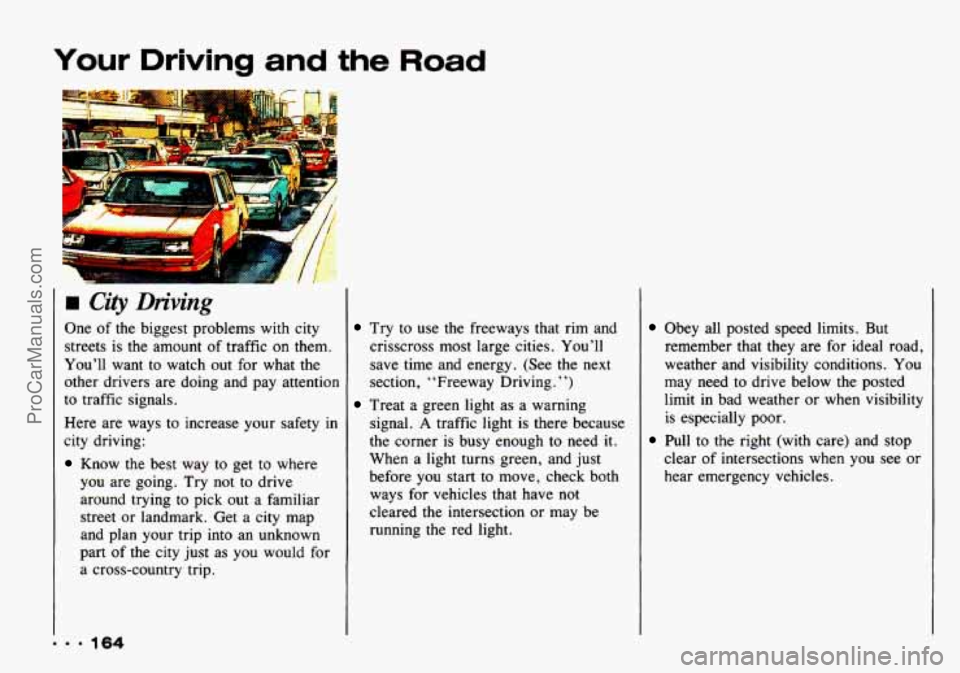
H City Dnving
... 164
One of the biggest problems with city
streets is
the amount of traffic on them.
You’ll want to watch out for what the
other drivers are doing and pay attention
to traffic signals.
Here are ways to increase your safety in
city driving:
Know the best way to get to where
you are going. Try not to drive
around trying to pick out
a familiar
street
or landmark. Get a city map
and plan your trip into an unknown
part of the city just as you
would for
a cross-country trip.
Try to use the freeways that rim and
crisscross most large cities. You’ll
save time and energy. (See the next
section, “Freeway Driving.”)
Treat a green light as a warning
signal.
A traffic light is there because
the corner is busy enough to need it.
When a light turns green, and just
before you start to move, check both
ways for vehicles that have not
cleared the intersection
or may be
running the red light.
Obey all posted speed limits.
But
remember that they are for ideal road,
weather and visibility conditions. You
may need to drive below the posted
limit in bad weather or when visibility
is especially poor.
clear of intersections when you see or
hear emergency vehicles.
Pull to the right (with care) and stop
ProCarManuals.com
Page 168 of 339
Your Driving and the Road
make sure there isn’t another vehicle in
your
‘ ‘blind’ ’ spot.
If you are moving from an outside to a
center lane on a freeway having more
than two lanes, make sure another
vehicle isn’t about to move into the
same spot. Look at the vehicles two
lanes over and watch for telltale signs:
turn signals flashing, an increase
in
speed, or moving toward the edge of the
lane. Be prepared to delay your move.
Once you are moving on the freeway,
make certain you allow a reasonable
following distance. Expect to move
slightly slower at night.
... 166
Leaving the Freeway
When you want to leave the freeway,
move to the proper lane well in
advance. Dashing across lanes at the last
minute is dangerous. If you miss your
exit do not, under any circumstances,
stop and back up. Drive on to the next
exit.
At each exit point is a deceleration lane.
Ideally it should be long enough for you
to enter
it at freeway speed (after
signaling, of course) and
then do your
braking before moving onto
the exit
ramp. Unfortunately, not all deceleration
lanes are long enough
- some are too
short for all the braking. Decide when
to start braking. If
you must brake on the through
lane, and if there is traffic
close behind you, you can allow a little
extra time and flash your brake lights (in
addition
to your turn signal) as extra
warning that you are about
to slow
down and exit.
The exit ramp can be curved, sometimes
quite sharply. The exit speed is usually
posted. Reduce your speed according to
your speedometer, not to your sense of
motion. After driving for any distance at
higher speeds,
you may tend to think
you are going slower than you actually
are. For example,
40 mph (65 km/h)
might seem like only
20 mph (30 km/h).
Obviously, this could lead to serious
trouble
on a ramp designed for
20 mph (30 km/h)!
ProCarManuals.com
Page 176 of 339
Your Driving and the Road
rn
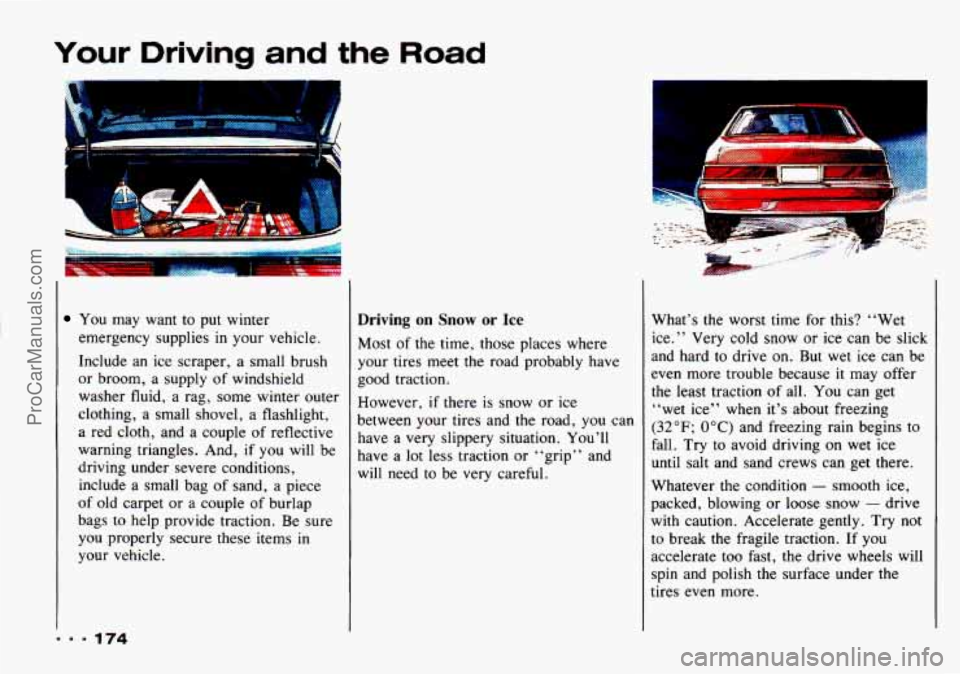
You may want to put winter
emergency supplies in your vehicle.
Include an ice scraper, a small brush
or broom, a supply of windshield
washer fluid, a rag, some winter outer
clothing, a small shovel, a flashlight,
a red cloth, and a couple of reflective
warning triangles. And, if
you will be
driving under severe conditions,
include
a small bag of sand, a piece
of old carpet or
a couple of burlap
bags to help provide traction.
Be sure
you properly secure these items
in
your vehicle.
... 174
Driving on Snow or Ice
Most of the time, those places where
your tires meet the road probably have
good traction.
However,
if there is snow or ice
between your tires and the road, you can
have a very slippery situation. You’ll
have a lot less traction or “grip” and
will need to be very careful.
t
What’s the worst time for this? “Wet
ice.
” Very cold snow or ice can be slick
and hard to drive on. But wet ice can be
even more trouble because it may offer
the least traction
of all. You can get
“wet ice” when it’s about freezing
(32°F; OOC) and freezing rain begins to
fall.
Try to avoid driving on wet ice
until salt and sand crews can get there.
Whatever the condition
- smooth ice,
packed, blowing or loose snow
- drive
with caution. Accelerate gently.
Try not
to break the fragile traction. If you
accelerate too fast, the drive wheels will
spin and polish the surface under the
tires even more.
ProCarManuals.com
Page 192 of 339
Problems on the Road
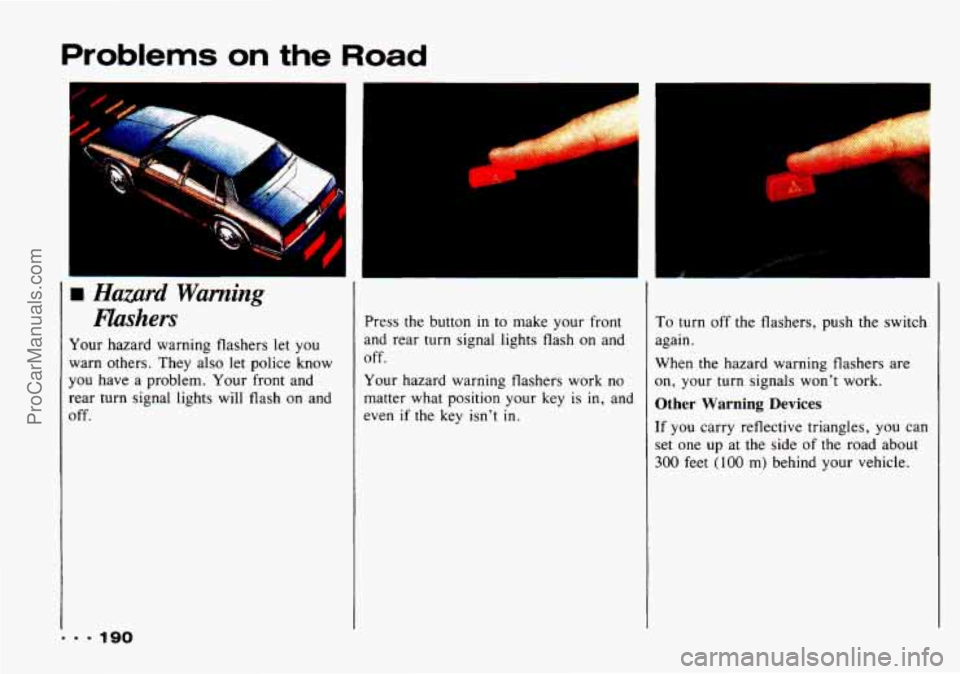
I Hazard Warning fishers
Your hazard warning flashers let you
warn others. They also let police know
you have a problem. Your front and
rear turn signal lights will flash on and
off.
Press th e button in t :o mak 'our fr 'on t
and rear turn signal lights flash on and
off.
Your hazard warning flashers work no
matter what position your key is in, and
even
if the key isn't in. To turn
again.
off the flashers,
push the switch
When the hazard warning flashers are
on, your turn signals won't work.
Other Warning Devices
If you carry reflective triangles, you can
set one up at the side
of the road about
300 feet (100 m) behind your vehicle.
ProCarManuals.com
Page 242 of 339
Service & Appearance Care
How to Check Lubricant:
If the level is below the bottom of the
filler plug hole, you’ll need to add some
lubricant.
If the differential is at operating
temperature (warm), add enough
lubricant to raise the level to the bottom
of the filler plug hole.
If the differential
is cold, add enough
lubricant to raise the level to
1/2 inch
(12 mm) below the filler plug hole.
What to Use:
Refer to the Maintenance Schedule to
determine what kind of lubricant to use.
See “Recommended Fluids and
Lubricants” in the Index.
Engine Coolant
The following explains your cooling
system and how to add coolant when it
is low. If you have a problem with
engine overheating, see “Engine
Overheating” in the Index.
The proper coolant for your Geo will:
Give freezing protection down to
Give boiling protection up to 258°F
Protect against rust and corrosion.
Help keep the proper engine
Let the warning lights work as they
-34°F (-37°C).
(125°C).
temperature. should.
What to Use:
Use a mixture of one-half clean water
(preferably distilled) and one-half
antifreeze or approved recycled coolant
that meets “GM Specification 6038M,”
which won’t damage aluminum parts.
Also use GM Engine Coolant
Supplement (sealer) with a complete
coolant change. If you use these, you
don’t need to add anything else.
ProCarManuals.com
Page 277 of 339
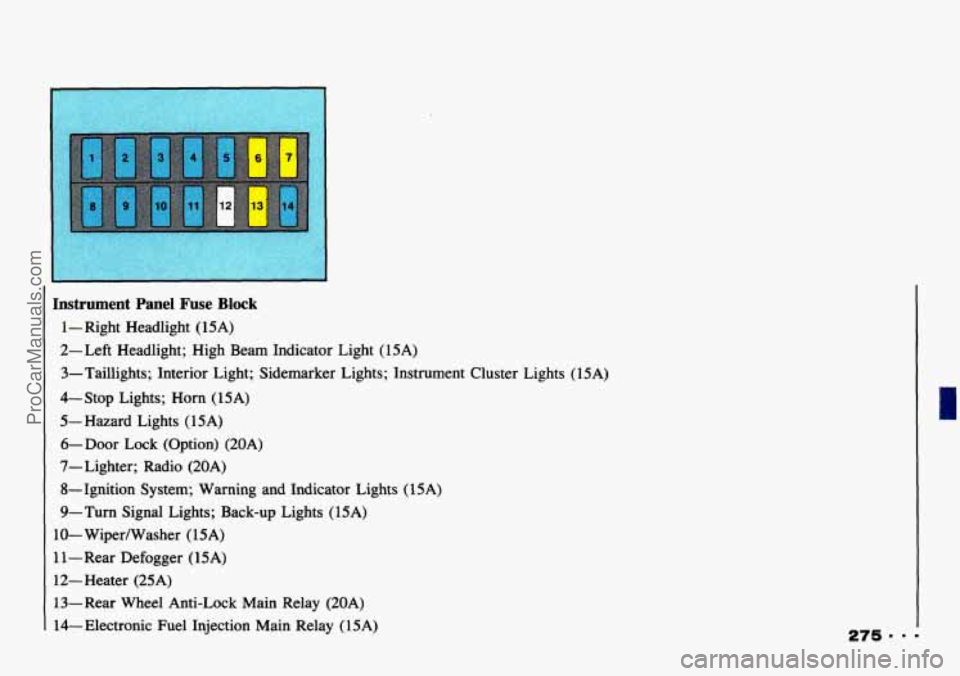
[ Instrument Panel Fuse Block
1 - Right Headlight (15A)
2- Left Headlight; High Beam Indicator Light (1 5A)
3-Taillights; Interior Light; Sidemarker Lights; Instrument Cluster Lights (15A)
4-Stop Lights; Horn (15A)
5- Hazard Lights (15A)
6-Door Lock (Option) (20A)
7- Lighter; Radio (20A)
8-Ignition System; Warning and Indicator Lights (15A)
9-Turn Signal Lights; Back-up Lights (15A)
10- Wiperwasher
(1 SA)
1 1 - Rear Defogger ( 15A)
12-Heater (25A) 13-Rear Wheel Anti-Lock Main Relay (20A)
14-Electronic Fuel Injection Main Relay (15A)
ProCarManuals.com
Page 278 of 339
Service & Appearance
I Replacement Bulbs
Care
Back-up ............................................................. 1156
Dome
............................................................. 9605 1559
Front Parking and Turn Signal
......................................... 1157 NA
Headlight (Halogen) ..................................................... 9004
Heater or Air Conditioning Control
.................................... 96052599
Charging System
................................................... 9433184
Check Engine
..................................................... 9433 184
Engineoil Pressure
................................................ 9433184
Indicator
and Warning
Brake
............................................................ 9433184
4WD
............................................................. 9433184
Headlight HighBeam
............................................... 9433184
Safety Belt
........................................................ 9433184
TurnSignal
....................................................... 9433184
Instrument Cluster
.................................................... 9605 156
License Plate
............................................................ 194
Lighter
............................................................. 9433184
Rear Defogger Switch
............................................. 96061736
Rear Wiper/Washer Switch
........................................... 9606 1736
Rear
Hazard and Turn Signal
........................................... 1156
Rear Parking andstop
................................................... 1157
Sidemarker
................................................. ........ 194
9 - 276
ProCarManuals.com
Page 306 of 339
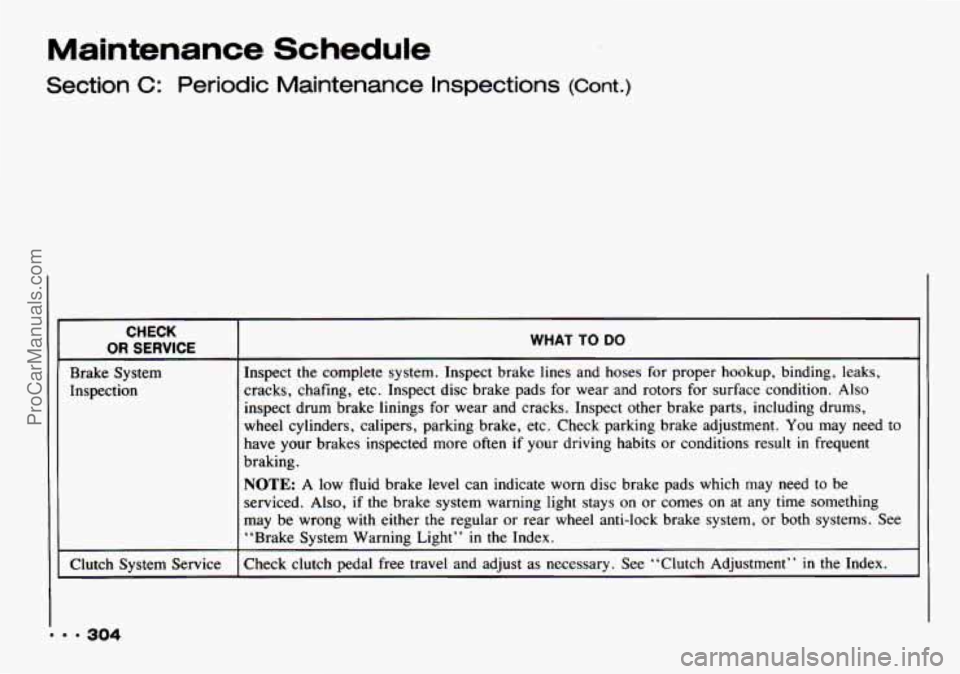
Maintenance Schedule
Section C: Periodic Maintenance Inspections (Cont.)
CHECK
OR SERVICE
Brake System
Inspection
Clutch System Service
~
WHAT TO DO
Inspect the complete system. Inspect brake lines and hoses for proper hookup, binding, leaks,
cracks, chafing, etc. Inspect disc brake pads for wear and rotors for surface condition.
Also
inspect drum brake linings for wear and cracks. Inspect other brake parts, including drums,
wheel cylinders, calipers, parking brake, etc. Check parking brake adjustment.
You may need to
have your brakes inspected more often if your driving habits or conditions result in frequent
braking.
NOTE: A low fluid brake level can indicate worn disc brake pads which may need to be
serviced. Also,
if the brake system warning light stays on or comes on at any time something
may be wrong with either the regular or rear wheel anti-lock brake system, or both systems. See
“Brake Svstem Warning Light” in the Index.
Check clutch pedal free travel and adjust as necessary. See “Clutch Adjustment”
in the Index.
ProCarManuals.com
Page 327 of 339
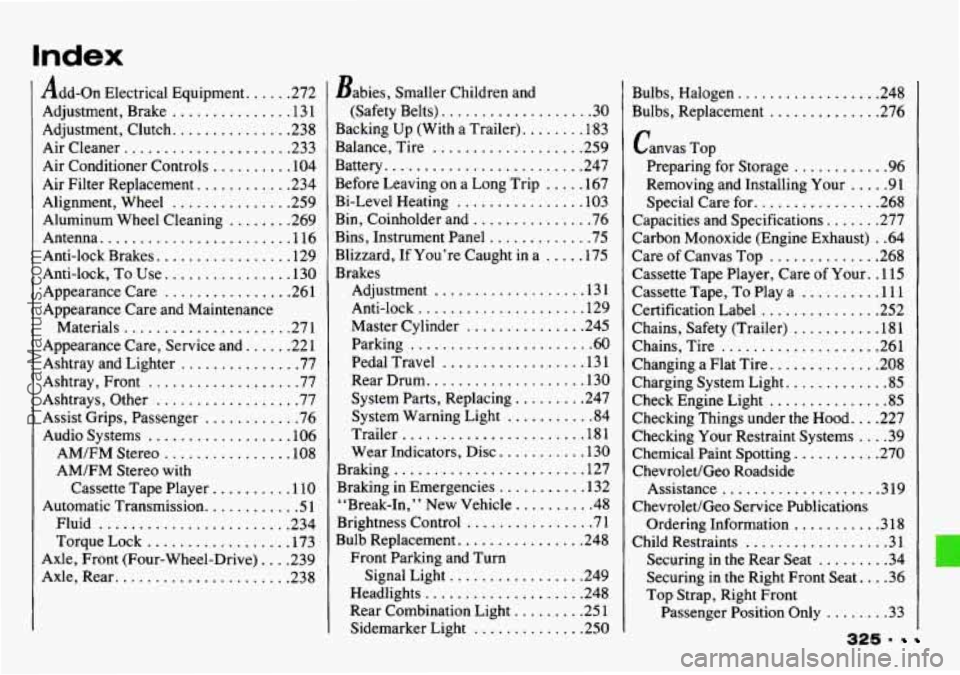
Index
Add-on Electrical Equipment ...... 272
Adjustment. Brake
............... 13 1
Adjustment. Clutch
............... 238
Air Cleaner
..................... 233
Air Conditioner Controls
.......... 104
Air Filter Replacement
............ 234
Alignment. Wheel
............... 259
Aluminum Wheel Cleaning
........ 269
Antenna
........................ 116
Anti-lock Brakes
................. 129
Anti-lock. To Use
................ 130
Appearance Care
................ 26 1
Appearance Care and Maintenance
Materials
..................... 27 1
Appearance Care. Service and
...... 22 1
Ashtray. Front ................... 77
Assist Grips. Passenger
............ 76
Audio Systems
.................. 106
AM/FM Stereo
................ 108
AM/FM Stereo with
Cassette Tape Player
.......... 110
Automatic Transmission
............ 5 1
Fluid ........................ 234
TorqueLock
.................. 173
Axle. Front (Four-Wheel-Drive)
.... 239
Axle, Rear
...................... 238
Ashtray and
Lighter
............... 77
Ashtrays, Other
.................. 77
Babies. Smaller Children and
(Safety Belts)
................... 30
Backing Up (With a Trailer)
........ 183
Balance. Tire
................... 259
Battery
......................... 247
Bi-Level Heating
................ 103
Bin. Coinholder and
............... 76
Bins. Instrument Panel
............. 75
Brakes
Before Leaving on a Long
Trip
..... 167
Blizzard. If You’re Caught
in a ..... 175
Adjustment
.................. -13 1
Anti-lock
..................... 129
Master Cylinder
............... 245
Parking
....................... 60
PedalTravel
.................. 131
Rear Drum
.................... 130
System Parts. Replacing
......... 247
System Warning Light
........... 84
Trailer
....................... 18 1
Wear Indicators. Disc
........... 130
Braking ........................ 127
Braking in Emergencies
........... 132
“Break-In.
.. New Vehicle .......... 48
Brightness Control
................ 7 1
Bulb Replacement ................ 248
Front Parking and Turn
Signal Light
................. 249
Headlights
.................... 248
Sidemarker Light
.............. 250
Rear Combination Light
......... 25
1 Bulbs. Halogen
.................. 248
Bulbs. Replacement
.............. 276
Canvas TOP
Preparing for Storage
............ 96
Removing and Installing Your
..... 91
Special Care
for ................ 268
Carbon Monoxide (Engine Exhaust)
. . 64
Care of Canvas Top
.............. 268
Cassette Tape Player. Care of Your
. . 115
Cassette Tape. To Play a
.......... 111
Certification Label
............... 252
Chains. Safety (Trailer)
........... 181
Chains. Tire
.................... 261
Changing a Flat Tire
.............. 208
Charging System Light
............. 85
Check Engine Light
............... 85
Capacities
and Specifications
....... 277
Checking Things under the Hood
.... 227
Checking Your Restraint Systems
.... 39
Chemical Paint Spotting ........... 270
Chevrolet/Geo Roadside
Assistance
.................... 319
Chevrolet/Geo Service Publications
Ordering Information
........... 318
Child Restraints
.................. 31
Securing in the Rear Seat
......... 34
Securing in the Right Front Seat .... 36
Top Strap. Right Front
Passenger Position Only
........ 33
325 .
ProCarManuals.com