brakes CHEVROLET TRACKER 1993 Owner's Manual
[x] Cancel search | Manufacturer: CHEVROLET, Model Year: 1993, Model line: TRACKER, Model: CHEVROLET TRACKER 1993Pages: 339, PDF Size: 15.75 MB
Page 171 of 339
What can you do about highway
hypnosis? First, be aware that it can
happen.
Then here are some tips:
Make sure your vehicle is well
ventilated, with a comfortably cool
interior.
Keep your eyes moving. Scan the
road ahead and to the sides. Check
your rearview mirrors frequently and
your instruments from time
to time.
This can help you avoid a fixed stare.
Wear good sunglasses in bright light.
Glare can cause drowsiness. But don’t
wear sunglasses at night. They will drastically reduce your overall
vision
at the very time you need all the
seeing power you have.
If you get sleepy, pull off the road
into a rest, service or parking area
and take a nap, get some exercise, or
both. For safety, treat drowsiness on
the highway as an emergency.
As in any driving situation, keep pace
with traffic and allow adequate
following distances.
--
A
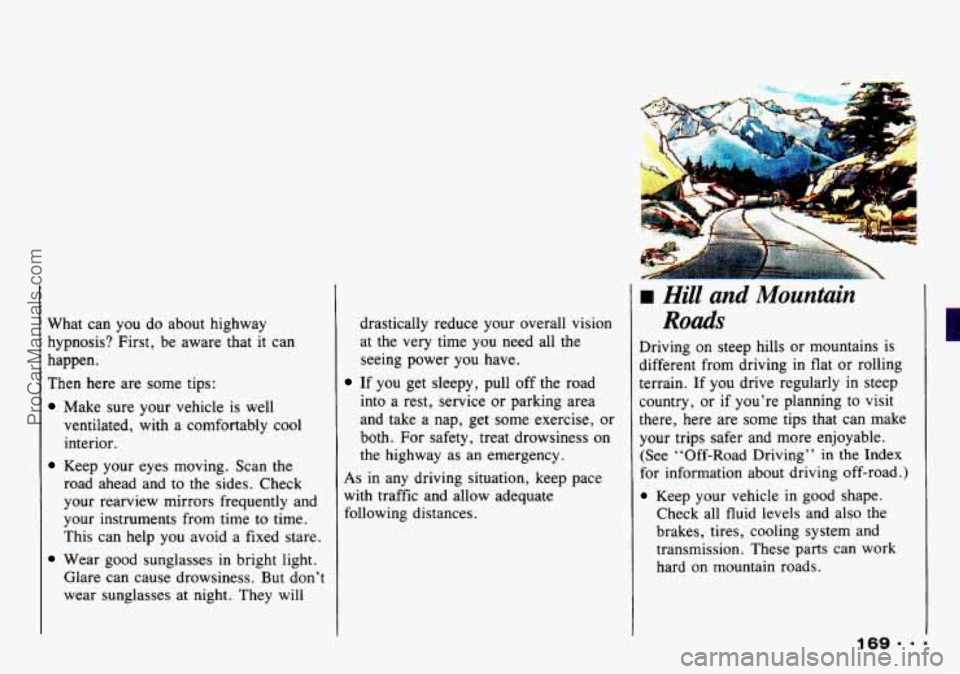
Driving on steep hills or mountains is
different from driving in flat or rolling
terrain. If you drive regularly
in steep
country, or if you’re planning
to visit
there, here are some tips that can make
your trips safer and more enjoyable.
(See “Off-Road Driving’’
in the Index
for information about driving off-road.)
Keep your vehicle in good shape.
Check all fluid levels and also the
brakes, tires, cooling system and
transmission. These ‘parts can work
hard on mountain roads.
ProCarManuals.com
Page 172 of 339
Your Driving and the Road
Know how to go down hills. The
most important thing to know is this:
let your engine do some
of the
slowing down. Don’t make your
brakes do it all. Shift to a lower gear
when you
go down a steep or long
hill. That way,
you will slow down
without excessive use
of your brakes.
CA UT/ON
A
If you don’t shift down, your
brakes could get
so hot that
they wouldn’t work well.
You
would then have poor braking or
even none going down a hill. You
could crash. Shift down
to let your
engine assist your brakes on a steep downhill slope.
A Coasting downhill in N
r - a (Neutral) or with the ignition
off is dangerous. Your brakes will
have to do all the work
of slowing
down. They could get
so hot that
they wouldn’t work well. You
could crash. Always have your
engine running and your vehicle in
gear when you
go downhill.
... 170
ProCarManuals.com
Page 177 of 339
Your anti-lock brakes improve your
ability to make a hard stop on a slippery
road. Even though you have the
anti-lock braking system, you’ll want to
begin stopping sooner than you would
on dry pavement. See “Anti-lock” in
the Index.
Allow greater following distance on any
slippery road.
Watch for slippery spots. The road
might be fine until
you hit a spot
that’s covered with ice. On an
otherwise clear road, ice patches may
appear
in shaded areas where the sun
can’t reach: around clumps of trees,
behind buildings, or under bridges. Sometimes the
surface
of a curve or
an overpass may remain icy
when the
surrounding roads are clear. If you
see a patch
of ice ahead of you, brake
before you are on it. Try not to brake
while you’re actually on the ice, and
avoid sudden steering maneuvers.
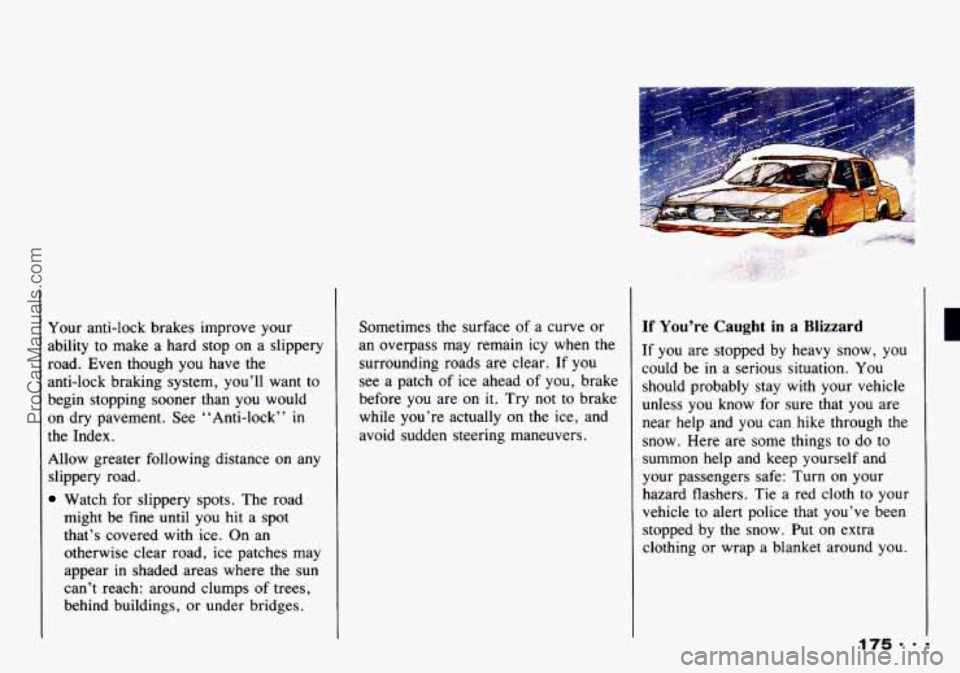
If You’re Caught in a Blizzard
If you are stopped by heavy snow, you
could be
in a serious situation. You
should probably stay with your vehicle
unless you know for sure that you are
near help and you can hike through the
snow. Here are some things to do to
summon help and keep yourself and
your passengers safe: Turn on your
hazard flashers. Tie a red cloth to your
vehicle to alert police that you’ve been
stopped by the snow. Put on extra
clothing or wrap a blanket around you.
ProCarManuals.com
Page 183 of 339
(CO) from your exhaust can get into
your vehicle (see “Carbon
Monoxide’’
in the Index). Dirt and
water can, too.
The bumpers on your vehicle are not
intended for hitches.
Do not attach
rental hitches or other bumper-type
hitches to them. Use only a
frame-mounted hitch that does
not
attach to the bumper.
Safety Chains
You should always attach chains
between your vehicle and your trailer.
Cross the safety chains under the tongue
of
the trailer so that the tongue will not
drop to
the road if it becomes separated
from
the hitch. Instructions about safety
chains may be provided by
the hitch
manufacturer or by the trailer
manufacturer. Follow
the manufacturer’s
recommendation for attaching safety
chains. Always leave just enough slack
so you can turn with your rig. And,
never allow safety chains to drag
on the
ground.
Trailer Brakes
If your trailer weighs more than 1,000
pounds (450 kg) loaded, then it needs its
own brakes
- and they must be
adequate. Be sure
to read and follow the
instructions for the trailer brakes
so
you’ll be able to install, adjust and
maintain them properly.
Don’t tap into your vehicle’s brake
system if the trailer’s brake system
will use more than
0.02 cubic inch
(0.3 cc) of fluid from your vehicle’s
master cylinder. If
it does, both
braking systems won’t work well.
You could even lose your brakes.
ProCarManuals.com
Page 184 of 339
Your Driving and the Road
Will the trailer brake parts take
3,000 psi (20 650 kPa) of pressure? If
not, the trailer brake system must not
be used with your vehicle.
If everything checks out this far, then
make the brake fluid tap at the port
on the master cylinder that sends fluid
to the rear brakes. But don’t use
copper tubing
for this. If you do, it
will bend and finally break off. Use
steel brake tubing.
88. 182
Driving With a Trailer
Towing a trailer requires a certain
amount
of experience. Before setting out
for the open road, you’ll want to get to
know your rig. Acquaint yourself with
the feel of handling and braking with the
added weight
of the trailer. And always
keep in mind that the vehicle you are
driving is now a good deal longer and
not nearly
so responsive as your vehicle
is by itself. Before you
start, check
the trailer hitch
and platform, safety chains, electrical
connector, lights, tires and mirror
adjustment. If the trailer has electric
brakes, start your vehicle and trailer
moving and then apply the trailer brake
controller by hand to be sure the brakes
are working. This lets you check your
electrical connection at the same time.
During your trip, check occasionally to
be sure that the load is secure, and that
the lights and any trailer brakes are still
working.
ProCarManuals.com
Page 186 of 339
Your Driving and the Road
they are not. It’s important to check
occasionally to be sure the trailer bulbs
are still working.
Driving on Grades
Reduce speed and shift to a lower gear
before you start down a long or steep
downgrade. If you don’t shift down, you
might have to use your brakes
so much
that they would get hot and no longer
work well.
On a long uphill grade, shift down and
reduce your speed
to around 45 mph
(70 km/h) to reduce the possibility of
engine and transmission overheating.
If your trailer weighs more than 1,000
pounds
(450 kg), and you have a manual
transmission with fifth gear, it’s better
not to use fifth gear. Just drive
in fourth
gear (or, as you need to, a lower gear).
Parking on Hills
You really should not park your vehicle,
with a trailer attached, on a hill. If
something goes wrong, your rig could
start to move. People can be injured,
and both your vehicle and the trailer can
be damaged.
But
if you ever have to park your rig on
a hill, here’s how to do
it:
1. Apply your regular brakes, but don’t shift into
P (Park)
yet, or into gear
for a manual transmission.
the trailer wheels.
2. Have someone place chocks under
3. When the wheel chocks are in place,
release the regular brakes until the
chocks absorb the load.
apply your parking brake, and then
shift
to P (Park), or R (Reverse) for
a manual transmission.
vehicle, be sure the transfer case is
in a drive gear - not in N (Neutral).
4. Reapply the regular brakes. Then
5. If you have a four-wheel-drive
... 184
ProCarManuals.com
Page 187 of 339
J
It be dangerous tu get out
of your vehicle if the shift lever
is not fully in P (Park) with the
parking brake firmly set.
If you have left the engine running,
the veficle can
move suddenly. You
or others could be injured. To be
sure your vehicle won’t move, when
you’re
on fairly level ground, use
the steps that follow.
If you have four-wheel drive, and
your transfer
case is in N (NeutraI) ,
your vehicle will be free to roll,
even
if your shift lever is in
P (Park). So, be sure the transfer
case is in a drive gear - not in
N (Neutral).
If you are parking on a hill, or if
you’re pulling a trailer; also see
“Parking On Hills” in the Index.
6. Release the regular brakes.
When You Are Ready to Leave after
Parking on a
Hill
1. Apply your regular brakes and hold
the pedal down while you:
Start your engine;
Shift into a gear; and
Release the parking brake.
2. Let up on the brake pedal.
3. Drive slowly until the trailer is clear
4. Stop and have someone pick up and
of the chocks.
store
the chocks.
Maintenance When Trailer Towing
Your vehicle will need service more
often when you’re pulling a trailer.
See
the Maintenance Schedule for more on
this. Things that are especially important
in trailer operation are automatic
transmission fluid (don’t overfill),
engine oil, axle lubricant, belts, cooling
system, and brake adjustment. Each
of
these is covered in this manual, and the
Index will help you find them quickly.
If
you’re trailering, it’s a good idea to
review these sections before you start
your trip.
Check periodically
to see that all hitch
nuts and bolts are tight.
185 9 =
ProCarManuals.com
Page 247 of 339
x
NO TIC€
When using concentrated wash fluid, follow the manufacturer‘
instructions for adding water.
ready-to-use washer fluid. Water can cause the solution to freeze
and damage your washer fluid
tank and other parts of the
washer system. Also, water
doesn’t clean as well as washer
fluid.
Fill your
I. -;her fl--- tank onl.
314 full when it’s very cold.
’his allows for expansion.
Don’t mix water with
it is completely full.
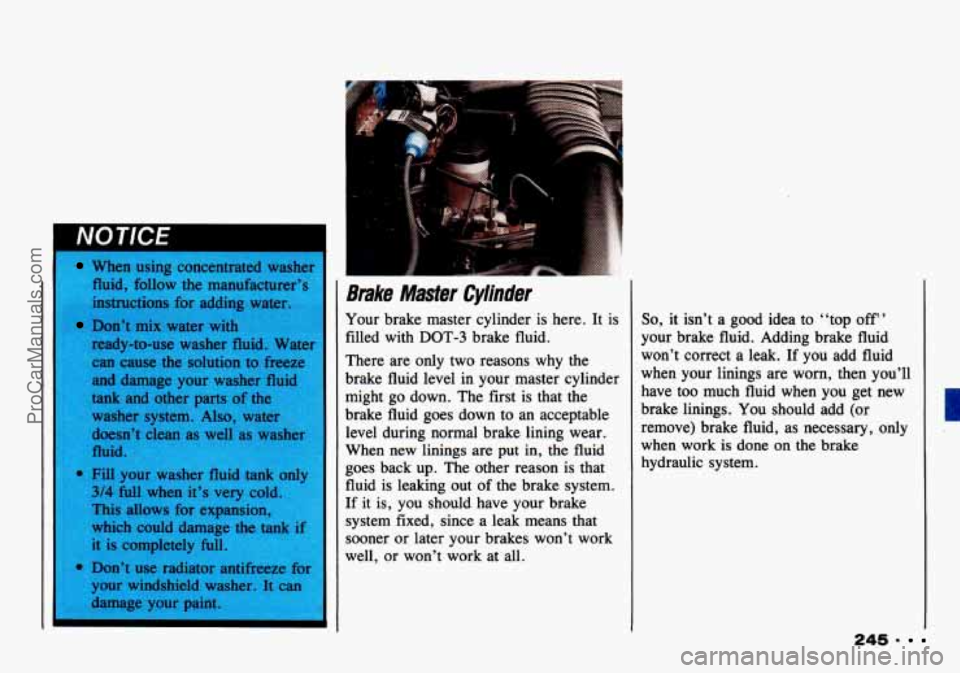
Brake Master Cylinder
Your brake master cylinder is here. It is
filled with DOT-3 brake fluid.
There are only two reasons why the
brake fluid level in your master cylinder
might go down. The first is that the
brake fluid goes down
to an acceptable
level during normal brake lining wear.
When new linings are put
in, the fluid
goes back up. The other reason is that
fluid is leaking out
of the brake system.
If it is, you should have your brake
system fixed, since a leak means that
sooner or later your brakes won’t work
well, or won’t work at
all.
So, it isn’t a good idea to “top ofr ’
your brake fluid. Adding brake fluid
won’t correct a leak.
If you add fluid
when your linings are worn, then you’ll
have too much fluid when you get new
brake linings. You should add (or
remove) brake fluid, as necessary, only
when work is done
on the brake
hydraulic system.
245 -
ProCarManuals.com
Page 249 of 339
Replacing Brake System Parts
The braking system on a modern vehicle
is complex. Its many parts have to be of
top quality and work well together if the
vehicle is to have really good braking.
Vehicles we design and test have
top-quality
GM brake parts in them, as
your Geo does when it is new. When
you replace parts of your braking system
- for example, when your brake linings
wear down and you have to have new
ones put in
- be sure you get new
genuine GM replacement parts. If you
don’t, your brakes may
no longer work
properly. For example, if someone puts
in brake linings that are wrong for your
vehicle, the balance between your front
and rear brakes can change,
for the
worse. The braking performance you’ve
come to expect can change in many
other ways if someone puts in the wrong
replacement brake parts.
Battery
Every new Geo has a Delco Freedom@
battery.
You never have to add water to
one of these. When it’s time for a new
battery, we recommend a Delco
Freedom@ battery. Get one that has the
catalog number shown on the original
battery’s label.
Vehicle Storage
If you’re not going to drive your vehicle
for
25 days or more, take off the black,
negative
(-) cable from the battery.
This will help keep your battery from
running down.
ProCarManuals.com
Page 299 of 339
5
6
Brakes - Tire rotations are a convenient
opportunity
to inspect the braking system. See
“Brake System Inspection”
in Section C.
Locking Front Hubs Inspection (If Equipped) -
At each oil change, inspect the locking front hubs
for correct operation. Repair or replace
if necessary.
(Both hubs must operate correctly for the front axle
to power
the front wheels.)
7 Steering and Suspension - At each oil change,
inspect the steering linkage and suspension for leaks
and damage. Repair or replace damaged or worn
parts.
ProCarManuals.com