brake CHEVROLET TRACKER 1993 Owner's Guide
[x] Cancel search | Manufacturer: CHEVROLET, Model Year: 1993, Model line: TRACKER, Model: CHEVROLET TRACKER 1993Pages: 339, PDF Size: 15.75 MB
Page 151 of 339
If your engine has stopped running,
you’ll need to restart
it. With the
brake pedal depressed and the
parking brake still applied, shift the
transmission
to P (Park) (or, shift to
Neutral if your vehicle has a
manual transmission) and restart the
engine. Then, shift to reverse,
release the parking brake, and
slowly back down the hill in
reverse.
As you are backing down the hill,
put your
left hand on the steering
wheel at the
12 o’clock position.
This way, you’ll be able
to tell if
your wheels are straight or turned to
the left or right as you back down. Here
are some things you
must not do
if you stall, or are about to stall, when
going up
a hill.
Never attempt to prevent a stall by
shifting into
N (Neutral) (or
depressing the clutch, if you have a
manual transmission)
to “rev-up” the
engine and regain forward
momentum. This won’t work. Your
vehicle will roll backwards very
quickly and you could go out of
control.
Instead, apply the regular brake to stop
the vehicle. Then apply the parking
brake. Shift into reverse, release the
parking brake, and slowly back down.
Never attempt to turn around if you
are about to stall when going up a
hill.
If the hill is steep enough to
stall your vehicle, it’s steep enough
to cause you to roll over if you turn
around. If you can’t make it up the
hill, you must back down the hill.
Q: Suppose, after stalling, I try to
back down the hill and decide
I
just can’t do it. What should I do?
A: Set the parking brake, put your
transmission
in P (Park) (or the
ProCarManuals.com
Page 152 of 339
Your Driving and the Road
manual transmission in first gear),
and turn off the engine. Leave the
vehicle and
go get some help. Exit
on the uphill side and stay clear of
the path the vehicle would take if it
rolled downhill.
Do not shift the
transfer case to
N (Neutral) when
you leave the vehicle. Leave it in
some gear.
A
Shifting the transfer case to
N (Neutral) can cause your
vehicle to roll even if the
transmission is in
P (Park) (or, if
you have the manual transmission,
even if you’re in gear). This is
because the
N (Neutral) position
on the transfer case overrides the
transmission.
If you are going to
leave your vehicle, set the parking
brake and shift the transmission to
P (Park) (or, put your manual
transmission in first gear). But
do I
not shift the transfer case to the N
(Neutral) position. Leave the
transfer case
in the 2H, 4H, or 4L I position.
Driving Downhill
When off-roading takes you downhill,
you’ll want to consider
a number of
things:
How steep is the downhill? Will I b
able to maintain vehicle control?
What’s the surface like? Smooth?
Rough? Slippery? Hard-packed dirt?
Gravel?
Are there hidden surface obstacles?
Ruts? Logs? Boulders?
What’s at the bottom of the hill? Is
there a hidden creek bank or even a
river bottom with large rocks?
ProCarManuals.com
Page 153 of 339
If you decide you can go down a hill
safely, then try to keep your vehicle
headed straight down, and use a low
gear. This way, engine drag can help
your brakes and they won’t have to do
all the work. Descend slowly, keeping
your vehicle under control at all times.
A
Heavy braking when going
down a hill can cause your
brakes to overheat and fade. This
could cause loss of control and a
serious accident. Apply the brakes
lightly when descending a hill and
use
a low gear to keep vehicle
speed under control.
Q:
A:
0
0
Are there some things I should not
do when driving down a hill?
Yes! These are important because if
you ignore them you could lose
control and have a serious accident.
When driving downhill, avoid turns
that take you across the incline
of
the hill. A hill that’s not too steep to
drive down may be too steep to
drive across. You could roll over if
you don’t drive straight down.
Never go downhill with the
transmission in
Neutral, or with the
clutch pedal depressed in a manual
shift. This is called
ProCarManuals.com
Page 154 of 339
Your Driving and the Road
e
“free-wheeling. ” Your brakes will
have to do all the work and could
overheat and fade.
Avoid braking
so hard that you lock
the wheels when going downhill. If
your front wheels are locked, you
can’t steer your vehicle. If your
wheels lock up during downhill
braking, you may feel the vehicle
starting to slide sideways.
To regain
your direction, just ease off the
brakes and steer to keep the front of
the vehicle pointing straight
downhill.
Q: Am I likely to stall when going
A:
0
e
downhill?
It’s much more likely to happen
going uphill. But if
it happens going
downhill, here’s what to do.
Stop your vehicle by applying
the
regular brakes. Apply the parking
brake.
Shift to
P (Park) (or to Neutral with
the manual transmission) and, while
still braking, restart the engine.
Shift back to a low gear, release
the
parking brake, and drive straight
down.
If the engine won’t start, get out and
Driving Across an Incline
Sooner or later, an off-road trail will
probably go across
the incline of a hill.
If this happens, you have to decide
whether to try to drive across the
incline. Here are some things to
consider:
A hill that can be driven straight up
or down may be too steep to drive
across. When you go straight up or
down a hill, the length of the wheel
base (the distance from the front
wheels to the rear wheels) reduces
the likelihood the vehicle will get
help.
... 152
ProCarManuals.com
Page 158 of 339
Your Driving and the Road
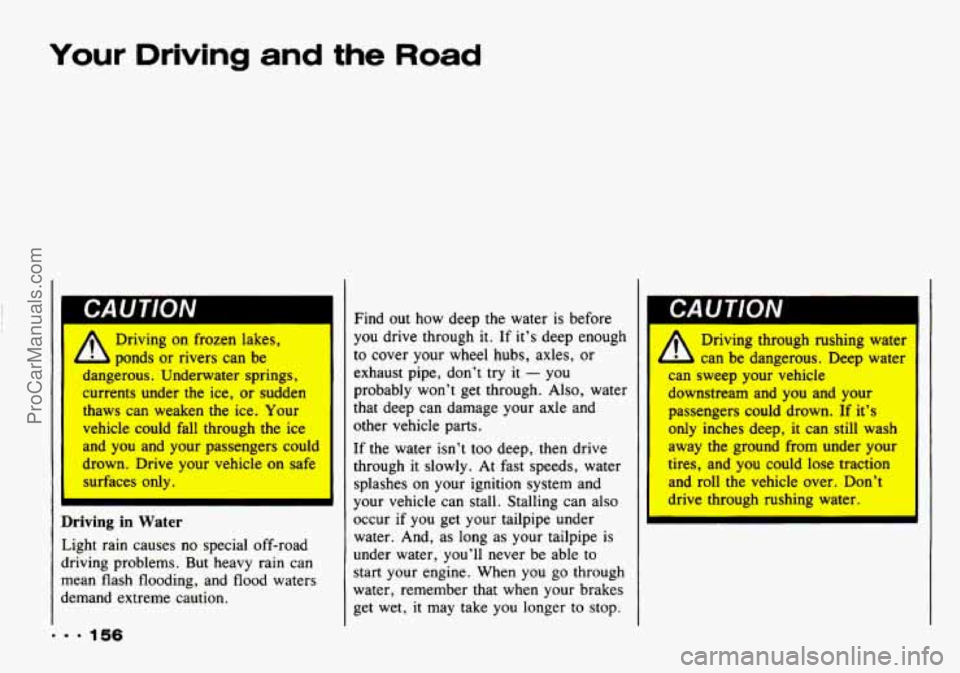
I CAUTION
A
Driving on frozen lakes,
ponds or rivers can be
dangerous. Underwater springs,
currents under the ice, or sudden
thaws can weaken
the ice. Your
vehicle could fall through
the ice
and you and your passengers could
drown. Drive your vehicle
on safe
surfaces only.
I CAUTION
)riving in Water
ight rain causes no special off-road
riving problems. But heavy rain can
lean flash flooding, and flood waters
emand extreme caution. Find
out how deep the water is before
you drive through it. If it’s deep enough
to cover your wheel hubs, axles, or
exhaust pipe, don’t
try it - you
probably won’t get through.
Also, water
that deep can damage your axle and
other vehicle parts.
If the water isn’t too deep, then drive
through it slowly. At fast speeds, water
splashes on your ignition system and
your vehicle can stall. Stalling can also
occur
if you get your tailpipe under
water. And, as long as your tailpipe is
under water, you’ll never be able to
start your engine. When you go through
water, remember that when your brakes
get wet,
it may take you longer to stop.
’ Driving through rushing water
- can be dangerous. Deep water
-m sweep your vehicle
downstream and you and your
passengers could drown. If it’s
only inches deep, it can still wash
away the ground from under your
tires, and you could lose traction
and roll the vehicle over. Don’t
drive through rushing water.
... 156
ProCarManuals.com
Page 159 of 339
After Off-Road Driving
Remove any brush or debris that has
collected on the underbody, chassis or
under the hood. These accumulations
can be a fire hazard.
After operation in mud or sand, have the
brake linings cleaned and checked.
These substances can cause glazing and
uneven braking. Check the body
structure, steering, suspension, wheels,
tires, and exhaust system for damage.
Also, check the fuel lines and cooling
system for any leakage.
Your vehicle will require more frequent
service due to off-road use. Refer
to the
Maintenance Schedule for additional
information.
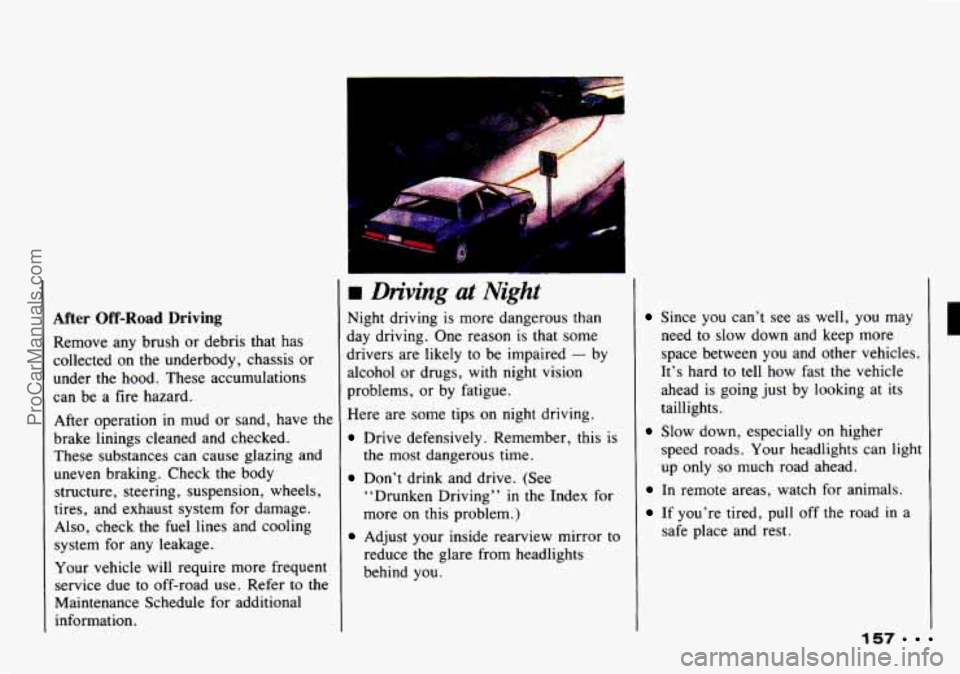
rn Driving at Night
Night driving is more dangerous than
day driving. One reason is that some
drivers are likely to be impaired
- by
alcohol or drugs, with night vision
problems, or by fatigue.
Here are some tips
on night driving.
Drive defensively. Remember, this is
the most dangerous time.
Don’t drink and drive. (See
“Drunken Driving” in the Index for
more on this problem.)
Adjust your inside rearview mirror to
reduce the glare from headlights
behind you.
Since you can’t see as well, you may
need to slow down and keep more
space between you and other vehicles.
It’s hard to tell how fast the vehicle
ahead is going just by looking at its
taillights.
Slow down, especially on higher
speed roads.
Your headlights can light
up only so much road ahead.
In remote areas, watch for animals.
If you’re tired, pull off the road in a
safe place and rest.
157
ProCarManuals.com
Page 162 of 339
Your Driving and the Road
I
*. ’ i
... 160
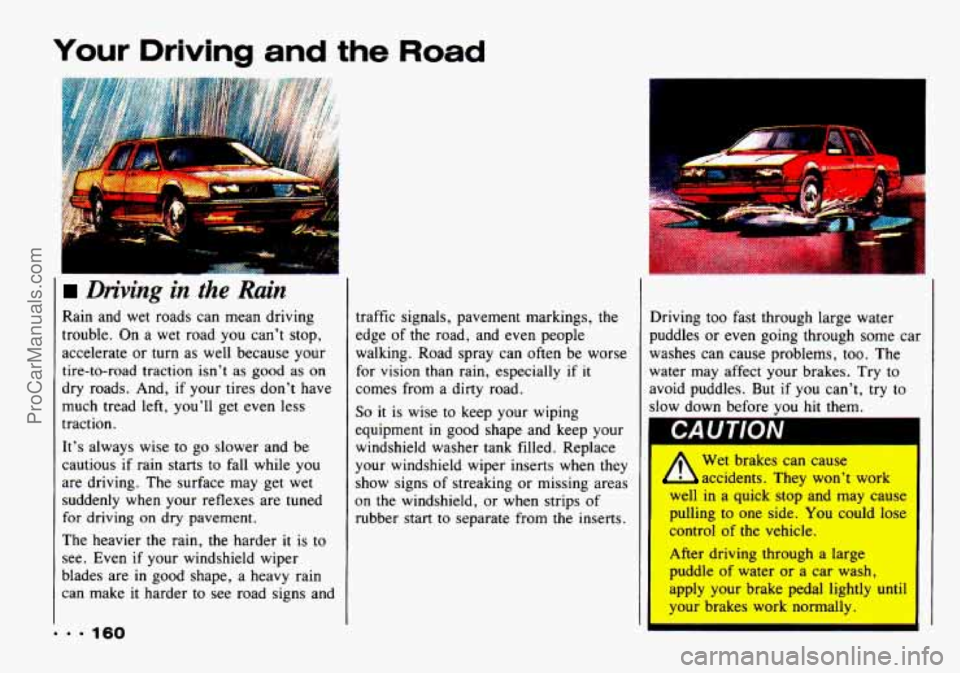
Driving in the Rain
Rain and wet roads can mean driving
trouble. On
a wet road you can’t stop,
accelerate or turn as well because your
tire-to-road traction isn’t as good as on
dry roads. And,
if your tires don’t have
much tread
left, you’ll get even less
traction.
It’s always wise to go slower and be
cautious
if rain starts to fall while you
are driving. The surface may get wet
suddenly when your reflexes are tuned
for driving on dry pavement.
The heavier the rain, the harder
it is to
see. Even if your windshield wiper
blades are
in good shape, a heavy rain
can make it harder to see road signs and traffic signals,
pavement markings, the
edge of the road, and even people
walking. Road spray can often be worse
for vision than rain, especially if
it
comes from a dirty road.
So it is wise to keep your wiping
equipment
in good shape and keep your
windshield washer tank filled. Replace
your windshield wiper inserts when they
show signs of streaking or missing areas
on the windshield, or when strips of
rubber start to separate from the inserts. Driving too
fast through large water
puddles or
even going through some car
washes can cause problems, too. The
water may affect your brakes. Try to
avoid puddles. But if you can’t, try to
slow down before
you hit them.
I A Wet brakes can cause
- accidents. They won’t work
well
in a quick stop and may cause
pulling to one side.
You could lose
control of the vehicle.
After driving through a large
puddle of water or a car wash,
apply your brake pedal lightly until
your brakes work normally.
ProCarManuals.com
Page 168 of 339
Your Driving and the Road
make sure there isn’t another vehicle in
your
‘ ‘blind’ ’ spot.
If you are moving from an outside to a
center lane on a freeway having more
than two lanes, make sure another
vehicle isn’t about to move into the
same spot. Look at the vehicles two
lanes over and watch for telltale signs:
turn signals flashing, an increase
in
speed, or moving toward the edge of the
lane. Be prepared to delay your move.
Once you are moving on the freeway,
make certain you allow a reasonable
following distance. Expect to move
slightly slower at night.
... 166
Leaving the Freeway
When you want to leave the freeway,
move to the proper lane well in
advance. Dashing across lanes at the last
minute is dangerous. If you miss your
exit do not, under any circumstances,
stop and back up. Drive on to the next
exit.
At each exit point is a deceleration lane.
Ideally it should be long enough for you
to enter
it at freeway speed (after
signaling, of course) and
then do your
braking before moving onto
the exit
ramp. Unfortunately, not all deceleration
lanes are long enough
- some are too
short for all the braking. Decide when
to start braking. If
you must brake on the through
lane, and if there is traffic
close behind you, you can allow a little
extra time and flash your brake lights (in
addition
to your turn signal) as extra
warning that you are about
to slow
down and exit.
The exit ramp can be curved, sometimes
quite sharply. The exit speed is usually
posted. Reduce your speed according to
your speedometer, not to your sense of
motion. After driving for any distance at
higher speeds,
you may tend to think
you are going slower than you actually
are. For example,
40 mph (65 km/h)
might seem like only
20 mph (30 km/h).
Obviously, this could lead to serious
trouble
on a ramp designed for
20 mph (30 km/h)!
ProCarManuals.com
Page 171 of 339
What can you do about highway
hypnosis? First, be aware that it can
happen.
Then here are some tips:
Make sure your vehicle is well
ventilated, with a comfortably cool
interior.
Keep your eyes moving. Scan the
road ahead and to the sides. Check
your rearview mirrors frequently and
your instruments from time
to time.
This can help you avoid a fixed stare.
Wear good sunglasses in bright light.
Glare can cause drowsiness. But don’t
wear sunglasses at night. They will drastically reduce your overall
vision
at the very time you need all the
seeing power you have.
If you get sleepy, pull off the road
into a rest, service or parking area
and take a nap, get some exercise, or
both. For safety, treat drowsiness on
the highway as an emergency.
As in any driving situation, keep pace
with traffic and allow adequate
following distances.
--
A
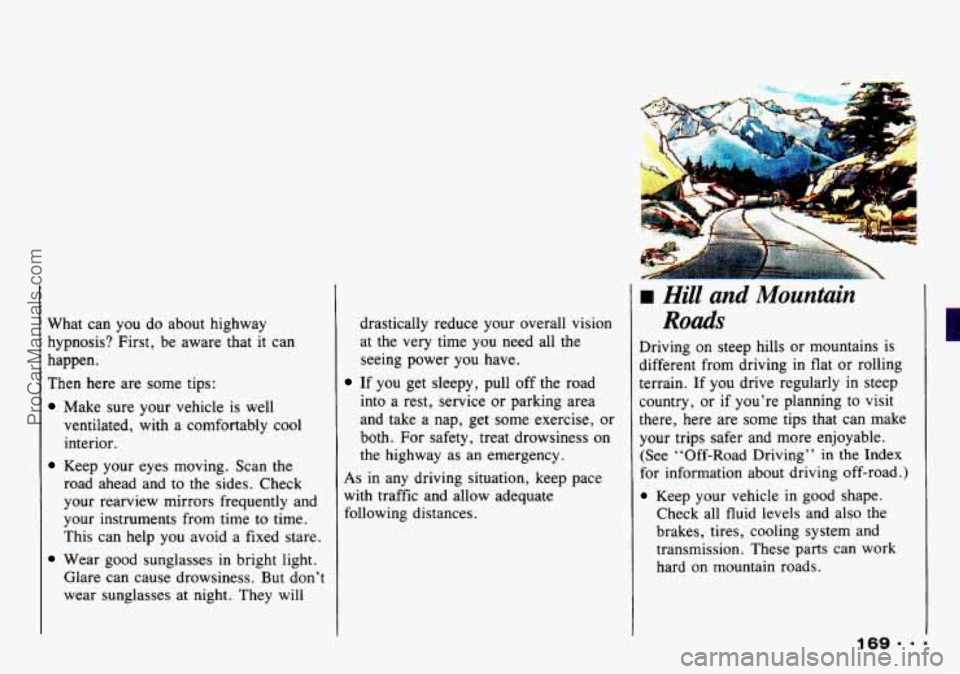
Driving on steep hills or mountains is
different from driving in flat or rolling
terrain. If you drive regularly
in steep
country, or if you’re planning
to visit
there, here are some tips that can make
your trips safer and more enjoyable.
(See “Off-Road Driving’’
in the Index
for information about driving off-road.)
Keep your vehicle in good shape.
Check all fluid levels and also the
brakes, tires, cooling system and
transmission. These ‘parts can work
hard on mountain roads.
ProCarManuals.com
Page 172 of 339
Your Driving and the Road
Know how to go down hills. The
most important thing to know is this:
let your engine do some
of the
slowing down. Don’t make your
brakes do it all. Shift to a lower gear
when you
go down a steep or long
hill. That way,
you will slow down
without excessive use
of your brakes.
CA UT/ON
A
If you don’t shift down, your
brakes could get
so hot that
they wouldn’t work well.
You
would then have poor braking or
even none going down a hill. You
could crash. Shift down
to let your
engine assist your brakes on a steep downhill slope.
A Coasting downhill in N
r - a (Neutral) or with the ignition
off is dangerous. Your brakes will
have to do all the work
of slowing
down. They could get
so hot that
they wouldn’t work well. You
could crash. Always have your
engine running and your vehicle in
gear when you
go downhill.
... 170
ProCarManuals.com