high beam CHEVROLET TRACKER 1993 Owners Manual
[x] Cancel search | Manufacturer: CHEVROLET, Model Year: 1993, Model line: TRACKER, Model: CHEVROLET TRACKER 1993Pages: 339, PDF Size: 15.75 MB
Page 10 of 339
How to Use this Manual
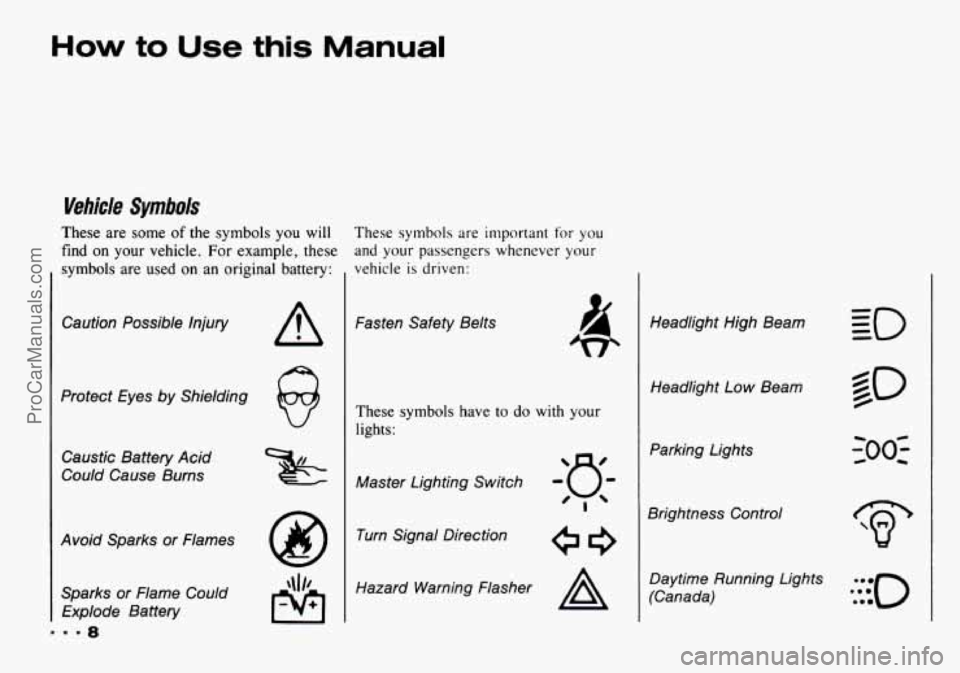
Vehicle Symbols
These are some of the symbols you will
find on your vehicle. For example, these
symbols are used
on an original battery:
Caution Possible injury
Protect Eyes by Shielding
Caustic Battery Acid
Could Cause Burns
Avoid Sparks or Flames
Sparks
or Flame Could
Explode Battery
These symbols are important for you
and your passengers whenever your
vehicle
is driven:
Fasten Safety Belts
i
These symbols have to do with your
lights:
Master Lighting Switch
Turn Signal Direction
Hazard Warning Flasher
A
Headlight High Beam
Headlight
Low Beam
Parking Lights
Brightness Control
5a ytime Running Lights
(Canada)
ProCarManuals.com
Page 69 of 339

H Horn
To sound the horn, press the horn
symbol on your steering wheel.
I Tilt meel (OPTION)
1 tilt steerng wheel allows you to adjust
he steering wheel before you drive.
lou can also raise it to the highest level
o give your legs more room when you
:xit and enter the vehicle.
?o tilt the wheel, hold the steering
vheel and lower the lever. Move the
teering wheel
to a comfortable level,
hen raise the lever to its highest
losition to lock the wheel in place.
H I;he Turn SignaULights
CoPttrolHeadlight Beam
Lever
The lever on the left side of the steering
column includes your:
Turn Signal and Lane Change
Headlight High/Low Beam and
Indicator
Passing Signal
Lighting Operation
67
c
ProCarManuals.com
Page 71 of 339
r
Opentiun of Lights
Although your vehicle's lighting system
(headlamps, parking lamps, fog lamps,
side marker lamps and taillamps) meet
all applicable Federal lighting
requirements, certain States and
Provinces may apply their own lighting
regulations that may require special
attention before you operate these
lamps. For example, some jurisdictions may
require that you operate your low
beam lamps with fog lamps at all times,
or that headlamps be turned on
whenever you must use your windshield
wipers. In addition, most jurisdictions
prohibit driving solely with parking
lamps, especially at dawn or dusk.
It is
recommended that you check with your
own State or Provincial highway
authority for applicable lighting
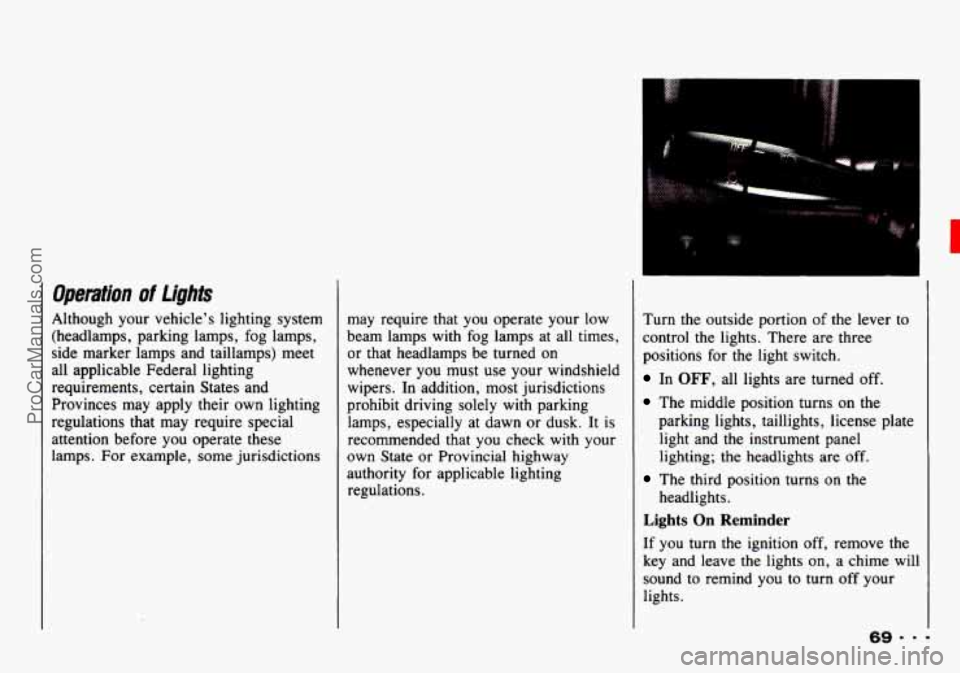
regulations. Turn
the outside portion of the lever to
control the lights. There are three
positions for the light switch.
In OFF, all lights are turned off.
The middle position turns on the
parking lights, taillights, license plate
light and the instrument panel
lighting; the headlights are
off.
The third position turns on the
headlights.
Lights On Reminder
If you turn the ignition off, remove the
key and leave the lights on, a chime will
sound to remind you to turn off your
lights.
ProCarManuals.com
Page 72 of 339
Features & Controls
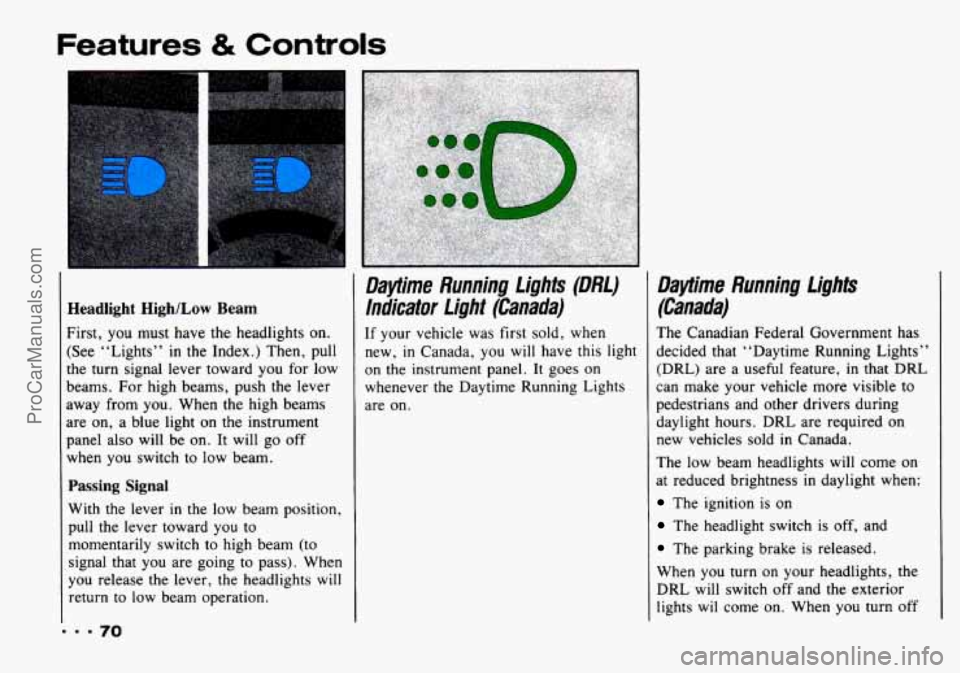
Headlight High/Low Beam
First, you must have the headlights on.
(See “Lights”
in the Index.) Then, pull
the turn signal lever toward you for low
beams. For high beams, push the lever
away from you. When the high beams
are on, a blue light on the instrument
panel also will be on. It will go off
when you switch
to low beam.
Passing Signal
With the lever in the low beam position,
pull the lever toward you to
momentarily switch to high beam (to
signal that you are going to pass). When
you release the lever, the headlights will
return to low beam operation.
Daytime Running fights (DM)
lndicator Light (Canada)
If your vehicle was first sold, when
new,
in Canada, you will have this light
on the instrument panel. It goes on whenever the Daytime Running Lights
are on.
Daytime Running f ights
(Canada)
The Canadian Federal Government has
decided that “Daytime Running Lights”
(DRL) are a useful feature, in that DRL
can make your vehicle more visible to
pedestrians and other drivers during
daylight hours. DRL are required
on
new vehicles sold in Canada.
The low beam headlights will come on
at reduced brightness
in daylight when:
The ignition is on
The headlight switch is off, and
The parking brake is released.
When you turn on your headlights, the
DRL will switch off and the exterior
lights wil come on. When you turn off
ProCarManuals.com
Page 160 of 339
Your Driving and the Road
Night Vision
No one can see as well at night as in the
daytime. But as we get older these
differences increase.
A 50-year-old
driver may require at least twice as
much light to see the same thing at night
as a 20-year-old.
What you do in the daytime can also
affect your night vision. For example, if
you spend the day
in bright sunshine
you are wise to wear sunglasses. Your
eyes will have less trouble adjusting to
night.
= = 158
But if you’re driving, don’t wear
sunglasses at night. They may cut down
on glare from headlights, but
they also
make a lot of things invisible
that should
remain visible - such as parked cars,
obstacles, pedestrians, or even trains
blocking railway crossings.
You may
want to put on your sunglasses after you
have pulled into a brightly-lighted
service or refreshment area. Eyes
shielded from that glare may adjust
more quickly to darkness back on
the
road. But be sure to remove your
sunglasses before you leave the service
area.
You can be temporarily blinded by
approaching lights. It can take a second
or two, or even several seconds, for
your eyes to readjust
to the dark. When
you are faced with severe glare (as from
a driver who doesn’t lower the high
beams, or a vehicle with misaimed
headlights), slow down a little. Avoid
staring directly into the approaching
lights. If there is a line of opposing
traffic, make occasional glances over the
line of headlights to make certain that
one of the vehicles isn’t starting to move
into your lane. Once you are past the
bright lights, give your eyes time to
readjust before resuming speed.
ProCarManuals.com
Page 161 of 339
High Beams
If the vehicle approaching you has its
high beams on, signal by flicking yours
to high and then back to low beam. This
is the usual signal to lower the headlight
beams.
If the other driver still doesn’t
lower the beams, resist the temptation
to
put your high beams on. This only
makes two half-blinded drivers.
On a freeway, use your high beams only
in remote areas where you won’t impair
approaching drivers. In some places,
like cities, using high beams is illegal. When
you follow
another vehicle on a
freeway or highway, use low beams.
True, most vehicles now have day-night
mirrors that enable the driver to reduce
glare. But outside mirrors are not
of this
type and high beams from behind can
bother the driver ahead.
A Few More Night Driving
Suggestions
Keep your windshield and all the glass
on your vehicle clean
- inside and out.
Glare at night is made much worse by
dirt on the glass. Even the inside
of the
glass can build up a film caused by dust.
Tobacco smoke also makes inside glass
surfaces very filmy and can be a vision
hazard if it’s left there. Dirty glass makes lights
dazzle and flash
more than clean glass would, making the
pupils of your eyes contract repeatedly.
You might even want to keep a cloth
and some glass cleaner in your vehicle if
you need to clean your glass frequently.
Remember that your headlights light up far less
of a roadway when you are in a
turn or curve.
Keep your eyes moving; that way, it’s
easier to pick out dimly lighted objects.
Just as your headlights should be
checked regularly for proper aim,
so
should your eyes be examined regularly.
Some drivers suffer from night blindness
- the inability to see in dim light - and
aren’t even aware of it.
ProCarManuals.com
Page 165 of 339
thick, wet haze that may even coat your
windshield. You can often spot these fog
patches or mist layers with your
headlights. But sometimes they can be
waiting for you as you come over a hill
or dip into a shallow valley. Start your
windshield wipers and washer, to help
clear accumulated road dirt. Slow down
carefully.
Tips on Driving in Fog
If you get caught in fog, turn your
headlights on low beam, even in
daytime. You’ll see
- and be seen -
better. Don’t use your high beams.
The light
will bounce off the water droplets that
make up fog and reflect back at you.
Use your defogger. In high humidity,
even a light buildup of moisture on the
inside
of the glass will cut down on your
already limited visibility. Run your
windshield wipers and washer
occasionally. Moisture can build up on
the outside glass, and what seems to be
fog may actually be moisture on the
outside
of your windshield.
Treat dense
fog as an emergency. Try to
find a place to pull off the road.
Of
course you want to respect another’s property,
but you might need to put
something between you and moving
vehicles
- space, trees, telephone poles,
a private driveway, anything that
removes you from other traffic.
If visibility
is near zero and you must
stop but are unsure whether you are
away from the road, turn your lights on,
start your hazard warning flashers, and
sound your horn at intervals or when
you hear approaching traffic.
Pass other vehicles
in fog only if you
can see far enough ahead to pass safely.
Even then, be prepared to delay your
pass
if you suspect the fog is worse up
ahead. If other vehicles try to pass you,
make
it easy for them.
16399-
ProCarManuals.com
Page 277 of 339
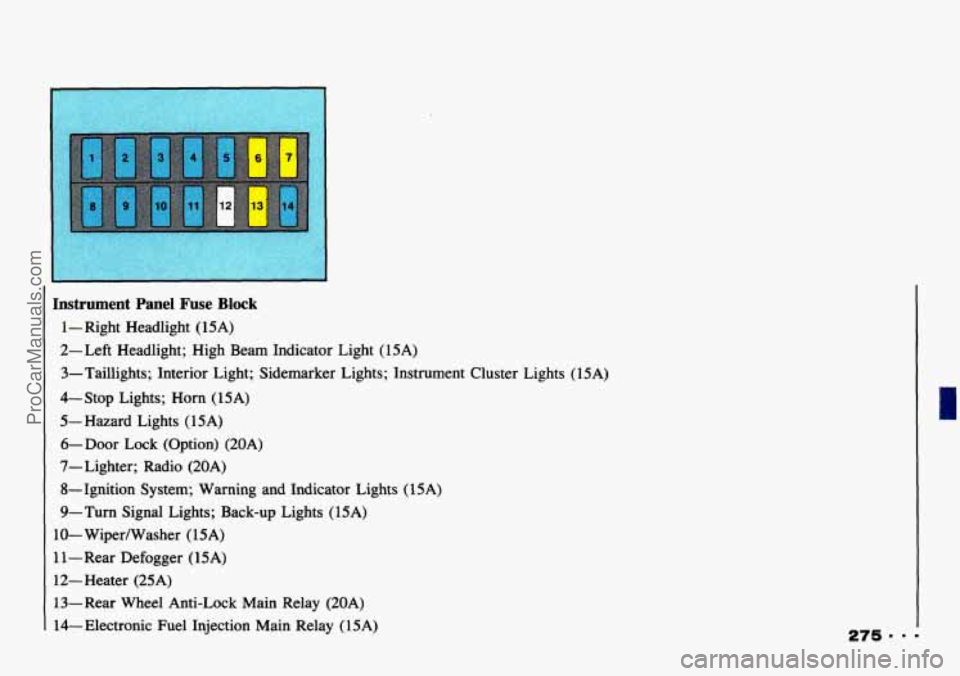
[ Instrument Panel Fuse Block
1 - Right Headlight (15A)
2- Left Headlight; High Beam Indicator Light (1 5A)
3-Taillights; Interior Light; Sidemarker Lights; Instrument Cluster Lights (15A)
4-Stop Lights; Horn (15A)
5- Hazard Lights (15A)
6-Door Lock (Option) (20A)
7- Lighter; Radio (20A)
8-Ignition System; Warning and Indicator Lights (15A)
9-Turn Signal Lights; Back-up Lights (15A)
10- Wiperwasher
(1 SA)
1 1 - Rear Defogger ( 15A)
12-Heater (25A) 13-Rear Wheel Anti-Lock Main Relay (20A)
14-Electronic Fuel Injection Main Relay (15A)
ProCarManuals.com
Page 278 of 339
Service & Appearance
I Replacement Bulbs
Care
Back-up ............................................................. 1156
Dome
............................................................. 9605 1559
Front Parking and Turn Signal
......................................... 1157 NA
Headlight (Halogen) ..................................................... 9004
Heater or Air Conditioning Control
.................................... 96052599
Charging System
................................................... 9433184
Check Engine
..................................................... 9433 184
Engineoil Pressure
................................................ 9433184
Indicator
and Warning
Brake
............................................................ 9433184
4WD
............................................................. 9433184
Headlight HighBeam
............................................... 9433184
Safety Belt
........................................................ 9433184
TurnSignal
....................................................... 9433184
Instrument Cluster
.................................................... 9605 156
License Plate
............................................................ 194
Lighter
............................................................. 9433184
Rear Defogger Switch
............................................. 96061736
Rear Wiper/Washer Switch
........................................... 9606 1736
Rear
Hazard and Turn Signal
........................................... 1156
Rear Parking andstop
................................................... 1157
Sidemarker
................................................. ........ 194
9 - 276
ProCarManuals.com
Page 330 of 339
Halogen Bulbs .................. 248
Halogen Headlight Bulb
Replacement
.................. 248
Hazard Warning Flashers
.......... 190
Haze. Driving in Fog. Mist and ..... 162
Head Restraints
................... 14
Headlights Halogen Bulb Replacement
....... 248
High/Low Beam
................ 70
Lever. Turn Signal/Lights
ControVHeadlight Beam
........ 67
Lights On Reminder
............. 69
Heater Controls ................. 102
Heating
........................ 103
Heating. Bi-Level
................ 103
High Beams
..................... 159
High/Low Beam. Headlight
......... 70
Highway Hypnosis
............... 168
Hill and Mountain Roads
.......... 169
Hill. Approaching a
.............. 146
Hills. Parking
on ................. 171
Hills. Driving on Off-Road
........ 145
Hitches (Trailer)
................. 180
Hood Release
................... 227
Hook-Ups. Front Towing
.......... 198
Hook-Ups. Rear Towing .......... 199
Hooks. Recovery
................ 2 18
Horn ........................... 67 Hubs. Free-Wheeling
.............. 58
Automatic
..................... 59
Manual
........................ 59
Hydroplaning
................... 16.1
Hypnosis. Highway .............. 168
Ice. Driving on Snow or .......... 174
Identification
Engine
....................... 272
Label. Service Parts
............ 272
Number. Vehicle
............... 272
Ignition Switch
................... 48
Incline. Driving across an
......... 152
Incline. Stalling on an
............. 154
Indicators. Warning Lights. Gages and
..................... 82
Inflation
- Tire Pressure .......... 254
Inspections. Periodic Maintenance
. . 303
Instrument Panel And Clusters
................... 80
Bins .......................... 75
Cleaning the Top of the
.......... 266
Fuse Block
.................... 275
Interior Lights
.................... 7 1
Jump Starting .................. 19 1
Keys ................ .... 44
Label. Certification
.............. 252
Label. Tire-Loading Information
.... 252 Lamp. Malfunction Indicator
. . ... 85
Lane Change Indicator. Turn
Signal and
..................... 68
Lap-Shoulder Belt (Safety Belt)
...... 24
Leather Cleaning
................ 265
Leaving the Freeway
............. 165
Leaving Your Vehicle with the Engine Running
................. 62
Levers Controls (Comfort Control System)
.................... 102
Turn SignaULights ControUHeadlight Beam
........ 67
Windshield Wiper/Washer
........ 72
Lighter. Cigarette
................. 77
Lights Brake System Warning
........... 84
Charging System
................ 85
Check Engine
.................. 85
Dome ......................... 71
Engine Oil Pressure
............. 85
Interior ........................ 71
Malfunction Indicator
............ 85
Oil Pressure. ................... 86
On Reminder ................... 69
Operation of ................... 69
Safety Belt Reminder ............ 23
Traffic
....................... 120
Warning. Gages and Indicators
.... 82
9 328
ProCarManuals.com