radiator cap CHEVROLET TRACKER 1993 Owners Manual
[x] Cancel search | Manufacturer: CHEVROLET, Model Year: 1993, Model line: TRACKER, Model: CHEVROLET TRACKER 1993Pages: 339, PDF Size: 15.75 MB
Page 205 of 339
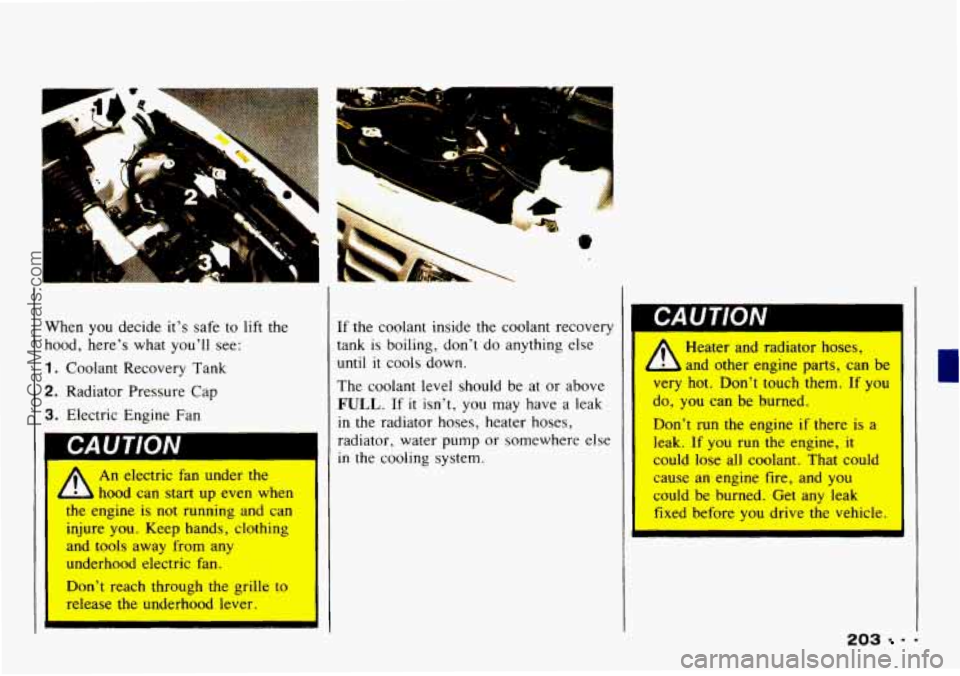
When you decide it’s safe to lift the
hood, here’s what you’ll see:
1. Coolant Recovery Tank
2. Radiator Pressure Cap
3. Electric Engine Fan
A An electric fan under the
hood can start up even when
thL @ne is not running and can
injure you. Keep hands, clothing
and tools away from any
underhood electric fan.
Don’t reach through the grille to
release the underhood lever.
- II E I L
If the coolant inside the coolant recovery
tank
is boiling, don’t do anything else
until it cools down.
The coolant level should be at
or above
FULL. If it isn’t, you may have a leak
in the radiator hoses, heater hoses,
radiator, water pump or somewhere else
in the cooling system.
unu I lVlV
Heater and radiator hoses,
1 L and other engine parts, can be
very hot. Don’t touch them. If you
do, you can be burned.
Don’t run the engine if there is a
leak. If you run the engine, it
could lose all coolant. That could
cause an engine fire, and you
could be burned. Get any leak
fixed before you drive the vehicle.
203 =
r
ProCarManuals.com
Page 207 of 339
' In cold weather, water can freeze
and crack the engine, radiator,
\eater core and other parts.
Us
he recommended coolant.
I A You can be burned if you
- b spill coolant on hot engine
parts. Coolant contains ethylene
glycol and it
will burn if the
engine parts are hot enough. Don't
-?ill coolant on a hot engine. When the coolant
in the coolant
recovery tank is at or above
FULL,
start your vehicle.
If the overheat warning continues,
there's one more thing you can try. You
can add the proper coolant mix directly
to the radiator, but be sure the cooling
system
is cool before you do it.
I
I
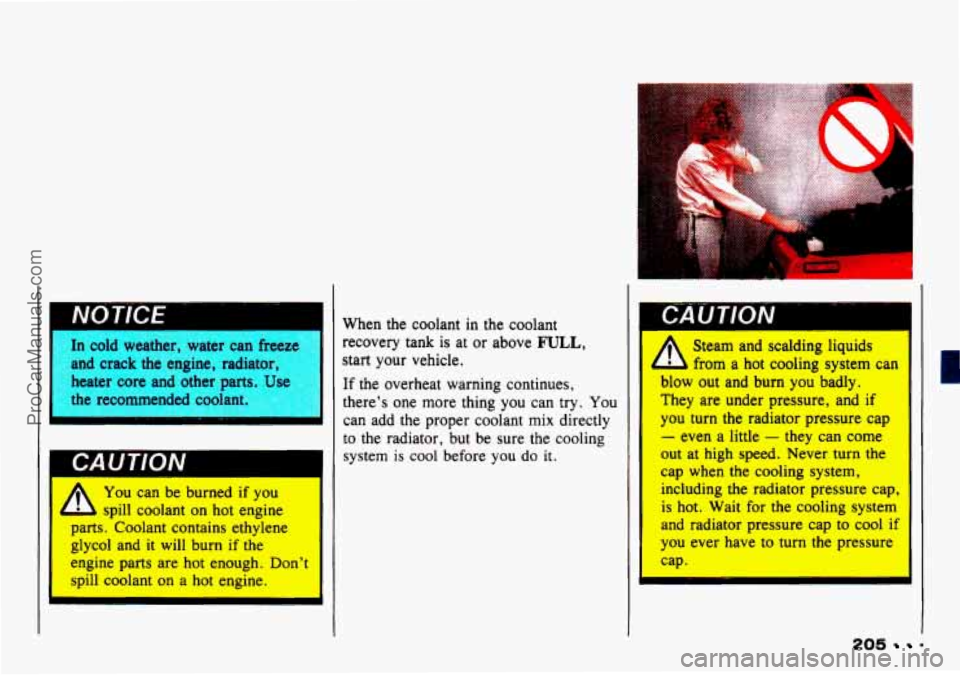
Steam and scalding liquids
- b from a hot cooling system car
blow out and burn you badly. I
They are under pressure, and if
you turn the radiator pressure cap
- even a little - they can come
out at high speed. Never turn
the
cap when the cooling system,
including the radiator pressure cap,
is hot. Wait for the cooling system
and radiator pressure cap to cool
il
you ever have to turn the pressure
cap.
205
ProCarManuals.com
Page 208 of 339
Problems on the Road
I
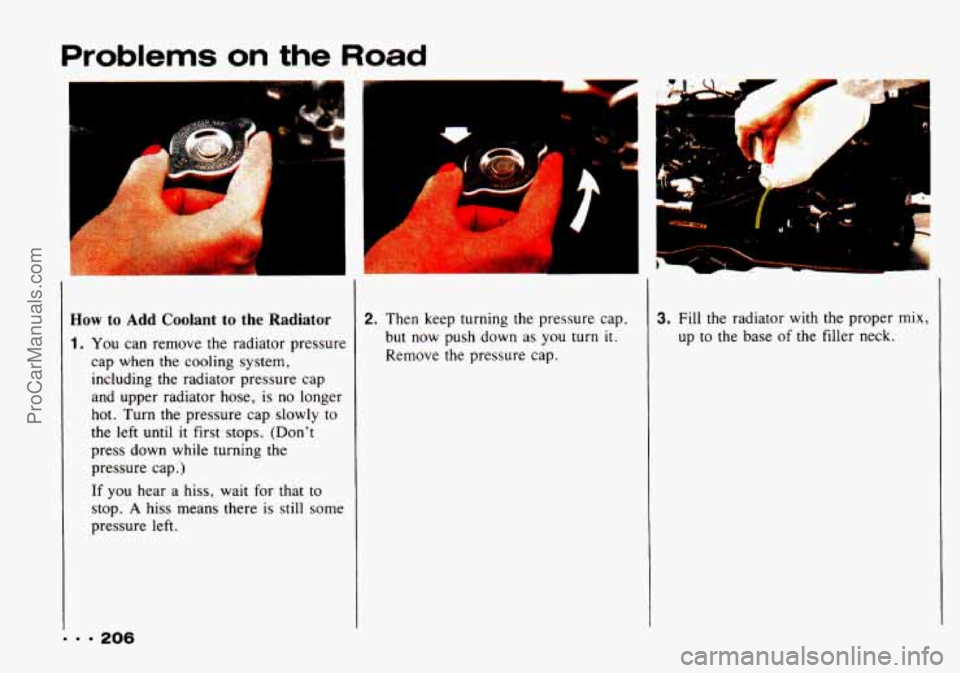
How to Add Coolant to the Radiator
1. You can remove the radiator pressure
cap when the cooling system,
including the radiator pressure cap
and upper radiator hose, is no longer
hot. Turn the pressure cap slowly
to
the left until it first stops. (Don't
press down while turning the
pressure cap.)
If you hear a hiss, wait for that to
stop. A hiss means there is still some
pressure
left.
2. Then keep turning the pressure cap,
but now push down as you turn
it.
Remove the pressure cap.
I A
3. Fill the radiator with the proper mix,
up
to the base of the filler neck.
ProCarManuals.com
Page 209 of 339
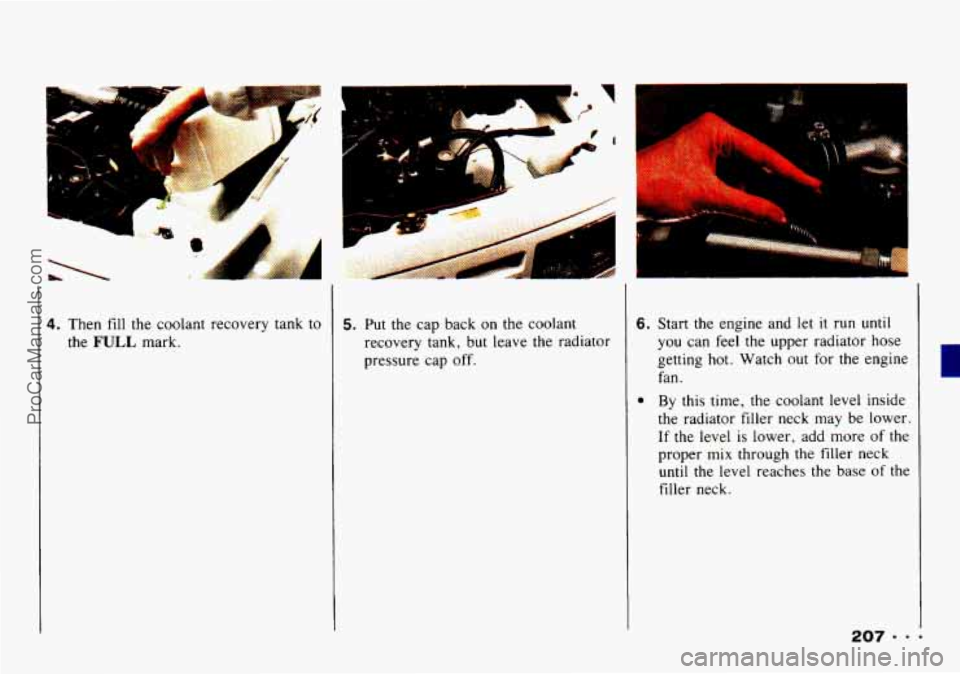
4. Then fill the coolant recovery tank to
the
FULL mark.
5. Put the cap back on the coolant
recovery tank, but leave the radiator
pressure cap
off.
6. Start the engine and let it run until
you can feel the upper radiator hose
getting
hot. Watch out for the engine
fan.
By this time, the coolant level inside
the radiator filler neck may be lower.
If the level is lower, add more of the
proper mix through the filler neck until the level reaches the base of the
filler neck.
r
ProCarManuals.com
Page 230 of 339
Service & Appearance Care
l-
a
I LUU I lV1V
An electric fan under the
hood can start up and injure
you even when the engine is not
running. Keep hands, clothing and
tools away from any underhood
electric
fan. Don't reach through
the grille to release the underhood
lever.
I
7."
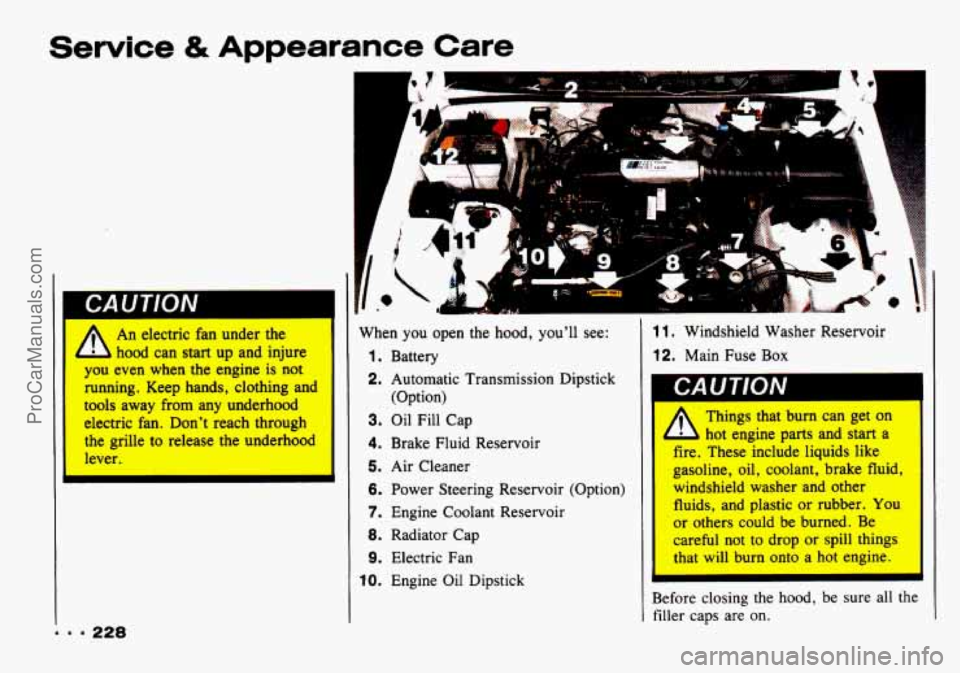
When you open the hood, you'll see:
1. Battery
2. Automatic Transmission Dipstick
(Option)
3. Oil Fill Cap
4. Brake Fluid Reservoir
5. Air Cleaner
6. Power Steering Reservoir (Option)
7. Engine Coolant Reservoir
8. Radiator Cap
9. Electric Fan
10. Engine Oil Dipstick
11. Windshield Washer Reservoir
12. Main Fuse Box
CAUTION
A
Things that burn can get on
hot engine parts and start a
fire. These include liquids like
gasoline, oil, coolant, brake fluid,
windshield washer and other
fluids, and plastic or rubber. You
or others could be burned. Be
careful not to drop or spill things
that will burn onto a hot engine.
Before closing the hood, be sure all the
filler caps are on.
... 228
ProCarManuals.com
Page 244 of 339
Service & Appearance Care
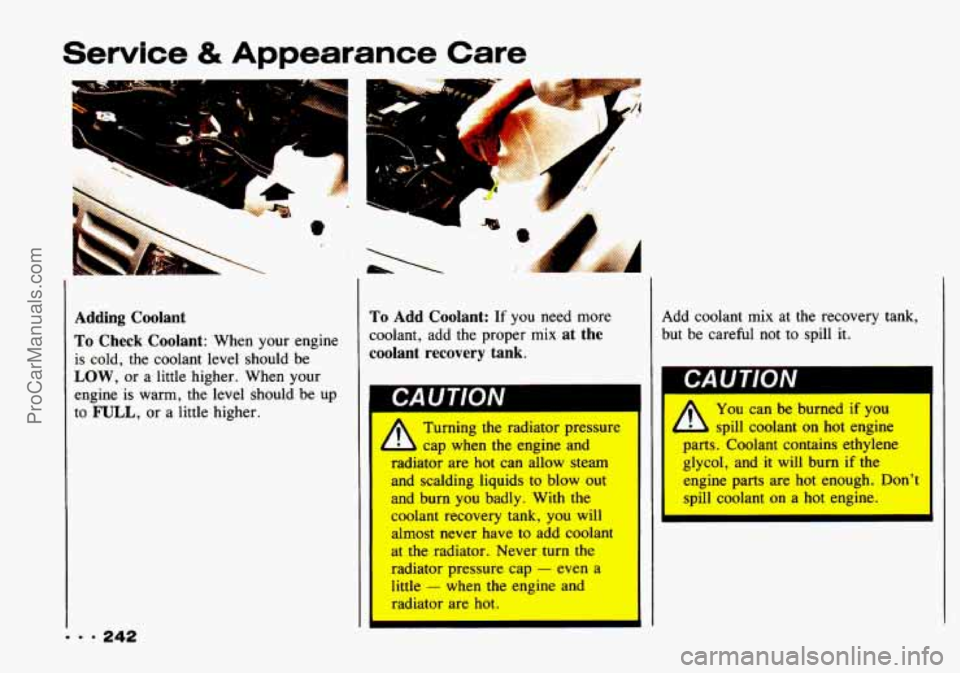
Adding Coolant
To Check Coolant: When your engine
is cold, the coolant level should be
LOW, or a little higher. When your
engine is warm, the level should be up
to
FULL, or a little higher.
To Add Coolant: If you need more
coolant, add the proper mix
at the
coolant recovery tank.
r Turning the radiator pressure
radiator are hot can allow steam
and scalding liquids to blow out
and burn you badly. With the
coolant recovery tank, you will
almost never have to add coolant
at the radiator. Never turn the
radiator pressure cap
- even a
little
- when the engine and
radiator are hot.
cap
when the engine and Add
coolant
mix at the recovery tank,
but be careful not to spill
it.
, You can be burned if you
- L spill coolant on hot engine
parts. Coolant contains ethylene
glycol, and
it will burn if the
engine parts are hot enough. Don't
spill coolant on a hot engine.
ProCarManuals.com
Page 245 of 339
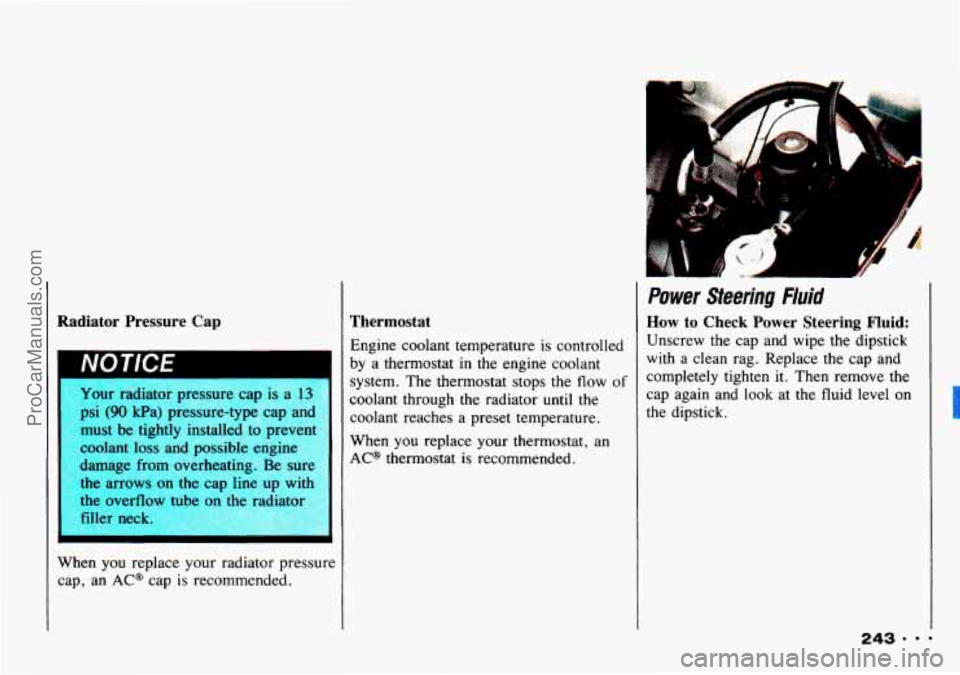
Radiator Pressure Cap
IVU I IIJt
Your radiator pressure cap is a 13
- i (90 kPa) pressure-type cap and
must be tightly installed to prevent
coolant
loss and possible engine
damage from overheating. Be sure
the arrows on the cap line up with
the overflow tube on the radiato
filler neck.
I
When you replace your radiator pressure
cap, an
AC* cap is recommended.
Thermostat
Engine coolant temperature is controlled
by a thermostat in the engine coolant
system. The thermostat stops the flow
of
coolant through the radiator until the
coolant reaches a preset temperature.
When you replace your thermostat, an
AC@ thermostat is recommended.
Power Steering Fluid
How to Check Power Steering Fluid:
Unscrew the cap and wipe the dipstick
with a clean rag. Replace the cap and
completely tighten it. Then remove the
cap again and look at the fluid level on
the dipstick.
ProCarManuals.com
Page 279 of 339
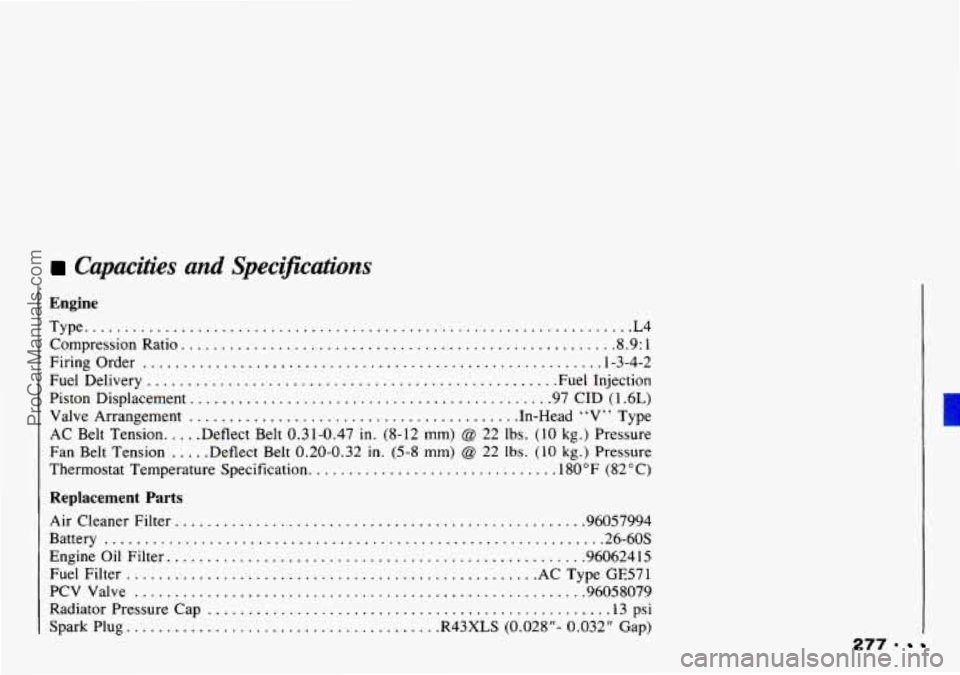
Capacities and Specifictu?ons
Engine
Type ....................................................................L4
Compression Ratio. . . . . . . . . . . . . . . . . . . . . . . . . . . . . . . . . . . . . . . . . . . . . . . . . . . . . .8.9: 1
Firing Order . . . . . . . . . . . . . . . . . . . . . . . . . . . . . . . . . . . . . . . . . . . . . . . . . . . . . . . . . l-3-4-2
Fuel Delivery . . . . . . . . . . . . . . . . . . . . . . . . . . . . . . . . . . . . . . . . . . . . . . . . . . .Fuel Injection
Piston Displacement
. . . . . . . . . . . . . . . . . . . . . . . . . . . . . . . . . . . . . . . . . . . . .97 CID (1.6L)
Valve Arrangement . . . . . . . . . . . , . . . . . . . . . . . , . . . . . . . . . . . . . . . . .In-Head “V” Type
AC Belt Tension.
. . . .Deflect Belt 0.31-0.47 in. (8-12 mm) @ 22 Ibs. (10 kg.) Pressure
Fan Belt Tension
. . . . .Deflect Belt 0.20-0.32 in. (5-8 mm) @ 22 Ibs. (10 kg.) Pressure
Thermostat Temperature Specification.
. . . . . . . . . . . . . . . . . . . . . . . . . . . . . .180”F (82°C)
Replacement Parts
Air Cleaner Filter ................................................... 96057994
Battery
..............................................................26-60s
Engineoil Filter .................................................... 96062415
Fuel Filter
................................................... AC TypeGE571
PCVValve
........................................................96058079
Radiator Pressure Cap . . . . . . . . . , . . . . . . . . . . . . . . . . . . . . . . . . . . . . . . . . . . . . . . . .13 psi
Spark Plug.
. . . . . . . . . . . . . . . . . . . . . . . . . . . . . . . . . . . . . .R43XLS (0.028”- 0.032” Gap)
277 9
ProCarManuals.com
Page 292 of 339
Maintenance Schedule
Section A: Scheduled Maintenance Services (Cont.)
Dplanatiun of Scheduled Maintenance Services
Below are explanations of the services listed in Schedules I
and 11.
290
ITEM
NO.
1
2
SERVICE
Engine Oil and Filter Change* - Always use SG
Energy Conserving I1 Oils of proper viscosity. The
SG designation may be shown alone or in
combination with others, such as SG/CC, SG/CD,
or SF, SG, CC, etc. To determine the preferred
viscosity for your vehicle’s engine (e.g., SAE
5W-30 or 1OW-30) see “Engine Oil’’ in the Index.
Engine Idle Speed Check* - Check the idle speed
and adjust it to underhood label specifications.
*An Emission Control Service.
The proper fluids and lubricants to use are listed in Section
D. Make sure whoever services your vehicle uses these. All
parts should be replaced and all necessary repairs done
before
you or anyone else drives the vehicle.
ITEM
NO. SERVICE
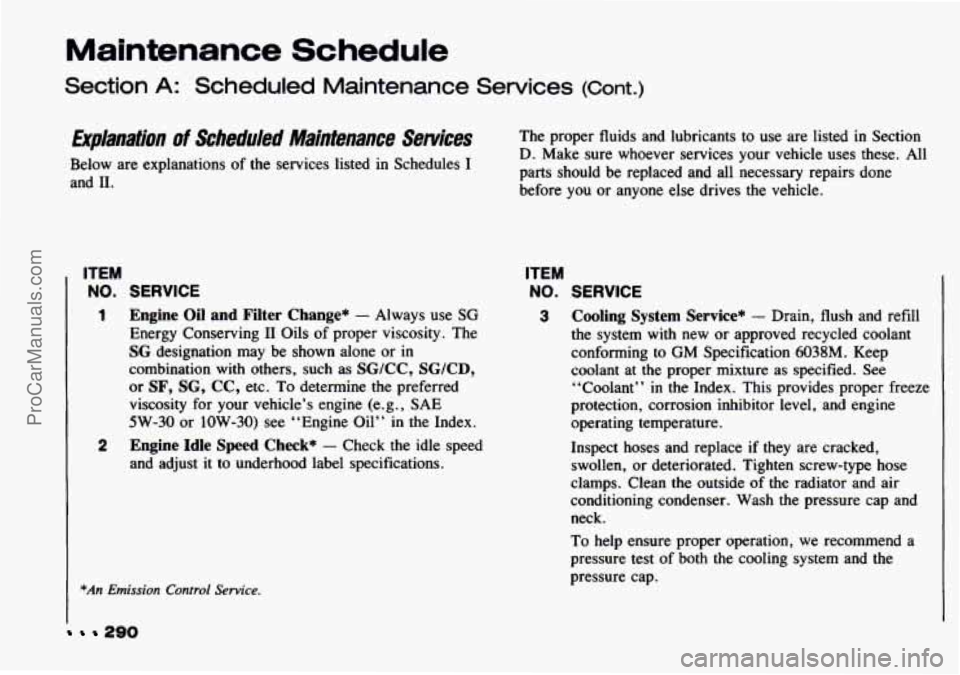
3 Cooling System Service* - Drain, flush and refill
the system with new or approved recycled coolant
conforming to
GM Specification 4038M. Keep
coolant at
the proper mixture as specified. See
“Coolant”
in the Index. This provides proper freeze
protection, corrosion inhibitor level, and engine
operating temperature.
Inspect hoses and replace
if they are cracked,
swollen, or deteriorated. Tighten screw-type hose
clamps. Clean the outside of the radiator and air
conditioning condenser. Wash
the pressure cap and
neck.
To help ensure proper operation, we recommend a
pressure test of both
the cooling system and the
pressure cap.
ProCarManuals.com
Page 332 of 339
9 9 330
Parking Brake
......................... 60
Downhill ..................... 172
Manual Transmission ............ 63
On a Hill with a Trailer.
When
You Are Ready to
Leave After ................. 185
On Hills ...................... 171
On Hills (With a Trailer) ........ 184
Over Things That Bum ........... 64
Uphill ........................ 172
Your Vehicle ................... 63
Parking and Turn Signal Light
Bulb Replacement. Front
........ 249
Parts, Replacement ............... 277
Passenger
Assist Grips
.................... 76
Positions (Safety Belt) ............ 28
Rear Seat (Safety Belt) ........... 28
Right Front Position (Safety Belt) . . 28
Passing ........................ 136
Passing (With a Trailer) ........... 183
Passing Signal .................... 70
Pavement Markings .............. 12 1
Pedal Travel. Brake .............. 13 1
Periodic Maintenance Inspections ... 303
Pockets. Front Seat Side ............ 75
Power Steering .................. 132
Power Steering Fluid ............. 243
Pregnancy. Safety Belt Use during ... 27
Pressure. Tire ................... 254
Problems on the Road ............. 189
Product Service Publications
(PSP’s)
....................... 32 1
Publications. Service ............. 320
Radiator Pressure Cap ........... 243
Radiator. How to Add Coolant ...... 206
Radio Reception. Understanding .... 115
Radio. To Play the
AM/FM Stereo
................ 108
AM/FM Stereo with
Cassette Tape Player
.......... 1 10
Rain. Driving in the .............. 160
Rainy Weather Tips. Some Other ... 161
RearAxle ...................... 238
Rear Drum Brakes ............... 13 1
Rear Vent Windows ............... 66
Rear Window
Defogger
..................... 105
Opening and Closing Your ........ 90
Removing and Installing Your ..... 91
Wiper/Washer .................. 73
Rearview Mirror. Inside ............ 74
Rearview Mirror. Inside Day/Night . . 74
Reception. Understanding Radio .... 1 15
Reclining Front Seatback ........... 13
Recommended Fluids and
Lubricants
................ 27 1. 305
Recovery Hooks. Using the ........ 218
Recovery. Off-Road .............. 135
Recreational Towing ............. 186
Towing Your Geo from the Front . . 187
Towing Your Geo from the Rear . . 186
Release. Hood ................... 227
Remote Areas. Traveling to ........ 142
Replacement Bulbs ............... 276
Replacement Parts ............... 277
Replacing Safety Belts after a Crash . . 39
Reporting Safety Defects
To General Motors
............. 318
To the Canadian Government ..... 318
To the United States Government . . 3 17
Restraint Systems. Checking Your ... 39
Restraint. Where to Put the Child .... 32
Restraints. Child .................. 34
Restraints. Head .................. 14
Road Signs ..................... 118
Color of ...................... 118
Shapeof ...................... 119
Symbols on ................... 120
Road. On the .................... 168
Road. Problems On the ............ 189
Roads. Hill and Mountain ......... 169
Roadside Assistance Program.
Chevrolet/Geo
............. - - .. 319
ProCarManuals.com