seats CHEVROLET TRACKER 1994 User Guide
[x] Cancel search | Manufacturer: CHEVROLET, Model Year: 1994, Model line: TRACKER, Model: CHEVROLET TRACKER 1994Pages: 258, PDF Size: 14.43 MB
Page 23 of 258
Seats and Restraint Systems
8
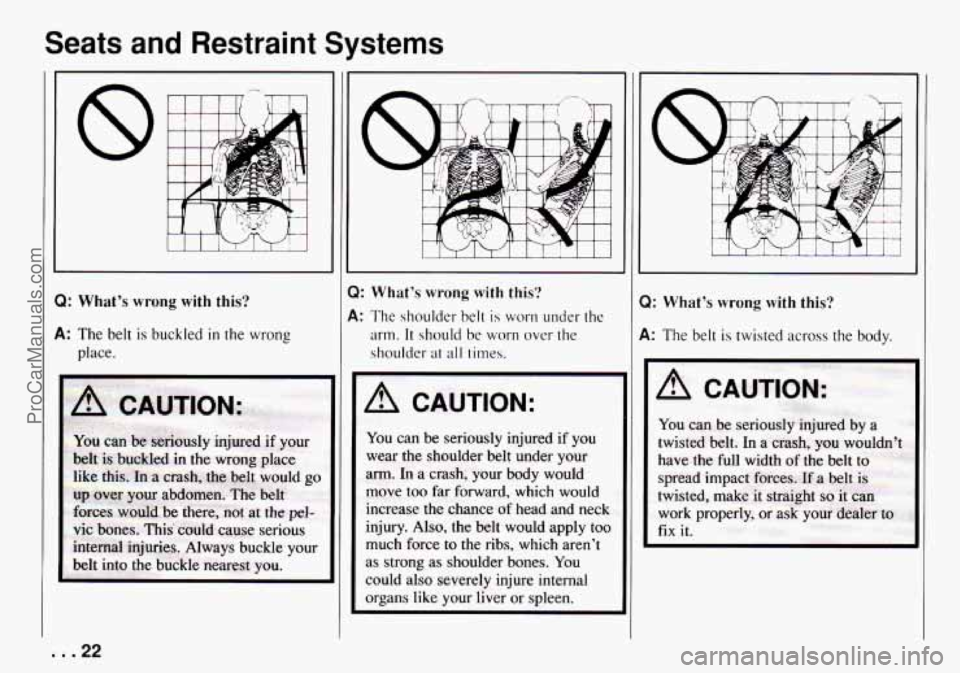
Q: What's wrong with this?
A: The belt is buckled in the wrong
place.
m
: What's wrong with this?
: The shoulder- belt is worn under the
arm. It should be worn over- the
shoulder
at all times.
A CAUTION:
You can be seriously injured if you
wear the shoulder belt under your
arm. In a crash, your budy would
move
too far forward, which would
increase the chance
of head and neck
injury. Also, the belt would apply too
much force to the ribs, which aren't
as strong as shoulder bones. You
could also severely injure internal
organs
like your liver or spleen.
C
P
2: What's wrong with this?
\: The belt is twisted across the body.
... 22
ProCarManuals.com
Page 25 of 258
Seats and Restraint Systems
L
Rear Seat Passengers
It‘s very important for rear seat
passengers
to buckle up! Accident
statistics show that unbelted people in the
rear seat are hurt more often
in crashes
than those who are wearing safety belts.
Rear passengers who aren’t safety belted
can be thrown
out of the vehicle in a
crash. And
they can strike others in the
vehicle who are wearing safety belts.
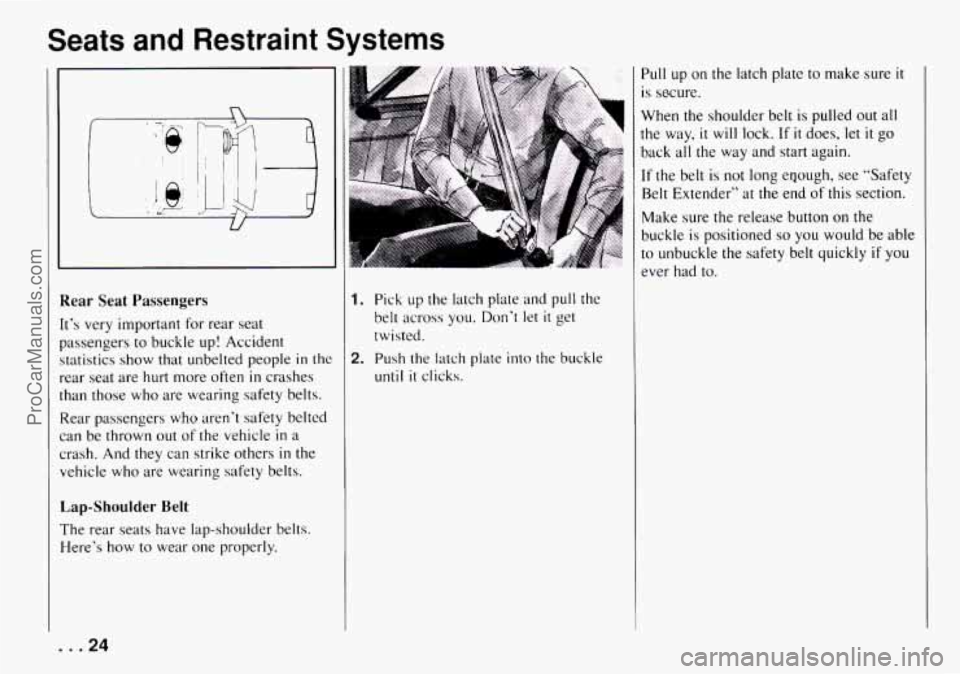
Lap-Shoulder Belt
The rear seats have lap-shoulder belts.
Here’s how
to wear one properly.
1. Pick up the latch plate and pull the
belt across you. Don’t
let it get
twisted.
2. Push the latch plate into the buckle
until it clicks.
Pull up on the latch plate to make sure it
is secure.
When the shoulder belt
is pulled out all
the way,
it will lock. If it does, let it go
back all the way and start again.
If the belt is not long eqough, see “Safety
Belt Extender” at the end of this section.
Make sure the release button
on the
buckle is positioned
so you would be able
to unbuckle the safety belt quickly
if you
ever had to.
... 24
ProCarManuals.com
Page 27 of 258
Seats and Restraint Systems
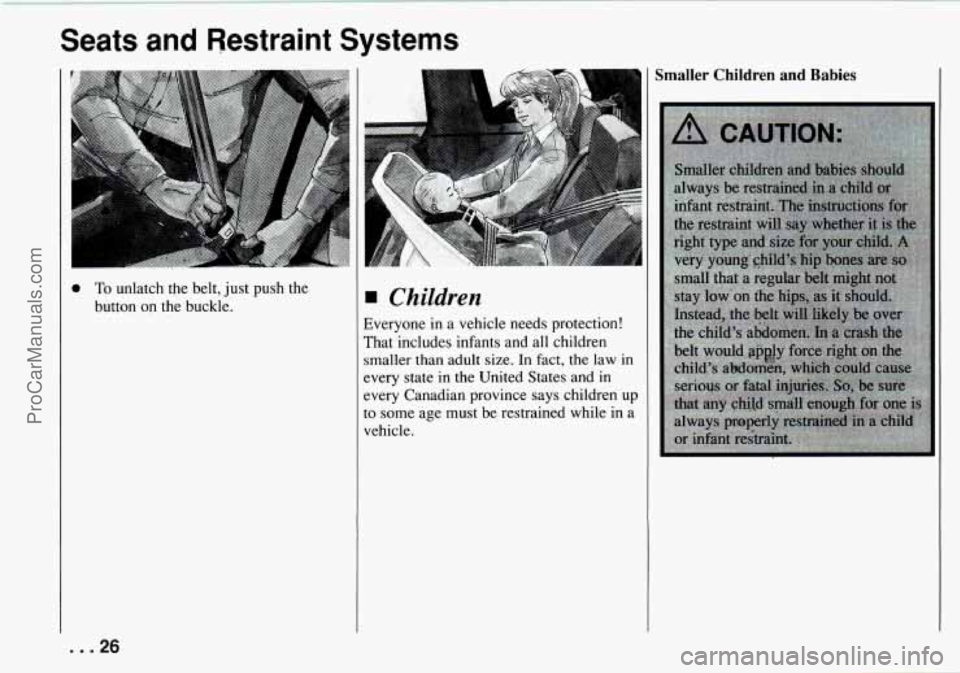
0 To unlatch the belt, just push the
button on the buckle.
I
Children
Everyone in a vehicle needs protection!
That includes infants and all children
smaller than adult size. In fact, the law
in
every state in the United States and in
every Canadian province says children
up
to some age must be restrained while in a
vehicle.
Smaller Children and Babies
... 26
ProCarManuals.com
Page 29 of 258
Seats and Restraint Systems
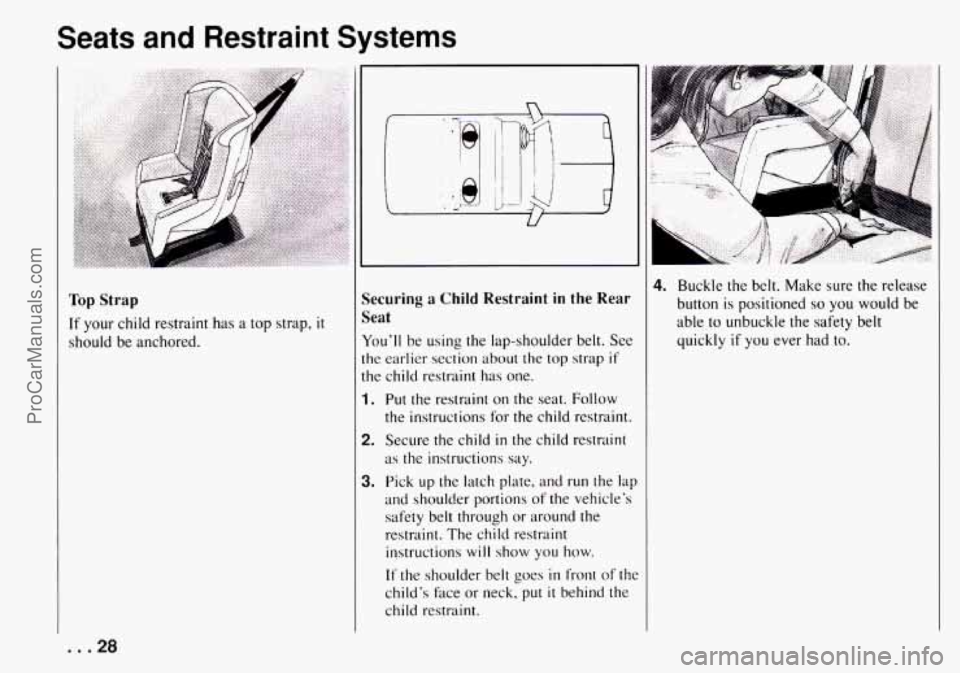
Top Strap
If your child restraint has a top strap, it
should be anchored.
Securing a Child Restraint in the Rear
Seat
You'll be using the lap-shoulder belt. See
the earlier section
about the top strap if
the child restraint has one.
1. Put the restraint on the seat. Follow
the instructions for the child restraint.
2. Secure the child in the child restraint
as the instructions say.
3. Pick up the latch plate, and run the lap
and shoulder portions of the vehicle's
safety belt through or around the
restraint. The child restraint
instructions
will show you how.
If the shoulder belt goes in front of the
child's face
or neck, put it behind the
child restraint.
4. Buckle the belt. Make sure the release
button is positioned
so you would be
able to unbuckle the safety belt
quickly
if you ever had to.
... 28
ProCarManuals.com
Page 31 of 258
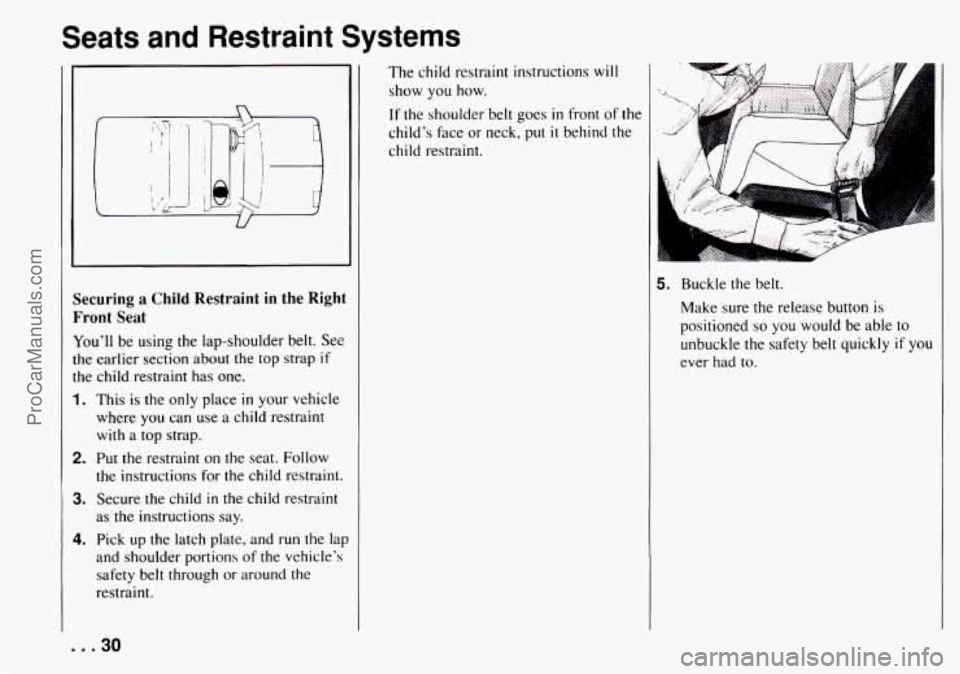
Seats and Restraint Systems
Securing a Child Restraint in the Right
Front Seat
You'll be using the lap-shoulder belt. See
the earlier section
about the top strap if
the child restraint has one.
1. This is the only place in your vehicle
where
you can use a child restraint
with a top strap.
2. Put the restraint on the seat. Follow
the instructions for the child restraint.
3. Secure the child in the child restraint
as the instructions say.
4. Pick up the latch plate, and run the lap
and shoulder portions of the vehicle's
safety belt through or around the
restraint. The child restraint
instructions
will
show you how.
If the shoulder belt goes in front of the
child's face or neck,
put it behind the
child restraint.
5. Buckle the belt.
Make sure the release button is
positioned
so you would be able to
unbuckle the safety belt quickly if you
ever
had to.
... 30
ProCarManuals.com
Page 33 of 258
Seats and Restraint Systems
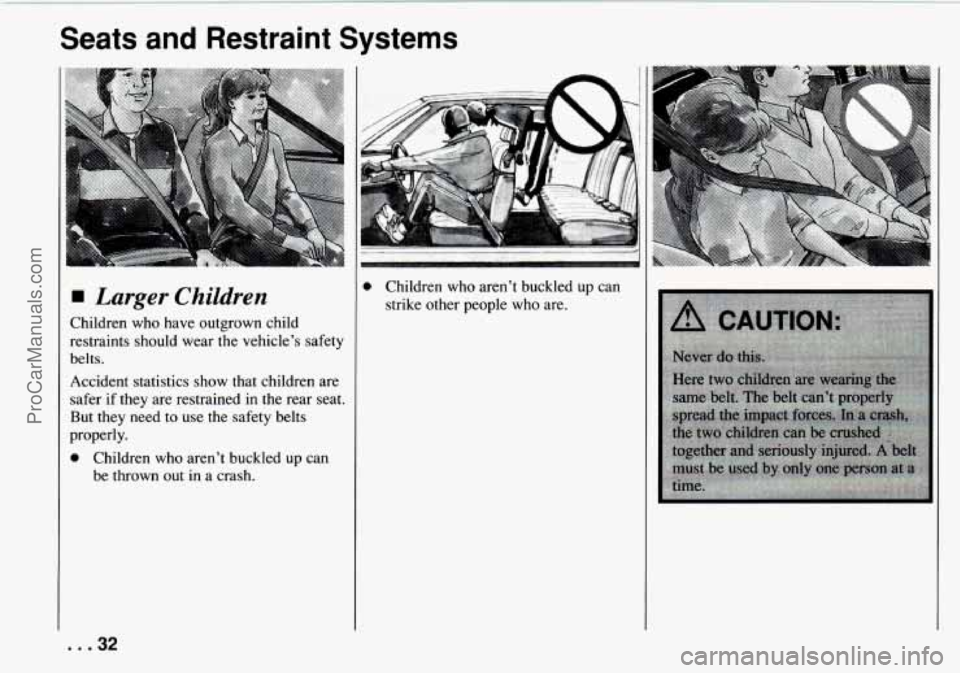
Larger Children
Children who have outgrown child
restraints should wear the vehicle’s safety
belts.
Accident statistics show that children are
safer if they are restrained
in the rear seat.
But they need to use the safety belts
properly.
0 Children who aren’t buckled up can
be thrown out
in a crash.
0 Children who aren’t buckled up can
strike other people who are.
... 32
ProCarManuals.com
Page 35 of 258
Seats and Restraint Systems
Replacing Safety Belts
after a Crash
If you’ve had a crash, do you need new
belts?
After a very minor collision, nothing may
be necessary. But if the belts were
stretched, as they would be
if worn during
a more severe crash, then
you need new
belts.
If belts are cut or damaged, replace them.
Collision damage also may mean you will
need to have safety belt or seat parts
repaired or replaced. New parts and
repairs may be necessary even if the belt
wasn’t being used at the time of the
collision.
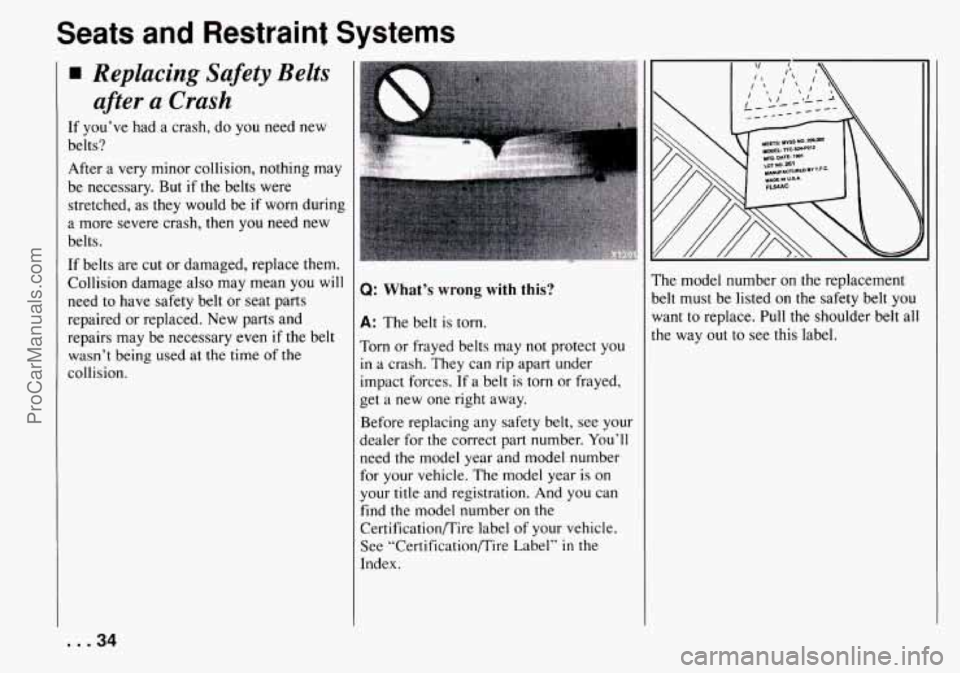
Q: What’s wrong with this?
A: The belt is torn.
Tom or frayed belts may not protect you
in a crash. They can rip apart under
impact forces.
If a belt is torn or frayed,
get a new one right away.
Before replacing any safety belt, see your
dealer for the correct part number. You’ll
need the model year and model number
for your vehicle. The model year is on
your title and registration. And you can
find the model number
on the
Certificationpire label
of your vehicle.
See “Certification/Tire Label”
in the
Index. The
model number on the replacement
belt must be listed
on the safety belt you
want to replace. Pull the shoulder belt all
the way out
to see this label.
... 34
ProCarManuals.com
Page 88 of 258

Ventilation Tips
0
0
0
Keep the hood and front air inlet free
of ice, snow, or any other obstruction
(such as leaves). The heater and
defroster will work far better, reducing
the chance of fogging the inside of
your windows.
When you enter a vehicle in cold
weather, move the fan lever towards
for a few moments before driving off.
This helps clear the intake ducts of
snow and moisture, and reduces the
chance of fogging the inside of your
windows.
Keep the air path under the front seats
clear of objects. This helps air to
circulate throughout your vehicle.
Audio Systems
Your Delco@ audio system has been
designed to operate easily and give years
of listening pleasure. But you will get the
most enjoyment out of
it if you acquaint
yourself with it first. Find out what your
Delco@ system can do and how to operate
all its controls, to be sure you’re getting
the most out of the advanced engineering
that went into
it.
NOTICE:
Before you add any sound equipment
to your vehicle - like a tape player,
CB radio, mobile telephone or
two-way radio
- be sure you can
add what you want.
If you can, it’s
very important to do it properly.
Added sound equipment may inter-
fere
with the operation of your
vehicle’s engine, Delco8 radio or
other systems, and even damage
them. And, your vehicle’s systems
may interfere with the operation of
sound equipment that has been added
improperly.
So, before adding sound equipment,
check with your dealer and be sure
to
check Federal rules covering mobile
radio and telephone units.
87 ...
ProCarManuals.com
Page 148 of 258
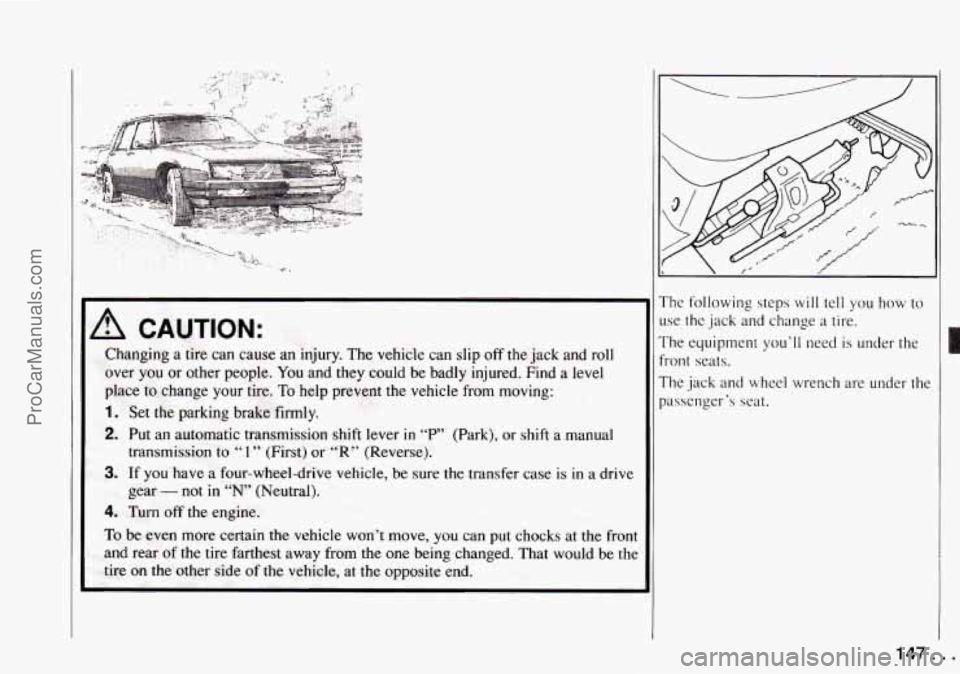
... .v ,
A CAUTION:
Changing a tire can cause an injury. The vehicle can slip off the jack and roll
over
you or other people. You and they could be badly injured. Find a level
place to change your tire.
To help prevent the vehicle from moving:
1. Set the parking brake firmly.
2. Put an automatic transmission shift lever in T“ (Park), or shift a manual
3. If you have a four-wheel-drive vehicle, be sure the transfer case is in a drive
4. Turn off the engine.
transmission
to “ 1” (First) or “R” (Reverse).
gear
- not in “N’ (Neutral).
To be even more certain the vehicle won’t move, you can put chocks at the front
and rear
of the tire farthest away from the one being changed. That would be the
tire
on the other side of the vehicle, at the opposite end. The
following steps
will tell you how to
.rse the jack and change
a tire.
The equipment you’ll need is under the
ront seats.
rhejack and wheel wrench
are under the
passenger’s
seat.
147 ...
ProCarManuals.com
Page 246 of 258

Customer Assistance for the Hearing
Customer Assistance Information
. . 233
Customer Satisfaction Procedure
... 234
or Speech Impaired (TDD)
..... 234
Damage. Finish
............... 194
Damage. Sheet Metal
............ 193
Daytime Running Lights
......... 56
Daytime Running Lights Indicator Light
....................... 72
Deep Standing Water.
Driving through
.............. 41
Defects. Safety
Reporting to General Motors
.... 236
Reporting to the Canadian
Reporting to the United States
Government
............... 236
Government
............... 236
Defensive Driving
.............. 100
Defogger. Rear Window ......... 86
Defogging and Defrosting
Windows
................... 85
Dehumidifying ................. 85
Dimensions. Vehicle ............ 202
Doing Your Own Service Work
.... 156
Dome Light ................... 57
Door Locks
.................... 37
Door Storage Compartments
...... 60
Downhill. Driving
.............. 1 12
Drive. Four-wheel
.............. 46
Drive. Four-wheel (Service)
...... 170 Driver Position
(Safety Belts)
... 20
Driving
Across an Incline
............. 11 3
At Night .................... 1 16
City
........................ 119
Defensive
................... 100
Downhill
................... 1 12
Drunken
.................... 100
Freeway
.................... 120
Guidelines
.................. 107
In Mud. Sand. Ice or Snow ..... 1 15
In the Rain .................. 117
In Water .................... 115
0ff.Road. With Your Geo Four-
Wheel-Drive Vehicle
........ 108
On Curves .................. 104
On Off-Road Hills
............ I10
On Snow or Ice
.............. 123
Through Deep Standing Water
... 41
Uphill
...................... 111
Winter
...................... 122
With a Trailer
................ 127
Your Tracker. About ........... 3
Drunken Driving
............... 100
Easy Entry Seats
.............. 12
Electrical Equipment. Add-on
..... 196
Emergencies. Braking in
......... 104
Emergencies. Steering in
......... 105 Engine
Coolant
..................... 170
Coolant (Block) Heater
........ 41
Coolant Temperature Gage
..... 70
Exhaust
..................... 51
Identification
................ 196
Oil
........................ 162
Oil Pressure Light
............ 71
Overheating
................. 140
Specifications
................ 200
Starting Your
................ 40
Environment. Your Vehicle
and the
..................... 204
Exhaust. Engine
................ 51
Extender. Safety Belt
....... 1 .... 33
Exterior Bright Metal Parts.
Protecting
................... 192
Fabric Protection
.............. 190
Fan Control Lever
.............. 84
Features and
Controls ........... 35
Filling Your Tank ............... 158
Filter. Air. Replacement
.......... 166
Finish Care (Paint)
.............. 192
Finish Damage (Paint)
........... 194
Flashers. Hazard Warning
........ 132
Flat Tire. Changing a
............ 146
Flat.
If a Tire Goes .............. 146
Flow-Through Ventilation System . . 86
245 ..
ProCarManuals.com