steering wheel CHEVROLET TRACKER 1994 User Guide
[x] Cancel search | Manufacturer: CHEVROLET, Model Year: 1994, Model line: TRACKER, Model: CHEVROLET TRACKER 1994Pages: 258, PDF Size: 14.43 MB
Page 116 of 258
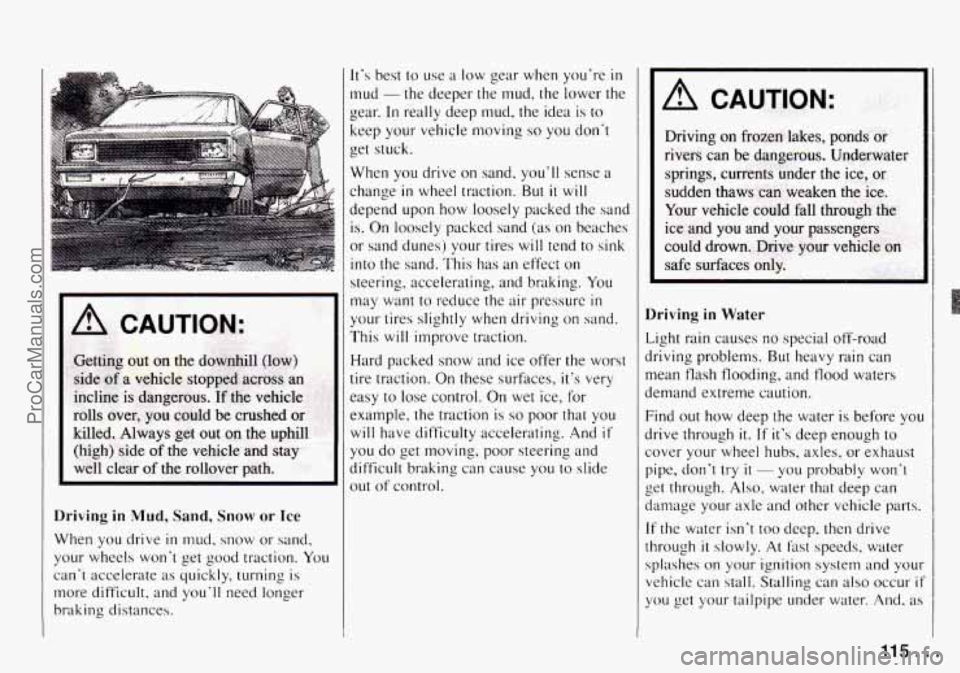
A CAUTION:
Driving in Mud, Sand, Snow or Ice
When you drive in mud, snow or sand,
your wheels won't get good traction. You
can't accelerate as quickly, turning is
more difficult, and you'll need longer
braking distances.
It's best to use a low gear when you're in
mud -the deeper the mud, the lower the
gear.
In really deep mud, the idea is to
keep your vehicle moving so you don't
get stuck.
When
you drive on sand, you'll sense a
change
in wheel traction. But it will
depend upon how loosely packed the sand
is. On loosely packed sand (as on beaches
or sand dunes) your tires will tend
to sink
into the sand. This has an effect on
steering. accelerating, and braking. You
may want to reduce the air pressure
in
your tires slightly when driving on sand.
This will improve traction.
Hard packed snow and ice offer the worst
tire traction. On these surfaces, it's very
easy
to lose control. On wet ice, for
example, the traction is
so poor that you
will have difficulty accelerating. .4nd
if
you do get moving, poor steering and
difficult braking can cause
you to slide
out of control.
A CAUTION:
Driving in Water
Light rain causes no special off-road
driving problems. But heavy rain can
mean tlash flooding, and tlood
waters
demand extreme caution.
Find out how deep the water is before you
drive through it.
If it's deep enough to
cover your wheel hubs, axles, or exhaust
pipe, don't
try il - you probably won't
get through.
Also, water that deep can
damage your axle and other vehicle parts.
If the water
isn't too deep, then drive
through
it slowly. At fast speeds. water
splashes on your ignition system and
your
vehicle can stall. Stalling can also occur if
you get your tailpipe under water. ,4nd, as
115 ...
ProCarManuals.com
Page 117 of 258
Your Driving and the Road
long as your tailpipe is under water, you'll
never be able to
start your engine. When
you go through water, remember that
when your brakes get wet, it may take
you longer to stop.
After Off-Road Driving
Remove any brush or debris that has
collected
on the underbody, chassis or
under the hood. These accumulations can
be a fire hazard.
After operation in mud or sand, have the
brake linings cleaned and checked. These
substances can cause glazing and uneven
braking. Check the body structure,
steering, suspension, wheels, tires, and exhaust system
for damage.
Also, check
the fuel lines and cooling system for any
leakage.
Your vehicle will require more frequent
service due to off-road
use. Refer to the
Maintenance Schedule for additional
information.
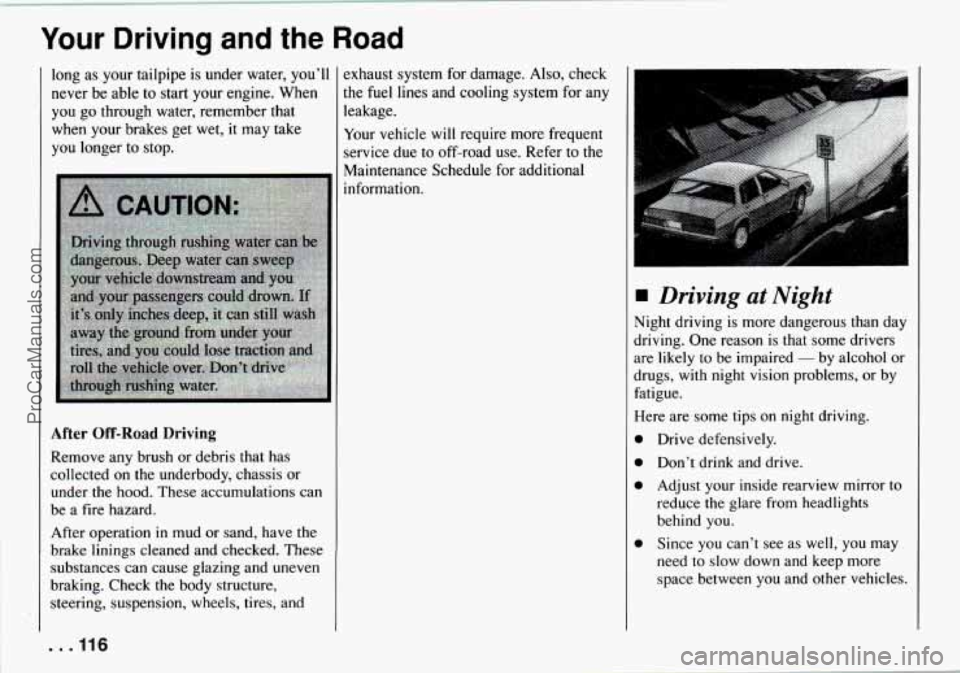
4 Driving at Night
Night driving is more dangerous than day
driving. One reason is that some drivers
are likely
to be impaired - by alcohol or
drugs, with night vision problems, or by
fatigue.
Here are some tips on night driving.
Drive defensively.
Don't drink and drive.
Adjust your inside rearview mirror to
reduce the glare from headlights
behind you.
Since you can't see as well,
you may
need to slow down and keep more space between
you and other vehicles.
. . .116
ProCarManuals.com
Page 129 of 258

Your Driving and the Road
passed vehicle before vou can return to
your lane.
Backing Up
Hold the bottom of the steering wheel
with one hand. Then, to move the trailer
to the left, just move that hand to the left.
To move
the trailer to the right, move
your hand to the right. Always back up
slowly and,
if possible, have someone
guide you.
Making Turns
When you’re turning with a trailer, make
wider turns than normal.
Do this so your
trailer won’t strike soft shoulders, curbs,
road signs, trees, or other objects. Avoid
jerky or sudden maneuvers. Signal well
in
advance.
Turn Signals When Towing a Trailer
When you tow a trailer, your vehicle has
to have a different turn signal flasher and
extra wiring. The green arrows on your
instrument panel will flash whenever you
signal a turn or lane change. Properly
hooked up, the trailer lights will also
flash, telling other drivers you’re about to
turn, change lanes or stop. When towing
a trailer, the green arrows
on your instrument panel will flash for
turns even
if the bulbs on the trailer are
burned out. Thus, you may think drivers
behind you are seeing your signal when
they are not. It’s important to check
occasionally to be sure the trailer bulbs
are still working.
Driving on Grades
Reduce speed and shift to a lower gear
before you start down a long or steep
downgrade. If you don’t shift down, you
might have to use your brakes
so much
that they would get hot and no longer
work well.
On a long uphill grade, shift down and
reduce your speed to around
45 mph
(70 km/h) to reduce the possibility of
engine and transmission overheating.
If
you are towing a trailer and you have
a manual transmission with fifth gear,
you may prefer not
to use fifth gear. Just
drive in fourth gear (or, as
you need to,
.a lower gear).
Parking on Hills
You really should not park your vehicle,
with a trailer attached, on a hill. If
something goes wrong, your
rig could start
to move. People can be injured, and
both your vehicle and the trailer can be
damaged.
But if you ever have to park
your rig on a
hill, here’s how to do it:
1. Apply your regular brakes, but don’t
shift into
“F’” (Park) yet, or into gear
for a manual transmission.
2. Have someone place chocks under the
3. When the wheel chocks are in place,
release the regular brakes until the
chocks absorb the load.
trailer wheels.
4. Reapply the regular brakes.
Then
apply your parking brake, and then
shift to
‘T” (Park), or “R” (Reverse)
for a manual transmission.
5. If you have a four-wheel-drive
vehicle, be sure the transfer case is
in
a drive gear - not in “N” (Neutral).
6. Release the regular brakes.
. .-’ . 1 28
ProCarManuals.com
Page 131 of 258

Your Driving and the Road
2. Set the parking brake.
3. If your Geo is a four-wheel-drive
vehicle, set your manual freewheeling
hubs
to ”FREE” or unlock your
automatic I‘reewheeling hubs. See “Four-wheel Drive”
in the Index.
4. Turn the ignilion key to ”ACC’‘ to
unlock the steering wheel.
5. Clamp the steering wheel in a
straight-ahead position, with a
clamping device designed for towing.
6. Release the parking brake.
I NOTICE:
I
Make sure that the towing speed does
not exceed
55 mph (90 km/h), or
your Geo could be badly damaged.
~~
Towing Your Geo from the Front
NOTICE:
If your vehicle has automatic free-
wheeling hubs
or two-wheel drive,
do not tow
it on all four wheels. If
you do, your transmission could be
damaged.
If you have a four-wheel-drive vehicle
with manual freewheeling hubs, it can be
towed from the front with
all four wheels
on the ground. Follow these steps:
1. Set the parking brake.
2. Turn the ignition key to “ACC” to
unlock the steering wheel.
3. Shift your automatic transmission into
“P” (Park), or your manual
transmission into “2” (Second).
4. Shift the transfer case to “N”
(Neutral).
“Four-wheel Drive”
in the Index.
5. Set the hubs to “FREE.” See
6. Reledse the parking brake,
Stop towing every 200 miles
(300 km)
and start the engine. Leave the transfer
case shift lever
in ”N” (Neutral). Shift
your automatic transmission
to “D”
(Drive); leave a manual transmission
in
“2” (Second) and release the clutch. Run
the engine
at medium speed for one
minute to circulate the oil in the transfer
case. Turn the ignition key to
“ACC.”
Now, you can continue towing your Geo.
I
NOTICE:
I
Make sure the towing speed does not
exceed
SO mph (80 km/h), or your
Geo could be badly damaged.
I
. . .130
ProCarManuals.com
Page 138 of 258

G
A CAUTION:
To help avoid injury to you or others:
0
i.
0
0
0
0
Never let passengers ride in a
vehicle that
is being towed.
Never
tow faster than safe or
Never tow with damaged parts
not fully secured.
Never get under
your vehicle
after
it has been lifted by the tow
truck.
Always use seperate safety
chains
on each side when towing
a vehicle.
Never use
T-hooks. Use “J”
hooks instead.
posted speeds.
When your vehicle is being towed, have
the ignition key
off. The steering wheel
should
be clamped in a straight-ahead
position, with a clamping device designed
for towing service.
Do not use the
vehicle’s steering column
lock for this.
The transmi.ssion and transfer case,
if you
have one, should be in “Neutral” and the
parking brake released.
Don’t have
your vehicle towed with the
rear wheels
in contact with the ground. If
a vehicle must be towed from the front
with sling-type or wheel lift equipment,
the rear wheels
must be supported on a
If your vehicle has four-wheel drive,
don’t have
it towed on the front wheels
unless
you must. If a vehicle with
four-wheel drive
must be towed on the
front wheels,
set your tnanual,
freewheeling hubs
to “FREE” or unlock
your automatic freewheeling hubs, and set
your transfer case to two-wheel drive. If
your vehicle must be towed on the front
wheels, don‘t
go more than 55 rnph (90
km/h).
dolly.
131 . . . ProCarManuals.com
Page 147 of 258
Problems on the Road
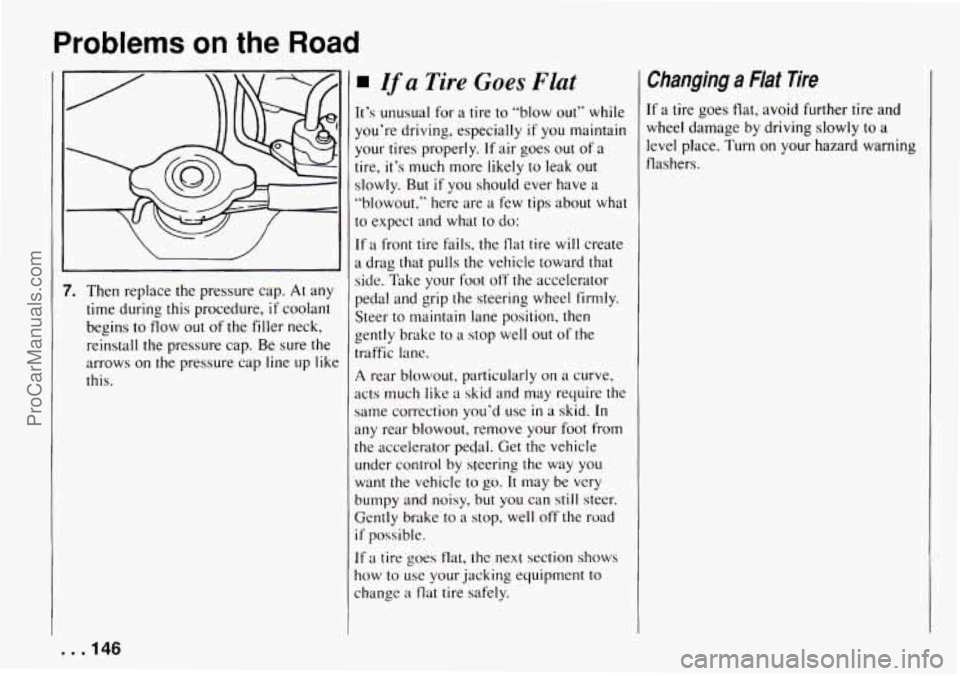
7, Then replace the pressure cap. At any
time during this procedure,
if coolant
begins
to flow out of the filler neck,
reinstall
the pressure cap. Be sure the
arrows on
the pressure cap line up like
this.
. .I46
If a Tire Goes Flat
It’s unusual for a tire to “blow out” while
you’re driving, especially
if you maintain
your tires properly.
If air goes out of a
tire, it’s much more likely to leak out
slowly.
But if you should ever have a
“blowout.” here are a few tips about what
to expect and what to do:
If a front tire Fails, the flat tire will create
a drag that pulls the vehicle toward that
side. Tdke your foot off
the accelerator
pedal and grip the steering wheel firmly.
Steer
to maintain lane position, then
gently brake to a stop well out
of the
traffic lane.
A rear blowout, particularly on a curve,
acts much like
a skid and may require the
same correction you’d use
in a skid. In
any rear blowout, remove your foot from
the accelerator pedal. Get the vehicle under control by steering
the way you
want the vehicle to go. It rnay be very
bumpy and noisy, but
you can still steer.
fently brake to a stop, well off the road
if possible.
If a tire goes tlat, the next section shows
how to use your jacking equipment
to
:hange a tlat tire safely.
Changing a Flat Tire
If a tire goes tlat, avoid further tire and
wheel damage by driving slowly
to a
level place.
Turn on your hazard warning
flashers.
ProCarManuals.com
Page 155 of 258
Problems on the Road
NOTICE:
Spinning your wheels can destroy
parts of your vehicle as well as the
tires. If you spin the wheels too fast
while shifting your transmission back
and forth, you can destroy your trans-
mission.
Rocking your vehicle to get it out:
First, turn your steering wheel left and
right. That
will clear the area around your
front wheels. Then shift back and forth
between
“R” (Reverse) and a forward
gear (or
with a manual transmission,
between First or Second gear and
Reverse), spinning the wheels as little as
possible. Release the accelerator pedal
while you shift, and press lightly on the
accelerator pedal when the transmission is
in gear. If that doesn’t get you out after a
few tries, you may need to be towed out.
Or, you can use your recovery hooks,
if
your vehicle has them. If you do need to
be towed out, see “Towing Your Vehicle”
in the Index.
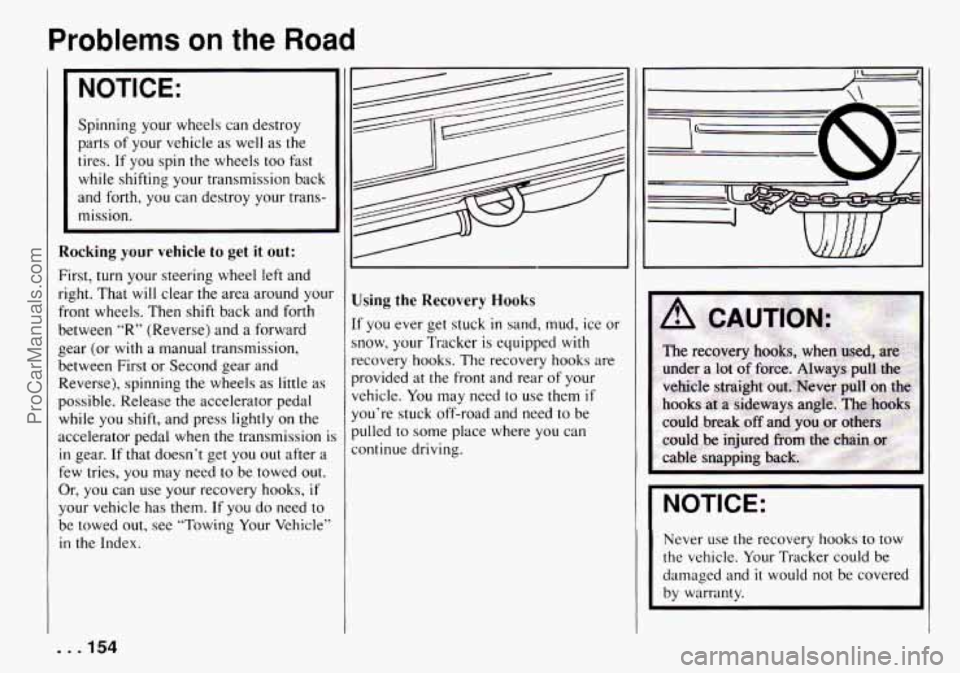
Using the Recovery Hooks
If you ever get stuck in sand, mud, ice or
snow, your Tracker is equipped
with
recovery hooks. The recovery hooks are
provided at the front
and rear of your
vehicle. You
may need to use them if
you’re stuck off-road and need to be
pulled to some place where you can
continue
driving.
NOTICE:
Never use the recovery hooks to tow
the vehicle. Your Tracker could be
darnaged
and it would not be covered
by warranty.
. . I154
ProCarManuals.com
Page 156 of 258
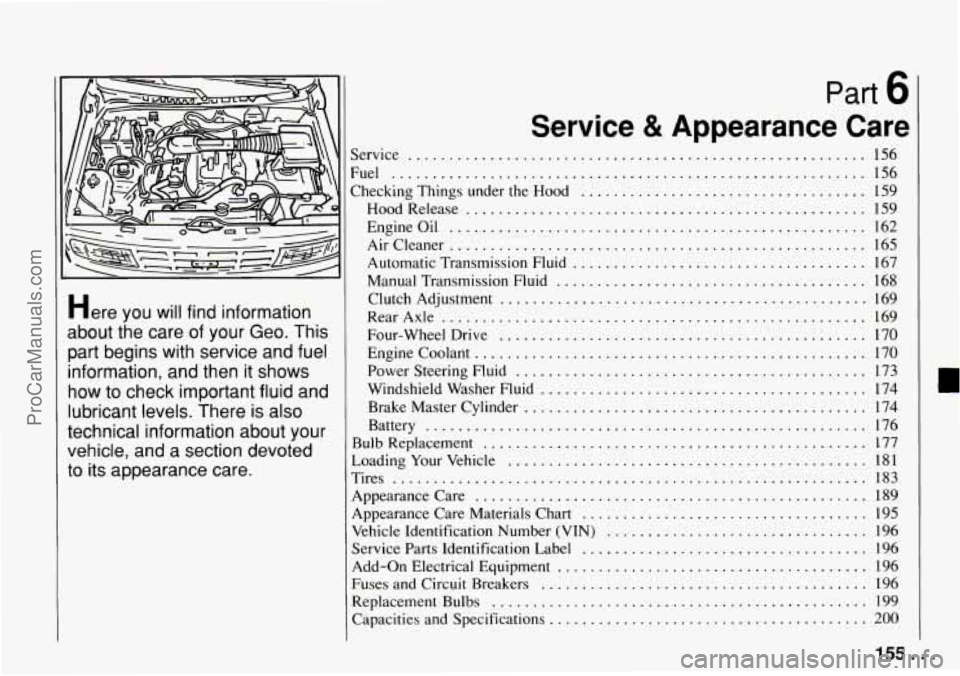
Here you will find information
about the care of your Geo
. This
part begins with service and fuel
information. and then it shows
how to check important fluid and
lubricant levels
. There is also
technical information about your
vehicle. and a section devoted
to its appearance care
.
Service & Appearance Care
Service ........................................................
Fuel ..........................................................
Checking Things under the Hood ...................................
HoodRelease .................................................
Engineoil ...................................................
Aircleaner ...................................................
Automatic Transmission Fluid ....................................
Manual Transmission Fluid ......................................
Clutch Adjustment .............................................
RearAxle ....................................................
Four-WheelDrive .............................................
Enginecoolant ................................................
Power Steering Fluid ...........................................
Windshield Washer Fluid ........................................
Brake Master Cylinder ..........................................
Bulb Replacement ...............................................
Loading Your Vehicle ..........................................
Tires ........................................................
Appearance Care Materials Chart ...................................
Vehicle Identification Number (VIN) ................................
Service Parts Identification Label ...................................
Add-on Electrical Equipment ......................................
Fuses and Circuit Breakers ........................................
Capacities and Specifications .......................................
Battery ......................................................
Appearancecare ................................................
ReplacementBulbs ..............................................
156
156
159
159
162
165
167
168
169 169
170 170
173
174
174
176 177
181
183
189 195 196
196
196
196
199
200
155 ...
ProCarManuals.com
Page 224 of 258

Maintenance Schedule
Section C: Periodic Maintenance Inspections
Listed below are inspections and services which should be performed at least twice a year (for instance, each spring and fall).
You should let your GM dealer’s service dep,artment or other qualified service center do these jobs. Make sure any necessary
repairs are completed at once.
‘7mi-
OR SERVICE
Restraint Systems
Steering, Suspension
and Front-Wheel-Drive Axle Boot and Seal
Inspection
Exhaust System
Inspection
I
Throttle Linkage
InsDection
I
WHAT SHOULD BE DONE I
Now and then, make sure all your belts, buckles, latch plates, retractors, anchorages and
reminder systems are working properly. Look for any loose parts or damage. If
you see anything
that might keep a restraint system from doing its job, have it repaired.
Inspect the froht and rear suspension and steering system for damaged, loose or missing parts,
signs of wear, or lack of lubrication. Inspect the power steering lines and hoses for proper
hookup, binding, leaks, cracks, chafing, etc. Clean and
then inspect the drive axle boot seals for
damage, tears or leakage. Replace seals if necessary.
Inspect the complete exhaust system. Inspect the body near the exhaust system.
Look for broken,
damaged, missing
or out-of-position parts as well as open seams, holes, loose connections, or
other conditions which could cause a heat build-up in the floor pan or could let exhaust fumes
into the vehicle. See “Engine Exhaust’’ in
the Index.
Inspect
the throttle linkage for interference or binding, and for damaged or missing parts.
Replace parts as needed.
I
223. I
ProCarManuals.com
Page 244 of 258
A bout Driving Your Tracker ..... 3
ABS ......................... 103
Adding Coolant ................ 171
Additives. Engine
Oil ............ 165
Adjustment. Clutch
............. 169
Air Cleaner .................... 165
Air Conditioner Controls
......... 85
Air Filter Replacement
........... 166
Air Intake Lever ................ 84
Airflow Lever
.................. 84
Alignment and Tire Balance
.
Wheel ...................... 187
Aluminum Wheels
.............. 193
AM/FM Stereo
................ 88
With Cassette Tape and Compact
Disc Player
................ 93
With Cassette Tape Player ...... 89
Antenna
...................... 98
Anti-Lock Brakes
.............. 103
To Use ..................... 103
Appearance Care ............... I89
Appearance Care and Materials
.... 195
Appearance Care. Service and
..... 155
Approaching
a Hill .............. 1 10
Ashtrays and Lighter ............ 62
Ashtray. Front
................. 63
Ashtray. Rear .................. 63
Assist Grips. Passenger .......... 62
Add-on
Electrical Equipment
..... 196
Adjustable Steering Column
...... 53
Audio Systems ................. 87
Audio Systems. Comfort
Controls and
................. 83
Automatic
Freewheeling Hubs
........... 47
Transmission
................ 42
Transmission Fluid ............ 167
Axle. Front
.................... 170
Axle
. Rear .................... 169
Babies. Smaller Children
and (Safety Belts)
............. 26
Balance. Wheel Alignment
and Tire
.................... 187
Battery
....................... 176
BBB Auto Line
- Alternative Dispute
Resolution Program. GM
Participation
in ............. 235
Before Leaving
on a Long Trip .... 120
Belt. Lap-Shoulder .............. 20
Bi-Level ...................... 84
Bin. Coinholder and ............. 61
Bins. Instrument Panel ........... 61
Blizzard. If You’re Caught in a ... 124
Box. Glove
.................... 60
Brakes
Adjustment
.................. 176
Anti-Lock (ABS)
............. 103
Fluid ....................... 1 74
Master Cylinder
.......... 174
Parking
......... 48 Brakes
Pedal Travel
................. i76
System Parts. Replacing ........ 176
System Warning Light
......... 69
Trailer ...................... i27
Wear ...................... 175
Braking (Control of
a Vehicle) ..... 102
Braking
in Emergencies .......... 104
“Break.In. .. New Vehicle ........ 39
Bright Metal Parts. Protecting
Exterior
.................... 192
Brightness Control
.............. 57
Bulb Replacement .............. 177
Stoplight .................. 181
Headlights .................. 177
Rear Combination
............ 180
Rear Sidemarker
.............. 179
Sidemarker ......... . .179
Bulbs. Halogen
............... 177
Bulbs. Replacement
............. 199
Canadian Roadside Assistance ... 237
Canvas Top
Preparing for Storage
.......... 80
Special Care for
.............. 193
Capacities and Specifications
...... 200
Carbon Monoxide .............. 51
Center High-Mounted
Front Parking and Turn Signal
... 178
Removing and Installing Your
... 76
243 ...
ProCarManuals.com