warning CHEVROLET TRACKER 1994 User Guide
[x] Cancel search | Manufacturer: CHEVROLET, Model Year: 1994, Model line: TRACKER, Model: CHEVROLET TRACKER 1994Pages: 258, PDF Size: 14.43 MB
Page 71 of 258

Features and Controls
If the light comes on while you are
driving,
pull off the road and stop
carefully. You may notice that the pedal is
harder
to push. Or, the pedal may go
closer to the floor. It may take longer to
stop. If the light is still on. have the
vehicle towed for service. (See “Towing
Your Vehicle“
in the Index.)
p CAUTION:
Your brake system may not be work-
ing properly if the brake system
warning light is on, Driving with the
brake system warning light on can
lead
to an accident. If the light is still
on after you’ve pulled off the road
and stopped carefully, have the
vehicle towed
for service.
The brake system warning light will also
come
on when you set your parking
brake, and
it will stay on if your parking
brake doesn’t release
fully. If it stays on
after your parking brake is fully released.
it means you have a brake problem.
‘ngine Coolant Temperature Gage
rhis gage shows the engine coolanl
emperature.
If the gage pointer moves to
he
”H” (red) side. your engine is too hot!
t means that your engine coolant has
)verheatcd and you should
stop your
ehicle and
turn off the engine HS soo~
Iossible.
1 as
HOT COOLANT CAN BURN YOU
BADLY!
In “Problems on the Road.” this manual
shows what to do. See ”Engine
Overheating”
in the Index.
Charging System Light
This light will come on briefly when you
turn on the ignition, but the engine is not
running, as
a check to show you it is
working. Then
it should go out when the
engine starts. If it stays on or comes on
while you are driving, you may have a
problem with the electrical charging
system.
It could indicate that you have a
loose generator drive
belt or another
electrical problem. Have
it checked right
away. Driving while this light is on could
drain
your battery.
If you must drive a short distance with
this light on,
be certain to turn off all your
accessories. such as
the radio and air
conditioner.
. . .70
ProCarManuals.com
Page 108 of 258
loss of Control
Let's review what driving experts say
about
what happens when the three
control system (brakes, steering and
acceleration) don't have enough friction
where
the tires meet the road to do what
the driver has asked.
In any emergency. don't give up. Keep
trying
to steer and constantly seek an
escape route or area
of less danger.
Skidding
In a skid. a driver can lose control of the
vehicle. Defensive drivers avoid most
skids by taking reasonable care suited
to
existing conditions. and by not
"overdriving" those conditions. But skids
are always possible.
The three types
of skids correspond to
your Geo's three control systems. In the
braking skid your wheels are.n't rolling.
In
the steering or cornering skid, too much
speed or steering
in a curve causes tires to
slip and lose cornering force. And
in the
acceleration skid too much throttle causes
the driving wheels
to spin.
A cornering skid and an acceleration skid
are best handled by easing your foot off
the accelerator pedal.
If your vehicle starts to slide, ease your
foot 011' the accelerator pedal and quickly
steer the way
you want the vehicle to go.
If you start steering quickly enough. your
vehicle
may straighten out. 41ways be
ready for
;I sccond skid if it occurs.
Of course, traction is reduced when water,
snow. ice. gravel. or other material is on
the road. For safety, you'll want to slow
down and adjust your driving
to these
conditions.
It is important to slow down
on slippery surfaces because stopping
distance will be longer
and vehicle
control more limited.
While driving on
a surface with reduced
traction.
try your best to avoid sudden
steering, acceleration,
or braking
(including engine braking by shifting
EO a
lower gear).
Any sudden changes could
cause the tires to slide. You may
not
realize the surface is slippery until yout-
vehicle is skidding. Learn
to recognize
warning clues
~ such as enough water,
ice or packed snow
on the road to make ;1
"nlir~-or.ed surf'rlce" - and slow down
when you have any doubt.
Remember: The rex-wheel anti-lock
braking system (RWAL) helps avoid
only
a rear braking skid. In a braking skid
(where the front wheels are
no longer rolling),
release enough pressure
on the
brakes to get the front wheels rolling
again. This restores steering control. Push
the brake pedal down steadily when you
have
to stop suddenly. As long as the
I'ront wheels are rolling,
you will have
sleering control.
Driving Guidelines
This multipurpose passenger vehicle is
defined as a utility vehicle in Consumer
Information Regulations issued
by the
National I-lighway Traffic Safety
Administration (NHTSA)
of the United
States Department of Transportation.
Utility vehicles have higher ground
clearance and a narrower track to make
them capable of performing
in a wide
variety
of off-road applications. Specific
design characteristics give them a higher
center of gravity than ordinary cars. An
advantage
of the higher ground clearance
is
a better view of the road allowing you
to anticipate problems. They are not
designed for cornering
at the same speeds
as conventional 2-wheel drive vehicles
any no re than low-slunl 7 .'p '-, orts cars are
designed
to perform satisfitctorily under
off-road conditions.
If at all possible,
avoid shurp turns or abrupt maneuvers.
107 ...
ProCarManuals.com
Page 120 of 258
clear room ahead, and be prepared to
have your view restricted by road
spray.
0 Have good tires with proper tread
depth. (See "Tires"
in the Index.)
City Driving
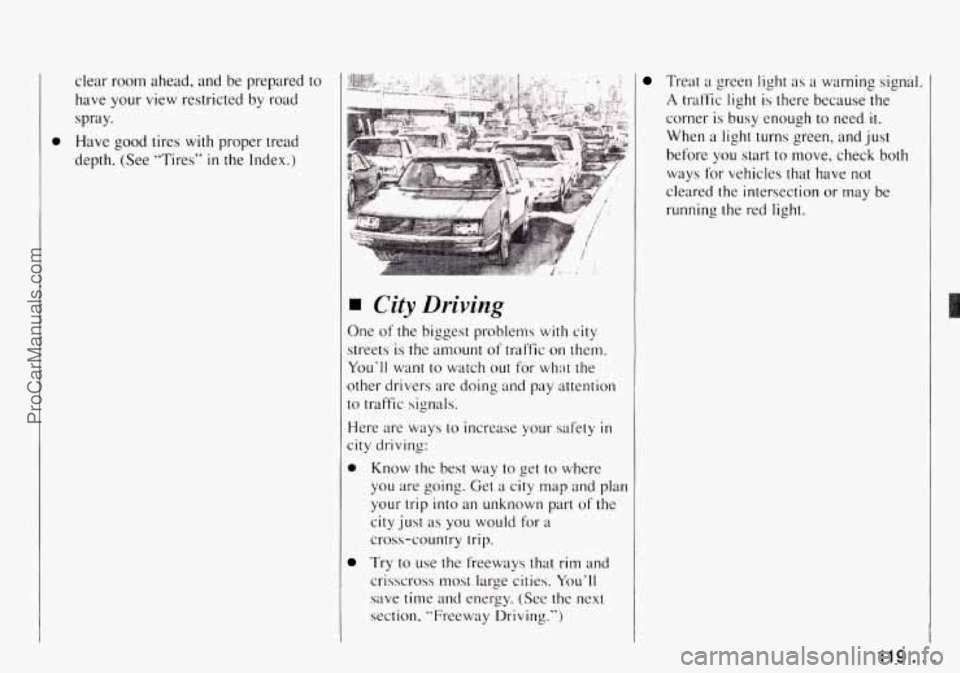
One ofthe biggest problems with city
streets is the arnount of trafl'ic
on them.
You'll want
to watch out for what the
other drivers are doing and pay attention
to traffic signals.
Here are ways to increase
your safety in
city driving:
0 Know the best way to get to where
you are going. Get
a city rnap and plan
your trip into an unknown part of the
city just
as you would for a
cross-country trip.
Try to use the freeways that rlrn and
crisscross tnost large cities.
You'll
save time and energy. (See the next
section, "Freeway Driving.")
Treat a green light as a warning signal.
A traffic light is there because the
corner is busy enough to need
it.
When a light turns green, and just
before
you start to move, check both
ways for vehicles that have not
cleared the intersection or may be
running the red light.
119.. . ProCarManuals.com
Page 124 of 258
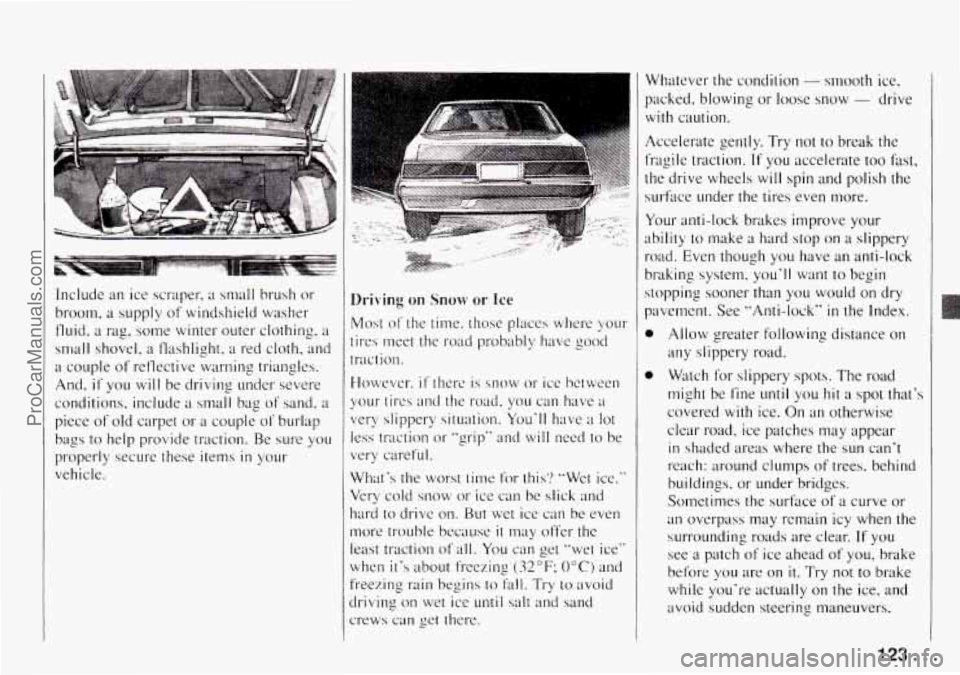
Include an ice scraper7 a small brush or
broom. a supply of windshield washer
fluid,
a rag, some winter outer clothing, a
small shovel, a flashlight, a red cloth, and
a couple of reflective warning triangles.
And,
if you will be driving under severe
conditions, include
:I small bag of sand, ;I
piece of old carpet or a couple of burlap
bags to
help provide traction. Be sure yo11
properl}, secure these item in your
vehicle.
Driving on Snow or Ice
Most of the time. those placcs where your
tires meet the road probably have good
traction.
Howe\w-.
it’ thcrc is snow or ice between
your tires antl the road, you can Iwve ;I
very slippery situation. You‘ll have ;t lot
less traction or “grip“ and will need to be
very careful.
What‘s the worst time
for this’? “Wet ice.”
Very cold snow
or ice can be slick and
hurd to drive on. Rut wet ice can be even
more trouble because
it nlay offer the
least traction
of all. You can get ”wet ice”
when it’s about freezing
(32°F; 0°C) and
freezing rain begins to fall. Try to avoid
hiving on wet ice
until salt and sand
:rews
can get there. Whatever the condition
- smooth ice.
packed. blowing or loose snow
- drive
with caution.
Accelerate gently. Try not
to break the
fragile traction. If you accelerate too fast,
the drive wheels will spin and polish the
surface under the tires even more.
Your anti-lock brakes improve your
ability
to make a hard stop on a slippery
road. Even though you have
an anti-lock
braking system.
you’ll want to begin
stopping sooner than
you would on dry
pavement.
See “Anti-lock” in the Index.
0
0
Allow greater following distance on
any slippery road.
Watch for slippery spots. The road
might be fine
until you hit H spot that’s
covered with ice.
On an otherwise
clear road. ice patches may appear
in shaded areas where the sun can’t
reach: around clumps
of trees. behind
buildings, or under bridges.
Sometimes the surftlce
of a curve or
an overpass may remain icy when the
surrounding roads are clear.
If you
see a patch of ice ahead of you, brake
before you are on
it. Try not to brake
while
you’re actually on the ice, and
avoid sudden steerins maneuvers.
123 ...
ProCarManuals.com
Page 132 of 258
D
It /A
Here you'll find what to do
about some problems that can
occur on the road.
I
Part 5
Problems on the Road
Hazard Warning Flashers ............ ............................ 132
JumpStarting .................................................... 133
Towing Yourvehicle .............................................. 136
Engine Overheating ............................................... 140
If a Tire Goes Flat ................................................ I46
If You're Stuck: In Sand, Mud, Ice or Snow ............................ IS3
131 ... ProCarManuals.com
Page 133 of 258
Problems on the Road
j
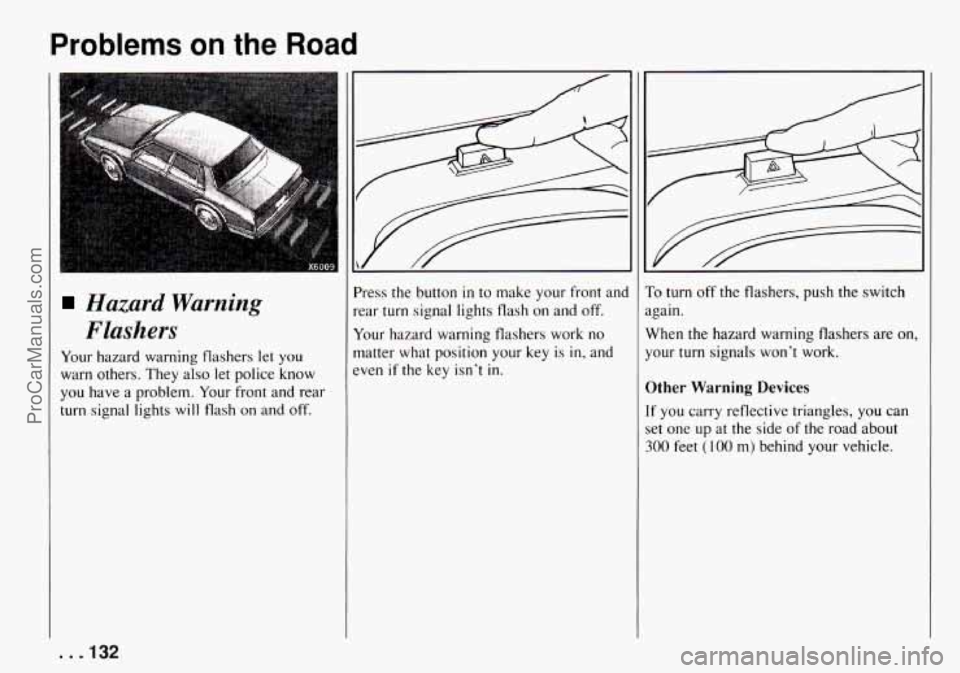
Hazard Warning
Flashers
Your hazard warning flashers let you
warn others. They also let police know
you have a problem. Your front and rear
turn signal lights
will tlash on and off. Press the button
in to make your front and
rear
turn signal lights flash on and off.
Your hazard warning flashers work no
matter what position your key
is in, and
even
if the key isn't in.
To turn off the flashers, push the switch
again.
When the hazard warning flashers are on,
your turn signals won't work.
Other Warning Devices
If you carry reflective triangles, you can
set one up at the side
of the road about
300 feet (100 m> behind your vehicle.
. . .I32
ProCarManuals.com
Page 137 of 258
Problems on the Road
h I B
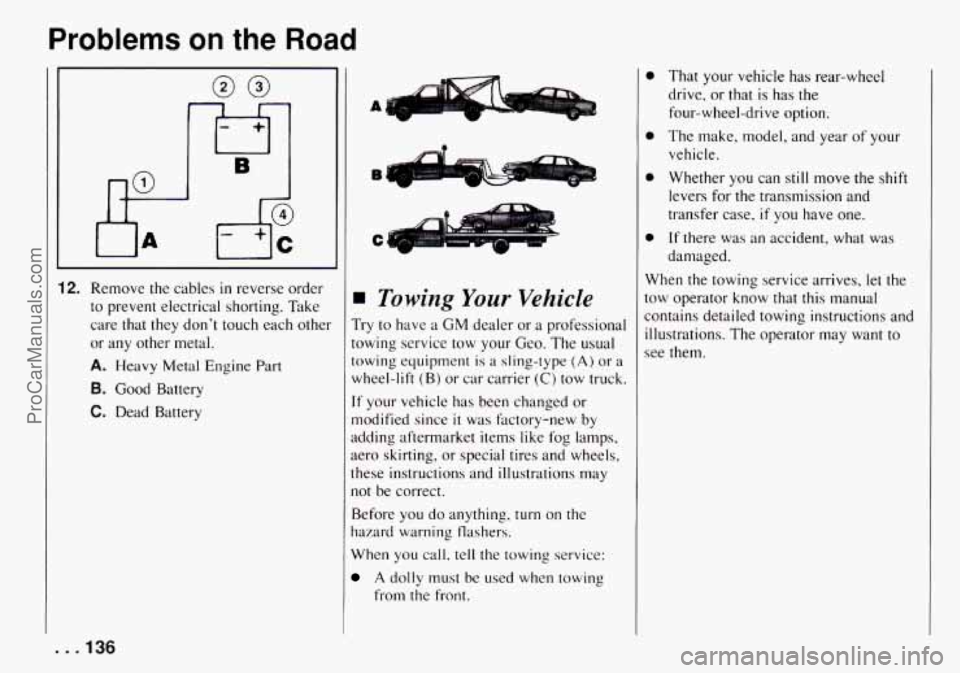
2. Remove the cables in reverse order
to prevent electrical shorting. Take
care that they don't touch each other
or any other metal.
A. Heavy Metal Engine Part
B. Good Battery
C. Dead Battery
C
Towing Your Vehicle
Try to have a GM dealer or a professional
towing service tow your Geo. The usual
towing equipment
is a sling-type (A) or a
wheel-lift (B) or car carrier (C) tow truck.
If your vehicle has been changed or
modified since
it was factory-new by
adding aftermarket items like fog lamps,
aero skirting, or special tires and wheels,
these instructions and illustrations may
not be correct.
Before you do anything, turn
on the
hazard warning flashers.
When you
call, tell the towing service:
A dolly must be used when towing
from the front.
0
e
e
That your vehicle has rear-wheel
drive, or that is has the
four-wheel-drive option.
The make, model, and year
of your
vehicle.
Whether you
can still move the shift
levers for the transmission and
transfer case,
if you have one.
If there was an accident, what was
damaged.
When the towing service arrives,
let the
tow operator know that this manual
contains detailed towing instructions and
illustrations. The operator may want to
see them.
. .I36
ProCarManuals.com
Page 141 of 258

Problems on the Road
Engine Overheating
You will find a coolant temperature gage
on your Geo instrument panel.
If Steam Is Coming from Your Engine:
NOTICE:
If your engine catches fire because
you keep driving with no coolant,
your vehicle can be badly damaged.
The costly repairs would not be cov-
ered by your warranty.
If No Steam Is Coming from Your
Engine:
If you get the overheat warning but see or
hear no steam, the problem may not be
too serious. Sometimes the engine can get
a little too hot when you:
0 Climb a long hill on a hot day.
0 Stop after high speed driving.
Idle for long periods in traffic.
Tow a trailer.
If you get the overheat warning with no
sign of steam, try this
for a minute or so:
1.
If you have an air conditioner, turn it
off.
2. Turn on your heater to full hot at the
highest fan speed and open the
window as necessary.
(Neutral).
3. If you’re in a traffic jam, shift to “N”
. . .140
ProCarManuals.com
Page 142 of 258

If you no longer have the overheat
warning, you can drive. Just to be safe,
drive slower for about
ten minutes. If the
warning doesn’t come back on,
you can
drive normally.
If the warning continues, pull over, stop,
and park your vehicle right away.
If there’s still no sign
of steam, you can
idle the engine for two or three minutes
while you’re parked, to see if the warning
stops. But then, if you still have the
warning, TURN
OFF THE ENGINE
AND GET EVERYONE OUT OF THE
VEHICLE until it cools down.
You may decide not to lift the hood but to
get service help right away.
2ooling System
Vhen you decide it’s safe to lift the hood,
lere’s what you’ll see on the 8-valve
mgine:
I. Coolant Recovery Tank
!. Radiator Pressure Cap
1. Electric Engine Fan lere’s
what you’ll see on the 16-valve
:ngine:
I. Coolant Recovery Tank
!. Radiator Pressure Cap
I. Electric Engine Fan
141 . . .
ProCarManuals.com
Page 144 of 258

~~ NOTICE:
~~~
In cold weather, water
can freeze and
crack the engine, radiator, heater core
and other parts.
Use the recom-
mended coolant. When
the coolant in the
coolant recovery
tank is at or above the
"FULL" mark.
start your vehicle.
If the overheat warning continues, there's
ope more thing you can try. You can add
the proper coolant mix directly to the
radiator, but be sure the coolink 7 . 4: y. stem
is cool before you
do it.
A CAUTION:
Steam and scalding liquids from a
hot cooling system can blow out and
burn you badly. They
are under pres-
sure, and
if you turn the radiator
pressure cap
- even a little - they can
come out
at high speed. Never turn
the cap when the
cooling system,
including the radiator pressure cap, is
hot. Wait for the cooling system and
radiator pressure
cap to cool if you
ever have to turn the pressure cap.
I
143.. ProCarManuals.com