oil CHEVROLET TRACKER 1994 Owner's Manual
[x] Cancel search | Manufacturer: CHEVROLET, Model Year: 1994, Model line: TRACKER, Model: CHEVROLET TRACKER 1994Pages: 258, PDF Size: 14.43 MB
Page 172 of 258
and refill. If you use this mixture. you
don't need to add anything else.
A CAUTION:
Adding only plain water to your
cooling system can
be dangerous.
Plain water, or some other
liquid like
alcohol, can
boil before the proper
coolant mix will. Your vehicle's
cool-
ant warning system is set for the
proper coolant
mix. With plain water
or the wrong mix, your engine could
get too hot but you wouldn't get the
overheat warning. Your engine could
catch fire and you or others could be
burned. Use a 50/50 mix of clean
water and a proper antifreeze.
NOTICE:
If you use an improper coolant mix,
your engine could overheat and be
badly damaged. The repair cost
wouldn't be covered by your war-
ranty.
Too much water in the mix can
freeze and crack the engine, radiator,
heater core and other parts. Some conditions, such
as air
trapped in
the cooling system, can af't'ect the coolant
level
in the radiator. Check the coolant
level when the engine is cold and follow
the steps under "Adding Coolant" for the
proper way
to add coolant.
If you have to add coolant Inore than four
times
a year. have your dealer check your
cooling system.
NOTICE:
If you use the proper coolant. you
don't have to add extra inhibitors
or
additives which claim to improve thc
system. These can
be harmful.
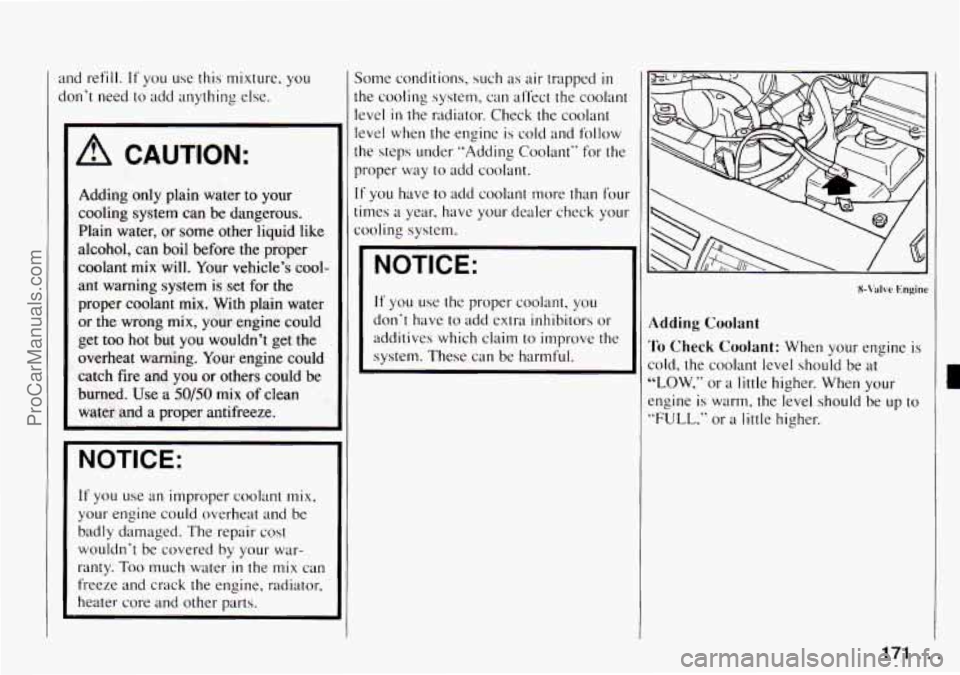
%-Valve Engine
Adding Coolant
To Check Coolant: When your engine is
cold.
the coolant level should be at
"LOW," or a little higher. When your
engine
is warm. the level should be up to
"FULL." or a little higher.
171 ..
ProCarManuals.com
Page 176 of 258
correct a leak. If you add fluid when your
linings are worn, then you’ll have too
much fluid when you get new brake
linings. You should add (or remove)
brake fluid, as necessary, only when work
is done on the brake hydraulic system.
Refer to the Maintenance Schedple to
determine when to check
yoqr drake
fluid. See “Periodic Maintenance
Inspections” in the Index.
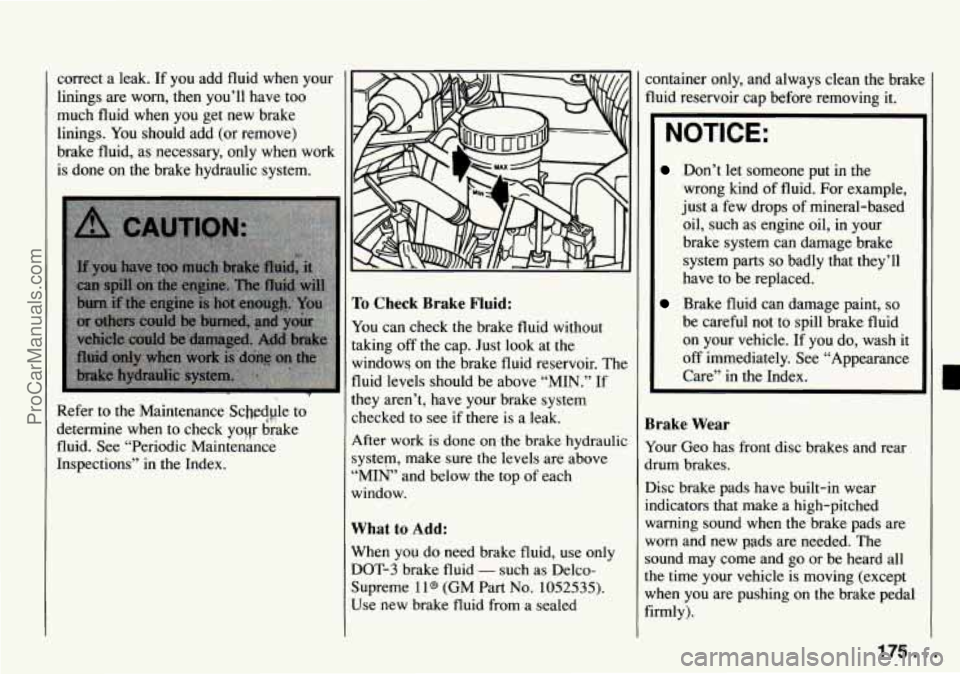
To Check Brake Fluid:
You can check the brake fluid without
taking
off the cap. Just look at the
windows on the brake fluid reservoir. The
fluid levels should be above “MIN.” If
they aren’t, have your brake system
checked to see if there is a leak.
After work is done
on the brake hydraulic
system, make sure the levels are above
“MIN’ and below the top
of each
window.
What to Add:
When you do need brake fluid, use only
DOT-3 brake fluid
- such as Delco-
Supreme 11s (GM Part
No. 1052535).
Use new brake fluid from a sealed container
only, and always clean the brakl
fluid reservoir cap before removing it.
NOTICE:
Don’t let someone put in the
wrong kind of fluid. For example,
just a few drops of mineral-based
oil, such as engine oil, in your
brake system can damage brake system parts
so badly that they’ll
have to be replaced.
Brake fluid can damage paint, so
be careful not to spill brake fluid
on your vehicle. If
you do, wash it
off immediately. See “Appearance
Care” in the Index.
Brake Wear
Your Geo has front disc brakes and rear
drum brakes.
Disc brake pads have built-in wear
indicators that make a high-pitched
warning sound when the brake pads are
worn and new pads are needed. The
sound may come and
go or be heard all
the time your vehicle is moving (except
when you are pushing on the brake pedal
firmly).
175 ...
ProCarManuals.com
Page 191 of 258
Service and Appearance Care
Use a clean cloth or sponge, and
change to
a clean area often. A soft
brush
may be used if stains are
stubborn.
Use solvent-type cleaners
in a
well-ventilated area only. If you use
them, don’t saturate the stained area.
If a ring forms after spot cleaning,
clean the entire area immediately or
it
will set.
Using Foam-Type Cleaner on Fabric
Vacuum and brush the area to remove
any loose dirt.
Always clean a whole trim panel or
section. Mask surrounding trim along
stitch or welt lines.
Mix Multi-Purpose Powdered Cleaner
following the directions on the
container label.
Use suds only and apply with a clean
sponge.
Don’t saturate the material.
Don’t rub
it roughly.
As soon as you’ve cleaned the section,
use a sponge to remove the suds.
Rinse the section
with a clean, wet
sponge.
Wipe off what’s left with a slightly
0 Then dry it immediately with a blow
damp
paper towel or cloth.
dryer or
a heat lamp.
I NOTICE:
I
Be careful with a hair dryer or heat
lamp. You could scorch the fabric.
Wipe with a clean cloth.
Using Solvent-Type Cleaner an Fabric
First, see if you have to use solvent-type
cleaner at all. Some spots and stains
will
clean off better with just water and mild
soap.
If you need to use a solvent:
0 Gently scrape excess soil from the
trim material with a clean, dull knife
or scraper. Use very
little cleaner, light
pressure and clean cloths (preferably
cheesecloth). Cleaning should start
at
the outside of the stain, “feathering”
toward the center. Keep changing
to a
clean section of the cloth.
0 When you clean a stain from fabric,
immediately dry the area
with an air
hose, hair dryer, or heat
lamp to help
prevent a cleaning ring.
(See the
previous
NOTICE.)
Fabric Protection
Your Geo has upholstery that has been
treated
with Scotchgard Fabric
Protector,
a 3M product. Scotchgard”
protects fabrics by repelling
oil and water,
which are the carriers of most
stains.
Even with this protection, you still need
to clean your upholstery often to keep
it
looking new.
Further information on cleaning
is
available by calling 1-800-433-3296
(in Minnesota, 1-800-642-6167).
Special Cleaning Problems
Greasy or
oily stains: Such as grease,
oil, butter, margarine, shoe polish, coffee
with cream, chewing gum, cosmetic
creams, vegetable oils, wax crayon, tar
and asphalt.
0 Carefully scrape off excess stain.
Follow the solvent-type instructions
described earlier.
. . .I90 ProCarManuals.com
Page 192 of 258
0 Shoe polish, wax crayon, tar and
asphalt will stain if left on a vehicle
seat fabric. They should be removed
as soon as possible. Be eareful,
because the cleaner
will dissolve
them and may cause them to spread.
Non-greasy stains: Such as catsup,
coffee (black), egg, fruit, fruit juice, milk,
soft drinks, wine, vomit, urine and blood.
Carefully scrape off excess stain, then
sponge the soiled area
with cool water.
If a stain remains, follow the
foam-type instructions described
earlier.
If an odor lingers after cleaning
vomit or urine, treat the area with
a waterhaking soda solution:
1 teaspoon (5 ml) of baking soda to
1 cup (250 ml) of lukewarm water.
solvent-type cleaner.
If needed, clean lightly with
Combination stains: Such as candy,
ice cream, mayonnaise, chili sauce and
unknown stains.
Carefully scrape off excess stain, then
0 If a stain remains, clean it with
clean with cool water and allow to dry.
solvent-type cleaner.
Cleaning Vinyl
Use warm water and a clean cloth.
0 Rub with a clean, damp cloth to
remove dirt.
You may have to do it
more than once.
Things like tar, asphalt and shoe
polish will stain
if yoa don’t get them
off quickly. Use a clean cloth and
solvent-type
vinyl cleaner.
Cleaning Leather
Use a soft cloth with lukewarm water and
a mild soap or saddle soap.
For stubborn stains, use a mild
solution of
10% isopropyl alcohol
(rubbing alchohol) and 90% water.
solvent-based or abrasive cleaners,
furniture polish
or shoe polish on
leather.
immediately.
If dirt is allowed to work
into finish,
it can harm the leather.
Never use oils, varnishes,
Soiled leather should be cleaned
ueaning the Top of the Instrument
Panel
Use only mild soap and water to clean
the top surfaces of the instrument panel.
Sprays containing silicones or waxes
may cause annoying reflections in the
windshield and even make it difficult to
see through the windshield under certain
conditions.
Care of Safety Belts
Keep belts clean and dry.
Do not; bleach or dye safety belts.
If you do, it may severely weaken
them, In a crash they might not be
able to provide adequate protection.
Clean safety belts only with mild
soap
and lukewarm water.
Glass
Glass should be cleaned often. GM Glass
Cleaner
(GM Part No. 1050427) or a
liquid household glass cleaner will
remove normal tobacco smoke and dust
films.
191 ... ProCarManuals.com
Page 195 of 258
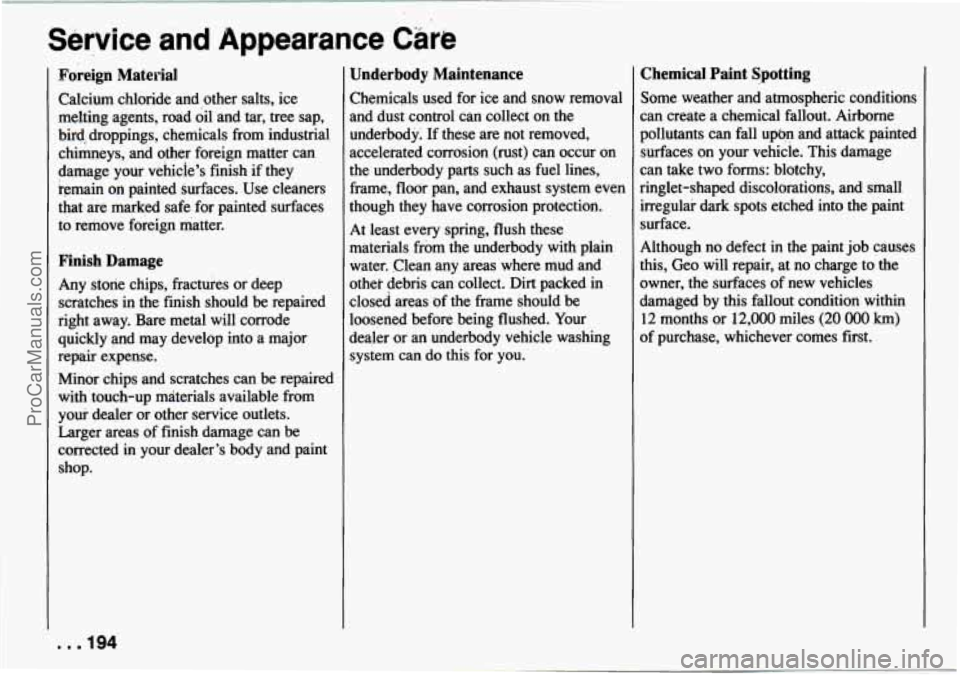
Service and Appearance Care
Foreign Material
Calcium chloride and other salts, ice
melting agents, road oil and tar,
tree sap,
bad$ droppings, chemicals from industrial
chimneys, and other foreign matter can
damage your vehicle’s finish if they
remain on painted Surfaces. Use cldners
that
&e marked safe for painted surfaces
to remove foreign matter.
Finish Damage
Any stone chips, fractui-es or deep
scratches in the finish should be repaired
right away. Bare metal will corrode
quickly and may develop into a major
repair expense.
Minor chips and scratches can be repaired
with touch-up materials available from
YOU^ dealer or other service outlets.
Larger areas
of finish damage can be
corrected in your dealer’s body and paint
shop.
Underbody Maintenance
Chemicals used for ice and snow removal
and dust control can collect on the
underbody;
If these are not removed,
accelerated corrosion (rust) can occur on
the underbody parts such as fuel lines,
frame,
floor pan, and exhaust system even
though they have corrosion protection.
At least every spring, flush these
materials
.from the underbody with plain
water. Clean any areas where mud and
othef deb& can collect.
Dirt packed in
closed areas
of the frame should be
loosened before
being flushed. Your
dealer or an underbody vehicle washing
system can do this
for you.
Chemical Paint Spotting
Some weather and atmospheric conditions
can create
a chemical fallout. Airborne
pollutants can fall up~n and attack painted
surfaces on your vehicle.
This damage
can take two forms: blotchy,
ringlet-shaped discolorations, and small
irregulai dark spots etched into the paint
surface.
Although no defect in the paint job causes
this, Geo
will repair, at no charge to the
owner, the surfaces of new vehicles
damaged by this fallout condition within
12 months or 12,000 miles (20
000 km)
of purchase, whichever comes first.
. . .I94
ProCarManuals.com
Page 200 of 258

Replacement Bulbs
Back-up ........................................................ 1156
Dome
...................................................... 96051559
Center High-Mounted Stop
........................................... 921
Front Parking and
Turn Signal .................................... 1157 NA
Headlight (Halogen) ............................................... 9004
Heater
or Air Conditioning Control ............................... 96052599
Charging System
............................................ 9433 184
Engine Oil Pressure
.......................................... 9433 184
4WD
...................................................... 9433184
Headlight High Beam
......................................... 9433 184
Instrument Cluster
............................................. 9605 156
Rear Defogger Switch ......................................... 9606 1736
Rear Hazard and
Turn Signal ........................................ 1156
Rear Wipermasher Switch
..................................... 9606 1736
Indicator and Warning
Brake
..................................................... 9433184
CheckEngine
............................................... 9433184
SafetyBelt
................................................. 9433184
Turnsignal
................................................. 9433184
Licenseplate
..................................................... 194
Lighter
...................................................... 9433184
Rearparkingandstop
............................................. 1157
Sidemarker ......................................... ............ 194
199 ...
ProCarManuals.com
Page 201 of 258
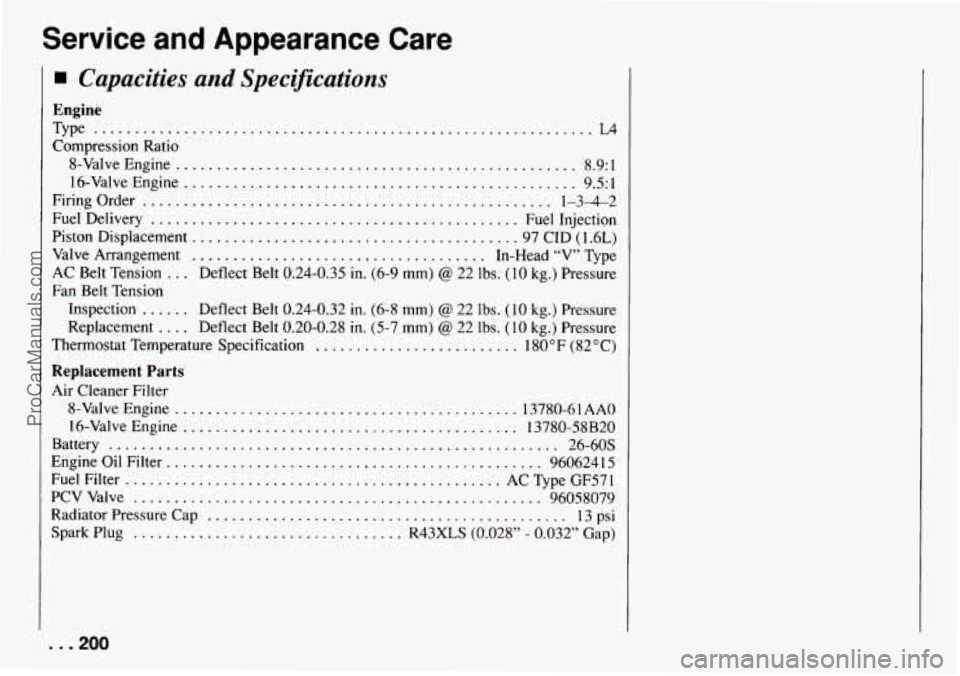
Service and Appearance Care
..........
Capacities and Specifications
Engine
Type .......................................... . * L4
Compression Ratio 8-Valve Engine
................................................. 8.9: 1
16-Valve Engine ................................................ 9.5: 1
Fuel Delivery
............................................. Fuel Injection
Piston Displacement
........................................ 97 CID (1.6L)
Valve Arrangement
.................................... In-Head “V” Type
Firingorder
.................................................. 1-342
AC Belt Tension ... Deflect
Belt 0.24-0.35 in. (6-9 mm) @I 22 lbs. (10 kg.) Pressure
Fan Belt Tension
Inspection
...... Deflect Belt 0.24-0.32 in. (6-8 mm) @ 22 lbs. (10 kg.) Pressure
Replacement
.... Deflect Belt 0.20-0.28 in. (5-7 mm) @ 22 lbs. (10 kg.) Pressure
Thermostat Temperature Specification
......................... 180°F (82°C)
Replacement Parts
Air Cleaner Filter
8-Valve Engine
.......................................... 13780-6 1 AAO
16-Valve Engine ......................................... 13780-58B20
Engine
Oil Filter .............................................. 9606241 5
Radiator Pressure Cap ............................................ 13 psi
Spark Plug ................................. R43XLS (0.028” - 0.032” Gap)
Battery
....................................................... 26-60s
Fuel Filter
.............................................. AC Type GF571
PCVValve
.................................................. 96058079
.. .200
ProCarManuals.com
Page 202 of 258
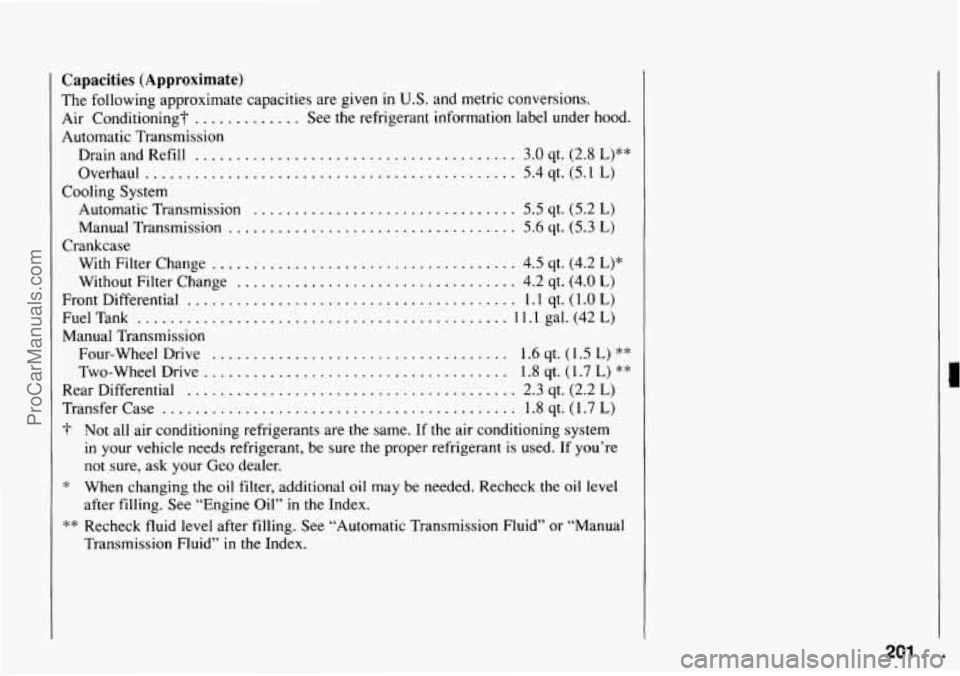
Capacities (Approximate)
The following approximate capacities are given in U.S. and metric conversions.
Air Conditioning”
............. See the refrigerant information label under hood.
Automatic Transmission Drain and Refill
....................................... 3.0 qt. (2.8 L)**
Overhaul ............................................. 5.4 qt. (5.1 L)
Automatic Transmission ................................ 5.5 qt. (5.2 L)
Manual Transmission ................................... 5.6 qt. (5.3 L)
With Filter Change ..................................... 4.5 qt. (4.2 L)*
Without Filter Change .................................. 4.2 qt. (4.0 L)
Front Differential ........................................ 1.1 qt. (1 .O L)
Fuel Tank ............................................. 11.1 gal. (42 L)
Manual Transmission
Cooling System
Crankcase
Four-wheel Drive
.................................... 1.6 qt. ( 1.5 L) **
Two-Wheel Drive ..................................... 1.8 qt. (1.7 L) **
Rear Differential ........................................ 2.3 qt. (2.2 L)
Transfer Case ........................................... 1.8 qt. ( 1.7 L)
T Not all air conditioning refrigerants are the same. If the air conditioning system
in your vehicle needs refrigerant, be sure the proper refrigerant is used. If you’re
not sure, ask your Geo dealer.
* When changing the oil filter, additional oil may be needed. Recheck the oil level
after filling. See “Engine Oil”
in the Index.
** Recheck fluid level after filling. See “Automatic Transmission Fluid” or “Manual
Transmission Fluid”
in the Index.
201 ...
ProCarManuals.com
Page 204 of 258

.
IMPORTANT:
KEEP THE ENGINE OIL
AT THE PROPER
LEVEL AND CHANGE AS
RECOMMENDED
This part covers the
maintenance required
for your
Geo . Your vehicle needs these
services to retain its safety.
dependability and emission
control performance
.
Maintenance Schec
Section
Introduction: A Word about Maintenance ........................
A .
B .
C .
D .
E .
Your Vehicle and the Environment .........................
How This Part Is Organized ............................
Scheduled Maintenance Services ........................
Using Your Maintenance Schedule .......................
Selecting the Right Schedule ............................
Schedule1 .......
Schedule11 ............................................
Owner Checks and Services .........
At Each Fuel Fill .......
At Least Once a Month .................. .......
At Least Twice a Year .........
AtLeastOnceaYear ..................................
Periodic Maintenance Inspections ...........................
Recommended Fluids and Lubricants ........................
MaintenanceRecord ......................................
................................
Explanation of Scheduled Maintenance Services ..............
....................
.........................
...................
ule
Protection
Plan
Have you purchased the GM Protection Plan? The Plan
supplements
your new car warranties .
See your GM dealer for details .
204
204
204
205
205
205
206
210
214
218
218 219
219 220
223
225
228
203 ...
ProCarManuals.com
Page 211 of 258
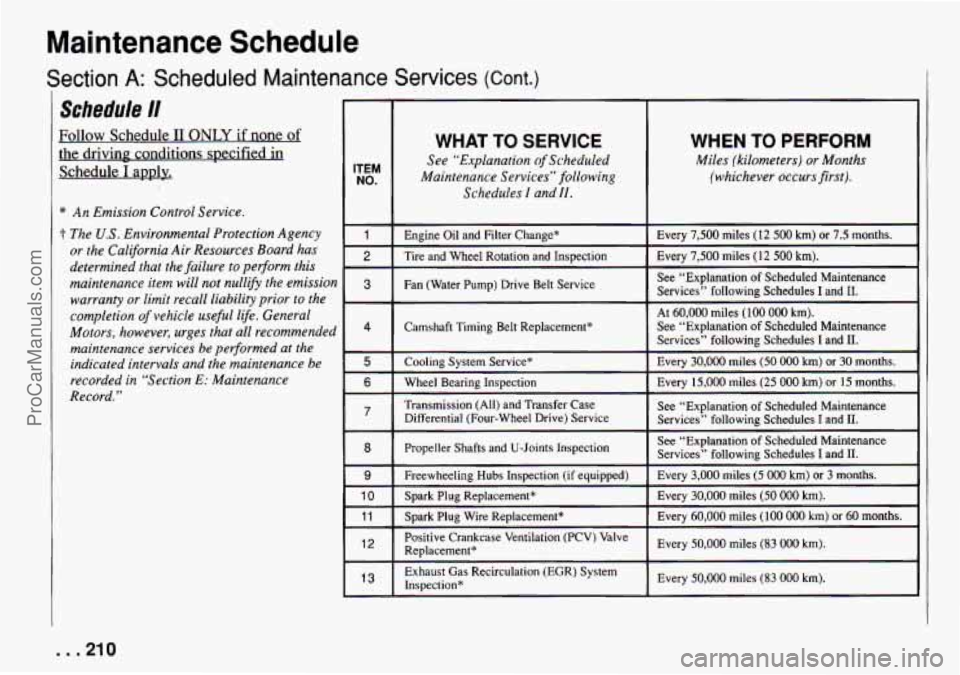
Maintenance Schedule
S ection A: Scheduled Maintenance Services (Cant.)
Schedule 11
Follow Schedule I1 ONLY if none of
the drivinp conditions specified in
Schedule
I apply.
* An Emission Control Service.
t The US. Environmental Protection Agency
or the California Air Resources Board has
determined that the-failure to pevform this
I I I
WHAT TO SERVICE
See “Explanation of Scheduled
Schedules
I and II.
ITEM NO. Maintenance Services” following
WHEN TO PERFORM
Miles (kilometers) or Months
(whichever occursFrst).
1 Engine Oil and Filter Change* Every 7,500 miles (12 500 km) or 7.5 months.
2 Tire and Wheel Rotation and Inspection Every 7,500 miles (12 500 km).
maintenance item will not nuh& the emission
warranty or limit recall liability prior to the
completion
of vehicle useful life. General
Motors, however, urges that all recommended
maintenance services be pevformed at the
indicated intervals and the maintenance be
recorded in “Section
E: Maintenance
Record.
’’
I.. 210
ProCarManuals.com