flat tire CHEVROLET TRACKER 1994 Owners Manual
[x] Cancel search | Manufacturer: CHEVROLET, Model Year: 1994, Model line: TRACKER, Model: CHEVROLET TRACKER 1994Pages: 258, PDF Size: 14.43 MB
Page 5 of 258
How to Use This Manual
How to Use This
Manual
Many people read their owner’s manual
from beginning to end when they first
receive their new vehicle. This will help
you learn about the features and controls
for your vehicle. In this manual, you’ll
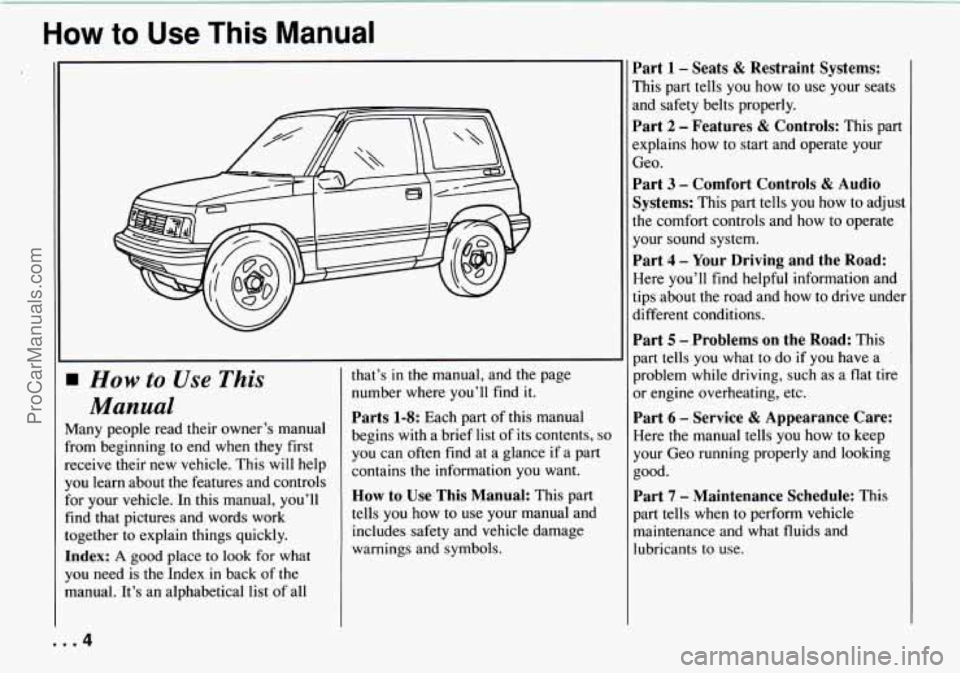
find that pictures and words work
together to explain things quickly.
Index: A good place to look for what
you need is
the Index in back of the
manual. It’s an alphabetical list of all that’s
in the manual, and the page
number where you’ll find
it.
Parts 1-8: Each part of this manual
begins with a brief list
of its contents, so
you can often find at a glance if a part
contains the information you want.
How to Use This Manual: This part
tells you how to use your manual and
includes safety and vehicle damage
warnings and symbols.
Part 1 - Seats & Restraint Systems:
This part tells you how to use your seats
and safety belts properly.
Part 2 - Features & Controls: This part
explains how to start and operate your
Geo.
Part 3 - Comfort Controls & Audio
Systems:
This part tells you how to adjust
the comfort controls and how to operate
your sound system.
Part 4 - Your Driving and the Road:
Here you’ll find helpful information and
tips about the road and how to drive under
different conditions.
Part 5 - Problems on the Road: This
part tells you what to
do if you have a
problem while driving, such as a flat tire
or engine overheating, etc.
Part 6 - Service & Appearance Care:
Here the manual tells you how to keep
your Geo running properly and looking
good.
Part 7 - Maintenance Schedule: This
part tells when
to perform vehicle
maintenance and what fluids and
lubricants to use.
... 4
ProCarManuals.com
Page 109 of 258
Your Driving and the Road
As with other vehicles of this type, failure
to operate this vehicle correctly may
result
in loss of control or vehicle
rollover.
Off-Road Driving with
Your Geo Four-wheel
Drive Vehicle
This off-road guide is for vehicles that
have four-wheel drive.
Also, see “Anti-lock Brakes”
in the Index.
If your vehicle doesn’t have four-wheel
drive, you shouldn’t drive off-road unless
you’re
on a level, solid surface.
Off-road driving can be great fun. But
it
does have some definite hazards. The
greatest of these is the terrain itself.
“Off-roading” means
you’ve left the great
North American road system behind.
Traffic lanes aren‘t marked. Curves aren’t
banked. There are no road signs. Surfwes
can be slippery, rough, uphill
or downhill.
In short, you’ve gone right back to nature.
Off-road driving involves
some new
skills. And that’s
why it’s very important
that
you read this guide. You’ll find many
driving tips and suggestions. These
will
help make your off-road driving safer and
more enjoyable.
=. .lo8
Before You Go Off-Roading
There are some things to do before you
go out. For example, be sure to have all
necessary maintenance and service work
done. Be sure you read all the information
about your four-wheel drive vehicle in
this manual. Is there enough fuel? Is the
spare tire
fully inflated‘? Are the fluid
levels up where they should
be‘? What are
the local laws
that apply to off-roacting
where you’ll be driving?
If you don’t
know, you should check with law
enforcement people
in the area. Will you
be on someone’s private land?
If so, be
sure
to get the necessary permission.
Loading Your Vehicle for Off-Road
Driving
There are some important things to
remember
about how to load your
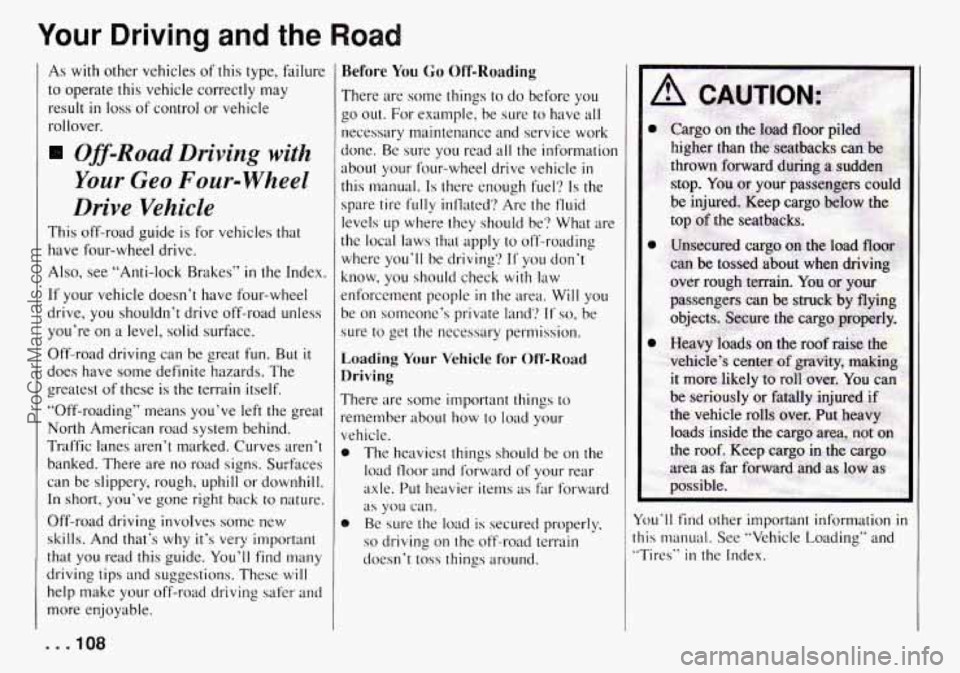
vehicle. The heavies1 things should
be on the
load floor and forward of your rear
axle. Put heavier items
as far forward
as you can.
e Be sure the load is secured properly,
so driving on the off-road terrain
doesn’t
toss things around.
You’ll find other important information in
this manual. See “Vehicle Loading” and
”Tires”
in the Index.
ProCarManuals.com
Page 122 of 258
0
0
Wiper Blades: Are they in good
shape?
Fuel, Engine Oil, Other Fluids:
Have you checked all levels?
Lights: Are they all working? Are the
lenses clean?
Tires: They are vitally important to a
safe, trouble-free trip. Is the tread
good enough for long-distance
driving? Are the tires all inflated to
the recommended pressure?
Weather Forecasts: What’s the
weather outlook along your route?
Should you delay your trip a short
time to avoid a major storm system?
Maps: Do you have up-to-date
maps?
Highway Hypnosis
Is there actually such a condition as
“highway hypnosis”? Or is it just plain
falling asleep at the wheel? Call
it
highway hypnosis, lack of awareness, or
whatever.
There is something about an easy stretch
of road with
the same scenery, along with
the hum of the tires
on the road, the drone
of the engine, and the rush of the wind
against the vehicle that can make you sleepy. Don’t let it happen
to you! If it
does, your vehicle can leave the road in
less than a second, and
you could crash
and be injured.
What can you do about highway
hypnosis? First, be aware that
it can
happen.
Then here are some tips:
0 Make sure your vehicle is well
ventilated, with a comfortably cool
interior.
0 Keep your eyes moving. Scan the
road ahead and to
the sides. Check
your mirrors and your instruments
frequently.
0 If you get sleepy, pull off the road into
a rest, service, or parking area and
take a nap, get some exercise,
or both.
For safety, treat drowsiness on the
highway as an emergency.
Hill and Mountain
Roads
Driving on steep hills or mountains is
different from driving
in flat or rolling
terrain. If you drive regularly in steep
country, or
if you’re planning to visit
there, here are some tips that can make
your trips safer and more enjoyable.
(See “Off-Road Driving” in the Index
for information about driving off-road.)
Keep your vehicle in good shape.
Check all fluid levels and also the
brakes, tires, cooling system and
transmission. These parts can work
hard
on mountain roads.
ILI . . .
ProCarManuals.com
Page 127 of 258

Your Driving and the Road
Three important considerations have to do
with weight:
Weight of the Trailer
How heavy can a trailer safely be?
It should never weigh more than 1,000
pounds (450 kg), But even that can be too
heavy.
It depends
on how you plan to use your
rig. For example, speed, altitude, road
grades, outside temperature and how
much your vehicle is used to pull a trailer
are all important. And, it can also depend
on any special equipment that you have
on your vehicle.
You can ask your dealer for our trailering
information or advice, or you can
write us
at:
Customer Assistance Department
Chevrolet/Geo
P.O.
Box 7047
Troy, MI 48007-7047
In Canada, write to:
General Motors of Canada Limited
Customer Assistance Center
1908 Colonel Sam Drive
Oshawa, Ontario L1H 8P7
A B
Weight of the Trailer Tongue
The tongue load (A) of any trailer is an
important weight to measure because it
affects the total or
gross weight of your
vehicle. The gross vehicle weight (GVW
includes the curb weight of the vehicle,
any cargo you may carry in it, and the
people who will be riding in the vehicle.
And if you will tow a trailer, you must
add the tongue load to the GVW because
your vehicle will be carrying that weight,
too. See “Loading Your Vehicle” in the
Index for more information about your
vehicle’s maximum load capacity.
If you’re using a “dead-weight” hitch, the
trailer tongue
(A) should weigh 10% of
the total loaded trailer weight
(B). If you
have a “weight-distributing” hitch, the :railer tongue
(A) should weigh 12% of
;he
total loaded trailer weight (B).
After you’ve loaded your trailer, weigh
the trailer and then the tongue, separately,
to see if the weights are proper. If they
uen’t, you may be able to get them right
simply by moving some items around
in
the trailer.
Total Weight on Your Vehicle’s Tires
Be sure your vehicle’s tires are inflated to
the limit for cold tires. You’ll find these
numbers
on the Certification label at the
rear edge of the driver’s door
or see “Tire
Loading” in the Index. Then be sure you
don’t
go over the GVW limit for your
vehicle.
Hitches
It’s important to have the correct hitch
equipment. Crosswinds, large trucks
going by, and rough roads are a few
reasons why you’ll need the right hitch.
Here are some rules to follow:
0 If you use a step bumper hitch, and
your trailer tongue has a V-shaped
foot, your bumper could be damaged
in sharp turns. Check the distance
from the front edge
of the foot to the
middle
of the hitch ball socket. If the
. . ,126
ProCarManuals.com
Page 132 of 258
D
It /A
Here you'll find what to do
about some problems that can
occur on the road.
I
Part 5
Problems on the Road
Hazard Warning Flashers ............ ............................ 132
JumpStarting .................................................... 133
Towing Yourvehicle .............................................. 136
Engine Overheating ............................................... 140
If a Tire Goes Flat ................................................ I46
If You're Stuck: In Sand, Mud, Ice or Snow ............................ IS3
131 ... ProCarManuals.com
Page 147 of 258
Problems on the Road
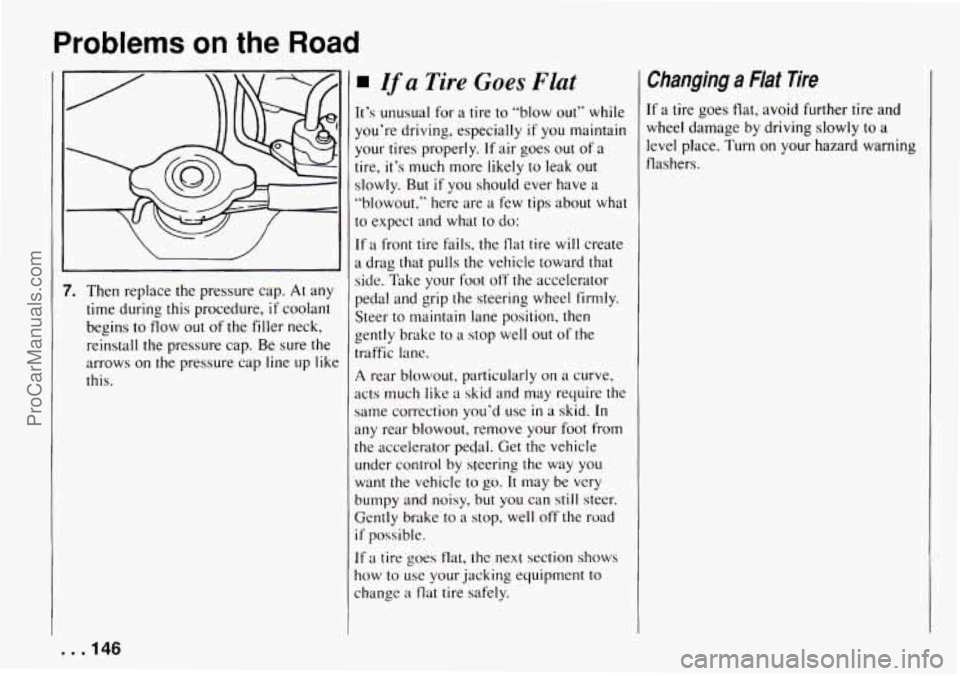
7, Then replace the pressure cap. At any
time during this procedure,
if coolant
begins
to flow out of the filler neck,
reinstall
the pressure cap. Be sure the
arrows on
the pressure cap line up like
this.
. .I46
If a Tire Goes Flat
It’s unusual for a tire to “blow out” while
you’re driving, especially
if you maintain
your tires properly.
If air goes out of a
tire, it’s much more likely to leak out
slowly.
But if you should ever have a
“blowout.” here are a few tips about what
to expect and what to do:
If a front tire Fails, the flat tire will create
a drag that pulls the vehicle toward that
side. Tdke your foot off
the accelerator
pedal and grip the steering wheel firmly.
Steer
to maintain lane position, then
gently brake to a stop well out
of the
traffic lane.
A rear blowout, particularly on a curve,
acts much like
a skid and may require the
same correction you’d use
in a skid. In
any rear blowout, remove your foot from
the accelerator pedal. Get the vehicle under control by steering
the way you
want the vehicle to go. It rnay be very
bumpy and noisy, but
you can still steer.
fently brake to a stop, well off the road
if possible.
If a tire goes tlat, the next section shows
how to use your jacking equipment
to
:hange a tlat tire safely.
Changing a Flat Tire
If a tire goes tlat, avoid further tire and
wheel damage by driving slowly
to a
level place.
Turn on your hazard warning
flashers.
ProCarManuals.com
Page 150 of 258

The spare tire is mounted on your tailgate
Pull the cover off of the spare tire. .nsert your key into the wheel lock on
the
;pare tire and pull the wheel lock off. Remove wheel nuts with the wheel
wrench.
Remove the
spare tire from the mounting
bracket and place
it near your flat tire.
Attach the jack handle
to the jack bolt.
Turn the jack handle clockwise (to the
right). That will raise the lift head a little.
149 ... ProCarManuals.com
Page 152 of 258
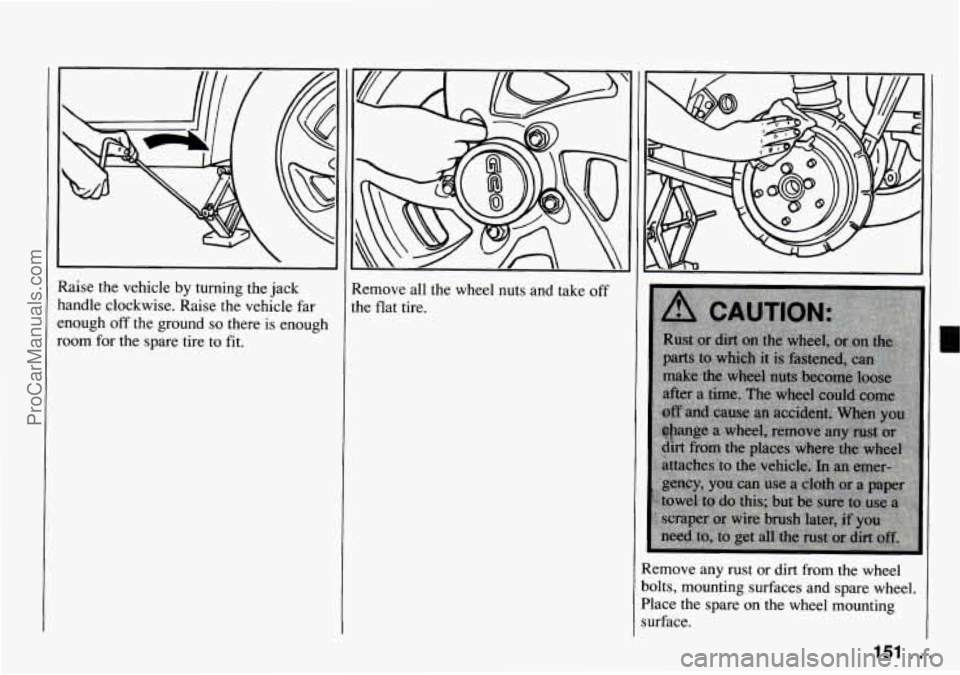
Raise the vehicle by turning the jack
handle clockwise. Raise the vehicle far
enqugh
off the ground so there is enough
room for the spare tire to fit. Remove all
the wheel nuts and take off
the
flat tire.
Remove any
rust or dirt from the wheel
bolts, mounting surfaces and spare wheel.
Place the spare on the wheel mounting
surface.
151 ...
ProCarManuals.com
Page 154 of 258
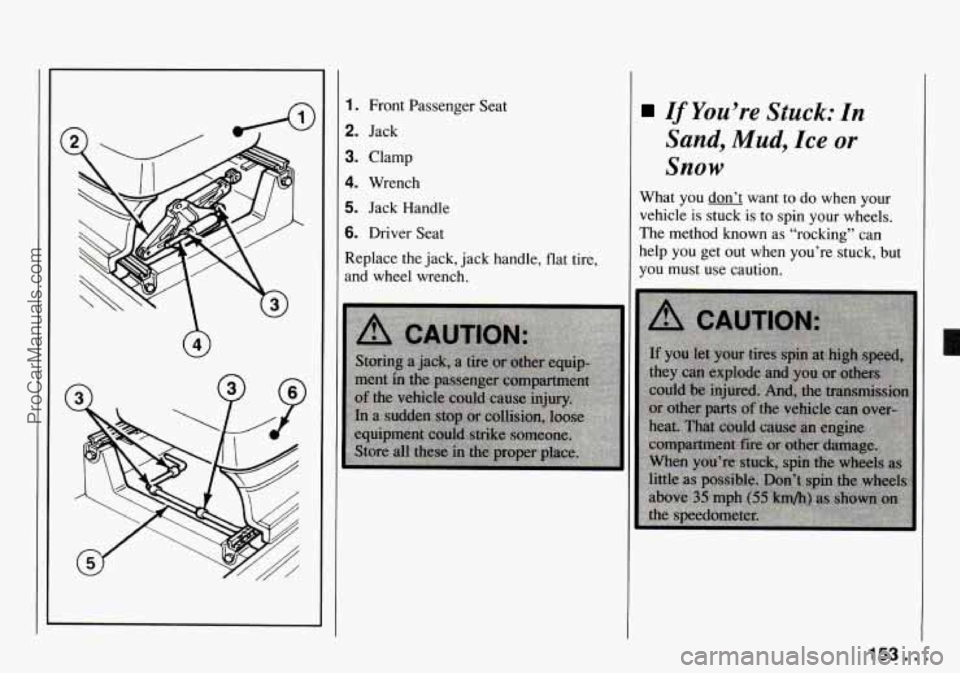
1. Front Passenger Seat
2. Jack
3. Clamp
4. Wrench
5. Jack Handle
6. Driver Seat
Replace the jack, jack handle, flat tire,
and wheel wrench.
If You’re Stuck: In
Sand, Mud, Ice or
Snow
What you don’t want to do when your
vehicle
is stuck is to spin your wheels.
The method known as “rocking” can
help you get out when you’re stuck, but
you must use caution.
153 ... ProCarManuals.com
Page 182 of 258

:enter High-Mounted Stoplight
Hardtop)
i, remove the bulb:
. Remove the side pins.
!. Pull the housing forward.
1. Turn the socket counterclockwise and
pull
it out.
I. Pull the bulb out of the socket.
i. Reverse the steps with a new bulb.
ll
GVWR ~GAWR FRT GAWR RR
I TIRES I
I PRESSURE COLD PSl!kPa I
IJ
Center High-Mounted Stoplight
(Convertible)
To remove the bulb:
1, Remove the two screws and the lens
housing.
pull
it out.
2. Turn the socket counterclockwise and
3. Pull the bulb out of the socket.
4. Reverse the steps with a new bulb.
Loading Your Vehicle
Two labels on your vehicle show how
much weight
it may properly carry. The
Tire-Loading Information label found
on
the driver’s door lock pillar tells you the
proper size, speed rating and
recommended inflation pressures for the
tires on your vehicle.
It also gives you
important information about the number
of people that can be
in your vehicle and
the total weight that
you can carry. This
weight is called the Vehicle Capacity
Weight and includes the weight
of all
occupants, cargo, and all
nonfactory-installed options.
181 . . .
ProCarManuals.com