oil change CHEVROLET TRACKER 1994 Owners Manual
[x] Cancel search | Manufacturer: CHEVROLET, Model Year: 1994, Model line: TRACKER, Model: CHEVROLET TRACKER 1994Pages: 258, PDF Size: 14.43 MB
Page 166 of 258

Engine Oil Additives
Don’t add anything to your oil. Your Geo
dealer is ready to advise
if you think
something should be added.
When to Change Engine Oil
See if any one of these is true for you:
Most trips are less than 4 miles (6 km).
It’s below freezing outside and most
trips are less than 10 miles (1 6 km).
The engine is at low speed most of the
time (as
in door-to-door delivery, or
stop-and-go traffic).
You tow a trailer often.
Most trips are through dusty places.
The vehicle is frequently operated
If any one of these is true for your
vehicle, then you need to change your
and filter every
3,000 miles (5 000 km) or
3 months - whichever comes first.
If none of them is true, change oil and
filter every
7,500 miles (1 2 500 km) or
7.5 months - whichever comes first.
off-road.
Engine
Coolant Heater (Engine Block
Heater)
An engine coolant heater can be a big
help
if you have to park outside in very
cold weather,
0°F (-I 8°C) or colder. If
your vehicle has this option, see “Engine
Coolant Heater”
in the Index.
What to Do with Used Oil
Did you know that used engine oil
contains elements that may be unhealthy
for your skin and could even cause
cancer? Don’t let used oil stay on your
skin for very long. Clean your skin and
nails
with soap and water, or a good hand
cleaner. Wash or properly throw away
clothing or rags containing used engine
oil. (See the manufacturer’s warnings
about
the use and disposal of oil products.)
Used oil can
be a real threat to the
environment.
If you change your own oil,
be sure
to drain all free-tlowing oil from
the filter before disposal. Don’t ever
dispose of oil by putting
it in the trash,
pouring
it on the ground, into sewers, or
into streams or bodies
of water. Instead.
recycle
it by taking it to a place that
collects used
oil. If you have a problem
properly disposing.
of your used oil, ask
your dealer,
a service station or a local
recycling center for help.
Air Cleaner
Refer to the Maintenance Schedule to
detertnine when to replace the
air filter.
See “Scheduled Maintenance Services“
ir
the Index.
A CAUTION:
Operating the engine with the air
cleaner off can cause you or others to
be burned. The air cleaner not only.
cleans the air,
it stops flame if the
engine backfires.
If it isn’t there, and
the engine backfires, you could be
burned. Don’t drive with it
off, and
be careful working
on the engine
with the
air cleaner off.
165.
ProCarManuals.com
Page 168 of 258
I A utomatic Transmission FIuid
When to Check and Change
A good time to check your automatic
transmission fluid level
is when the
engine
oil is changed. Refer to the
Maintenance Schedule to determine when
to change your fluid. See “Scheduled
Maintenance Services”
in the Index.
How to Check
Because this operation can be a little
difficult, you may choose to have
this
done at your Geo dealership Service
Department.
If you do
it yourself, be sure to follow all
the instructions here, or you could get a
false reading on the dipstick.
NOTICE:
Too much or too little tluid can
damage your transmission.
Too much
can mean that some of the fluid could
come out and fall on hot engine parts
or exhaust system parts, starting
a fire.
Be sure to get an accurate reading
if
you check your transmission tluid. Wait
at least 30 minutes before checking
the transmission fluid level
if you have
been driving:
0 When outside temperatures are above
0 At high speed for quite a while.
0 In heavy traffic - especially in hot
While pulling a trailer.
To get the right reading, the fluid should
be at normal operating temperature,
which is 180°F to 200°F
(82°C to 93°C).
To check transmission fluid hot: Get the
vehicle warmed
up by driving about IS
miles (24 km) when outside temperatures
are above 50°F
( 10°C). If it’s colder than
50°F (IOOC), drive the vehicle in “D”
(Third Gear) until the engine temperature
gage moves
and then remains steady for
ten minutes. Then follow the hot check
procedures.
To check transmission fluid cold: A cold
check is made after the vehicle has been
sitting for eight hours or more
with the
engine off
and is used only as a reference.
Let
the engine run at idle for five minutes
if outside temperatures are 50°F (10°C)
or more. If it’s colder than 50°F (IO’C),
you
may have to idle the engine longer.
90°F (32°C).
weather. Should
the
fluid level be low during a
cold check, you must perform a hot check
before adding fluid. This will give you a
more accurate reading
of the fluid level.
To check the fluid hot or cold
0 Park your vehicle on a level place.
0 With the parking brake applied, place
0 With your foot on the brake pedal,
Keep the
engine running.
the shift lever
in “P’ (Park).
move the shift lever through each gear
range, pausing for about three seconds
in each range. Then, position the shift
lever
in “P” (Park).
minutes or more.
0 Let the engine run at idle for three
167.,
ProCarManuals.com
Page 169 of 258
Service and Appearance Care
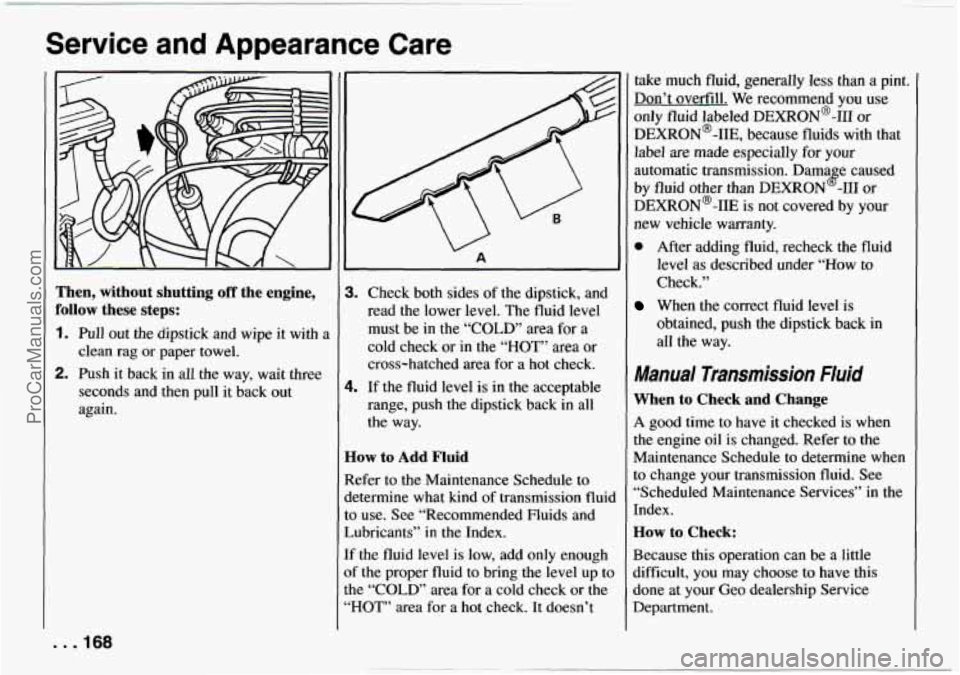
Then, without shutting off the engine,
follow these steps:
1. Pull out the dipstick and wipe it with a
clean rag or paper towel.
2. Push it back in all the way, wait three
seconds and then pull it back out
again.
. . .I68
~
3. Check both sides of the dipstick, and
read the lower level. The fluid level
must be in the “COLD’ area for a
cold check or
in the “HOT” area or
cross-hatched area for a hot check.
4. If the fluid level is in the acceptable
range, push the dipstick back
in all
the way.
How to Add Fluid
Refer to the Maintenance Schedule to
determine what kind of transmission fluid
to use. See “Recommended Fluids and
Lubricants”
in the Index.
[f the fluid level is low, add only enough
of the proper fluid to bring the level up to
the “COLD” area for a cold check or the
“HOT” area for a hot check. It doesn’t take
much fluid, generally less than a
pint.
Don’t overfill. We recommend you use
only fluid labeled DEXRON@-III
or
DEXRON@-IIE, because fluids with that
label are made especially for
your
automatic transmission. Dama e caused
by fluid other than DEXRON
8 -m or
DEXRON@-IIE is not covered by your
new vehicle warranty.
0 After adding fluid, recheck the fluid
level as described under “How to
Check.”
obtained, push
the dipstick back in
all the way.
When the correct fluid level is
Manual Transmission Fluid
When to Check and Change
A good time to have it checked is when
the engine oil is changed. Refer to the
Maintenance Schedule to determine when
to change your transmission fluid. See
“Scheduled Maintenance Services”
in the
Index.
How to Check:
Because this operation can be a little
difficult, you may choose to have this
done at your Geo dealership Service
Department.
ProCarManuals.com
Page 171 of 258
~~
~~ ~ ~~~~ ~ Service and Appearance Care
Four- Wheel Drive
Most
lubricant checks in this section also
apply to four-wheel-drive vehicles.
However, they have
two additional
systems that need lubricatiog.
Transfer Case
When to Check qnd Change Lubricant
Refer to the Maintenance Schedule to
determine how often to check the
lubricant and when to change
it. See
“Scheduled Maintenance Services”
in the
Index.
How to Check Lubricant
If the level is below the bottom of the
filler plug hole, you’ll need to add some
lubricant. Add enough lubricant to raise
the level to the bottom of the filler plug
hole.
What to Use
Refer to the Maintenance Schedule to
determine what kind of lybricant to use.
See “Recommended Fluids and
Lubricants”
in the Index.
Front Axle
When
to Check and Change Lubricant
Refer to the Maintenance Schedule to a
determine how often to check the
lubricant and when to change it. See
“Periodic Maintenance Inspections” and
“Scheduled Maintenance Services”
in the
Index.
How to Check Lubricant
If the level is below the bottom of the
filler plug hole, you’ll need to add some
lubricant.
If the differential is at operating
temperature (warm), add enough lubricant
to raise the level to the bottom of the filler
plug hole.
If the differential
is cold, add enough
lubricant to raise the level to
1/2 inch (12
mm) below the filler plug hole.
What to Use
Refer to the Maintenance Schedule to
determine
what kind of lubricant to use.
See “Recommended Fluids and
Lubricants”
in the Index.
Engine Coolant
The following explains your cooling
system and how to add coolant when it is
low. If you have a problem with engine
overheating, see “Engine Overheating”
in
the Index.
The proper coolant for your Geo will:
Give freezing protection down to
-20°F (-29”C), or -34°F (-37°C)
in
Canada and for vehicles with the cold
climate option.
Give boiling protection up to 258°F
(125°C).
Protect against rust and corrosion.
Help keep the proper engine
temperature.
Let the warning lights work as they
should.
What to Use:
Use a mixture of one-half clean water
(preferably distilled) and one-half
antifreeze that meets “GM Specification
6038-M,” which won’t damage aluminum
parts.
You can also use a recycled coolant
conforming to
“GM Specification
6038-M”
with a complete coolant flush
. . .I70
ProCarManuals.com
Page 191 of 258
Service and Appearance Care
Use a clean cloth or sponge, and
change to
a clean area often. A soft
brush
may be used if stains are
stubborn.
Use solvent-type cleaners
in a
well-ventilated area only. If you use
them, don’t saturate the stained area.
If a ring forms after spot cleaning,
clean the entire area immediately or
it
will set.
Using Foam-Type Cleaner on Fabric
Vacuum and brush the area to remove
any loose dirt.
Always clean a whole trim panel or
section. Mask surrounding trim along
stitch or welt lines.
Mix Multi-Purpose Powdered Cleaner
following the directions on the
container label.
Use suds only and apply with a clean
sponge.
Don’t saturate the material.
Don’t rub
it roughly.
As soon as you’ve cleaned the section,
use a sponge to remove the suds.
Rinse the section
with a clean, wet
sponge.
Wipe off what’s left with a slightly
0 Then dry it immediately with a blow
damp
paper towel or cloth.
dryer or
a heat lamp.
I NOTICE:
I
Be careful with a hair dryer or heat
lamp. You could scorch the fabric.
Wipe with a clean cloth.
Using Solvent-Type Cleaner an Fabric
First, see if you have to use solvent-type
cleaner at all. Some spots and stains
will
clean off better with just water and mild
soap.
If you need to use a solvent:
0 Gently scrape excess soil from the
trim material with a clean, dull knife
or scraper. Use very
little cleaner, light
pressure and clean cloths (preferably
cheesecloth). Cleaning should start
at
the outside of the stain, “feathering”
toward the center. Keep changing
to a
clean section of the cloth.
0 When you clean a stain from fabric,
immediately dry the area
with an air
hose, hair dryer, or heat
lamp to help
prevent a cleaning ring.
(See the
previous
NOTICE.)
Fabric Protection
Your Geo has upholstery that has been
treated
with Scotchgard Fabric
Protector,
a 3M product. Scotchgard”
protects fabrics by repelling
oil and water,
which are the carriers of most
stains.
Even with this protection, you still need
to clean your upholstery often to keep
it
looking new.
Further information on cleaning
is
available by calling 1-800-433-3296
(in Minnesota, 1-800-642-6167).
Special Cleaning Problems
Greasy or
oily stains: Such as grease,
oil, butter, margarine, shoe polish, coffee
with cream, chewing gum, cosmetic
creams, vegetable oils, wax crayon, tar
and asphalt.
0 Carefully scrape off excess stain.
Follow the solvent-type instructions
described earlier.
. . .I90 ProCarManuals.com
Page 202 of 258
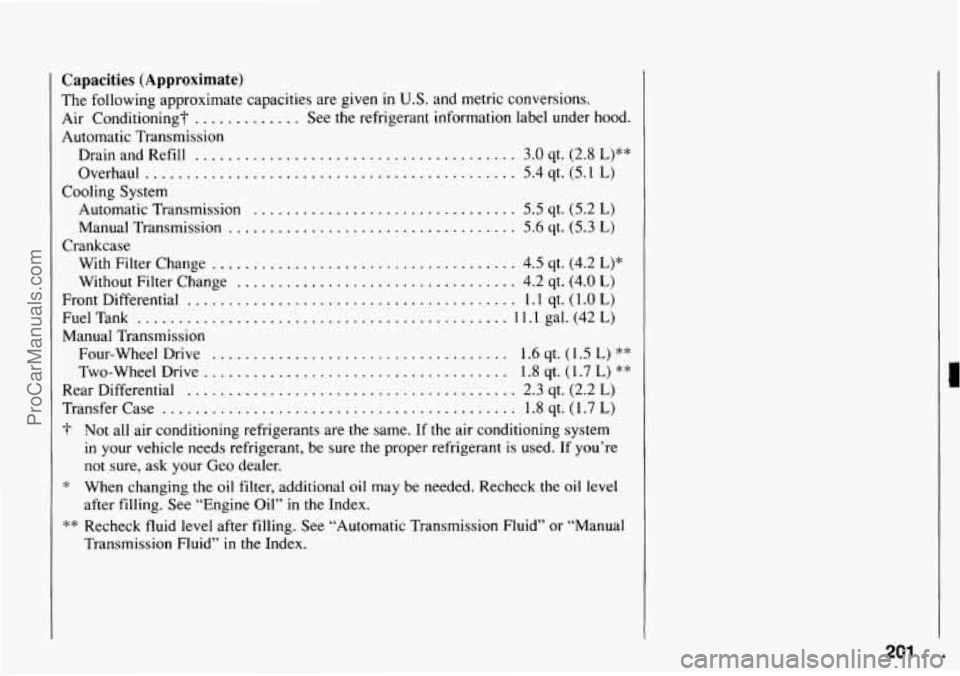
Capacities (Approximate)
The following approximate capacities are given in U.S. and metric conversions.
Air Conditioning”
............. See the refrigerant information label under hood.
Automatic Transmission Drain and Refill
....................................... 3.0 qt. (2.8 L)**
Overhaul ............................................. 5.4 qt. (5.1 L)
Automatic Transmission ................................ 5.5 qt. (5.2 L)
Manual Transmission ................................... 5.6 qt. (5.3 L)
With Filter Change ..................................... 4.5 qt. (4.2 L)*
Without Filter Change .................................. 4.2 qt. (4.0 L)
Front Differential ........................................ 1.1 qt. (1 .O L)
Fuel Tank ............................................. 11.1 gal. (42 L)
Manual Transmission
Cooling System
Crankcase
Four-wheel Drive
.................................... 1.6 qt. ( 1.5 L) **
Two-Wheel Drive ..................................... 1.8 qt. (1.7 L) **
Rear Differential ........................................ 2.3 qt. (2.2 L)
Transfer Case ........................................... 1.8 qt. ( 1.7 L)
T Not all air conditioning refrigerants are the same. If the air conditioning system
in your vehicle needs refrigerant, be sure the proper refrigerant is used. If you’re
not sure, ask your Geo dealer.
* When changing the oil filter, additional oil may be needed. Recheck the oil level
after filling. See “Engine Oil”
in the Index.
** Recheck fluid level after filling. See “Automatic Transmission Fluid” or “Manual
Transmission Fluid”
in the Index.
201 ...
ProCarManuals.com
Page 204 of 258

.
IMPORTANT:
KEEP THE ENGINE OIL
AT THE PROPER
LEVEL AND CHANGE AS
RECOMMENDED
This part covers the
maintenance required
for your
Geo . Your vehicle needs these
services to retain its safety.
dependability and emission
control performance
.
Maintenance Schec
Section
Introduction: A Word about Maintenance ........................
A .
B .
C .
D .
E .
Your Vehicle and the Environment .........................
How This Part Is Organized ............................
Scheduled Maintenance Services ........................
Using Your Maintenance Schedule .......................
Selecting the Right Schedule ............................
Schedule1 .......
Schedule11 ............................................
Owner Checks and Services .........
At Each Fuel Fill .......
At Least Once a Month .................. .......
At Least Twice a Year .........
AtLeastOnceaYear ..................................
Periodic Maintenance Inspections ...........................
Recommended Fluids and Lubricants ........................
MaintenanceRecord ......................................
................................
Explanation of Scheduled Maintenance Services ..............
....................
.........................
...................
ule
Protection
Plan
Have you purchased the GM Protection Plan? The Plan
supplements
your new car warranties .
See your GM dealer for details .
204
204
204
205
205
205
206
210
214
218
218 219
219 220
223
225
228
203 ...
ProCarManuals.com
Page 211 of 258
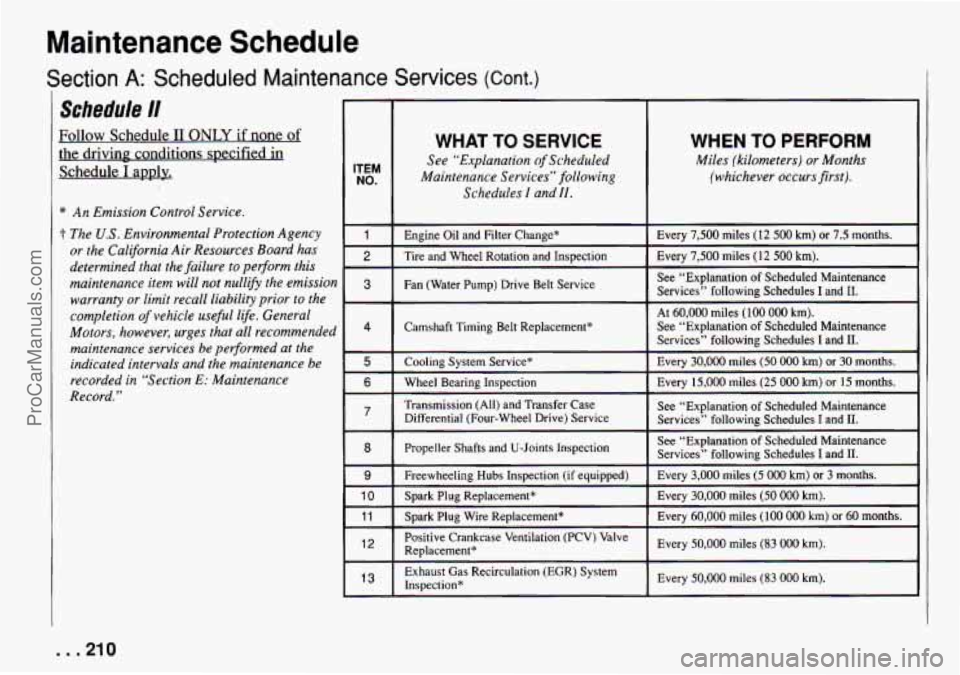
Maintenance Schedule
S ection A: Scheduled Maintenance Services (Cant.)
Schedule 11
Follow Schedule I1 ONLY if none of
the drivinp conditions specified in
Schedule
I apply.
* An Emission Control Service.
t The US. Environmental Protection Agency
or the California Air Resources Board has
determined that the-failure to pevform this
I I I
WHAT TO SERVICE
See “Explanation of Scheduled
Schedules
I and II.
ITEM NO. Maintenance Services” following
WHEN TO PERFORM
Miles (kilometers) or Months
(whichever occursFrst).
1 Engine Oil and Filter Change* Every 7,500 miles (12 500 km) or 7.5 months.
2 Tire and Wheel Rotation and Inspection Every 7,500 miles (12 500 km).
maintenance item will not nuh& the emission
warranty or limit recall liability prior to the
completion
of vehicle useful life. General
Motors, however, urges that all recommended
maintenance services be pevformed at the
indicated intervals and the maintenance be
recorded in “Section
E: Maintenance
Record.
’’
I.. 210
ProCarManuals.com
Page 215 of 258
Maintenance Schedule
Section A: Scheduled Maintenance Services (Cont.)
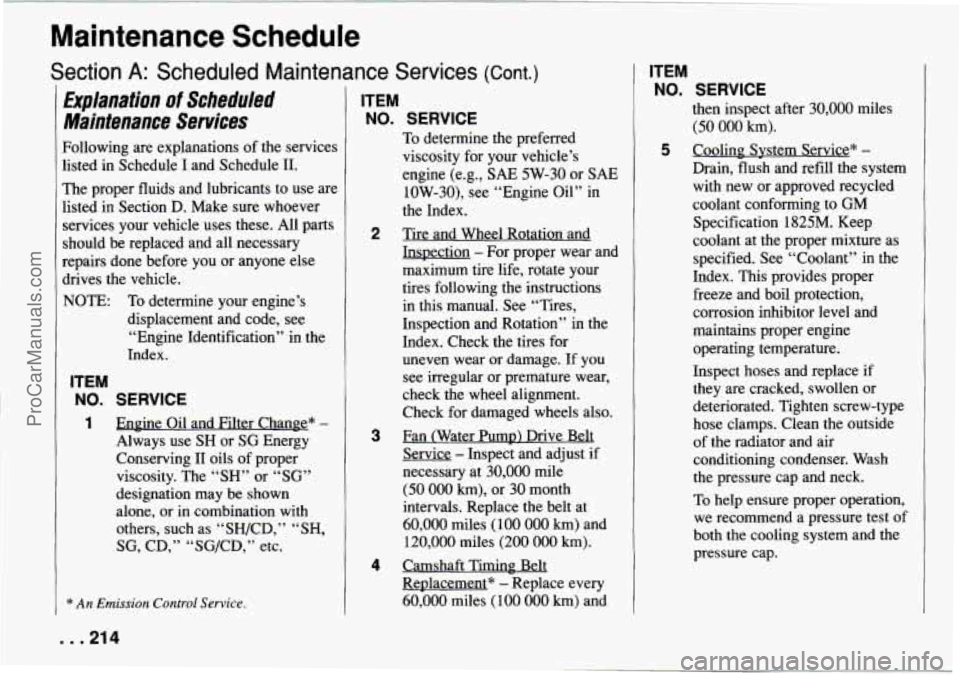
&planation of Scheduled
Maintenance Services
?allowing are explanations of the services
isted in Schedule
I and Schedule II.
he proper fluids and lubricants to use are
.isted
in Section D. Make sure whoever
rervices your vehicle uses these. All parts
should be replaced and all necessary
repairs done before you or anyone else
~ives the vehicle.
NOTE: To determine your engine’s
displacement and code, see
“Engine Identification” in the
Index.
ITEM
NO. SERVICE
1 -e Oil and Filter Change* -
Always use SH or SG Energy
Conserving
II oils of proper
viscosity. The
“SH” or “SG”
designation may be shown
alone, or in combination with
others, such as “SHKD,”
“SH,
SG, CD,” “SG/CD,” etc.
* An Emission Control Service.
ITEM
NO. SERVICE
2
3
4
To determine the preferred
viscosity for your vehicle’s
engine (e.g.,
SAE 5W-30 or SAE
10W-30), see “Engine Oil” in
the Index.
Tire Wheel Rotation and
Jnspectioq
- For proper wear and
maximum tire life, rotate your
tires following the instructions
in this manual. See
“Ties,
Inspection and Rotation’’ in the
Index. Check the tires for
uneven wear or damage.
If you
see irregular or premature wear,
check the wheel alignment.
Check for damaged wheels also.
Fan (Water Pump) Drive Belt
Servk
- Inspect and adjust if
necessary at
30,000 mile
(50 000 km), or 30 month
intervals. Replace the belt at
60,000 miles (100 000 km) and
120,000 miles (200 000 km).
-shaft Timin? Belt
Replacemeat”
- Replace every
60,000 miles (100 000 km) and
ITEM NO.
SERVICE
then inspect after 30,000 miles
(50 000 km).
Drain, flush and refill the system
with new or approved recycled
coolant conforming to
GM
Specification 182SM. Keep
coolant at the proper mixture
as
specified. See “Coolant” in the
Index. This provides proper
freeze and boil protection,
corrosion inhibitor level and
maintains proper engine
operating temperature.
Inspect hoses and replace
if
they are cracked, swollen or
deteriorated. Tighten screw-type
hose clamps. Clean the outside
of the radiator and air
conditioning condenser. Wash
the pressure cap and neck.
To help ensure proper operation,
we recommend a pressure test
of
both the cooling system and the
nressure cap.
5 Coolin? Sys&nSemice* -
. . ,214
ProCarManuals.com
Page 216 of 258
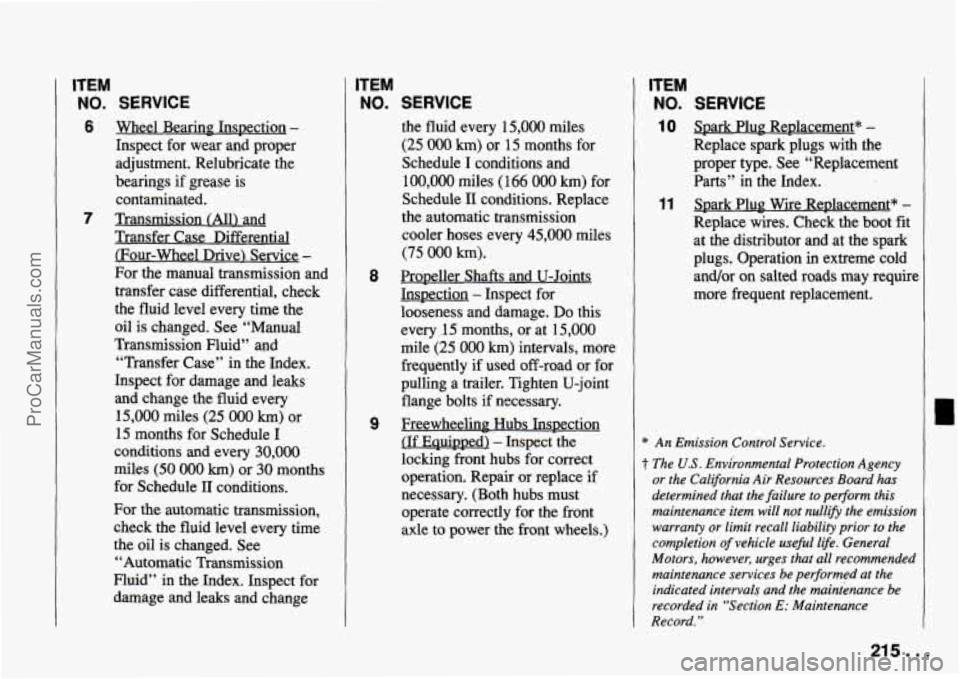
ITEM
NO. SERVICE
6 Wheel Bearin? InsDection -
Inspect for wear and proper
adjustment. Relubricate the
bearings if grease is
contaminated.
7 Transmission (All) and
Transfer Case Differential
(Four-wheel Drive) Service
-
For the manual transmission and
transfer case differential, check
the fluid level every time the
oil is changed. See “Manual
Transmission Fluid” and
“Transfer Case” in the Index.
Inspect for damage and leaks
and change the fluid every
15,000 miles
(25 000 km) or
15 months for Schedule
I
conditions and every 30,000
miles (50 000 km) or 30 months
for Schedule
II conditions.
For the automatic transmission,
check the fluid level every time
the oil is changed. See
“Automatic Transmission
Fluid” in the Index. Inspect for
damage and leaks and change
ITEM
NO. SERVICE
8
9
the fluid every 15,000 miles
(25 0o0 km) or 15 months for
Schedule
I conditions and
100,000 miles ( 166 000 km) for
Schedule
I1 conditions. Replace
the automatic transmission cooler hoses every
45,000 miles
(75 000 km).
Propeller Shafts and U-Joints
Inspection
- Inspect for
looseness and damage.
Do this
every,.l5 months, or at 15,000
mile
(25 000 km) intervals, more
frequently if used off-road
or for
pulling a trailer. Tighten U-joint
flange bolts if necessary.
Freewheeling Hubs InsDection
/If Equipped) - Inspect the
locking front hubs for correct
operation. Repair or replace if
necessary. (Both hubs must
operate correctly for the front
axle to power the front wheels.)
ITEM
NO. SERVICE
10
11
Spark Plug Replacement” -
Replace spark plugs with the
proper type. See “Replacement Pans” in the Index.
Spark Plup Wire Replacement”
-
Replace wires. Check the boot fit
at the distributor and
at the spark
plugs. Operation in extreme cold
and/or on salted roads may require
more frequent replacement.
* An Emission Control Service.
t The U.S. Environmental Protection Agency
or the California Air Resources Board has
determined that the failure to perform this
maintenance item will not null@ the emission
warranty
or limit recall liability prior to the
completion
of vehicle useful life. General
Motors, however, urges that all recommended
maintenance services be pegormed at the
indicated intervals and the maintenance be
recorded
in “Section E: Maintenance
Record.
’’
215 ...
ProCarManuals.com