warning lights CHEVROLET TRACKER 1994 Owners Manual
[x] Cancel search | Manufacturer: CHEVROLET, Model Year: 1994, Model line: TRACKER, Model: CHEVROLET TRACKER 1994Pages: 258, PDF Size: 14.43 MB
Page 7 of 258
How to Use This Manual
NOTICE:
These mean there is something that
could damage
your vehicle.
Vehicle Damage Warnings
Also, in this book you will find these
notices.
In the notice area, we tell you about
something that
can darnage your vehicle.
Many times, this damage would not be
covered by your warranty. and
it could be
costly. But
the notice will tell you what to
do to help avoid the damage.
When
you read other manuals. you might
see CAUTION and NOTICE warnings
in
different colors or in different words.
You’ll also see warning labels
on your
vehicle. They use yellow for cautions. bluc
for notices and the words CAUTION or
NOTICE.
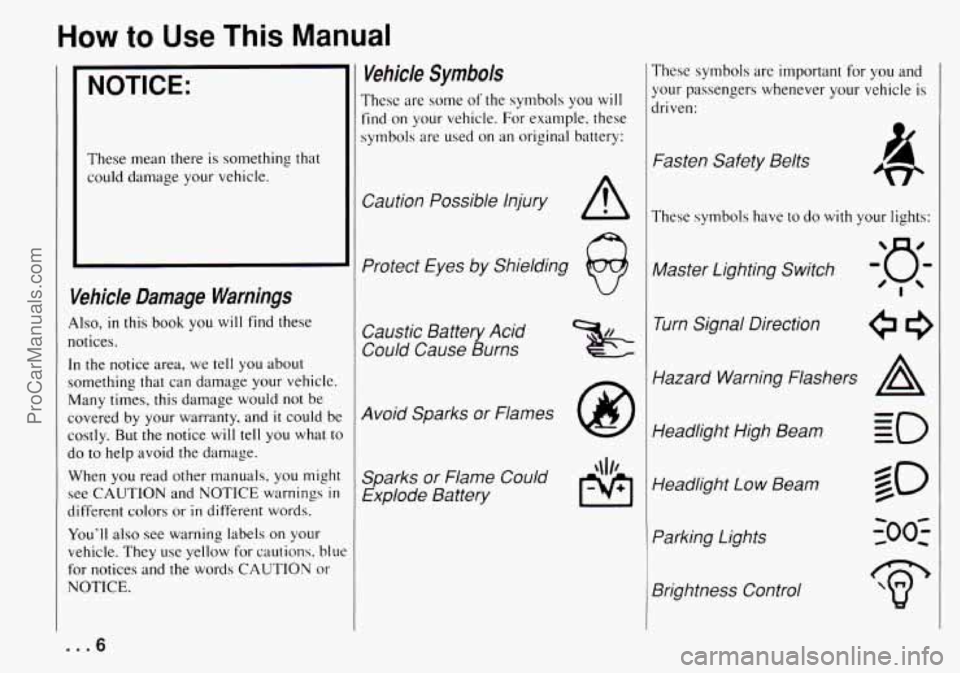
Vehicle Symbols
These are some of the symbols you will
find on your vehicle. For example. these
symbols are used on an original battery:
Caution Possible Injury A
Protect Eyes by Shielding
@
Caustic Battery Acid
Could Cause Burns
Avoid Sparks or Flames
Sparks
or Flame Could
Explode Battery
8
These symbols are important for you and
your passengers whenever your vehicle is
driven:
Fasten Safety Belts
These symbols have to do with your lights:
Master lighting Switch
Turn Signal Direction
Hazard Warning Flashers
-0 -
- Headlight High Beam
Headlight Low Beam Parking Lights
Brightness Control
0
g0
=oo: 4
... 6
ProCarManuals.com
Page 8 of 258
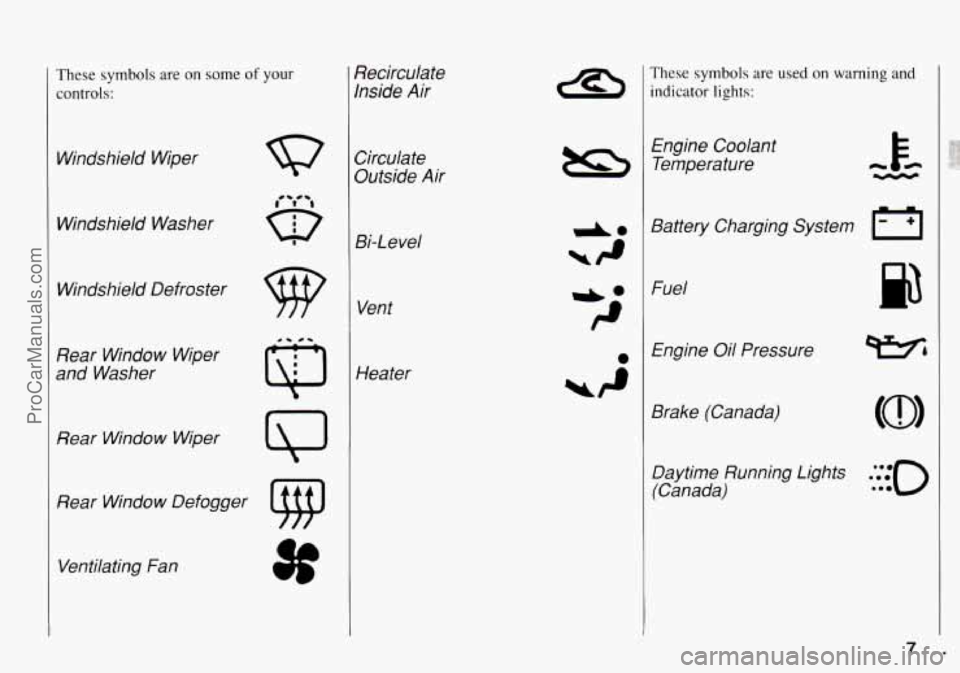
These symbols are on some of your
controls:
Windshield Wiper
Windshield Washer
Windshield Defroster
Rear Window Wiper
and Washer
Rear Window Wiper
Rear Window Defogger Ventilating Fan Recirculate
Inside
Air
Circulate
Outside Air
Bi-Level
Vent
Heater
These symbols are used on warning and
indicator
lights:
Engine Coolant Temperature
Battery Charging System
Fl
Fuel
Engine Oil Pressure
Brake (Canada) Daytime Running Lights
.***to
(Canada) **e
f ...
ProCarManuals.com
Page 36 of 258
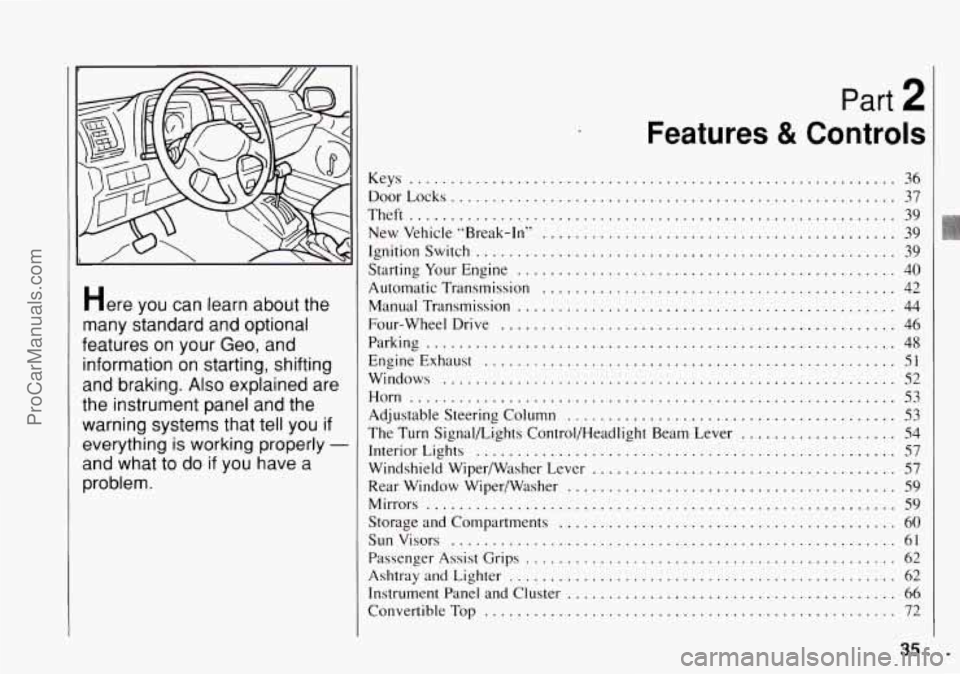
Here you can learn about the
many standard and optional
features on your Geo. and
information on starting. shifting
and braking
. Also explained are
the instrument panel and the
warning systems that tell you
if
everything is working properly -
and what to do if you have a
problem
.
Part 2
Features & Controls
Keys ........................................................... 36
DoorLocks ...................................................... 37
Theft
........................................................... 39
New Vehicle “Break-In” ........................................... 39
Ignitionswitch ................................................... 39
Starting
Your Engine .............................................. 40
Automatic Transmission ................. ...................... 42
Manual Transmission
............... ...................... 44
Four-wheel Drive ................................................ 46
Parking ......................................................... 48
EngineExhaust
.................................................. 51
Windows ....................................................... 52
Horn
........................................................... 53
Adjustable Steering Column ........................................ 53
Interior Lights
................................................... 57
Windshield WiperjWasher Lever
..................................... 57
Rear Window Wiperwasher
........................................ 59
Mirrors ......................................................... 59
Storage and Compartments
....................................... 60
Sun Visors
................................... .. ..... 61
Passenger Assist Grips
............................................. 62
Ashtray and Lighter
............................................... 62
Instrument Panel and Cluster
........................................ 66
The Turn Signalbights Control/Headlight Beam Lever ................... 54
ConvertibleTop
.................................................. 72
35 I ..
ProCarManuals.com
Page 41 of 258
Features and Controls
ON (C): Position to which the switch
returns after
you start your engine and
release the switch. The switch stays in the
“ON’ position when the engine is
running. But even when the engine is not
running, you can use
“ON’ to operate
your electrical power accessories and to
display some instrument panel warning
and indicator lights.
START (D): Starts the engine. When the
engine starts, release the key. The ignition
switch will return to
“ON’ for normal
driving.
When the engine is not running, “ACC”
and
“ON’ allow you to operate your
electrical accessories, such as the radio
and ventilation fan.
A warning chime will sound if you open
the driver’s door when the ignition is in
“ACC” or “LOCK” and the key is in the
ignition.
NOTICE:
If your key seems stuck in “LOCK”
and you can’t
turn it, be sure it is all
the way in. If it is, then turn the steer-
ing wheel left and right while you
turn the key hard. But turn the key
only with your hand. Using a tool to
force it could break the key or the
ignition switch. If none of this works,
then your vehicle needs service.
Starting Your Engine
Automatic transmission: Move your
shift lever to
“P” (Park) or “N’ (Neutral).
Your engine won’t start in any other
position
- that’s a safety feature. To
restart when you’re already moving, use
“N’ (Neutral) only.
NOTICE:
Don’t try to shift to “P’ (Park) if your
Geo is moving.
If you do, you could
damage the transmission. Shift to
“P”
(Park) only when your vehicle is
stopped.
Manual transmission: The gear selector
should be in neutral. Hold the clutch
pedal to the floor and start the engine.
Your vehicle won’t start if the clutch
pedal is
not all the way down - that’s
a safety feature.
To start your engine:
1. Without pushing the accelerator pedal,
turn your ignition key
to “START.”
When the engine starts, let
go of the
key.
... 40
ProCarManuals.com
Page 69 of 258

Features and Controls
Tachometer
The tachometer shows engine speed in
thousands of revolutions per minute
(rpm).
You can use it while driving to
select correct shift points. The tachometel
may not return to zero when the engine
is
not running.
NOTICE:
Do not operate the engine with the
tachometer in
the red area, or engine
damage may occur.
r
I:
!
1
1
1
... 68
and Indicators
This section describes the warning lights
and gages that may be on your vehicle.
The pictures will help you locate them.
Warning lights and gages can signal that
something
is wrong before it becomes
serious enough to cause
an expensive
repair or replacement. Paying attention to
your warning lights and gages could also
save you or others from injury.
Warning lights go
on when there may be
or is a problem with one
of your vehicle’s
functions.
As you will see in the details
on the next few pages, some warning
lights come
on briefly when you turn the
ignition key just to let you know they’re
working. If you are familiar with this
section, you should not be alarmed when
this happens.
Gages can indicate when there may be or
is a problem with one of your vehicle’s
functions. Often gages and warning lights
work together to
let you know when
there’s a problem with your vehicle.
When one of the warning lights comes
on
and stays on when you are driving, or
when one
of the gages shows there may be
a problem, check the section that
tells
you what to do about it. Please follow the
manual’s advice. Waiting to
do repairs
can be costly
- and even dangerous. So
please get to know your warning lights
and gages. They’re a big help.
ProCarManuals.com
Page 133 of 258
Problems on the Road
j
Hazard Warning
Flashers
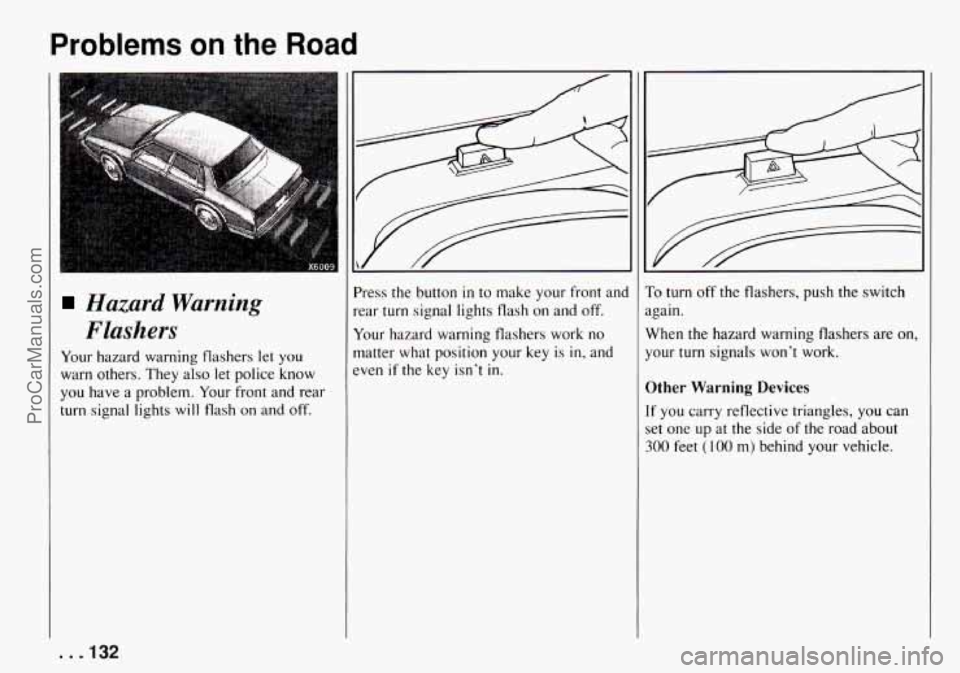
Your hazard warning flashers let you
warn others. They also let police know
you have a problem. Your front and rear
turn signal lights
will tlash on and off. Press the button
in to make your front and
rear
turn signal lights flash on and off.
Your hazard warning flashers work no
matter what position your key
is in, and
even
if the key isn't in.
To turn off the flashers, push the switch
again.
When the hazard warning flashers are on,
your turn signals won't work.
Other Warning Devices
If you carry reflective triangles, you can
set one up at the side
of the road about
300 feet (100 m> behind your vehicle.
. . .I32
ProCarManuals.com
Page 171 of 258
~~
~~ ~ ~~~~ ~ Service and Appearance Care
Four- Wheel Drive
Most
lubricant checks in this section also
apply to four-wheel-drive vehicles.
However, they have
two additional
systems that need lubricatiog.
Transfer Case
When to Check qnd Change Lubricant
Refer to the Maintenance Schedule to
determine how often to check the
lubricant and when to change
it. See
“Scheduled Maintenance Services”
in the
Index.
How to Check Lubricant
If the level is below the bottom of the
filler plug hole, you’ll need to add some
lubricant. Add enough lubricant to raise
the level to the bottom of the filler plug
hole.
What to Use
Refer to the Maintenance Schedule to
determine what kind of lybricant to use.
See “Recommended Fluids and
Lubricants”
in the Index.
Front Axle
When
to Check and Change Lubricant
Refer to the Maintenance Schedule to a
determine how often to check the
lubricant and when to change it. See
“Periodic Maintenance Inspections” and
“Scheduled Maintenance Services”
in the
Index.
How to Check Lubricant
If the level is below the bottom of the
filler plug hole, you’ll need to add some
lubricant.
If the differential is at operating
temperature (warm), add enough lubricant
to raise the level to the bottom of the filler
plug hole.
If the differential
is cold, add enough
lubricant to raise the level to
1/2 inch (12
mm) below the filler plug hole.
What to Use
Refer to the Maintenance Schedule to
determine
what kind of lubricant to use.
See “Recommended Fluids and
Lubricants”
in the Index.
Engine Coolant
The following explains your cooling
system and how to add coolant when it is
low. If you have a problem with engine
overheating, see “Engine Overheating”
in
the Index.
The proper coolant for your Geo will:
Give freezing protection down to
-20°F (-29”C), or -34°F (-37°C)
in
Canada and for vehicles with the cold
climate option.
Give boiling protection up to 258°F
(125°C).
Protect against rust and corrosion.
Help keep the proper engine
temperature.
Let the warning lights work as they
should.
What to Use:
Use a mixture of one-half clean water
(preferably distilled) and one-half
antifreeze that meets “GM Specification
6038-M,” which won’t damage aluminum
parts.
You can also use a recycled coolant
conforming to
“GM Specification
6038-M”
with a complete coolant flush
. . .I70
ProCarManuals.com
Page 199 of 258

Service and Appearance Care
Main Fuse Block
1 - Generator to Battery Circuit (60A)
2
- Circuits Only Active When
Ignition Switch is
in “ACC,” “ON”
or “START” (50A)
3
- Circuits Always Active (40A)
4 - Circuits Always Active (30A)
. . .198
nstrument Panel Fuse Block
- Right Headlight (15A)
~ - Left Headlight; High Beam Indicatol
Light
( 1 SA)
I- Taillights; Interior Light; Sidemarker Lights; Instrument Cluster Lights
( 1 SA)
. - Stop Lights; Horn (15A)
~ - Hazard Lights (15A)
I - Door Lock (Option) (20A)
’ - Lighter; Radio (20A)
1 - Ignition System; Warning and
1 - Turn Signal Lights; Back-up Lights
Indicator Lights
( 1 SA)
( 1 SA)
10 - Wiper/Washer ( 15A)
1 1 - Rear Defogger (1 5A)
12 - Heater
(25A)
13
- Rear Wheel Anti-Lock Main Relay
(20A)
14 - Electronic Fuel Injection Main
Relay
( 15A)
ProCarManuals.com
Page 244 of 258
A bout Driving Your Tracker ..... 3
ABS ......................... 103
Adding Coolant ................ 171
Additives. Engine
Oil ............ 165
Adjustment. Clutch
............. 169
Air Cleaner .................... 165
Air Conditioner Controls
......... 85
Air Filter Replacement
........... 166
Air Intake Lever ................ 84
Airflow Lever
.................. 84
Alignment and Tire Balance
.
Wheel ...................... 187
Aluminum Wheels
.............. 193
AM/FM Stereo
................ 88
With Cassette Tape and Compact
Disc Player
................ 93
With Cassette Tape Player ...... 89
Antenna
...................... 98
Anti-Lock Brakes
.............. 103
To Use ..................... 103
Appearance Care ............... I89
Appearance Care and Materials
.... 195
Appearance Care. Service and
..... 155
Approaching
a Hill .............. 1 10
Ashtrays and Lighter ............ 62
Ashtray. Front
................. 63
Ashtray. Rear .................. 63
Assist Grips. Passenger .......... 62
Add-on
Electrical Equipment
..... 196
Adjustable Steering Column
...... 53
Audio Systems ................. 87
Audio Systems. Comfort
Controls and
................. 83
Automatic
Freewheeling Hubs
........... 47
Transmission
................ 42
Transmission Fluid ............ 167
Axle. Front
.................... 170
Axle
. Rear .................... 169
Babies. Smaller Children
and (Safety Belts)
............. 26
Balance. Wheel Alignment
and Tire
.................... 187
Battery
....................... 176
BBB Auto Line
- Alternative Dispute
Resolution Program. GM
Participation
in ............. 235
Before Leaving
on a Long Trip .... 120
Belt. Lap-Shoulder .............. 20
Bi-Level ...................... 84
Bin. Coinholder and ............. 61
Bins. Instrument Panel ........... 61
Blizzard. If You’re Caught in a ... 124
Box. Glove
.................... 60
Brakes
Adjustment
.................. 176
Anti-Lock (ABS)
............. 103
Fluid ....................... 1 74
Master Cylinder
.......... 174
Parking
......... 48 Brakes
Pedal Travel
................. i76
System Parts. Replacing ........ 176
System Warning Light
......... 69
Trailer ...................... i27
Wear ...................... 175
Braking (Control of
a Vehicle) ..... 102
Braking
in Emergencies .......... 104
“Break.In. .. New Vehicle ........ 39
Bright Metal Parts. Protecting
Exterior
.................... 192
Brightness Control
.............. 57
Bulb Replacement .............. 177
Stoplight .................. 181
Headlights .................. 177
Rear Combination
............ 180
Rear Sidemarker
.............. 179
Sidemarker ......... . .179
Bulbs. Halogen
............... 177
Bulbs. Replacement
............. 199
Canadian Roadside Assistance ... 237
Canvas Top
Preparing for Storage
.......... 80
Special Care for
.............. 193
Capacities and Specifications
...... 200
Carbon Monoxide .............. 51
Center High-Mounted
Front Parking and Turn Signal
... 178
Removing and Installing Your
... 76
243 ...
ProCarManuals.com
Page 246 of 258

Customer Assistance for the Hearing
Customer Assistance Information
. . 233
Customer Satisfaction Procedure
... 234
or Speech Impaired (TDD)
..... 234
Damage. Finish
............... 194
Damage. Sheet Metal
............ 193
Daytime Running Lights
......... 56
Daytime Running Lights Indicator Light
....................... 72
Deep Standing Water.
Driving through
.............. 41
Defects. Safety
Reporting to General Motors
.... 236
Reporting to the Canadian
Reporting to the United States
Government
............... 236
Government
............... 236
Defensive Driving
.............. 100
Defogger. Rear Window ......... 86
Defogging and Defrosting
Windows
................... 85
Dehumidifying ................. 85
Dimensions. Vehicle ............ 202
Doing Your Own Service Work
.... 156
Dome Light ................... 57
Door Locks
.................... 37
Door Storage Compartments
...... 60
Downhill. Driving
.............. 1 12
Drive. Four-wheel
.............. 46
Drive. Four-wheel (Service)
...... 170 Driver Position
(Safety Belts)
... 20
Driving
Across an Incline
............. 11 3
At Night .................... 1 16
City
........................ 119
Defensive
................... 100
Downhill
................... 1 12
Drunken
.................... 100
Freeway
.................... 120
Guidelines
.................. 107
In Mud. Sand. Ice or Snow ..... 1 15
In the Rain .................. 117
In Water .................... 115
0ff.Road. With Your Geo Four-
Wheel-Drive Vehicle
........ 108
On Curves .................. 104
On Off-Road Hills
............ I10
On Snow or Ice
.............. 123
Through Deep Standing Water
... 41
Uphill
...................... 111
Winter
...................... 122
With a Trailer
................ 127
Your Tracker. About ........... 3
Drunken Driving
............... 100
Easy Entry Seats
.............. 12
Electrical Equipment. Add-on
..... 196
Emergencies. Braking in
......... 104
Emergencies. Steering in
......... 105 Engine
Coolant
..................... 170
Coolant (Block) Heater
........ 41
Coolant Temperature Gage
..... 70
Exhaust
..................... 51
Identification
................ 196
Oil
........................ 162
Oil Pressure Light
............ 71
Overheating
................. 140
Specifications
................ 200
Starting Your
................ 40
Environment. Your Vehicle
and the
..................... 204
Exhaust. Engine
................ 51
Extender. Safety Belt
....... 1 .... 33
Exterior Bright Metal Parts.
Protecting
................... 192
Fabric Protection
.............. 190
Fan Control Lever
.............. 84
Features and
Controls ........... 35
Filling Your Tank ............... 158
Filter. Air. Replacement
.......... 166
Finish Care (Paint)
.............. 192
Finish Damage (Paint)
........... 194
Flashers. Hazard Warning
........ 132
Flat Tire. Changing a
............ 146
Flat.
If a Tire Goes .............. 146
Flow-Through Ventilation System . . 86
245 ..
ProCarManuals.com