four wheel drive CHEVROLET TRACKER 1995 User Guide
[x] Cancel search | Manufacturer: CHEVROLET, Model Year: 1995, Model line: TRACKER, Model: CHEVROLET TRACKER 1995Pages: 354, PDF Size: 18.24 MB
Page 139 of 354
Off-Road Driving with Your Geo
Four-wheel Drive Vehicle
This off-road guide is for vehicles that have four-wheel
drive.
Also, see “Anti-Lock Brakes” in the Index.
If your vehicle doesn’t have four-wheel drive, you
shouldn’t drive off-road unless you’re on a level, solid
surface.
Off-road driving can be great fun. But it does have some
definite hazards. The greatest of these is the terrain
itself.
“Off-roading” means you’ve
left the great North
American road system behind. Traffic lanes aren’t
marked. Curves aren’t banked. There are no road signs.
Surfaces can be slippery, rough, uphill or downhill. In
short, you’ve gone right back to nature.
Off-road driving involves some new skills. And that’s
why it’s very important that you read this guide. You’ll
find many driving tips and suggestions. These will help
make your off-road driving safer and more enjoyable.
Before You Go Off-Roading
There are some things to do before you go out. For
example, be sure to have all necessary maintenance and
service work done. Check to make sure all underbody
shields (if
so equipped) are properly attached. Be sure
you read all the information about your four-wheel drive
vehicle
in this manual. Is there enough fuel? Is the spare
tire fully inflated? Are the fluid levels up where they
should be? What are the local laws that apply
to
off-roading where you’ll be driving? If you don’t know,
you should check with law enforcement people
in the
area. Will you be on someone’s private land? If
so, be
sure to get the.necessary permission.
Loading Your Vehicle for Off-Road Driving
There are some important things to remember about
how to load your vehicle.
0 The heaviest things should be on the load floor and
forward
of your rear axle. Put heavier items as far
forward as you can.
0 Be sure the load is secured properly, so driving on
the off-road terrain doesn’t toss things around.
4-14
ProCarManuals.com
Page 165 of 354
Recreational Vehicle Towing
There may be times when you want to tow your Geo
behind another vehicle for use at your destination. Be
sure to use the proper towing equipment designed for
recreational towing. Follow the instructions for the
towing equipment.
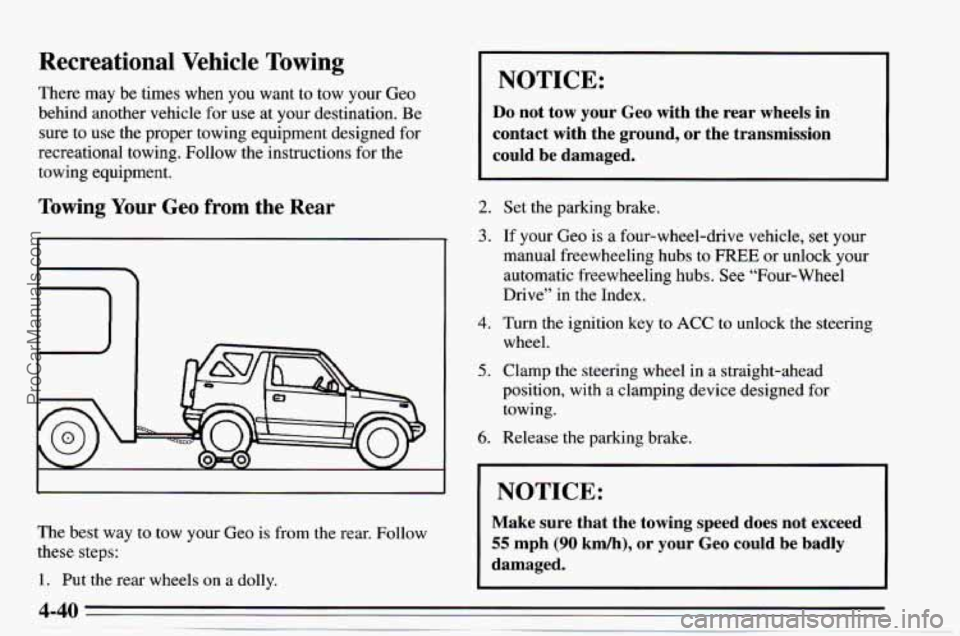
Towing Your Geo from the Rear
The best way to cow your Geo is from the rear. Follow
these steps:
1. Put the rear wheels on a dolly.
I NOTICE:
Do not tow your Geo with the rear wheels in
contact with the ground,
or the transmission
could be damaged.
2. Set the parking brake.
3. If your Geo is a four-wheel-drive vehicle, set your
manual freewheeling hubs
to FREE or unlock your
automatic freewheeling hubs. See “Four-wheel
Drive” in the Index.
4. Turn the ignition key to ACC to unlock the steering
5. Clamp the steering wheel in a straight-ahead
wheel.
position, with a clamping device designed for
towing.
6. Release the parking brake.
NOTICE:
Make sure that the towing speed does not exceed
55 mph
(90 km/h), or your Geo could be badly
damaged.
ProCarManuals.com
Page 166 of 354
Towing Your Geo from the Front
I NOTICE:
If your vehicle has automatic freewheeling hubs
or two-wheel drive, do not tow it on all four
wheels. If you do, your transmission could be
damaged.
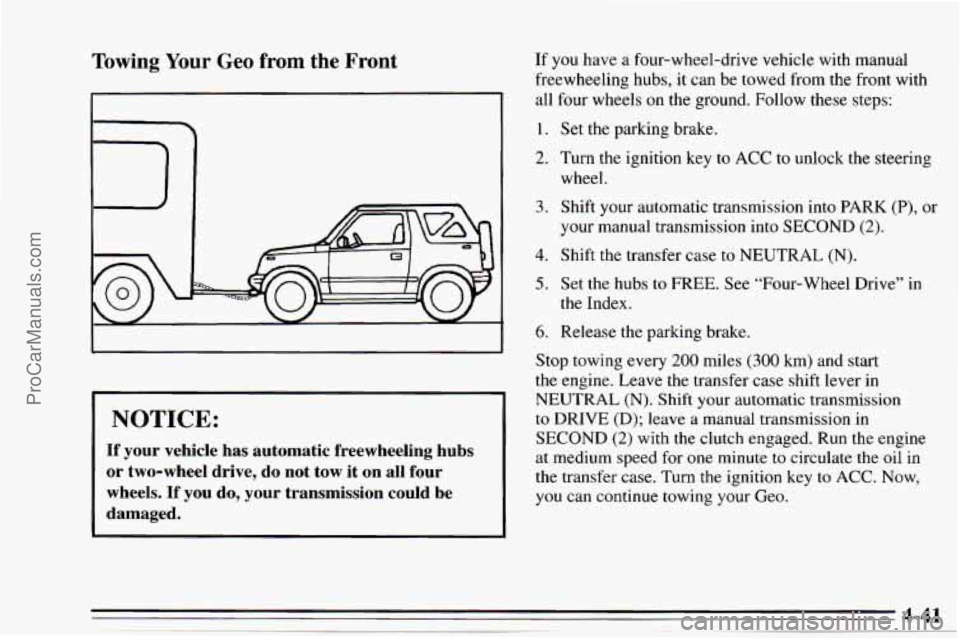
If you have a four-wheel-drive vehicle with manual
freewheeling hubs, it can be towed from the front with
all four wheels on the ground. Follow these steps:
1. Set the parking brake.
2. Turn the ignition key to ACC to unlock the steering
wheel.
3. Shift your automatic transmission into PARK (P), or
your manual transmission into SECOND
(2).
4. Shift the transfer case to NEUTRAL (N).
5. Set the hubs to FREE. See “Four-wheel Drive” in
the Index.
6. Release the parking brake.
Stop towing every
200 miles (300 km) and start
the engine. Leave the transfer
case shift lever in
NEUTRAL (N). Shift your automatic transmission
to
DRIVE (D); leave a manual transmission in
SECOND
(2) with the clutch engaged. Run the engine
at medium speed for
one minute to circulate the oil in
the transfer case. Turn the ignition key to ACC. Now,
you can continue towing your Geo.
ProCarManuals.com
Page 168 of 354
f :[:BY CAM1 AUTOMOTIVE CANADA GVWR GAWR FRT GAWR RR
The
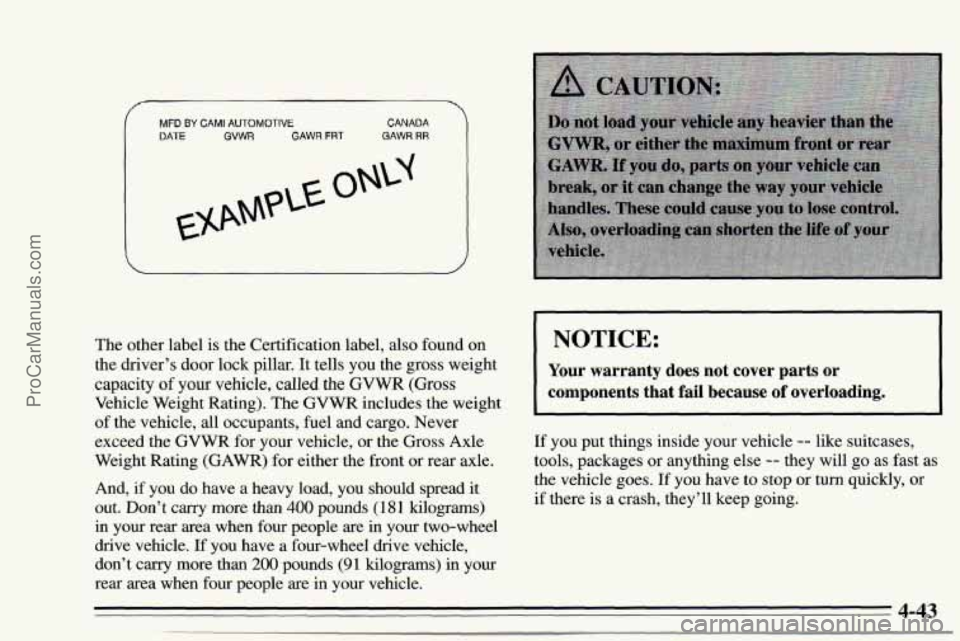
other label is the Certification label, also found on
the driver’s door lock pillar. It tells you the gross weight
capacity of your vehicle, called
the GVWR (Gross
Vehicle Weight Rating). The GVWR includes the weight
of the vehicle,
all occupants, fuel and cargo. Never
exceed the GVWR for your vehicle, or the Gross Axle
Weight Rating
(GAWR) for either the front or rear axle.
And,
if you do have a heavy load, you should spread it
out. Don’t
carry more than 400 pounds (181 kilograms)
in your rear area when four people are in your two-wheel
drive vehicle.
If you have a four-wheel drive vehicle,
don’t carry more than
200 pounds (9 1 kilograms) in your
rear area when four people are in your vehicle.
NOTICE:
Your warranty does not cover parts or
components that fail because
of overloading.
If you put things inside your vehicle -- like suitcases,
tools, packages or anything else
-- they will go as fast as
the vehicle goes. If
you have to stop or turn quickly, or
if there is a crash, they’ll keep going.
4-43
ProCarManuals.com
Page 170 of 354
Your vehicle can tow a trailer. To identify what the
vehicle trailering capacity
is for your vehicle, you
should read the information in “Weight of the Trailer”
that
appears later in this section. But trailering is
different than just driving your vehicle by itself.
Trailering means changes in handling, durability, and
fuel economy. Successful, safe trailering takes correct
equipment, and it has to be used properly.
That’s the reason for this section. In it are many
time-tested, important trailering tips and safety rules.
Many
of these are important for your safety and that of
your passengers.
So please read this section carefully
before you pull a trailer.
Load-pulling components such as the engine,
transmission, wheel assemblies, and tires are forced
to
work harder against the drag of the added weight. The
engine
is required to operate at relatively higher speeds
and under greater loads, generating extra heat. What’s
more, the trailer adds considerably
to wind resistance,
increasing the pulling requirements.
If You Do Decide To Pull A Trailer
If you do, here are some important points.
0
0
0
0
There are many different laws, including speed limit
restrictions, having
to do with trailering. Make sure
your rig will
be legal, not only where you live but
also where
you’ll be driving. A good source for this
information can be state or provincial police.
Consider using a sway control. You
can ask a hitch
dealer about sway controls.
Don’t tow a trailer at all during the first
500 miles
(800 km) your new vehicle is driven. Your engine,
axle or other parts could be damaged.
Then, during the first
500 miles (800 km) that you
tow a trailer, don’t drive over
50 mph (80 km/h) and
don’t make starts at full throttle. This helps your
engine and other parts of your vehicle wear
in at the
heavier loads.
If
you have an automatic transmission, you should use
DRIVE (D) (or, as
you need to, a lower gear) when
towing
a trailer. Operating your vehicle in DRIVE (D)
when towing a trailer will minimize heat build-up and
extend the
life of your transmission. If you have a
manual transmission and
you are towing a trailer, it’s
better
not to use FIFTH (5) gear. Just drive in
FOURTH (4) gear (or, as you need to, a lower gear).
ProCarManuals.com
Page 175 of 354
When towing a trailer, the green arrows on your
instrument panel will flash for turns even if the bulbs on
the trailer are burned out. Thus, you may think drivers
behind you are seeing your signal when
they are not. It’s
important to check occasionally to be sure the trailer
bulbs are still working.
Driving On Grades
Reduce speed and shift to a lower gear before you start
down a long or steep downgrade.
If you don’t shift
down, you might have to
use your brakes so much that
they would get hot and no longer work well.
On a long uphill grade, shift down and reduce your
speed
to around 45 mph (70 km/h) to reduce the
possibility of engine and transmission overheating.
If you are towing a trailer and you have a manual
transmission with fifth gear, you may prefer not to use
fifth gear. Just drive in fourth gear (or,
as you need to, a
lower gear).
Parking on Hills
You really should not park your vehicle, with a trailer
attached,
on a hill. If something goes wrong, your rig
could start
to move. People can be injured, and both
your vehicle and the trailer can be damaged.
But if you ever have to park your rig on a hill, here’s
how to do it:
1. Apply your regular brakes, but don’t shift into
PARK
(P) yet, or into gear for a manual
transmission.
2. Have someone place chocks under the trailer wheels.
3. When the wheel chocks are in place, release the
regular brakes until the chocks absorb the load.
4. Reapply the regular brakes. Then apply your parking
brake, and then shift to PARK
(P), or REVERSE (R)
for a manual transmission.
5. If you have a four-wheel drive vehicle, be sure
the transfer case is
in a drive gear -- not in
NEUTRAL
(N).
6. Release the regular brakes.
ProCarManuals.com
Page 183 of 354
Towing Your Vehicle
I
I
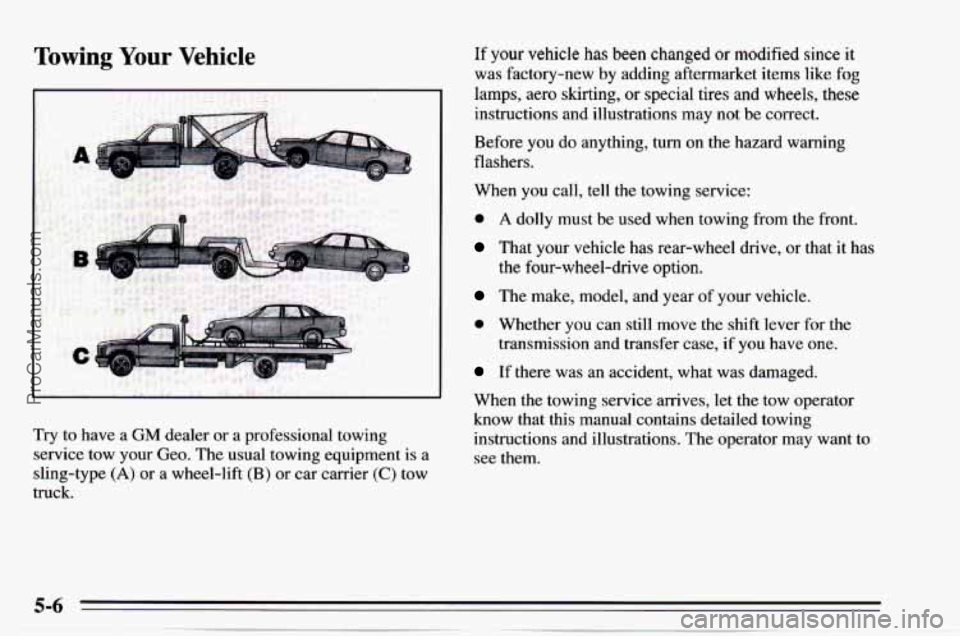
Try to have a GM dealer or a professional towing
service tow your Geo. The usual towing equipment is
a
sling-type (A) or a wheel-lift (B) or car carrier (C) tow
truck.
If your vehicle has been changed or modified since it
was factory-new by adding aftermarket items
like fog
lamps, aero skirting, or special tires and wheels, these
instructions and illustrations may not be correct.
Before you do anything, turn on the hazard warning
flashers.
When
you call, tell the towing service:
0 A dolly must be used when towing from the front.
That your vehicle has rear-wheel drive, or that it has
The make, model, and year of your vehicle.
0 Whether you can still move the shift lever for the
transmission and transfer case, if you have
one.
the four-wheel-drive option.
If there was an accident, what was damaged.
When the towing service arrives, let the tow operator
know that this manual contains detailed towing
instructions and illustrations. The operator may want
to
see them.
ProCarManuals.com
Page 184 of 354
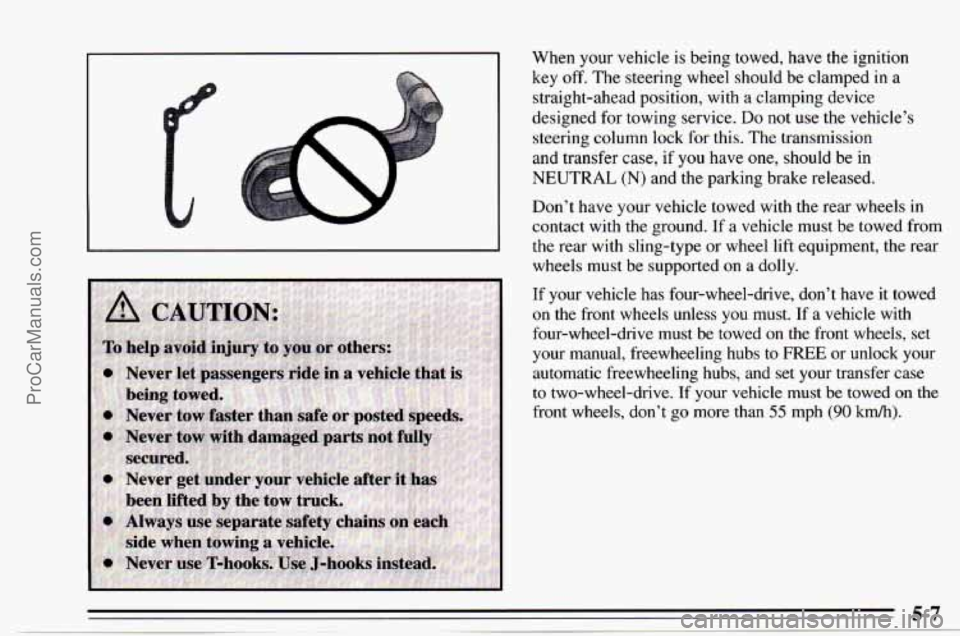
When your vehicle is being towed, have the ignition
key
off. The steering wheel should be clamped in a
straight-ahead position, with a clamping device
designed for towing service.
Do not use the vehicle’s
steering column lock
for this. The transmission
and transfer
case, if you have one, should be in
NEUTRAL (N) and the parking brake released.
Don’t have your vehicle towed with the rear wheels in
contact with the ground. If a vehicle must be towed from
the rear with sling-type or wheel lift equipment, the rear
wheels must be supported on a dolly.
If your vehicle has four-wheel-drive, don’t have it towed on
the front wheels unless you must. If a vehicle with
four-wheel-drive must be towed
on the front wheels, set
your manual, freewheeling hubs to FREE or unlock your
automatic freewheeling hubs, and set your transfer case
to two-wheel-drive. If
your vehicle must be towed on the
front wheels, don’t
go more than 55 mph (90 km/h).
5-7
ProCarManuals.com
Page 235 of 354
Rear Axle Four- Wheel Drive
When to Check and Change Lubricant
Refer to the
Maintenance Schedule to determine how
often to check the lubricant and when to change it. See
“Periodic Maintenance Inspections” and “Scheduled
Maintenance Services” in the Index.
How to Check Lubricant
If the level is below the bottom of the filler plug hole,
you’ll need to add some lubricant. Add enough lubricant
to raise the level to the bottom
of the filler plug hole.
What to Use
Refer to the Maintenance Schedule to determine what
kind
of lubricant to use. See “Recommended Fluids and
Lubricants” in the Index. Most
lubricant checks in this section also apply to
four-wheel-drive vehicles. However, they have
two
additional systems that need lubrication.
Transfer Case
When to Check and Change Lubricant
Refer to the Maintenance Schedule to determine how
often to check the lubricant and when
to change it. See
“Scheduled Maintenance Services” in the Index.
How to Check Lubricant
If the level is below the bottom of the filler plug hole,
you’ll need to add some lubricant. Add enough lubricant
to raise the level
to the bottom of the filler plug hole.
What to Use
Refer to the Maintenance Schedule to determine what
kind
of lubricant to use. See “Recommended Fluids and
Lubricants” in the Index.
ProCarManuals.com
Page 259 of 354
Used Replacement Wheels Tire Chains
NOTICE:
Use tire chains only where legal and only when
you must. Use only
SAE Class “S” type chains
that are the proper size for your tires. Install
them on the tires of the drive axle (four-wheel
drive vehicles can use chains on both axles).
Tighten them as tightly as possible with the ends
securely fastened. Drive slowly and follow the
chain manufacturer’s instructions.
If you can
hear the chains contacting your vehicle, stop and
retighten them.
If the contact continues, slow
down until it stops. Driving too fast or spinning
the wheels with chains
on will damage your
vehicle.
6-48
ProCarManuals.com