steering wheel CHEVROLET TRACKER 1995 User Guide
[x] Cancel search | Manufacturer: CHEVROLET, Model Year: 1995, Model line: TRACKER, Model: CHEVROLET TRACKER 1995Pages: 354, PDF Size: 18.24 MB
Page 142 of 354
When you drive over obstacles or rough terrain, keep a
firm grip on the steering wheel. Ruts, troughs, or other
surface features can jerk the wheel out
of your hands if
you’re not prepared.
When you drive over bumps, rocks, or other obstacles,
your wheels can leave the ground.
If this happens, even
with one or two wheels, you can’t control the vehicle as
well or at all.
Because you will be on an unpaved surface, it’s
especially important to avoid sudden acceleration,
sudden turns,
or sudden braking.
In a way, off-road driving requires a different lund
of
alertness from driving on paved roads and highways.
There are no road signs, posted speed limits or signal
lights. You have to use your own good judgment about
what
is safe and what isn’t.
Drinking and driving can be very dangerous on any
road. And this
is certainly true for off-road driving. At
the very time you need special alertness and driving
skills, your reflexes, perceptions and judgment can be
affected by even a small amount
of alcohol. You could
have a serious
-- or even fatal -- accident if you drink
and drive or ride with a driver who has been drinking.
(See “Drunken Driving” in
the Index.)
Driving On Off-Road Hills
Off-road driving often takes you up, down, or across a
hill. Driving safely on hills requires good judgment and
an understanding
of what your vehicle can and can’t do.
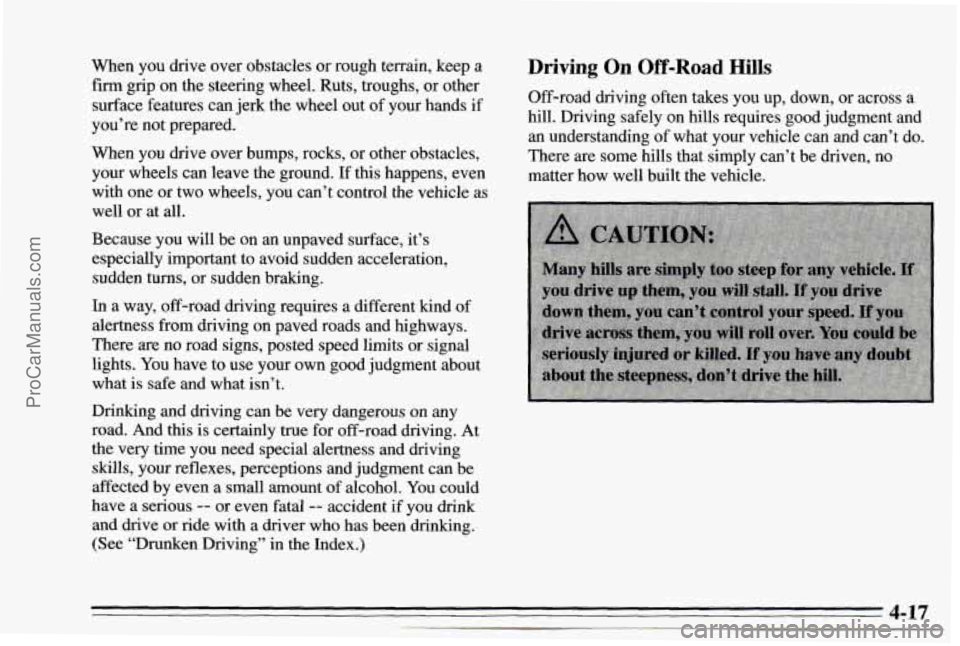
There are some hills that simply can’t be driven, no
matter how well built the vehicle.
4-17
ProCarManuals.com
Page 143 of 354
Approaching a Hill
When you approach a hill, you need to decide if it’s one
of those hills that’s just too steep to climb, descend, or
cross. Steepness can be hard to judge. On a very small
hill, for example, there may be a smooth, constant
incline with only
a small change in elevation where you
can easily see all the way to the top. On a large hill, the
incline may get steeper as you near the top, but
you may
not see this because the crest
of the hill is hidden by
bushes, grass, or shrubs.
Here are some other things to consider as you approach
a hill.
0 Is there a constant incline, or does the hill get sharply
steeper in places?
Is there good traction on the hillside, or will the
Is there a straight path up or down the hill so you
0 Are there obstructions on the hill that can block your
surface cause
tire slipping?
won’t have
to make turning maneuvers?
path (boulders, trees, logs or ruts)?
embankment, a drop-off, a fence? Get out and walk
the hill if you don’t know. It’s the smart way
to find
out.
What’s beyond the hill? Is there a cliff, an
0 Is the hill simply too rough? Steep hills often have
ruts, gullies, troughs and exposed rocks because they
are more susceptible to the effects of erosion.
Driving Uphill
Once you decide you can safely drive up the hill, you
need to take some special steps.
0
a
0
Use a low gear and get a firm grip on the steering
wheel.
Get a smooth start up the hill and try to maintain
your speed. Don’t use more power than
you need,
because you don’t want your wheels to start spinning
or sliding.
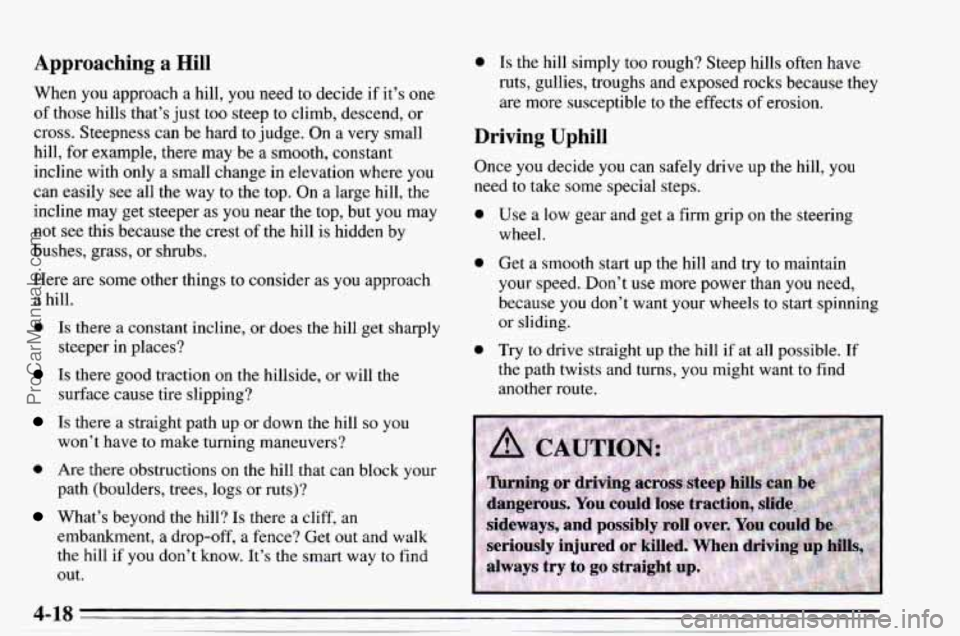
Try to drive straight up the hill if at all possible.
If
the path twists and turns, you might want to find
another route.
ProCarManuals.com
Page 144 of 354
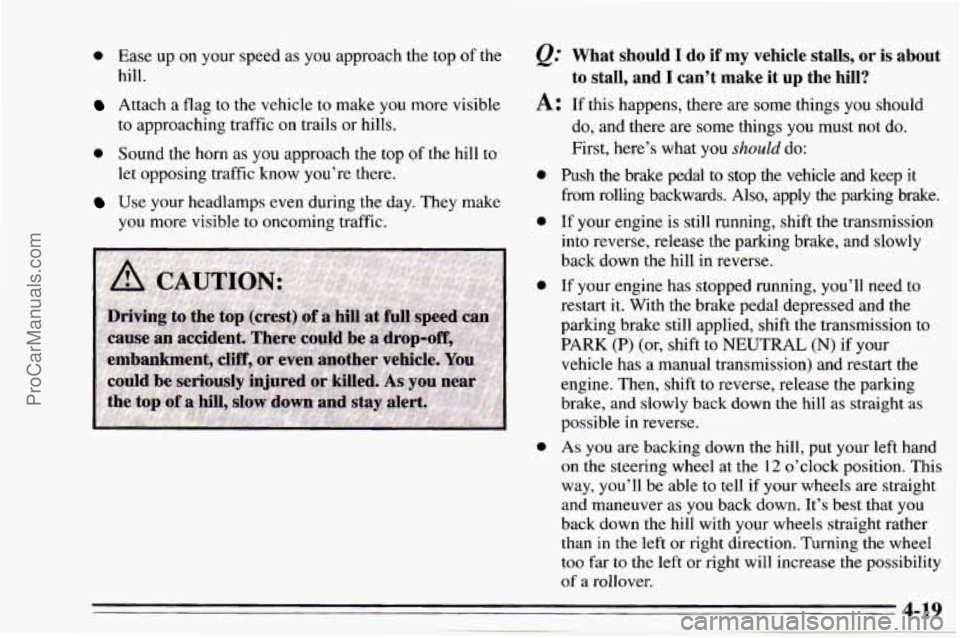
0 Ease up on your speed as you approach the top of the
hill.
Attach a flag to the vehicle to make you more visible
to approaching traffic on trails or hills.
0 Sound the horn as you approach the top of the hill to
let opposing traffic know you’re there.
Use your headlamps even during the day. They make
you more visible to oncoming traffic.
What should I do if my vehicle stalls, or is about
to stall, and
I can’t make it up the hill?
A: If this happens, there are some things you should
0
0
0
0
do, and there are some things you must not do.
First, here’s what you
should do:
Push the brake pedal
to stop the vehicle and keep it
from rolling backwards. Also, apply the parking brake.
If your engine is still running, shift the transmission
into reverse, release the parking brake, and slowly
back down the hill in reverse.
If your engine has stopped running, you’ll need to
restart it. With the brake pedal depressed and the
parking brake still applied, shift the transmission to
PARK
(P) (or, shift to NEUTRAL (N) if your
vehicle has a manual transmission) and restart the
engine. Then, shift to reverse, release the parking
brake, and slowly back down the hill
as straight as
possible in reverse.
As you are backing down the hill, put your left hand
on the steering wheel at the 12 o’clock position. This
way, you’ll be able to tell if your wheels are straight
and maneuver as you back down. It’s best that you
back down the hill with your wheels straight rather
than in the left or right direction. Turning the wheel
too far to the left or right will increase the possibility
of a rollover.
ProCarManuals.com
Page 150 of 354
Driving In Mud, Sand, Snow, Or Ice
When you drive in mud, snow or sand, your wheels
won’t get good traction. You can’t accelerate as quickly,
turning
is more difficult, and you’ll need longer braking
distances.
It’s best to use a low gear when you’re
in mud -- the
deeper the mud, the lower the gear. In really deep mud,
the idea is to keep your vehicle moving
so you don’t get
stuck.
When you drive on sand, you’ll sense
a change in wheel
traction. But
it will depend upon how loosely packed the
sand is. On loosely packed sand (as on beaches or sand
dunes) your tires will tend to sink into the sand. This has
an effect on steering, accelerating, and braking. You
may want to reduce the air pressure
in your tires slightly
when driving on sand. This will improve traction. Hard
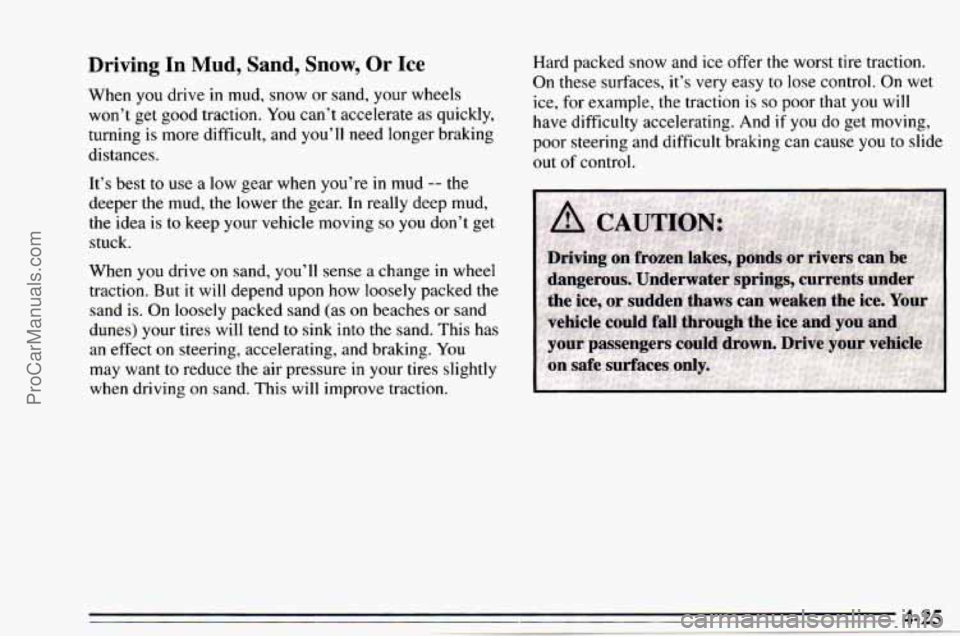
packed snow and ice offer the worst tire traction.
On these surfaces, it’s very easy to lose control. On wet
ice, for example, the traction is
so poor that you will
have difficulty accelerating. And if you do get moving,
poor steering and difficult braking can cause you to slide
out of control.
ProCarManuals.com
Page 151 of 354
Driving In Water
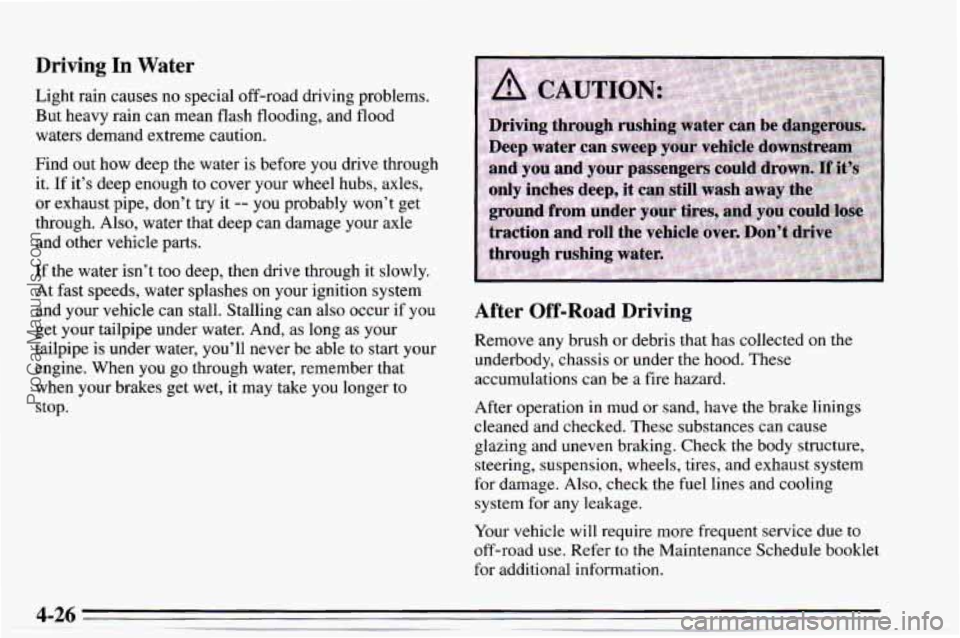
Light rain causes no special off-road driving problems.
But heavy rain can mean flash flooding, and flood
waters demand extreme caution.
Find out how deep the water is before you drive through
it. If it’s deep enough
to cover your wheel hubs, axles,
or exhaust pipe, don’t try it
-- you probably won’t get
through. Also, water that deep can damage your axle
and other vehicle parts.
If the water isn’t too deep, then drive through it slowly.
At fast speeds, water splashes on your ignition system
and your vehicle can stall. Stalling can also occur if
you
get your tailpipe under water. And, as long as your
tailpipe is under water, you’ll never
be able to start your
engine. When you go through water, remember that
when your brakes get wet, it may take you longer
to
stop.
After Off-Road Driving
Remove any brush or debris that has collected on the
underbody, chassis or under the hood. These
accumulations can be
a fire hazard.
After operation in mud or sand, have the brake linings
cleaned and checked. These substances can cause
glazing and uneven braking. Check the body structure,
steering, suspension, wheels, tires, and exhaust system
for damage. Also, check the fuel lines and cooling
svstem for any leakage.
rour vehicle
will require more frequent service due to
off-road use. Refer to the Maintenance Schedule booklet
for additional information.
ProCarManuals.com
Page 162 of 354
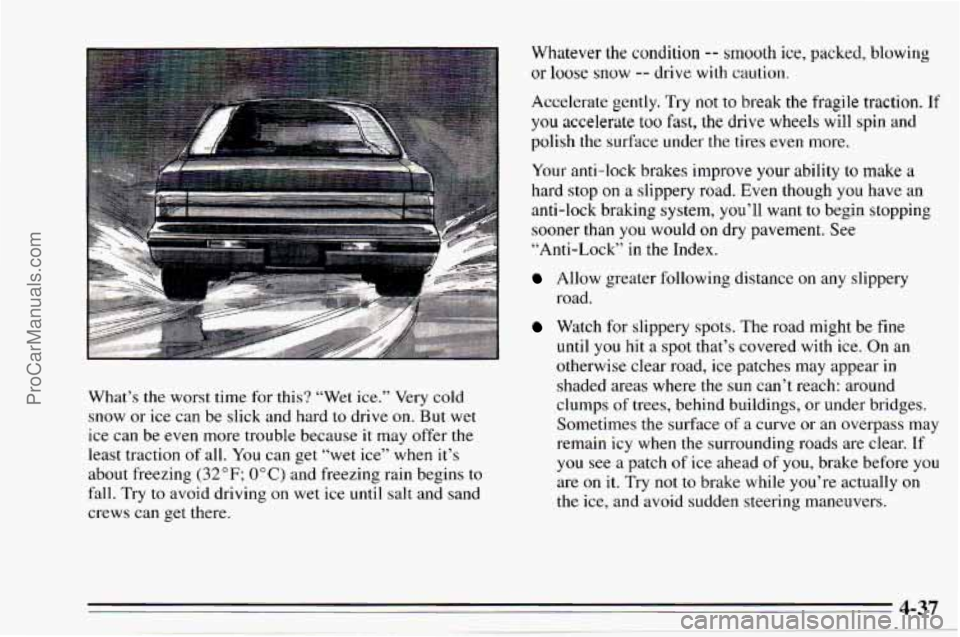
What’s the worst time for this? “Wet ice.” Very cold
snow or ice can be slick and hard
to drive on. But wet
ice can be even more trouble because it may offer
the
least traction of all. You can get “wet ice” when it’s
about freezing (32” F; 0°C) and freezing rain begins to
fall. Try
to avoid driving on wet ice until salt and sand
crews can get there. Whatever
the condition
-- smooth ice, packed, blowing
or loose snow
-- drive with caution.
Accelerate gently. Try not
to break the fragile traction. If
you accelerate too fast, the drive wheels will spin and
polish the surface under the tires even more.
Your anti-lock brakes improve
your ability to make a
hard stop on a slippery road. Even though you have an
anti-lock braking system, you’ll want
to begin stopping
sooner than you would on dry pavement. See
“Anti-Lock”
in the Index.
Allow greater following distance on any slippery
road.
Watch for slippery spots. The road might be fine
until
you hit a spot that’s covered with ice. On an
otherwise clear road, ice patches may appear in
shaded areas where the sun can’t reach: around
clumps of trees, behind buildings,
or under bridges.
Sometimes the surface
of a curve or an overpass may
remain icy when
the surrounding roads are clear. If
you see a patch of ice ahead of you, brake before you
are
on it. Try not to brake while you’re actually on
the ice, and avoid sudden steering maneuvers,
ProCarManuals.com
Page 165 of 354
Recreational Vehicle Towing
There may be times when you want to tow your Geo
behind another vehicle for use at your destination. Be
sure to use the proper towing equipment designed for
recreational towing. Follow the instructions for the
towing equipment.
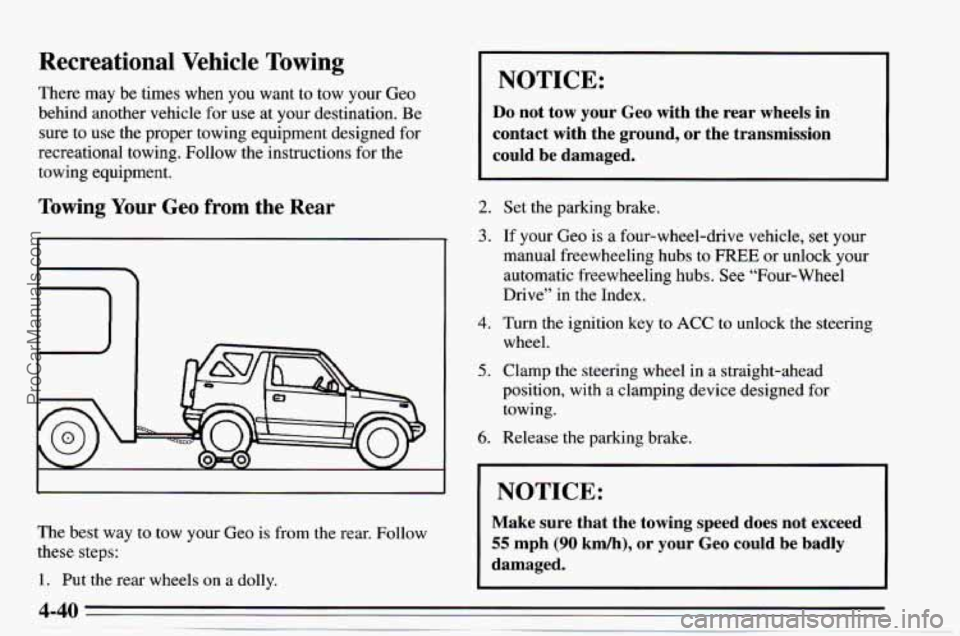
Towing Your Geo from the Rear
The best way to cow your Geo is from the rear. Follow
these steps:
1. Put the rear wheels on a dolly.
I NOTICE:
Do not tow your Geo with the rear wheels in
contact with the ground,
or the transmission
could be damaged.
2. Set the parking brake.
3. If your Geo is a four-wheel-drive vehicle, set your
manual freewheeling hubs
to FREE or unlock your
automatic freewheeling hubs. See “Four-wheel
Drive” in the Index.
4. Turn the ignition key to ACC to unlock the steering
5. Clamp the steering wheel in a straight-ahead
wheel.
position, with a clamping device designed for
towing.
6. Release the parking brake.
NOTICE:
Make sure that the towing speed does not exceed
55 mph
(90 km/h), or your Geo could be badly
damaged.
ProCarManuals.com
Page 166 of 354
Towing Your Geo from the Front
I NOTICE:
If your vehicle has automatic freewheeling hubs
or two-wheel drive, do not tow it on all four
wheels. If you do, your transmission could be
damaged.
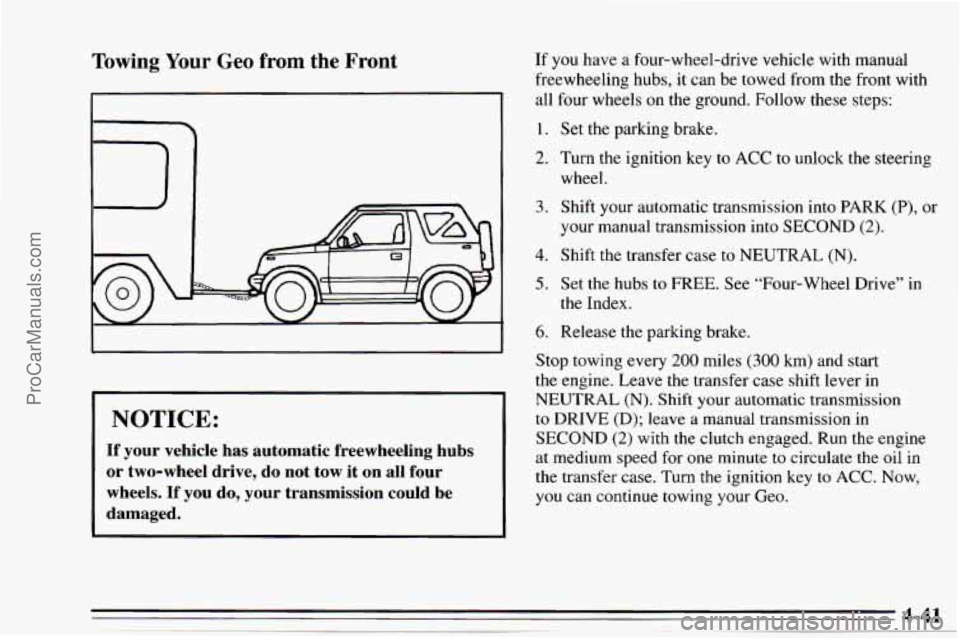
If you have a four-wheel-drive vehicle with manual
freewheeling hubs, it can be towed from the front with
all four wheels on the ground. Follow these steps:
1. Set the parking brake.
2. Turn the ignition key to ACC to unlock the steering
wheel.
3. Shift your automatic transmission into PARK (P), or
your manual transmission into SECOND
(2).
4. Shift the transfer case to NEUTRAL (N).
5. Set the hubs to FREE. See “Four-wheel Drive” in
the Index.
6. Release the parking brake.
Stop towing every
200 miles (300 km) and start
the engine. Leave the transfer
case shift lever in
NEUTRAL (N). Shift your automatic transmission
to
DRIVE (D); leave a manual transmission in
SECOND
(2) with the clutch engaged. Run the engine
at medium speed for
one minute to circulate the oil in
the transfer case. Turn the ignition key to ACC. Now,
you can continue towing your Geo.
ProCarManuals.com
Page 167 of 354
I
NOTICE:
The front wheels transmit shocks during towing.
The steering column may not be strong enough to
withstand the shocks. Always unlock the steering
wheel before towing.
Loading Your Vehicle
I NOTICE:
Make sure that the towing speed does not exceed
damaged.
I 50 mph (SO kmh), or your Geo could be badly
f
TIRE PLACARD
GhR GWVR FRT GAWR RR
WKg
TIRES
RIMS
INFLATION PRESSURE COLD PSVkPa
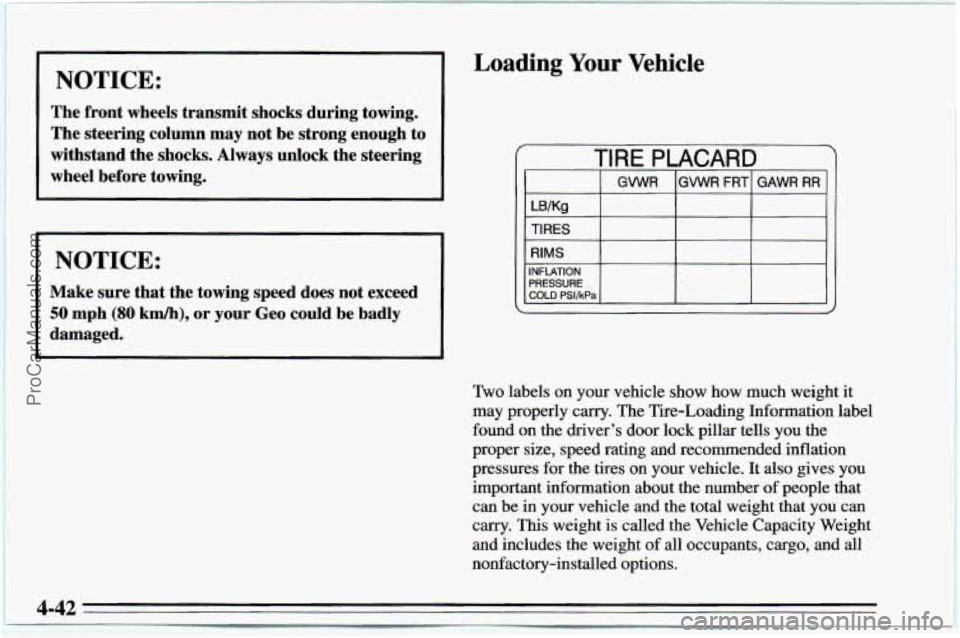
Two labels on your vehicle show how much weight it
may properly carry. The Tire-Loading Information label
found on the driver’s door lock pillar tells you the
proper size, speed rating and recommended inflation
pressures for the tires on your vehicle. It also gives you
important information about the number of people that
can be in your vehicle and the total weight that
you can
carry.
This weight is called the Vehicle Capacity Weight
and includes the weight of all occupants, cargo, and all
nonfactory-installed options.
4-42
ProCarManuals.com
Page 174 of 354
Following Distance
Stay at least twice as far behind the vehicle ahead as you
would when driving your vehicle without a trailer. This
can help you avoid situations that require heavy braking
and sudden turns.
Making lhrns
Passing
You’ll need more passing distance up ahead when
you’re towing a trailer. And, because you’re a good deal
longer, you’ll need to go much farther beyond the
passed vehicle before you can return to your lane.
Backing Up
Hold the bottom of the steering wheel with one hand.
Then, to move the trailer to the left, just move that hand
to the left.
To move the trailer to the right, move your
hand to the right. Always back up slowly and, if
possible, have someone guide you.
I NOTICE:
Making very sharp turns while trailering could
cause the trailer to come in contact with the
vehicle.
Your vehicle could be damaged. Avoid
making very
sharp turns while trailering.
When you’re turning with a trailer, make wider turns
than normal.
Do this so your trailer won’t strike soft
shoulders, curbs, road signs, trees, or other objects.
Avoid jerky or sudden maneuvers. Signal well in
advance.
Turn Signals When Towing a Trailer
When you tow a trailer, your vehicle has to have extra
wiring (included in the optional trailering package). The
green arrows on your instrument panel will flash
whenever you signal a turn or lane change. Properly
hooked up, the trailer lamps will also flash, telling other
drivers you’re about to turn, change lanes or stop.
ProCarManuals.com