trailer CHEVROLET TRACKER 1995 User Guide
[x] Cancel search | Manufacturer: CHEVROLET, Model Year: 1995, Model line: TRACKER, Model: CHEVROLET TRACKER 1995Pages: 354, PDF Size: 18.24 MB
Page 175 of 354
When towing a trailer, the green arrows on your
instrument panel will flash for turns even if the bulbs on
the trailer are burned out. Thus, you may think drivers
behind you are seeing your signal when
they are not. It’s
important to check occasionally to be sure the trailer
bulbs are still working.
Driving On Grades
Reduce speed and shift to a lower gear before you start
down a long or steep downgrade.
If you don’t shift
down, you might have to
use your brakes so much that
they would get hot and no longer work well.
On a long uphill grade, shift down and reduce your
speed
to around 45 mph (70 km/h) to reduce the
possibility of engine and transmission overheating.
If you are towing a trailer and you have a manual
transmission with fifth gear, you may prefer not to use
fifth gear. Just drive in fourth gear (or,
as you need to, a
lower gear).
Parking on Hills
You really should not park your vehicle, with a trailer
attached,
on a hill. If something goes wrong, your rig
could start
to move. People can be injured, and both
your vehicle and the trailer can be damaged.
But if you ever have to park your rig on a hill, here’s
how to do it:
1. Apply your regular brakes, but don’t shift into
PARK
(P) yet, or into gear for a manual
transmission.
2. Have someone place chocks under the trailer wheels.
3. When the wheel chocks are in place, release the
regular brakes until the chocks absorb the load.
4. Reapply the regular brakes. Then apply your parking
brake, and then shift to PARK
(P), or REVERSE (R)
for a manual transmission.
5. If you have a four-wheel drive vehicle, be sure
the transfer case is
in a drive gear -- not in
NEUTRAL
(N).
6. Release the regular brakes.
ProCarManuals.com
Page 176 of 354
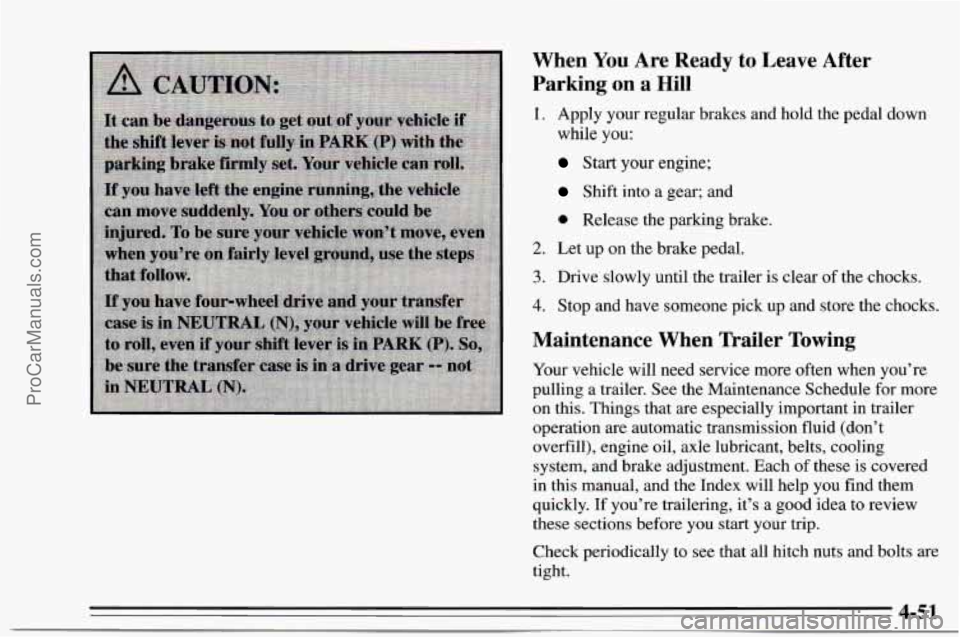
When You Are Ready to Leave After
Parking on a Hill
1. Apply your regular brakes and hold the pedal down
while you:
Start your engine;
Shift into a gear; and
0 Release the parking brake.
2. Let up on the brake pedal.
3. Drive slowly until the trailer is clear of the chocks.
4. Stop and have someone pick up and store the chocks.
Maintenance When Trailer Towing
Your vehicle will need service more often when you’re
pulling a trailer. See the Maintenance Schedule for more
on this. Things that
are especially important in trailer
operation are automatic transmission fluid (don’t
overfill), engine oil, axle lubricant, belts, cooling
system, and brake adjustment. Each of these is covered
in this manual, and the Index will help you find them
quickly. If you’re trailering, it’s a good idea to review
these sections before you start your trip.
Check periodically to see that all hitch nuts and bolts are
tight.
4-51
ProCarManuals.com
Page 189 of 354
If No Steam Is Coming From Your Engine
I NOTICE:
If your engine catches fire because you keep
driving with no coolant, your vehicle can be
badly damaged. The costly repairs would not be
covered by your warranty.
If you get the overheat warning but see or hear no
steam,
the problem may not be too serious. Sometimes
the engine can get a little too hot when you:
Climb a long hill on a hot day.
Stop after high speed driving.
Idle for long periods in traffic.
Tow a trailer.
If
you get the overheat warning with no sign of steam,
try this for a minute or
so:
1. If you have an air conditioner, turn it off.
2. Turn on your heater to full hot at the highest fan
speed and open the window as necessary.
3. If you’re in a traffic jam, shift to NEUTRAL (N);
otherwise, shift to the highest gear while
driving
-- DRIVE (D) for automatic transmissions.
If you no longer have the overheat warning, you can drive.
Just to be safe, drive slower for about ten minutes. If the
warning doesn’t come back on,
you can drive normally.
If the warning continues, pull over, stop, and park your
vehicle right away.
If there’s still
no sign of steam, you can idle the engine for two
or
three minutes while you’re parked, to see if the warning
ProCarManuals.com
Page 226 of 354
As shown in the chart, SAE 5W-30 is best for your
vehicle. However, you can use
SAE 10W-30 if it's going
to be 0°F (-18°C) or above. These numbers on an oil
container show its viscosity, or thickness.
Do not use
other viscosity oils, such
as SAE 20W-50.
NOTICE:
Use only engine oil with the American Petroleum
Institute Certified For Gasoline Engines
"Starburst" symbol. Failure to use the proper oil
can result in engine damage not covered by your
warranty.
GM Goodwrench@ oil (in Canada, GM Engine Oil)
meets all the requirements for your vehicle.
Engine Oil Additives
Don't add anything to your oil. Your Chevrolet/Geo
dealer is ready to advise if you think something should
be added.
When to Change Engine Oil
See if any one of these is true for you:
Most trips are less than 5 to 10 miles (8 to 16 krn).
This
is particularly important when outside
temperatures are below freezing.
driving in stop and
go traffic).
Most trips include extensive idling (such as frequent
You operate your vehicle in dusty areas or off-road
You frequently tow a trailer or use a carrier on top of
frequently.
your vehicle.
If any one
of these is true for your vehicle, then you
need to change your oil and filter every 3,000 miles
(5 000 km) or 3 months -- whichever comes first.
If none of them is true, change oil and filter every
7,500 miles (12 500 km) or 7.5 months -- whichever
comes first.
ProCarManuals.com
Page 230 of 354
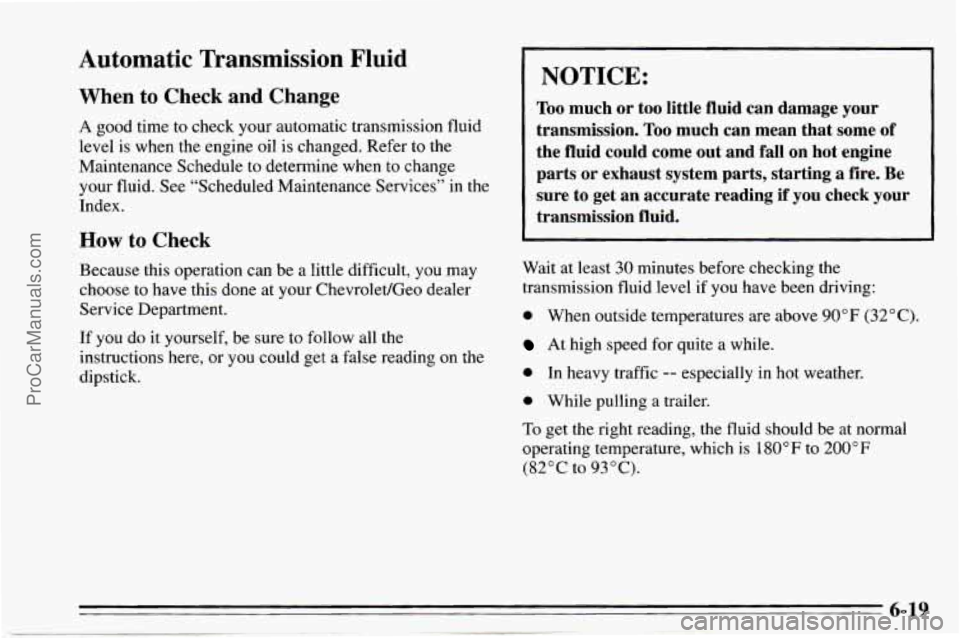
Automatic Transmission Fluid
When to Check and Change
A good time to check your automatic transmission fluid
level is when the engine oil is changed. Refer to the
Maintenance Schedule to determine
when to change
your fluid. See “Scheduled Maintenance Services”
in the
Index.
How to Check
Because this operation can be a little difficult, you may
choose to have this done at your Chevrolet/Geo dealer
Service Department.
If you do it yourself, be sure to follow all the
instructions here, or you could get a false reading on the
dipstick.
NOTICE:
Too much or too little fluid can damage your
transmission.
Too much can mean that some of
the fluid could come out and fall on hot engine
parts or exhaust system parts, starting a fire. Be sure to get an accurate reading if you check your
transmission fluid.
Wait at least 30 minutes before checking the
transmission fluid level if you have been driving:
0 When outside temperatures are above 90°F (32°C).
At high speed for quite a while.
0 In heavy traffic -- especially in hot weather.
0 While pulling a trailer.
To get the right reading, the fluid should be at normal
operating temperature, which is
180” F to 200” F
(82°C to 93°C).
ProCarManuals.com
Page 281 of 354
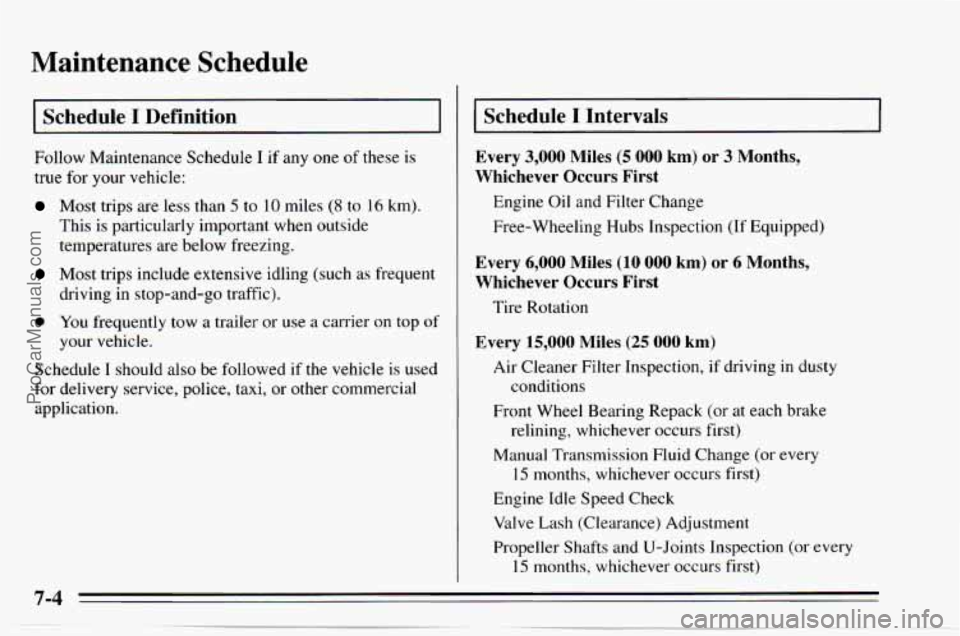
Maintenance Schedule
I Schedule I Definition
Follow Maintenance Schedule I if any one of these is
true for your vehicle:
Most trips are less than 5 to 10 miles (8 to 16 km).
This is particularly important when outside
temperatures are below freezing.
driving
in stop-and-go traffic).
Most trips include extensive idling (such as frequent
0 You frequently tow a trailer or use a carrier on top of
your vehicle.
Schedule
I should also be followed if the vehicle is used
for delivery service, police, taxi, or other commercial
application.
Schedule I Intervals
Every 3,000 Miles (5 000 km) or 3 Months,
Whichever Occurs First
Engine Oil and Filter Change
Free-Wheeling Hubs Inspection (If Equipped)
Every 6,000 Miles (10 000 km) or 6 Months,
Whichever Occurs First
Tire Rotation
Every 15,000 Miles (25 000 km)
Air Cleaner Filter Inspection, if driving in dusty
Front Wheel Bearing Repack (or at each brake
Manual Transmission Fluid Change (or every
Engine Idle Speed Check
Valve Lash (Clearance) Adjustment
Propeller Shafts and U-Joints Inspection (or every conditions
relining, whichever occurs first)
15 months, whichever occurs first)
15 months, whichever occurs first)
ProCarManuals.com
Page 288 of 354
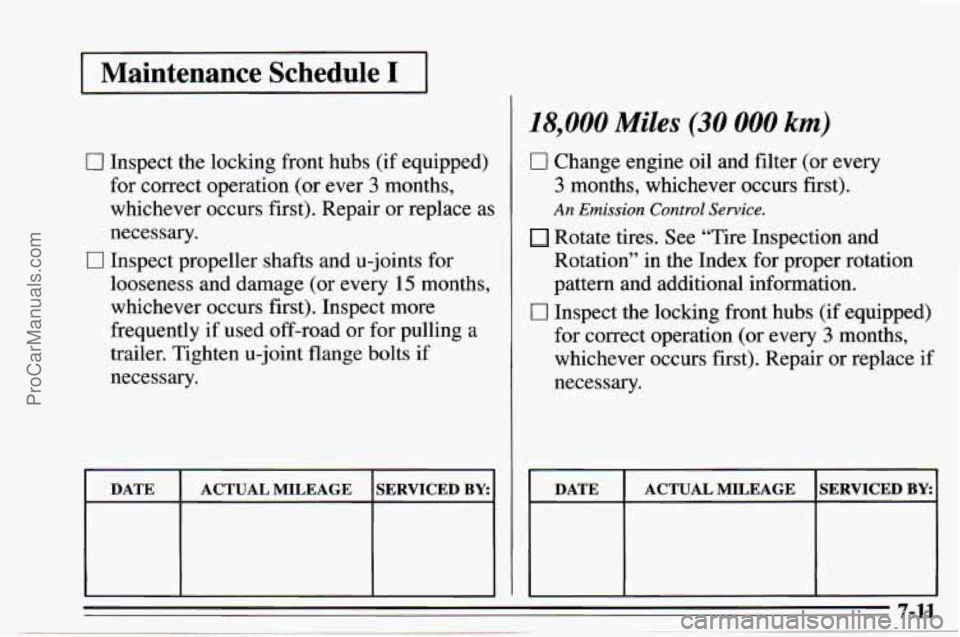
I Maintenance Schedule I I
0 Inspect the locking front hubs (if equipped)
for correct operation (or ever
3 months,
whichever occurs first). Repair
or replace as
necessary.
0 Inspect propeller shafts and u-joints for
looseness and damage (or every
15 months,
whichever occurs first). Inspect more
frequently if used off-road
or for pulling a
trailer. Tighten u-joint flange bolts if
necessary.
18,000 Miles (30 000 km)
0 Change engine oil and filter (or every
3 months, whichever occurs first).
An Emission Control Service.
Rotate tires. See “Tire Inspection and
Rotation”
in the Index for proper rotation
pattern and additional information.
0 Inspect the locking front hubs (if equipped)
for correct operation (or
every 3 months,
whichever occurs first). Repair or replace if
necessary.
I I I I
DATE ACTUAL MILEAGE SERVICED BY:
ProCarManuals.com
Page 292 of 354
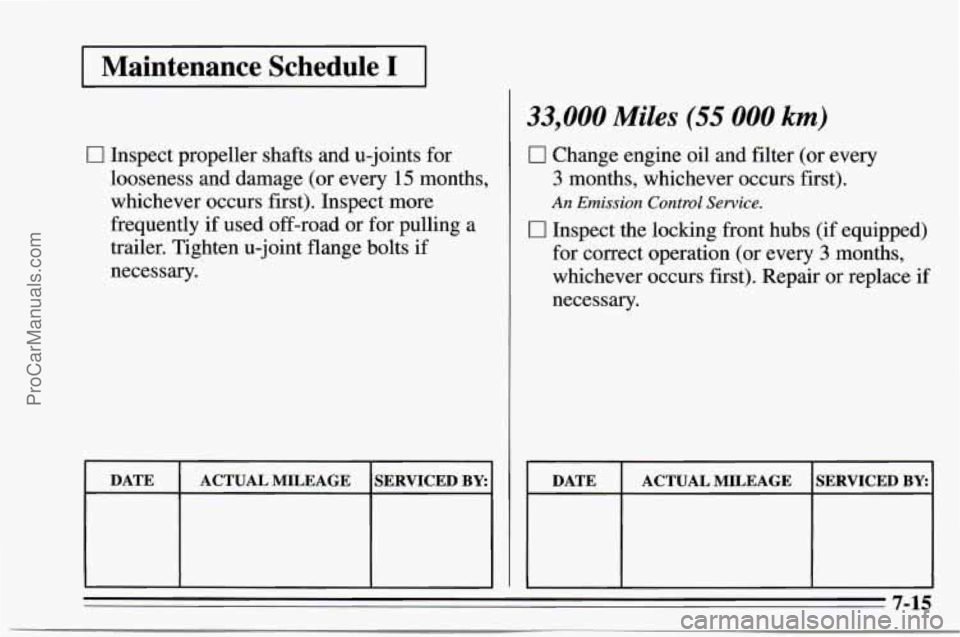
I Maintenance Schedule I I
33,000 Miles (55 000 km)
C 1 Inspect propeller shafts and u-joints for
looseness and damage (or every
15 months,
whichever occurs first). Inspect more
frequently if used off-road or for pulling a
trailer. Tighten u-joint flange bolts if
necessary.
DATE ACTUAL MILEAGE SERVICED BY:
0 Change engine oil and filter (or every
3 months, whichever occurs first).
An Emission Control Service.
0 Inspect the locking front hubs (if equipped)
for correct operation (or every
3 months,
whichever occurs first). Repair or replace
if
necessary.
DATE SERVICED BY: ACTUAL MILEAGE
7-15
ProCarManuals.com
Page 295 of 354
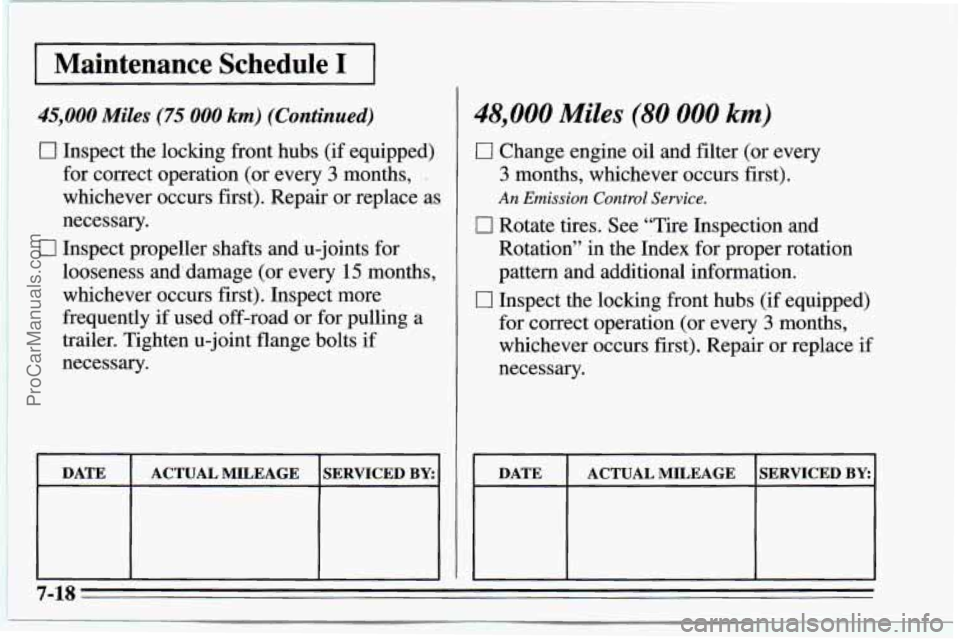
1 Maintenance Schedule I I
45,000 Miles (75 000 km) (Continued)
[7 Inspect the locking front hubs (if equipped)
for correct operation (or every
3 months, .
whichever occurs first). Repair or replace as
necessary.
0 Inspect propeller shafts and u-joints for
looseness and‘damage (or every
15 months,
whichever occurs first). Inspect more
frequently
if used off-road or for pulling a
trailer. Tighten u-joint flange bolts if
necessary.
48,000 Miles (80 000 km)
0 Change engine oil and filter (or every
3 months, whichever occurs first).
0 Rotate tires. See “Tire Inspection and
Rotation” in the Index for proper rotation
pattern and additional information.
0 Inspect the locking front hubs (if equipped)
for correct operation (or every
3 months,
whichever occurs first). Repair or replace
if
necessary.
An Emission Control Sewice.
DATE ACTUAL MILEAGE SERVICED BY: DATE ACTUAL MILEAGE
SERVICED BY:
7-18
ProCarManuals.com
Page 296 of 354
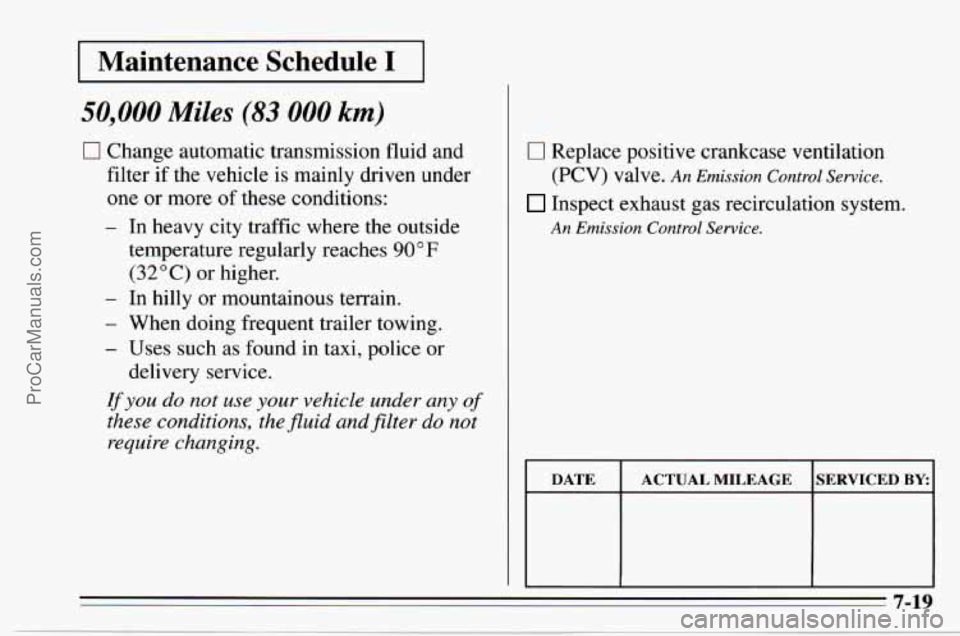
Maintenance Schedule I
50,000 Miles (83 000 km)
0 Change automatic transmission fluid and
filter if the vehicle is mainly driven under
one
or more of these conditions:
- In heavy city traffic where the outside
temperature regularly reaches
90 O F
(32°C) or higher.
- In hilly or mountainous terrain.
- When doing frequent trailer towing.
- Uses such as found in taxi, police or
If you do not use your vehicle under any of
these conditions, the fluid andfilter do not
require changing.
delivery service.
0 Replace positive crankcase ventilation
(Pcv) valve. An Emission Control Service.
Inspect exhaust gas recirculation system.
An Emission Control Service.
I DATE I ACTUAL MILEAGE lSERVICED BXI
ProCarManuals.com