heater CHEVROLET TRACKER 1995 Owners Manual
[x] Cancel search | Manufacturer: CHEVROLET, Model Year: 1995, Model line: TRACKER, Model: CHEVROLET TRACKER 1995Pages: 354, PDF Size: 18.24 MB
Page 106 of 354
Gem Section 3 Comfort Controls and Audio Systems
In this section you’ll find out how to operate the comfort
control systems and audio systems offered
with your
Geo. Be sure to read about the particular system
supplied with your vehicle.
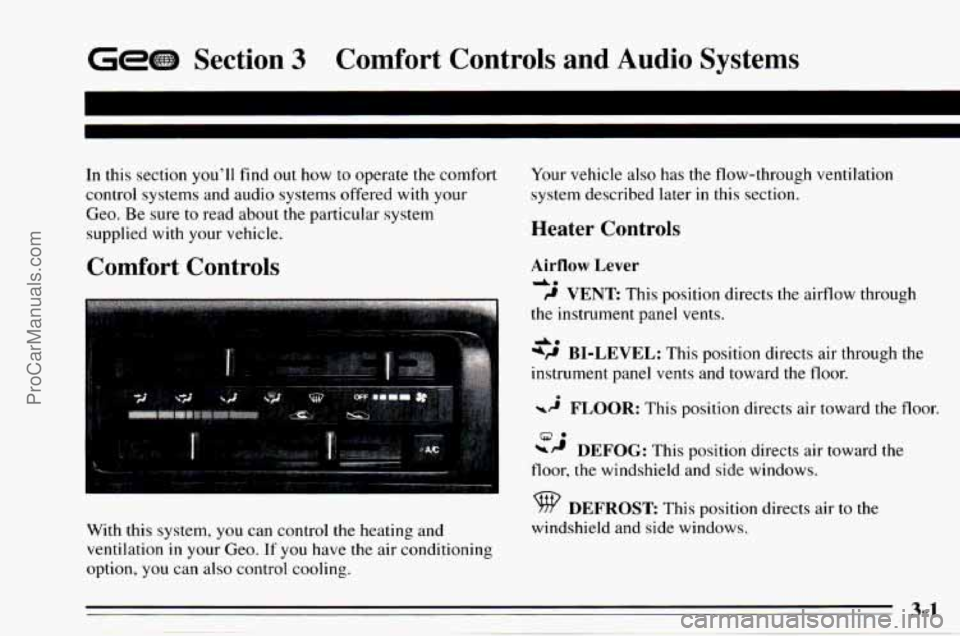
Comfort Controls
With this system, you can control the heating and
ventilation
in your Geo. If you have the air conditioning
option, you can
also control cooling. Your
vehicle also has the flow-through ventilation
system described later
in this section.
Heater Controls
Airflow Lever
da
9 VENT This position directs the airflow through
the instrument panel vents.
*P BI-LEVEL: This position directs air through the
instrument panel vents and toward
the floor.
-2 FLOOR: This position directs air toward the floor.
DEFOG: This position directs air toward the
A*
9.
floor, the windshield and side windows.
DEFROST This position directs air to the
windshield and side windows.
ProCarManuals.com
Page 108 of 354
Air Conditioner Controls (Option)
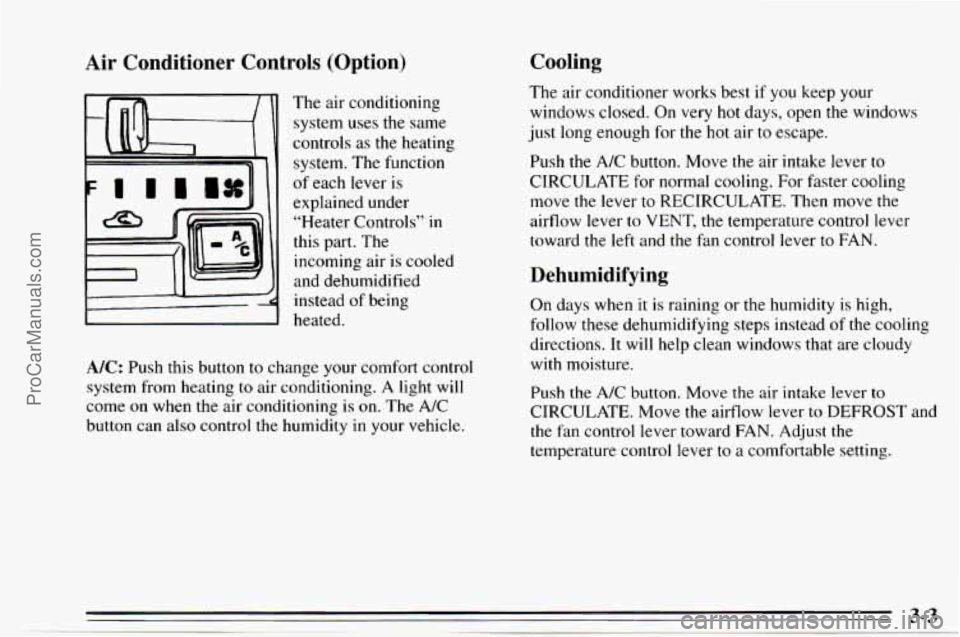
The air conditioning
system uses
the same
controls
as the heating
system. The function
of each lever is
explained under
“Heater Controls”
in
this part. The
incoming air
is cooled
and dehumidified
instead of being
heated.
A/C: Push this button to change your comfort control
system from heating
to air conditioning. A light will
come on when the air conditioning is on. The A/C
button can also control the humidity in your vehicle.
Cooling
The air conditioner works best if you keep your
windows closed. On very hot days, open the windows
just
long enough for the hot air to escape.
Push the
A/C button. Move the air intake lever to
CIRCULATE for normal cooling. For faster cooling
move the lever to RECIRCULATE, Then move the
airflow lever to VENT, the temperature control lever
toward the left and the
fan control lever to FAN.
Dehumidifying
On days when it is raining or the humidity is high,
follow these dehumidifying steps instead
of the cooling
directions.
It will help clean windows that are cloudy
with moisture.
Push
the A/C button. Move the air intake lever to
CIRCULATE. Move the airflow lever to DEFROST and
the
fan control lever toward FAN. Adjust the
temperature control lever to a comfortable setting.
ProCarManuals.com
Page 109 of 354
Rear Window Defogger
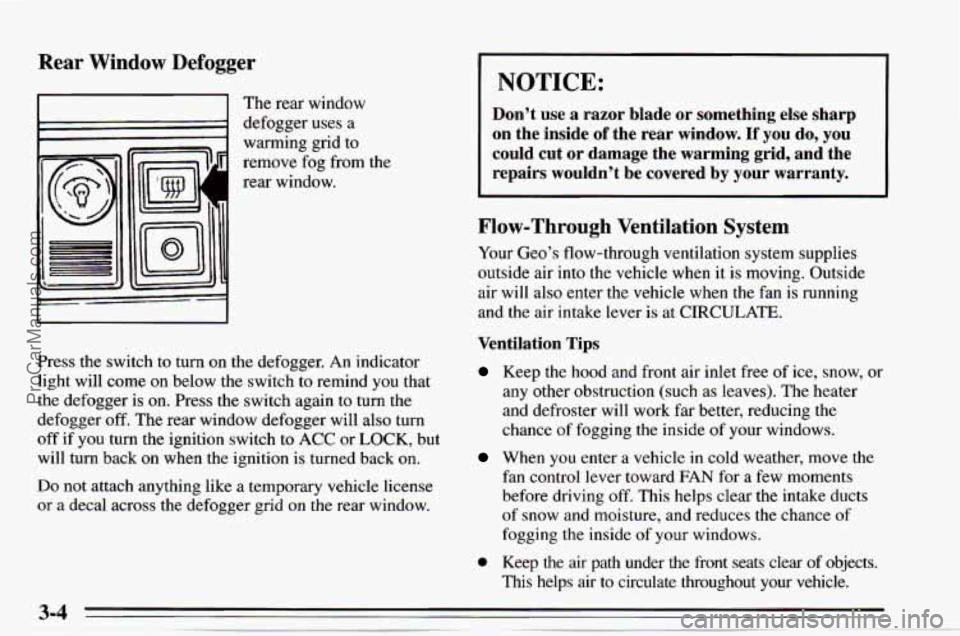
I I The rear window
1 defogger uses a
warming grid
to
remove fog from the
rear window.
Press the switch
to turn on the defogger. An indicator
light will come on below the switch to remind you that
the defogger is
on. Press the switch again to turn the
defogger
off. The rear window defogger will also turn
off if you turn the ignition switch to ACC or LOCK, but
will turn back on when the ignition
is turned back on.
Do not attach anything like a temporary vehicle license
or a decal across the defogger grid on the rear window.
I NOTICE:
Don’t use a razor blade or something else sharp
on the inside
of the rear window. If you do, you
could cut or damage the warming grid, and the
repairs wouldn’t be covered by
your warranty.
Flow-Through Ventilation System
Your Geo’s flow-through ventilation system supplies
outside air into the vehicle when it is moving. Outside
air will also enter the vehicle when the fan
is running
and the air intake lever is at CIRCULATE.
Ventilation Tips
Keep the hood and front air inlet free of ice, snow, or
any other obstruction (such as leaves). The heater
and defroster will work far better, reducing the
chance of fogging the inside of your windows.
When you enter a vehicle in cold weather, move the
fan control lever toward FAN for a few moments
before driving
off. This helps clear the intake ducts
of snow and moisture, and reduces the chance of
fogging the inside of your windows.
0 Keep the air path under the front seats clear of objects.
This helps air to circulate throughout your vehicle.
ProCarManuals.com
Page 164 of 354
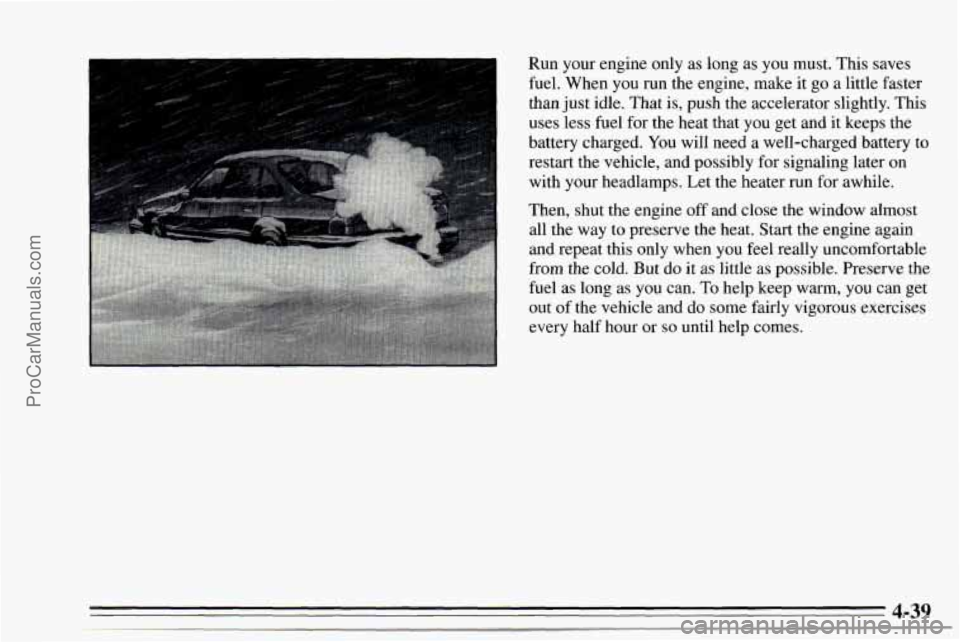
Run your engine only as long as you must. This saves
fuel. When you run the engine, make it go a little faster
than just idle. That
is, push the accelerator slightly. This
uses less fuel for the heat that you get and it keeps the
battery charged. You will need
a well-charged battery to
restart the vehicle, and possibly for signaling later
on
with your headlamps. Let the heater run for awhile.
Then, shut the engine
off and close the window almost
all the way to preserve the heat. Start the engine again
and repeat this only when you feel really uncomfortable
from the cold. But do it
as little as possible. Preserve the
fuel as long as you can.
To help keep warm, you can get
out of the vehicle and do some fairly vigorous exercises
every half hour or
so until help comes.
4-39
ProCarManuals.com
Page 189 of 354
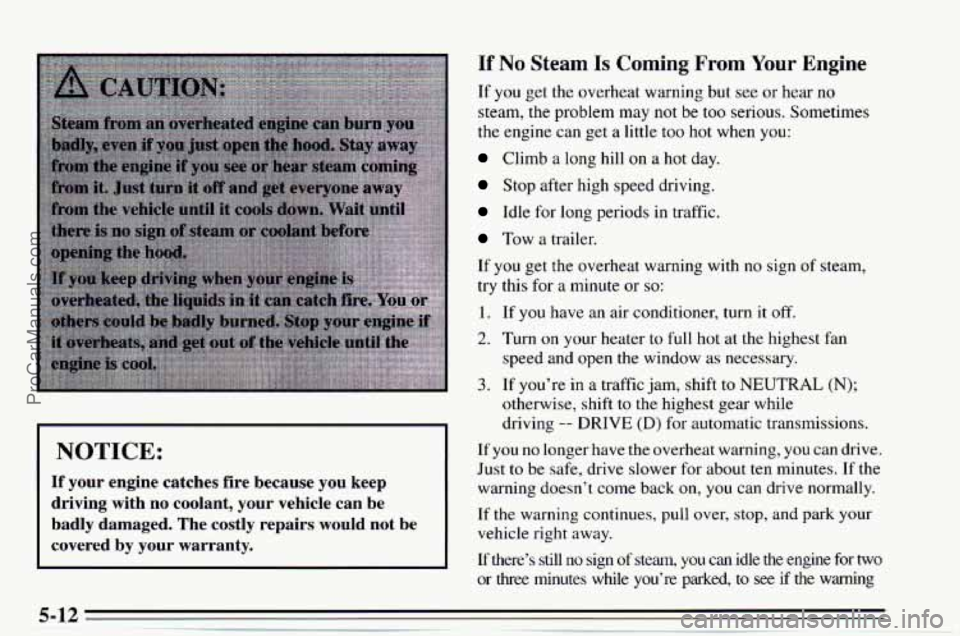
If No Steam Is Coming From Your Engine
I NOTICE:
If your engine catches fire because you keep
driving with no coolant, your vehicle can be
badly damaged. The costly repairs would not be
covered by your warranty.
If you get the overheat warning but see or hear no
steam,
the problem may not be too serious. Sometimes
the engine can get a little too hot when you:
Climb a long hill on a hot day.
Stop after high speed driving.
Idle for long periods in traffic.
Tow a trailer.
If
you get the overheat warning with no sign of steam,
try this for a minute or
so:
1. If you have an air conditioner, turn it off.
2. Turn on your heater to full hot at the highest fan
speed and open the window as necessary.
3. If you’re in a traffic jam, shift to NEUTRAL (N);
otherwise, shift to the highest gear while
driving
-- DRIVE (D) for automatic transmissions.
If you no longer have the overheat warning, you can drive.
Just to be safe, drive slower for about ten minutes. If the
warning doesn’t come back on,
you can drive normally.
If the warning continues, pull over, stop, and park your
vehicle right away.
If there’s still
no sign of steam, you can idle the engine for two
or
three minutes while you’re parked, to see if the warning
ProCarManuals.com
Page 191 of 354
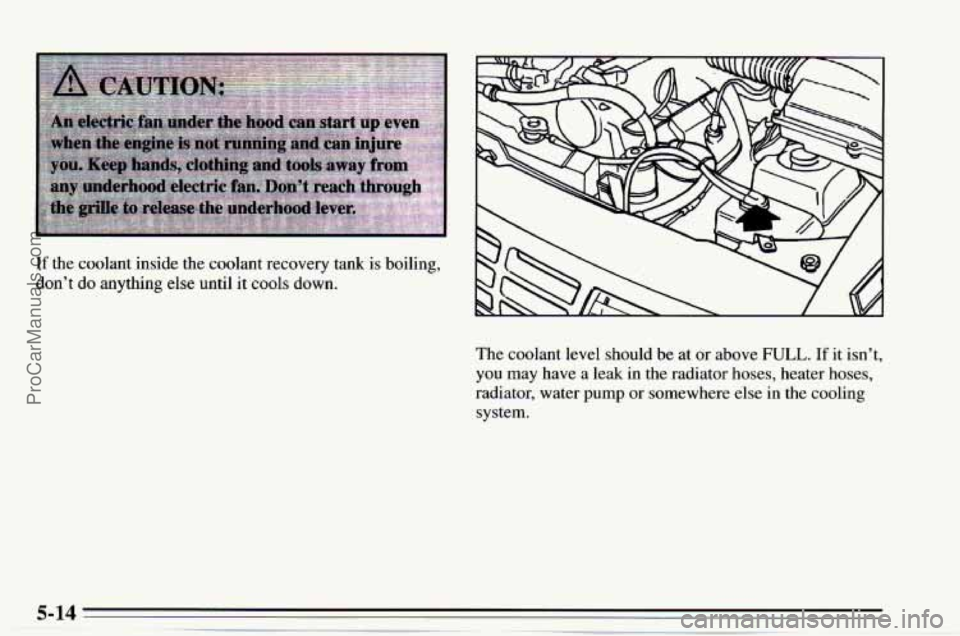
If the coolant inside the coolant recovery tank is boiling,
don’t do anything
else until it cools down.
The coolant level should be at or above
FULL. If it isn’t,
you may have a leak in the radiator hoses, heater hoses,
radiator, water pump or somewhere else in the cooling
system.
ProCarManuals.com
Page 193 of 354
I NOTICE:
In cold weather, water can freeze and crack the
engine, radiator, heater core and other parts. Use
the recommended coolant.
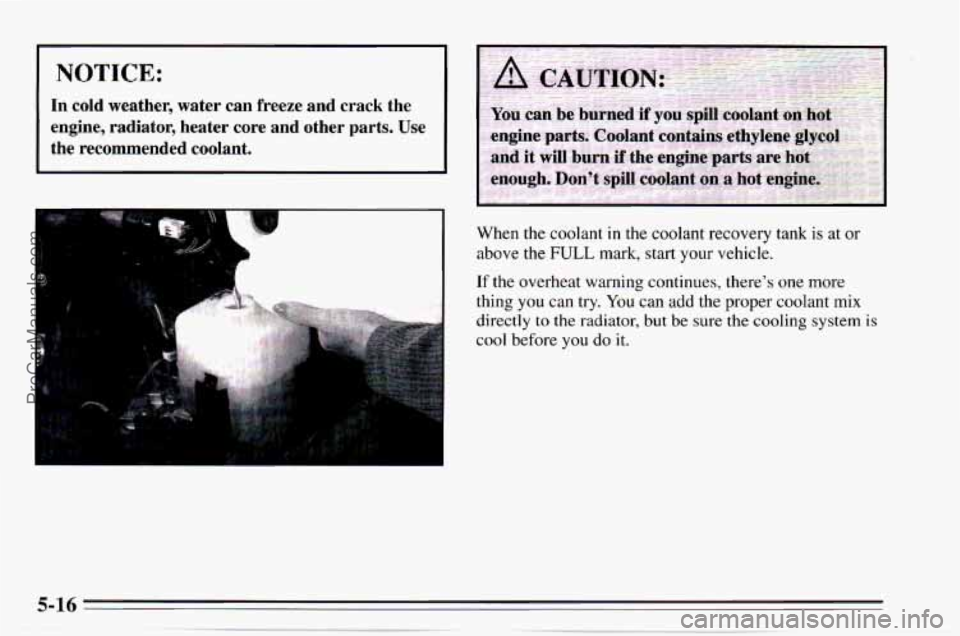
When the coolant in the coolant recovery tank is at or
above the
FULL mark, start your vehicle.
If the overheat warning continues, there's one more
thing
you can try. You can add the proper coolant mix
directly to the radiator, but be sure the cooling system is
cool before you do it.
ProCarManuals.com
Page 237 of 354
I NOTICE:
If you use an improper coolant mix, your engine
could overheat and be badly damaged. The
repair cost wouldn’t be covered by your
warranty.
Too much water in the mix can freeze
and crack the engine, radiator, heater core and
other parts.
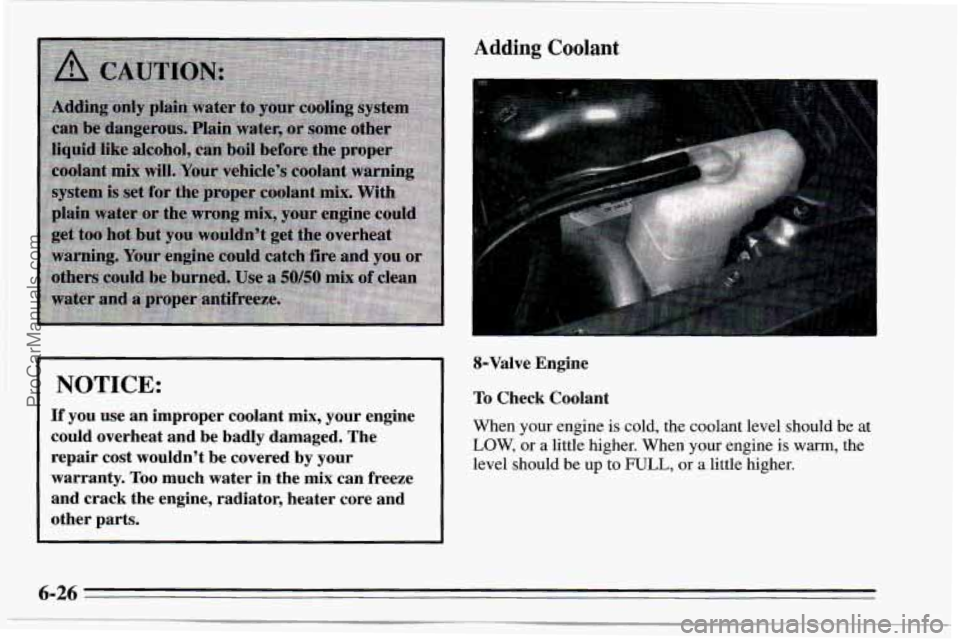
Adding Coolant
8-Valve Engine
To Check Coolant
When your engine is cold, the coolant level should be at
LOW, or
a little higher. When your engine is warm, the
level should be
up to FULL, or a little higher.
6-26
ProCarManuals.com
Page 274 of 354
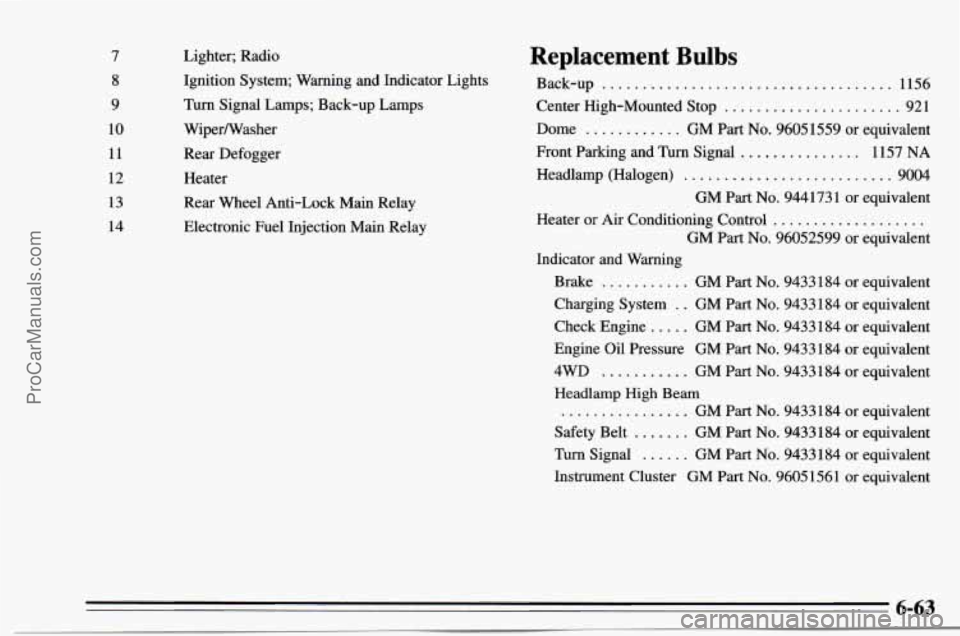
7 8
9
10 11
12
13
14 Lighter;
Radio
Ignition System; Warning and Indicator Lights
Turn Signal Lamps; Back-up Lamps
WiperNasher
Rear Defogger
Heater
Rear Wheel Anti-Lock Main Relay
Electronic Fuel Injection Main Relay Replacement Bulbs
Back-up .................................... 1156
Center High-Mounted Stop
...................... 921
Dome
............ GM Part No. 9605 1559 or equivalent
Front Parking and Turn Signal
............... 1157 NA
Headlamp (Halogen) .......................... 9004
GM Part
No. 944173 1 or equivalent
GM Part
No. 96052599 or equivalent
Heater
or Air
Conditioning Control ...................
Indicator and Warning
Brake
........... GM Part No. 9433184 or equivalent
Check Engine
..... GM Part No. 9433184 or equivalent
4WD ........... GM Part No. 9433184 or equivalent
................ GM Part No. 9433184 or equivalent
Safety Belt
....... GM Part No. 9433184 or equivalent
Turn Signal
...... GM Part No. 9433 184 or equivalent
Charging System
. . GM Part No. 9433184
or equivalent
Engine Oil Pressure GM Part
No. 9433184 or equivalent
Headlamp High Beam
Instrument Cluster GM Part
No. 9605 1561 or equivalent
6-63
ProCarManuals.com
Page 348 of 354
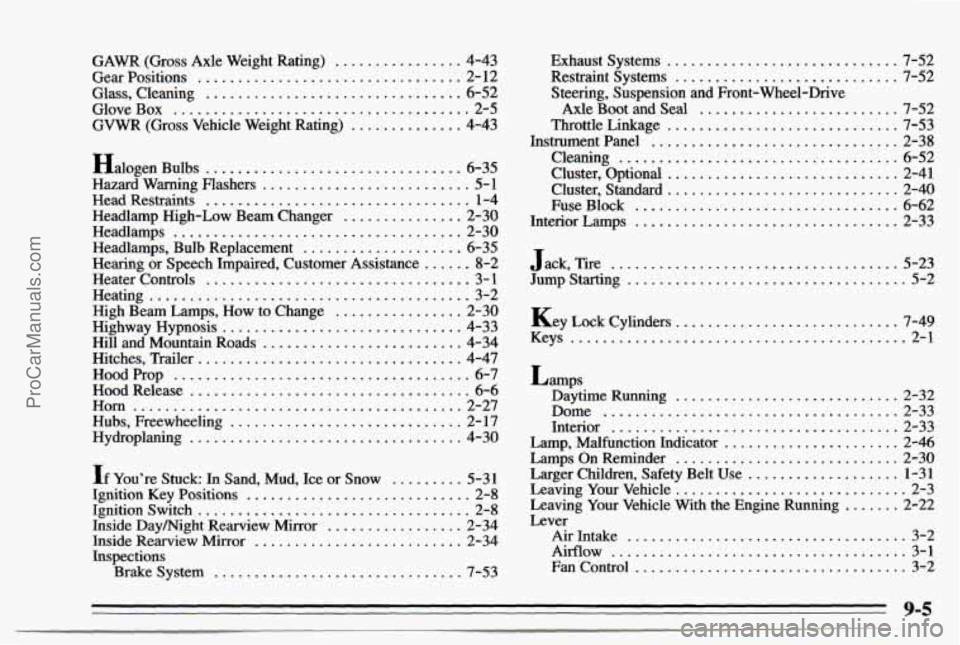
GAWR (Gross Axle Weight Rating) ................ 4-43
Gear Positions
................................. 2- 12
GloveBox
..................................... 2-5
GVWR (Gross Vehicle Weight Rating) .............. 4-43
Halogen Bulbs
................................ 6-35
Hazard Warning Flashers
.......................... 5-1
Head Restraints
................................. 1-4
Headlamp High-Low Beam Changer
............... 2-30
Headlamps
.................................... 2-30
Headlamps. Bulb Replacement
.................... 6-35
Hearing or Speech Impaired. Customer Assistance
...... 8-2
Heater Controls
................................. 3-1
Heating
........................................ 3-2
High Beam Lamps. How
to Change ................ 2-30
Highway Hypnosis
.............................. 4-33
Hill and Mountain Roads
......................... 4-34
Glass. Cleaning
................................ 6-52
Hitches. Trailer
................................. 4-47
HoodProp
..................................... 6-7
Hood Release
................................... 6-6
Horn ......................................... 2-27
Hubs. Freewheeling
............................. 2- 17
Hydroplaning
.................................. 4-30
If You’re Stuck: In Sand. Mud. Ice or Snow ......... 5-31
Ignition Key Positions
............................ 2-8
Inside Daymight Rearview Mirror
................. 2-34
Inside Rearview Mirror
.......................... 2-34
Inspections
Brakesystem
............................... 7-53
Ignition Switch
.................................. 2-8 Exhaust Systems
............................. 7-52
Restraint Systems
............................ 7-52
Steering. Suspension and Front-Wheel-Drive
Axle Boot and Seal
......................... 7-52
Throttle Linkage
............................. 7-53
Instrument Panel
............................... 2-38
Cleaning
................................... 6-52
Cluster. Optional
............................. 2-41
Cluster. Standard
............................. 2-40
Fuse Block
................................. 6-62
InteriorLamps
................................. 2-33
.................................... J ack. Tire 5-23
Jump Starting
................................... 5-2
Key Lock Cylinders ............................ 7-49
Keys
.......................................... 2-1
Lamps Daytime Running
............................ 2-32
Dome
..................................... 2-33
Interior
.................................... 2-33
Lamp. Malfunction Indicator
...................... 2-46
LampsOnReminder
............................ 2-30
Larger Children. Safety Belt Use
................... 1-31
Leaving Your Vehicle
............................. 2-3
Leaving Your Vehicle With the Engine Running
....... 2-22
Lever AirIntake
................................... 3-2
Airflow ..................................... 3-1
Fancontrol
.................................. 3-2
9-5
ProCarManuals.com