four wheel drive CHEVROLET TRACKER 1996 Owner's Manual
[x] Cancel search | Manufacturer: CHEVROLET, Model Year: 1996, Model line: TRACKER, Model: CHEVROLET TRACKER 1996Pages: 387, PDF Size: 18.54 MB
Page 208 of 387
Towing Your Vehicle
Try to have a Chevrolet/Geo dealer or a professional
towing service tow your Geo. See “Roadside
Assistance” in the Index.
If your vehicle has been changed or modified since it
was factory-new by adding aftermarket items like fog
lamps, aero skirting, or special tires and wheels, these
instructions may not
be correct.
Before you do anything, turn on the hazard
warning flashers.
When you call, tell the towing service:
That your vehicle has rear-wheel drive, or that it has
the four-wheel-drive option.
The make, model and year of your vehicle.
Whether you can still move the shift lever for’the
transmission and transfer case,
if you have one.
0 If there was an accident, what was damaged.
When the towing service arrives, let the tow operator
know that this manual contains detailed towing
instructions
and illustrations. The operator may want to
see them.
I a CAUTION:
To help avoid injury to you or others:
Never let passengers ride in a vehicle that is
Never tow faster than safe or posted speeds.
Never tow with damaged parts not
Never get under your vehicle after it has
Always use separate safety chains on each
Never use T-hooks. Use J-hooks instead.
being towed.
fully
secured.
been lifted by the tow truck.
side when towing
a vehicle.
5-7
ProCarManuals.com
Page 211 of 387
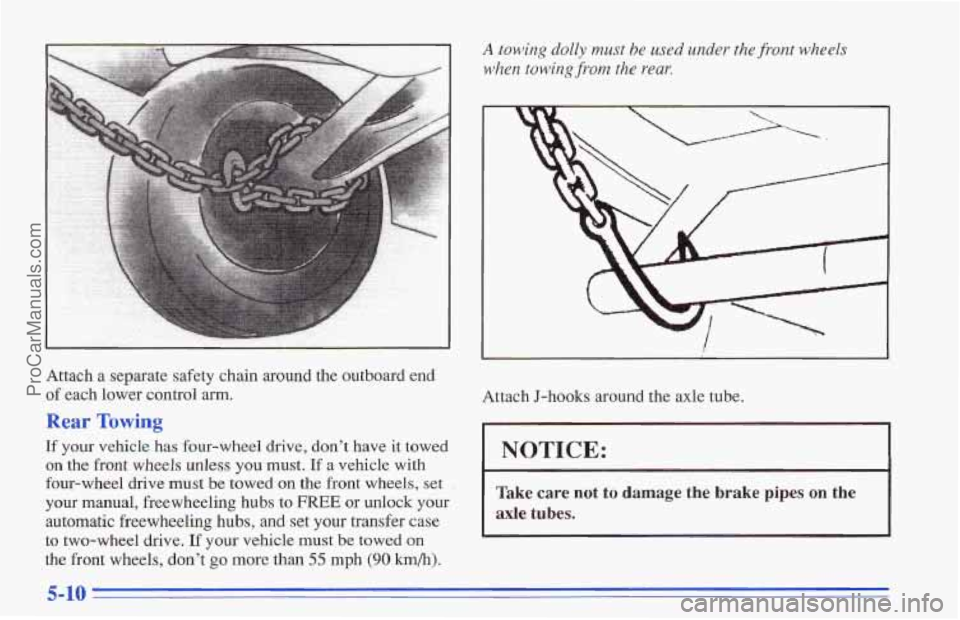
Attach a separate safety chain around the outboard end
of each lower control arm.
Rear Towing
If your vehicle has four-wheel drive, don't have it towed
on the front wheels unless you must. If a vehicle with
four-wheel drive must
be towed on the front wheels, set
your manual, freewheeling
hubs to FREE or unlock your
automatic freewheeling
hubs, and set your transfer case
to two-wheel drive. If your vehicle must be towed on
the-front wheels, don't go more'than 55 mph (90 kmh).
A towing dolly must be used under the front wheels
when towing from the reur.
r
Attach J-hooks around the axle tube.
I NOTICE:
Take care not to damage the brake pipes on the
axle tubes.
5-10
ProCarManuals.com
Page 223 of 387
If a Tire Goes Plat
It’s unusual for a tire to “blow out” while you’re driving,
especiaIIy
if you maintain your tires properly. If air goes
out
of a tire, it’s much more likely to leak put slowly.
But if you should ever have a “blowout,” here are a few
tips about
what to expect and what to do:
If a front tire fails, the flat tire will create a drag that
pulls the vehicle toward that side. Take your foot
off the
accelerator pedal
and grip the steering wheel firmly.
Steer to maintain lane position, and then gently brake to
a stop well out
of the traffic lane.
A rear blowout, particularly on a curve, acts much like a
skid and may require the same correction you’d use in a
skid. In any rear blowout, remove your foot from the
accelerator pedal. Get the vehicle under control by
steering the way you want the vehicle to go.
It may be
very
bumpy and noisy, but you can still steer. Gently
brake to a stop
-- well off the road if possible.
If a tire goes flat, the next part shows how to use your
jacking equipment to change a flat tire safely.
Changing a Flat Tire
If a tire goes flat, avoid further tire and wheel damage
by driving slowly
to a level place. Turn on your hazard
warning flashers.
I
’ A CAUTION:
Changing a tire can cause an injury. The vehicle
can slip
off the jack and roll over you or other
people.
You and they could be badly injured.
Find
a level place to change your tire. To help
prevent the vehicle
from moving:
1. Set the parking brake firmly.
2. Put an automatic transmission shift
lever in PARK (P) or shift a manual
transmission to FIRST (1) or
REVERSE
(R).
3. If you have a four-wheel-drive vehicle,
be sure the transfer case is in
a drive
gear
-- not in NEUTRAL (N).
4. Turn off the engine.
To be even more certain the vehicle won’t move,
you can put blocks at the front and rear of the
tire farthest away from the one being changed.
That would be the tire on the other side of the
vehicle,
at the opposite end.
~~
5-22
ProCarManuals.com
Page 259 of 387
Four-wheel Drive How to Check Lubricant
Most lubricant checks in th’is section also apply to
four-wheel-drive vehicles. However,
they have two
additional systems that need lubrication.
Transfer Case
When to Check and Change Lubricant
Refer to the Maintenance Schedule to deternine how
often to check the lubricant and when to change it. See
“Scheduled Maintenance
Services” in the Index.
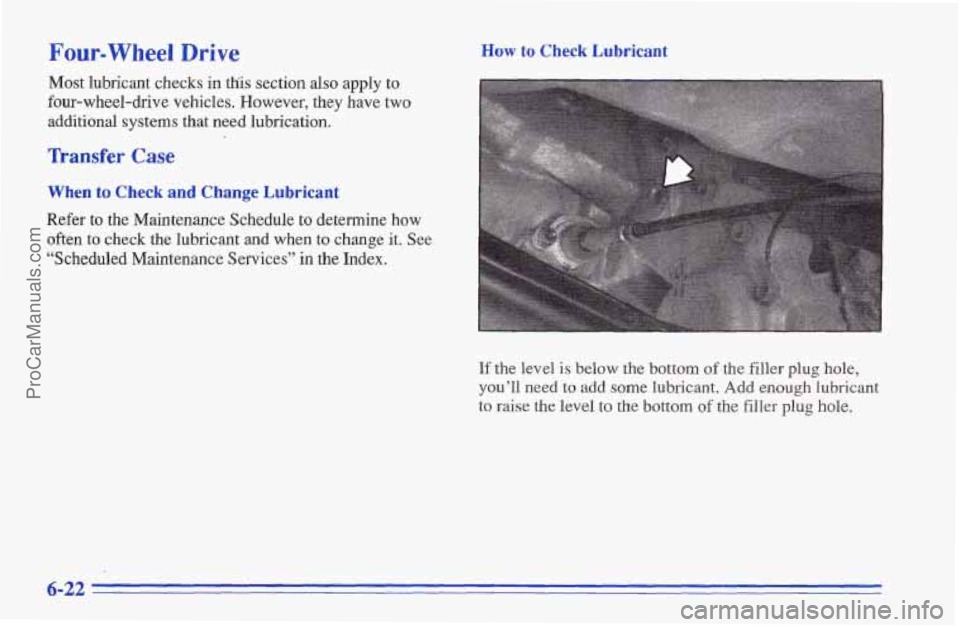
If the level is below the bottom of the filler plug hole,
you’ll need to add some lubricant. Add enough lubricant
to raise the level to the bottom of the filler plug hole.
6-22
ProCarManuals.com
Page 284 of 387
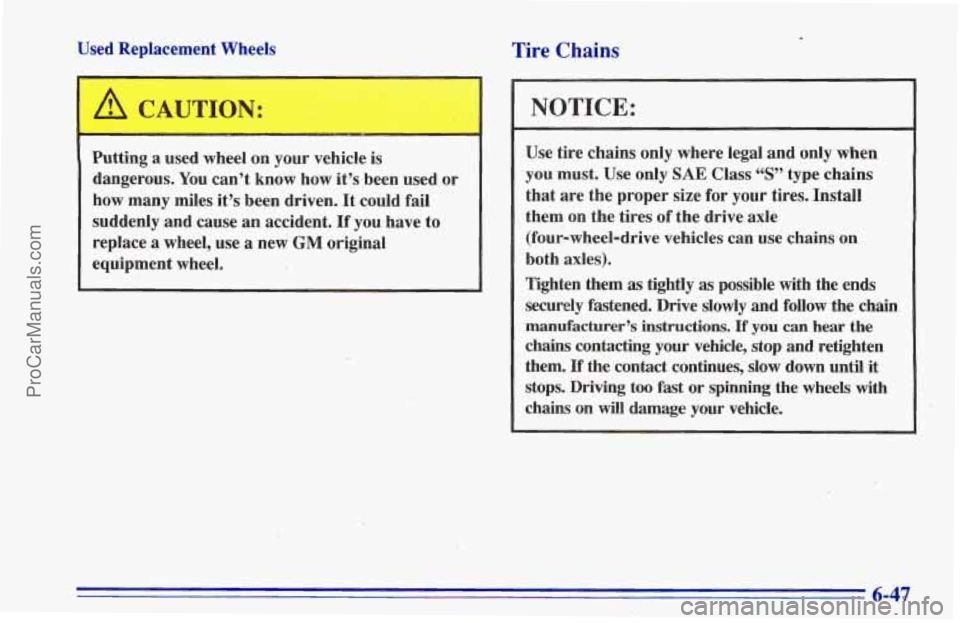
Used Replacement Wheels
L
A CAUTION:
Putting a used wheel on your vehicle is
dangerous.
You can’t know how it’s been used or
how many miles it’s been driven. It could fail
suddenly and cause
an accident. If you have to
replace
a wheel, use a new GM original
equipment wheel.
Tire Chains
NOTICE:
Use tire chains only where legal and only when
you must. Use only SAE Class “S” type chains
that are the proper size for your tires. Install
them on the tires of the drive axle
(four-wheel-drive vehicles can use chains
on
both axles).
Tighten them
as tightly as possible with the ends
securely fastened. Drive slowly and follow the chain
manufacturer’s instructions. If you can hear the
chains contacting your vehicle, stop and retighten
them.
If the contact continues, slow down until it
stops. Driving too fast or spinning the wheels with
chains on will damage
your vehicle.
6-47
ProCarManuals.com
Page 296 of 387
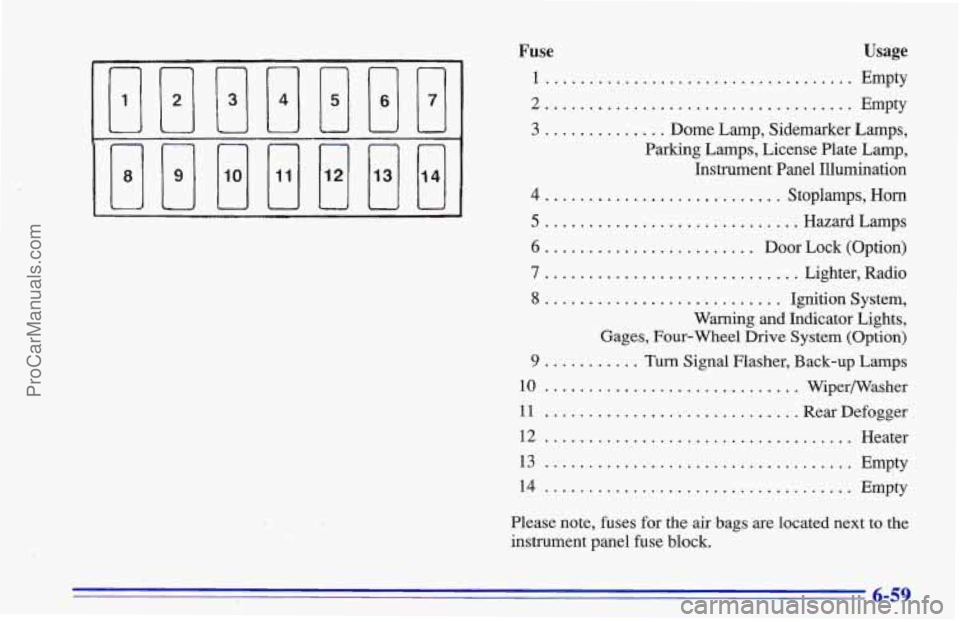
Fuse Usage
5
l... .............................. Empty
2................................... Empty
3 ............ Dome Lamp, Sidemarker Lamps,
Parking Lamps, License Plate Lamp, Instrument Panel Illumination
4 ........................... Stoplamps, Horn
5 ............................. Hazard Lamps
6..... ................. Door Lock (Option)
7 ............................. Lighter, Radio
8 ........................... Ignition System,
Warning and Indicator Lights,
Gages, Four-wheel Drive System (Option)
9 ........... Turn Signal Flasher, Back-up Lamps
10 .....
11 ...
...................... Wipermasher
.........
.. ..I .... Rear Defogger
12 ................................... Heater
13
................................. Empty
14 ................................... Empty
Please note, fuses for the air bags are located next to the
instrument
panel fuse block.
6-59
ProCarManuals.com
Page 300 of 387
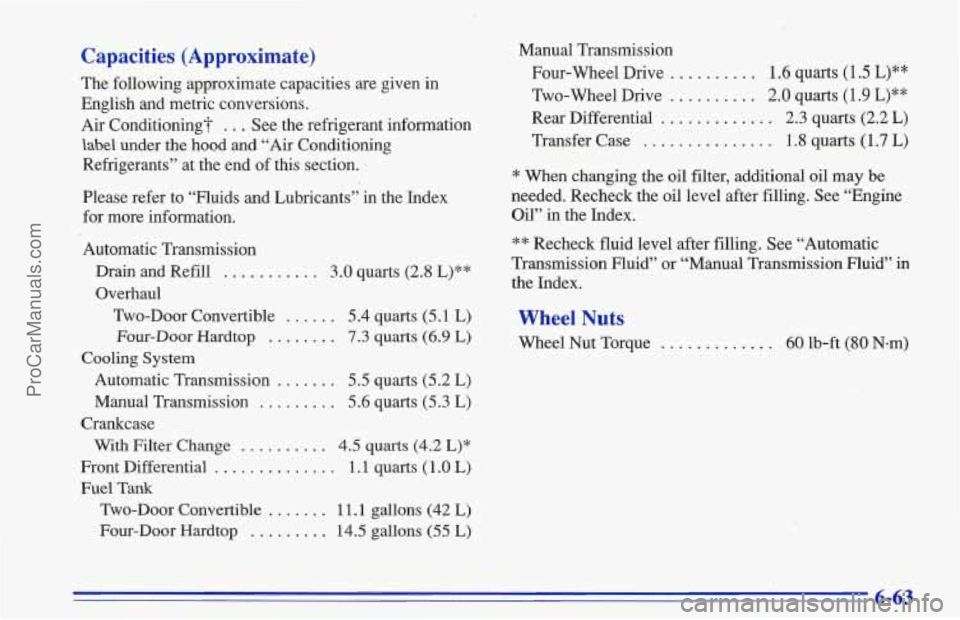
Capacities (Approximate)
The following approximate capacities are given in
English and metric conversions.
label under the hood and “Air Conditioning
Refrigerants” at the end of this section.
Air Conditioning?
... See the refrigerant information
Please refer to “Fluids and Lubricants” in the Index
for more information.
Automatic Transmission Drain and Refill
...... . 3.0 quarts (2.8 L)**
Overhaul
Two-Door Convertible
...... 5.4 quarts (5.1 L)
Four-Door Hardtop
........ 7.3 quarts (6.9 L)
Automatic Transmission ....... 5.5 quarts (5.2 L)
Manual Transmission
....... 5.6 quarts (5.3 L)
With Filter Change ........ 4.5 quarts (4.2 L)*
Front Differential ............ 1.1 quarts (1.0 L)
Fuel Tank
Two-Door Convertible
....... 11.1 gallons (42 L)
Four-Door Hardtop ......... 14.5 gallons (55 L)
Cooling System
Crankcase Manual Transmission
Four-wheel Drive
........ 1.6 quarts (1.5 L)**
Two-Wheel Drive .......... 2.0 quarts (1.9 L)**
Rear Differential ............. 2.3 quarts (2.2 L)
Transfer Case ............... 1.8 quarts (1.7 L)
* When changing the oil filter, additional oil may be
needed. Recheck the oil level after filling. See “Engine
Oil” in the Index.
** Recheck fluid level after filling. See “Automatic
Transmission Fluid” or “Manual Transmission Fluid” in
the Index.
Wheel Nuts
Wheel Nut Torque ............. 60 lb-ft (80 N-m)
6-63
ProCarManuals.com
Page 301 of 387
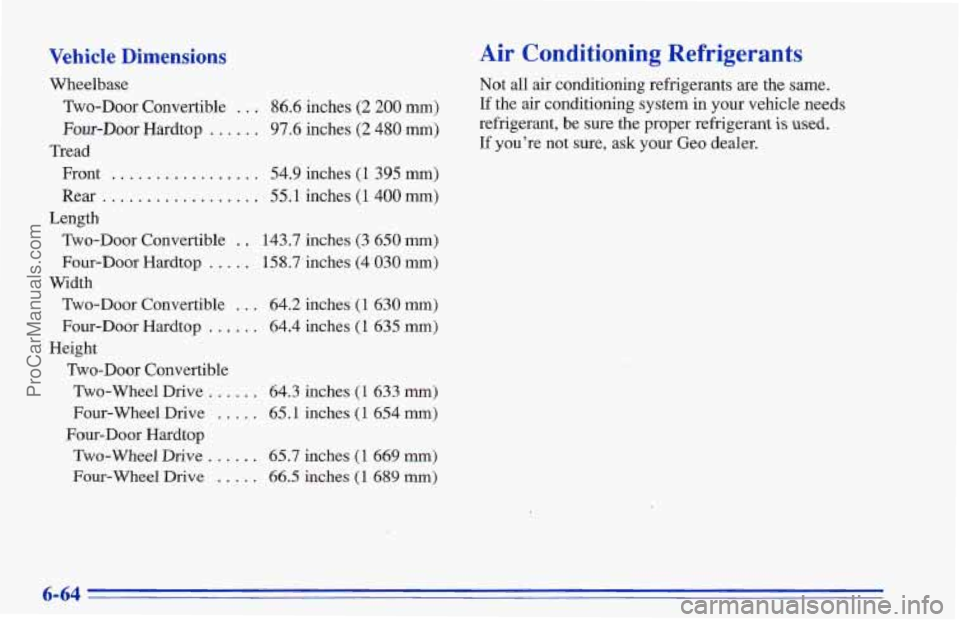
Vehicle Dimensions
Wheelbase Two-Door Convertible
... 86.6 inches (2 200 mm)
Four-Door Hardtop
...... 97.6 inches (2 480 mm)
Tread
Front
................. 54.9 inches (1 395 mm)
Rear ................ 55.1 inches (1 400 mm)
Length
Two-Door Convertible
. . 143.7 inches (3 650 mm)
Four-Door Hardtop ..... 158.7 inches (4 030 mm)
Two-Door Convertible ... 64.2 inches (1 630 mm)
Four-Door Hardtop ...... 64.4 inches (1 635 mm)
Two-Door Convertible
Two-Wheel Drive
...... 64.3 inches (1 633 mm)
Width
Height Four-wheel Drive
..... 65.1 inches (1 654 mm)
Four-Door Hardtop
Two-Wheel Drive ...... 65.7 inches (1 669 mm)
Four-wheel Drive ..... 66.5 inches (1 689 mm)
Air Conditioning Refrigerants
Not all air conditioning refrigerants'are the same.
If the air conditioning system in your vehicle needs
refrigerant, be sure the proper refrigerant
is used.
If you're not sure, ask your Geo dealer.
6-64
ProCarManuals.com
Page 353 of 387
Steering Column Lock Check
While parked, and with the parking brake set, try to turn
the
key to LOCK in each shift lever position.
With an automatic transmission, the key should turn
to LOCK only when the shift lever is in PARK (P).
With a manual transmission, the key should turn to
LOCK only if you push the key in farther, while
turning it towards
LOCK.
On vehicles with a key release lever, try to turn the key
to LOCK without pressing the lever. The key should
turn to LOCK only when you press the key lever.
On all vehicles, the key should come out only in LOCK.
Parking Brake and Automatic Transmission
PARK (P) Mechanism Check
/d CAUTION:
When you are doing this check, your vehicle
could begin to
move. You or others could be
injured and property
could be damaged. Make
sure there
is room in front of your vehicle in case
it begins
to roll. Be ready to apply the regular
brake at once should the vehicle begin to move.
Park on a fairly steep hill, with the vehicle facing
downhill. Keeping your foot on the regular brake, set the
parking brake.
To check the parking brake: With the engine running
and transmission in NEUTRAL (N), slowly remove
foot pressure from the regular brake pedal.
Do this
until the vehicle is held by the parking brake only.
To check the PARK (P) mechanism’s holding ability:
Shift to
PARK (P). Then release all brakes. If your
vehicle is four-wheel
drive, be sure the transfer case
is not in NEUTRAL (N).
Underbody Flushing Service
At least every spring, use plain water to flush any
corrosive materials from the underbody. Take care to
clean thoroughly any areas where mud and other debris
can collect.
7-50
ProCarManuals.com
Page 355 of 387
Throttle Linkage Inspection
Inspect the throttle linkage for interference or binding,
and for damage or missing parts. Replace parts as
needed. Replace any cables that have high effort
or
excessive wear. Do not lubricate accelerator and cruise
control cables.
Rear Axle (All) and Front Axle
(Four-wheel Drive) Service
Check the gear lubricant level and add if needed. See
“Rear
Axle” and “Four-wheel Drive” in the Index.
A fluid loss may indicate a problem. Check the
system(s), and repair
the system(s) if needed. Refer
to “Scheduled Maintenance Services,” earlier in this
section, to determine when to change the lubricant.
Brake System Inspection
Inspect the complete system. Inspect brake lines and
hoses
for proper hook-up, binding, leaks, cracks,
chafing,
etc. Inspect disc brake pads for wear and rotors
for surface condition.
Also inspect drum brake linings
for wear and cracks. Inspect other brake
parts, including
drums, wheel cylinders, calipers, parking brake, etc.
Check parking brake adjustment.
You may need to have
your brakes inspected more often if your driving habits
or conditions result in frequent braking.
Clutch System Service
Check clutch pedal free travel and adjust as necessary.
See “Clutch Adjustment”
in the Index.
7-52
ProCarManuals.com