check oil CHEVROLET TRACKER 1997 User Guide
[x] Cancel search | Manufacturer: CHEVROLET, Model Year: 1997, Model line: TRACKER, Model: CHEVROLET TRACKER 1997Pages: 388, PDF Size: 20.12 MB
Page 257 of 388
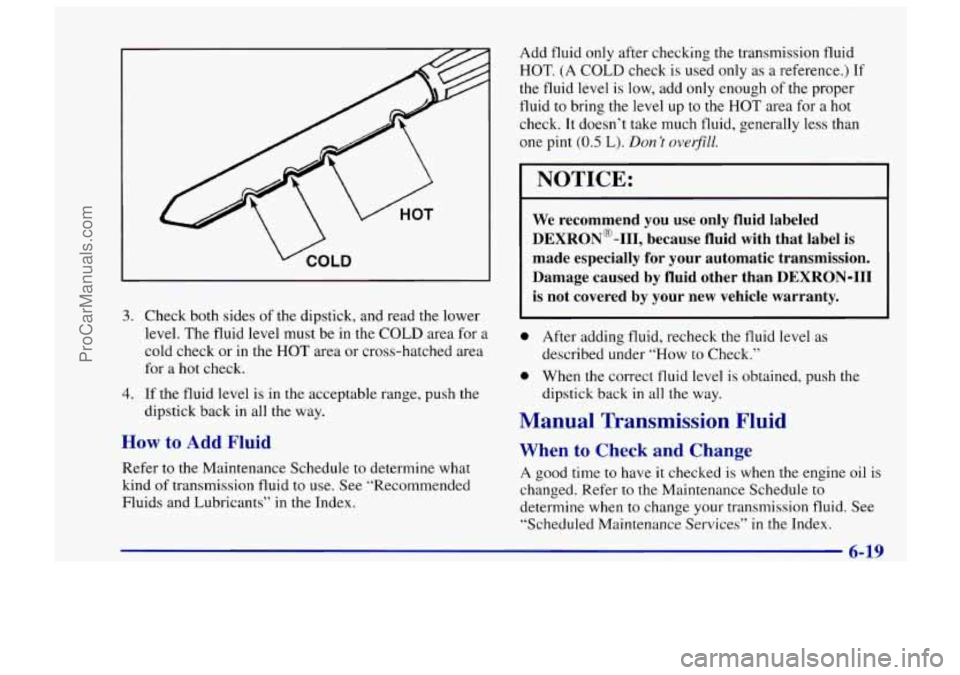
3. Check both sides of the dipstick, and read the lower
level. The fluid level must be
in the COLD area for a
cold check or
in the HOT area or cross-hatched area
for a hot check.
4. If the fluid level is in the acceptable range, push the
dipstick back in all the way.
How to Add Fluid
Refer to the Maintenance Schedule to determine what
kind
of transmission fluid to use. See “Recommended
Fluids and Lubricants” in the Index. Add
fluid only after checking the transmission fluid
HOT. (A COLD check
is used only as a reference.) If
the fluid level is low, add only enough of the proper
fluid to bring the level up to the HOT area for a hot
check.
It doesn’t take much fluid, generally less than
one pint
(0.5 L). Don ’I ove$iZZ.
NOTICE:
We recommend you use only fluid labeled
DEXRON@-111, because fluid with that label is
made especially for your automatic transmission.
Damage caused by fluid other than DEXRON-I11
is not covered by your new vehicle warranty.
0 After adding fluid, recheck the fluid level as
0 When the correct fluid level is obtained, push the
described under
“How to Check.”
dipstick back
in all the way.
Manual Transmission Fluid
When to Check and Change
A good time to have it checked is when the engine oil is
changed. Refer
to the Maintenance Schedule to
determine when to change your transmission fluid. See
“Scheduled Maintenance Services”
in the Index.
6-19
1
ProCarManuals.com
Page 261 of 388
Front Axle
When to Check and Change Lubricant
Refer to the Maintenance Schedule to determine how
often to check the lubricant and when to change it. See
“Periodic Maintenance Inspections” and “Scheduled
Maintenance Services” in the Index.
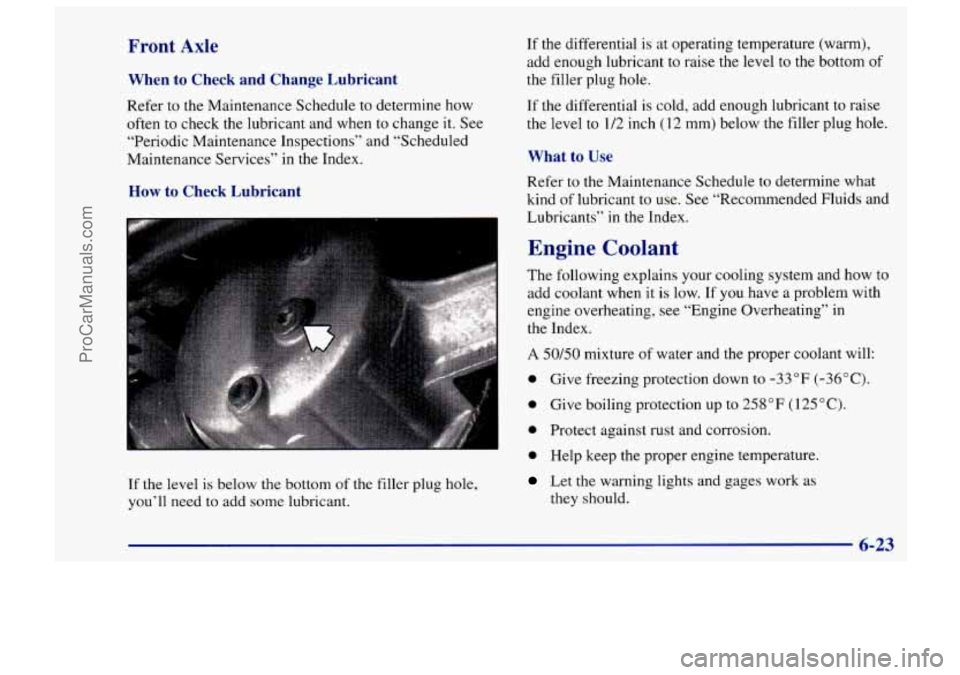
How to Check Lubricant
If the differential is at operating temperature (warm),
add enough lubricant to raise the level to the bottom of
the filler plug
hole.
If the differential is cold, add enough lubricant to raise
the level to 1/2 inch
(I 2 mm) below the filler plug hole.
What to Use
Refer to the Maintenance Schedule to determine what
kind
of lubricant to use. See “Recommended Fluids and
Lubricants”
in the Index.
Engine Coolant
The following explains your cooling system and how to
add coolant when it is low. If you have a problem with
engine overheating, see “Engine Overheating” in
the Index.
If the level is below the bottom of the filler plug hole,
you’ll need to add some lubricant.
A 50/50 mixture of water and the proper coolant will:
0 Give freezing protection down to -33°F (-36°C).
0 Give boiling protection up to 258°F (125°C).
0 Protect against rust and corrosion.
0 Help keep the proper engine temperature.
Let the warning lights and gages work as
they should.
6-23
I
ProCarManuals.com
Page 262 of 388
What to Use
Use a mixture of one-half clean water (preferably
distilled) and one-half coolant that meets
GM
Specification 1825-M, which won’t damage aluminum
parts. You can also use a recycled coolant conforming to
GM Specification 1825-M with a complete coolant flush
and refill. If you use this mixture, you don’t need to add
anything else.
Adding only plain water to your cooling system
can be dangerous. Plain water, or some other
liquid like alcohol, can boil before the proper
coolant mix will. Your vehicle’s coolant warning
system is set for the proper coolant mix. With
plain water or the wrong mix, your engine could
get too hot but you wouldn’t get the overheat
warning. Your engine could catch fire and you
or
others could be burned. Use a 50/50 mix of clean
water and the proper coolant.
I
NOTICE:
If you use an improper coolant mix, your engine
could overheat and be badly damaged. The
repair cost wouldn’t be covered by your
warranty.
Too much water in the mix can freeze
and crack the engine, radiator, heater core and
other parts.
If you have to add coolant more than four times a year,
have your dealer check your cooling system.
I NOTICE:
If you use the proper coolant, you don’t have to
add extra inhibitors or additives which claim to
improve the system. These can be harmful.
6-24
ProCarManuals.com
Page 301 of 388
Capacities (Approximate)
The following approximate capacities are given in
English and metric conversions.
Air Conditioning?
............. See the refrigerant
information label under
the hood and “Air Conditioning
Refrigerants” at the end
of this section.
Automatic Transmission
Pan Removal and Replacement Three-Speed
............. 3.0 quarts (2.8 L)**
Four-Speed ............... 2.64 quarts (2.5 L)
After Complete Overhaul
Three-Speed
............... 5.3 quarts (5.1 L)
Four-Speed ................ 7.3 quarts (6.9 L)
Cooling System
Automatic Transmission
....... 5.5 quarts (5.2 L)
Manual Transmission ......... 5.6 quarts (5.3 L)
Crankcase With Filter Change
.......... 4.5 quarts (4.2 L)*
Front Differential ............ 1.1 quarts (1 .O L)
Fuel Tank
Two-Door Convertible
....... 11.1 gallons (42 L)
Four-Door Hardtop .......... 14.5 gallons (55 L)
Manual Transmission
Four-wheel Drive
.......... 1.6 quarts (1.5 L)**
Two-Wheel Drive .......... 2.0 quarts (1.9 L)**
Rear Differential ............. 2.3 quarts (2.2 L)
Transfer Case ............... 1.8 quarts (1.7 L)
* When changing the oil filter, additional oil may be
needed. Recheck the oil level after filling. See
“Engine Oil” in the Index.
** Recheck fluid level after filling. See “Automatic
Transmission Fluid” or “Manual Transmission
Fluid” in
the Index.
6-63
ProCarManuals.com
Page 307 of 388
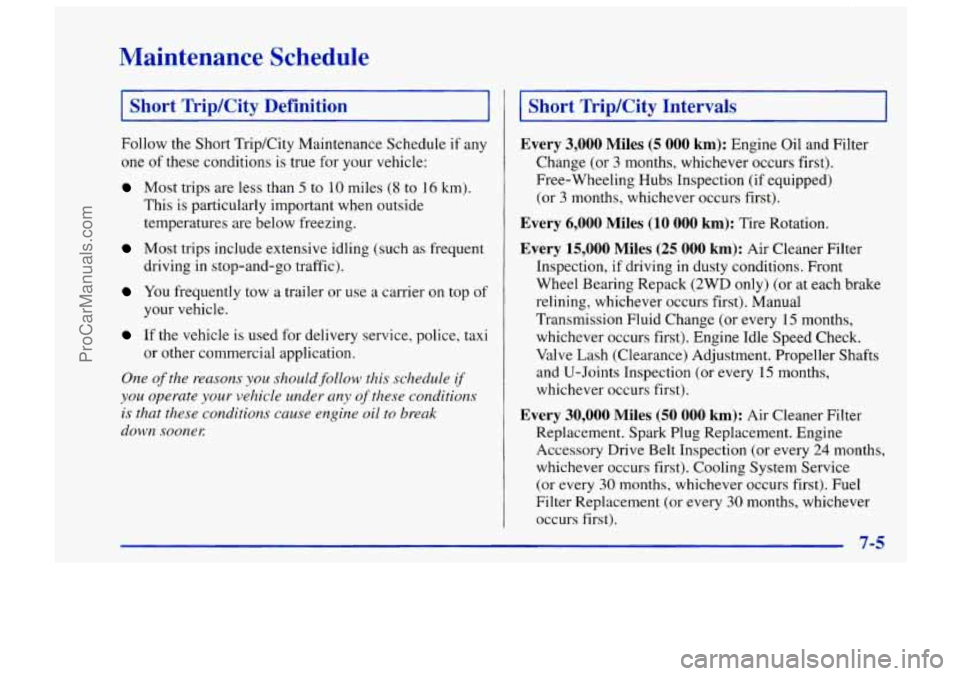
Maintenance Schedule
Short Trip/City Definition
Follow the Short Trip/City Maintenance Schedule if any
one
of these conditions is true for your vehicle:
Most trips are less than 5 to 10 miles (8 to 16 km).
This is particularly important when outside
temperatures are below freezing.
Most trips include extensive idling (such as frequent
driving in stop-and-go traffic).
You frequently tow a trailer or use a carrier on top of
your vehicle.
If the vehicle is used for delivery service, police, taxi
or other commercial application.
One of the reasons you should follow this schedule if
you operate your vehicle under any of these conditions
is that these conditions
cause engine oil to breuk
down sooneE
Short Trip/City Intervals
Every 3,000 Miles (5 000 km): Engine Oil and Filter
Change (or
3 months, whichever occurs first).
Free-Wheeling Hubs Inspection (if equipped)
(or
3 months, whichever occurs first).
Every 6,000 Miles (10 000 km): Tire Rotation.
Every 15,000 Miles (25 000 km): Air Cleaner Filter
Inspection, if driving in dusty conditions. Front
Wheel Bearing Repack (2WD only) (or at each brake
relining, whichever occurs first). Manual
Transmission Fluid Change (or every
15 months,
whichever occurs first). Engine Idle Speed Check.
Valve Lash (Clearance) Adjustment. Propeller Shafts
and U-Joints Inspection (or every
15 months,
whichever occurs first).
Every 30,000 Miles (50 000 km): Air Cleaner Filter
Replacement. Spark Plug Replacement. Engine
Accessory Drive Belt Inspection (or every
24 months,
whichever occurs first). Cooling System Service
(or every
30 months, whichever occurs first). Fuel
Filter Replacement (or every
30 months, whichever
occurs first).
ProCarManuals.com
Page 309 of 388
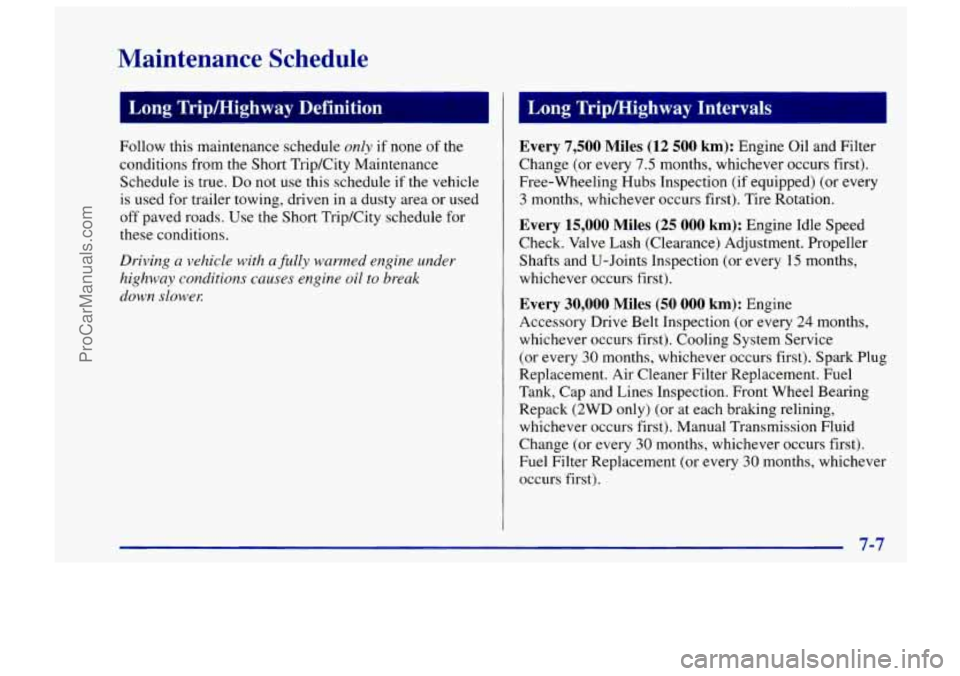
Maintenance Schedule
Follow this maintenance schedule only if none of the
conditions from the Short TripKity Maintenance
Schedule is true.
Do not use this schedule if the vehicle
is used for trailer towing, driven in a dusty area or used
off paved roads. Use the Short TripKity schedule for
these conditions.
Driving a vehicle with a fully warmed engine under
highway conditions causes engine oil to
break
down slower:
Every 7,500 Miles (12 500 km): Engine Oil and Filter
Change (or every
7.5 months, whichever occurs first).
Free-Wheeling
Hubs Inspection (if equipped) (or every
3 months, whichever occurs first). Tire Rotation.
Every 15,000 Miles (25 000 km): Engine Idle Speed
Check. Valve
Lash (Clearance) Adjustment. Propeller
Shafts and U-Joints Inspection (or every
15 months,
whichever occurs first).
Every 30,000 Miles (50 000 km): Engine
Accessory Drive Belt Inspection (or every
24 months,
whichever occurs first). Cooling System Service
(or every
30 months, whichever occurs first). Spark Plug
Replacement. Air Cleaner Filter Replacement. Fuel
Tank, Cap and Lines Inspection. Front Wheel Bearing
Repack (2WD only) (or at each braking relining,
whichever occurs first). Manual Transmission Fluid
Change (or every
30 months, whichever occurs first).
Fuel Filter Replacement (or every
30 months, whichever
occurs first).
7-7
ProCarManuals.com
Page 311 of 388
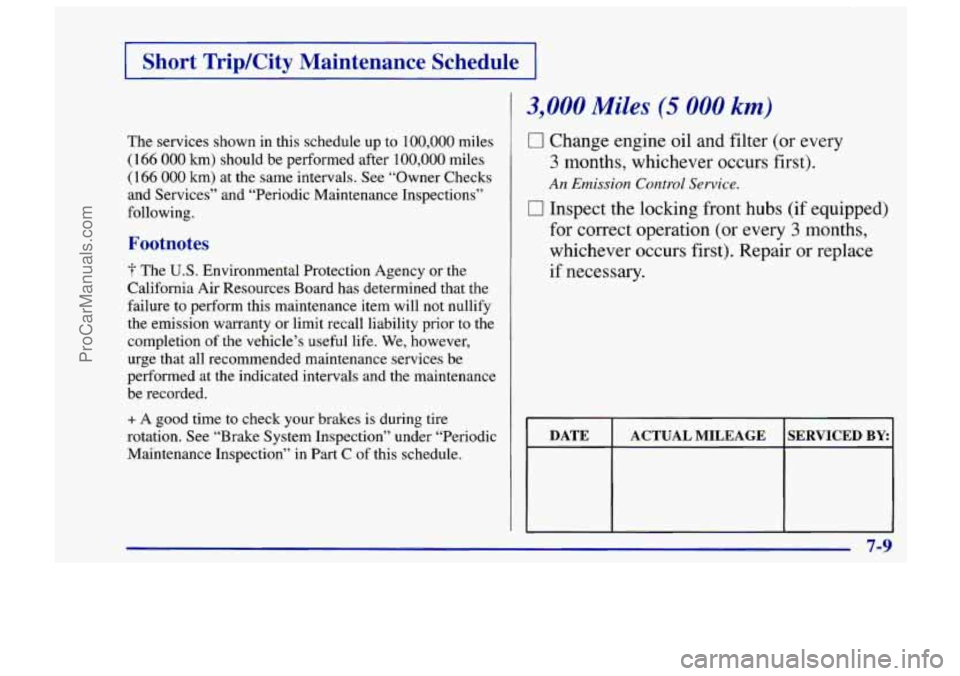
I Short TripKity Maintenance Schedule I
The services shown in this schedule up to 100,000 miles
(1 66 000 km) should be performed after 100,000 miles
(1 66 000 km) at the same intervals. See “Owner Checks
and Services’’ and “Periodic Maintenance Inspections”
following.
Footnotes
? The U.S. Environmental Protection Agency or the
California Air Resources Board has determined that the
failure to perform this maintenance item will
not nullify
the emission warranty or limit recall liability prior to the
completion
of the vehicle’s useful life. We, however,
urge that all recommended maintenance services be
performed at the indicated intervals and the maintenance
be recorded.
+ A good time to check your brakes is during tire
rotation. See “Brake System Inspection” under “Periodic
Maintenance Inspection” in Part C of this schedule.
3,000 Miles (5 000 km)
0 Change engine oil and filter (or every
3 months, whichever occurs first).
An Emission Control Service.
0 Inspect the locking front hubs (if equipped)
for correct operation (or every
3 months,
whichever occurs first). Repair or replace
if necessary.
DATE
SERVICED BY ACTUAL MILEAGE
7-9
ProCarManuals.com
Page 314 of 388
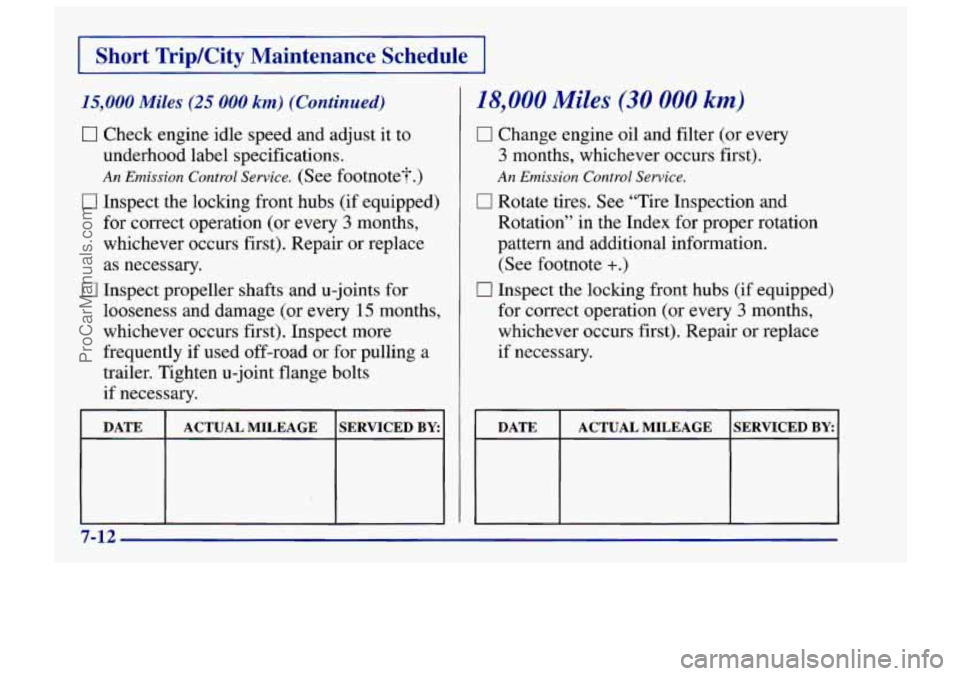
I Short TripKity Maintenance Schedule I
15,000 Miles (25 000 km) (Continued)
0 Check engine idle speed and adjust it to
underhood label specifications.
An Emission Control Service. (See footnote”f)
0 Inspect the locking front hubs (if equipped)
for correct operation (or every
3 months,
whichever occurs first). Repair or replace
as necessary.
0 Inspect propeller shafts and u-joints for
looseness and damage (or every
15 months,
whichever occurs first). Inspect more
frequently if used off-road
or for pulling a
trailer. Tighten u-joint flange bolts
if necessary.
18,000 Miles (30 000 km)
0 Change engine oil and filter (or every
3 months, whichever occurs first).
An Emission Control Service.
0 Rotate tires. See “Tire Inspection and
Rotation” in the Index for proper rotation
pattern and additional information.
(See footnote
+.)
0 Inspect the locking front hubs (if equipped)
for correct operation (or every
3 months,
whichever occurs first). Repair or replace
if necessary.
I DATE I ACTUAL MILEAGE ISERVICED BY I
7-12
ProCarManuals.com
Page 320 of 388
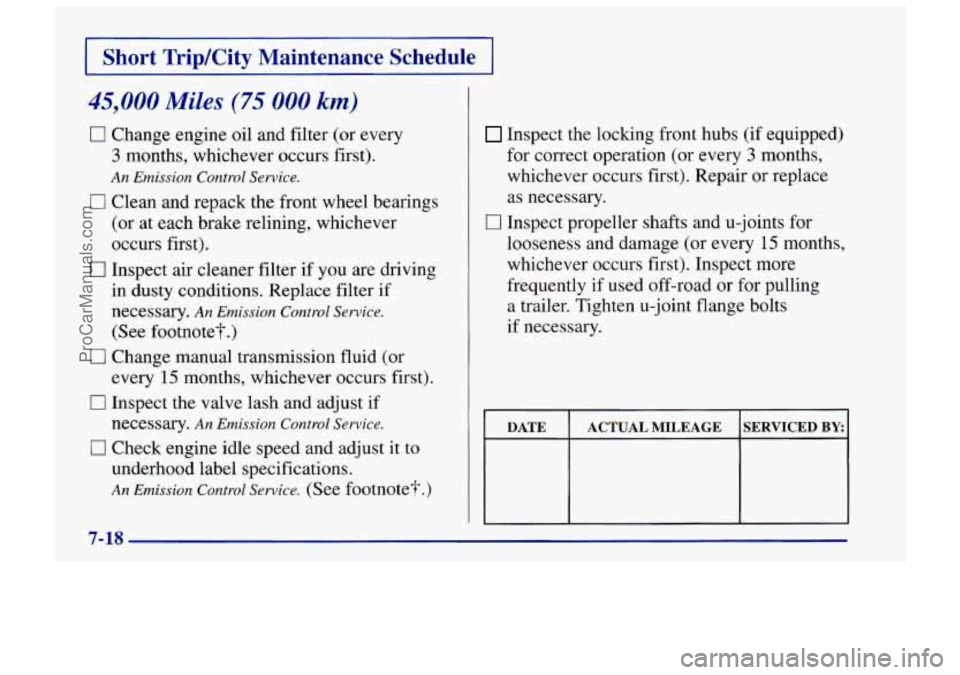
I Short Trip/City Maintenance Schedule I
45,000 Miles (75 000 km)
0 Change engine oil and filter (or every
3 months, whichever occurs first).
An Emission Control Service.
0 Clean and repack the front wheel bearings
(or at each brake relining, whichever
occurs first).
in dusty conditions. Replace filter
if
necessary. An Emission Control Service.
(See footnote?.)
0 Change manual transmission fluid (or
every
15 months, whichever occurs first).
0 Inspect the valve lash and adjust if
necessary.
An Emission Control Service.
0 Check engine idle speed and adjust it to
underhood label specifications.
An Emission Control Service. (See footnote?.)
0 Inspect air cleaner filter if you are driving
Inspect the locking front hubs (if equipped)
for correct operation (or every
3 months,
whichever occurs first). Repair or replace
as necessary.
0 Inspect propeller shafts and u-joints for
looseness and damage
(or every 15 months,
whichever occurs first). Inspect more
frequently if used off-road or for pulling
a trailer. Tighten u-joint flange bolts
if necessary.
I DATE 1 ACTUAL MILEAGE ISERVICED BY: I
7-18
ProCarManuals.com
Page 329 of 388
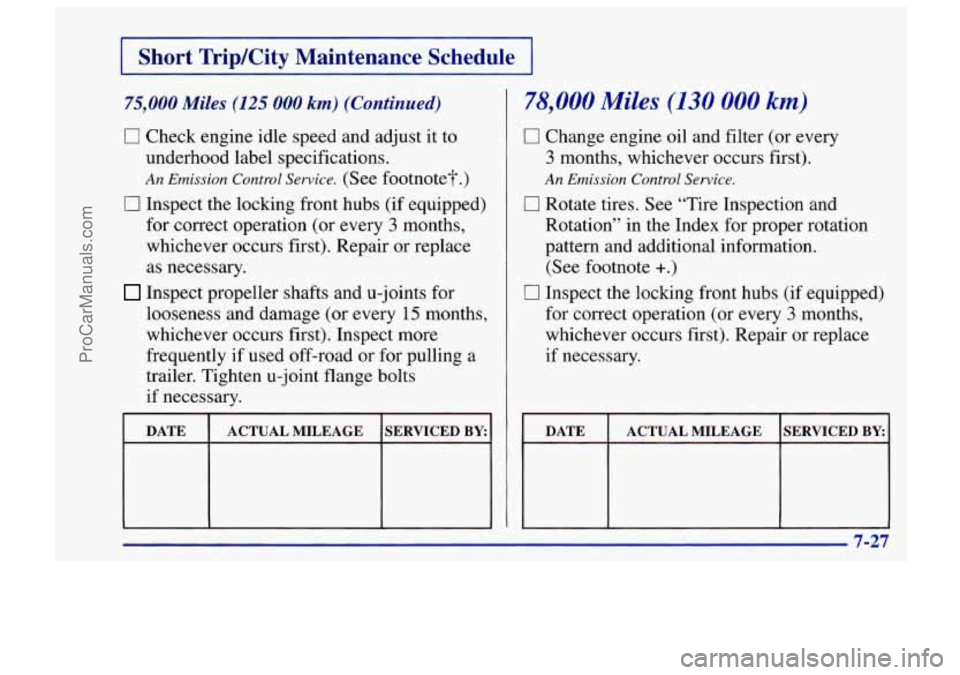
I Short TripKity Maintenance Schedule I
75,000 Miles (125 000 km) (Continued)
0 Check engine idle speed and adjust it to
underhood label specifications.
An Emission Control Service. (See footnote?.)
0 Inspect the locking front hubs (if equipped)
for correct operation (or every
3 months,
whichever occurs first). Repair or replace
as necessary.
Inspect propeller shafts and u-joints for
looseness and damage (or every
15 months,
whichever occurs first). Inspect more
frequently if used off-road or for pulling a
trailer. Tighten u-joint flange bolts
if necessary.
I DATE I ACTUAL MILEAGE ISERVICED BY:^
78,000 Miles (130 000 km)
0 Change engine oil and filter (or every
3 months, whichever occurs first).
L7 Rotate tires. See “Tire Inspection and
Rotation” in the Index for proper rotation
pattern and additional information.
(See footnote
+.)
0 Inspect the loclung front hubs (if equipped)
for correct operation (or every
3 months,
whichever occurs first). Repair or replace
if necessary.
An Emission Control Service.
DATE
SERVICED BY ACTUAL MILEAGE
ProCarManuals.com