cooling CHEVROLET TRACKER 1997 User Guide
[x] Cancel search | Manufacturer: CHEVROLET, Model Year: 1997, Model line: TRACKER, Model: CHEVROLET TRACKER 1997Pages: 388, PDF Size: 20.12 MB
Page 219 of 388
How to Add Coolant to the Coolant
Recovery Tank
If you haven’t found a problem yet, but the coolant level
isn’t at or above the
FULL mark, add a 50/50 mixture
of clean water (preferably distilled) and a proper coolant
at the coolant recovery tank. (See “Engine Coolant’’
in the Index for more information about the proper
coolant
mix.)
Adding only plain water to your cooling system
can be dangerous. Plain water, or some other
liquid like alcohol, can boil before the proper
coolant mix will. Your vehicle’s coolant warning
system is set for the proper coolant mix. With
plain water or the wrong mix, your engine could
get too hot but you wouldn’t get the overheat
warning. Your engine could catch fire and you or
others could be burned. Use a
50/50 mix of clean
water and
a proper coolant.
NOTICE:
In cold weather, water can freeze and crack the
engine, radiator, heater core and other parts.
Use the recommended coolant and the proper
coolant mix.
5-17
I
ProCarManuals.com
Page 220 of 388
/ CAUTION:
You can be burned if you spill coolant on hot
engine parts. Coolant contains ethylene glycol
and
it will burn if the engine parts are hot
enough. Don't spill coolant on a hot engine.
When the coolant in the coolant recovery tank is at or
above the
FULL mark, start your vehicle.
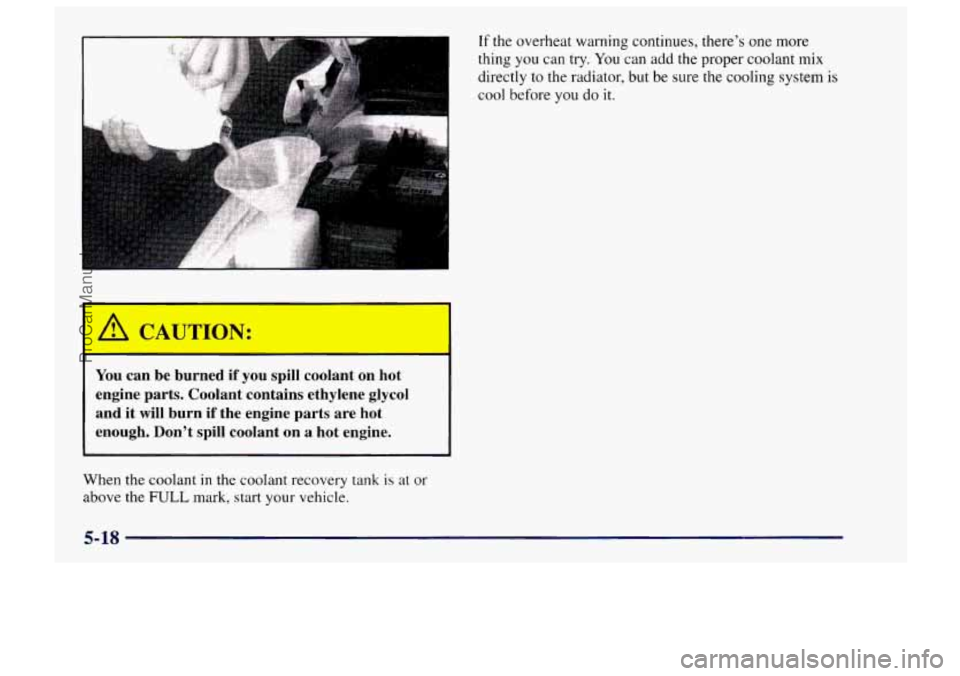
If the overheat warning continues, there's one more
thing you can try.
You can add the proper coolant mix
directly
to the radiator, but be sure the cooling system is
cool before you do it.
5-18
ProCarManuals.com
Page 221 of 388
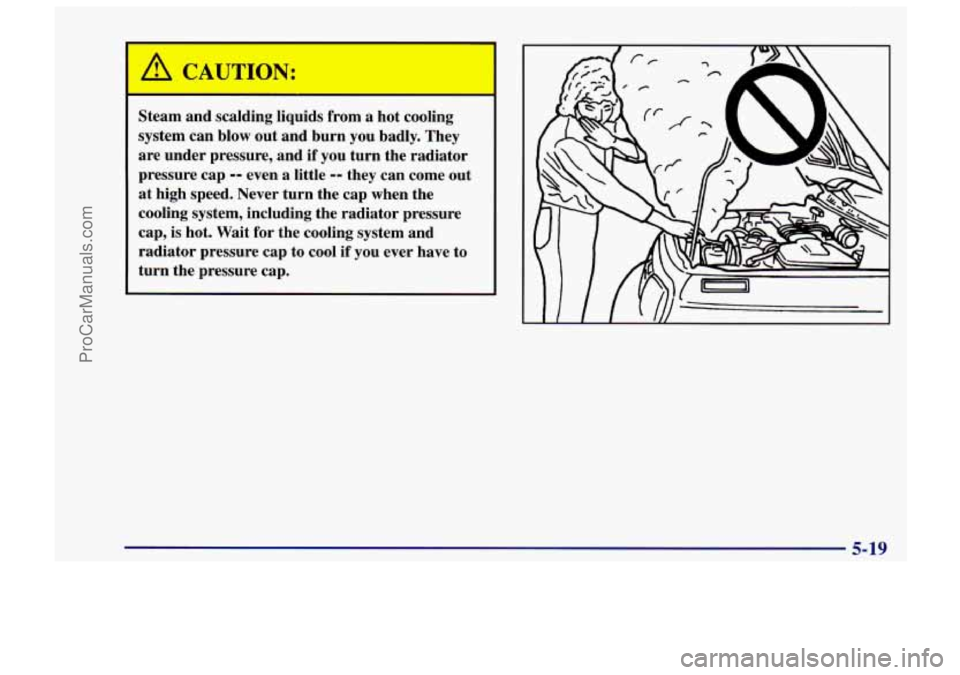
Steam and scalding liquids from a hot cooling
system can blow out and burn you badly. They
are under pressure, and if you turn the radiator
pressure cap
-- even a little -- they can come out
at high speed. Never turn the cap when the
cooling system, including the radiator pressure
cap,
is hot. Wait for the cooling system and
radiator pressure cap to cool
if you ever have to
turn the pressure cap.
5-19
I
ProCarManuals.com
Page 222 of 388
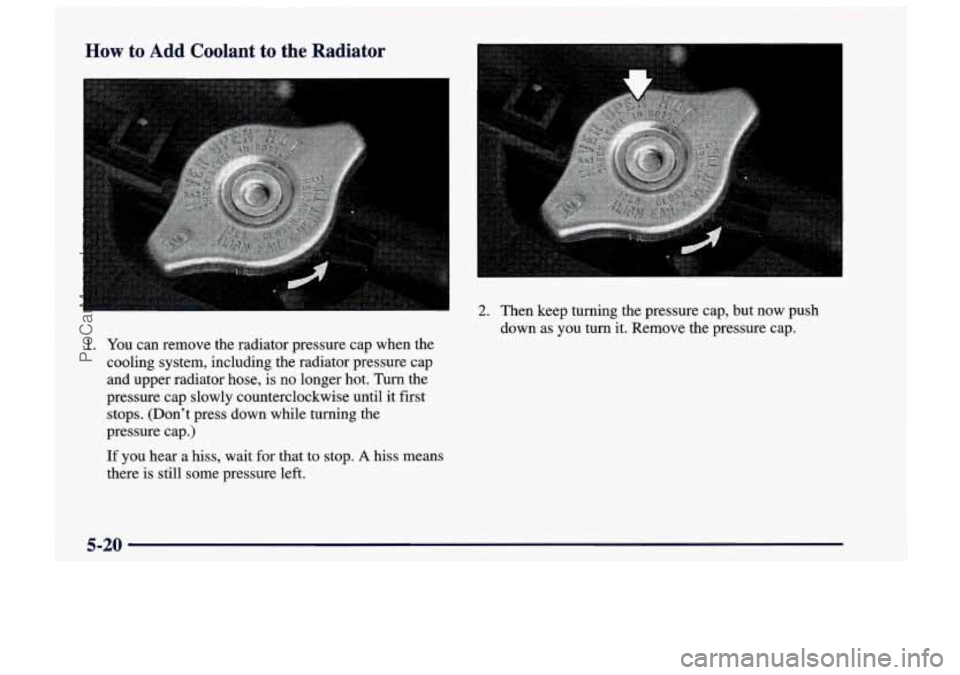
How to Add Coolant to the Radiator
2. Then keep turning the pressure cap, but now push
down as you turn it. Remove the pressure cap.
1. You can remove the radiator pressure cap when the
cooling system, including the radiator pressure cap
and upper radiator hose, is no longer hot.
Turn the
pressure cap slowly counterclockwise until it first
stops. (Don’t press down while turning the
pressure cap.)
If you hear a
hiss, wait for that to stop. A hiss means
there is still some pressure left.
5-20
ProCarManuals.com
Page 261 of 388
Front Axle
When to Check and Change Lubricant
Refer to the Maintenance Schedule to determine how
often to check the lubricant and when to change it. See
“Periodic Maintenance Inspections” and “Scheduled
Maintenance Services” in the Index.
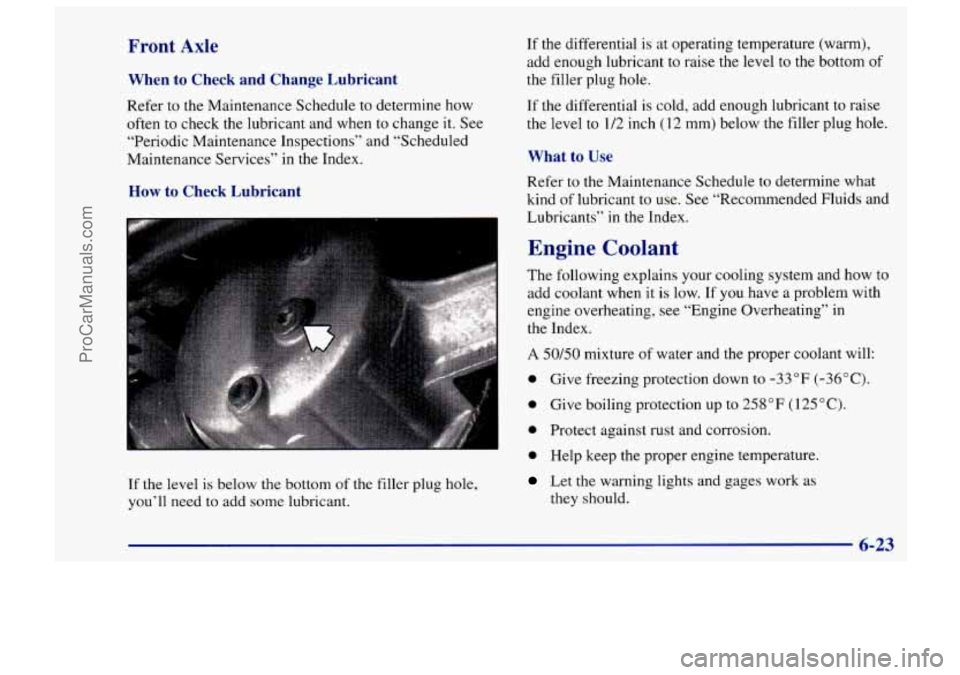
How to Check Lubricant
If the differential is at operating temperature (warm),
add enough lubricant to raise the level to the bottom of
the filler plug
hole.
If the differential is cold, add enough lubricant to raise
the level to 1/2 inch
(I 2 mm) below the filler plug hole.
What to Use
Refer to the Maintenance Schedule to determine what
kind
of lubricant to use. See “Recommended Fluids and
Lubricants”
in the Index.
Engine Coolant
The following explains your cooling system and how to
add coolant when it is low. If you have a problem with
engine overheating, see “Engine Overheating” in
the Index.
If the level is below the bottom of the filler plug hole,
you’ll need to add some lubricant.
A 50/50 mixture of water and the proper coolant will:
0 Give freezing protection down to -33°F (-36°C).
0 Give boiling protection up to 258°F (125°C).
0 Protect against rust and corrosion.
0 Help keep the proper engine temperature.
Let the warning lights and gages work as
they should.
6-23
I
ProCarManuals.com
Page 262 of 388
What to Use
Use a mixture of one-half clean water (preferably
distilled) and one-half coolant that meets
GM
Specification 1825-M, which won’t damage aluminum
parts. You can also use a recycled coolant conforming to
GM Specification 1825-M with a complete coolant flush
and refill. If you use this mixture, you don’t need to add
anything else.
Adding only plain water to your cooling system
can be dangerous. Plain water, or some other
liquid like alcohol, can boil before the proper
coolant mix will. Your vehicle’s coolant warning
system is set for the proper coolant mix. With
plain water or the wrong mix, your engine could
get too hot but you wouldn’t get the overheat
warning. Your engine could catch fire and you
or
others could be burned. Use a 50/50 mix of clean
water and the proper coolant.
I
NOTICE:
If you use an improper coolant mix, your engine
could overheat and be badly damaged. The
repair cost wouldn’t be covered by your
warranty.
Too much water in the mix can freeze
and crack the engine, radiator, heater core and
other parts.
If you have to add coolant more than four times a year,
have your dealer check your cooling system.
I NOTICE:
If you use the proper coolant, you don’t have to
add extra inhibitors or additives which claim to
improve the system. These can be harmful.
6-24
ProCarManuals.com
Page 285 of 388
A CAUTION:
Using the wrong replacement wheels, wheel
bolts or wheel nuts on your vehicle can be
dangerous.
It could affect the braking and
handling of your vehicle, make your tires lose
air and make you lose control.
You could have
a collision in which you or others could be
injured. Always use the correct wheel, wheel
bolts and wheel nuts for replacement.
NOTICE:
The wrong wheel can also cause problems with
bearing life, brake cooling, speedometer or
odometer calibration, headlamp aim, bumper
height, vehicle ground clearance and tire or tire
chain clearance to the body and chassis.
See “Changing a Flat Tire” in the Index for
more information.
Used Replacement Wheels
I A CAUTION:
Putting a used wheel on your vehicle is
dangerous.
You can’t know how it’s been used
or how far it’s been driven.
It could fail suddenly
and cause an accident.
If you have to replace a
wheel, use a new GM original equipment 1 wheel.
6-47
ProCarManuals.com
Page 301 of 388
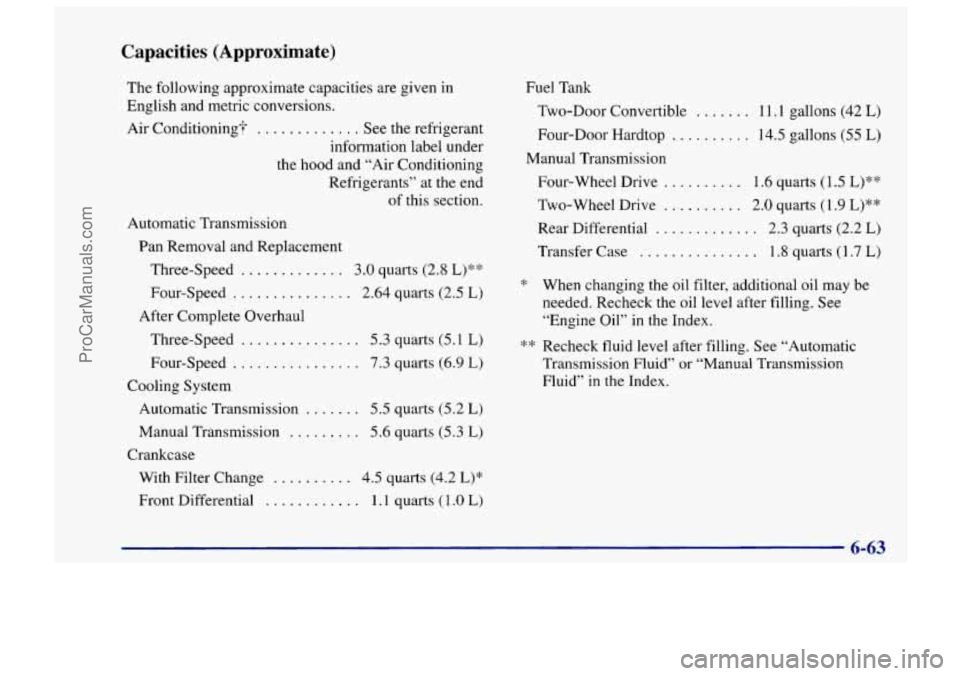
Capacities (Approximate)
The following approximate capacities are given in
English and metric conversions.
Air Conditioning?
............. See the refrigerant
information label under
the hood and “Air Conditioning
Refrigerants” at the end
of this section.
Automatic Transmission
Pan Removal and Replacement Three-Speed
............. 3.0 quarts (2.8 L)**
Four-Speed ............... 2.64 quarts (2.5 L)
After Complete Overhaul
Three-Speed
............... 5.3 quarts (5.1 L)
Four-Speed ................ 7.3 quarts (6.9 L)
Cooling System
Automatic Transmission
....... 5.5 quarts (5.2 L)
Manual Transmission ......... 5.6 quarts (5.3 L)
Crankcase With Filter Change
.......... 4.5 quarts (4.2 L)*
Front Differential ............ 1.1 quarts (1 .O L)
Fuel Tank
Two-Door Convertible
....... 11.1 gallons (42 L)
Four-Door Hardtop .......... 14.5 gallons (55 L)
Manual Transmission
Four-wheel Drive
.......... 1.6 quarts (1.5 L)**
Two-Wheel Drive .......... 2.0 quarts (1.9 L)**
Rear Differential ............. 2.3 quarts (2.2 L)
Transfer Case ............... 1.8 quarts (1.7 L)
* When changing the oil filter, additional oil may be
needed. Recheck the oil level after filling. See
“Engine Oil” in the Index.
** Recheck fluid level after filling. See “Automatic
Transmission Fluid” or “Manual Transmission
Fluid” in
the Index.
6-63
ProCarManuals.com
Page 307 of 388
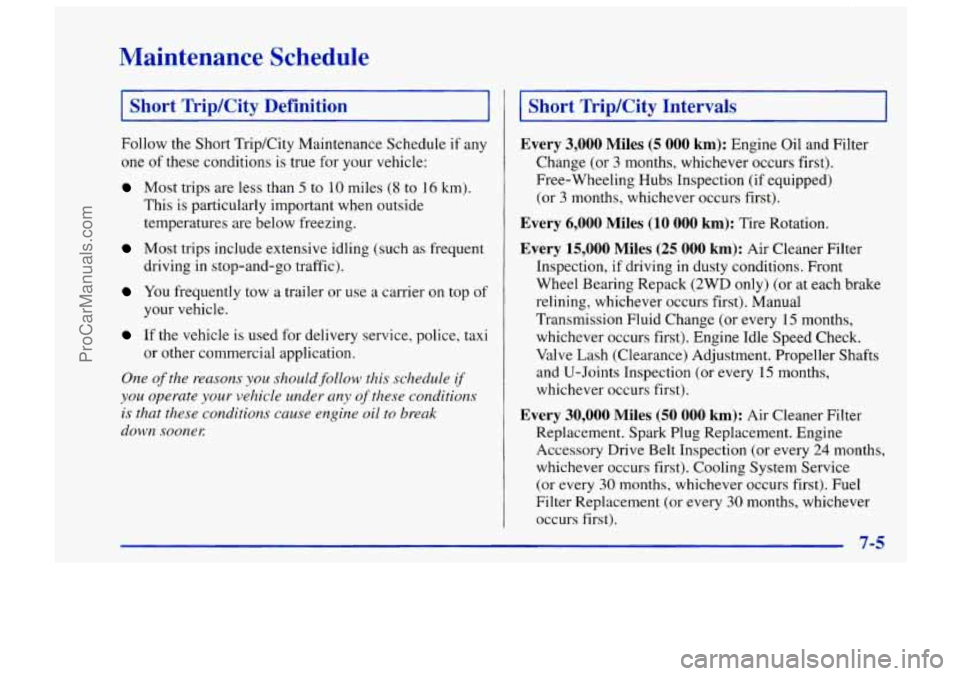
Maintenance Schedule
Short Trip/City Definition
Follow the Short Trip/City Maintenance Schedule if any
one
of these conditions is true for your vehicle:
Most trips are less than 5 to 10 miles (8 to 16 km).
This is particularly important when outside
temperatures are below freezing.
Most trips include extensive idling (such as frequent
driving in stop-and-go traffic).
You frequently tow a trailer or use a carrier on top of
your vehicle.
If the vehicle is used for delivery service, police, taxi
or other commercial application.
One of the reasons you should follow this schedule if
you operate your vehicle under any of these conditions
is that these conditions
cause engine oil to breuk
down sooneE
Short Trip/City Intervals
Every 3,000 Miles (5 000 km): Engine Oil and Filter
Change (or
3 months, whichever occurs first).
Free-Wheeling Hubs Inspection (if equipped)
(or
3 months, whichever occurs first).
Every 6,000 Miles (10 000 km): Tire Rotation.
Every 15,000 Miles (25 000 km): Air Cleaner Filter
Inspection, if driving in dusty conditions. Front
Wheel Bearing Repack (2WD only) (or at each brake
relining, whichever occurs first). Manual
Transmission Fluid Change (or every
15 months,
whichever occurs first). Engine Idle Speed Check.
Valve Lash (Clearance) Adjustment. Propeller Shafts
and U-Joints Inspection (or every
15 months,
whichever occurs first).
Every 30,000 Miles (50 000 km): Air Cleaner Filter
Replacement. Spark Plug Replacement. Engine
Accessory Drive Belt Inspection (or every
24 months,
whichever occurs first). Cooling System Service
(or every
30 months, whichever occurs first). Fuel
Filter Replacement (or every
30 months, whichever
occurs first).
ProCarManuals.com
Page 309 of 388
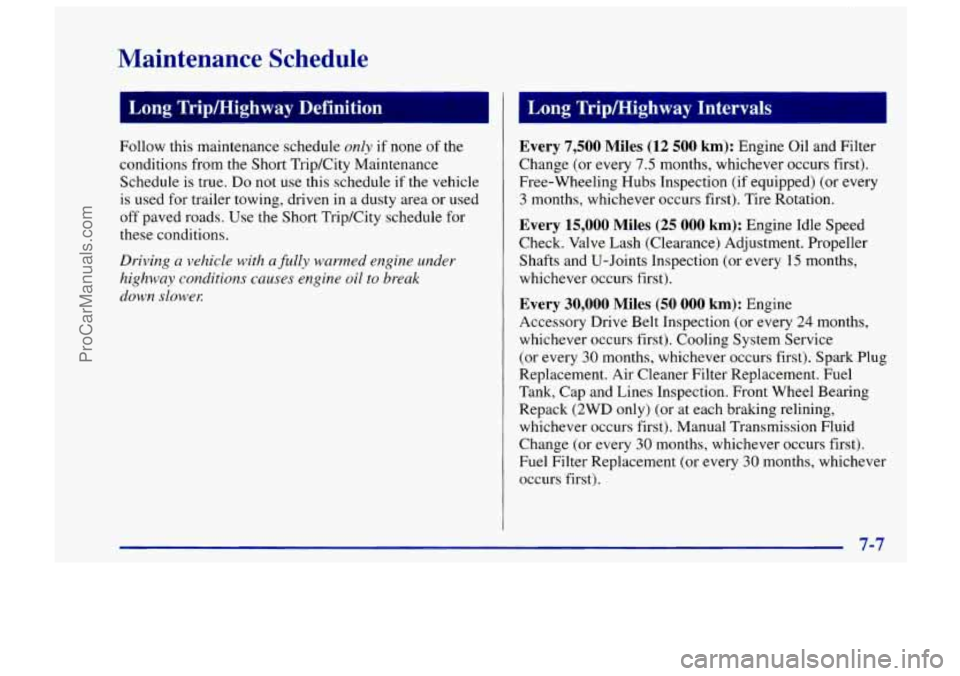
Maintenance Schedule
Follow this maintenance schedule only if none of the
conditions from the Short TripKity Maintenance
Schedule is true.
Do not use this schedule if the vehicle
is used for trailer towing, driven in a dusty area or used
off paved roads. Use the Short TripKity schedule for
these conditions.
Driving a vehicle with a fully warmed engine under
highway conditions causes engine oil to
break
down slower:
Every 7,500 Miles (12 500 km): Engine Oil and Filter
Change (or every
7.5 months, whichever occurs first).
Free-Wheeling
Hubs Inspection (if equipped) (or every
3 months, whichever occurs first). Tire Rotation.
Every 15,000 Miles (25 000 km): Engine Idle Speed
Check. Valve
Lash (Clearance) Adjustment. Propeller
Shafts and U-Joints Inspection (or every
15 months,
whichever occurs first).
Every 30,000 Miles (50 000 km): Engine
Accessory Drive Belt Inspection (or every
24 months,
whichever occurs first). Cooling System Service
(or every
30 months, whichever occurs first). Spark Plug
Replacement. Air Cleaner Filter Replacement. Fuel
Tank, Cap and Lines Inspection. Front Wheel Bearing
Repack (2WD only) (or at each braking relining,
whichever occurs first). Manual Transmission Fluid
Change (or every
30 months, whichever occurs first).
Fuel Filter Replacement (or every
30 months, whichever
occurs first).
7-7
ProCarManuals.com