parking brake CHEVROLET TRACKER 1997 User Guide
[x] Cancel search | Manufacturer: CHEVROLET, Model Year: 1997, Model line: TRACKER, Model: CHEVROLET TRACKER 1997Pages: 388, PDF Size: 20.12 MB
Page 92 of 388
When you turn on the headlamp switch, your DRL will
go out, and your headlamps will come on.
The other lamps that come
on with your headlamps will
also come on.
When you turn off the headlamp switch, the regular
lamps will go off, and your low-beam headlamps will
come on at the reduced brightness of
DRL.
To idle your vehicle with the DRL off, set the parking
brake. The
DRL will stay off until you release the
parking brake.
As with any vehicle, you should turn on the regular
headlamp system when you need it.
Interior Lamps
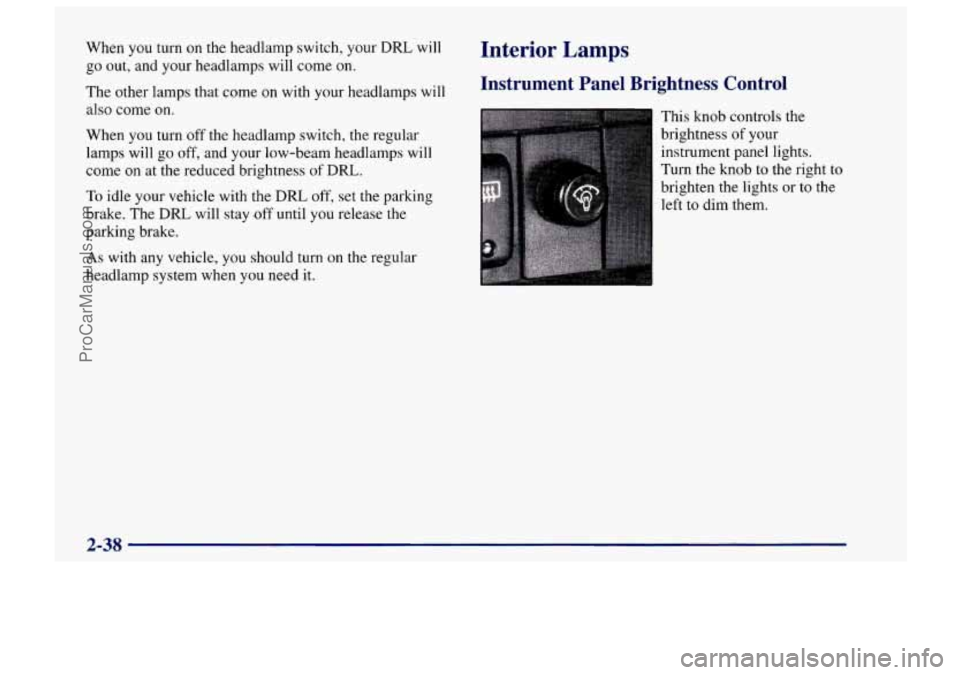
Instrument Panel Brightness Control
This knob controls the
brightness of your
instrument panel lights.
Turn the knob to the right to
brighten the lights or to the
left to dim them.
2-38
ProCarManuals.com
Page 96 of 388
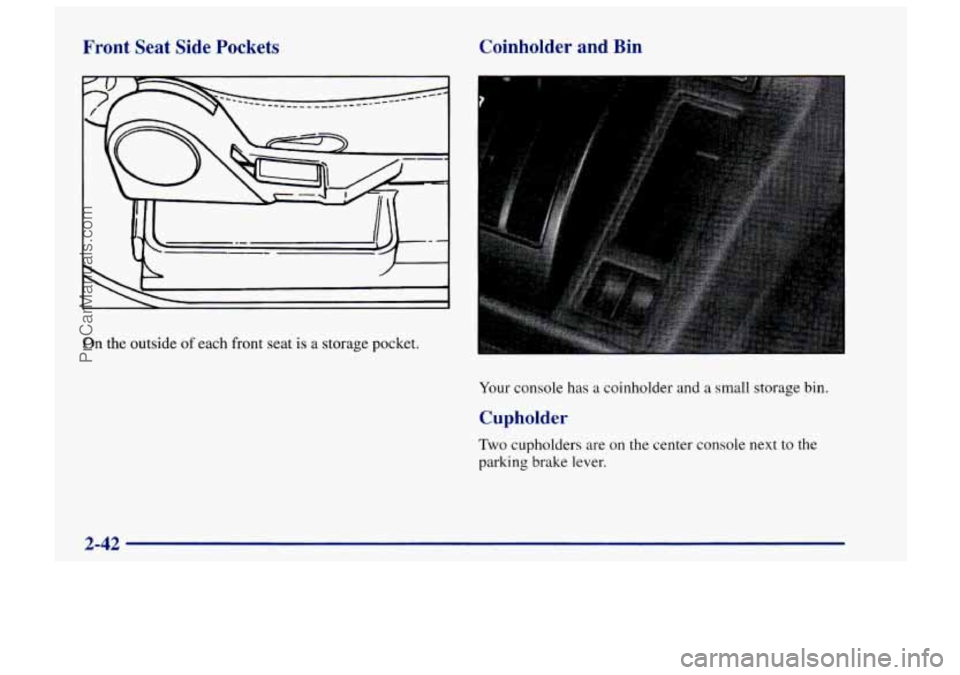
Front Seat Side Pockets Coinholder and Bin
On
the outside of each front seat is a storage pocket.
Your console has
a coinholder and a small storage bin.
Cupholder
Two cupholders are on the center console next to the
parking brake lever.
2-42
ProCarManuals.com
Page 113 of 388
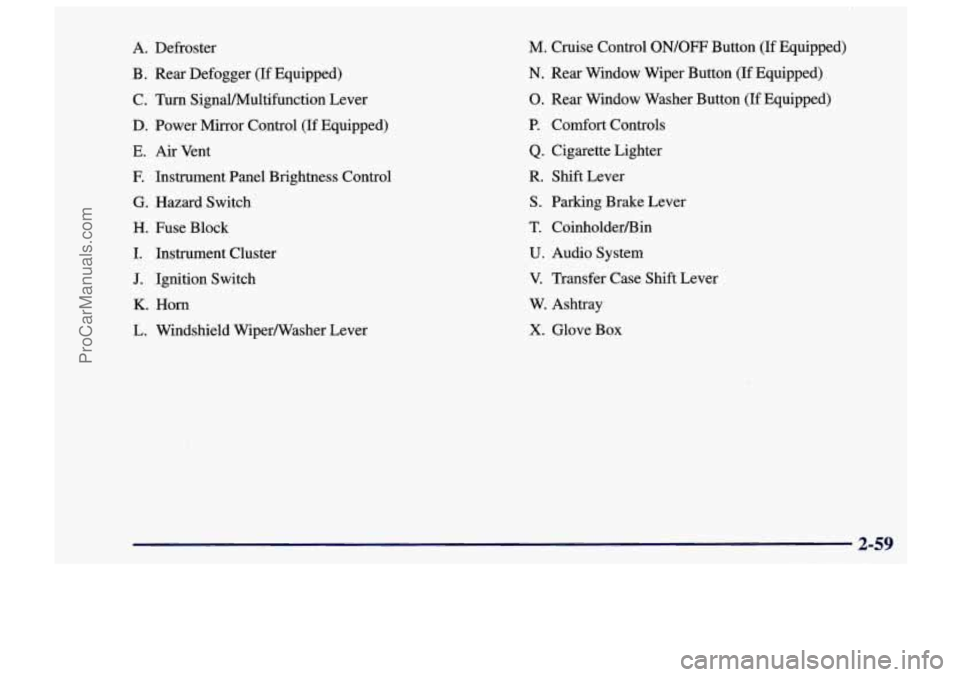
A. Defroster
B. Rear Defogger (If Equipped)
C. Turn SignaYMultifunction Lever
D. Power Mirror Control
(If Equipped)
E.
Air Vent
E Instrument Panel Brightness Control
G. Hazard Switch
H. Fuse Block
I. Instrument Cluster
J. Ignition Switch
K. Horn
L. Windshield Wipermasher Lever
M. Cruise Control ON/OFF Button (If Equipped)
N. Rear Window Wiper Button (If Equipped)
0. Rear Window Washer Button (If Equipped)
P. Comfort Controls
Q. Cigarette Lighter
R. Shift Lever
S. Parking Brake Lever
T. CoinholderlBin
U. Audio System
V. Transfer Case Shift Lever
W. Ashtray
X. Glove Box
2-59
ProCarManuals.com
Page 118 of 388
_-- ~~~~~
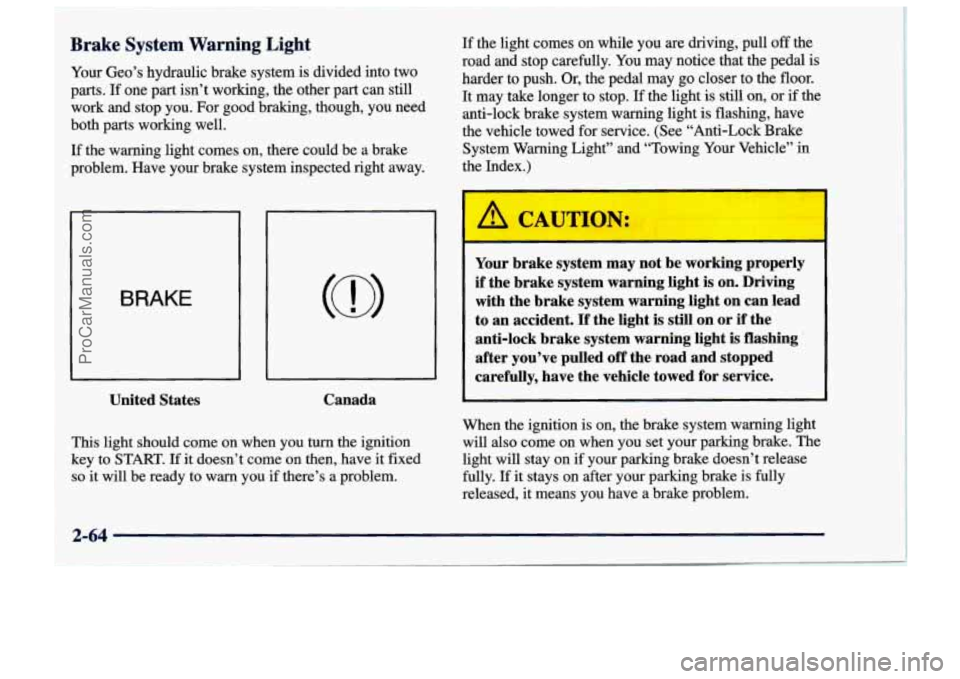
Brake System Warning Light
Your Geo’s hydraulic brake system is divided into two
parts.
If one part isn’t working, the other part can still
work and stop you. For good braking, though, you need
both parts working well.
If the warning light comes on, there could be a brake
problem. Have your brake system inspected right away.
If the light comes on while you are driving, pull off the
road and stop carefully. You may notice that the pedal
is
harder to push. Or, the pedal may go closer to the floor.
It may take longer to stop. If the light is still on, or if the
anti-lock brake system warning light is flashing, have
the vehicle towed for service. (See “Anti-Lock Brake
System Warning Light” and “Towing Your Vehicle” in
the Index.)
BRAKE
United States Canada
This light
should come on when you turn the ignition
key to STmT. If it doesn.’t come on then, have it fixed
so it will be ready to warn you if there’s a problem.
Ih
CA -JTION:
Your brake system may not be working properly
if the brake system warning light is on. Driving
with the brake system warning light on can lead
to an accident.
If the light is still on or if the
anti-lock brake system warning light is flashing
after you’ve pulled
off the road and stopped
carefully, have the vehicle towed for service.
When the ignition is on, the brake system warning light
will
also come on when you set your parking brake. The
light will stay on if your parking brake doesn’t release
fully. If it stays on after your parking brake is fully
released, it means you have
a brake problem.
r
2-64
ProCarManuals.com
Page 168 of 388
&.’ What should I do if my vehicle stalls, or is about
A: If this happens, there are some things you should
to stall, and I can’t make it up the hill?
do, and there are some things you must not do.
First, here’s what you
should do:
Push the brake pedal to stop the vehicle and keep it
from rolling backwards. Also, apply the parking brake.
If your engine is still running, shift the transmission
to REVERSE (R), release the parking brake, and
slowly back down the hill in REVERSE
(R).
If your engine has stopped running, you’ll need to
restart
it. With the brake pedal depressed and the
parking brake still applied, shift the transmission to
PARK
(P) (or, shift to NEUTRAL (N) if your
vehicle has a manual transmission) and restart the
engine. Then, shift to REVERSE (R), release the
parking brake, and slowly back down the hill as
straight as possible in REVERSE (R).
0 As you are backing down the hill, put your left hand
on the steering wheel at the 12 o’clock position. This
way, you’ll be able to tell
if your wheels are straight and maneuver
as you back down. It’s best that you
back down the hill with your wheels straight rather
than in the left or right direction. Turning the wheel
too far to the left or right will increase the possibility
of a rollover.
Here are some things you
must not do if you stall, or
are about to stall, when going up a hill.
Never attempt to prevent a stall by shifting into
NEUTRAL
(N) (or depressing the clutch, if you
have a manual transmission) to “rev-up” the engine
and regain forward momentum. This won’t work.
Your vehicle will roll backwards very quickly and
you could go out of control.
Instead, apply the regular brake to stop the vehicle. Then
apply the parking brake. Shift to REVERSE (R), release
the parking brake, and slowly back straight down.
Never attempt to turn around if you are about to stall
when going up a hill. If the hill is steep enough to
stall your vehicle, it’s steep enough to cause you to
roll over if you turn around.
If you can’t make it up
the hill,
you must back straight down the hill.
4-22
I
ProCarManuals.com
Page 169 of 388
&.' Suppose, after stalling, I try to back down
the hill and decide
I just can't do it. What
should
I do?
A: Set the parking brake, put your transmission
in PARK
(a) (or the manual transmission in
FIRST (1)) and turn off the engine. Leave the
vehicle and go get some help. Exit on the uphill
side and stay clear
of the path the vehicle would
take if it rolled downhill.
Do not shift the transfer
case to NEUTRAL (N) when
you leave the vehicle
Leave
it in some gear.
1 C A UTIO'T:
Shifting the transfer case to NEUTRAL (N) can
cause your vehicle to roll even if the transmission
is in PARK (P) (or, if you have the manual
transmission, even if you're in gear). This is
because the
NEUTRAL (N) position on the
transfer case overrides the transmission.
If you
are
going to leave your vehicle, set the parking
brake and shift the transmission to
PARK (P)
(or, put your manual transmission in FIRST (1)).
But do not shift the transfer case to the
NEUTRAL (N) position. Leave the transfer
case in the
2H, 4H or 4L position.
4-23
ProCarManuals.com
Page 171 of 388
0 Unless you have anti-lock: Avoid braking so hard that
you lock the wheels when going downhill. If your
wheels are locked, you can't steer your vehicle.
If your
wheels lock up during downhill braking,
you may feel
the vehicle starting to slide sideways. To regain your
direction, just ease
off the brakes and steer to keep the
front
of the vehicle pointing straight downhill.
e." Am I likely to stall when going downhill?
A: It's much more likely to happen going uphill. But if
0
0
0
0
it happens going downhill, here's what to do.
Stop your vehicle by applying the regular brakes.
Apply the parking brake.
Shift
to PARK (P) (or to NEUTRAL (N) with the
manual transmission) and, while still braking, restart
the engine.
Shift back to a low gear, release the parking brake,
and drive straight down.
If the engine won't start, get
out and get help.
Driving Across an Incline
Sooner or later, an off-road trail will probably go across
the incline of a hill. If this happens, you have
to decide
whether
to try to drive across the incline. Here are some
things to consider:
0
0
A hill that can be driven straight up or down may be
too steep to drive across. When you go straight up
or down a hill, the length of the wheel base (the
distance from the front wheels to the rear wheels)
reduces the likelihood the vehicle will tumble end
over end. But when you drive across an incline, the
much more narrow track width (the distance between
the left and right wheels) may not prevent the vehicle
from tilting and rolling over. Also, driving across an
incline puts more weight on the downhill wheels.
This could cause a downhill slide
or a rollover.
Surface conditions can be a problem when you drive
across a hill. Loose gravel, muddy spots, or even wet
grass can cause your tires to slip sideways, downhill.
If the vehicle slips sideways,
it can hit something
that will trip
it (a rock, a rut, etc.) and roll over.
4-25
ProCarManuals.com
Page 191 of 388
I NOTICE:
Do not tow your Geo with the rear wheels in
contact with the ground, or the transmission
could be damaged.
2.
3.
4.
Set the parking brake.
If your Geo is a four-wheel-drive vehicle, set your
manual free-wheeling hubs to
FREE or unlock your
automatic freewheeling hubs. See “Four-wheel
Drive” in the Index.
Turn the ignition key to ACC to unlock the
steering wheel.
I NOTICE:
Make sure that the towing speed does not
exceed
55 mph (90 km/h), or your Geo could be
badly damaged.
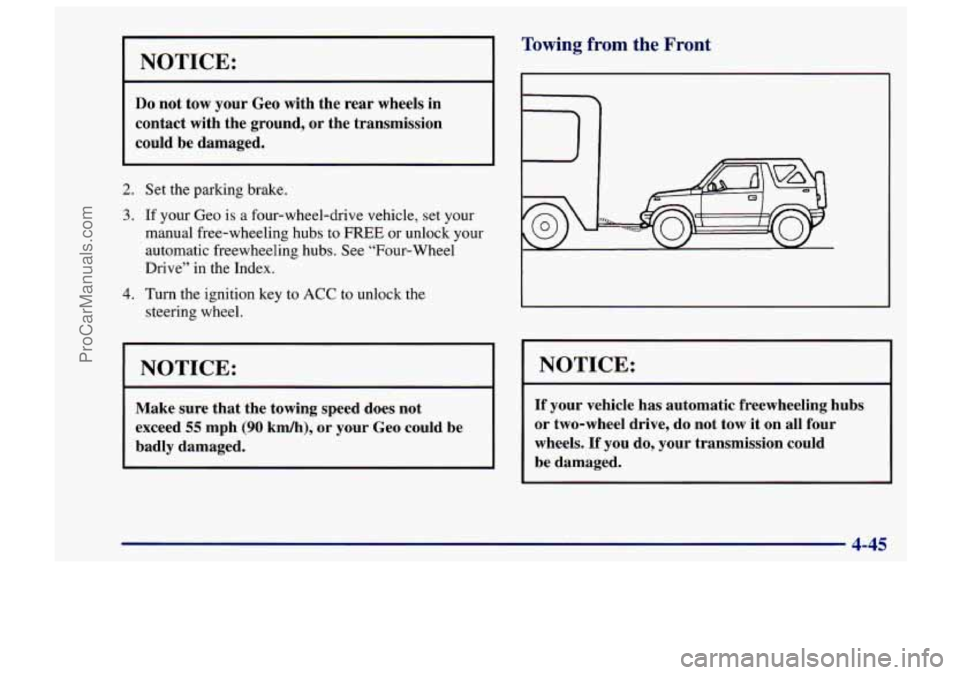
Towing from the Front
h
I1 I
I NOTICE: I
If your vehicle has automatic freewheeling hubs
or two-wheel drive,
do not tow it on all four
wheels.
If you do, your transmission could
be damaged.
4-45
I
ProCarManuals.com
Page 192 of 388
If you have a four-wheel-drive vehicle with manual
freewheeling hubs, it can be towed from the front with
all four wheels on the ground. Follow these steps:
1. Set the parking brake.
2. Turn the ignition key to ACC to unlock the
steering wheel.
3. Shift your automatic transmission into PARK (P), or
your manual transmission to SECOND (2).
4. Shift the transfer case to NEUTRAL (N).
5. Set the hubs to FREE. See “Four-Wheel-Drive” in
the Index.
6. Release the parking brake.
Stop towing every
200 miles (300 km) and start
the engine. Leave the transfer case shift lever
in
NEUTRAL (N). Shift your automatic transmission
to
DRIVE (D); leave a manual transmission in
SECOND (2) with the clutch engaged. Run the engine at
medium speed for one minute to circulate oil in the
transfer case.
Turn the ignition key to ACC. Now you
can continue towing your Geo.
I NOTICE:
The front wheels transmit shocks during towing.
The steering column may not be strong enough to
withstand the shocks. Always unlock the steering
wheel before towing.
NOTICE:
Make sure that the towing speed does not
exceed
50 mph (80 kmh), or your Geo could be
badly damaged.
4-46
ProCarManuals.com
Page 201 of 388
Turn Signals When Towing a Trailer
When you tow a trailer, your vehicle has to have extra
wiring (included in the optional trailering package).
The arrows on your instrument panel will flash
whenever you signal a turn or lane change. Properly
hooked up, the trailer lamps will also flash, telling other
drivers you’re about to turn, change lanes or stop.
When towing a trailer, the arrows on your instrument panel
will flash for turns even if
the bulbs on the trailer are burned
out. Thus, you may think drivers behind
you are seeing your
signal when they are not. It’s important to check occasionally
to be sure the trailer bulbs are still working.
Driving On Grades
Reduce speed and shift to a lower gear before you start
down a long or steep downgrade. If you don’t shift
down, you might have
to use your brakes so much that
they would get hot and no longer work well.
On a long uphill grade, shift down and reduce your
speed to around
45 mph (70 km/h) to reduce the
possibility of engine and transmission overheating.
If you are towing a trailer and
you have a manual
transmission with FIFTH
(5) gear, you may prefer not to
use FIFTH (5). Just drive in FOURTH (4) (or, as you
need to, a lower gear).
Parking on Hills
You really should not park your vehicle, with a trailer
attached, on a
hill. If something goes wrong, your rig
could start to move. People can be injured, and both
your vehicle and the trailer can
be damaged.
But
if you ever have to park your rig on a hill, here’s
how to do it:
1.
2.
3.
4.
5.
6.
Apply your regular brakes, but don’t shift into
PARK (P)
yet, or into gear for a manual transmission.
Have someone place chocks under the trailer wheels.
When the wheel chocks are
in place, release the
regular brakes until the chocks absorb the load.
Reapply the regular brakes.
Then apply your parking
brake, and then shift to
PARK (P), or REVERSE (R)
for a manual transmission.
If you have a four-wheel-drive vehicle, be sure
the transfer case
is in a drive gear -- not in
NEUTRAL (N).
Release the regular brakes.
4-55
I
ProCarManuals.com