ECU CHEVROLET TRACKER 1997 Owner's Manual
[x] Cancel search | Manufacturer: CHEVROLET, Model Year: 1997, Model line: TRACKER, Model: CHEVROLET TRACKER 1997Pages: 388, PDF Size: 20.12 MB
Page 184 of 388
Highway Hypnosis
Is there actually such a condition as “highway hypnosis”?
Or is it just plain falling asleep at the wheel? Call it
highway hypnosis, lack
of awareness, or whatever.
There is something about an easy stretch
of road with
the same scenery, along with the hum
of the tires on the
road, the drone
of the engine, and the rush of the wind
against the vehicle that can make you sleepy. Don’t let it
happen to you!
If it does, your vehicle can leave the
road in
less than a secund, and you could crash and
be injured
.
What can you do about highway hypnosis? First, be
aware that it can happen.
Then here are some tips:
0 Make sure your vehicle is well ventilated, with a
comfortably cool interior.
0 Keep your eyes moving. Scan the road ahead
and
to the sides. Check your mirrors and your
instruments frequently.
0 If you get sleepy, pull off the road into a rest, service
or parking area and take a nap, get some exercise,
or
both. For safety, treat drowsiness on the highway as
an emergency.
Hill and Mountain Roads
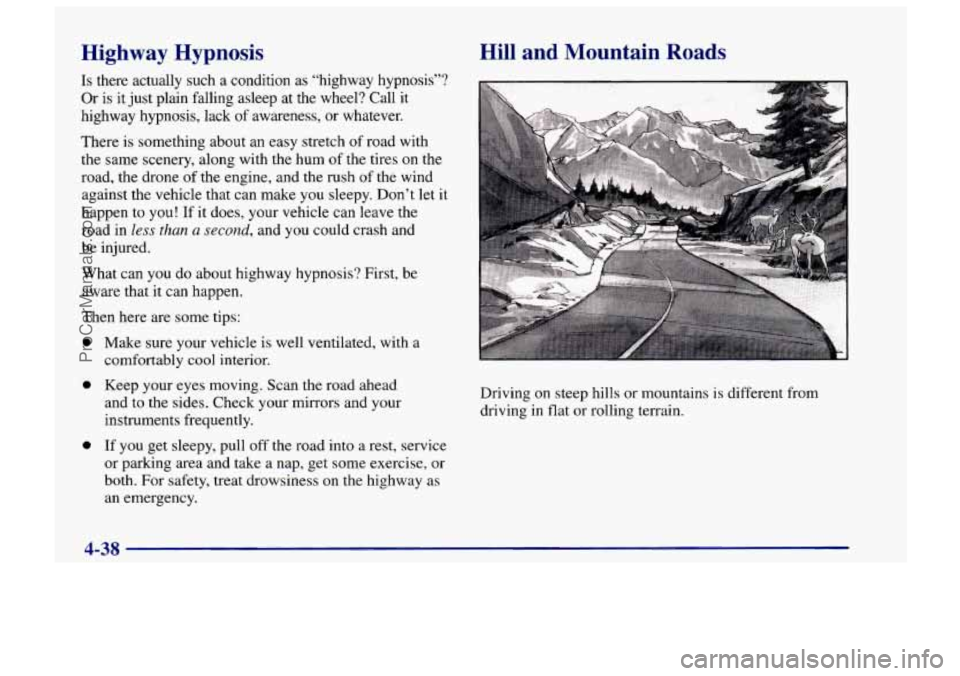
Driving on steep hills or mountains is different from
driving in flat or rolling terrain.
4-38
ProCarManuals.com
Page 194 of 388
Do not load your vehicle any heavier than the
GVWR, or either the maximum front or rear
GAWR. If you do, parts on your vehicle can
break, or it can change the way your vehicle
handles. These could cause you to lose control.
Also, overloading can shorten the life of
your vehicle.
NOTICE:
Your warranty does not cover parts or
components that fail because of overloading.
If you put things inside your vehicle -- like suitcases,
tools, packages or anything else
-- they will go as fast as
the vehicle goes. If you have to stop or turn quickly, or
if there
is a crash, they’ll keep going.
=
Things you put inside your vehicle can strike
and injure people in
a sudden stop or turn,
or in
a crash.
Put things in the cargo area of your vehicle.
Try to spread the weight evenly.
Never stack heavier things, like suitcases,
inside the vehicle
so that some of them are
above the tops of the seats.
Don’t leave an unsecured child restraint in
your vehicle.
When you carry something inside the
vehicle, secure it whenever you can.
Don’t leave a seat folded down unless you
need to.
There’s also important loading information for off-road
driving in this manual. See “Loading Your Vehicle for
Off-Road Driving” in the Index.
4-48
ProCarManuals.com
Page 199 of 388
Safety Chains
You should always attach chains between your vehicle
and your trailer. Cross the safety chains under the tongue
of the trailer
so that the tongue will not drop to the road
if
it becomes separated from the hitch. Instructions
about safety chains may be provided by the hitch
manufacturer or by the trailer manufacturer. Follow the
manufacturer’s recommendation for attaching safety
chains and do not attach them to the bumper. Always
leave just enough slack
so you can turn with your rig.
And, never allow safety chains to drag on the ground.
Trailer Brakes
If your trailer weighs more than 1,000 lbs. (450 kg)
loaded, then it needs its own brakes -- and they must be
adequate. Be sure to read and follow the instructions for
the trailer brakes
so you’ll be able to install, adjust and
maintain them properly.
0 Don’t tap into your vehicle’s brake system if the
trailer’s brake system will use more than
0.02 cubic
inch
(0.3 cc) of fluid from your vehicle’s master
cylinder. If
it does, both systems won’t work well.
You could even lose your brakes.
Will the trailer brake parts take 3,000 psi
(20 650 kPa) of pressure? If not, the trailer brake
system must not be used with your vehicle.
If everything checks out this far, then make the brake
fluid tap at the port on the master cylinder that sends
fluid to the rear brakes. But don’t
use copper tubing
for this.
If you do, it will bend and finally break off.
Use steel brake tubing.
Driving with a Trailer
Towing a trailer requires a certain amount of experience.
Before setting
out for the open road, you’ll want to get
to know your rig. Acquaint yourself with the feel of
handling and braking with the added weight of the
trailer. And always keep in mind that the vehicle you are
driving is now a good deal longer and
not nearly as
responsive as your vehicle is by itself.
Before you start, check the trailer hitch and platform
(and attachments), safety chains, electrical connector,
lamps, tires and mirror adjustment. If the trailer has
electric brakes, start your vehicle and trailer moving and
then apply the trailer brake controller by hand to be sure
the brakes are working. This lets
you check your
electrical connection at the same time.
During your trip, check occasionally to be sure that the
load is secure, and that
the lamps and any trailer brakes
are still working.
- 4-53
ProCarManuals.com
Page 210 of 388
Towing Your Vehicle
Try to have a Chevrolet/Geo dealer or a professional
towing service tow your Tracker. See “Roadside
Assistance” in the Index.
If your vehicle has been changed
or modified since it
was factory-new by adding aftermarket items like fog
lamps, aero skirting,
or special tires and wheels, these
instructions may not be correct.
Before
you do anything, turn on the hazard
warning flashers.
When you call, tell the towing service:
0 That your vehicle has rear-wheel drive, or that it has
0 The make, model and year of your vehicle.
0 Whether you can still move the shift lever for the
transmission and transfer case, if you have one.
the four-wheel-drive option.
If there was
an accident, what was damaged. When the
towing service arrives, let
the tow operator
know that this manual contains detailed towing
instructions and illustrations. The operator may want to
see them.
To help avoid injury to you or others:
0 Never let passengers ride in a vehicle that is
Never tow faster than safe or posted speeds.
0 Never tow with damaged parts not
0 Never get under your vehicle after it has
Always use separate safety chains on each
Never use T-hooks. Use J-hooks instead.
being towed.
fully secured.
been lifted
by the
tow truck.
side when towing a vehicle.
5-8
ProCarManuals.com
Page 211 of 388
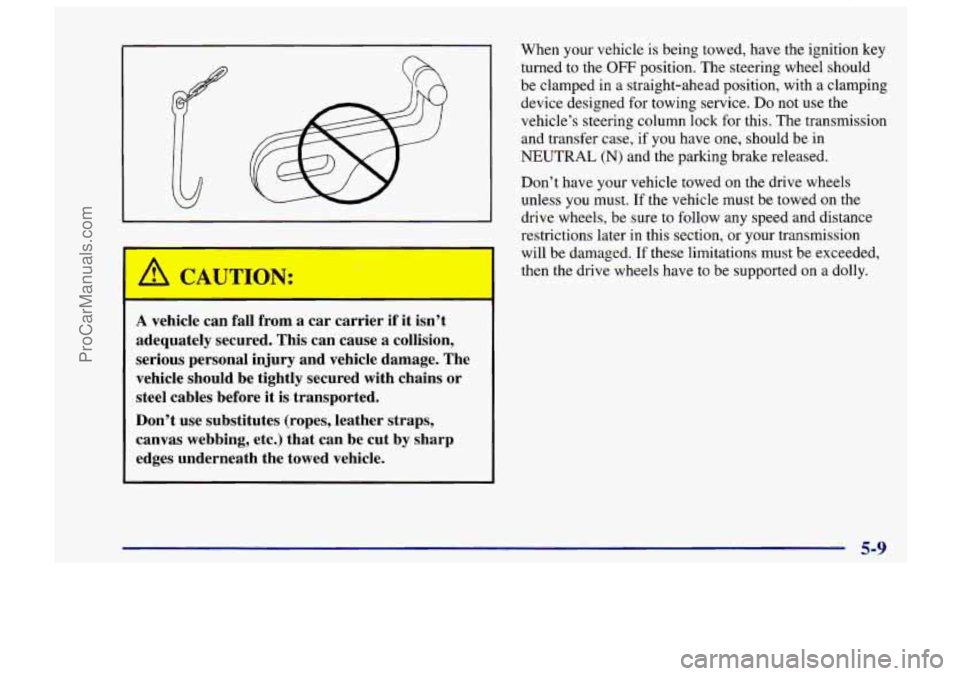
A vehicle can fall from a car carrier if it isn’t
adequately secured. This can cause
a collision,
serious personal injury and vehicle damage. The
vehicle should be tightly secured with chains or
steel cables before it
is transported.
Don’t use substitutes (ropes, leather straps,
canvas webbing, etc.) that can be cut by sharp
edges underneath the towed vehicle.
When your vehicle is being towed, have the ignition key
turned to the
OFF position. The steering wheel should
be clamped in a straight-ahead position, with a clamping device designed for towing service.
Do not use the
vehicle’s steering column lock for this. The transmission
and transfer case, if you have one, should
be in
NEUTRAL (N) and the parking brake released.
Don’t have your vehicle towed on the drive wheels
unless you must. If the vehicle must be towed on the
drive wheels, be sure to follow any speed and distance
restrictions later in this section,
or your transmission
will be damaged.
If these limitations must be exceeded,
then the drive wheels have to be supported on a dolly.
5-9
I
ProCarManuals.com
Page 286 of 388
Tire Chains
NOTICE:
Use tire chains only where legal and only when
you must. Use only
SAE Class “S” type chains
that are the proper size for your tires. Install them
on the tires
of the drive axle (fourwheel-drive
vehicles can use chains on both axles).
Tighten them as tightly as possible with the ends
securely fastened. Drive slowly and follow the
chain manufacturer’s instructions.
If you can
hear the chains contacting your vehicle, stop
and retighten them.
If the contact continues,
slow down until it stops. Driving too fast or
spinning the wheels with chains on will
damage your vehicle.
Appearance Care
Remember, cleaning products can be hazardous. Some
are toxic. Others can burst into flame if you strike a
match or get them on
a hot part of the vehicle. Some are
dangerous if you breathe their fumes in a closed space.
When you
use anything from a container to clean your
Geo, be sure to follow the manufacturer’s warnings and
instructions. And always open your doors or windows
when you’re cleaning the inside.
Never use these to clean your vehicle:
0 Gasoline
0 Benzene
0 Naphtha
0 Carbon Tetrachloride
Acetone
0 Paint Thinner
Turpentine
0 Lacquer Thinner
0 Nail Polish Remover
They can all be hazardous
-- some more than
others
-- and they can all damage your vehicle, too.
6-48
ProCarManuals.com
Page 376 of 388
Brake Adjustment
.................................. 6-32
Fluid
....................................... 6-29
Master Cylinder
.............................. 6-29
Parking
..................................... 2-21
PedalTravel
................................. 6-32
Replacing System
Parts ........................ 6-32
System Warning Light
......................... 2-64
Trailer
...................................... 4-53
Transmission Shift Interlock
.................... 2-25
Transmission Shift Interlock Check
............... 7-5 1
Wear
....................................... 6-31
Brakes, Anti-Lock
............................... 4-7
Braking
........................................ 4-6
Braking
in Emergencies ........................... 4-9
Break-In, New Vehicle
........................... 2-7
Brightness Control
.............................. 2-38
BTSI
......................................... 2-25
BTSICheck
................................... 7-51
Bulb Replacement
.............................. 6-33
Canadian Roadside Assistance
.................... 8-7
Canvas Top Lowering and Raising
......................... 2-50
Preparing for Storage
.......................... 2-56
Removing and Installing
....................... 2-55
Capacities and Specifications
...................... 6-62
Carbon Monoxide
..................... 2-5,2-27, 4-43
Cassette Deck Service
........................... 7-49
Cassette Tape Player
........................ 3-8, 3-11
Cassette Tape Player Care
........................ 3- 1 8
CD Player Theft-Deterrent Feature ................. 3 - 15 Center
High-Mounted Stoplamp Bulb Replacement
.... 6-39
Certification Label
.............................. 4-47
Chains. Safety
................................. 4-53
Chains. Tire
................................... 6-48
Changing a Flat Tire
............................. 5-23
Charging System Light
.......................... 2-63
Checking Your Restraint Systems
.................. 1-45
Chemical Paint Spotting
.......................... 6-56
Child Restraints
........................... 1-35. 1-36
Securing in a Rear Seat Position
................. 1-37
Securing in the Right Front Seat Position
.......... 1-39
TopStrap
................................... 1-37
WheretoPut
................................ 1-36
Circuit Breakers and Fuses
....................... 6-59
Cleaner. Air
................................... 6-14
Cleaning Aluminum Wheels
............................ 6-55
Canvas Top and Plastic Window
................. 6-54
Exterior LampsLenses
........................ 6-53
Fabric
...................................... 6-49
Glass Surfaces
............................... 6-52
Inside of Your Ceo
............................ 6-49
Instrument Panel
............................. 6-51
Outside of Your Geo .......................... 6-53
Stains
...................................... 6-50
Tires
....................................... 6-55
Vinyl
....................................... 6-51
Wheels
..................................... 6-55
Cigarette Lighter
............................... 2-43
Special Problems
............................. 6-50
Windshield and Wiper Blades
................... 6-52
Climate Control System
........................... 3-2
9-2
ProCarManuals.com
Page 382 of 388
Rear Axle
....................................... 6-21
Combination Lamp Bulb Replacement
............ 6-38
Door Security Locks ........................... 2-4
Folding Seatbacks
......................... 1-6. 1-9
Seat Passengers
.............................. 1-3 1
Sidemarker Lamp Bulb Replacement ............. 6-37
Turn Signal Lamp Bulb Replacement
............. 6-38
Window Defogger ............................. 3-5
Window Defogger Light ........................ 3-5
Windshield Washer ........................... 2-33
Defogger Light
................................ 3-5
Towing
..................................... 5-11
Rear Window
Opening and Closing Your
...................... 2-47
Removing and Installing
....................... 2-47
Inside Daymight
............................. 2-39
Rearview Mirrors
............................... 2-39
Convex Outside
.............................. 2-41
Inside Daymight Rearview
..................... 2-39
ManualAdjust
............................... 2-40
Power Remote Control
......................... 2-40
Reclining Front Seatbacks
......................... 1-3
Recommended Fluids and Lubricants
............... 7-55
RecoveryHooks ................................ 5-35
Recovery Tank. Coolant
.......................... 5- 17
Refrigerants. Air Conditioning .................... 6-64
Bulbs
...................................... 6-62
Parts
....................................... 6-62
Wheel
...................................... 6-46
Recreational
Vehicle Towing
...................... 4-44
Replacement Replacing Safety Belts
........................... 1-46
Reporting Safety Defects
......................... 8-10
Checking
................................... 1-45
Child
....................................... 1-36
Head
....................................... l-4
Replacing Parts After a Crash ................... 1-46
System Check
................................ 7-50
Reverse, Automatic Transmission
.................. 2-11
Reverse, Manual Transmission
.................... 2-15
Right Front Passenger Position
.................... 1-25
Roadside Assistance
.............................. 8-5
Roadside Assistance, Canadian
..................... 8-7
Rocking Your Vehicle ........................... 5-35
Rotation, Tires
................................. 6-42
Restraints
Safety Belt Extender
............................ 1-45
Safety Belts ................................... 1-12
Adults
...................................... 1-18
Care
....................................... 6-52
Children
.................................... 1-34
Driver Position
............................... 1-18
Extender .................................... 1-45
How to Wear Properly
......................... 1-18
Incorrect Usage
.................... 1-20, 1-43, 1-44
Lap-Shoulder
........................... 1 - 18, 1 -32
Larger Children
.............................. 1-42
Passenger Position
............................ 1-25
Questions and Answers
........................ 1-17
Rear Seat Passengers .......................... 1-31
9-8
ProCarManuals.com
Page 383 of 388
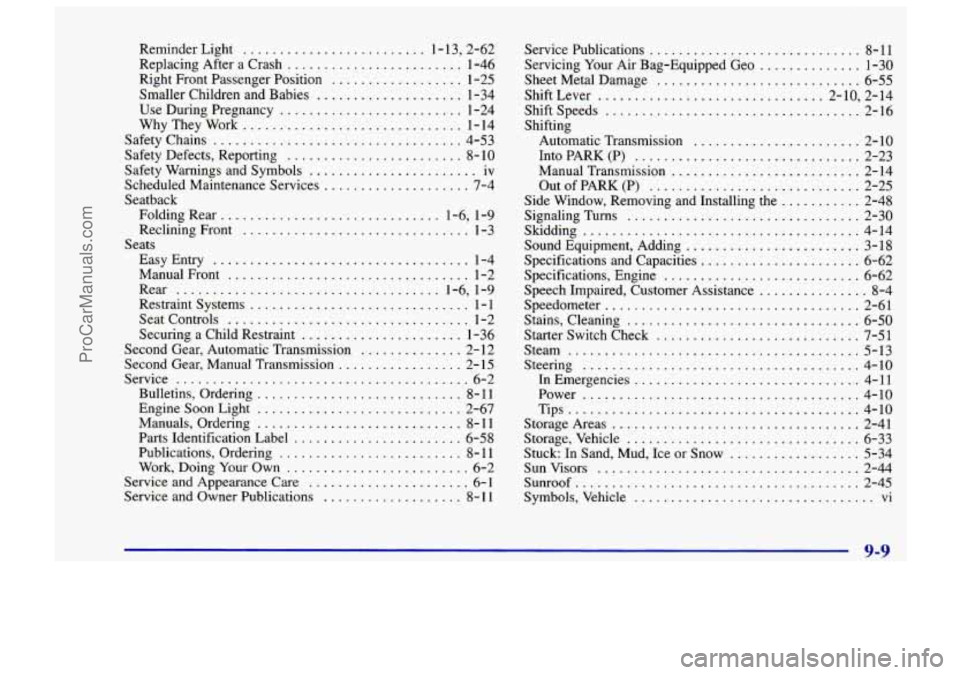
Reminder Light ......................... 1 . 13. 2.62
Replacing After a Crash
........................ 1-46
Right Front Passenger Position
.................. 1-25
Smaller Children and Babies
.................... 1-34
Use During Pregnancy
......................... 1-24
WhyTheyWork
.............................. 1-14
Safety Chains
.................................. 4-53
Safety Defects. Reporting
........................ 8-10
Safety Warnings and Symbols
....................... iv
Scheduled Maintenance Services
.................... 7-4
Seatback
Folding Rear
.............................. 1-6. 1-9
Reclining Front
............................... 1-3
EasyEntry
................................... 1-4
ManualFront ................................. 1-2
Rear
.................................... 1-6. 1.9
Restraint Systems
.............................. 1 . 1
Seat Controls ................................. 1-2
Securing a Child Restraint
...................... 1-36
Second Gear. Automatic Transmission
.............. 2- 12
Second Gear. Manual Transmission
................. 2- 15
Service ........................................ 6-2
Bulletins. Ordering ............................ 8- 11
Engine Soon Light
............................ 2-67
Manuals. Ordering ............................ 8- 1 1
Parts Identification Label ....................... 6-58
Publications. Ordering
......................... 8- 11
Work. Doing Your
Own ......................... 6-2
Service and Appearance Care ...................... 6-1
Service and Owner Publications ................... 8- 1 1
Seats Service Publications
.............................. 8-1
1
Sheet Metal Damage
............................ 6-55
Shift Lever
............................... 2- 10. 2- 14
Shiftspeeds ................................... 2-16
Shifting Automatic Transmission
....................... 2-10
IntoPARK(P)
............................... 2-23
Manual Transmission
.......................... 2-14
Out of PARK (P)
............................. 2-25
Signaling Turns
................................ 2-30
Skidding
...................................... 4-14
Sound Equipment. Adding
........................ 3-18
Specifications and Capacities
...................... 6-62
Specifications. Engine
........................... 6-62
Speedometer
................................... 2-61
Stains. Cleaning
................................ 6-50
Starter Switch Check
............................ 7-51
Steam ........................................ 5-13
Steering
...................................... 4-10
In Emergencies
............................... 4-11
Power
...................................... 4-10
Tips
........................................ 4-10
StorageAreas
.................................. 2-41
Storage. Vehicle ................................ 6-33
Stuck: In Sand. Mud.
Ice or Snow .................. 5-34
Sunvisors
.................................... 2-44
Sunroof ....................................... 2-45
Symbols. Vehicle
................................. vi
Servicing
Your Air Bag-Equipped Geo
.............. 1-30
Side Window. Removing and Installing the
........... 2-48
Speech Impaired. Customer Assistance
............... 8-4
9-9
ProCarManuals.com