automatic transmission CHEVROLET TRACKER 1997 Owner's Manual
[x] Cancel search | Manufacturer: CHEVROLET, Model Year: 1997, Model line: TRACKER, Model: CHEVROLET TRACKER 1997Pages: 388, PDF Size: 20.12 MB
Page 254 of 388
Automatic Transmission Fluid
When to Check and Change
A good time to check your automatic transmission fluid
level is when the engine oil
is changed.
Change both the fluid and filter every
50,000 miles
(83 000 km) if the vehicle is mainly driven under one or
more
of these conditions:
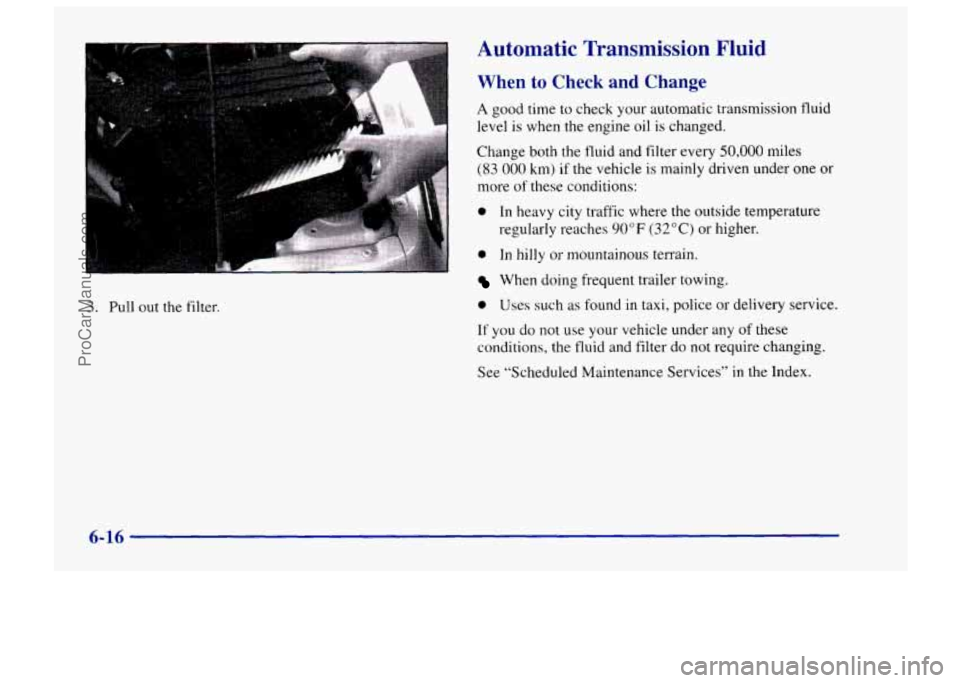
3. Pull out the filter.
0 In heavy city traffic where the outside temperature
regularly reaches
90°F (32°C) or higher.
0 In hilly or mountainous terrain.
When doing frequent trailer towing.
0 Uses such as found in taxi, police or delivery service.
If you do not use your vehicle under any of these
conditions, the fluid and filter do not require changing.
See “Scheduled Maintenance Services”
in the Index.
6-16
ProCarManuals.com
Page 257 of 388
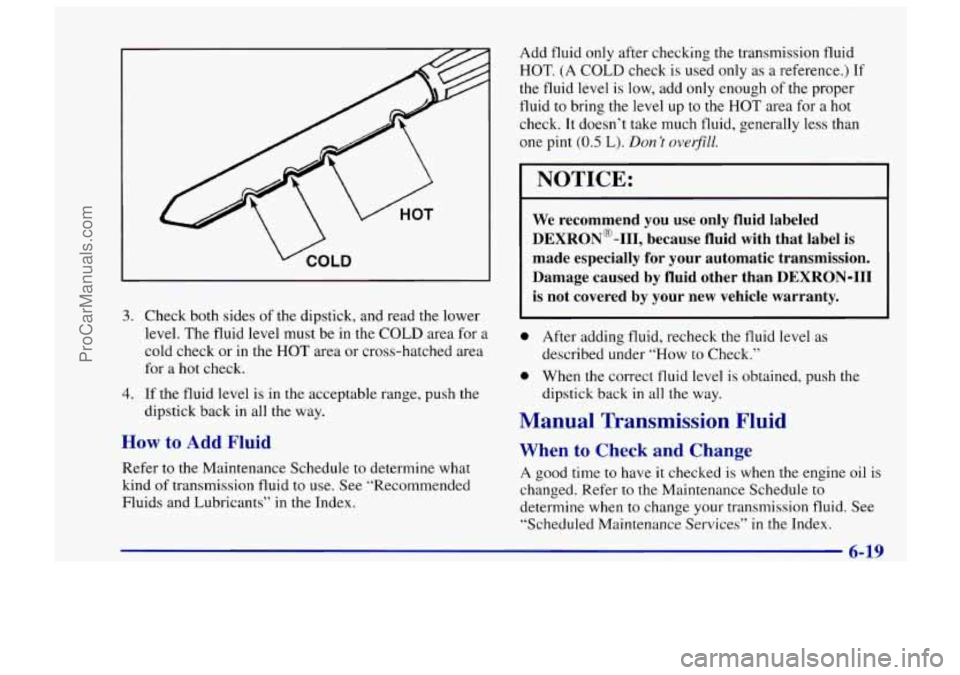
3. Check both sides of the dipstick, and read the lower
level. The fluid level must be
in the COLD area for a
cold check or
in the HOT area or cross-hatched area
for a hot check.
4. If the fluid level is in the acceptable range, push the
dipstick back in all the way.
How to Add Fluid
Refer to the Maintenance Schedule to determine what
kind
of transmission fluid to use. See “Recommended
Fluids and Lubricants” in the Index. Add
fluid only after checking the transmission fluid
HOT. (A COLD check
is used only as a reference.) If
the fluid level is low, add only enough of the proper
fluid to bring the level up to the HOT area for a hot
check.
It doesn’t take much fluid, generally less than
one pint
(0.5 L). Don ’I ove$iZZ.
NOTICE:
We recommend you use only fluid labeled
DEXRON@-111, because fluid with that label is
made especially for your automatic transmission.
Damage caused by fluid other than DEXRON-I11
is not covered by your new vehicle warranty.
0 After adding fluid, recheck the fluid level as
0 When the correct fluid level is obtained, push the
described under
“How to Check.”
dipstick back
in all the way.
Manual Transmission Fluid
When to Check and Change
A good time to have it checked is when the engine oil is
changed. Refer
to the Maintenance Schedule to
determine when to change your transmission fluid. See
“Scheduled Maintenance Services”
in the Index.
6-19
1
ProCarManuals.com
Page 301 of 388
Capacities (Approximate)
The following approximate capacities are given in
English and metric conversions.
Air Conditioning?
............. See the refrigerant
information label under
the hood and “Air Conditioning
Refrigerants” at the end
of this section.
Automatic Transmission
Pan Removal and Replacement Three-Speed
............. 3.0 quarts (2.8 L)**
Four-Speed ............... 2.64 quarts (2.5 L)
After Complete Overhaul
Three-Speed
............... 5.3 quarts (5.1 L)
Four-Speed ................ 7.3 quarts (6.9 L)
Cooling System
Automatic Transmission
....... 5.5 quarts (5.2 L)
Manual Transmission ......... 5.6 quarts (5.3 L)
Crankcase With Filter Change
.......... 4.5 quarts (4.2 L)*
Front Differential ............ 1.1 quarts (1 .O L)
Fuel Tank
Two-Door Convertible
....... 11.1 gallons (42 L)
Four-Door Hardtop .......... 14.5 gallons (55 L)
Manual Transmission
Four-wheel Drive
.......... 1.6 quarts (1.5 L)**
Two-Wheel Drive .......... 2.0 quarts (1.9 L)**
Rear Differential ............. 2.3 quarts (2.2 L)
Transfer Case ............... 1.8 quarts (1.7 L)
* When changing the oil filter, additional oil may be
needed. Recheck the oil level after filling. See
“Engine Oil” in the Index.
** Recheck fluid level after filling. See “Automatic
Transmission Fluid” or “Manual Transmission
Fluid” in
the Index.
6-63
ProCarManuals.com
Page 308 of 388
Maintenance Schedule
1 Short TriplCity Intervals I
Every 50,000 Miles (83 000 km): Automatic
Transmission Service (severe conditions only).
Positive Crankcase Ventilation (PCV)
Valve Replacement.
Every 60,000 Miles (100 000 km): Engine Timing and
Distributor Check. Fuel Tank Cap Gasket
Replacement. Emission System Hoses Inspection. Camshaft Timing Belt Replacement. Brake Fluid
Service. Spark Plug
Wire Replacement (or every 60
months, whichever occurs first). Wiring Harness and
Connectors Inspection
(or every 60 months,
whichever occurs first).
Short TriplCity Intervals
At 90,000 Miles (150 000 km): Camshaft Timing
Every 100,000 Miles (166 000 km): Fuel
Belt Inspection.
Injector Inspection. Evaporative Emissions
Canister Replacement.
These intervals only summarize maintenance services.
Be sure
to follow the complete maintenance schedule on
th.e following pages.
7-6
ProCarManuals.com
Page 310 of 388
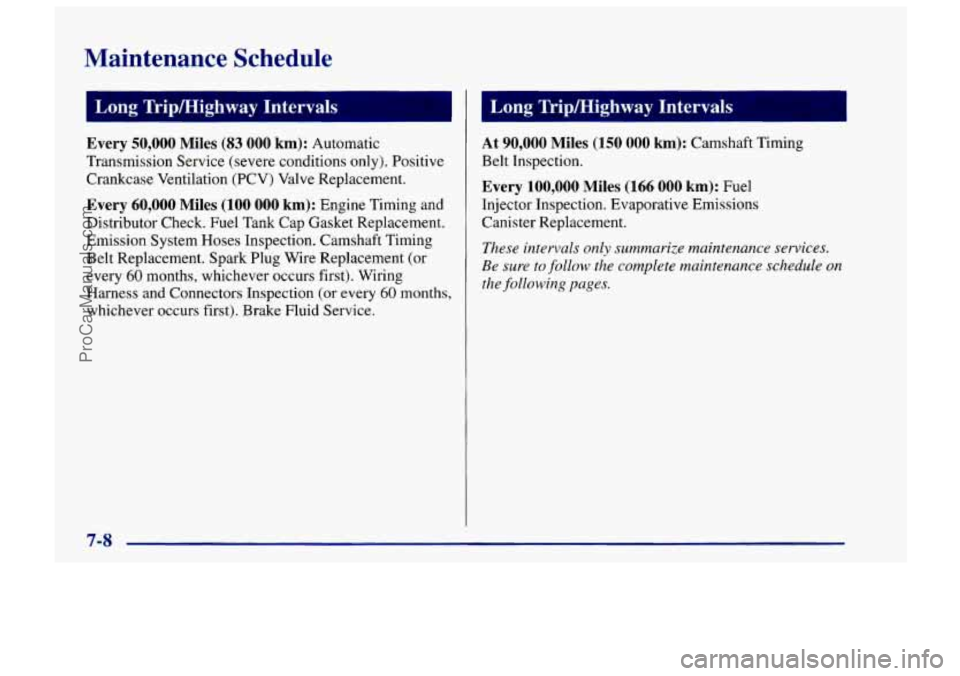
Maintenance Schedule
Long Tripmighway Intervals fi
Every 50,000 Miles (83 000 km): Automatic
Transmission Service (severe conditions only). Positive
Crankcase Ventilation (PCV) Valve Replacement.
Every 60,000 Miles (100 000 km): Engine Timing and
Distributor Check. Fuel Tank Cap Gasket Replacement.
Emission System Hoses Inspection. Camshaft Timing
Belt Replacement.
Spark Plug Wire Replacement (or
every
60 months, whichever occurs first). Wiring
Harness and Connectors Inspection
(or every 60 months,
whichever occurs first). Brake Fluid Service.
At 90,000 Miles (150 000 km): Camshaft Timing
Belt Inspection.
Every 100,000 Miles (166 000 km): Fuel
Injector Inspection. Evaporative Emissions
Canister Replacement.
These intervals only summarize maintenance services.
Be sure
to follow the complete maintenance schedule on
the following pages.
7-8
ProCarManuals.com
Page 321 of 388
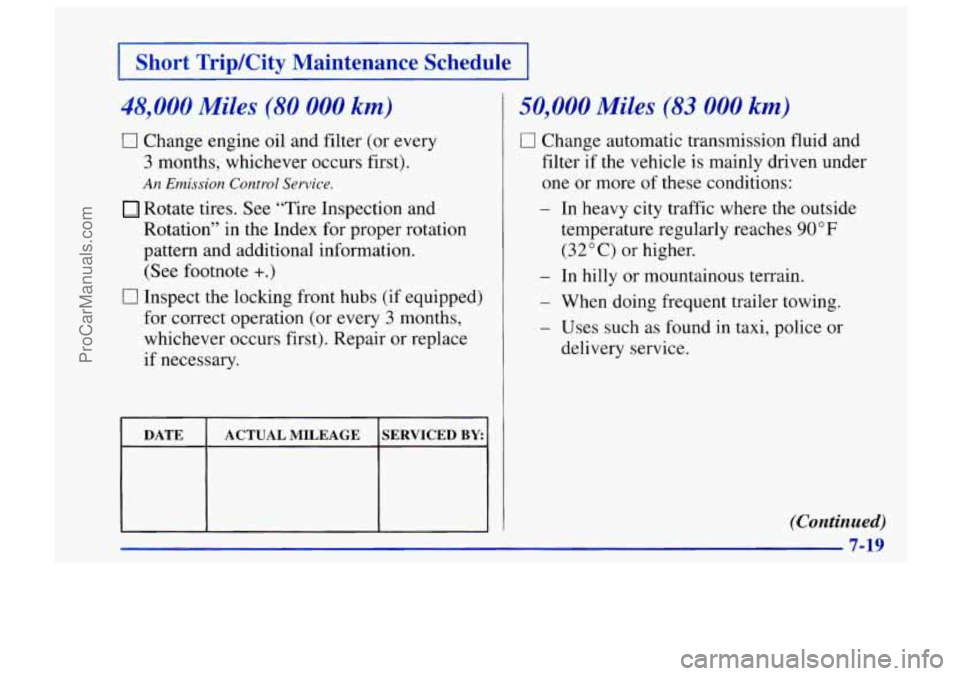
I Short Trip/City Maintenance Schedule I
48,000 Miles (80 000 km)
0 Change engine oil and filter (or every
3 months, whichever occurs first).
Rotate tires. See “Tire Inspection and
Rotation” in the Index for proper rotation
pattern and additional information.
(See footnote
+.)
0 Inspect the locking front hubs (if equipped)
for correct operation (or every
3 months,
whichever occurs first). Repair or replace
if necessary.
An Emission Control Service.
50,000 Miles (83 000 km)
0 Change automatic transmission fluid and
filter if the vehicle
is mainly driven under
one or more of these conditions:
- In heavy city traffic where the outside
temperature regularly reaches
90 OF
(32 O C) or higher.
- In hilly or mountainous terrain.
- When doing frequent trailer towing.
- Uses such as found in taxi, police or
delivery service.
DATE ACTUAL MILEAGE SERVICED BY
(Continued)
7-19
ProCarManuals.com
Page 335 of 388
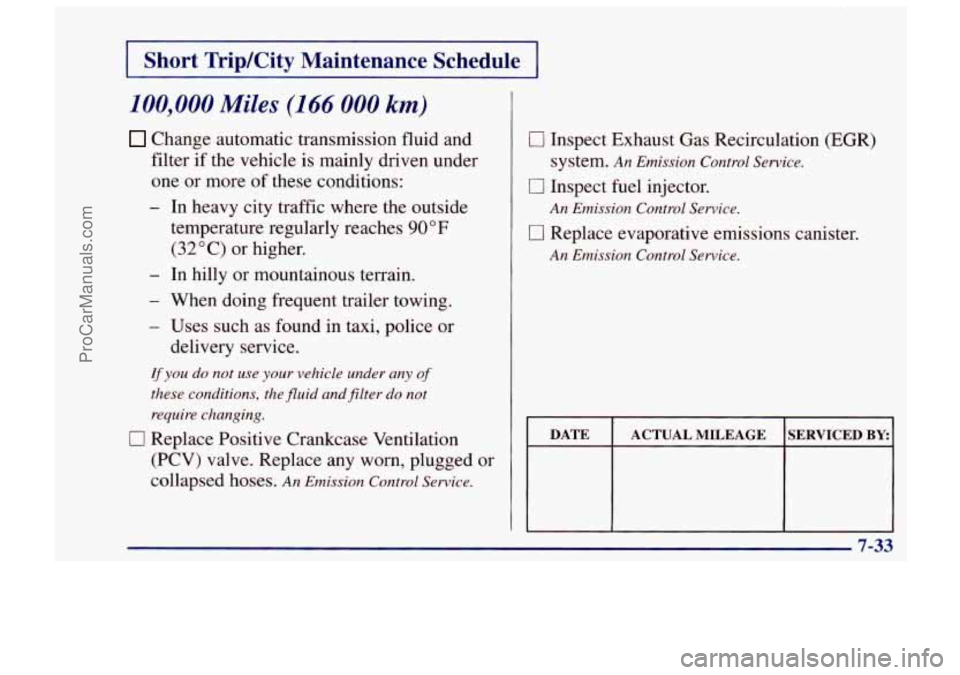
I Short Trip/City Maintenance Schedule I
100,000 Miles (1 66 000 km)
Change automatic transmission fluid and
filter if the vehicle is mainly driven under
one or more
of these conditions:
- In heavy city traffic where the outside
temperature regularly reaches
90 O F
(32 O C) or higher.
- In hilly or mountainous terrain.
- When doing frequent trailer towing.
- Uses such as found in taxi, police or
delivery service.
Ifynu do not use your vehicle under any of
these conditions, the fluid and filter do not
require changing.
0 Replace Positive Crankcase Ventilation
(PCV) valve. Replace any worn, plugged or
collapsed hoses.
An Emission Control Service.
0 Inspect Exhaust Gas Recirculation (EGR)
0 Inspect fuel injector.
0 Replace evaporative emissions canister.
system.
An
Emission Control Service.
An Emission Control Service.
An Emission Control Service.
DATE
SERVICED BY: ACTUAL MILEAGE
I I I
- 7-33
ProCarManuals.com
Page 342 of 388
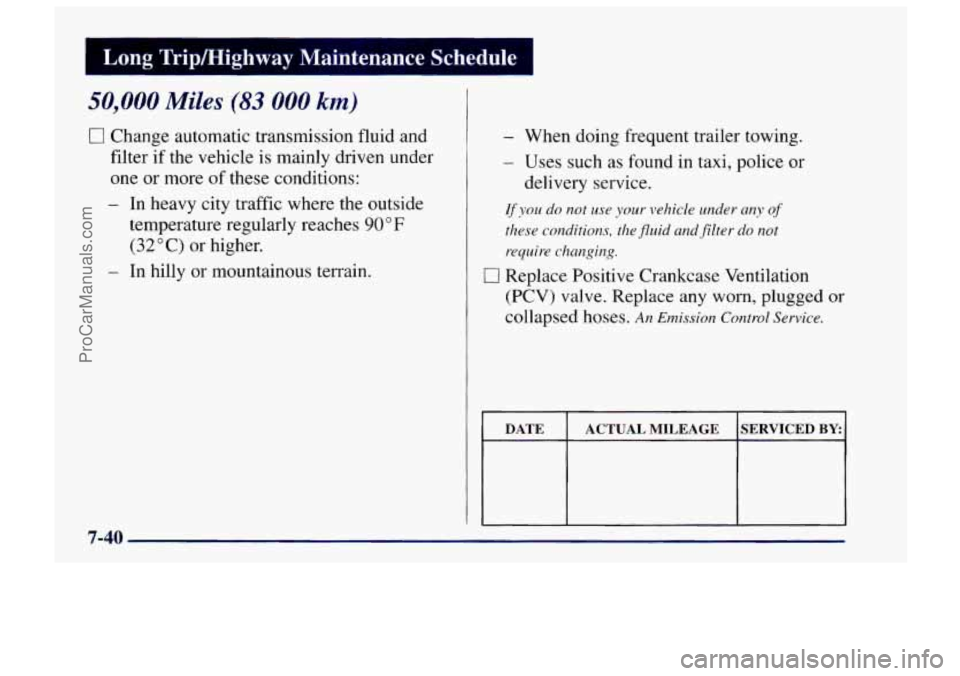
Long Tripmighway Maintenance Schedule
50,000 Miles (83 000 km)
0 Change automatic transmission fluid and
filter if the vehicle is mainly driven under
one or more
of these conditions:
- In heavy city traffic where the outside
temperature regularly reaches
90 O F
(32°C) or higher.
- In hilly or mountainous terrain.
- When doing frequent trailer towing.
- Uses such as found in taxi, police or
delivery service.
Ifyo~l do not use your vehicle under any of
these conditions, the fluid and filter do not
require chcrnging.
(PCV) valve. Replace any worn, plugged or
collapsed hoses. An Emission Control Service.
0 Replace Positive Crankcase Ventilation
7-40
ProCarManuals.com
Page 350 of 388
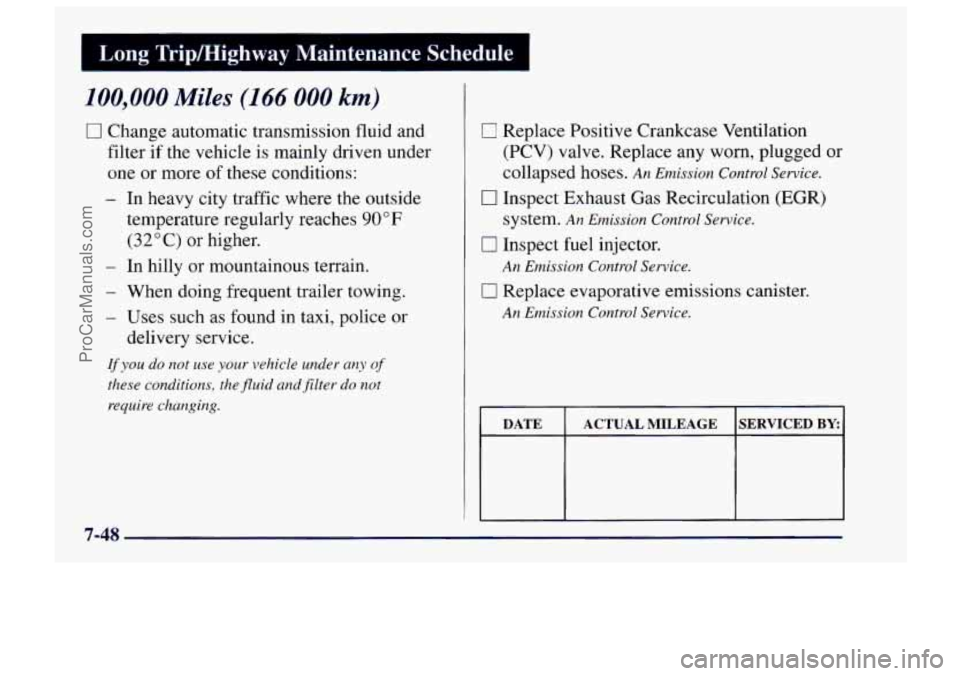
Long Tripmighway Maintenance Schedule I
100,000 Miles (1 66 000 km)
0 Change automatic transmission fluid and
filter if the vehicle is mainly driven under
one or more
of these conditions:
- In heavy city traffic where the outside
temperature regularly reaches
90 O F
(32°C) or higher.
- In hilly or mountainous terrain.
- When doing frequent trailer towing.
- Uses such as found in taxi, police or
delivery service.
lfyo~l do not use your vehicle under any of
these conditions, the.fZuid and filter do not
require changing.
0 Replace Positive Crankcase Ventilation
(PCV) valve. Replace any worn, plugged or
collapsed hoses.
An Emission Control Service.
17 Inspect Exhaust Gas Recirculation (EGR)
0 Inspect fuel injector.
0 Replace evaporative emissions canister.
system.
An Emission Control Service.
An Emission
Control Service.
An Emission Control Service.
DATE
SERVICED BY ACTUAL MILEAGE
7-48
ProCarManuals.com
Page 352 of 388
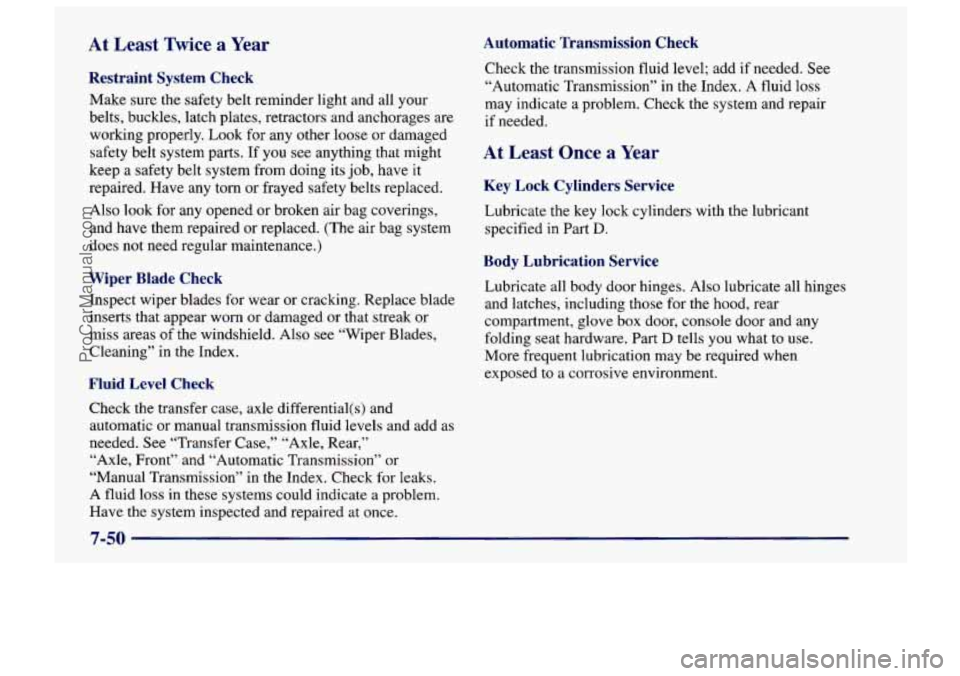
At Least Twice a Year Automatic Transmission Check
Restraint System Check
Make sure the safety belt reminder light and all your
belts, buckles, latch plates, retractors and anchorages are
working properly.
Look for any other loose or damaged
safety belt system parts. If you see anything that might
keep a safety belt system from doing its job, have it
repaired. Have any torn or frayed safety belts replaced.
Also look for any opened or broken air bag coverings,
and have them repaired or replaced. (The air bag system
does not need regular maintenance.)
Wiper Blade Check
Inspect wiper blades for wear or cracking. Replace blade
inserts that appear worn
or damaged or that streak or
miss areas of the windshield. Also
see “Wiper Blades,
Cleaning”
in the Index.
Fluid Level Check
Check the transfer case, axle differential(s) and
automatic or manual transmission fluid levels and add as
needed. See “Transfer Case,” “Axle, Rear,”
“Axle, Front” and “Automatic Transmission” or
“Manual Transmission”
in the Index. Check for leaks.
A fluid loss in these systems could indicate a problem.
Have the system inspected and repaired at once. Check
the transmission fluid level; add if needed. See
“Automatic Transmission” in the Index. A fluid
loss
may indicate a problem. Check the system and repair
if needed.
At Least Once a Year
Key Lock Cylinders Service
Lubricate the key lock cylinders with the lubricant
specified in Part
D.
Body Lubrication Service
Lubricate all body door hinges. Also lubricate all hinges
and latches, including those for the hood, rear
compartment, glove box door, console door and any
folding seat hardware. Part
D tells you what to use.
More frequent lubrication may be required when
exposed to a corrosive environment.
7-50
ProCarManuals.com