fuel CHEVROLET TRACKER 1997 Owner's Manual
[x] Cancel search | Manufacturer: CHEVROLET, Model Year: 1997, Model line: TRACKER, Model: CHEVROLET TRACKER 1997Pages: 388, PDF Size: 20.12 MB
Page 243 of 388
Fuels in Foreign Countries
If you plan on driving in another country outside the
United States
or Canada, the proper fuel may be hard to
find. Never use leaded gasoline or any other fuel not
recommended in the previous text on fuel. Costly repairs
caused by use of improper fuel wouldn’t be covered by
your warranty.
To check on fuel availability, ask an auto club, or
contact a major
oil company that does business in the
country where you’ll
be driving.
You can also write
us at the following address for
advice. Just tell
us where you’re going and give your
Vehicle Identification Number (VIN).
General Motors International Product Center
1908 Colonel Sam Drive
Oshawa, Ontario
LlH 8P7
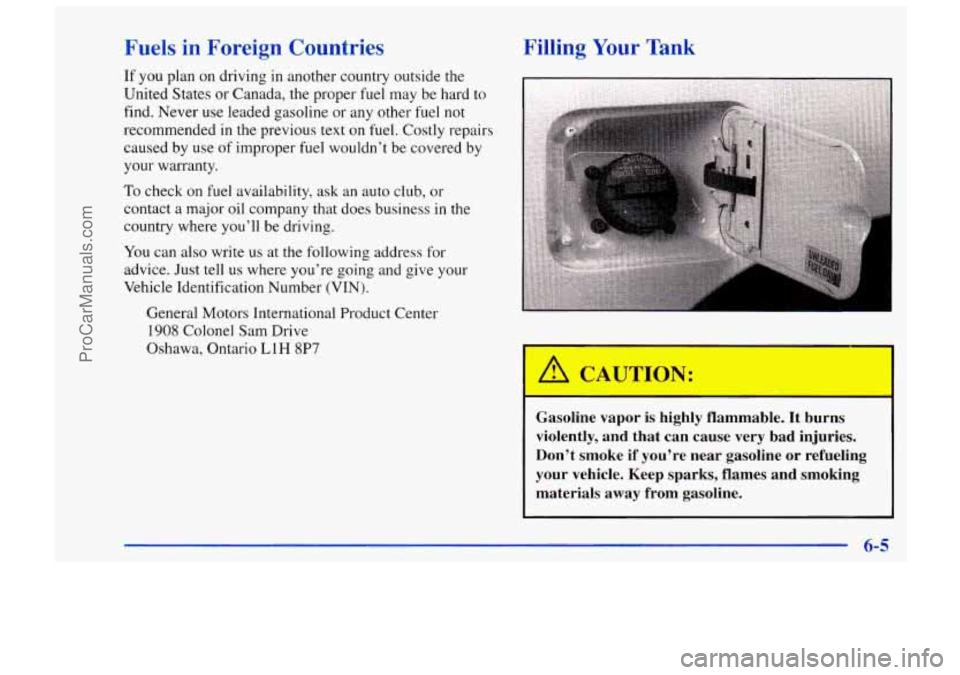
Filling Your Tank
W
Gasoline vapor is highly flammable. It burns
violently, and that can cause very bad injuries.
Don’t smoke if you’re near gasoline
or refueling
your vehicle. Keep sparks, flames and smoking materials away
from gasoline.
6-5
ProCarManuals.com
Page 244 of 388
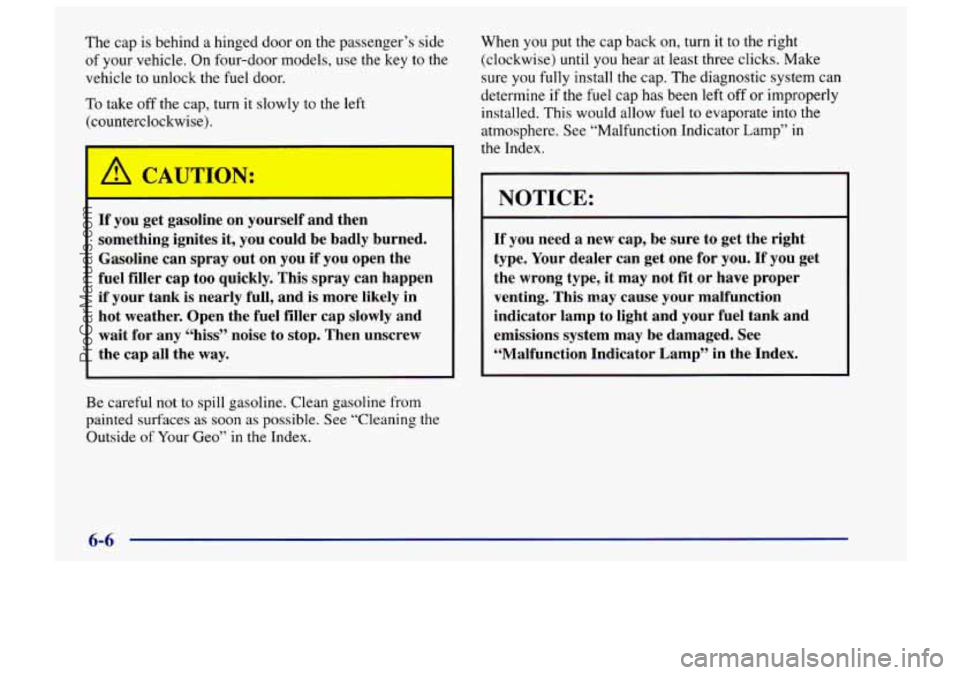
The cap is behind a hinged door on the passenger’s side
of your vehicle. On four-door models, use the key to the
vehicle to unlock the
fuel door.
To take off the cap, turn it slowly
to the left
(counterclockwise).
1 /1 CAUTION:
If you get gasoline on yourself and then
something ignites it, you could be badly burned.
Gasoline can spray out on you
if you open the
fuel filler cap
too quickly. This spray can happen
if your tank is nearly full, and is more likely in
hot weather. Open the fuel filler cap slowly and
wait for any “hiss” noise
to stop. Then unscrew
the cap all the
way.
Be careful not to spill gasoline. Clean gasoline from
painted surfaces
as soon as possible. See “Cleaning the
Outside of Your Geo”
in the Index. When you
put the cap back on, turn it to the right
(clockwise)
until you hear at least three clicks. Make
sure you
fully install the cap. The diagnostic system can
determine
if the fuel cap has been left off or improperly
installed. This would allow fuel to evaporate into the
atmosphere. See “Malfunction Indicator Lamp”
in
the Index.
I
NOTICE:
If you need a new cap, be sure to get the right
type. Your dealer can get one for you. If you get
the wrong type, it may not fit or have proper
venting. This may cause
your malfunction
indicator lamp to light and your fuel tank and
emissions system may be damaged. See
“Malfunction Indicator Lamp” in the Index.
6-6
ProCarManuals.com
Page 248 of 388
Before closing the hood, be sure all the filler caps
are on.
Then lift the hood to relieve pressure
on the hood prop.
Remove the hood prop from the slot in the hood and
return the prop to its retainer. Then let the hood down
and close it firmly.
Engine Oil
If the engine oil pressure
light
on the instrument
panel comes on, it means
you need to check your
engine oil
level right away.
For more information, see “Engine Oil Pressure Light”
in the Index. You should check your engine oil level
regularly; this is an added reminder. It’s
a good idea
to check your engine oil every time you
get fuel. In order
to get an accurate reading, the oil must
be warm and
the vehicle must be on level ground.
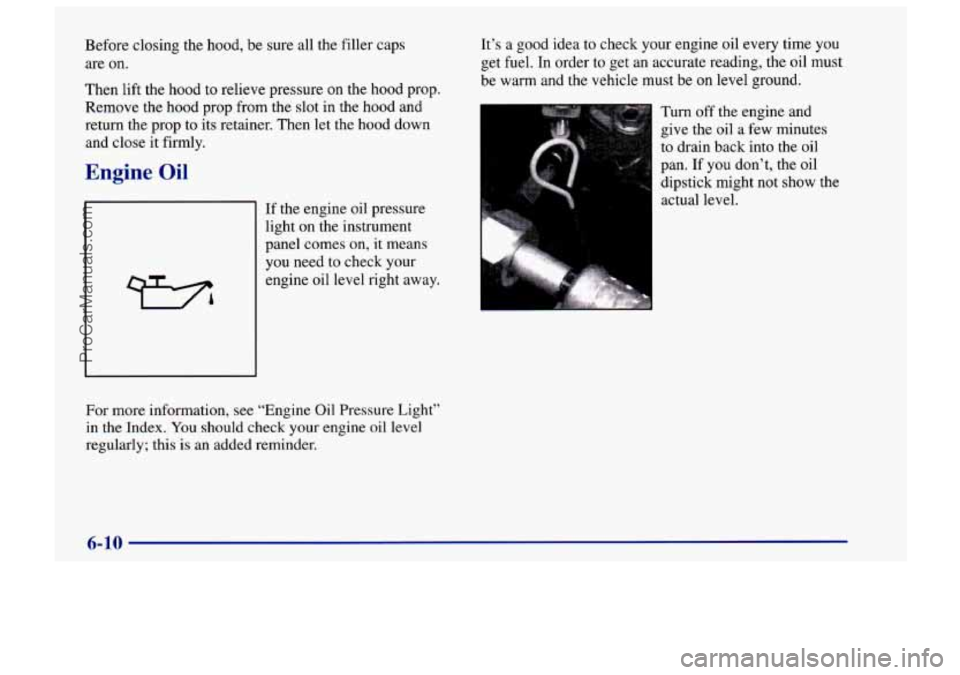
Turn off the engine and
give the oil a few minutes
to drain back into the oil
pan. If
you don’t, the oil
dipstick might not show the
actual level.
6-10
ProCarManuals.com
Page 250 of 388
What Kind of Oil to Use
Oils recommended for your vehicle can be identified by
looking for the “Starburst” symbol. This symbol
indicates that the oil has been certified by the American
Petroleum Institute (API).
Do not use any oil which
does not carry this Starburst symbol.
I:
If you change your
own oil, be sure you
use oil that has the
Starburst symbol on
the front of the oil
container. If you have
your oil changed for
you, be sure the oil put
into your engine is
American Petroleum
I J
Institute certified for
gasoline engines.
~~~ ~~~~~~
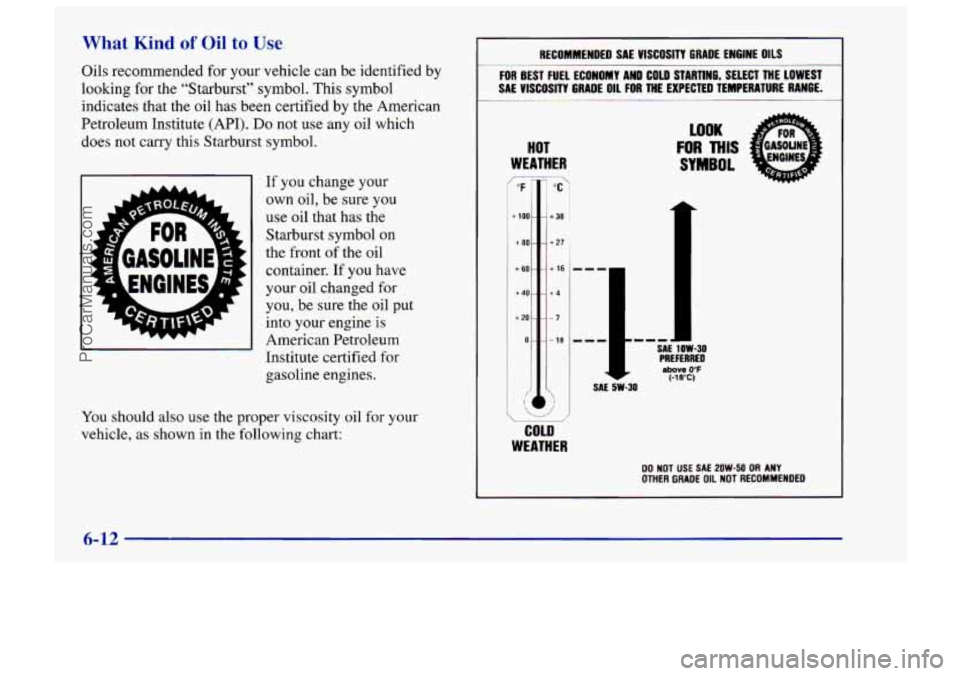
You should also use the proper viscosity oil for your
vehicle, as shown in the following chart:
RECOMMENDED SAE VISCOSITY GRADE ENGINE OILS
FOR BEST FUEL ECONOMY AND COLD STARTING, SELECT THE LOWEST
SAE VISCOSITY GRADE OIL
FOR THE EXPECTED TEMPERATURE RANGE. -
HOT
WEATHER
“F
t 100
+ ao
+ 60
+ 40.
+ 20.
0-
t3a ~
+ 27
+ 16
t4
-7
- 18
SAE 5W-30
LOOK
FOR MIS
SYMBOL
above 0°F (’1 WC)
WEATHER
00 NOT USE SAE 2OW-50 OR ANY OTHER GRADE OIL NOT RECOMMENDED
6-12
ProCarManuals.com
Page 279 of 388
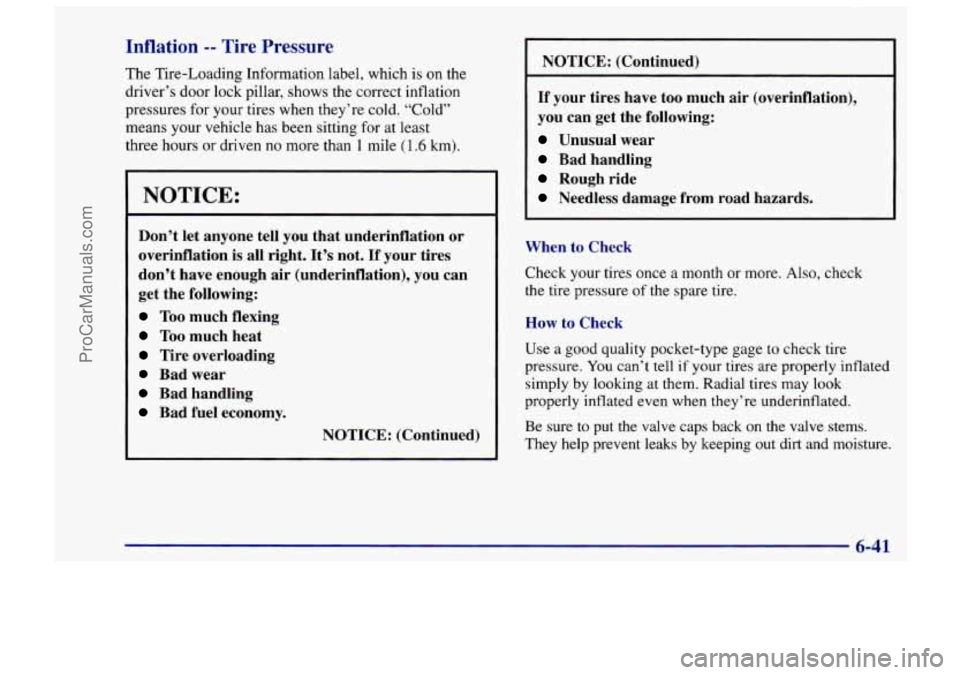
Inflation -- Tire Pressure
The Tire-Loading Information label, which is on the
driver’s door lock pillar, shows
the correct inflation
pressures for your tires when they’re cold. “Cold”
means your vehicle has been sitting for at least
three hours or driven
no more than 1 mile ( 1.6 km).
I NOTICE:
Don’t let anyone tell you that underinflation or
overinflation is all right. It’s not.
If your tires
don’t have enough air (underinflation), you can
get the following:
Too much flexing
Too much heat
Tire overloading
Bad wear
Bad handling
Bad fuel economy.
NOTICE: (Continued) NOTICE:
(Continued)
If your tires have too much air (overinflation),
you can get the following:
Unusual wear
Bad handling
Rough ride
Needless damage from road hazards.
When to Check
Check your tires once a month or more. Also, check
the tire pressure of the spare tire.
How to Check
Use a good quality pocket-type gage to check tire
pressure. You can’t tell
if your tires are properly inflated
simply by looking at them. Radial tires may look
properly inflated even when they’re underinflated.
Be sure to put the valve caps back on the valve stems.
They help prevent leaks by keeping out dirt and moisture.
6-4 1
ProCarManuals.com
Page 294 of 388
Finish Damage
Any stone chips, fractures or deep scratches in the finish
should be repaired right away. Bare metal will corrode
quickly and may develop into a major repair expense.
Minor chips and scratches can be repaired
with touch-up
materials available from your dealer or other service
outlets. Larger areas
of finish damage can be corrected
in your dealer’s body and paint shop.
Underbody Maintenance
Chemicals used for ice and snow removal and dust
control can collect on the underbody.
If these are not
removed, accelerated corrosion (rust) can occur
on
the underbody parts such as fuel lines, frame, floor
pan and exhaust system even though they have
corrosion protection.
At least every spring,
flush these materials from the
underbody wi.th plain water. Clean any areas where mud
and other debris can collect. Dirt packed
in closed areas
of the frame should be loosened before being flushed.
Your dealer or an underbody car washing system can
do this for you.
Chemical Paint Spotting
Some weather and atmospheric conditions can create
a chemical fallout. Airborne pollutants can fall upon
and attack painted surfaces on your vehicle.
This
damage can take two forms: blotchy, ringlet-shaped
discolorations, and small irregular dark spots etched
into
the paint surface.
Although
no defect in the paint job causes this, Geo
will repair, at no charge to the owner, the surfaces
of
new vehicles damaged by this fallout condition within
12 months or 12,000 miles
(20 000 km) of purchase,
whichever occurs first.
6-56
ProCarManuals.com
Page 299 of 388
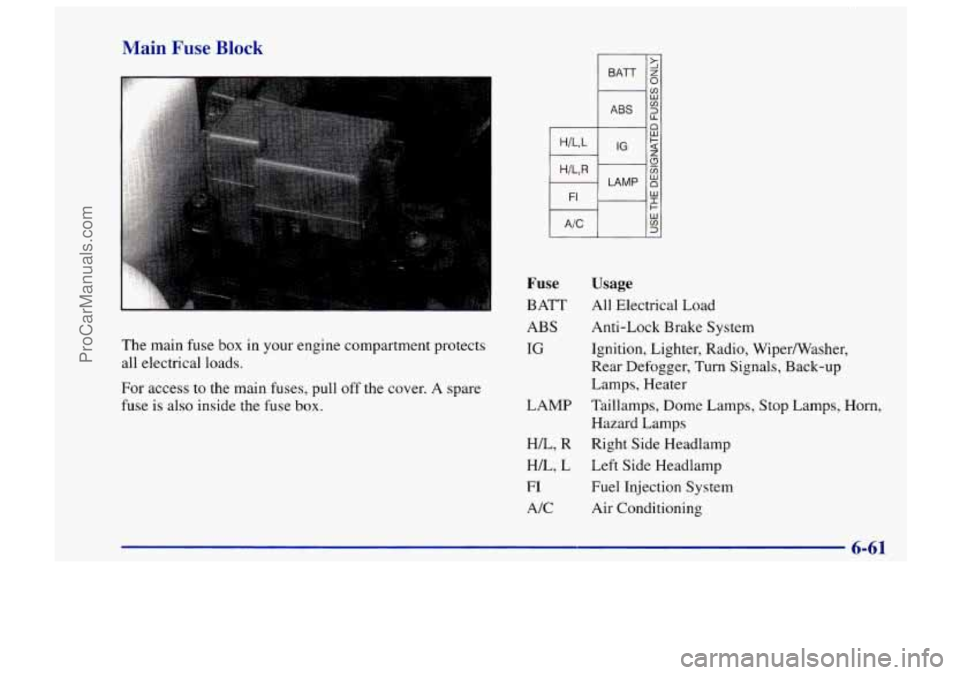
Main Fuse Block
The main fuse box in your engine compartment protects
all electrical loads.
For access
to the main fuses, pull off the cover. A spare
fuse
is also inside the fuse box.
Fuse
BATT
ABS
IG
LAMP
H/L,
R
H/L, L
FI
AIC
Usage
All Electrical Load
Anti-Lock Brake System
Ignition, Lighter, Radio, Wipermasher,
Rear Defogger, Turn Signals, Back-up
Lamps, Heater
Taillamps, Dome Lamps, Stop Lamps, Horn,
Hazard Lamps
Right Side Headlamp
Left Side Headlamp
Fuel Injection System
Air Conditioning
6-61
ProCarManuals.com
Page 300 of 388
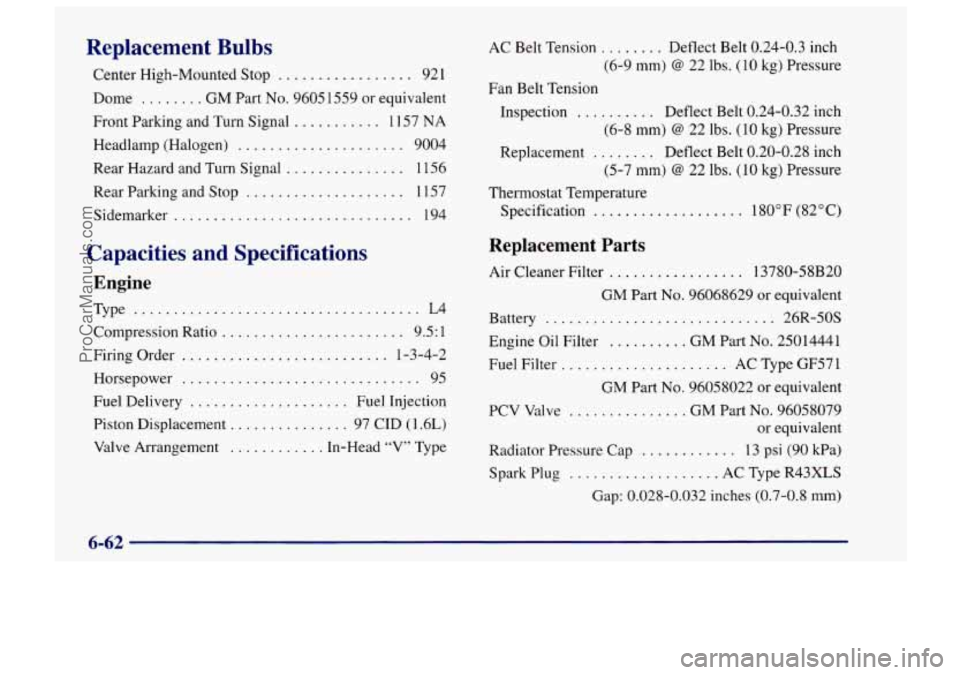
Replacement Bulbs
Center High-Mounted Stop ................. 921
Dome
........ GM Part No. 96051559 or equivalent
Front Parking and Turn Signal
........... 11 57 NA
Headlamp (Halogen) ..................... 9004
Rear Hazard and Turn Signal
............... 1156
Rear Parking and Stop
.................... 1157
Sidemarker
.............................. 194
Capacities and
Engine
Type ............
Specifications
........................ L4
Compression Ratio ....................... 9.5: 1
Firing Order
.......................... 1-3-4-2
Horsepower
.............................. 95
Fuel Delivery .................... Fuel Injection
Piston Displacement
............... 97 CTD (1.6L)
Valve Arrangement
............ In-Head “V” Type AC
Belt Tension
........ Deflect Belt 0.24-0.3 inch
(6-9 mm)
@ 22 lbs. (10 kg) Pressure
Fan Belt Tension
Inspection
.......... Deflect Belt 0.24-0.32 inch
(6-8 mm)
@ 22 lbs. (10 kg) Pressure
Replacement
........ Deflect Belt 0.20-0.28 inch
(5-7 mm)
@ 22 lbs. (10 kg) Pressure
Specification
................... 180” F (82 O C)
Thermostat Temperature
Replacement Parts
Air Cleaner Filter ................. 13780-58k20
GM Part No. 96068629 or equivalent
Battery
....... .................... 26R-50s
Engine
Oil Filter .......... GM Part No. 25014441
Fuel Filter
..................... AC Type GF571
GM Part No. 96058022 or equivalent
PCV Valve
............... GM Part No. 96058079
or equivalent
Radiator Pressure Cap
............ 13 psi (90 kPa)
Spark Plug
................... AC Type R43XLS
Gap: 0.028-0.032 inches
(0.7-0.8 mm)
ProCarManuals.com
Page 301 of 388
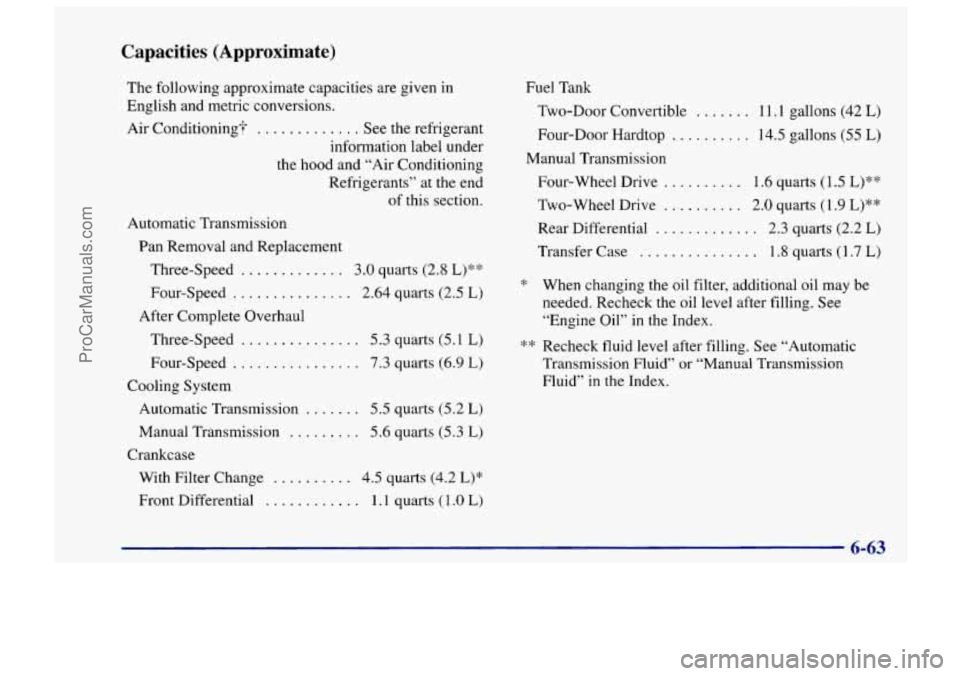
Capacities (Approximate)
The following approximate capacities are given in
English and metric conversions.
Air Conditioning?
............. See the refrigerant
information label under
the hood and “Air Conditioning
Refrigerants” at the end
of this section.
Automatic Transmission
Pan Removal and Replacement Three-Speed
............. 3.0 quarts (2.8 L)**
Four-Speed ............... 2.64 quarts (2.5 L)
After Complete Overhaul
Three-Speed
............... 5.3 quarts (5.1 L)
Four-Speed ................ 7.3 quarts (6.9 L)
Cooling System
Automatic Transmission
....... 5.5 quarts (5.2 L)
Manual Transmission ......... 5.6 quarts (5.3 L)
Crankcase With Filter Change
.......... 4.5 quarts (4.2 L)*
Front Differential ............ 1.1 quarts (1 .O L)
Fuel Tank
Two-Door Convertible
....... 11.1 gallons (42 L)
Four-Door Hardtop .......... 14.5 gallons (55 L)
Manual Transmission
Four-wheel Drive
.......... 1.6 quarts (1.5 L)**
Two-Wheel Drive .......... 2.0 quarts (1.9 L)**
Rear Differential ............. 2.3 quarts (2.2 L)
Transfer Case ............... 1.8 quarts (1.7 L)
* When changing the oil filter, additional oil may be
needed. Recheck the oil level after filling. See
“Engine Oil” in the Index.
** Recheck fluid level after filling. See “Automatic
Transmission Fluid” or “Manual Transmission
Fluid” in
the Index.
6-63
ProCarManuals.com
Page 303 of 388
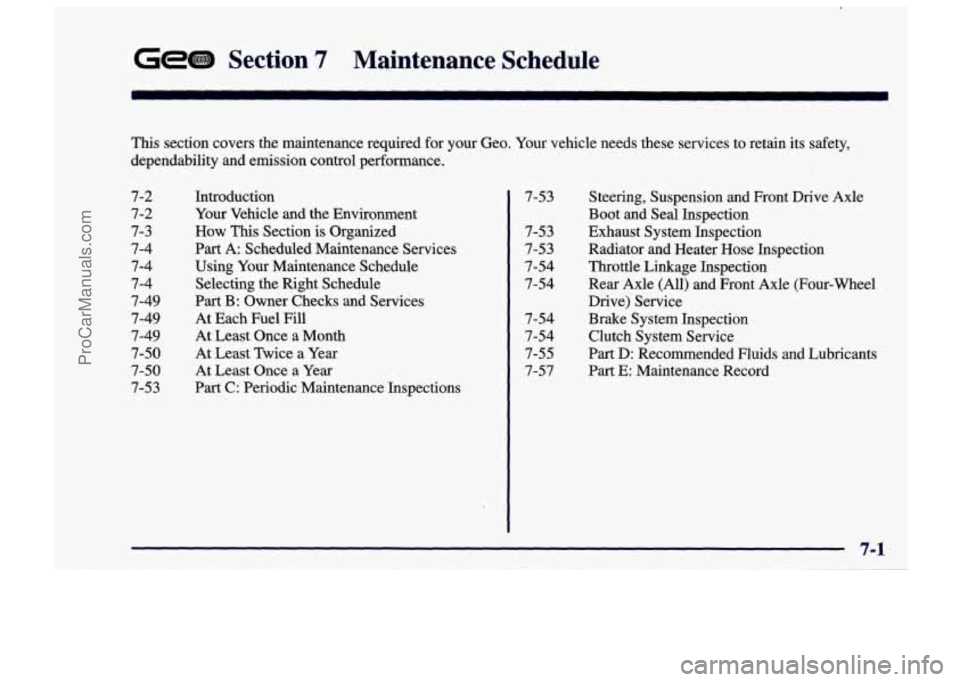
GeGS Section 7 Maintenance Schedule
This section covers the maintenance required for your Geo. Your vehicle needs these services to retain its safety,
dependability and emission control performance.
7-2
7-2
7-3
7-4 7-4
7-4
7-49 7-49
7-49
7-50
7-50
7-53
Introduction Your Vehicle and the Environment
How This Section is Organized
Part A: Scheduled Maintenance Services
Using Your Maintenance Schedule
Selecting the Right Schedule
Part B: Owner Checks and Services
At Each Fuel Fill
At Least Once a Month
At Least Twice
a Year
At Least Once a Year
Part C: Periodic Maintenance Inspections
7-53
7-53
7-53
7-54
7-54
7-54
7-54
7-55
7-57
Steering, Suspension and Front Drive Axle
Boot and Seal Inspection
Exhaust System Inspection
Radiator and Heater Hose Inspection
Throttle Linkage Inspection Rear Axle (All) and Front Axle (Four-wheel
Drive) Service
Brake System Inspection
Clutch System Service
Part D: Recommended Fluids and Lubricants
Part E: Maintenance Record
7-1
ProCarManuals.com