belt CHEVROLET TRACKER 1997 Owner's Guide
[x] Cancel search | Manufacturer: CHEVROLET, Model Year: 1997, Model line: TRACKER, Model: CHEVROLET TRACKER 1997Pages: 388, PDF Size: 20.12 MB
Page 46 of 388
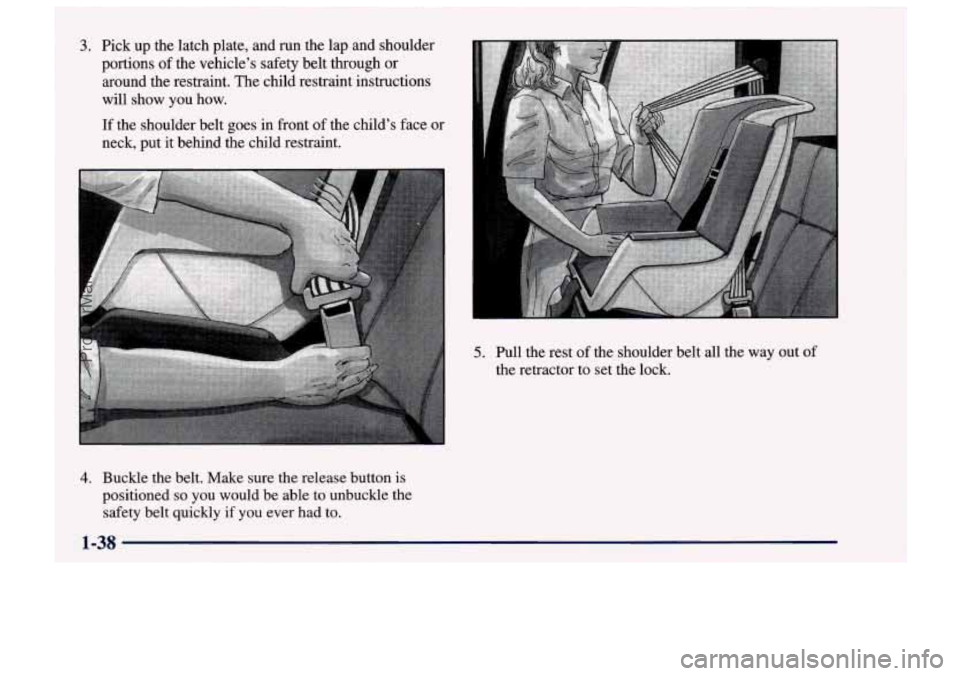
3. Pick up the latch plate, and run the lap and shoulder
portions
of the vehicle’s safety belt through or
around the restraint. The child restraint instructions
will show you how.
If the shoulder belt goes in front of the child’s face or
neck, put it behind the child restraint.
4. Buckle the belt. Make sure the release button is
positioned
so you would be able to unbuckle the
safety belt quickly if
you ever had to.
5. Pull the rest of the shoulder belt all the way out of
the retractor to set the lock.
1-38
ProCarManuals.com
Page 47 of 388
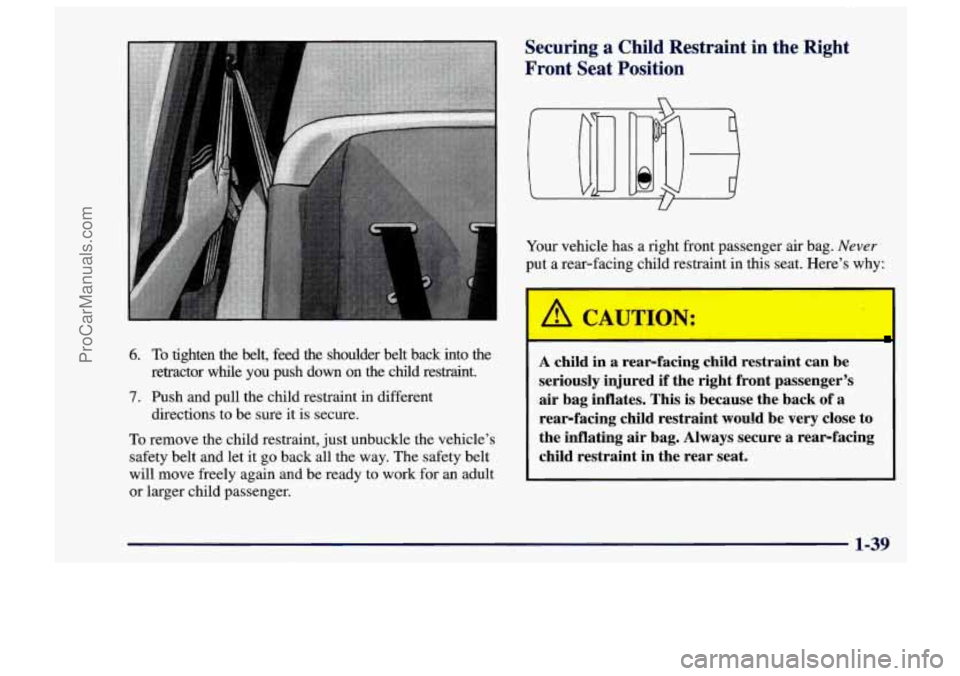
6. To tighten the belt, feed the shoulder belt back into the
retractor while you push down on the child restraint.
7. Push and pull the child restraint in different
directions to be sure it is secure.
To remove the child restraint, just unbuckle the vehicle’s
safety belt and let it go back all the way. The safety belt
will move freely again and be ready
to work for an adult
or larger child passenger.
Securing a Child Restraint in the Right
Front Seat Position
Your vehicle has a right front passenger air bag. Never
put a rear-facing child restraint in this seat. Here’s why:
I A CAUTION:
A child in a rearfacing child restraint can be
seriously injured if the right front passenger’s
air bag inflates. This is because the back of a
rearfacing child restraint would be very close to
the inflating air bag. Always secure a rear-facing
child restraint in the rear seat.
1-39
ProCarManuals.com
Page 48 of 388
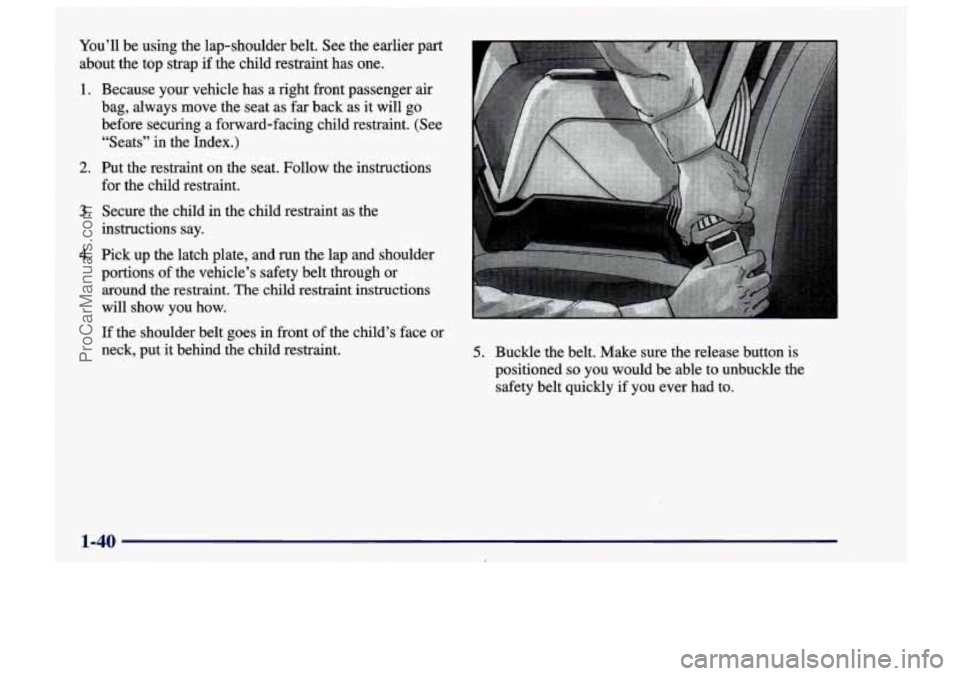
You’ll be using the lap-shoulder belt. See the earlier part
about the top strap
if the child restraint has one.
1.
2.
3.
4.
Because your vehicle has a right front passenger air
bag, always move the seat as far back as it will go
before securing a forward-facing child restraint. (See
“Seats” in the Index.)
Put the restraint on the seat. Follow the instructions
for the child restraint.
Secure the child in the child restraint as the
instructions say.
Pick up the latch plate, and run the lap and shoulder
portions of the vehicle’s safety belt through or
around the restraint. The child restraint instructions
will show
you how.
If the shoulder belt goes in front of the child’s face or
neck, put it behind the child restraint.
5. Buckle the belt. Make sure the release button is
positioned
so you would be able to unbuckle the
safety belt quickly
if you ever had to.
ProCarManuals.com
Page 49 of 388
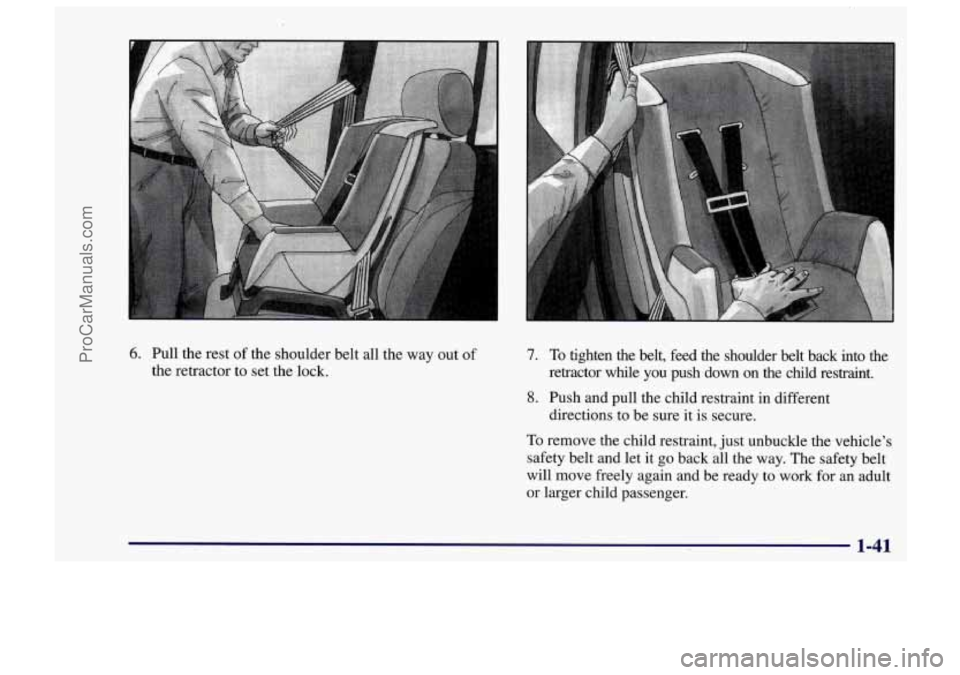
6. Pull the rest of the shoulder belt all the way out of
the retractor to set the lock. 7. To tighten the belt, feed the shoulder belt back into the
retractor while you push down on the child restraint.
8. Push and pull the child restraint in different
directions to be sure it is secure.
To remove the child restraint, just unbuckle the vehicle’s
safety belt and let it go back all the way. The safety belt
will move freely again and be ready to work for an adult
or larger child passenger.
1-41
ProCarManuals.com
Page 50 of 388
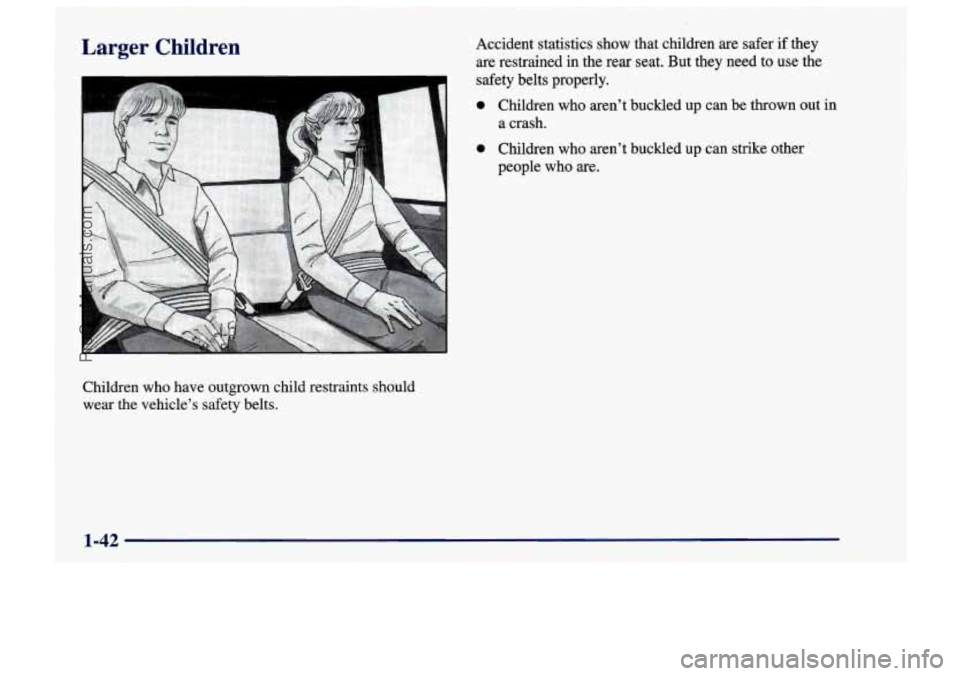
Larger Children
Children who have outgrown child restraints should
wear the vehicle’s safety belts. Accident
statistics show that children are safer
if they
are restrained
in the rear seat. But they need to use the
safety belts properly.
0 Children who aren’t buckled up can be thrown out in
0 Children who aren’t buckled up can strike other
a
crash.
people who are.
ProCarManuals.com
Page 51 of 388
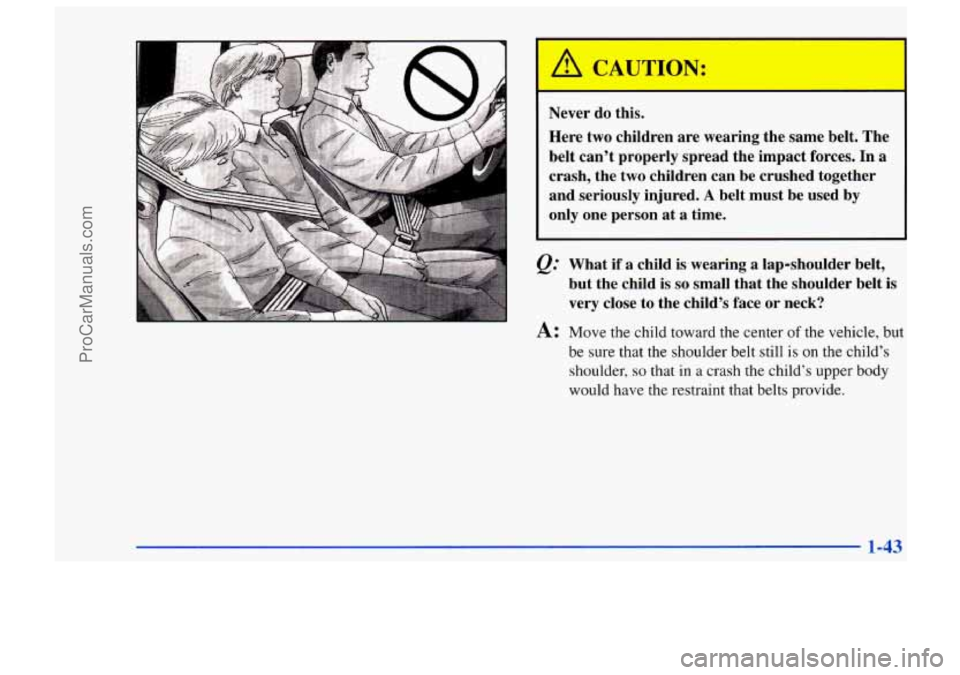
A CAUTION:
Never do this.
Here two children are wearing the same belt. The
belt can’t properly spread the impact forces. In a
crash, the two children can be crushed together
and seriously injured.
A belt must be used by
only one person
at a time.
A:
What if a child is wearing a lap-shoulder belt,
but the child is
so small that the shoulder belt is
very close to the child’s face or neck?
Move the child toward the center of the vehicle, but
be sure that the shoulder
belt still is on the child’s
shoulder, so that in
a crash the child’s upper body
would have the restraint that belts provide.
1-43
ProCarManuals.com
Page 52 of 388
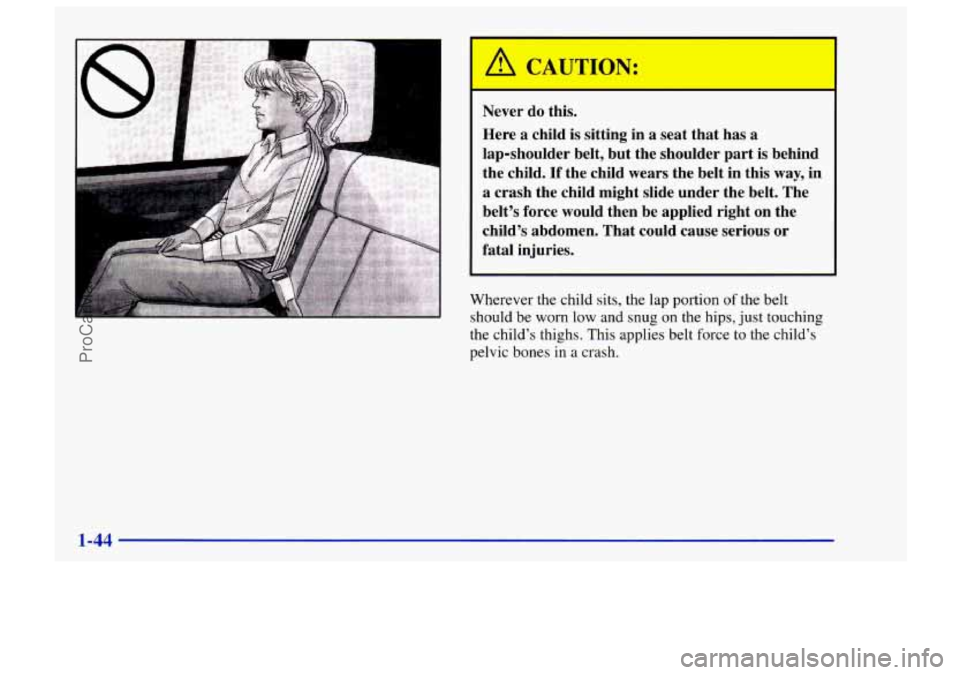
I A CAUTION:
Never do this.
Here a child is sitting in
a seat that has a
lap-shoulder belt, but the shoulder part is behind
the child.
If the child wears the belt in this way, in
a crash the child might slide under the belt. The
belt’s force would then be applied right on the
child’s abdomen. That could cause serious or
fatal injuries.
Wherever the child sits, the lap portion of the belt
should be worn low and snug on the hips, just touching
the child’s thighs. This applies belt force
to the child’s
pelvic bones in
a crash.
1-44
ProCarManuals.com
Page 53 of 388
Safety Belt Extender
If the vehicle’s safety belt will fasten around you, you
should use it.
But if
a safety belt isn’t long enough to fasten, your
dealer will order you an extender. It’s free. When you go
in to order it, take the heaviest coat you will wear, so the
extender will be long enough for you. The extender will
be just for you, and just for the seat in your vehicle that
you choose. Don’t let someone else use it, and use
it
only for the seat it is made to fit. To wear it, just attach it
to the regular safety belt.
Checking Your Restraint Systems
Now and then, make sure the safety belt reminder light
and all your belts, buckles, latch plates, retractors and
anchorages are working properly. Look for any other
loose or damaged safety belt system parts. If you see
anything that might keep a safety belt system from
doing its job, have it repaired.
Tom or frayed safety belts may not protect you in a
crash. They can rip apart under impact forces. If a belt is
torn or frayed, get a new
one right away.
Also look for any opened or broken air bag covers, and
have them repaired or replaced. (The air bag system
does not need regular maintenance.)
1-45
ProCarManuals.com
Page 54 of 388
Replacing Restraint System Parts
After a Crash
If you’ve had a crash, do you need new belts?
After a very minor collision, nothing may be necessary.
But if the belts were stretched, as they would be if worn
during a more severe crash, then you need new belts.
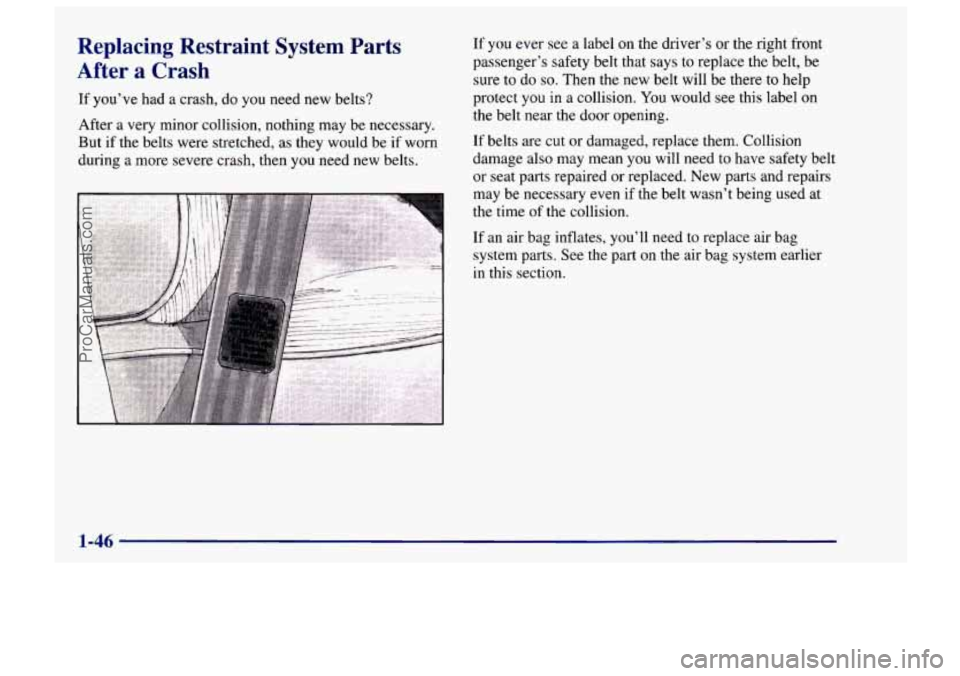
If you ever see a label on the driver’s or the right front
passenger’s safety belt that says to replace the belt, be
sure to do
so. Then the new belt will be there to help
protect you in a collision. You would see
this label on
the belt near the door opening.
If belts are cut or damaged, replace them. Collision
damage also may mean you will need to have safety belt
or seat parts repaired or replaced. New parts and repairs
may be necessary even if the belt wasn’t being used at
-
the time of the collision.
If an air bag inflates, you’ll need to replace air bag
system parts. See the part on the air bag system ear
in this section. tlier
1-46
ProCarManuals.com
Page 57 of 388
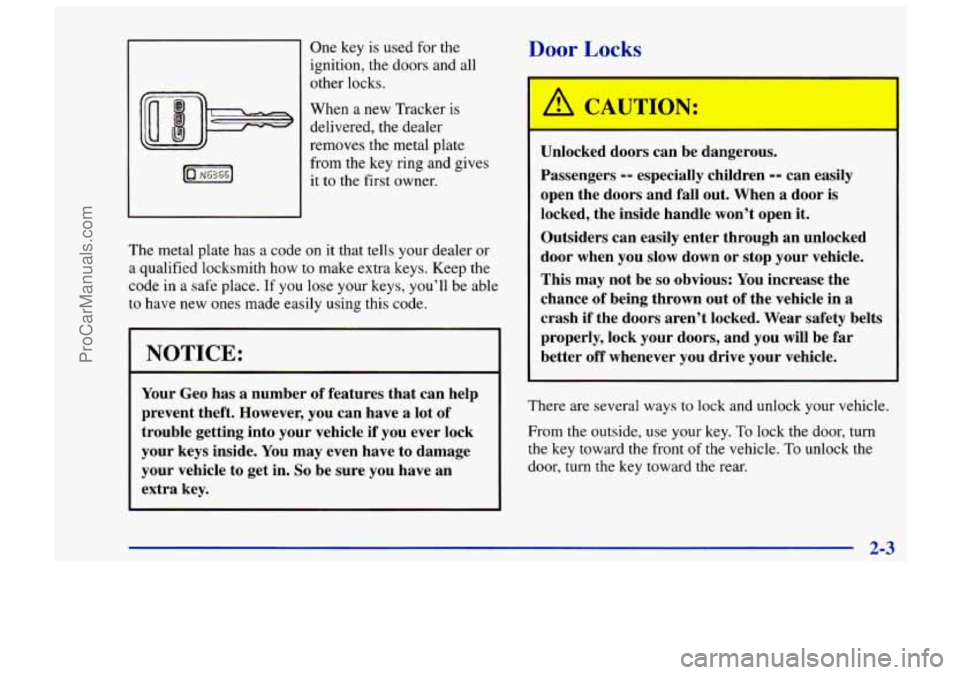
One key is used for the
ignition, the doors and all
other locks.
When
a new Tracker is
delivered, the dealer
removes the metal plate
from the key ring and gives
it
to the first owner.
The metal plate has a code on it that tells your dealer or
a qualified locksmith how to make extra keys. Keep the
code in a safe place. If you lose your keys,
you’ll be able
to have new ones made easily using this code.
NOTICE:
Your Geo has a number of features that can help
prevent theft. However, you can have a lot of
trouble getting into your vehicle if you ever lock
your keys inside. You may even have to damage
your vehicle to get in.
So be sure you have an
extra key.
Door Locks
Unlocked doors can be dangerous.
Passengers
-9 especially children 9- can easily
open the doors and fall out. When a door is
locked, the inside handle won’t open it.
Outsiders can easily enter through an unlocked
door when you slow down or stop your vehicle.
This may not be
so obvious: You increase the
chance of being thrown out of the vehicle in a
crash if the doors aren’t locked. Wear safety belts
properly, lock your doors, and you will be
far
better off whenever you drive your vehicle.
There are several ways to lock and unlock your vehicle.
From the outside,
use your key. To lock the door, turn
the key toward the front
of the vehicle. To unlock the
door, turn the key toward the rear.
2-3
ProCarManuals.com