brake light CHEVROLET TRACKER 1997 Owners Manual
[x] Cancel search | Manufacturer: CHEVROLET, Model Year: 1997, Model line: TRACKER, Model: CHEVROLET TRACKER 1997Pages: 388, PDF Size: 20.12 MB
Page 8 of 388
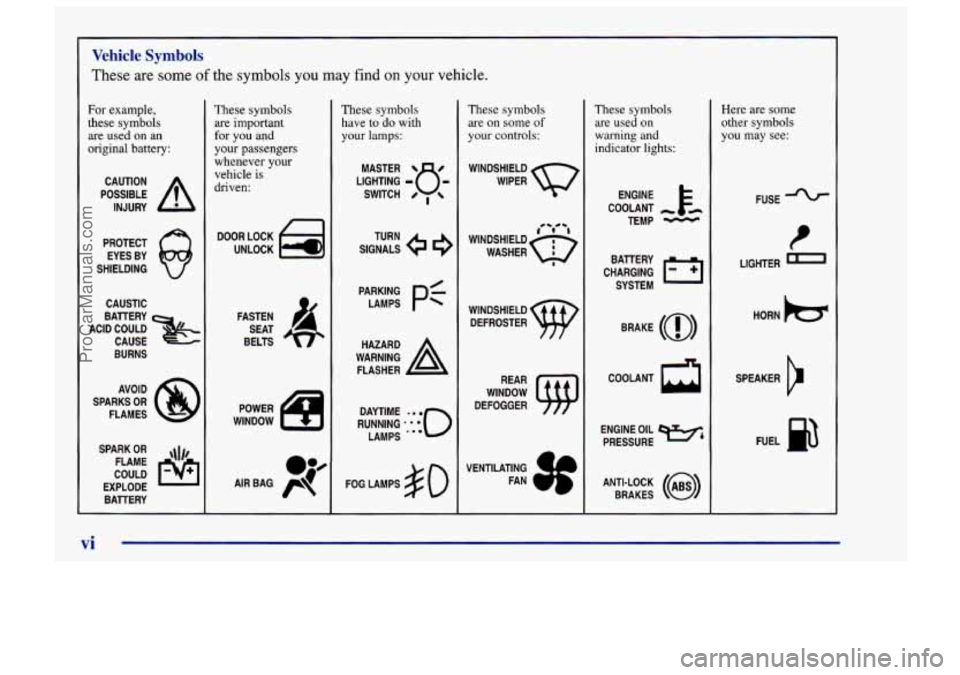
Vehicle Symbols
These are some of the symbols you may find on your vehicle.
For example,
these symbols
are used
on an
original battery:
POSSIBLE A
CAUTION
INJURY
PROTECT EYES BY
SHIELDING
CAUSTIC
ACID COULD CAUSE
BA~ERY
BURNS
AVOID
SPARKS
OR
FLAMES
SPARK
OR ,\I/,
COULD FLAME
EXPLODE BATTERY
These symbols
are important
for you and
your passengers
whenever your
vehicle
is
driven:
DOOR LOCK
UNLOCK
FASTEN SEAT
BELTS
POWER
WINDOW
These symbols have
to do with
your lamps:
SIGNALS 9
TURN
FOG LAMPS
3 0
These symbols
are on some
of
your controls:
WINDSHIELD
WIPER
WINDSHIELD DEFROSTER
WINDOW
DEFOGGER
VENTILATING FAN
These symbols are used on
warning and
indicator lights:
COOLANT -
TEMP -
CHARGING I-1
BAllERY
SYSTEM
BRAKE
(a)
ENGINE OIL e,
PRESSURE
ANTI-LOCK
(@)
BRAKES
Here are some
other symbols
you may see:
FUSE
LIGHTER
D
HORN )tr
SPEAKER
b
FUEL Ja
vi
ProCarManuals.com
Page 55 of 388
Gem Section 2 Features and Controls
Here you can learn about the many standard and optional features on your Geo, and information on starting, shifting
and braking. Also explained
are the instrument panel and the warning systems that tell you if everything is working
properly
-- and what to do if you have a problem.
2-2
2-3
2-5
2-6
2-7 2-7
2-9
2-10
2- 14
2-
17
2-2 I
2-23
2-25
Keys
Door Locks
Tailgate
Theft
New Vehicle ‘Break-In”
Ignition Positions Starting Your Engine
Automatic Transmission Operation
Manual Transmission
Four-wheel Drive Parking Brake
Shifting Into PARK (P) (Automatic
Transmission Models Only)
Shifting Out of PARK (P)
(Automatic Transmission)
2-26 Parking Over Things That Burn
2-27
2-27
2-28
2-29
2-29
2-37
2-3
8
2-39
2-4 1
2-43
2-44
2-44
2-5
8
2-60 2-62
Engine Exhaust
Running Your Engine While You’re Parked
(Automatic Transmission)
Windows
Horn
Turn SignaVMultifunction Lever
Exterior Lamps
Interior Lamps
Mirrors Storage Compartments
Ashtrays and Lighter
Sun Visors
Convertible Top
Instrument Panel
Instrument Panel Cluster
Warning Lights, Gages and Indicators
2-1
ProCarManuals.com
Page 75 of 388
Remember that driving in FOUR-WHEEL HIGH (4H)
or FOUR-WHEEL LOW (4L) may reduce fuel
economy. Also, driving in four-wheel drive on dry
pavement could cause your tires to wear faster and make
your transfer case harder to shift.
You can shift from TWO-WHEEL HIGH (2H) to
FOUR-WHEEL HIGH
(4H) or from FOUR-WHEEL
HIGH (4H) to TWO-WHEEL HIGH (2H) at any speed
if your hubs are locked and your wheels are straight
ahead. Your front axle will engage faster if you take
your foot off the accelerator pedal for a few seconds as
you shift.
Shifting Into or Out of FOUR-WHEEL LOW (4L)
1. Stop your vehicle and shift your transmission to
NEUTRAL (N).
2. Shift the transfer case in one continuous motion.
Don’t pause in NEUTRAL
(N) as you shift into
FOUR-WHEEL
HIGH (4H), or your gears could clash.
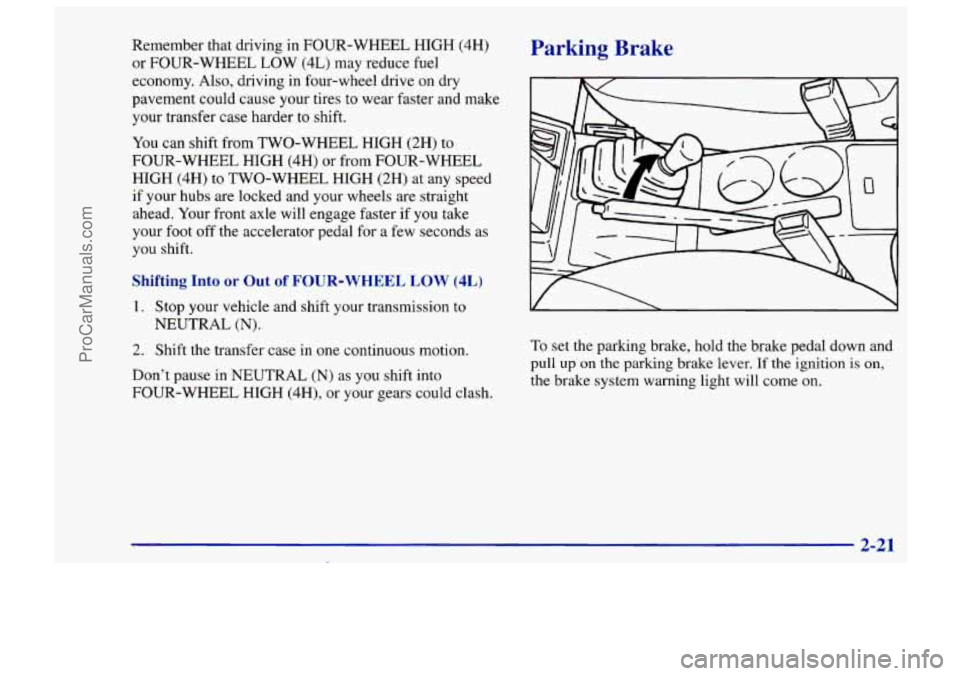
To set the parking brake, hold the brake pedal down and
pull
up on the parking brake lever. If the ignition is on,
the brake system warning light will come on.
2-21
ProCarManuals.com
Page 91 of 388
Passing Another Vehicle While Using Cruise Control
Use the accelerator pedal to increase your speed. When
you take your foot off the pedal, your vehicle will slow
down to the cruise control speed you set earlier.
Using Cruise Control on Hills
How well your cruise control will work on hills depends
upon your speed, load and the steepness
of the hills.
When going up steep hills, you may have to step on the
accelerator pedal to maintain your speed. When going
downhill, you may have to brake or shift to a lower gear
to keep your speed down. Of course, applying the brake
takes you out
of cruise control. Many drivers find this to
be too much trouble and don’t use cruise control on
steep hills.
Getting Out of Cruise Control
There are three ways to turn off cruise control:
Step lightly on the brake pedal, or push the clutch
pedal if you have a manual transmission.
Push in the CANCEL button on the end of the cruise
control lever.
Press OFF on the cruise control switch.
Erasing Speed Memory
When you turn off the cruise control or the ignition,
your cruise control set speed memory is erased.
Exterior Lamps
Daytime Running Lamps
Daytime Running Lamps (DRL) can make it easier for
others to see the front of your vehicle during the day.
DRL can be helpful in many different driving
conditions, but they can be especially helpful in the
short periods after dawn and before sunset.
The
DRL system will make your low-beam headlamps
come
on at a reduced brightness when:
The ignition is on,
0 The headlamp switch is off, and
0 The parking brake is released.
2-37
ProCarManuals.com
Page 92 of 388
When you turn on the headlamp switch, your DRL will
go out, and your headlamps will come on.
The other lamps that come
on with your headlamps will
also come on.
When you turn off the headlamp switch, the regular
lamps will go off, and your low-beam headlamps will
come on at the reduced brightness of
DRL.
To idle your vehicle with the DRL off, set the parking
brake. The
DRL will stay off until you release the
parking brake.
As with any vehicle, you should turn on the regular
headlamp system when you need it.
Interior Lamps
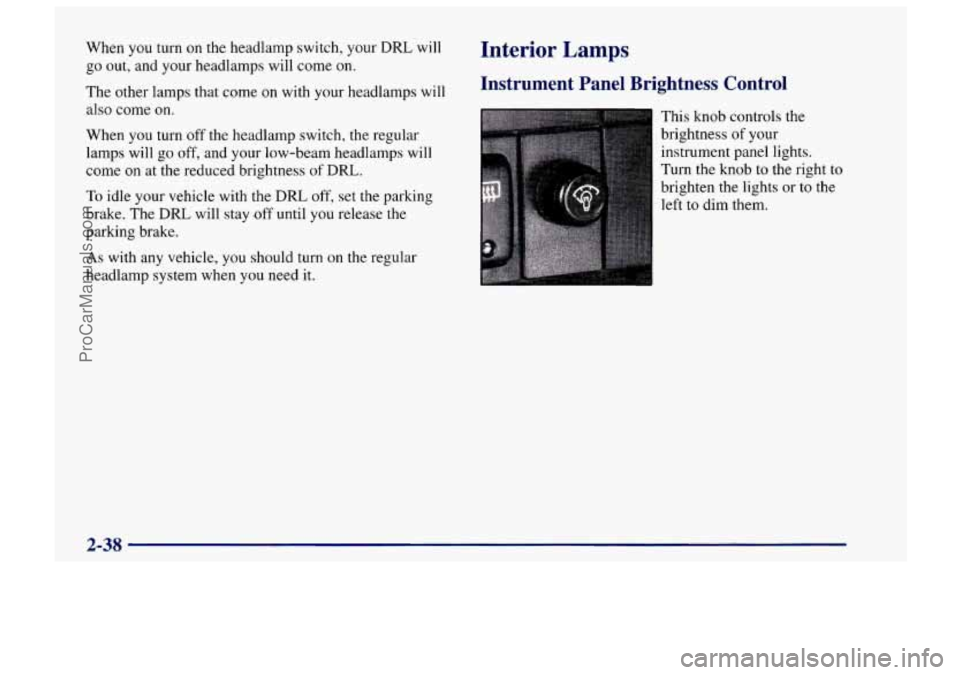
Instrument Panel Brightness Control
This knob controls the
brightness of your
instrument panel lights.
Turn the knob to the right to
brighten the lights or to the
left to dim them.
2-38
ProCarManuals.com
Page 113 of 388
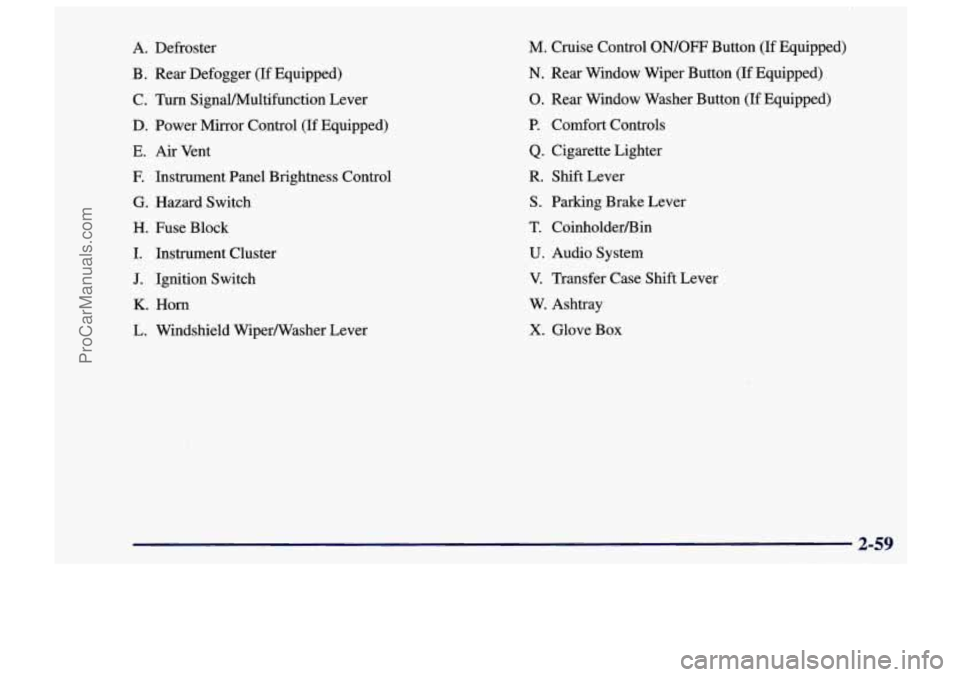
A. Defroster
B. Rear Defogger (If Equipped)
C. Turn SignaYMultifunction Lever
D. Power Mirror Control
(If Equipped)
E.
Air Vent
E Instrument Panel Brightness Control
G. Hazard Switch
H. Fuse Block
I. Instrument Cluster
J. Ignition Switch
K. Horn
L. Windshield Wipermasher Lever
M. Cruise Control ON/OFF Button (If Equipped)
N. Rear Window Wiper Button (If Equipped)
0. Rear Window Washer Button (If Equipped)
P. Comfort Controls
Q. Cigarette Lighter
R. Shift Lever
S. Parking Brake Lever
T. CoinholderlBin
U. Audio System
V. Transfer Case Shift Lever
W. Ashtray
X. Glove Box
2-59
ProCarManuals.com
Page 118 of 388
_-- ~~~~~
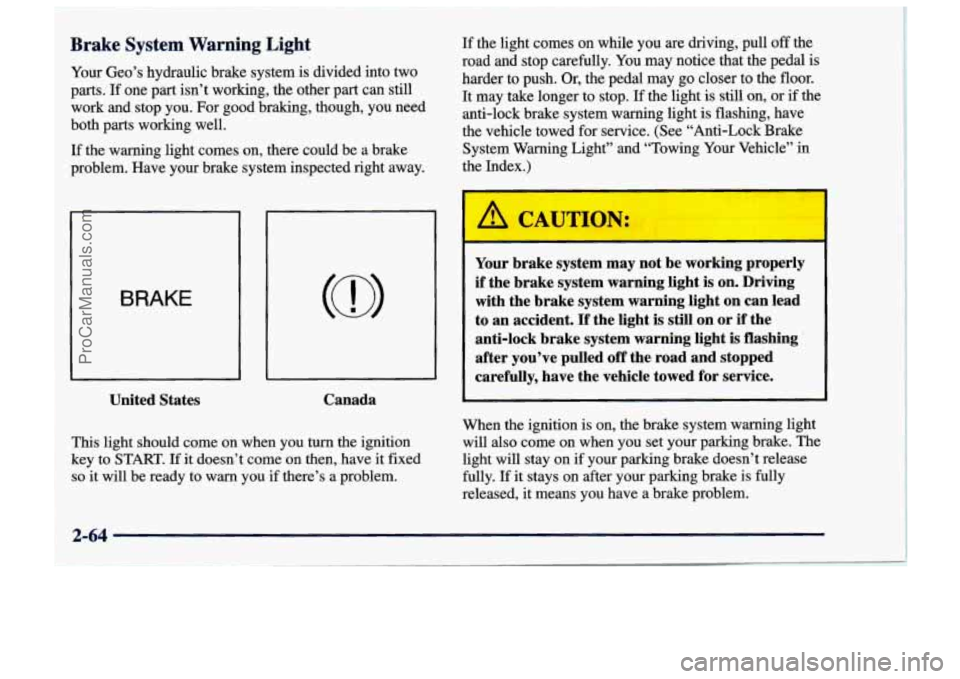
Brake System Warning Light
Your Geo’s hydraulic brake system is divided into two
parts.
If one part isn’t working, the other part can still
work and stop you. For good braking, though, you need
both parts working well.
If the warning light comes on, there could be a brake
problem. Have your brake system inspected right away.
If the light comes on while you are driving, pull off the
road and stop carefully. You may notice that the pedal
is
harder to push. Or, the pedal may go closer to the floor.
It may take longer to stop. If the light is still on, or if the
anti-lock brake system warning light is flashing, have
the vehicle towed for service. (See “Anti-Lock Brake
System Warning Light” and “Towing Your Vehicle” in
the Index.)
BRAKE
United States Canada
This light
should come on when you turn the ignition
key to STmT. If it doesn.’t come on then, have it fixed
so it will be ready to warn you if there’s a problem.
Ih
CA -JTION:
Your brake system may not be working properly
if the brake system warning light is on. Driving
with the brake system warning light on can lead
to an accident.
If the light is still on or if the
anti-lock brake system warning light is flashing
after you’ve pulled
off the road and stopped
carefully, have the vehicle towed for service.
When the ignition is on, the brake system warning light
will
also come on when you set your parking brake. The
light will stay on if your parking brake doesn’t release
fully. If it stays on after your parking brake is fully
released, it means you have
a brake problem.
r
2-64
ProCarManuals.com
Page 119 of 388
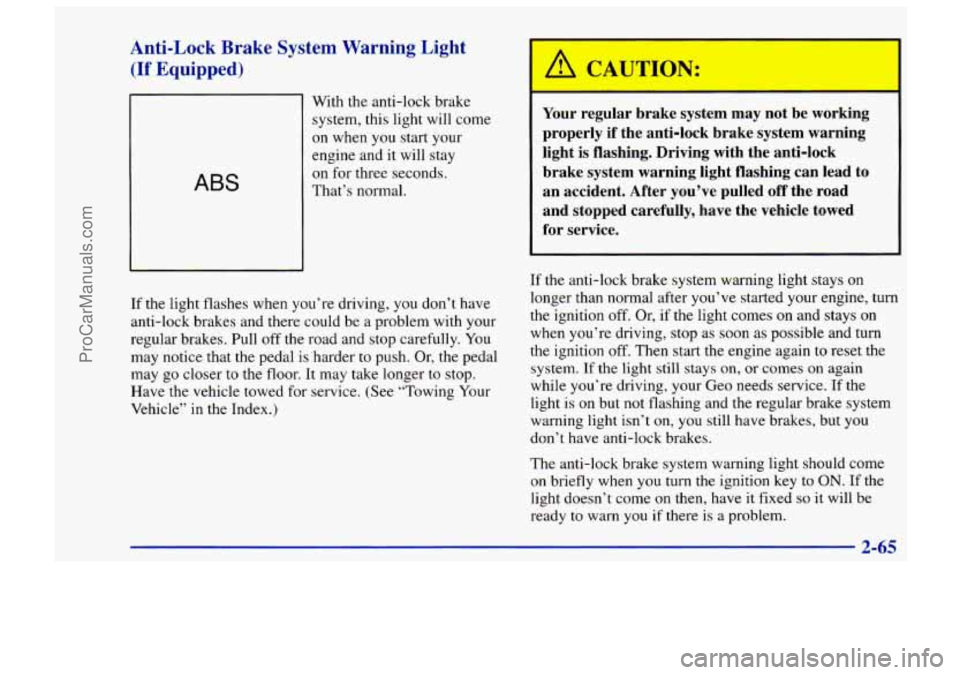
Anti-Lock Brake System Warning Light
(If Equipped)
ABS
With the anti-lock brake
system, this light will come
on when you start your
engine and it will stay
on for three seconds.
That’s normal.
If the light flashes when you’re driving, you don’t have
anti-lock brakes and there could be a problem with your
regular brakes. Pull
off the road and stop carefully. You
may notice that the pedal
is harder to push. Or, the pedal
may go closer to the floor.
It may take longer to stop.
Have the vehicle towed for service. (See “Towing Your
Vehicle” in the Index.)
A CAUTION:
Your regular brake system may not be working
properly if the anti-lock brake system warning
light is flashing. Driving with the anti-lock
brake system warning light flashing can lead to an accident. After you’ve pulled off the road
and stopped carefully, have the vehicle towed
for service.
If the anti-lock brake system warning light stays on
longer than normal after you’ve started your engine, turn
the ignition off. Or, if the light comes on and stays on
when you’re driving, stop as
soon as possible and turn
the ignition off. Then
start the engine again to reset the
system.
If the light still stays on, or comes on again
while you’re driving, your Geo needs service. If the
light is on but not flashing and the regular brake system
warning light isn’t on,
you still have brakes, but you
don’t have anti-lock brakes.
The anti-lock brake system warning light should come
on briefly when you turn the ignition key to
ON. If the
light doesn’t come
on then, have it fixed so it will be
ready to warn
you if there is a problem.
2-65
!
ProCarManuals.com
Page 120 of 388
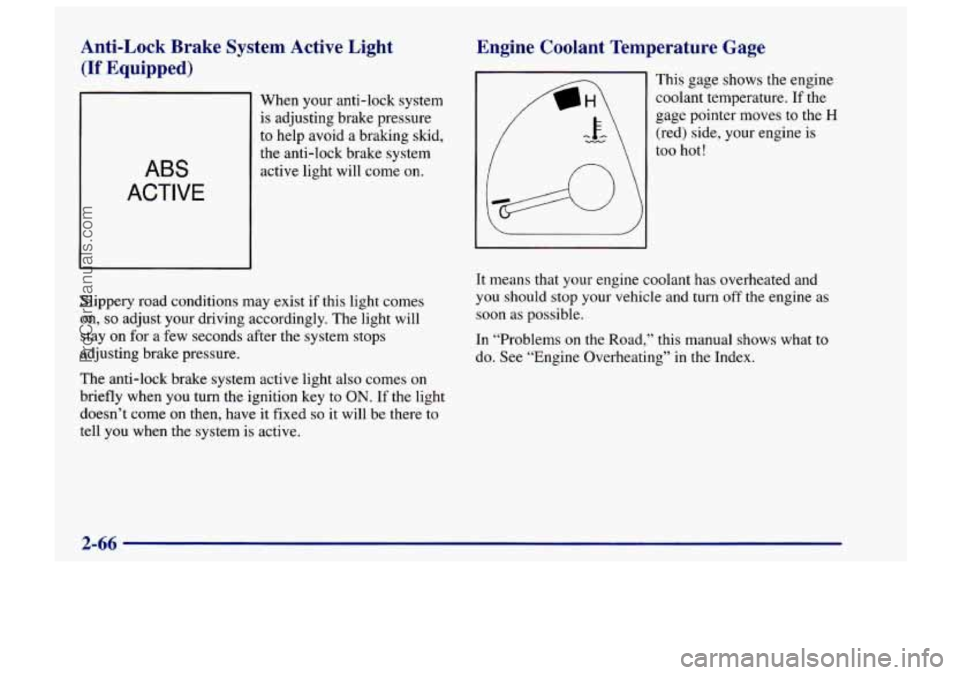
Anti-Lock Brake System Active Light
(If Equipped)
ABS
ACTIVE
Engine Coolant Temperature Gage
When your anti-lock system
is adjusting brake pressure
to help avoid a braking skid,
the anti-lock brake system
active light will come on.
Slippery road conditions may exist if this light comes
on,
so adjust your driving accordingly. The light will
stay on for a few seconds after the system stops
adjusting brake pressure.
The anti-lock brake system active light also comes on
briefly when you turn the ignition key
to ON. If the light
doesn’t come on then, have it fixed
so it will be there to
tell you when the system
is active. This
gage shows the engine
coolant temperature. If the
gage pointer moves to the
H
(red) side, your engine is
too hot!
It means that your engine coolant has overheated and
you should
stop your vehicle and turn off the engine as
soon as possible.
In “Problems on the Road,” this manual shows what to
do. See “Engine Overheating” in the Index.
2-66
ProCarManuals.com
Page 153 of 388
Avoid needless heavy braking. Some people drive in
spurts
-- heavy acceleration followed by heavy
braking
-- rather than keeping pace with traffic. This is a
mistake. Your brakes may not have time to cool between
hard stops. Your brakes will wear
out much faster if you
do
a lot of heavy braking. If you keep pace with the
traffic and allow realistic following distances,
you will
eliminate a lot
of unnecessary braking. That means
better braking and longer brake life,
If your engine ever stops while you’re driving, brake
normally but don’t pump your brakes. If you do, the
pedal may get harder
to push down. If your engine
stops, you will still have some power brake assist. But
you will use it when
you brake. Once the power assist is
used up,
it may take longer to stop and the brake pedal
will be harder to push.
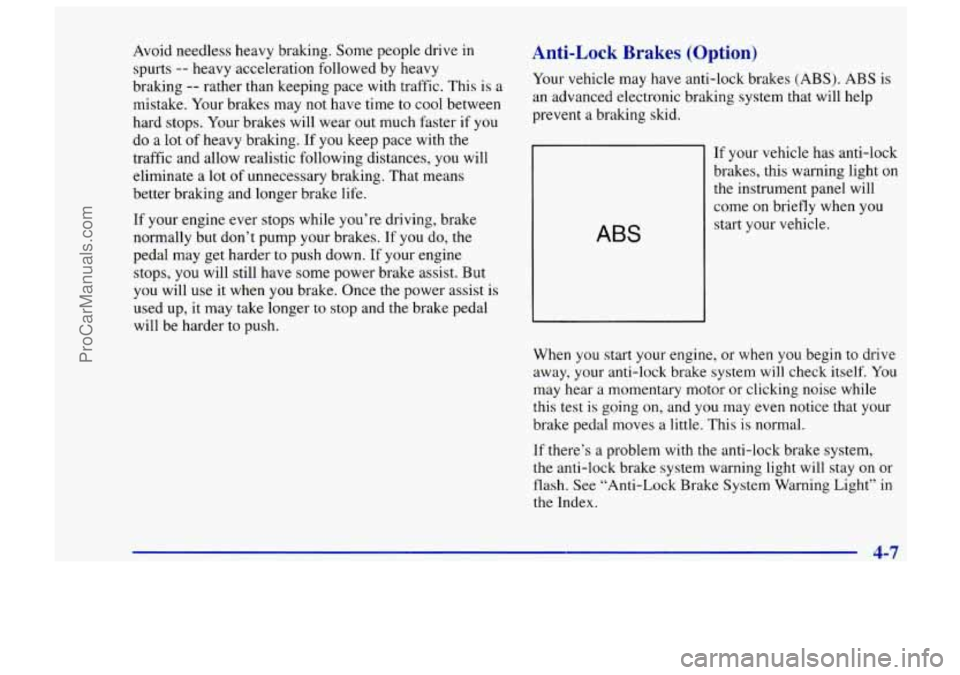
Anti-Lock Brakes (Option)
Your vehicle may have anti-lock brakes (ABS). ABS is
an advanced electronic braking system that will help
prevent a braking skid.
ABS
If your vehicle has anti-lock
brakes, this warning light on
the instrument panel will
come on briefly when you
start your vehicle.
When you start your engine,
or when you begin to drive
away, your anti-lock brake system will check itself.
You
may hear a momentary motor or clicking noise while
this test is going on, and you may even notice that your
brake pedal moves a little. This is normal.
If there’s a problem with the anti-lock brake system,
the anti-lock brake system warning light will stay on or
flash. See “Anti-Lock Brake System Warning Light” in
the Index.
4-7
I
ProCarManuals.com