radiator cap CHEVROLET TRACKER 1997 Owners Manual
[x] Cancel search | Manufacturer: CHEVROLET, Model Year: 1997, Model line: TRACKER, Model: CHEVROLET TRACKER 1997Pages: 388, PDF Size: 20.12 MB
Page 217 of 388
Cooling System
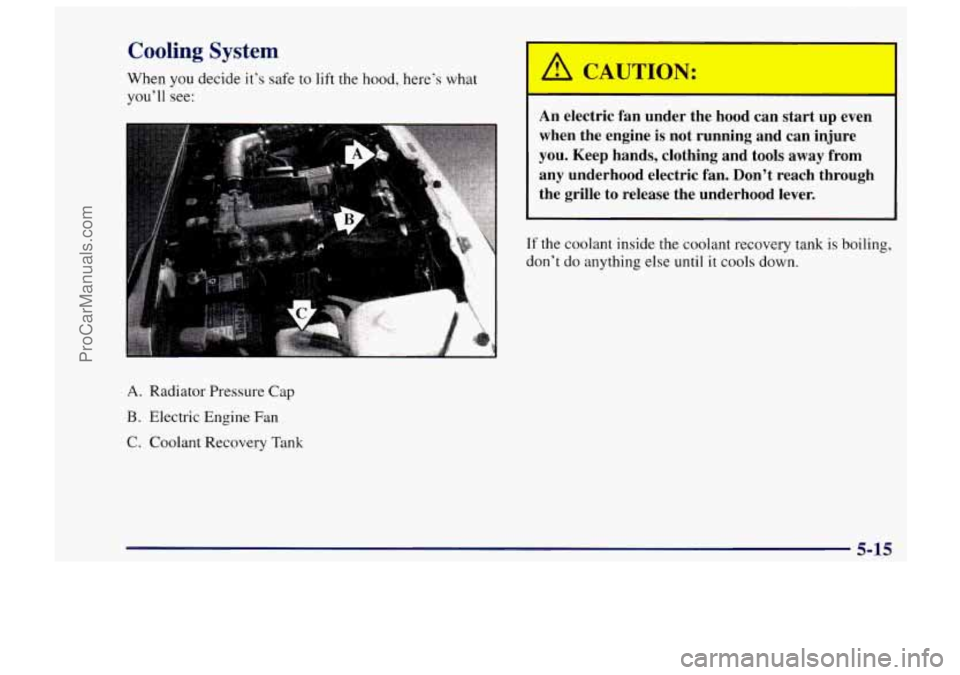
When you decide it’s safe to lift the hood, here‘s what
you’ll see:
A. Radiator Pressure Cap
B. Electric Engine Fan
C. Coolant Recovery Tank
5-15
I
ProCarManuals.com
Page 221 of 388
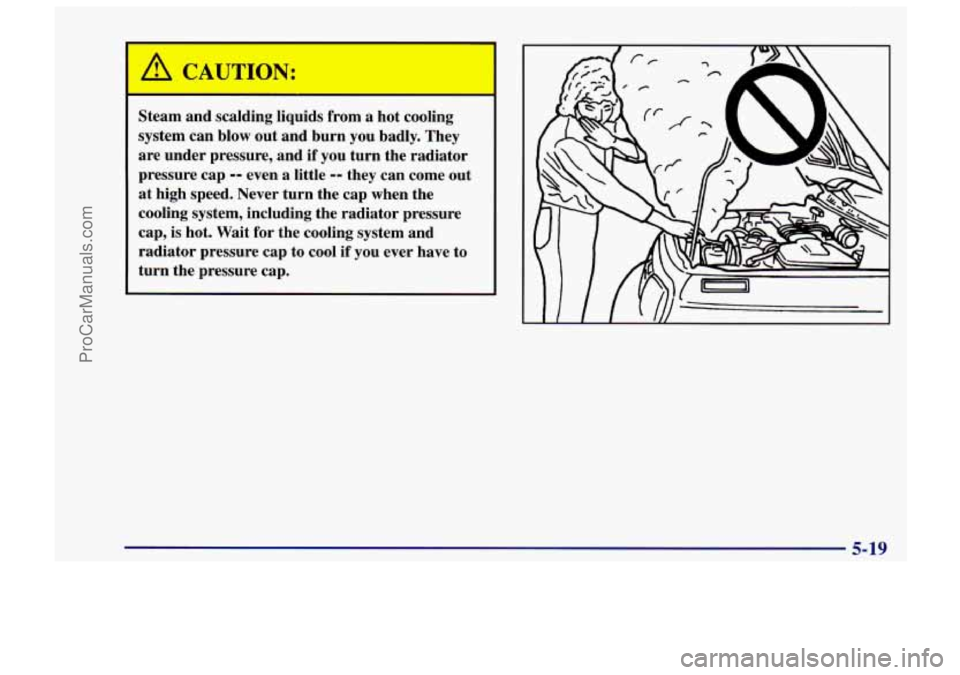
Steam and scalding liquids from a hot cooling
system can blow out and burn you badly. They
are under pressure, and if you turn the radiator
pressure cap
-- even a little -- they can come out
at high speed. Never turn the cap when the
cooling system, including the radiator pressure
cap,
is hot. Wait for the cooling system and
radiator pressure cap to cool
if you ever have to
turn the pressure cap.
5-19
I
ProCarManuals.com
Page 222 of 388
How to Add Coolant to the Radiator
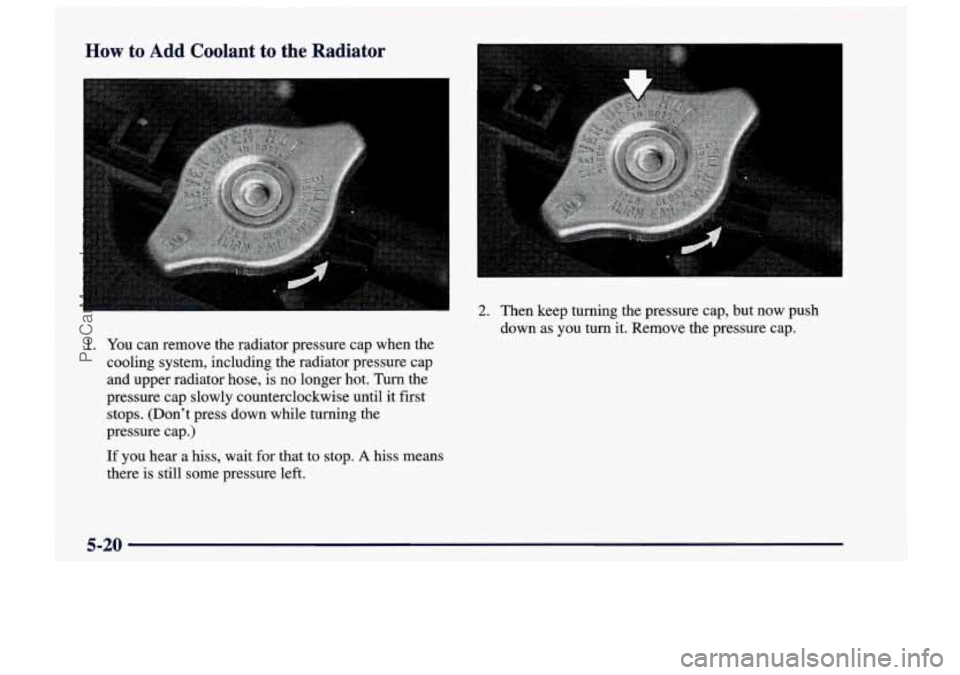
2. Then keep turning the pressure cap, but now push
down as you turn it. Remove the pressure cap.
1. You can remove the radiator pressure cap when the
cooling system, including the radiator pressure cap
and upper radiator hose, is no longer hot.
Turn the
pressure cap slowly counterclockwise until it first
stops. (Don’t press down while turning the
pressure cap.)
If you hear a
hiss, wait for that to stop. A hiss means
there is still some pressure left.
5-20
ProCarManuals.com
Page 223 of 388
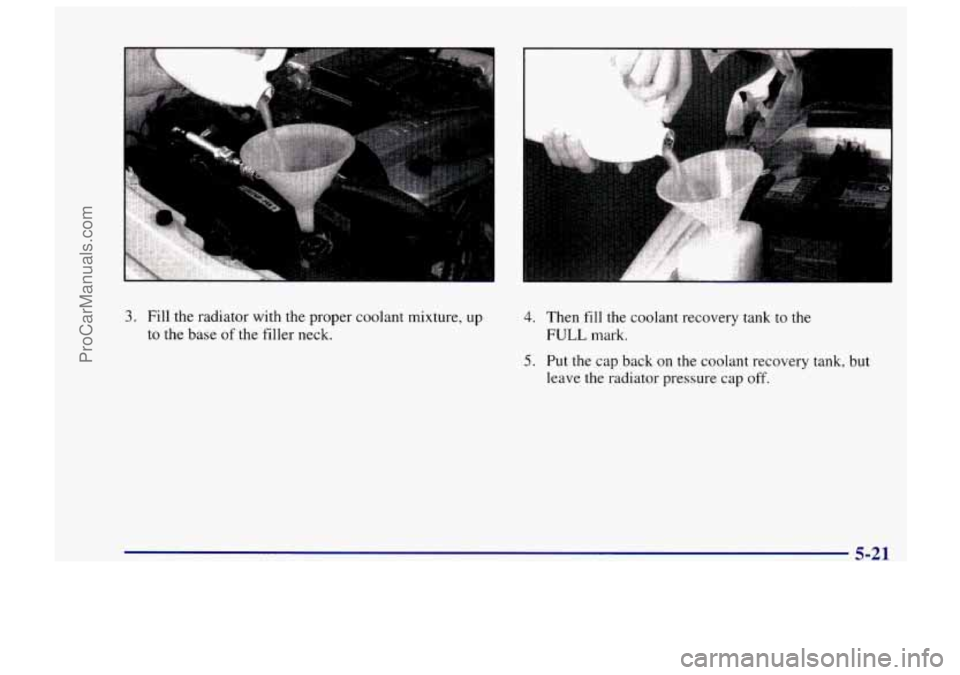
3. Fill the radiator with the proper coolant mixture, up
to the base of the filler neck. 4. Then fill the coolant recovery tank to the
FULL mark.
5. Put the cap back on the coolant recovery tank, but
leave the radiator pressure cap off.
5-21
I
ProCarManuals.com
Page 224 of 388
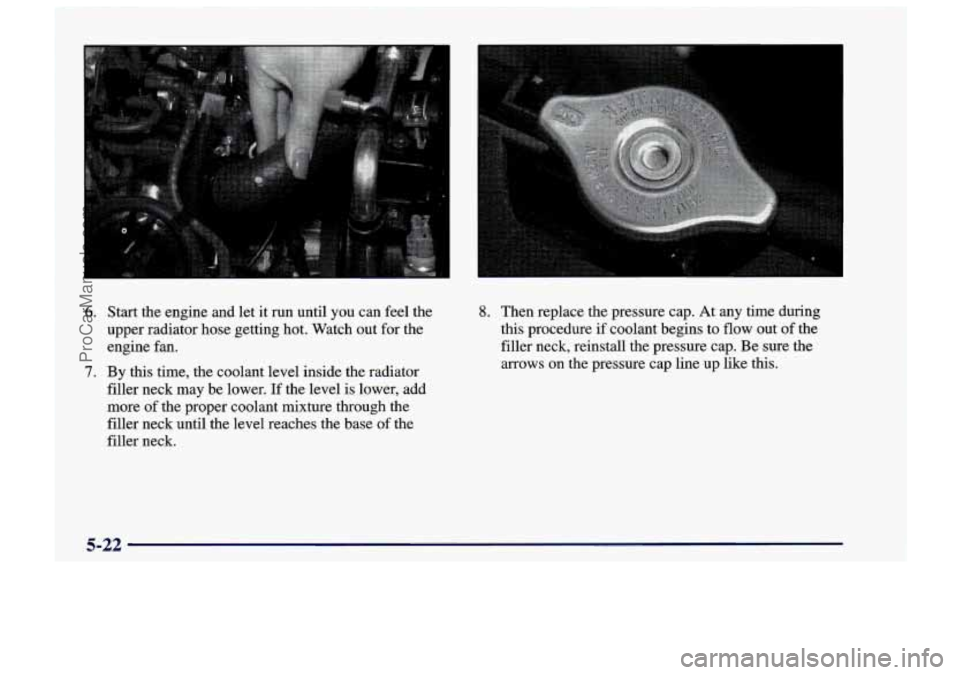
6. Start the engine and let it run until you can feel the
upper radiator hose getting hot. Watch out for the
engine fan.
filler neck may be lower.
If the level is lower, add
more of
the proper coolant mixture through the
filler neck until the level reaches the base of the
filler neck.
7. By this time, the coolant level inside the radiator
8. Then replace the pressure cap. At any time during
this procedure
if coolant begins to flow out of the
filler neck, reinstall the pressure cap. Be sure the
arrows
on the pressure cap line up like this.
5-22
ProCarManuals.com
Page 239 of 388
GE4iB Section 6 Service and Appearance Care
Here you will find information about the care of your Geo. This section begins with service and fuel information, and
then it shows how to check important fluid and lubricant levels. There is also technical information about your
vehicle, and a part devoted to its appearance care.
6-2
6-3
6-7
6-10
6- 14
6- 16
6-19
6-2 1
6-2
1
6-22
6-23
6-26
6-27
6-29
6-33
Service
Fuel
Checking Things Under the
Hood
Engine Oil
Air Cleaner
Automatic Transmission Fluid
Manual Transmission Fluid
Clutch Adjustment
Rear Axle
Four-wheel
Drive
Engine Coolant
Radiator Pressure Cap
Windshield Washer Fluid
Brakes
Battery
6-33
6-3
3
6-40
6-48
6-49
6-53
6-54
6-56
6-56
6-57
6-58
6-58
6-62
6-64
Bulb Replacement
Halogen Bulbs
Tires
'
Appearance Care
Cleaning the Inside of Your Geo
Cleaning the Outside of Your Geo
Special Care for Canvas Top and Plastic
Windows
Underbody Maintenance
Chemical Paint Spotting
Appearance Care Materials Chart
Vehicle Identification Number
(VIN)
Electrical System
Replacement Bulbs
Air Conditioning Refrigerants
6-1
ProCarManuals.com
Page 263 of 388
Checking Coolant
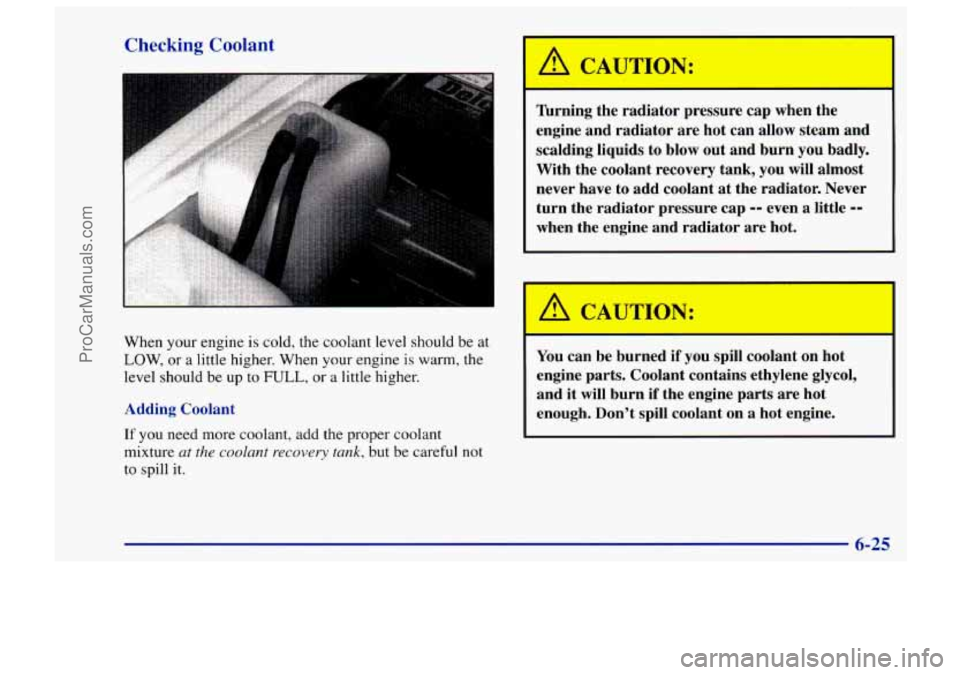
When your engine is cold, the coolant level should be at
LOW,
or a little higher. When your engine is warm, the
level should be
up to FULL, or a little higher.
Adding Coolant
If you need more coolant, add the proper coolant
mixture
at the coolant recovery tank, but be careful not
to spill it.
A CAUTION:
Turning the radiator pressure cap when the
engine and radiator are hot can allow steam and
scalding liquids to blow out and burn
you badly.
With the coolant recovery tank, you will almost
never have to add coolant at the radiator. Never
turn the radiator pressure cap
-- even a little --
when the engine and radiator are hot.
You can be burned
if you spill coolant on hot
engine parts. Coolant contains ethylene glycol,
and it will burn if the engine parts are hot
enough. Don’t spill coolant on a hot engine.
6-25
I
ProCarManuals.com
Page 264 of 388
Radiator Pressure Cap Power Steering Fluid
I NOTICE:
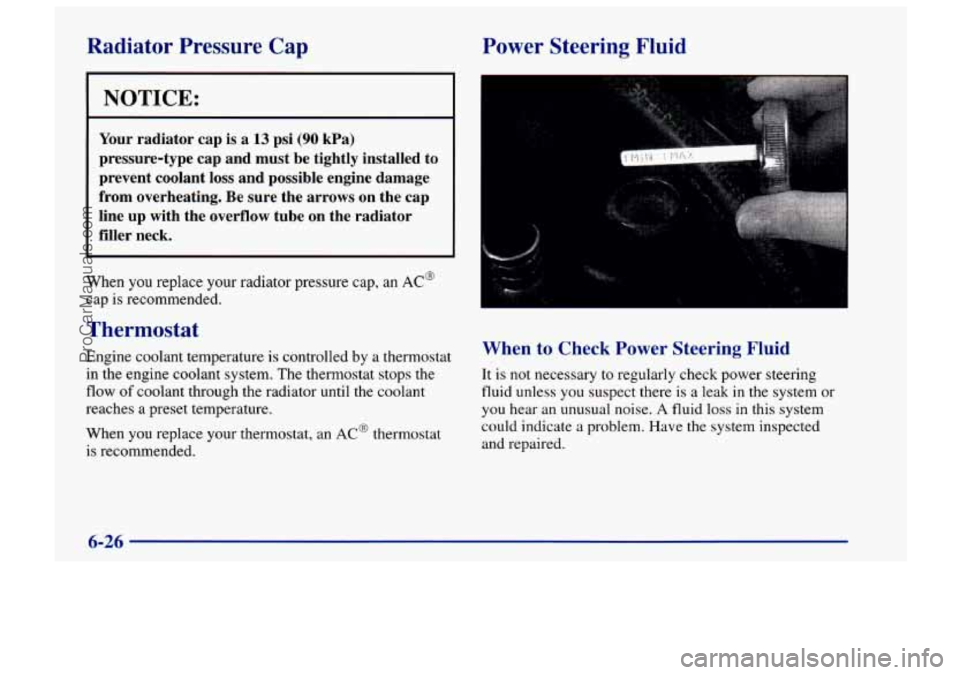
Your radiator cap is a 13 psi (90 kPa)
pressure-type cap and must be tightly installed to
prevent coolant loss and possible engine damage
from overheating. Be sure the arrows on the cap
line up with the overflow tube
on the radiator
filler neck.
When you replace your radiator pressure cap, an AC@
cap is recommended. 'I
Thermostat
Engine coolant temperature is controlled by a thermostat
in the engine coolant system. The thermostat stops the
flow of coolant through the radiator until the coolant
reaches a preset temperature.
When
you replace your thermostat, an AC@ thermostat
is recommended.
When to Check Power Steering Fluid
It is not necessary to regularly check power steering
fluid
unless you suspect there is a leak in the system or
you hear an unusual noise.
A fluid loss in this system
could indicate
a problem. Have the system inspected
and repaired.
6-26
ProCarManuals.com
Page 266 of 388
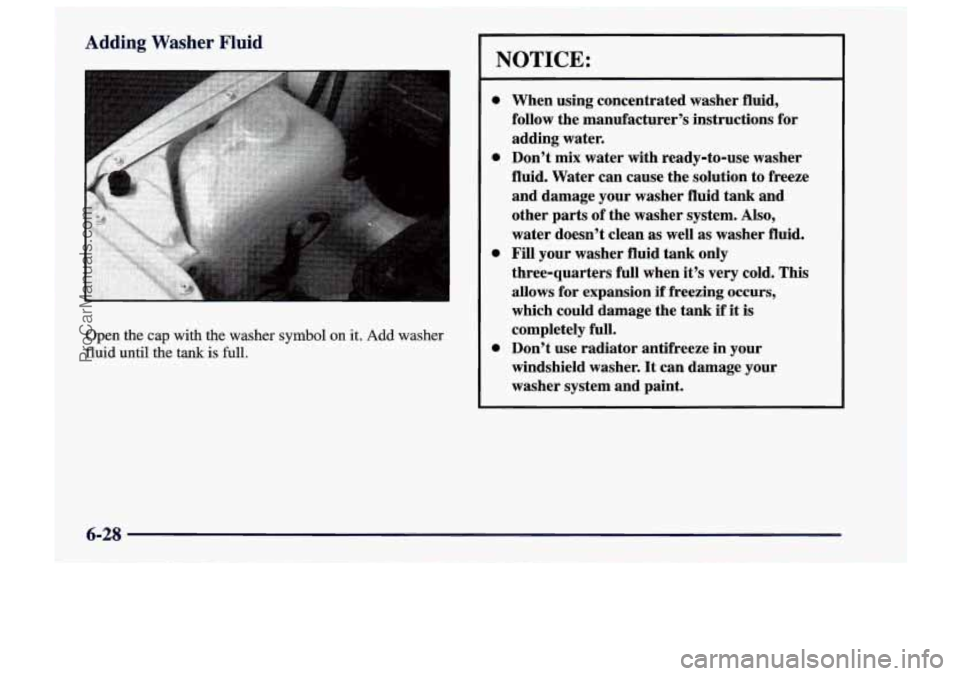
Adding Washer Fluid
Open the cap with the washer symbol on it. Add washer
fluid until the tank is
full.
NOTICE:
0
0
0
0
When using concentrated washer fluid,
follow the manufacturer’s instructions for
adding water.
Don’t mix water with ready-to-use washer
fluid. Water can cause the solution to freeze
and damage your washer fluid tank and
other parts of the washer system. Also,
water doesn’t clean as well as washer fluid.
Fill your washer fluid tank only
three-quarters full when it’s very cold. This
allows for expansion if freezing
occurs,
which could damage the tank if it is
completely full.
Don’t use radiator antifreeze in your
windshield washer. It can damage your
washer system and paint.
6-28
ProCarManuals.com
Page 300 of 388
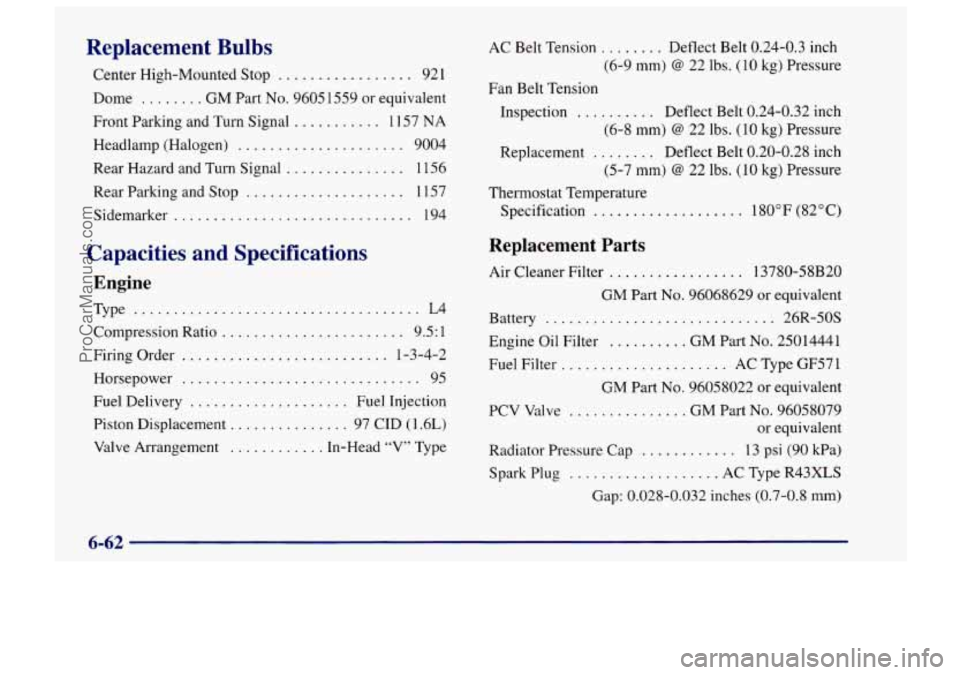
Replacement Bulbs
Center High-Mounted Stop ................. 921
Dome
........ GM Part No. 96051559 or equivalent
Front Parking and Turn Signal
........... 11 57 NA
Headlamp (Halogen) ..................... 9004
Rear Hazard and Turn Signal
............... 1156
Rear Parking and Stop
.................... 1157
Sidemarker
.............................. 194
Capacities and
Engine
Type ............
Specifications
........................ L4
Compression Ratio ....................... 9.5: 1
Firing Order
.......................... 1-3-4-2
Horsepower
.............................. 95
Fuel Delivery .................... Fuel Injection
Piston Displacement
............... 97 CTD (1.6L)
Valve Arrangement
............ In-Head “V” Type AC
Belt Tension
........ Deflect Belt 0.24-0.3 inch
(6-9 mm)
@ 22 lbs. (10 kg) Pressure
Fan Belt Tension
Inspection
.......... Deflect Belt 0.24-0.32 inch
(6-8 mm)
@ 22 lbs. (10 kg) Pressure
Replacement
........ Deflect Belt 0.20-0.28 inch
(5-7 mm)
@ 22 lbs. (10 kg) Pressure
Specification
................... 180” F (82 O C)
Thermostat Temperature
Replacement Parts
Air Cleaner Filter ................. 13780-58k20
GM Part No. 96068629 or equivalent
Battery
....... .................... 26R-50s
Engine
Oil Filter .......... GM Part No. 25014441
Fuel Filter
..................... AC Type GF571
GM Part No. 96058022 or equivalent
PCV Valve
............... GM Part No. 96058079
or equivalent
Radiator Pressure Cap
............ 13 psi (90 kPa)
Spark Plug
................... AC Type R43XLS
Gap: 0.028-0.032 inches
(0.7-0.8 mm)
ProCarManuals.com