recommended oil CHEVROLET TRACKER 1997 Owners Manual
[x] Cancel search | Manufacturer: CHEVROLET, Model Year: 1997, Model line: TRACKER, Model: CHEVROLET TRACKER 1997Pages: 388, PDF Size: 20.12 MB
Page 183 of 388
Once you are moving on the freeway, make certain you
allow a reasonable following distance. Expect to move
slightly slower at night.
When you want to leave the freeway, move to the proper
lane well in advance. If you miss your exit, do not,
under any circumstances, stop and back up. Drive on to
the next exit.
The exit ramp can be curved, sometimes quite sharply.
The exit speed is usually posted.
Reduce your speed according to your speedometer, not
to your sense of motion. After driving for any distance
at higher speeds, you may tend to think you are going
slower than you actually are.
Before Leaving on a Long Trip
Make sure you’re ready. Try to be well rested. If you
must start when you’re not fresh
-- such as after a day’s
work
-- don’t plan to make too many miles that first part
of the journey. Wear comfortable clothing and shoes you
can easily drive in.
Is your vehicle ready for a long trip? If you keep it
serviced and maintained, it’s ready
to go. If it needs
service, have it done before starting out. Of course,
you’ll find experienced and able service experts in Geo
dealerships all across North America. They’ll be ready
and willing
to help if you need it.
Here are some things you can check before a trip:
0
0
a
0
0
0
a
Windshield Washer Fluid: Is the reservoir full? Are
all windows clean inside and outside?
Wiper Blades: Are they in good shape?
Fuel, Engine Oil, Other Fluids: Have you checked
all levels?
Lamps: Are they all working? Are the lenses clean?
Tires: They are vitally important to a safe,
trouble-free trip. Is the tread good enough for
long-distance driving? Are the tires all inflated to the
recommended pressure?
Weather Forecasts: What’s the weather outlook
along your route? Should
you delay your trip a short
time
to avoid a major storm system?
Maps: Do you have up-to-date maps?
4-37
I
ProCarManuals.com
Page 219 of 388
How to Add Coolant to the Coolant
Recovery Tank
If you haven’t found a problem yet, but the coolant level
isn’t at or above the
FULL mark, add a 50/50 mixture
of clean water (preferably distilled) and a proper coolant
at the coolant recovery tank. (See “Engine Coolant’’
in the Index for more information about the proper
coolant
mix.)
Adding only plain water to your cooling system
can be dangerous. Plain water, or some other
liquid like alcohol, can boil before the proper
coolant mix will. Your vehicle’s coolant warning
system is set for the proper coolant mix. With
plain water or the wrong mix, your engine could
get too hot but you wouldn’t get the overheat
warning. Your engine could catch fire and you or
others could be burned. Use a
50/50 mix of clean
water and
a proper coolant.
NOTICE:
In cold weather, water can freeze and crack the
engine, radiator, heater core and other parts.
Use the recommended coolant and the proper
coolant mix.
5-17
I
ProCarManuals.com
Page 243 of 388
Fuels in Foreign Countries
If you plan on driving in another country outside the
United States
or Canada, the proper fuel may be hard to
find. Never use leaded gasoline or any other fuel not
recommended in the previous text on fuel. Costly repairs
caused by use of improper fuel wouldn’t be covered by
your warranty.
To check on fuel availability, ask an auto club, or
contact a major
oil company that does business in the
country where you’ll
be driving.
You can also write
us at the following address for
advice. Just tell
us where you’re going and give your
Vehicle Identification Number (VIN).
General Motors International Product Center
1908 Colonel Sam Drive
Oshawa, Ontario
LlH 8P7
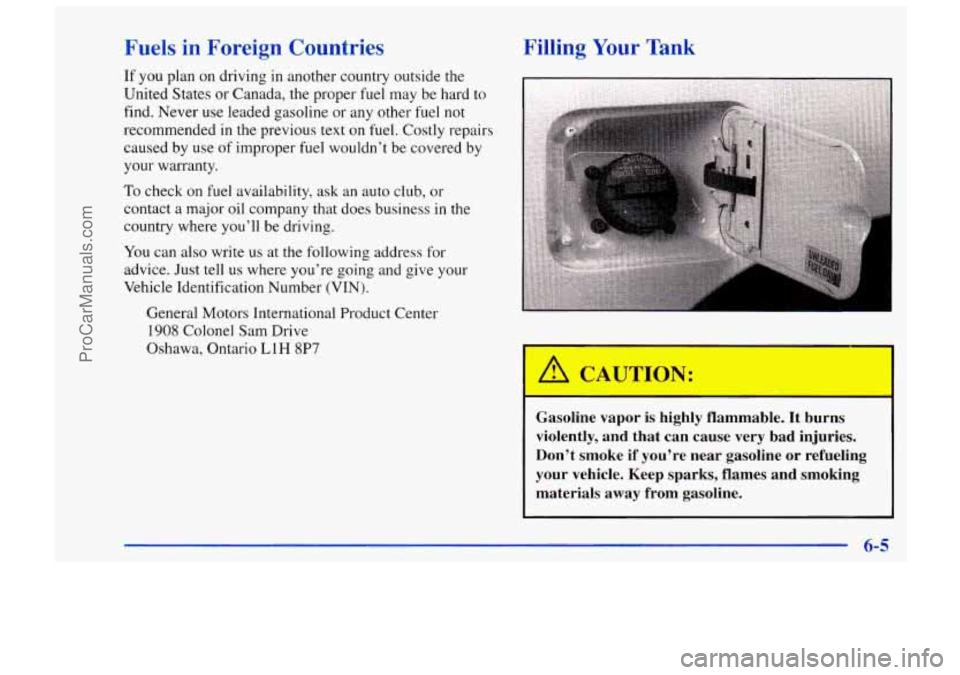
Filling Your Tank
W
Gasoline vapor is highly flammable. It burns
violently, and that can cause very bad injuries.
Don’t smoke if you’re near gasoline
or refueling
your vehicle. Keep sparks, flames and smoking materials away
from gasoline.
6-5
ProCarManuals.com
Page 250 of 388
What Kind of Oil to Use
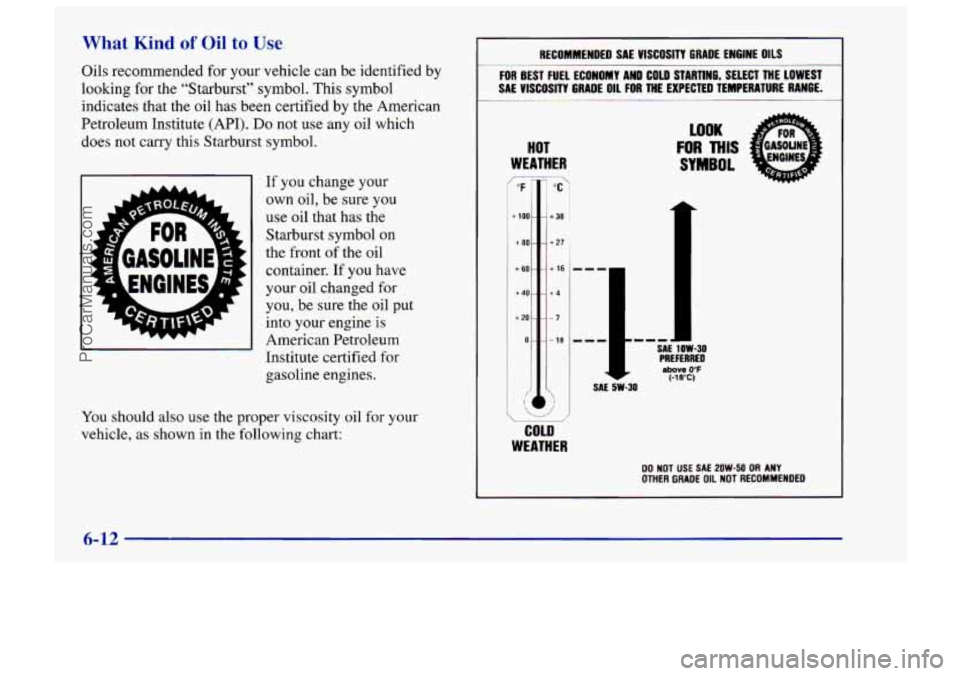
Oils recommended for your vehicle can be identified by
looking for the “Starburst” symbol. This symbol
indicates that the oil has been certified by the American
Petroleum Institute (API).
Do not use any oil which
does not carry this Starburst symbol.
I:
If you change your
own oil, be sure you
use oil that has the
Starburst symbol on
the front of the oil
container. If you have
your oil changed for
you, be sure the oil put
into your engine is
American Petroleum
I J
Institute certified for
gasoline engines.
~~~ ~~~~~~
You should also use the proper viscosity oil for your
vehicle, as shown in the following chart:
RECOMMENDED SAE VISCOSITY GRADE ENGINE OILS
FOR BEST FUEL ECONOMY AND COLD STARTING, SELECT THE LOWEST
SAE VISCOSITY GRADE OIL
FOR THE EXPECTED TEMPERATURE RANGE. -
HOT
WEATHER
“F
t 100
+ ao
+ 60
+ 40.
+ 20.
0-
t3a ~
+ 27
+ 16
t4
-7
- 18
SAE 5W-30
LOOK
FOR MIS
SYMBOL
above 0°F (’1 WC)
WEATHER
00 NOT USE SAE 2OW-50 OR ANY OTHER GRADE OIL NOT RECOMMENDED
6-12
ProCarManuals.com
Page 251 of 388
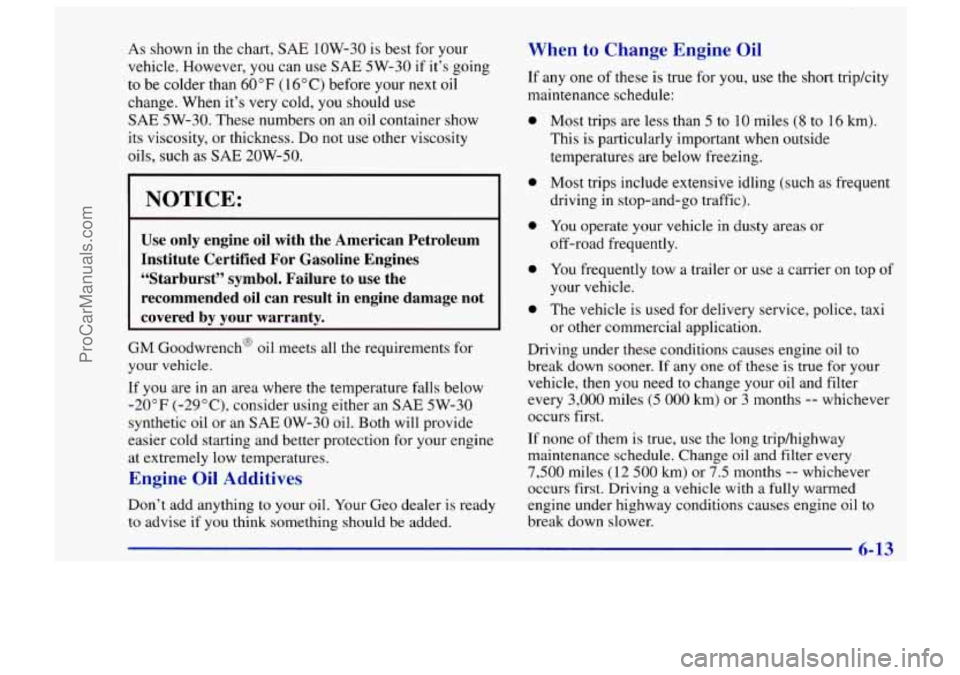
As shown in the chart, SAE 1OW-30 is best for your
vehicle. However, you can use
SAE 5W-30 if it’s going
to be colder than
60°F ( 16°C) before your next oil
change. When it’s very cold, you should use
SAE 5W-30. These numbers on an oil container show
its viscosity, or thickness.
Do not use other viscosity
oils, such as
SAE 20W-50.
NOTICE:
Use only engine oil with the American Petroleum
Institute Certified For Gasoline Engines
“Starburst’’ symbol. Failure to use the
recommended oil can result in engine damage not
covered
by your warranty.
GM Goodwrench’ oil meets all the requirements for
your vehicle.
If you are
in an area where the temperature falls below
-20°F (-29”C), consider using either an SAE 5W-30
synthetic oil or an
SAE OW-30 oil. Both will provide
easier cold starting and better protection for your engine
at extremely low temperatures.
Engine Oil Additives
Don’t add anything to your oil. Your Geo dealer is ready
to advise if you think something
should be added.
When to Change Engine Oil
If any one of these is true for you, use the short tripkity
maintenance schedule:
0
0
0
0
0
Most trips are less than 5 to 10 miles (8 to 16 km).
This is particularly important when outside
temperatures are below freezing.
Most trips include extensive idling (such as frequent
driving
in stop-and-go traffic).
You operate your vehicle in dusty areas or
off-road frequently.
You frequently tow a trailer or
use a carrier on top of
your vehicle.
The vehicle is used for delivery service, police, taxi
or other commercial application.
Driving under these conditions causes engine oil to
break down sooner. If any one
of these is true for your
vehicle, then you need to change your oil and filter
every
3,000 miles (5 000 km) or 3 months -- whichever
occurs first.
If none of them is true, use the long triphighway
maintenance schedule. Change oil and filter every
7,500 miles (12 500 km) or 7.5 months -- whichever
occurs first. Driving a vehicle with a
fully warmed
engine under highway conditions causes engine oil to
break down slower.
6-13
I
ProCarManuals.com
Page 257 of 388
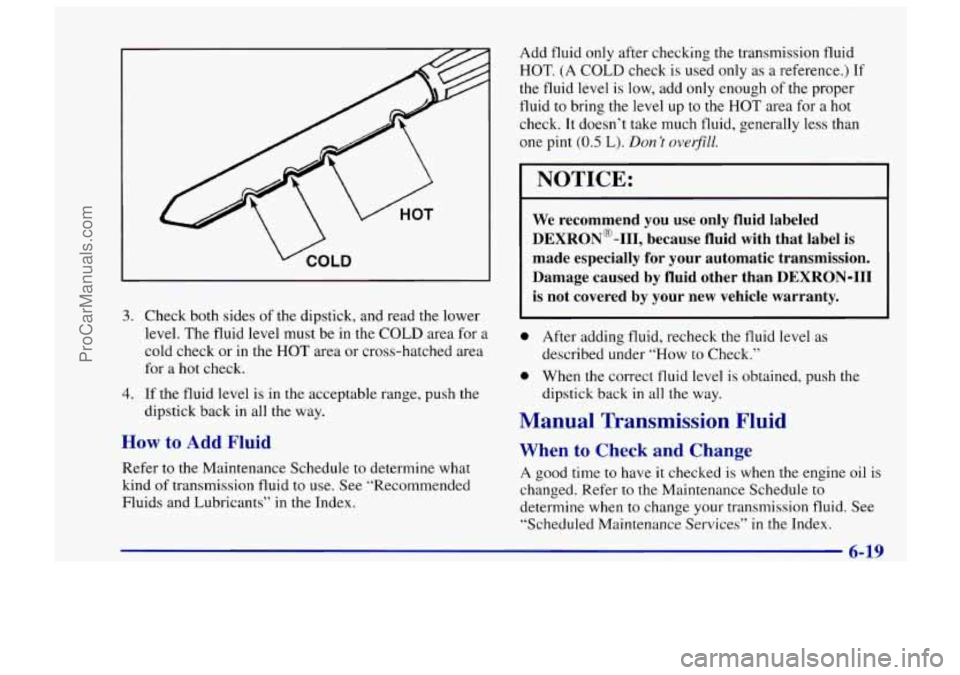
3. Check both sides of the dipstick, and read the lower
level. The fluid level must be
in the COLD area for a
cold check or
in the HOT area or cross-hatched area
for a hot check.
4. If the fluid level is in the acceptable range, push the
dipstick back in all the way.
How to Add Fluid
Refer to the Maintenance Schedule to determine what
kind
of transmission fluid to use. See “Recommended
Fluids and Lubricants” in the Index. Add
fluid only after checking the transmission fluid
HOT. (A COLD check
is used only as a reference.) If
the fluid level is low, add only enough of the proper
fluid to bring the level up to the HOT area for a hot
check.
It doesn’t take much fluid, generally less than
one pint
(0.5 L). Don ’I ove$iZZ.
NOTICE:
We recommend you use only fluid labeled
DEXRON@-111, because fluid with that label is
made especially for your automatic transmission.
Damage caused by fluid other than DEXRON-I11
is not covered by your new vehicle warranty.
0 After adding fluid, recheck the fluid level as
0 When the correct fluid level is obtained, push the
described under
“How to Check.”
dipstick back
in all the way.
Manual Transmission Fluid
When to Check and Change
A good time to have it checked is when the engine oil is
changed. Refer
to the Maintenance Schedule to
determine when to change your transmission fluid. See
“Scheduled Maintenance Services”
in the Index.
6-19
1
ProCarManuals.com
Page 261 of 388
Front Axle
When to Check and Change Lubricant
Refer to the Maintenance Schedule to determine how
often to check the lubricant and when to change it. See
“Periodic Maintenance Inspections” and “Scheduled
Maintenance Services” in the Index.
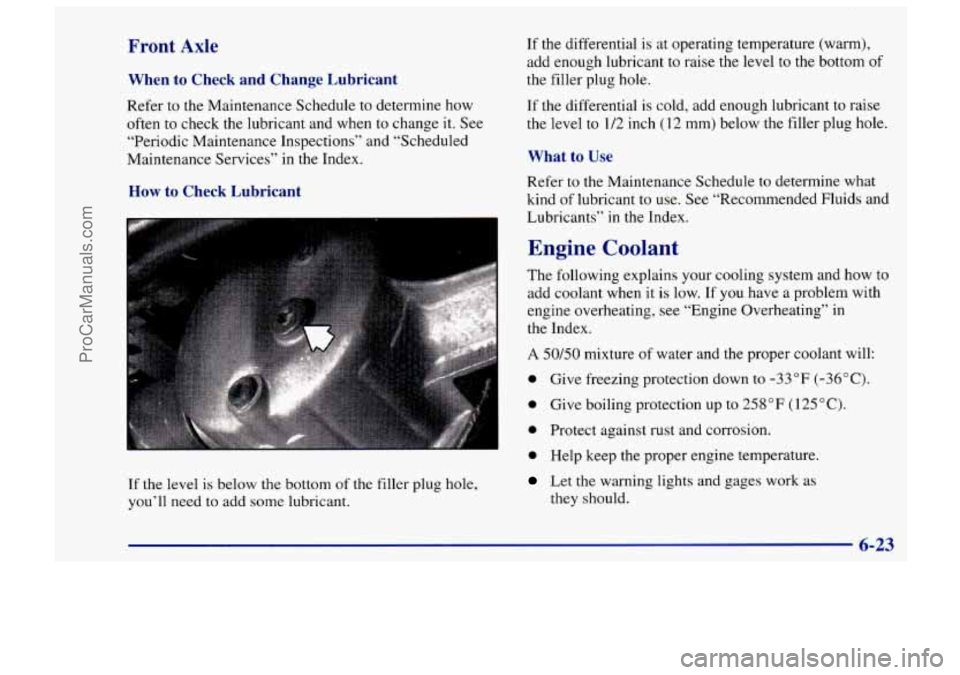
How to Check Lubricant
If the differential is at operating temperature (warm),
add enough lubricant to raise the level to the bottom of
the filler plug
hole.
If the differential is cold, add enough lubricant to raise
the level to 1/2 inch
(I 2 mm) below the filler plug hole.
What to Use
Refer to the Maintenance Schedule to determine what
kind
of lubricant to use. See “Recommended Fluids and
Lubricants”
in the Index.
Engine Coolant
The following explains your cooling system and how to
add coolant when it is low. If you have a problem with
engine overheating, see “Engine Overheating” in
the Index.
If the level is below the bottom of the filler plug hole,
you’ll need to add some lubricant.
A 50/50 mixture of water and the proper coolant will:
0 Give freezing protection down to -33°F (-36°C).
0 Give boiling protection up to 258°F (125°C).
0 Protect against rust and corrosion.
0 Help keep the proper engine temperature.
Let the warning lights and gages work as
they should.
6-23
I
ProCarManuals.com
Page 292 of 388
Foreign materials such as calcium chloride and other
salts, ice melting agents, road oil and tar, tree sap, bird
droppings, chemicals from industrial chimneys, etc., can
damage your vehicle’s finish if they remain on painted
surfaces. Wash the vehicle as soon as possible. If
necessary, use non-abrasive cleaners that are marked
safe for painted surfaces to remove foreign matter.
Exterior painted surfaces are subject to aging, weather
and chemical fallout that can take their toll over a
period of years. You can help to keep the paint finish
looking new by keeping your Geo garaged or covered
whenever possible.
Protecting Exterior Bright Metal Parts
Bright metal parts should be cleaned regularly to
keep their luster. Washing with water is all that is
usually needed. However, you may
use chrome polish
on chrome or stainless steel trim, if necessary.
Use special care with aluminum trim.
To avoid
damaging protective trim, never use auto or chrome
polish, steam or caustic soap to clean aluminum. A
coating
of wax, rubbed to high polish, is recommended
for all bright metal parts.
Special Care for Canvas Top and
Plastic
Windows
To protect the canvas top:
0 After you wash the vehicle, make sure the top is
completely dry before you open or remove it.
0 Don’t get any vinyl cleaner on the vehicle’s painted
finish; it could leave streaks.
0 Don’t go through automatic car washes; the canvas
top could be damaged.
The plastic windows are pliable and can be scratched
if
you don’t take these precautions when you clean them:
0 Wipe off dust with a soft cotton cloth moistened with
clean, cool or lukewarm water. Don’t use a “dry”
cloth. Wipe in one direction only, not back and forth.
To remove frost, snow or ice, use lukewarm water.
Don’t
use a scraper or any de-icing fluids.
Wash the windows with a soft cloth and clean, cool
or lukewarm water. Never use a dry cloth, hot water,
strong soap or detergent, solvents or harsh cleaning
agents. Rinse thoroughly and wipe with a slightly
moist soft, clean cloth.
6-54
ProCarManuals.com
Page 304 of 388
I
IMPORTANT.
KEEP ENGINE OIL
AT THE PROPER
LEVEL AND CHANGE AS
RECOMMENDED
Have you purchased the GM Protection Plan? The Plan
supplements
your new vehicle warranties. See your
Warranty and Owner Assistance booklet, or your
Geo dealer for details.
Introduction
Your Vehicle and the Environment
Proper vehicle maintenance not only helps to keep your
vehicle
in good working condition, but also helps the
environment. All recommended maintenance procedures
are important. Improper vehicle maintenance can even
affect the quality
of the air we breathe. Improper fluid
levels or the wrong tire inflation can increase the level
of emissions from your vehicle. To help protect our
environment, and to keep your vehicle in good
condition, please maintain your vehicle properly.
7-2
ProCarManuals.com
Page 311 of 388
I Short TripKity Maintenance Schedule I
The services shown in this schedule up to 100,000 miles
(1 66 000 km) should be performed after 100,000 miles
(1 66 000 km) at the same intervals. See “Owner Checks
and Services’’ and “Periodic Maintenance Inspections”
following.
Footnotes
? The U.S. Environmental Protection Agency or the
California Air Resources Board has determined that the
failure to perform this maintenance item will
not nullify
the emission warranty or limit recall liability prior to the
completion
of the vehicle’s useful life. We, however,
urge that all recommended maintenance services be
performed at the indicated intervals and the maintenance
be recorded.
+ A good time to check your brakes is during tire
rotation. See “Brake System Inspection” under “Periodic
Maintenance Inspection” in Part C of this schedule.
3,000 Miles (5 000 km)
0 Change engine oil and filter (or every
3 months, whichever occurs first).
An Emission Control Service.
0 Inspect the locking front hubs (if equipped)
for correct operation (or every
3 months,
whichever occurs first). Repair or replace
if necessary.
DATE
SERVICED BY ACTUAL MILEAGE
7-9
ProCarManuals.com