ECU CHEVROLET TRACKER 1998 1.G User Guide
[x] Cancel search | Manufacturer: CHEVROLET, Model Year: 1998, Model line: TRACKER, Model: CHEVROLET TRACKER 1998 1.GPages: 386, PDF Size: 21.17 MB
Page 51 of 386

Downloaded from www.Manualslib.com manuals search engine Securing a Child Restraint in a Rear
Seat Position
You’ll be using the lap-shoulder belt. See the earlier part
about the top strap if the child restraint has one. Be sure
to follow the instructions that came with the child
restraint. Secure the child in the child restraint when and
as the instructions say.
1. Put the restraint on the seat.
2. Pick up the latch plate, and run the lap and shoulder
portions of the vehicle’s safety belt through or
around the restraint. The child restraint instructions
will show
you how.
3. Buckle the belt. Make sure the release button is
positioned so you would be able to unbuckle the
safety belt quickly
if you ever had to.
If the shoulder belt goes in front
of the child’s face or
neck, put it behind the child restraint.
1-44
Page 52 of 386

Downloaded from www.Manualslib.com manuals search engine 4. Pull the rest of the shoulder belt all the way out of
the retractor to set the lock. 5. To tighten the belt, feed the shoulder belt back into
the retractor while
you push down on the child
restraint.
If you’re using a forward-facing child
restraint, you may find it helpful to use your knee
to push down on the child restraint
as you tighten
the belt.
6. Push and pull the child restraint in different
directions to be sure
it is secure.
1-45
Page 53 of 386

Downloaded from www.Manualslib.com manuals search engine To remove the child restraint, just unbuckle the vehicle’s
safety belt and let it go back all the way. The safety belt
will
move freely again and be ready to work for an adult
or larger child passenger.
Securing a Child Restraint in the Right
Front Seat Position
Your vehicle has a right front passenger air bag. Never
put a rear-facing child restraint in this seat. Here’s why:
‘ A CA JTION:
A child in a rearfacing child restraint can be
seriously injured
if the right front passenger’s
air bag inflates, even if your vehicle has
reduced-force frontal air bags. This
is because
the back of a rearfacing child restraint would be
very close to the inflating
air bag. Always secure
a rearfacing child restraint in the rear seat.
You’ll be using the lap-shoulder belt. See the earlier
part about the top strap
if the child restraint has one. Be
sure to follow the instructions that came with the child
restraint. Secure the child in the child restraint when and
as the instructions say.
1. Because your vehicle has a right front passenger air
bag, always move the seat as
far back as it will go
before securing a forward-facing child restraint. (See “Seats” in the Index.)
2. Put the restraint on the sear.
1-46
Page 55 of 386

Downloaded from www.Manualslib.com manuals search engine 6. To tighten the belt, feed the shoulder belt back into the
retractor while you push down on the child restraint.
You may find it helpful to use your knee to push down
on
the child restraint as you tighten the belt.
directions
to be sure it is secure.
7. Push and pull the child restraint in different
To remove the child restraint, just unbuckle the vehicle’s
safety belt and let it
go back all the way. The safety belt
will move freely again and be ready to work for
an adult
or larger child passenger.
Larger Children
t
Children who have outgrown child restraints should
wear the vehicle’s safety belts.
Page 64 of 386
Downloaded from www.Manualslib.com manuals search engine Rear Door Security Locks (4-DOOr Models)
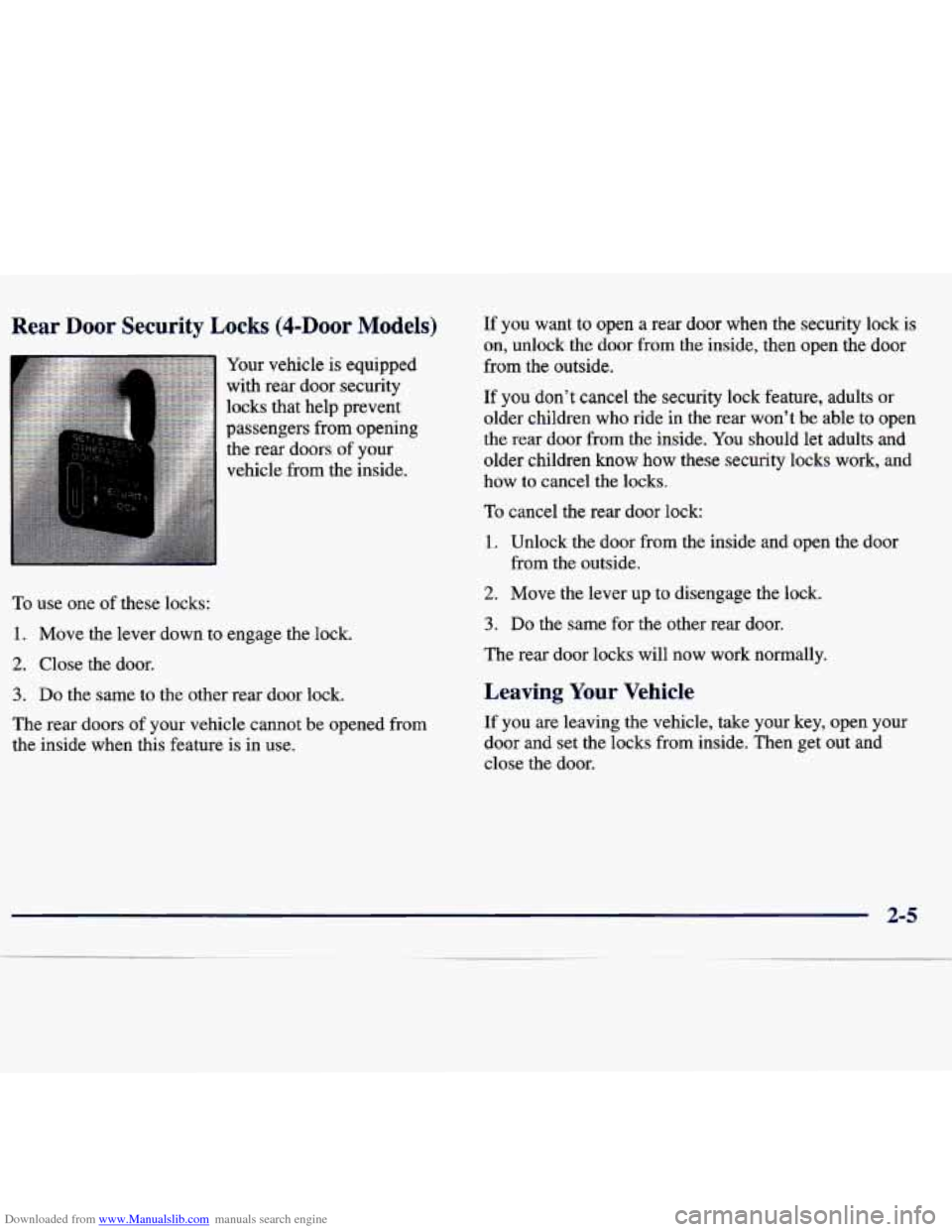
Your vehicle is equipped
with rear door security
locks that help prevent
passengers from opening
the rear doors of your
vehicle from the inside.
To use one of these locks:
1. Move the lever down to engage the lock.
2. Close the door.
3. Do the same to the other rear door lock.
The rear doors of your vehicle cannot be opened from
the inside when this feature is in use. If
you want to open a rear door when the security
lock is
on, unlock the door from the inside, then open the door
from the outside.
If you
don’t cancel the security lock feature, adults or
older children who ride in the rear won’t be able to open
the rear door from the inside.
You should let adults and
older children know how these security locks work, and
how to cancel the locks.
To cancel the rear door lock:
1. Unlock the door from the inside and open the door
from the outside.
2. Move the lever up to disengage the lock.
3. Do the same for the other rear door.
The rear door locks will now work normally.
Leaving Your Vehicle
If you are leaving the vehicle, take your key, open your
door and set the locks from inside. Then get
out and
close the door.
2-5
Page 102 of 386
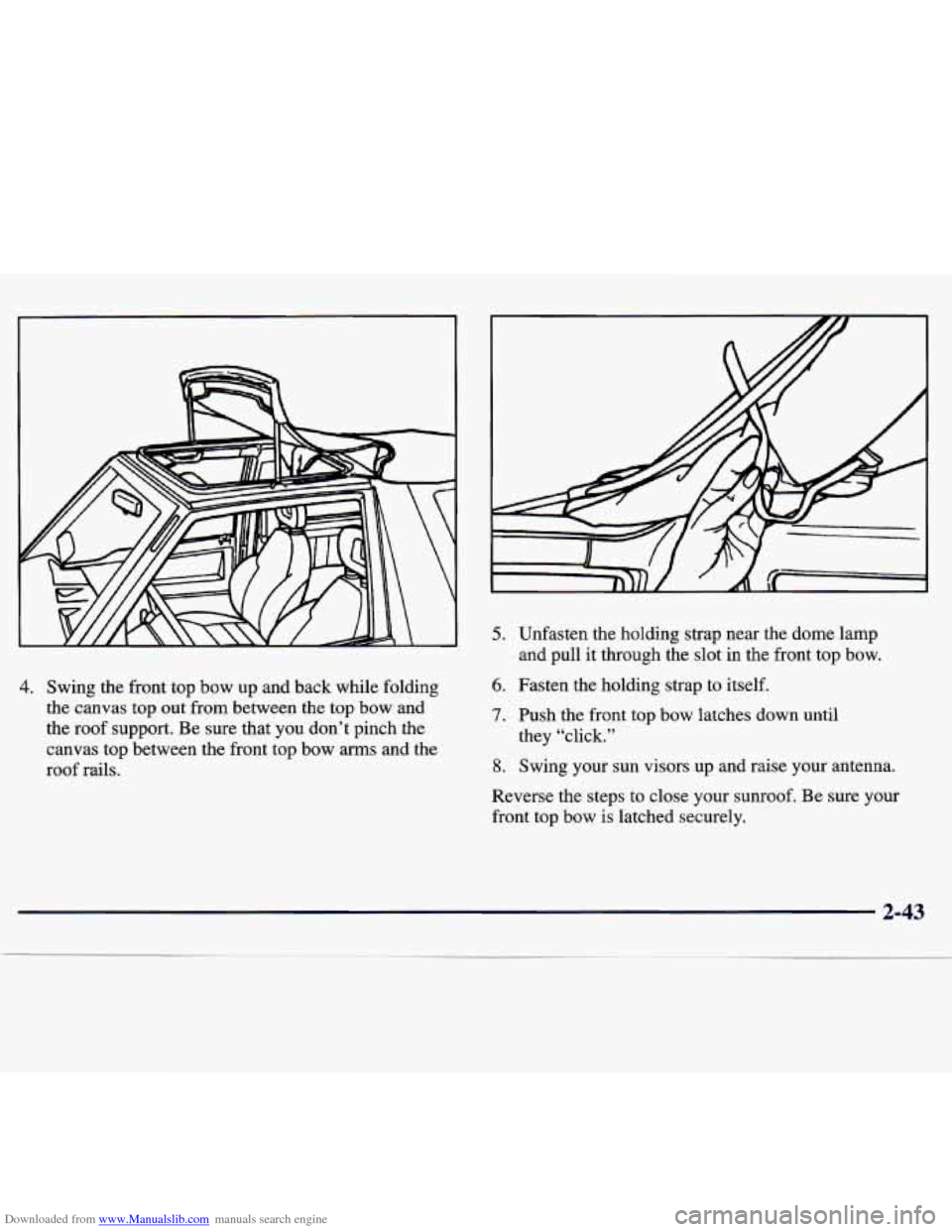
Downloaded from www.Manualslib.com manuals search engine 4. Swing the front top bow up and back while folding
the canvas top out from between the top bow and
the roof
support. Be sure that you don’t pinch the
canvas top between the front top bow arms and the
roof rails.
5. Unfasten the holding strap near the dome lamp
and pull it through the slot in the front top bow.
6. Fasten the holding strap to itself.
7. Push the front top bow latches down until
8. Swing your sun visors up and raise your antenna.
Reverse the steps to close your
sunroof. Be sure your
front top bow
is latched securely.
they “click.”
2-43
Page 105 of 386
Downloaded from www.Manualslib.com manuals search engine L
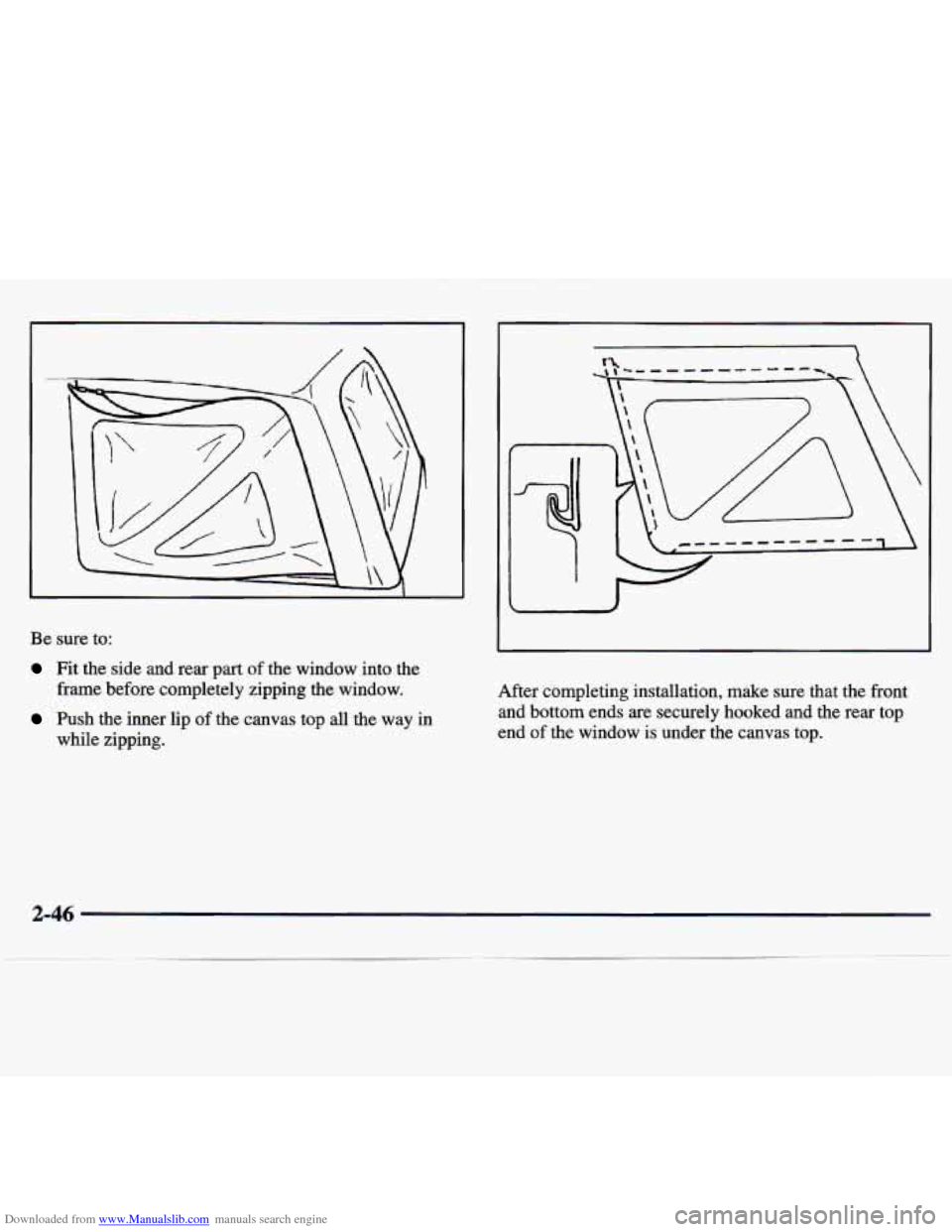
Be sure to:
Fit the side and rear part of the window into the
frame before completely zipping the window.
Push the inner lip of the canvas top all the way in
while zipping. After completing installation, make sure that the front
and bottom ends are securely hooked and the rear top
end of the window is under the canvas top.
2-46
Page 106 of 386
Downloaded from www.Manualslib.com manuals search engine Lowering and Raising the Canvas Top
1. Remove the side windows of the canvas top as
shown previously.
2. Open the rear window and hang it down inside the
luggage compartment.
I I
I II
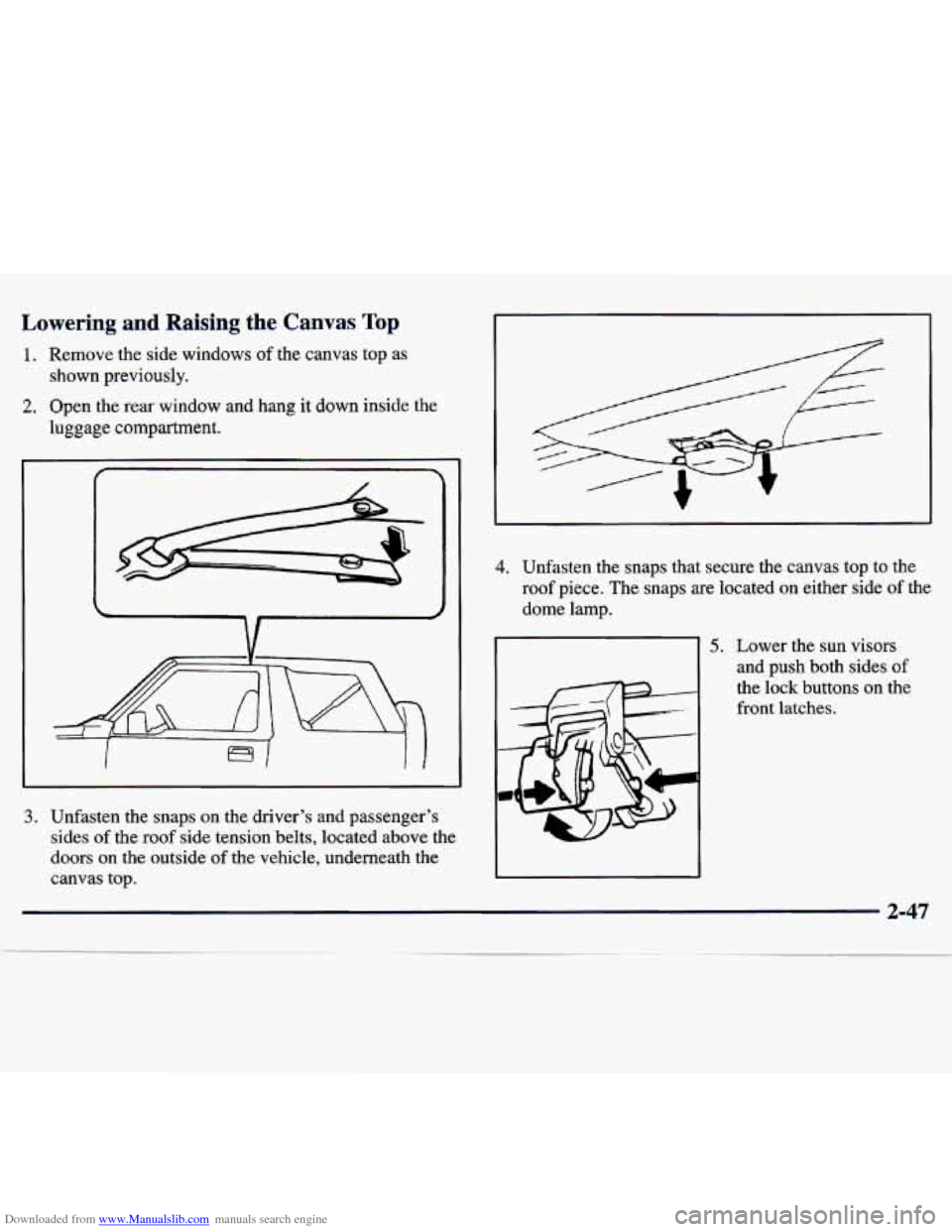
4. Unfasten the snaps that secure the canvas top to the
roof piece. The snaps are located on either side
of the
dome lamp.
I and push both sides of
the lock buttons on the
front
latches.
5. Lower the sun visors
3. Unfasten the snaps on the driver’s and passenger’s
sides of the roof side tension belts, located above the
doors
on the outside of the vehicle, underneath the
canvas top.
2-47
Page 107 of 386
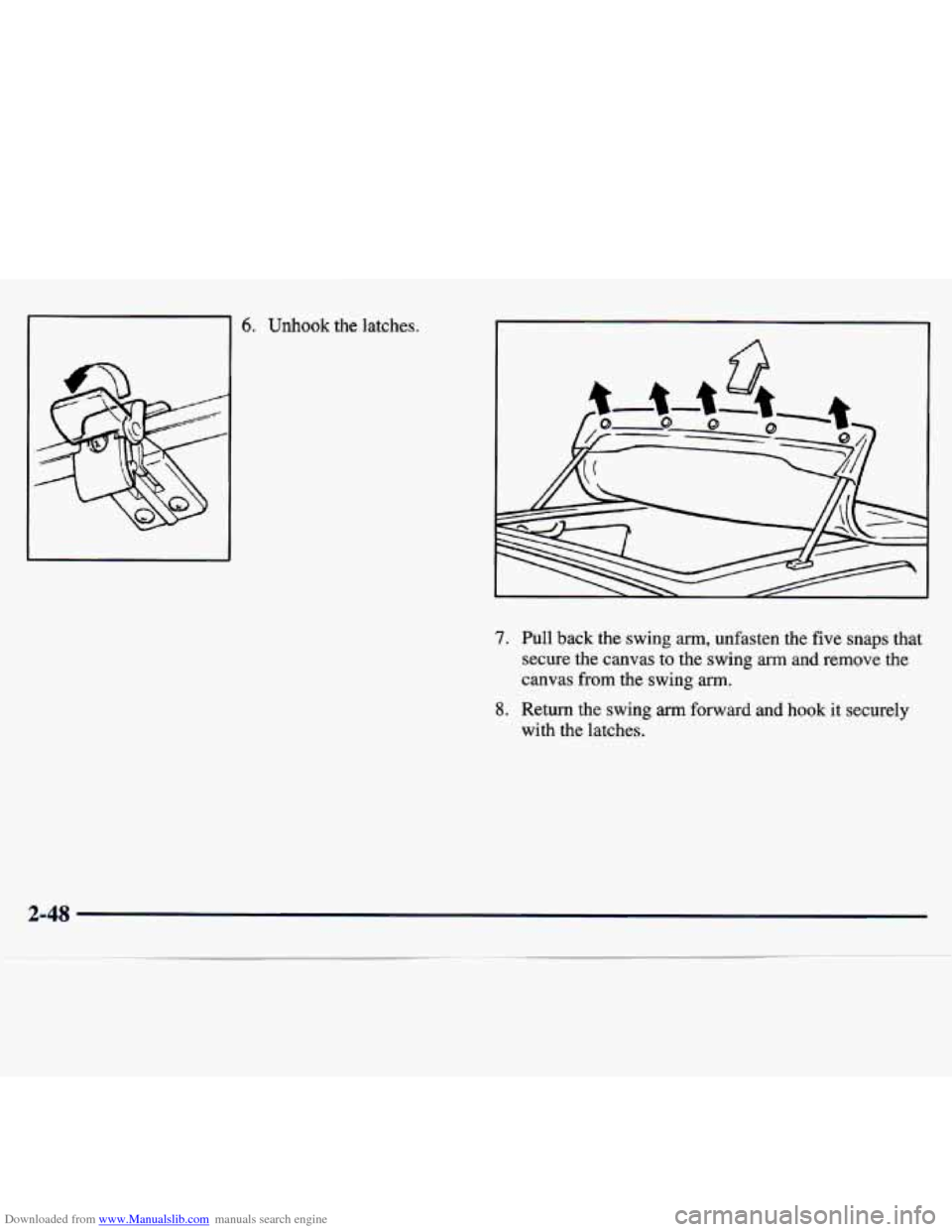
Downloaded from www.Manualslib.com manuals search engine 6. Unhook the latches.
7. Pull back the swing arm, unfasten the five snaps that
secure the canvas
to the swing arm and remove the
canvas from
the swing arm.
8. Return the swing arm forward and hook it securely
with the latches.
2-48
Page 161 of 386
Downloaded from www.Manualslib.com manuals search engine Before You Go Off-Roading
There are some things to do before you go out. For
example, be sure to have all necessary maintenance and service work done. Check to make sure all underbody
shields (if
so equipped) are properly attached. Be sure
you read all the information about your
four-wheel-drive vehicle in this manual. Is there enough
fuel?
Is the spare tire fully inflated? Are the fluid levels
up where they should be? What are the local laws that
apply to off-roading where you’ll be driving? If you
don’t know, you should check with law enforcement
people in the area. Will you be on someone’s private land? If
so, be sure to get the necessary permission.
Loading Your Vehicle for Off-Road Driving
There are some important things to remember about
how
to load your vehicle.
The heaviest things should be on the load floor and
forward of your rear axle. Put heavier items as far
forward as you can.
Be sure the load is secured properly, so driving on
the off-road terrain doesn’t
toss things around.
Cargo on the load floor piled higher than
the seatbacks can be thrown forward
during a sudden stop. You or your
passengers could be injured. Keep cargo
below the top of the seatbacks.
Unsecured cargo on the load floor can be
tossed about when driving over rough
terrain. You
or your passengers can be
struck by flying objects. Secure the
cargo properly.
Heavy loads on the roof raise the vehicle’s
center of gravity, making
it more likely to
roll over. You can be seriously or fatally
injured if the vehicle rolls over.
Put heavy
loads inside the cargo area, not on the roof.
Keep cargo in the cargo area
as far forward
and low as possible.
You’ll find other important information in this manual. See “Vehicle Loading,” “Luggage Carrier” and “Tires\
”
in the Index.