brake light CHEVROLET TRACKER 1998 1.G User Guide
[x] Cancel search | Manufacturer: CHEVROLET, Model Year: 1998, Model line: TRACKER, Model: CHEVROLET TRACKER 1998 1.GPages: 386, PDF Size: 21.17 MB
Page 120 of 386
Downloaded from www.Manualslib.com manuals search engine Anti-Lock Brake System Warning
Light (Option)
ABS
With the anti-lock brake
system, this light will
come on when you start
your engine and it will
stay on for three seconds.
That’s normal.
If the light flashes when you’re driving, you don’t have
anti-lock brakes and there could be a problem with your
regular brakes. Pull
off the road and stop carefully. You
may notice that the pedal is harder to push. Or, the pedal
may
go closer to the floor. It may take longer to stop.
Have the vehicle towed for service. (See “Towing Your
Vehicle’’ in the Index.)
I
I h, CAUTION:
Your regular brake system may not be working
properly if the anti-lock brake system warning
light is flashing. Driving with the anti-lock
brake system warning light flashing can lead to an accident. After you’ve pulled off the road
and stopped carefully, have the vehicle towed
for service.
If the anti-lock brake system warning light stays on longer than normal after you’ve started your engine, turn
the ignition off. Or, if the light comes
on and stays on
when you’re driving, stop
as soon as possible and turn
the ignition off. Then start the engine again to reset the
system.
If the light still stays on, or comes on again
while you’re driving, your vehicle needs service. If the
light is on but not flashing and the regular brake system
warning light isn’t on, you still have brakes, but
you
don’t have anti-lock brakes.
The anti-lock brake system warning light should come
on briefly when you turn the ignition key to
ON. If the
light doesn’t come on
then, have it fixed so it will be
ready to warn you
if there is a problem.
Page 121 of 386
Downloaded from www.Manualslib.com manuals search engine Anti-Lock Brake System Active
Light (Option)
~
._.a
Engine Coolant Temperature Gage
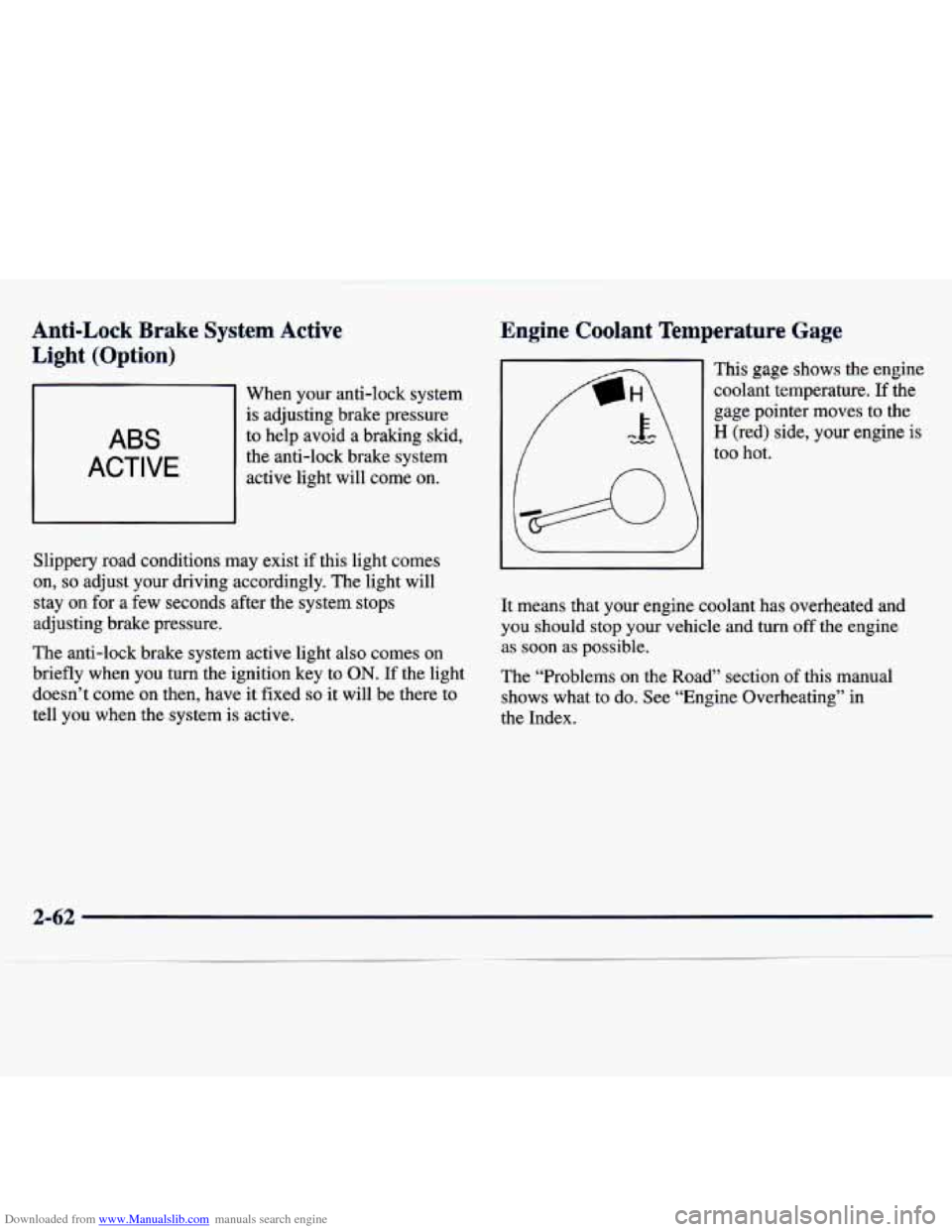
ABS
ACTIVE
r 1
When your anti-lock system is adjusting brake pressure
to help avoid a braking skid,
the anti-lock brake system active light will come on.
Slippery road conditions may exist if this light comes
on,
so adjust your driving accordingly. The light will
stay on for a few seconds after the system stops
adjusting brake pressure.
The anti-lock brake system active light also comes on
briefly when you turn the ignition key to
ON. If the light
doesn’t come on then, have it fixed
so it will be there to
tell you when the system is active. This
gage shows the engine
coolant temperature. If the
gage pointer moves to the
H (red) side, your engine is
too hot.
It means that your engine coolant has overheated and
you should stop your vehicle and
turn off the engine
as soon as possible.
The “Problems on the Road” section of this manual
shows what to do. See “Engine Overheating’’ in
the Index.
2-62
Page 152 of 386
Downloaded from www.Manualslib.com manuals search engine Avoid needless heavy braking. Some people drive in
spurts
-- heavy acceleration followed by heavy
braking
-- rather than keeping pace with traffic. This is a
mistake. Your brakes may not have time to cool between
hard stops.
Your brakes will wear out much faster if you
do a lot of heavy braking.
If you keep pace with the
traffic and allow realistic following distances, you will
eliminate a lot of unnecessary braking. That means
better braking and longer brake life.
If your engine ever stops while you’re driving, brake
normally but don’t pump your brakes. If you do, the
pedal may get harder to push down. If your engine
stops, you will still have some power brake assist. But
you will
use it when you brake. Once the power assist is
used up, it may take longer to stop and the brake pedal
will be harder to push.
Anti-Lock Brakes (Option)
Your vehicle may have anti-lock brakes (ABS). ABS is
an advanced electronic braking system that will help
prevent a braking skid.
ABS
If your vehicle has anti-lock
brakes, this warning light on
the instrument panel will
come on briefly when you
start your vehicle.
When you start your engine, or when you begin to drive away, your anti-lock brake system will check
itself. You
may hear a momentary motor or clicking noise while
this test is going on, and you may even notice that your
brake pedal moves or pulses a little. This is normal.
If there’s
a problem with the anti-lock brake system, the
anti-lock brake system warning light will stay on or
flash. See “Anti-Lock Brake System Warning Light” in
the Index.
4-7
Page 154 of 386
Downloaded from www.Manualslib.com manuals search engine Remember: Anti-lock doesn’t change the time you need
to get your foot up to the brake pedal or always decrease
stopping distance. If you get too close
to the vehicle in
front of you, you won’t have time to apply your brakes
if that vehicle suddenly
slows or stops. Always leave
enough room up ahead to stop, even though you have anti-lock brakes.
Using Anti-Lock
Don’t pump the brakes. Just hold the brake pedal down
firmly and let anti-lock work for you. You may feel a
slight brake pedal pulsation or notice some noise, but
this is normal.
ABS
ACTIVE
When your anti-lock system
is adjusting brake pressure
to help avoid a braking skid,
this light will come on. See
“Anti-Lock Brake System
Active Light” in the Index.
Braking in Emergencies
At some time, nearly every driver gets into a situation
that requires hard braking.
If you have anti-lock, you can steer and brake at the
same time. However, if you don’t have anti-lock, your
first reaction
-- to hit the brake pedal hard and hold it
down
-- may be the wrong thing to do. Your wheels can
stop rolling. Once they do, the vehicle can’t respond to
your steering. Momentum will carry it in whatever direction it was headed when the wheels stopped rolling.
That could be
off the road, into the very thing you were
trying to avoid, or into traffic.
If you don’t have anti-lock, use a “squeeze” braking
technique. This
will give you maximum braking while
maintaining steering control.
You do this by pushing on
the brake pedal with steadily increasing pressure.
In an emergency, you will probably want to squeeze the
brakes hard without locking the wheels. If you hear or
feel the wheels sliding, ease
off the brake pedal. This
will help
you retain steering control. (If you do have
anti-lock, it’s different: see “Anti-Lock Brakes” in
the Index
.)
In many emergencies, steering can help you more than
even
the very best braking.
4-9
Page 168 of 386
Downloaded from www.Manualslib.com manuals search engine A CAUTION:
I
Shifting the transfer case to NEUTRAL (N) can
cause your vehicle to roll even if the transmission
is in
PARK (P) (or, if you have the manual
transmission, even
if you’re in gear). This is
because the NEUTRAL
(N) position on the
transfer case overrides the transmission. You or
someone else could be injured. If you are going to
leave your vehicle, set the parking brake and
shift the transmission to PARK
(P) (or, put your
manual transmission in FIRST
(1)). But do not
shift the transfer case to the NEUTRAL
(N)
position. Leave the transfer case in the 2H, 4H or
4L position.
Driving Downhill
When off-roading takes you downhill, you’ll want to
consider a number of things:
0 How steep is the downhill? Will I be able to maintain
vehicle control?
0
0
0
What’s the surface like? Smooth? Rough? Slippery?
Hard-packed dirt? Gravel?
Are there hidden surface obstacles? Ruts?
Logs? Boulders?
What’s at the bottom of the hill?
Is there a hidden
creek bank
or even a river bottom with large rocks?
If you decide you can
go down a hill safely, then try to
keep your vehicle headed straight down, and use a low gear. This way, engine drag can help your brakes and
they won’t have to do all the work. Descend slowly,
keeping your vehicle under control at all times.
Heavy braking when going down
a hill can cause
your brakes to overheat and fade. This could
cause loss
of control and a serious accident.
Apply the brakes lightly when descending
a
hill and use a low gear to keep vehicle speed
under control.
4-23
Page 173 of 386
Downloaded from www.Manualslib.com manuals search engine Driving in Water
Light rain causes no special off-road driving problems. But heavy rain can mean flash flooding, and flood
waters demand extreme caution.
Find out how deep the water is before you drive through
it.
If it’s deep enough to cover your wheel hubs, axles or
exhaust pipe, don’t try it
-- you probably won’t get
through. Also, water that deep can damage your axle
and other vehicle parts.
If the water isn’t too deep, then drive through it slowly.
At fast speeds, water splashes on your ignition system
and your vehicle can stall. Stalling can also occur if you
get your tailpipe under water. And, as long as your
tailpipe is under water, you’ll never be able
to start your
engine. When you
go through water, remember that
when your brakes get wet, it may take you longer
to stop.
A CAUTION:
Driving through rushing water can be dangerous.
Deep water can sweep your vehicle downstream
and you and your passengers could drown.
If it’s
only shallow water, it can still wash
away the
ground from under your tires, and you could lose
traction and roll the vehicle over. Don’t drive
through rushing water.
See “Driving Through Water” in the Index
for more
information on driving through water,
4-28
Page 177 of 386
Downloaded from www.Manualslib.com manuals search engine lb
CAC 'ION:
-
Wet brakes can cause accidents. They won't work
as well in a quick stop and may cause pulling to
one side. You could lose control of the vehicle.
After driving through a large puddle
of water or
a car wash, apply your brake pedal lightly until
your brakes work normally.
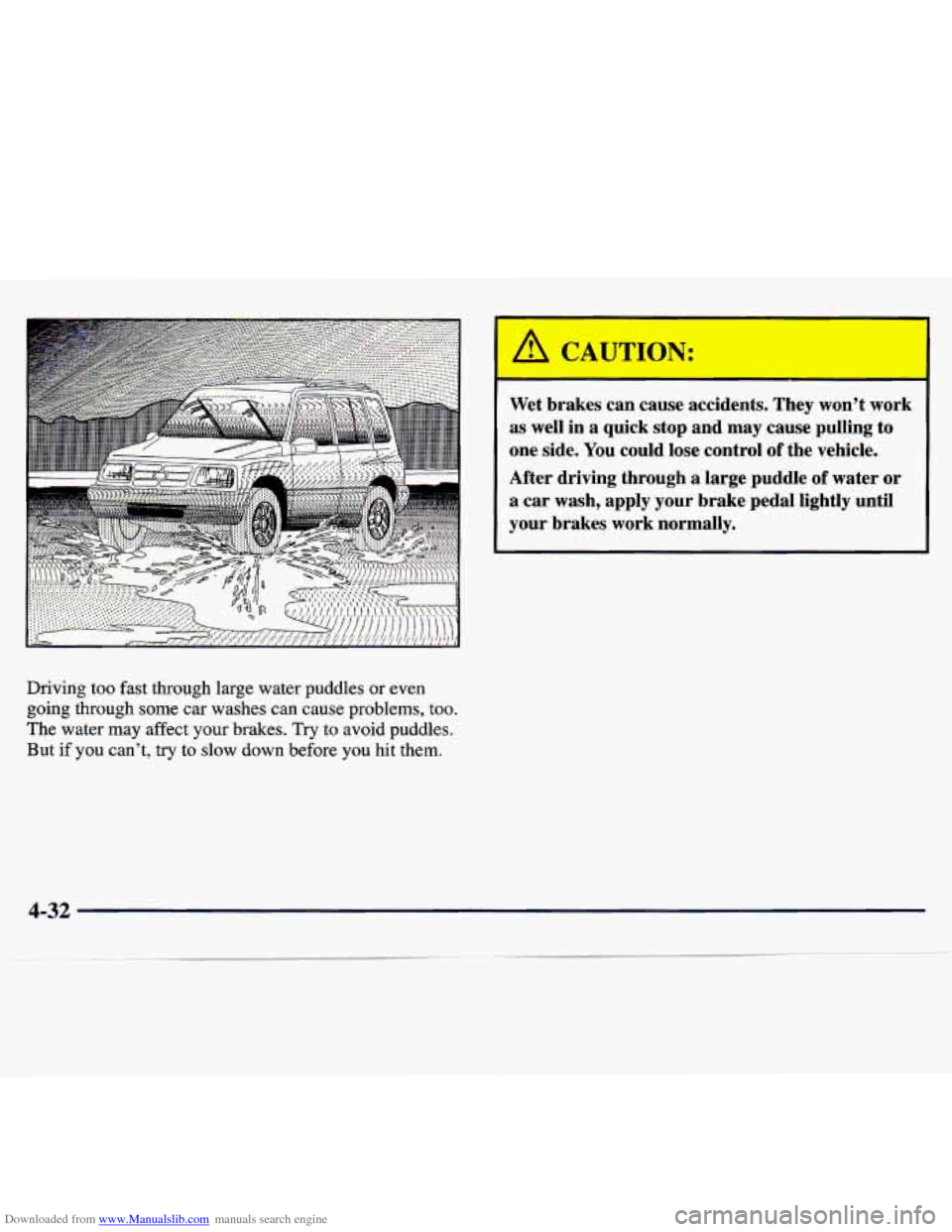
Driving too fast through large water puddles or even going through some car washes can cause problems,
too.
The water may affect your brakes. Try to avoid puddles.
But if you can't, try to slow down before you hit them.
4-32
Page 269 of 386
Downloaded from www.Manualslib.com manuals search engine Brake Wear
Your vehicle has front disc brakes and rear drum brakes.
Disc brake pads have built-in wear indicators that
make a high-pitched warning sound when the brake
pads are worn and new pads are needed. The sound
may come and go or be heard all the time your vehicle
is moving (except when you are pushing on the brake
pedal firmly).
The brake wear warning sound means that soon
your brakes won’t work well. That could lead to
an accident. When you hear the brake wear
warning sound, have your vehicle serviced.
NOTICE:
Continuing to drive with worn-out brake pads
could result in costly brake repair.
Some driving conditions or climates may cause a
brake squeal when the brakes are first applied
or
lightly applied. This does not mean something is
wrong with your brakes.
Properly torqued wheel nuts are necessary to help
prevent brake pulsation. When tires are rotated, inspect
brake pads for wear and evenly torque wheel nuts in
the proper sequence to
GM specifications.
Your rear drum brakes don’t have wear indicators,
but if you ever hear a rear brake rubbing noise, have the
rear brake linings inspected immediately. Also, the rear
brake drums should be removed and inspected each time
the tires are removed for rotation or changing. When
you have the front brake pads replaced, have the rear
brakes inspected, too.
Brake linings should always be replaced as complete
axle sets.
See “Brake System Inspection” in Section
7 of this
manual under Part C “Periodic Maintenance Inspections.”
Brake Pedal Travel
See your dealer if the brake pedal does not return to
normal height, or if there is a rapid increase in pedal
travel. This could be a sign
of brake trouble.
6-32
Page 297 of 386
Downloaded from www.Manualslib.com manuals search engine 1
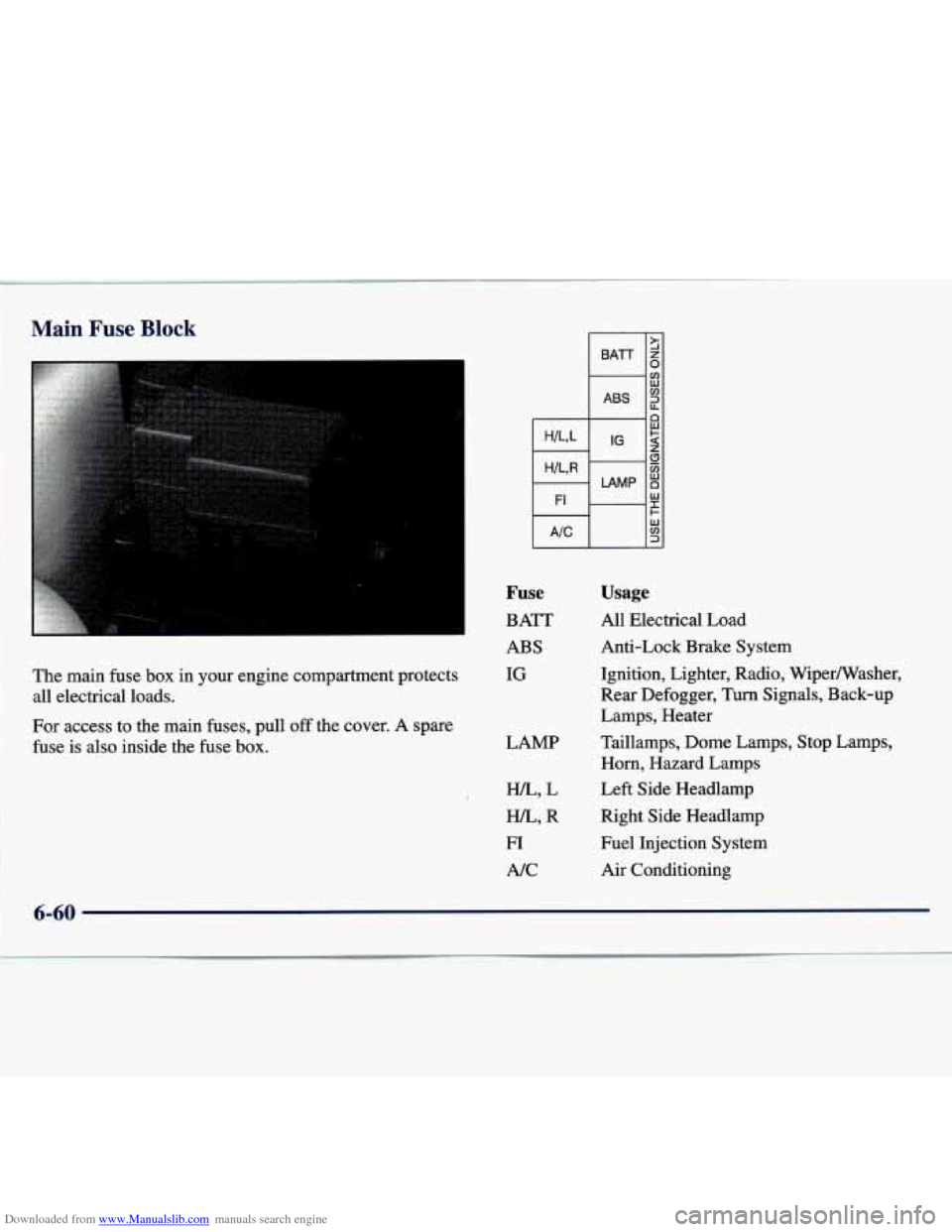
Main Fuse Block
The main fuse box in your engine compartment protects
all electrical loads.
For access to the main fuses, pull
off the cover. A spare
fuse is also inside the fuse
box.
Fuse
BATT
ABS
IG
LAMP
Usage
All Electrical Load
Anti-Lock Brake System
Ignition, Lighter, Radio, WiperNasher,
Rear Defogger,
Turn Signals, Back-up
Lamps, Heater
Taillamps, Dome
Lamp, Stop Lamps,
Horn, Hazard Lamps
Left Side Headlamp
Right Side Headlamp
Fuel Injection System
Air Conditioning
6-60
Page 374 of 386

Downloaded from www.Manualslib.com manuals search engine 0 Section 9 Index
Adding Equipment to the Outside of Your Vehicle ..... 6-3
Air Bag
....................................... 1-25
Adding Equipment
............................ 1-3 1
How Does it Restrain .......................... 1-29
How it Works ................................ 1-27
Location
.................................... 1-27
Readiness Light
......................... 1-26. 2-59
Servicing
................................... 1-31
What Makes it Inflate
.......................... 1-28
What Will You See After
it Inflates ............... 1-29
When Should it Inflate
......................... 1-28
Aircleaner
.................................... 6-15
Air Conditioning ................................ 3-3
Air Conditioning Refrigerants ..................... 6-63
Alignment and Balance. Tire
...................... 6-46
Antenna
...................................... 3-17
Antifreeze
..................................... 6-24
Anti-Lock Brake System Active Light
................. 2-62. 4.9
Brake System Warning Light
................ 2.61. 4.7
Brakes
...................................... 4-7
Appearance Care Materials
....................... 6-56
Arbitration Program
.............................. 8-9
Ashtrays ...................................... 2-40
Aluminum Wheels. Cleaning
...................... 6-54
AppearanceCare
............................... 6-48 Audio Systems
.................................. 3-6
Automatic
Overdrive
................................... 2-15
Overdrive
Off Switch .......................... 2-15
Automatic Transmission
.......................... 2-9
Check
...................................... 7-48
Fluid
....................................... 6-17
Operation
................................... 2-11
Park Mechanism Check
........................ 7-50
Starting Your Engine
........................... 2-9
Front
....................................... 6-23
Rear
....................................... 6-22
Shifting
..................................... 2-11
Axle
Battery
...................................... 6-33
Jump Starting
................................. 5-3
Warnings
................................ 5.3. 5.4
BBB Auto Line
................................. 8-9
Better Business Bureau Mediation
................... 8-9
Blizzard
...................................... 4-41
Brake
Adjustment
.................................. 6-33
Fluid
....................................... 6-30
Master Cylinder
.............................. 6-29
Parking
..................................... 2-21