engine oil CHEVROLET TRACKER 1998 1.G Owner's Manual
[x] Cancel search | Manufacturer: CHEVROLET, Model Year: 1998, Model line: TRACKER, Model: CHEVROLET TRACKER 1998 1.GPages: 386, PDF Size: 21.17 MB
Page 257 of 386
Downloaded from www.Manualslib.com manuals search engine How to Add Fluid
Refer to the Maintenance Schedule to determine what
kind
of transmission fluid to use. See “Recommended
Fluids and Lubricants” in the Index.
Add fluid only after checking the transmission fluid
while it is hot. (A cold check is used only as
a
reference.) If the fluid level is low, add only enough of
the proper fluid to bring the level up to the
HOT area for
a hot check. It doesn’t take much fluid, generally less
than one pint
(0.5 L). Don’t overfzll.
NOTICE:
We recommend you use only fluid labeled
DEXRON@-111, because fluid with that label is
made especially for your automatic transmission.
Damage caused by fluid other than
DEXRON-I11
is not covered by your new vehicle warranty.
After adding fluid, recheck the fluid level as
When the correct fluid level is obtained, push the described under
“How to
Check.”
dipstick back in all the way.
Manual Transmission Fluid
When to Check and Change
A good time to have it checked is when the engine
oil is changed. Refer to the Maintenance Schedule to
determine when to change your transmission fluid. See
“Scheduled Maintenance Services” in the Index.
How to Check
Because this operation can ue a little difficult, you may
choose to have this done at your Chevrolet dealership
Service Department.
If you do it yourself, be sure to follow all the
instructions here, or you could get a false reading.
NOTICE:
Too much or too little fluid can damage your
transmission.
Too much can mean that some of
the fluid could come out and fall on hot engine
parts or exhaust system
parts, starting a fire. Be
sure to get an accurate reading if you check your
transmission fluid.
6-20
Page 261 of 386
Downloaded from www.Manualslib.com manuals search engine When the differential is cold, add enough lubricant
to raise the level to 1/2 inch (12
mm) below the filler
plug hole.
When the differential is at operating temperature
(warm), add enough lubricant to raise the level to
the bottom
of the filler plug hole.
What to Use
Refer to the Maintenance Schedule to determine what
kind of lubricant to use. See “Recommended Fluids and
Lubricants” in the Index.
Engine Coolant
The following explains your cooling system and
how to add coolant when it is low. If you have a
problem with engine overheating, see “Engine
Overheating” in the Index.
A 50/50 mixture of water and the proper coolant will:
0 Give freezing protection down to -33°F (-36°C).
Give boiling protection up to 258 OF (1 25 O C).
Protect against rust and corrosion.
Help keep the proper engine temperature.
Let the warning lights and gages work as
they should.
What to Use
Use a mixture of one-half clean water (preferably
distilled) and one-half coolant that meets GM
Specification 1825-M, which won’t damage aluminum
parts.
You can also use a recycled coolant conforming
to GM Specification 1825-M with a complete coolant
flush and refill.
If you use this mixture, you don’t need
to add anything else.
Adding only plain water
to your cooling system
can be dangerous. Plain water, or some other
liquid like alcohol, can boil before the proper
coolant mixture will. Your vehicle’s coolant
warning system
is set for the proper coolant
mixture. With plain water or the wrong mixture,
your engine could get
too hot but you wouldn’t
get the overheat warning. Your engine could
catch fire and you or others could be burned.
Use a
50/50 mixture of clean water and the
proper coolant.
Page 268 of 386
Downloaded from www.Manualslib.com manuals search engine What to Add
When you do need brake fluid, use only DOT-3
brake fluid
-- such as Delco Supreme 11 @ (GM Part
No. 12377967). Use new brake fluid from a sealed
container only.
Always clean the brake fluid reservoir cap and the area
around the cap before removing it. This will help keep
dirt from entering the reservoir.
I
With the wrong kind of fluid in your brake
system, your brakes may not work well, or they
may not even work at
all. This could cause a
crash. Always use the proper brake fluid.
NOTICE:
0
0
Using the wrong fluid can badly damage
brake system parts. For example, just
a few
drops of mineral-based oil, such as engine
oil, in your brake system
can damage brake
system parts
so badly that they’ll have to be
replaced. Don’t let someone put in the
wrong kind of fluid.
If you spill brake fluid on your vehicle’s
painted surfaces, the paint finish can be
damaged. Be careful not
to spill brake fluid
on your vehicle.
If you do, wash it off
immediately. See “Appearance Care” in
the Index.
6-31
-
Page 286 of 386
Downloaded from www.Manualslib.com manuals search engine Cleaning the Inside of Your Vehicle
Use a vacuum cleaner often to get rid of dust and loose
dirt. Wipe vinyl, leather, plastic and painted surfaces
with a clean, damp cloth.
Your dealer has two cleaners, Multi-Purpose Interior
Cleaner and Capture Non-Solvent
Dry Spot and Soil
Remover. They will clean normal spots and stains
very
well. You can get GM-approved cleaning products from
your dealer. (See "Appearance Care and Materials" in
the Index.)
Here are some cleaning tips:
0 Always read the instructions on the cleaner label.
0 Clean up stains as soon as you can -- before they set.
0 Carefully scrape off any excess stain.
Use a clean cloth or sponge, and change to a
clean area often.
A soft brush may be used if
stains are stubborn.
0 If a ring forms after spot cleaning, clean the entire
area immediately or it will set.
Using Multi-Purpose Interior Cleaner
on Fabric
1. Vacuum and brush the area to remove any loose dirt.
2. Always clean a whole trim panel or section. Mask
surrounding trim along stitch or welt lines.
3. Mix powdered cleaner following the directions on
the container label to
form thick suds.
4. Use suds only and apply with a clean sponge. Don't
5. As soon as you've cleaned the section, use a sponge
saturate the material and
don't rub
it roughly.
to remove the suds.
6. Wipe cleaned area with a clean, damp towel or cloth.
7. Wipe with a clean cloth and let dry.
Page 287 of 386
Downloaded from www.Manualslib.com manuals search engine Special Fabric Cleaning Pr-+ms
Stains caused by such things as catsup, coffee (black),
egg, fruit, fruit juice, milk, soft
drinks, vomit, urine and
blood can be removed as follows:
1. Carefully scrape off excess stain, then sponge the
soiled area with cool water.
2. If a stain remains, follow the multi-purpose interior
cleaner instructions described earlier.
3. If an odor lingers after cleaning vomit
or urine,
treat the area with a waterhaking soda solution:
1 teaspoon
(5 ml) of baking soda to 1 cup (250 ml)
of lukewarm water.
4. Let dry.
Stains caused by candy, ice cream, mayonnaise, chili
sauce and unknown stains can be removed as follows:
1. Carefully scrape off excess stain.
2. First, clean with cool water and allow to
dry completely.
3. If a stain remains, follow instructions for
Multi-Purpose Interior Cleaner.
Fabric Protection
Your vehicle has upholstery that has been treated with
Scotchgard Fabric Protector, a
3M product. It protects
fabrics by repelling oil and water, which
are the carriers
of most stains. Even with this protection, you still need
to clean your upholstery often to keep
it looking new.
Further information on cleaning is available by calling 1-800-433-3296 (in Minnesota, 1-800-642-6167).
Cleaning Vinyl
Use warm water and a clean cloth.
0 Rub with a clean, damp cloth to remove dirt. You
may have to do it more than once.
Things like tar, asphalt and shoe polish will stain
if you don't get them off quickly. Use a clean cloth
and a vinyueather cleaner. See your dealer for
this product.
Cleaning the Top of the Instrument Panel
Use only mild soap and water to clean the top surfaces
of the instrument panel. Sprays containing silicones
or
waxes may cause annoying reflections in the windshield
and even make it difficult to see through the windshield
under certain conditions.
6-50
Page 290 of 386
Downloaded from www.Manualslib.com manuals search engine I NOTICE:
Machine compounding or aggressive polishing on
a basecoatklearcoat paint finish may dull the
finish or leave swirl marks.
Foreign materials such as calcium chloride and other
salts, ice melting agents, road oil and tar, tree sap, bird
droppings, chemicals from industrial chimneys, etc., can
damage your vehicle’s finish if they remain on painted
surfaces. Wash the vehicle as soon as possible.
If
necessary, use non-abrasive cleaners that are marked
safe for painted surfaces to remove foreign matter.
Exterior painted surfaces are subject to aging, weather and chemical fallout that can take their toll over a period
of years.
You can help to keep the paint finish looking
new by keeping your vehicle garaged
or covered
whenever possible.
Special Care for Canvas Top and
Plastic Windows
To protect the canvas top:
After you wash the vehicle, make sure the top is
completely dry before you open or remove
it.
0 Don’t get any vinyl cleaner on the vehicle’s painted
finish; it could leave streaks.
Don’t go through automatic car washes; the canvas
The plastic windows are pliable and can be scratched
if
you don’t take these precautions when you clean them:
top could be damaged.
0
0
0
0
Wipe off dust with a
soft cotton cloth moistened with
clean, cool or lukewarm water. Don’t use a “dry”
cloth. Wipe in one direction only, not back and forth.
To remove frost, snow or ice, use lukewarm water.
Don’t use a scraper or any de-icing fluids.
Wash the windows with a soft cloth and clean, cool
or lukewarm water. Never use a dry cloth, hot water,
strong soap or detergent, solvents or harsh cleaning
agents. Rinse thoroughly and wipe with a slightly
moist soft, clean cloth.
Don’t put any labels, stickers or tape on windows.
It’s hard to remove adhesives left on the window
when such items are removed. If
a sticker or label
must be removed, remove any adhesive left on the
window while the adhesive is still soft and sticky.
Press on a new sticker or piece of tape and then lift
it
off again; keep doing this until all the adhesive
lifts
off with the sticker or tape.
6-53
Page 293 of 386
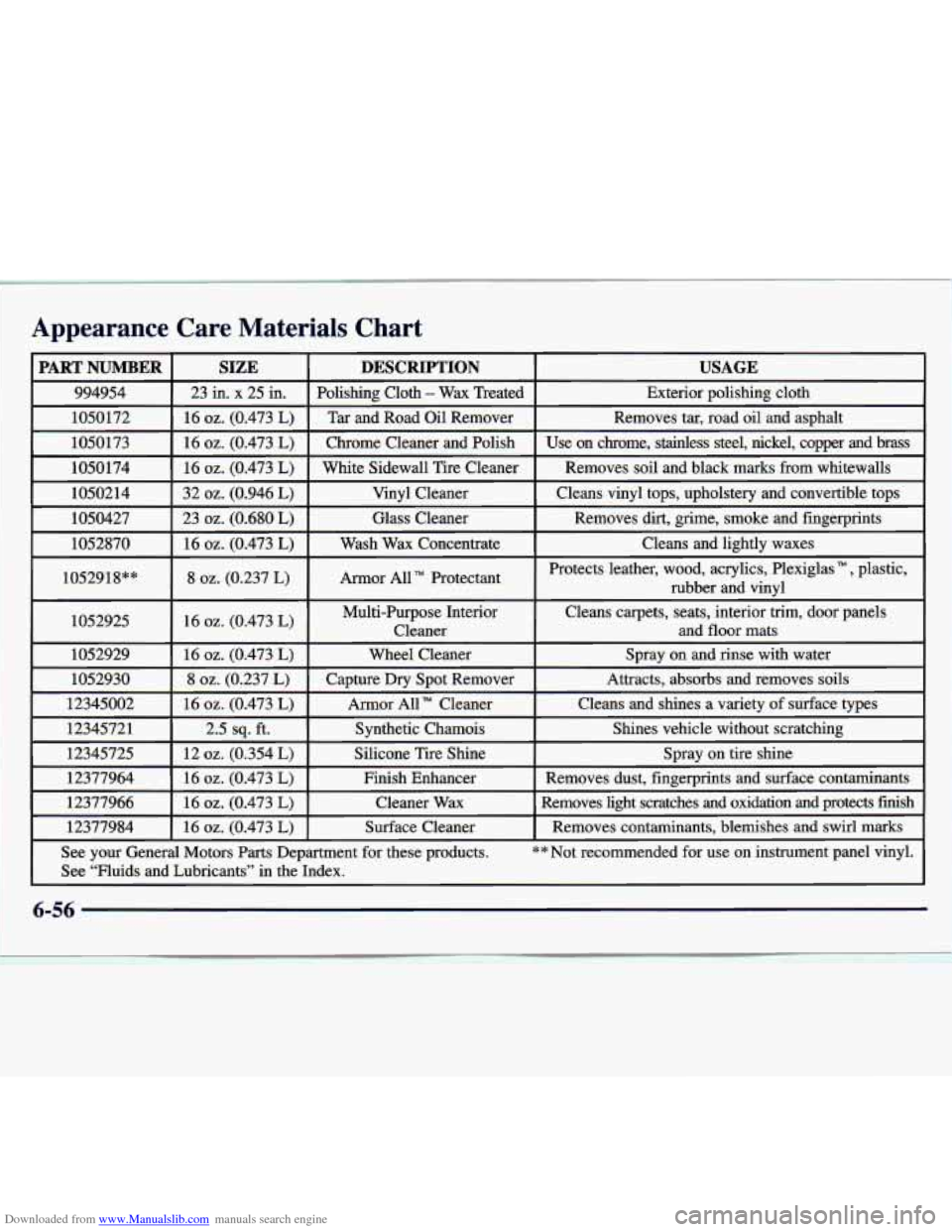
Downloaded from www.Manualslib.com manuals search engine Appearance Care Materials Chart
PART NUMBER SIZE
DESCRIPTION USAGE
~~
994954 23 in. x 25 in. Polishing Cloth - Wax Treated Exterior polishing cloth
~~
1050172 16 oz. (0.473 L) Tar and Road Oil Remover Removes tar, road oil an\
d asDhalt
1050173 16
oz. (0.473 L) Chrome Cleaner and Polish Use on chrome, stainless steel, nickel, copper and bras7
1050174
16 oz. (0.473 L) White Sidewall Tire Cleaner Removes soil and black marks from whitewalls
1050214 32
oz. (0.946 L) Vinyl Cleaner Cleans vinyl tops, upholstery and convertible tops
1050427 23
oz. (0.680 L) Glass Cleaner Removes dirt, grime, smoke and fingerprints
1052870 16
oz. (0.473 L) Wash Wax Concentrate Cleans and lightly waxes
I 1052918"" I 8 oz. (0.237 L) I Armor
All" Protectant I
Protects leather, wood, acrylics, Plexiglas " , plastic,
rubber and vinvl
I
1052925 16 oz. (0.473 L)
1052929 16 oz. (0.473 L) Wheel Cleaner Spray on and rinse with water
Multi-Purpose Interior Cleans carpets, seats, interior trim, door\
panels
Cleaner and floor mats I I I
I 1052930 I 8 oz. (0.237 L) I Capture Dry Spot Remover I Attracts, absorbs and removes soils I
--
I
I I A ..L I
12345002 I 16 oz. (0.473 L) I Armor All TM Cleaner I Cleans and shines a variety of surface types I I I
I 1234572 1 I 2.5 sq. ft. I Synthetic Chamois I Shines vehicle without scratching;
--
I I I
I 12345725 I 12 oz. (0.354 L) I Silicone Tire Shine I Spray on tire shine I
v
I I I
I 12377964 I 16 oz. (0.473 L) I Finish Enhancer I Removes dust, fingerprints and surface contaminants I
--
12377966 16 oz. (0.473 L) Cleaner Wax Removes light scratches and oxidation and protects finish
12377984 16
oz. (0.473 L) Surface Cleaner Removes contaminants, blemishes and swirl marks
See your General Motors
Parts Department for these products. ** Not recommended for use on instrument panel vinyl.
See
"Fluids and Lubricants" in the Index. __ -_ _ - c
6-56
Page 298 of 386
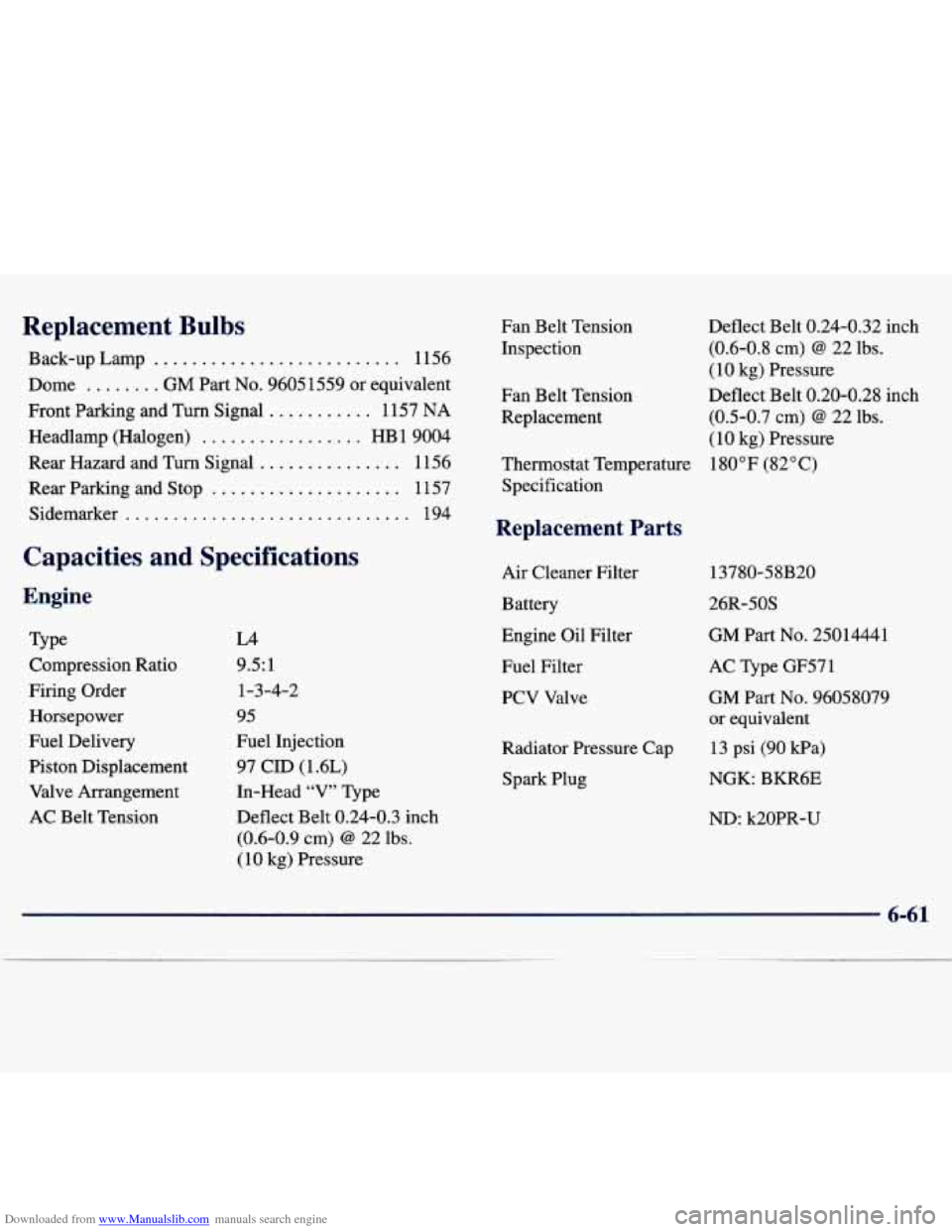
Downloaded from www.Manualslib.com manuals search engine Replacement Bulbs
Back-up Lamp .......................... 1156
Dome
........ GM Part No. 9605 1559 or equivalent
Front Parking and Turn Signal
........... 1157 NA
Headlamp (Halogen)
................. HB19004
Rear Hazard and Turn Signal
............... 1156
Rear Parking and Stop
.................... 1157
Sidemarker
.............................. 194
Capacities and Specifications
Engine
Type Compression Ratio
Firing Order Horsepower
Fuel Delivery
Piston Displacement
Valve Arrangement
AC Belt Tension
LJ4
9.5: 1
1-3-4-2
95
Fuel Injection
97 CID (1.6L)
In-Head
“V” Type
Deflect Belt 0.24-0.3 inch
(0.6-0.9 cm)
@ 22 lbs.
( 10 kg) Pressure Fan Belt Tension Deflect Belt 0.24-0.32 inch
Inspection (0.6-0.8 cm)
@ 22 lbs.
Fan Belt Tension Deflect Belt 0.20-0.28 inch
Replacement
(0.5-0.7 cm) @ 22 lbs.
Thermostat Temperature 1 80°F (82
O C)
Specification (10
kg) Pressure
(10 kg) Pressure
Replacement Parts
Air Cleaner Filter
Battery
Engine Oil Filter
Fuel Filter
PCV Valve
Radiator Pressure
Cap
Spark Plug 13780-58B20
26R-50s
GM Part
No. 25014441
AC Type GF571
GM Part
No. 96058079
or equivalent
13 psi (90 Wa)
NGK: BKR6E
ND: k2OPR-U
6-61
Page 299 of 386
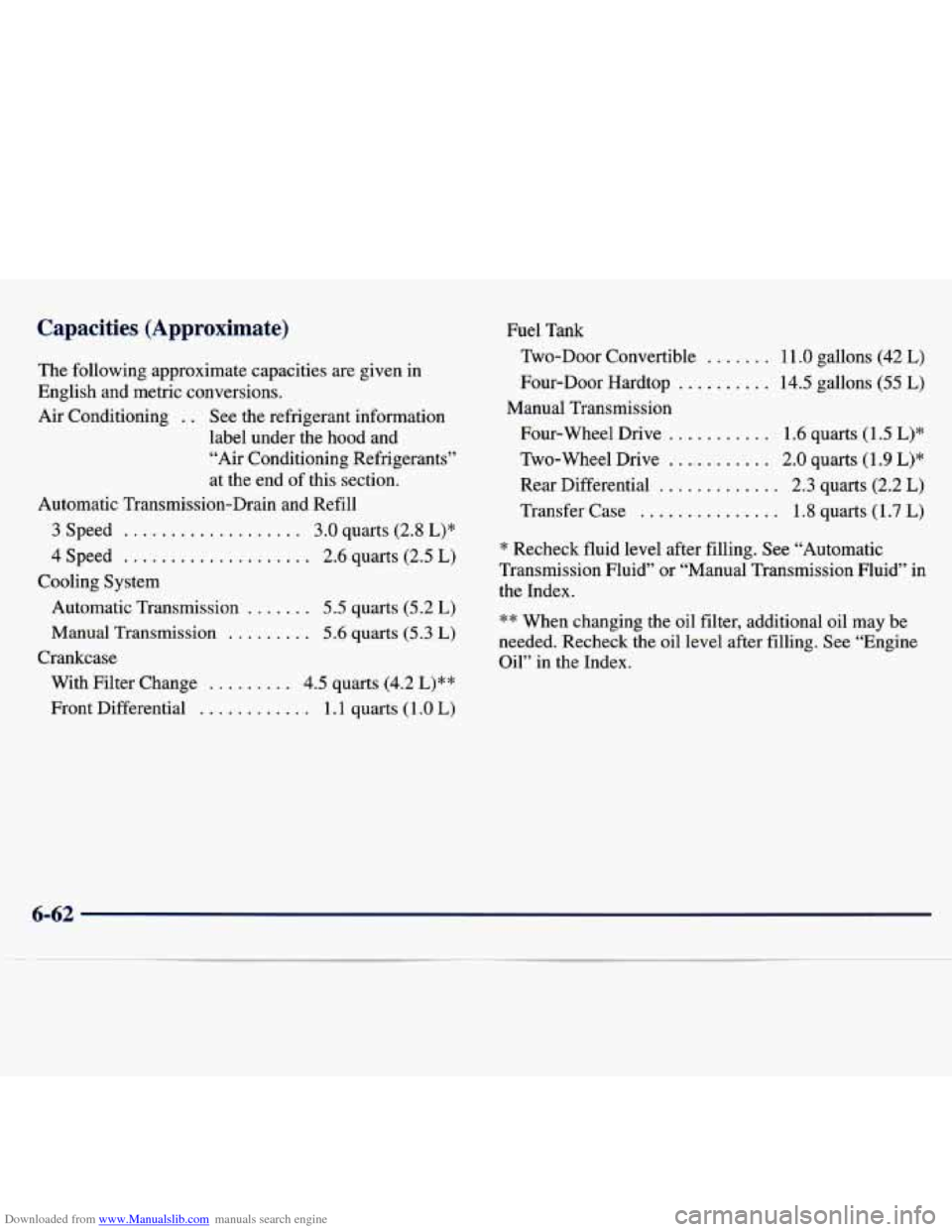
Downloaded from www.Manualslib.com manuals search engine Capacities (Approximate)
The following approximate capacities are given in
English and metric conversions.
Air Conditioning
. . See the refrigerant information
label under the hood and
“Air Conditioning Refrigerants”
at the end of this section.
Automatic Transmission-Drain and Refill
3 Speed ................... 3.0 quarts (2.8 L)*
4 Speed .................... 2.6 quarts (2.5 L)
Automatic Transmission ....... 5.5 quarts (5.2 L)
Manual Transmission ......... 5.6 quarts (5.3 L)
Cooling System
Crankcase
With Filter Change
......... 4.5 quarts (4.2 L)**
Front Differential ............ 1.1 quarts ( 1 .O L)
Fuel Tank
Two-Door Convertible
....... 11 .O gallons (42 L)
Four-Door Hardtop .......... 14.5 gallons (55 L)
Manual Transmission Four-wheel Drive
........... 1.6 quarts (1.5 L)*
Two-Wheel Drive ........... 2.0 quarts (1.9 L)*
Rear Differential ............. 2.3 quarts (2.2 L)
Transfer Case ............... 1.8 quarts (1.7 L)
* Recheck fluid level after filling. See “Automatic
Transmission Fluid” or “Manual Transmission Fluid” in
the Index.
** When changing the oil filter, additional oil may be
needed. Recheck the oil level after filling. See “Engine
Oil” in the Index.
6-62
Page 305 of 386
Downloaded from www.Manualslib.com manuals search engine I IMPORTANT: I
KEEP ENGINE OIL
AT THE PROPER
LEVEL AND CHANGE AS
RECOMMENDED
protectjon I
Have you purchased the GM Protection Plan? The Plan
supplements your new vehicle warranties. See your
Warranty and Owner Assistance booklet, or your
Chevrolet dealer for details.
Introductic -I
Your Vehicle and the Environment
Proper vehicle maintenance not only helps to keep your
vehicle in good working condition, but also helps the
environment. All recommended maintenance procedures
are important. Improper vehicle maintenance can even affect the quality of the air we breathe. Improper fluid
levels or the wrong tire inflation can increase the level
of emissions from your vehicle.
To help protect our
environment, and to keep your vehicle in good
condition, please maintain your vehicle properly.
How This Section is Organized
The remainder of this section is divided into five parts:
“Part A: Scheduled Maintenance Services” shows
what to have done and how often. Some of these
services can be complex,
so unless you are technically
qualified and have the necessary equipment,
you should
let your dealer’s service department or another qualified
service center do these jobs.
7-2