steering wheel CHEVROLET TRACKER 1998 1.G Owner's Manual
[x] Cancel search | Manufacturer: CHEVROLET, Model Year: 1998, Model line: TRACKER, Model: CHEVROLET TRACKER 1998 1.GPages: 386, PDF Size: 21.17 MB
Page 186 of 386
Downloaded from www.Manualslib.com manuals search engine Remember, unless you have anti-lock, if you brake so
hard that your wheels stop rolling, you’ll just slide.
Brake
so your wheels always keep rolling and you can
still steer.
Whatever your braking system, allow greater
following distance
on any slippery road.
0 Watch for slippery spots. The road might be fine
until you hit a spot that’s covered with ice. On an
otherwise clear road, ice patches may appear in
shaded areas where the sun can’t reach: around
clumps of trees, behind buildings or under bridges.
Sometimes the surface of a curve or
an overpass may
remain icy when the surrounding roads are clear.
If
you see a patch of ice ahead of you, brake before you
are on it.
Try not to brake while you’re actually on
the ice, and avoid sudden steering maneuvers.
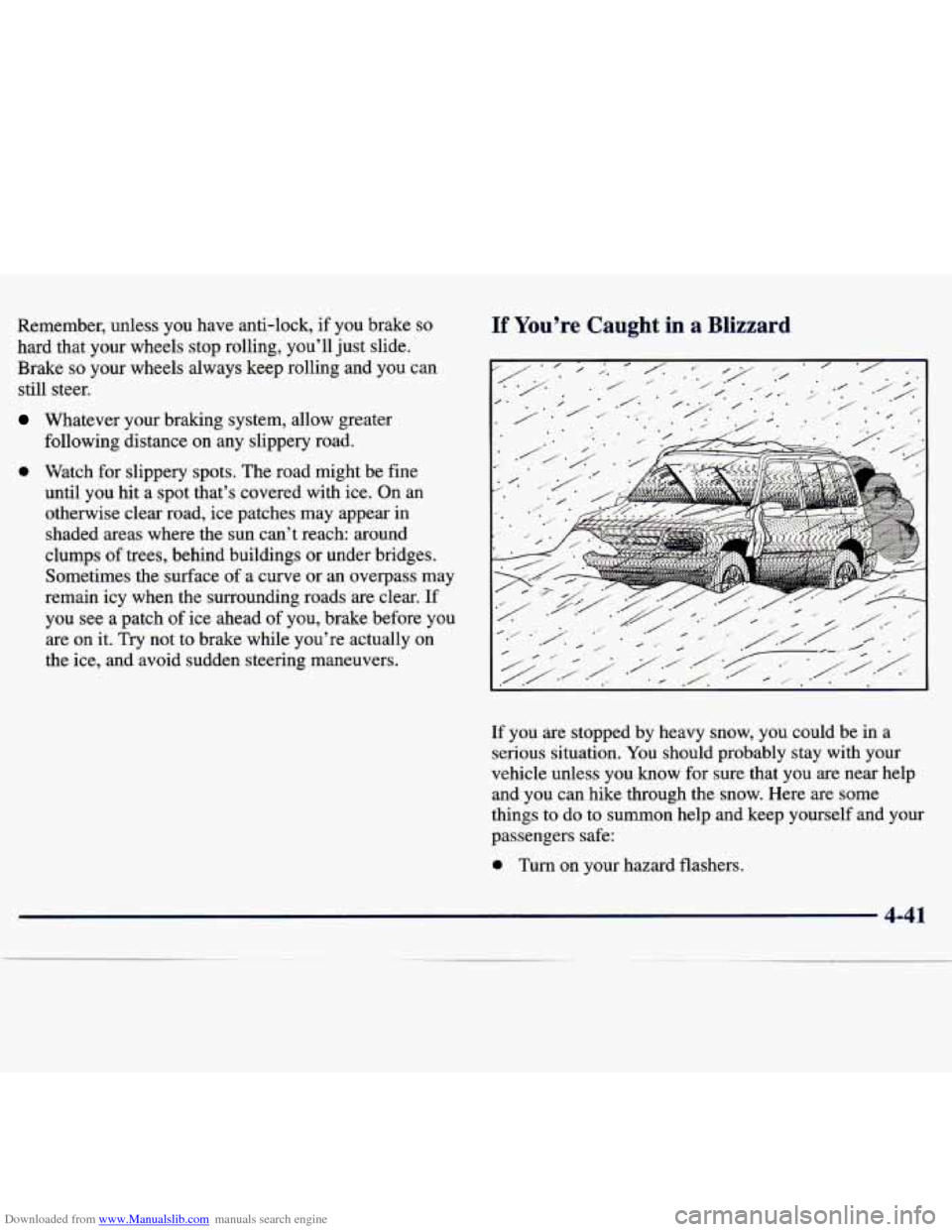
If You’re Caught in a Blizzard
If you are stopped by heavy snow, you could be in a
serious situation. You should probably stay with your
vehicle unless you know for sure that you are near help
and you can hike through the snow. Here are some
things to do to summon help and keep yourself and your
passengers safe:
0 Turn on your hazard flashers.
4-41
Page 189 of 386
Downloaded from www.Manualslib.com manuals search engine NOTICE:
Do not tow your vehicle with the rear wheels in
contact with the ground,
or the transmission
could be damaged.
2. Set the parking brake.
3. If your vehicle is a four-wheel-drive vehicle, set
your manual free-wheeling hubs to
FREE or unlock
your automatic freewheeling hubs. See “Four- Wheel
Drive”
in the Index.
4. Turn the ignition key to ACC to unlock the
steering wheel.
NOTICE:
Make sure that the towing speed does not exceed
55 mph (90 km/h), or your vehicle could be
badly damaged.
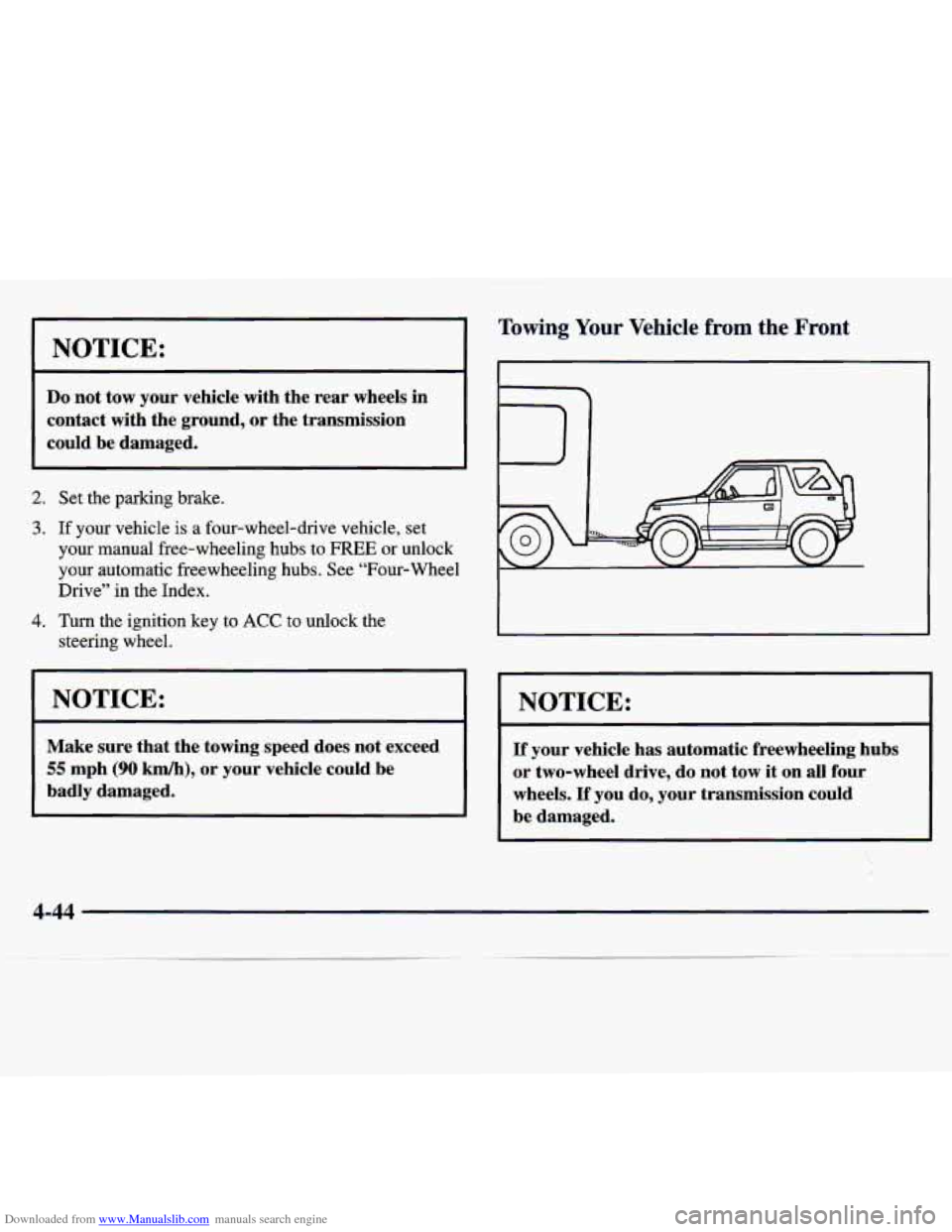
Towil- - Your Vehicle from the Front
I
NOTICE:
If your vehicle has automatic freewheeling hubs
or two-wheel drive, do not tow it on all four
wheels.
If you do, your transmission could
be damaged.
4-44
Page 190 of 386
Downloaded from www.Manualslib.com manuals search engine If you have a four-wheel-drive vehicle with manual
freewheeling hubs,
it can be towed from the front with
all four wheels on the ground. Follow these steps:
1.
2.
3.
4.
5.
6.
Set the parking brake.
Turn the ignition key to ACC to unlock the
steering wheel.
Shift your automatic transmission into
PARK (P), or
your manual transmission to SECOND
(2).
Shift the transfer case to NEUTRAL (N).
Set the hubs to
FREE. See “Four-wheel Drive” in
the Index.
Release the parking brake.
Stop towing every
200 miles (300 km) and start
the engine. Leave the transfer case shift lever in
NEUTRAL (N). Shift your automatic transmission
to DRIVE (D); leave a manual transmission in
SECOND
(2) with the clutch engaged. Run the engine at
medium speed for one minute to circulate oil in the
transfer case.
Turn the ignition key to ACC. Now, you
can continue towing your vehicle.
NOTICE:
The front wheels transmit shocks during towing.
The steering column may not be strong enough to
withstand the shocks. Always unlock the steering
wheel before towing.
I NOTICE:
Make sure that the towing speed does not exceed
50 mph (80 km/h), or your vehicle could be
badly damaged.
4-45
Page 198 of 386
Downloaded from www.Manualslib.com manuals search engine Following DisL --- ;e
Stay at least twice as far behind the vehicle ahead as you
would when driving your vehicle without a trailer. This
can help you avoid situations that require heavy braking
and sudden turns.
Passing
You’ll need more passing distance up ahead when you’re towing a trailer. And, because you’re a good deal \
longer, you’ll need to go much farther beyond the
passed vehicle before you can return to your lane.
Backing Up
Hold the bottom of the steering wheel with one hand.
Then, to move the trailer
to the left, just move that hand
to the left.
To move the trailer to the right, move your
hand to the right. Always back up slowly and, if
possible, have someone guide you.
Making mrns
NOTICE:
Making very sharp turns while trailering could
cause the trailer to come in contact with the
vehicle. Your vehicle could be damaged. Avoid
making very sharp turns while trailering.
When you’re turning with a trailer, make wider turns
than normal.
Do this so your trailer won’t strike
soft shoulders, curbs, road signs, trees or other
objects. Avoid jerky or sudden maneuvers. Signal well
in advance.
4-53
Page 210 of 386
Downloaded from www.Manualslib.com manuals search engine When your vehicle is being towed, have the ignition
key turned to OFF. The steering wheel should be
clamped
in a straight-ahead position, with a clamping
device designed for towing service.
Do not use the
vehicle’s steering column lock for this. The transmission
and transfer case, if
you have one, should be in
NEUTRAL (N) and the parking brake released.
Don’t have your vehicle towed on the drive wheels
unless you must.
If the vehicle must be towed on the
drive wheels, be sure to follow any speed and distance
restrictions later in this section, or
your transmission
will be damaged. If these limitations must be exceeded,
then the drive wheels have to be supported on a dolly.
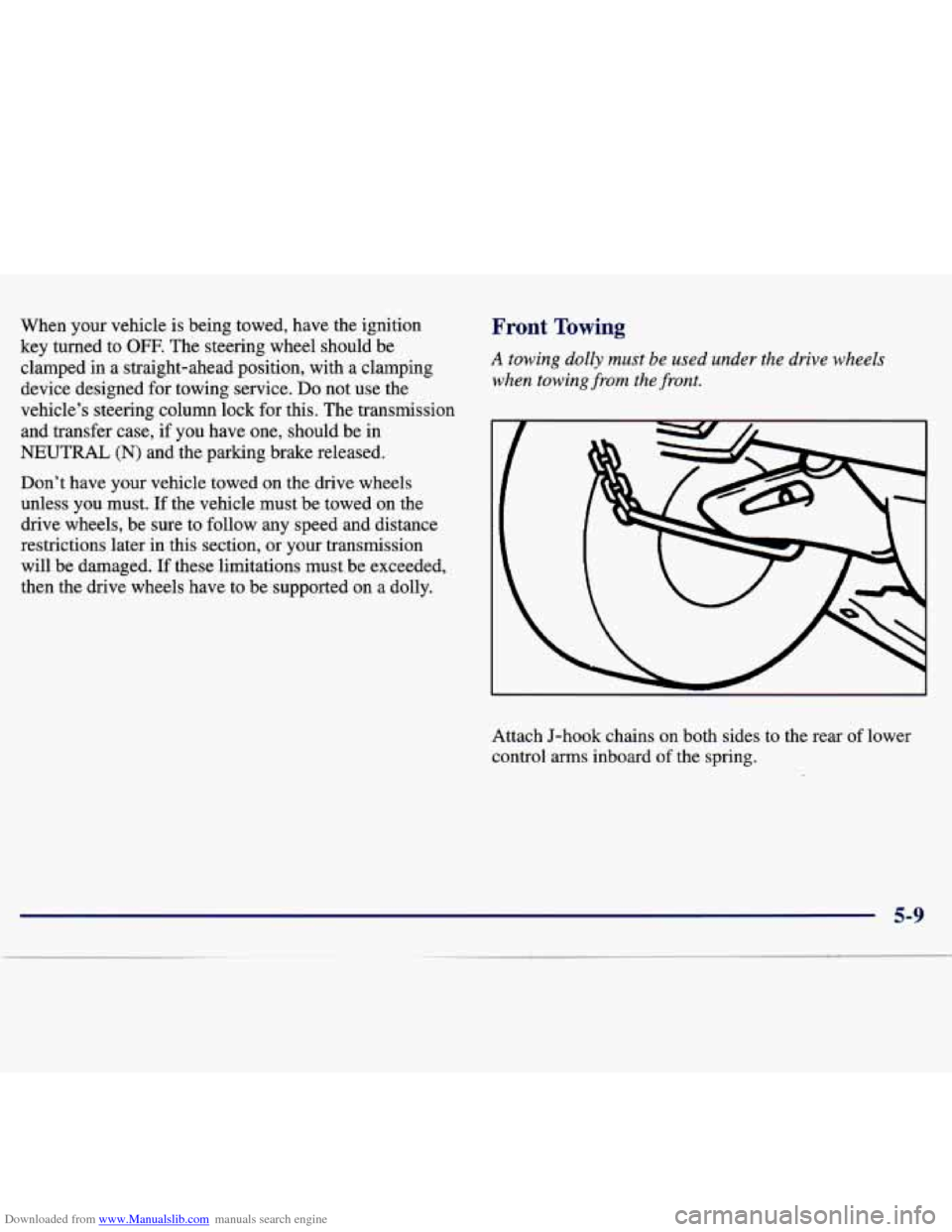
Front Towing
A towing dolly must be used under the drive wheels
when towing from the front.
Attach J-hook chains on both sides to the rear of lower
control arms inboard
of the spring.
5-9
Page 222 of 386
Downloaded from www.Manualslib.com manuals search engine If a Tire Goes Flat
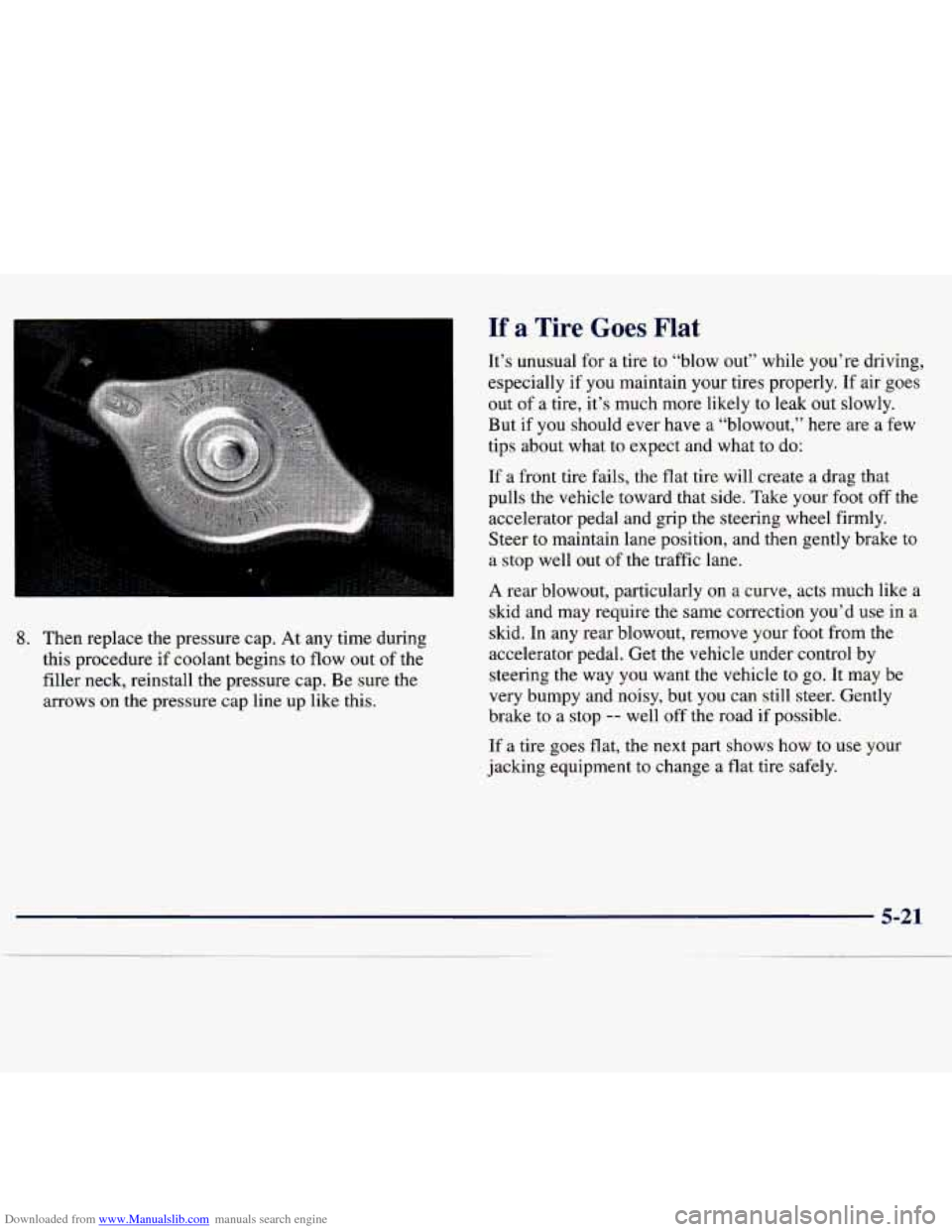
8. Then replace the pressure cap. At any time during
this procedure if coolant begins to flow out of the
filler neck, reinstall the pressure cap. Be sure the
arrows on the pressure cap line up like this. It’s unusual
for a tire to “blow out” while you’re driving,
especially if you maintain your tires properly. If air goes
out of a tire, it’s much more likely to leak out slowly.
But if you should ever have a “blowout,” here are a few\
tips about what to expect and what to do:
If a front tire fails, the flat tire will create a drag that
pulls the vehicle toward that side. Take your foot off the
accelerator pedal and grip the steering wheel firmly.
Steer to maintain lane position, and then gently brake to
a stop well out
of the traffic lane.
A rear blowout, particularly on a curve, acts much like a
skid and may require the same correction you’d use in a
skid. In any rear blowout, remove your foot from the
accelerator pedal. Get the vehicle under control by
steering the way you want the vehicle to go. It may be
very bumpy and noisy, but you can still steer. Gently
brake to a stop
-- well off the road if possible.
If a tire goes flat, the next part shows how to
use your
jacking equipment
to change a flat tire safely.
Page 234 of 386
Downloaded from www.Manualslib.com manuals search engine Rocking Your Vehicle To Get It Out Using the Recovery Hooks
First, turn your steering wheel left and right. That will
clear the area around your front wheels.
If you have a
four-wheel drive vehicle, shift into 4HI. Then shift back
and forth between
REVERSE (R) and a forward gear
(or with a manual transmission, between
FIRST (1) or
SECOND (2) and REVERSE (R)), spinning the wheels
as little as possible. Release the accelerator pedal while
you shift, and press lightly on the accelerator pedal
when the transmission
is in gear. If that doesn’t get you
out after
a few tries, you may need to be towed out. Or,
you can use your recovery hooks
if your vehicle has
them.
If you do need to be towed out, see “Towing Your
Vehicle”
in the Index.
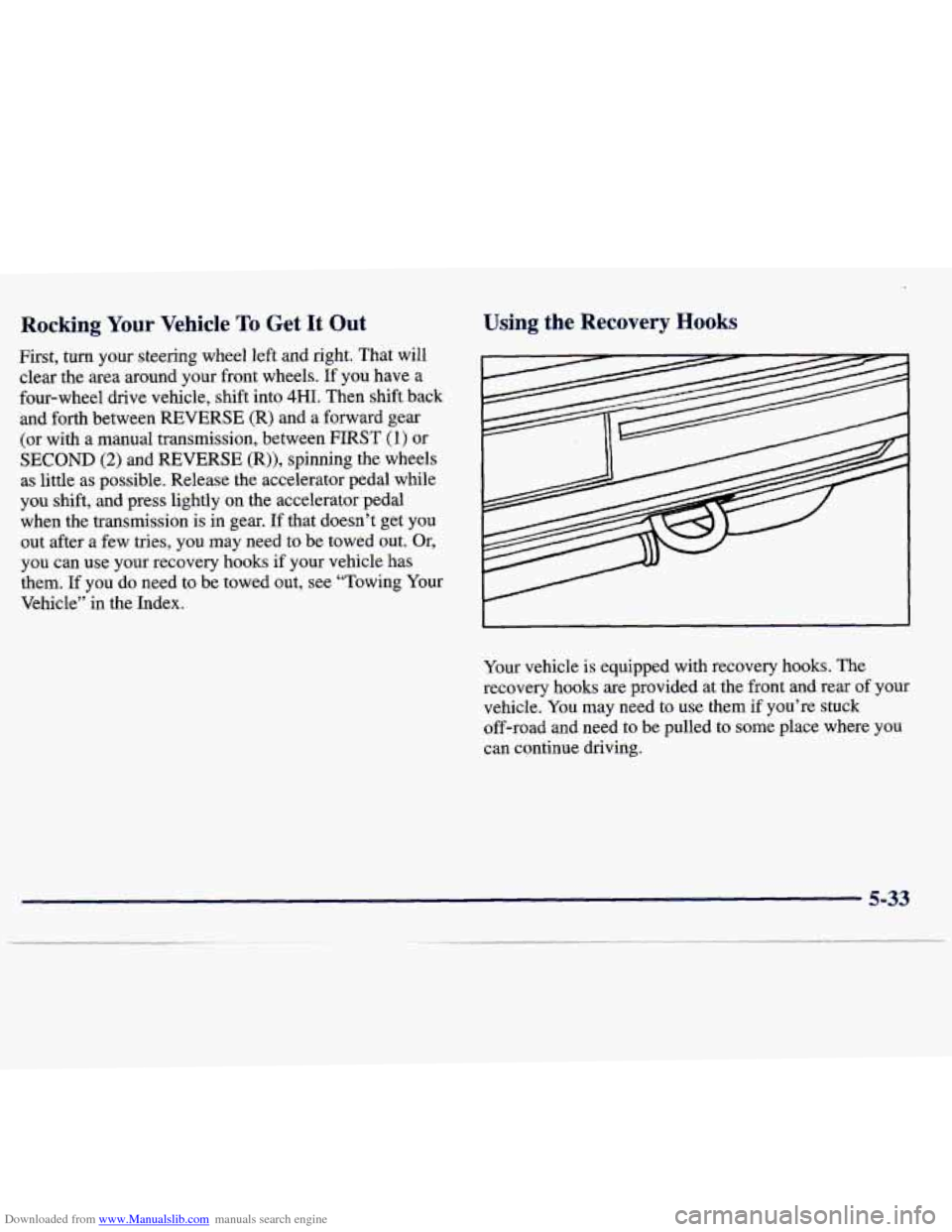
Your vehicle
is equipped with recovery hooks. The
recovery hooks are provided at the front and rear of your
vehicle. You
may need to use them if you’re stuck
off-road and need to
be pulled to some place where you
can continue driving.
Page 238 of 386
Downloaded from www.Manualslib.com manuals search engine 0 Section 6 Service and Appearance Care
Here you will find information about the care of your vehicle. This section begins with service and fuel information,
and then it shows how to check important fluid and lubricant levels. There is also technical i\
nformation about your
vehicle, and a part devoted to its appearance care.
6-2
6-3
6-5
6-5
6-7
6- 8 6-11
6-15
6-17
6-20
6-24
6-26
6-27
6-27
6-28
6-29
6-33
6-34 Service
Fuel
Fuels in Foreign Countries
Filling Your Tank
Filling a Portable Fuel Container
Checking Things Under the Hood
Engine Oil
Air Cleaner
Automatic Transmission Fluid
Manual Transmission Fluid
Engine Coolant
Radiator Pressure Cap
Thermostat
Power Steering Fluid
Windshield Washer Fluid Brakes
Battery
Bulb Replacement 6-40
6-48
6-49
6-5
1
6-52
6-53
6-54
6-54
6-55
6-55
6-56 6-57
6-57
6-61
6-6
1
6-63 Tires
Appearance Care Cleaning the Inside of Your Vehicle
Cleaning the Outside
of the Windshield,
Backglass and Wiper Blades
Cleaning the Outside of Your Vehicle
Special Care for Canvas Top and
Plastic Windows
Cleaning Aluminum Wheels
(If Equipped)
Cleaning Tires
Finish Damage
Underbody Maintenance
Appearance Care Materials Chart
Vehicle Identification Number (VIN)
Electrical System Replacement Bulbs
Capacities and Specifications
Air Conditioning Refrigerants
6-1
Page 356 of 386

Downloaded from www.Manualslib.com manuals search engine Part D: Recommended Fluids
and Lubricants
NOTE: Fluids and lubricants identified below by name,
part number or specification may be obtained from
your dealer.
FLUIDLUBRICANT
Engine Oil with the American
Petroleum Institute Certified
For Gasoline Engines “Starburst” symbol of the
proper viscosity. To determine the preferred viscosity for your
vehicle’s engine, see “Engine
Oil” in the Index.
50/50 mixture of clean water
(preferably distilled) and good
quality Ethylene Glycol Base
Coolant (GM Part
No. 1052753
or equivalent) conforming to
GM Specification 1825M or
approved recycled coolant
conforming to GM
Specification 1825M. See
“Engine Coolant” in the Index.
USAGE
Hydraulic Brake
System
Parking Brake Cable
Guides
Power Steering System
Manual
Transmission (All) and Transfer Case
(Four-Wheel-Drive)
Automatic
Transmission
~
Key Lock Cylinders
FLUIDLUBRICANT
Delco Supreme 11@ Brake
Fluid (GM Part No. 12377967
or equivalent DOT-3 Brake
Fluid).
Chassis Lubricant (GM Part
No. 12377985 or equivalent) or
lubricant meeting requirements
of NLGI
# 2, Category LB
or GC-LB.
DEXRON@-I11 Automatic
Transmission Fluid.
GM Goodwrench Synthetic
Manual Transmission Gear Oil
quart) or equivalent SAE
75W-90
GL-4 Gear Oil.
DEXRON@-I11 Automatic
Transmission Fluid.
Multi-Pu ose Lubricant,
Superlube
% (GM Part
No. 12346241 or equivalent).
(GM Part
NO. 12346190 - 1
Page 378 of 386

Downloaded from www.Manualslib.com manuals search engine Gages Engine Coolant Temperature
.................... 2-62
Fuel ....................................... 2-67
GAWR
....................................... 4-46
Gear Positions. Automatic Transmission
............. 2- 11
GloveBox
.................................... 2-39
Gross Axle Weight Rating ........................ 4-46
Gross Vehicle Weight Rating
...................... 4-46
Guide en Franqais
-11
GVWR ....................................... 4-46
Gear Positions. Manual Transmission
............... 2-
15
.. ................................
Halogen Bulbs ................................ 6-34
Hazard Warning Flashers
.......................... 5-2
HeadRestraints
................................. 1-4
Headlamps
.................................... 2-3 1
Bulb Replacement ............................ 6-34
High/Low Beamchanger
...................... 2-31
Hearing Impaired. Customer Assistance
.............. 8-4
Heating
........................................ 3-3
Highway Hypnosis
.............................. 4-37
Hill and Mountain Roads ......................... 4-37
Hitches. Trailer
................................. 4-51
Hood Checking Thingsunder
......................... 6-8
Prop
........................................ 6-9
Release
...................................... 6-8
Hood Latch Operation Check
..................... 7-47
Horn
......................................... 2-29
Hubs. Freewheeling
............................. 2- 18
Hydroplaning
.................................. 4-33 Ignition
Positions
............................... 2-8
Ignition Transmission Lock Check
................. 7-50
Inflation. Tire
.................................. 6-41
Inside Daymight Rearview Mirror
................. 2-38
Inspections Brakesystem
................................ 7-52
Engine Cooling System
........................ 7-51
Exhaust Systems
............................. 7-51
Front Axle
.................................. 7-52
Front Drive Axle Boot
......................... 7-51
Front Drive Axle Seal
......................... 7-51
Ignition Transmission Lock Check
............... 7-50
Rear Axle
................................... 7-52
Steering
.................................... 7-51
Suspension
.................................. 7-51
Throttle Linkage
.............................. 7-52
Instrument Panel
............................... 2-54
Brightness Control
............................ 2-37
Cleaning
.................................... 6-50
Cluster
..................................... 2-56
FuseBlock
.................................. 6-58
Interior Lamps
................................. 2-37
Jack. Tire
.................................... 5-24
Jumpstarting
................................... 5-3
Key Lock Cylinders Service
..................... 7-48
Keys
.......................................... 2-2
9-5