wheel CHEVROLET TRACKER 1998 1.G Repair Manual
[x] Cancel search | Manufacturer: CHEVROLET, Model Year: 1998, Model line: TRACKER, Model: CHEVROLET TRACKER 1998 1.GPages: 386, PDF Size: 21.17 MB
Page 226 of 386
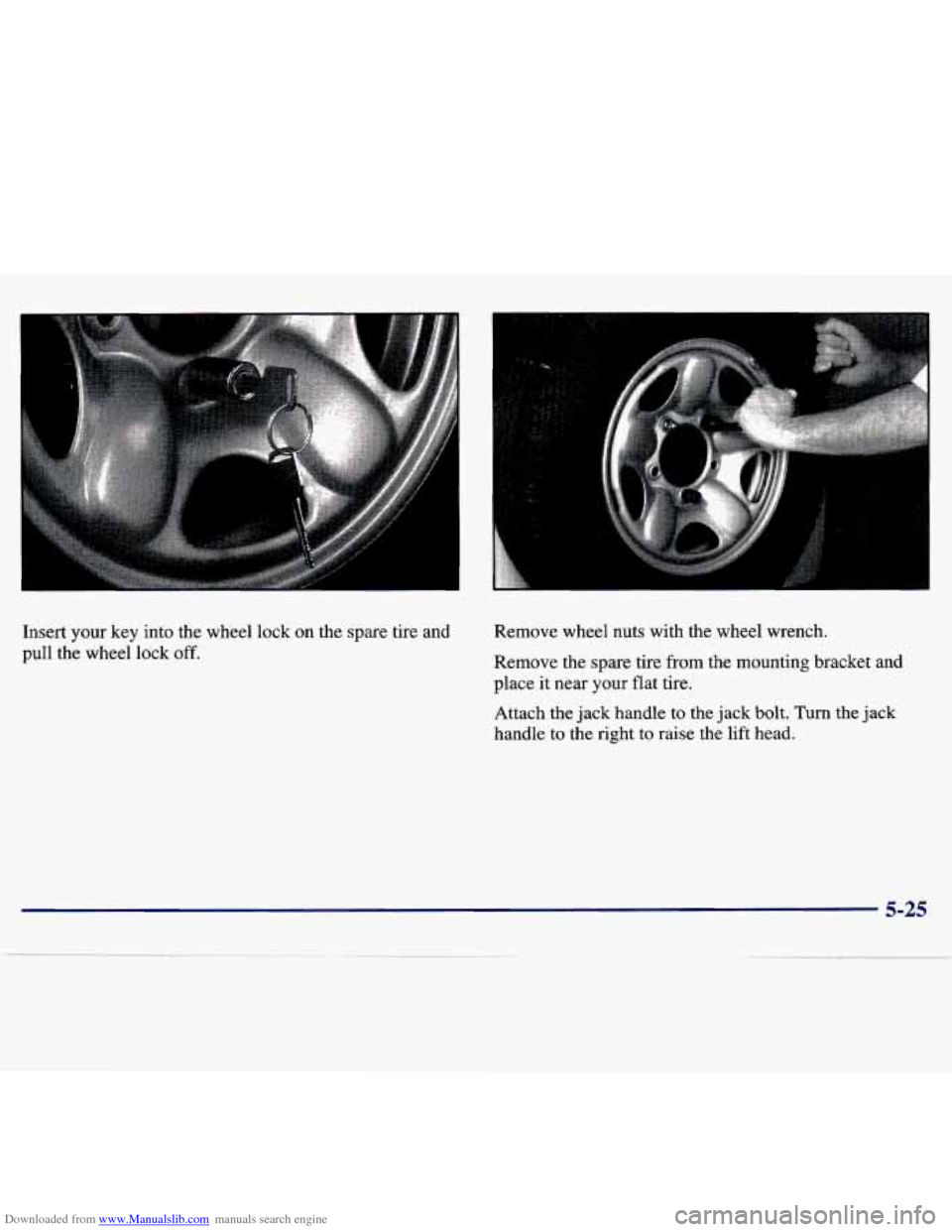
Downloaded from www.Manualslib.com manuals search engine Insert your key into the wheel lock on the spare tire and
pull the wheel lock
off.
Kemove wheel nuts with the wheel wrench.
Remove the spare tire from the mounting bracket and
place it near your flat tire.
Attach the jack handle to the jack bolt.
Turn the jack
handle to the right to raise the lift head.
5-25
Page 227 of 386
Downloaded from www.Manualslib.com manuals search engine Removing the Flat Tire and Installing the Spare Tire
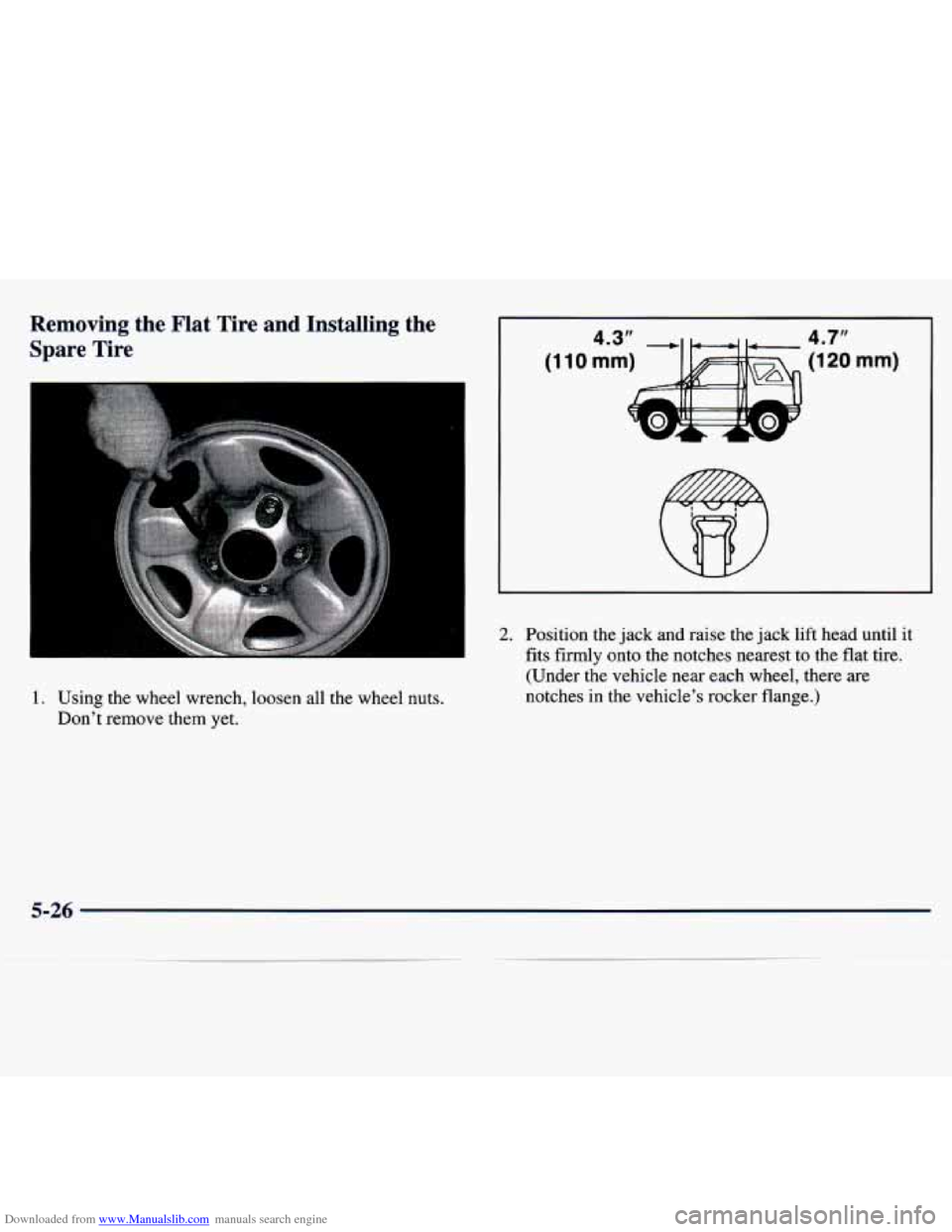
1. Using the wheel wrench, loosen all the wheel nuts.
Don't remove them yet.
2. Position the jack and raise the jack lift head until it
fits firmly onto the notches nearest to the flat tire.
(Under the vehicle near each wheel, there are
notches in the vehicle's rocker flange.)
5-26
Page 229 of 386
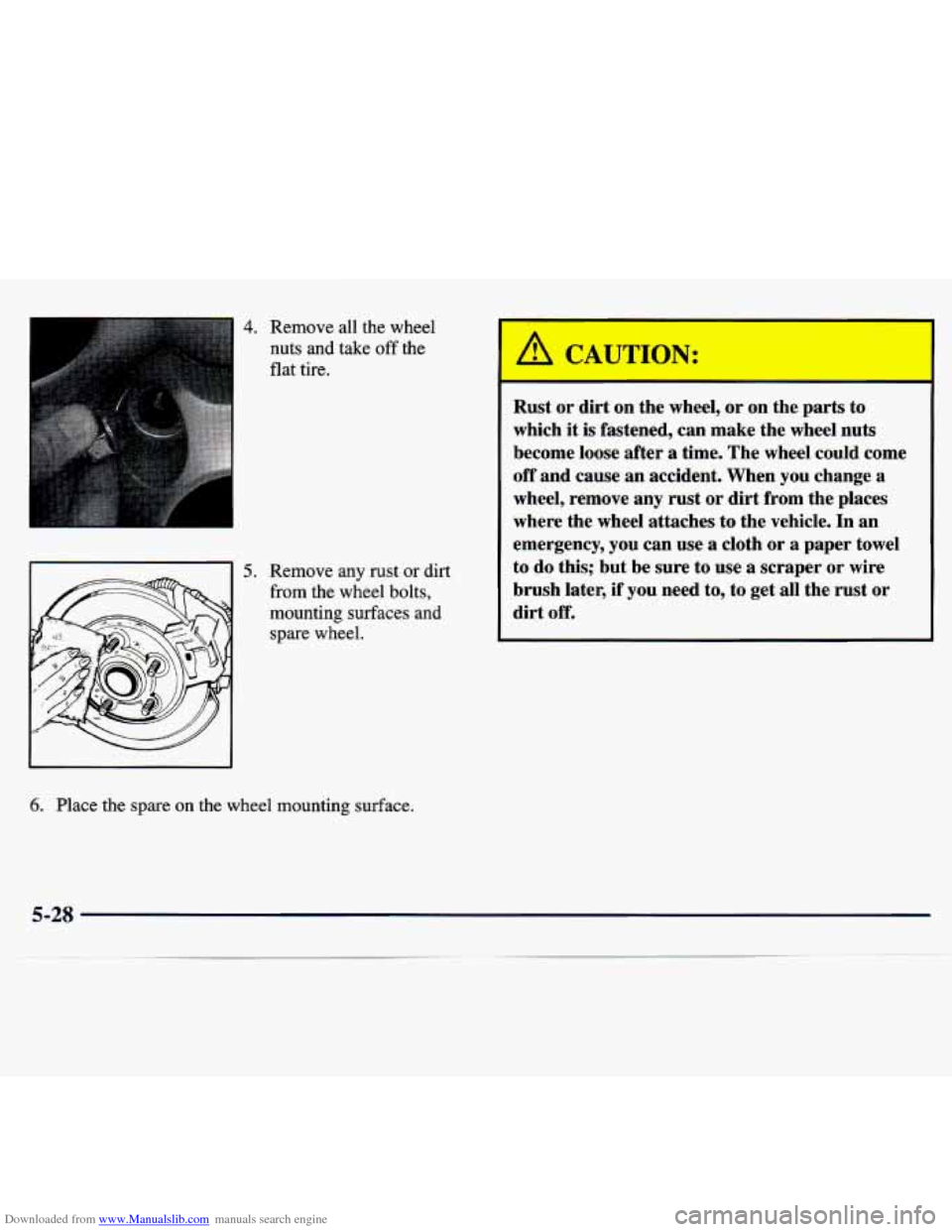
Downloaded from www.Manualslib.com manuals search engine 4. Remove all the wheel
nuts and take
off the
flat
tire.
Remove any rust or dirt
from the wheel bolts,
mounting surfaces and
spare wheel. Rust
or dirt on the wheel, or on me parts to
which
it is fastened, can make the wheel nuts
become loose after
a time. The wheel could come
off and cause an accident. When you change
a
wheel, remove any rust or dirt from the places
where the wheel attaches to the vehicle. In an
emergency, you can use
a cloth or a paper towel
to do this; but be sure to use
a scraper or wire
brush later, if you need to, to get all the rust or
dirt
off.
--.
6. Place the spare on the wheel mounting surface.
5-28
Page 230 of 386
Downloaded from www.Manualslib.com manuals search engine A CAUTION:
Never use oil or grease on studs or nuts. If you
do, the nuts might come loose. Your wheel could
fall off, causing a serious accident.
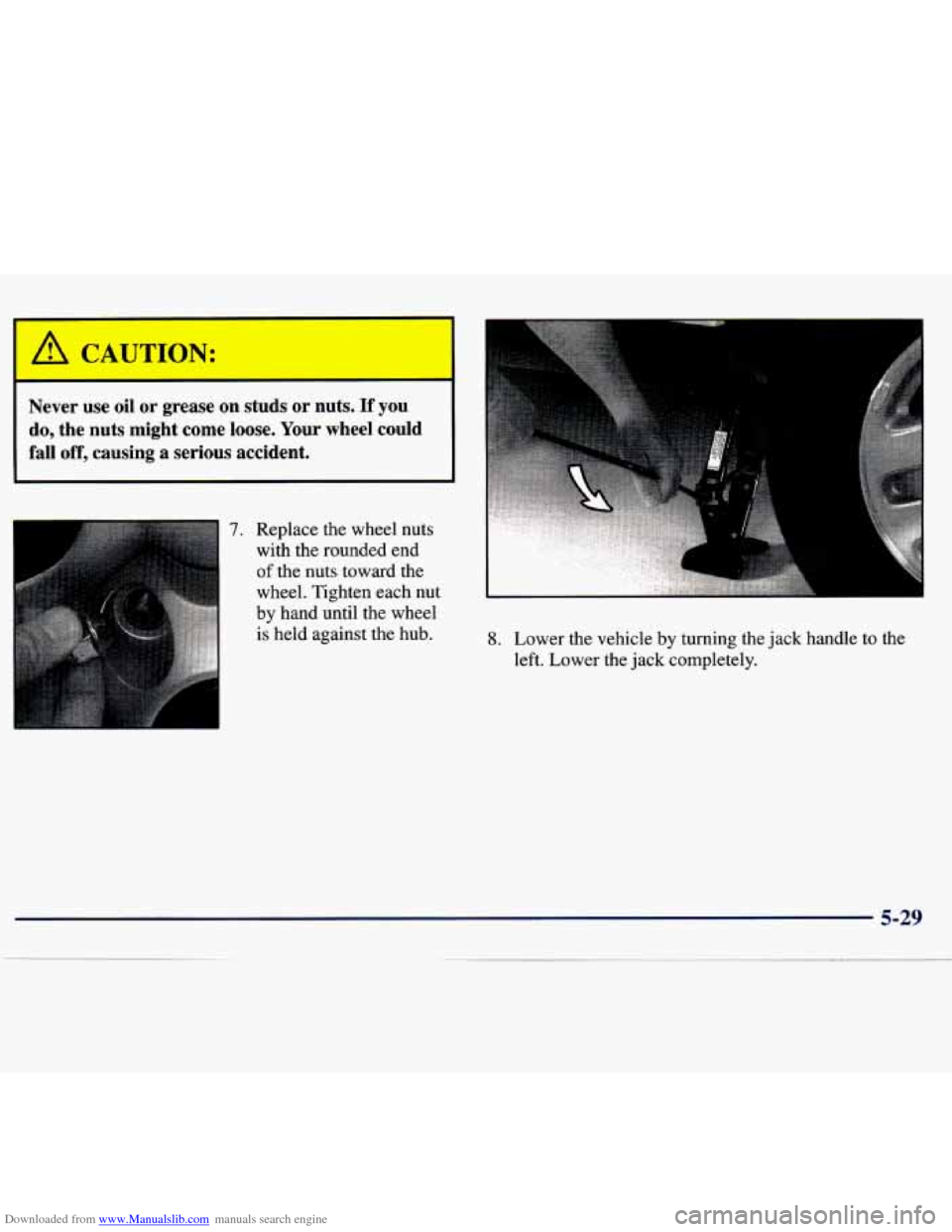
7. Replace the wheel nuts
with the rounded end
of the nuts toward the
wheel. Tighten each nut
by hand until the wheel is held against the hub.
8. Lower the vehicle by turning the jack handle to the
left. Lower the jack completely.
Page 231 of 386
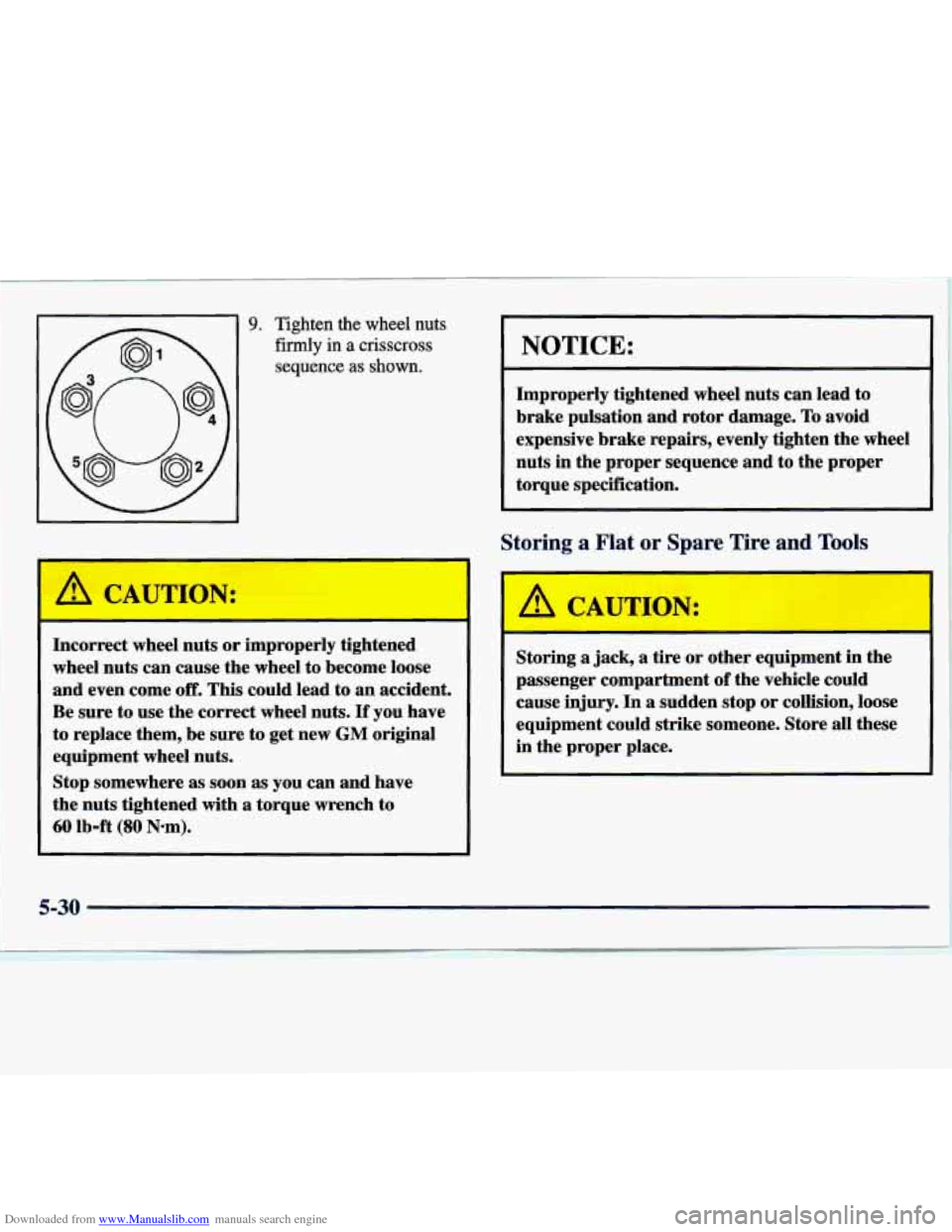
Downloaded from www.Manualslib.com manuals search engine 9. Tighten the wheel nuts
firmly in a crisscross
sequence as shown.
- a CAUTION:
NOTICE:
I'
Improperly tightened wheel nuts can lead to
brake pulsation and rotor damage. To avoid
expensive brake repairs, evenly tighten the wheel
nuts in the proper sequence and to the proper
torque specification.
I
-- I-
Incorrect wheel nuts or improperly tightened
wheel nuts can cause the wheel to become loose
and even come
off. This could lead to an accident.
Be sure to use the correct wheel nuts.
If you have
to replace them, be sure to get new
GM original
equipment wheel nuts.
Stop somewhere as soon
as you can and have
the nuts tightened with
a torque wrench to
60 lb-ft (80 Nom).
a CAUTION:
Storing a jack, a tire or other equipment in the
passenger compartment of the vehicle could
cause injury. In
a sudden stop or collision, loose
equipment could strike someone. Store all these
in the proper place.
I
5-30
Page 232 of 386
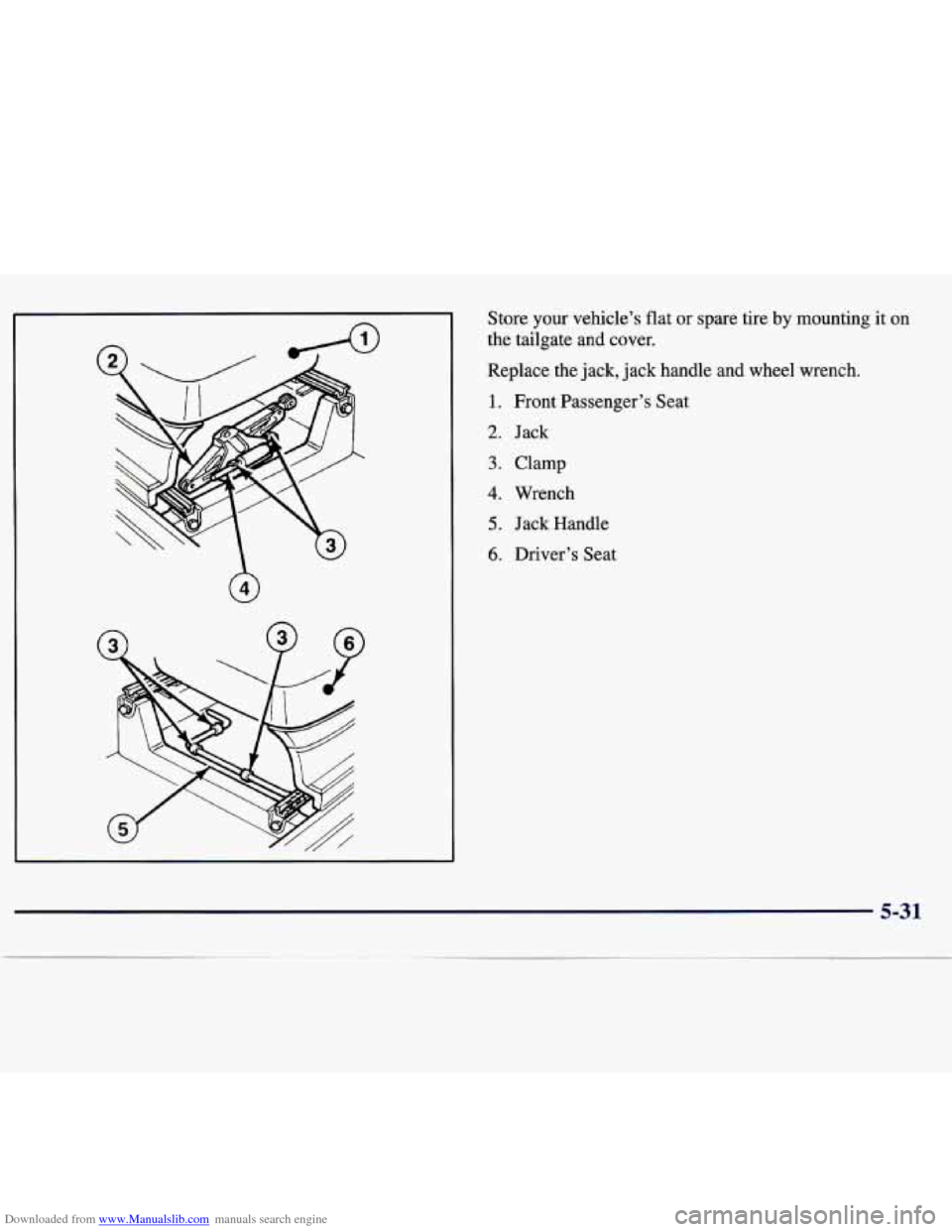
Downloaded from www.Manualslib.com manuals search engine Store your vehicle’s flat or spare tire by mounting it on
the tailgate and cover.
Replace the jack, jack handle and wheel wrench.
1. Front Passenger’s Seat
2. Jack
3. Clamp
4. Wrench
5. Jack Handle
6. Driver’s Seat
5-31
Page 233 of 386
Downloaded from www.Manualslib.com manuals search engine If You’re Stuck: In Sand, Mud,
Ice or Snow
What you don’t want to do when your vehicle is stuck is
to spin your wheels too fast. The method known as
“rocking” can help you get out when you’re stuck, but \
you must use caution.
If you let your tires spin
at high speed, they can
explode, and you
or others could be injured. And,
the transmission or other parts of the vehicle can
overheat. That could cause an engine
compartment fire or other damage. When you’re
stuck, spin the wheels as little as possible. Don’t
spin the wheels above
35 mph (55 km/h) as shown
on the speedometer.
NOTICE:
Spinning your wheels can destroy parts of your
vehicle as well as the tires.
If you spin the wheels
too fast while shifting your transmission back
and forth, you can destroy your transmission.
For information about using tire chains on your vehicle,
see “Tire Chains” in the Index.
5-32
Page 234 of 386
Downloaded from www.Manualslib.com manuals search engine Rocking Your Vehicle To Get It Out Using the Recovery Hooks
First, turn your steering wheel left and right. That will
clear the area around your front wheels.
If you have a
four-wheel drive vehicle, shift into 4HI. Then shift back
and forth between
REVERSE (R) and a forward gear
(or with a manual transmission, between
FIRST (1) or
SECOND (2) and REVERSE (R)), spinning the wheels
as little as possible. Release the accelerator pedal while
you shift, and press lightly on the accelerator pedal
when the transmission
is in gear. If that doesn’t get you
out after
a few tries, you may need to be towed out. Or,
you can use your recovery hooks
if your vehicle has
them.
If you do need to be towed out, see “Towing Your
Vehicle”
in the Index.
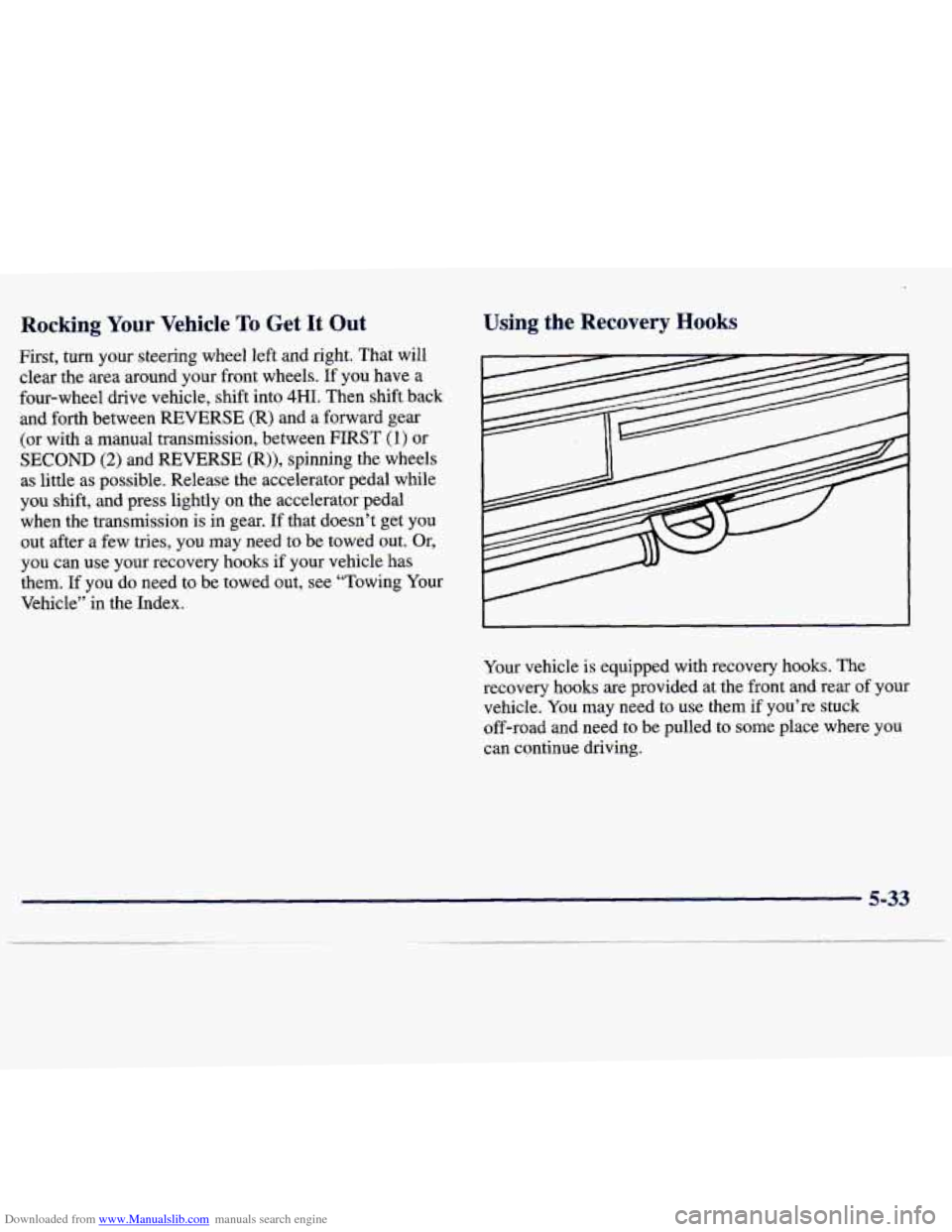
Your vehicle
is equipped with recovery hooks. The
recovery hooks are provided at the front and rear of your
vehicle. You
may need to use them if you’re stuck
off-road and need to
be pulled to some place where you
can continue driving.
Page 238 of 386
Downloaded from www.Manualslib.com manuals search engine 0 Section 6 Service and Appearance Care
Here you will find information about the care of your vehicle. This section begins with service and fuel information,
and then it shows how to check important fluid and lubricant levels. There is also technical i\
nformation about your
vehicle, and a part devoted to its appearance care.
6-2
6-3
6-5
6-5
6-7
6- 8 6-11
6-15
6-17
6-20
6-24
6-26
6-27
6-27
6-28
6-29
6-33
6-34 Service
Fuel
Fuels in Foreign Countries
Filling Your Tank
Filling a Portable Fuel Container
Checking Things Under the Hood
Engine Oil
Air Cleaner
Automatic Transmission Fluid
Manual Transmission Fluid
Engine Coolant
Radiator Pressure Cap
Thermostat
Power Steering Fluid
Windshield Washer Fluid Brakes
Battery
Bulb Replacement 6-40
6-48
6-49
6-5
1
6-52
6-53
6-54
6-54
6-55
6-55
6-56 6-57
6-57
6-61
6-6
1
6-63 Tires
Appearance Care Cleaning the Inside of Your Vehicle
Cleaning the Outside
of the Windshield,
Backglass and Wiper Blades
Cleaning the Outside of Your Vehicle
Special Care for Canvas Top and
Plastic Windows
Cleaning Aluminum Wheels
(If Equipped)
Cleaning Tires
Finish Damage
Underbody Maintenance
Appearance Care Materials Chart
Vehicle Identification Number (VIN)
Electrical System Replacement Bulbs
Capacities and Specifications
Air Conditioning Refrigerants
6-1
Page 259 of 386
Downloaded from www.Manualslib.com manuals search engine Rear Axle What to Use
When
to Check and Change Lubricant
Refer to the Maintenance Schedule to determine how
often
to check the lubricant and when to change it. See
“Periodic Maintenance Inspections” and “Scheduled
Maintenance Services” in the Index.
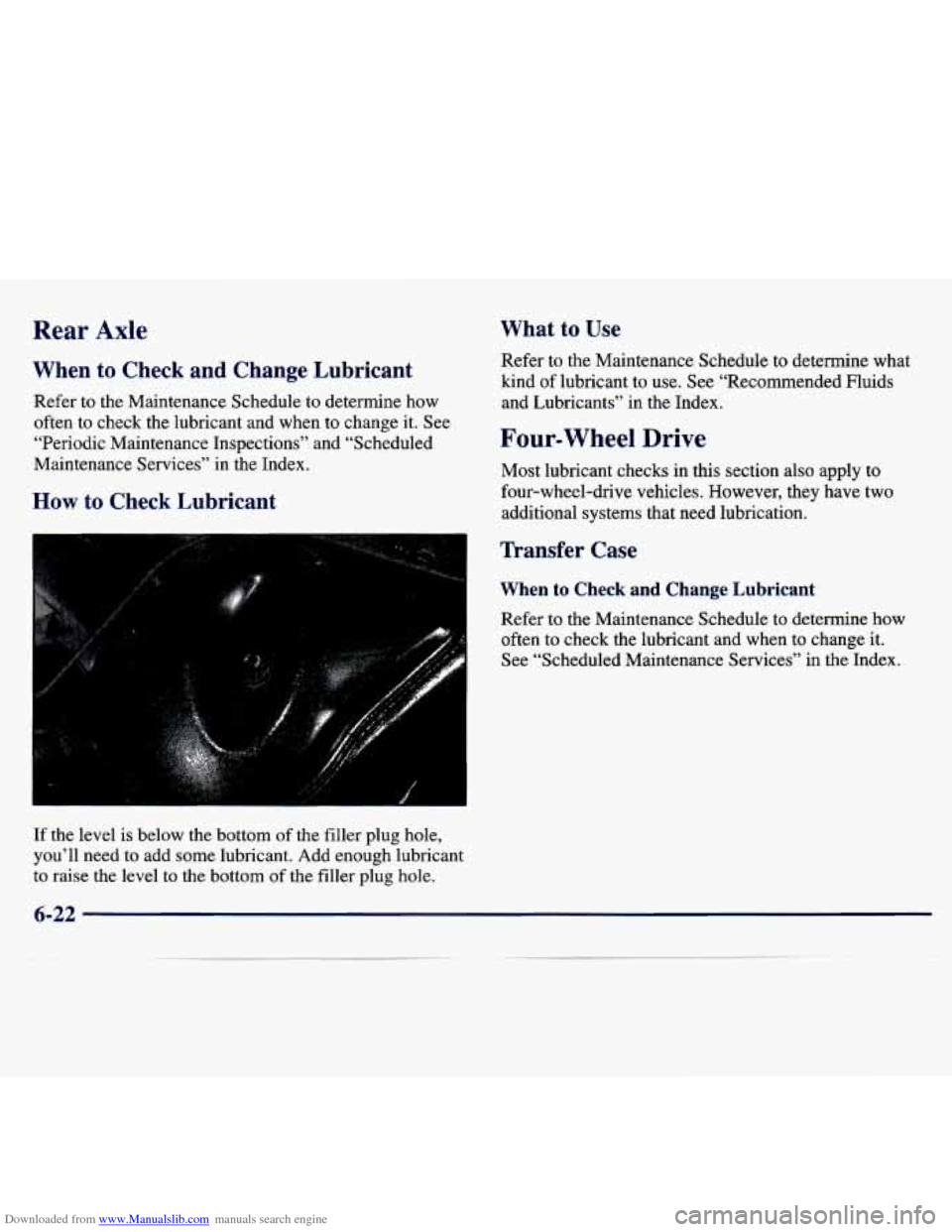
If the level is below the bottom of the filler plug hole,
you’ll need to add some lubricant. Add enough lubricant
to raise the level to the bottom of the filler plug hole. Refer to the Maintenance Schedule
to determine what
kind
of lubricant to use. See “Recommended Fluids
and Lubricants” in the Index.
Four-wheel Drive
Most lubricant checks in this section also apply to
four-wheel-drive vehicles. However, they have two additional systems that need lubrication.
Transfer Case
When to Check and Change Lubricant
Refer to the Maintenance Schedule to determine how
often to check the lubricant and when to change
it.
See “Scheduled Maintenance Services” in the Index.
6-22