wheel CHEVROLET TRACKER 2002 2.G Workshop Manual
[x] Cancel search | Manufacturer: CHEVROLET, Model Year: 2002, Model line: TRACKER, Model: CHEVROLET TRACKER 2002 2.GPages: 390, PDF Size: 2.62 MB
Page 203 of 390
4-46
CAUTION:
Shifting a four-wheel-drive vehicle's transfer
case into NEUTRAL can cause your vehicle to
roll even if the transmission is in Park (P), for an
automatic transmission, or if your vehicle is in
gear, for a manual transmission. You or others
could be injured. Make sure the parking brake
is firmly set before you shift the transfer case
to NEUTRAL.
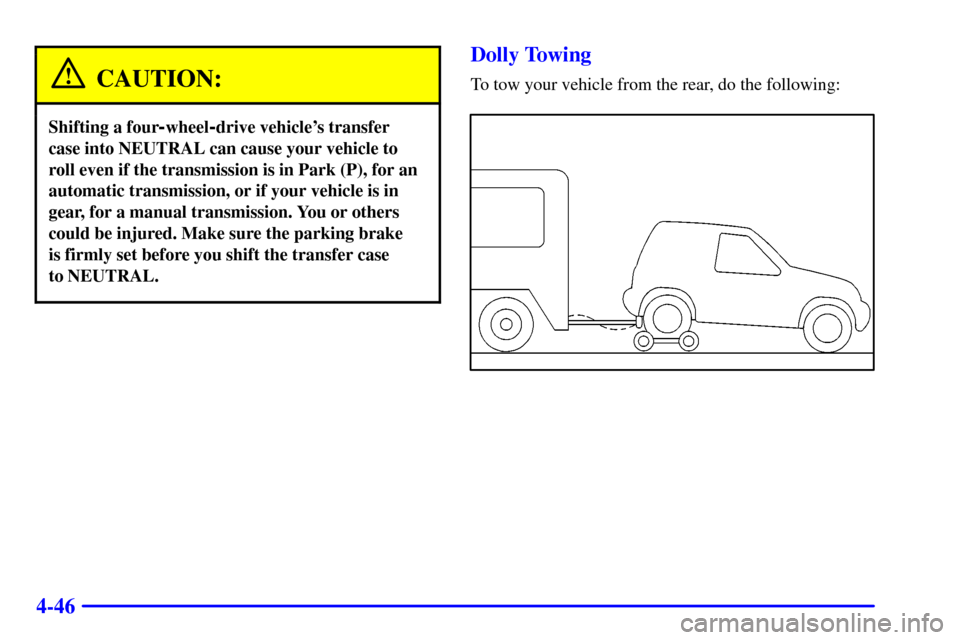
Dolly Towing
To tow your vehicle from the rear, do the following:
Page 204 of 390
4-47
The best way to tow your vehicle is from the rear.
Follow these steps:
1. Put the rear wheels on a dolly.
NOTICE:
Do not tow your vehicle with the rear wheels
in contact with the ground, or the transmission
could be damaged.
2. If your vehicle is a four-wheel-drive vehicle,
turn the ignition key to ON, move the transfer
case lever into NEUTRAL and make sure the 4WD
light on the instrument panel cluster is turned off.
See ªFour
-Wheel Driveº in the Index.
3. Turn the ignition key to ACC to unlock the
steering wheel.
4. Make sure the front wheels are facing straight
forward and secure the steering wheel with a
steering wheel clamping device designed for towing.
NOTICE:
Make sure that the towing speed does not
exceed 55 mph (90 km/h), or your vehicle could
be badly damaged.
CAUTION:
Shifting a four-wheel-drive vehicle's transfer
case into NEUTRAL can cause your vehicle to
roll even if the transmission is in PARK (P), for
an automatic transmission, or if your vehicle is
in gear, for a manual transmission. You or others
could be injured. Make sure the parking brake
is firmly set before you shift the transfer case
into NEUTRAL.
Page 205 of 390

4-48
Loading Your Vehicle
Two labels on your vehicle show how much weight it
may properly carry. The tire
-loading information label
found on the driver's door lock pillar tells you the
proper size and recommended inflation pressures for
the tires on your vehicle.
The other label is the certification label, also found on
the driver's door lock pillar. It tells you the gross weight
capacity of your vehicle, called the Gross Vehicle Weight
Rating (GVWR). The GVWR includes the weight of the
vehicle, all occupants, fuel and cargo. Never exceed the
GVWR for your vehicle, or the Gross Axle Weight
Rating (GAWR) for either the front or rear axle.
And, if you do have a heavy load, you should spread it
out. Don't carry more than 400 lbs. (181 kg) in your
rear area when four people are in your two
-wheel-drive
vehicle. If you have a four
-wheel-drive vehicle, don't
carry more than 200 lbs. (91 kg) in your rear area when
four people are in your vehicle.
Page 207 of 390
4-50
Towing a Trailer
CAUTION:
If you don't use the correct equipment and drive
properly, you can lose control when you pull a trailer.
For example, if the trailer is too heavy, the brakes
may not work well
-- or even at all. You and your
passengers could be seriously injured. Pull a trailer
only if you have followed all the steps in this section.
Ask your dealer for advice and information about
towing a trailer with your vehicle.
NOTICE:
Pulling a trailer improperly can damage your
vehicle and result in costly repairs not covered by
your warranty. To pull a trailer correctly, follow
the advice in this part, and see your dealer for
important information about towing a trailer with
your vehicle.
Your vehicle can tow a trailer. To identify what the
vehicle trailering capacity is for your vehicle, you
should read the information in ªWeight of the Trailerº
that appears later in this section. But trailering is
different than just driving your vehicle by itself.
Trailering means changes in handling, durability and
fuel economy. Successful, safe trailering takes correct
equipment, and it has to be used properly.
That's the reason for this section. In it are many
time
-tested, important trailering tips and safety rules.
Many of these are important for your safety and that
of your passengers. So please read this section carefully
before you pull a trailer.
Load
-pulling components such as the engine,
transmission, wheel assemblies and tires are forced
to work harder against the drag of the added weight.
The engine is required to operate at relatively higher
speeds and under greater loads, generating extra heat.
What's more, the trailer adds considerably to wind
resistance, increasing the pulling requirements.
Page 212 of 390
4-55 Passing
You'll need more passing distance up ahead when
you're towing a trailer. And, because you're a good
deal longer, you'll need to go much farther beyond
the passed vehicle before you can return to your lane.
Backing Up
Hold the bottom of the steering wheel with one hand.
Then, to move the trailer to the left, just move that hand
to the left. To move the trailer to the right, move your
hand to the right. Always back up slowly and, if possible,
have someone guide you.
Making Turns
NOTICE:
Making very sharp turns while trailering could
cause the trailer to come in contact with the
vehicle. Your vehicle could be damaged.
Avoid making very sharp turns while trailering.
When you're turning with a trailer, make wider turns than
normal. Do this so your trailer won't strike soft shoulders,
curbs, road signs, trees or other objects. Avoid jerky or
sudden maneuvers. Signal well in advance.
Turn Signals When Towing a Trailer
When you tow a trailer, your vehicle has to have extra
wiring (included in the optional trailering package).
The arrows on your instrument panel will flash whenever
you signal a turn or lane change. Properly hooked up,
the trailer lamps will also flash, telling other drivers
you're about to turn, change lanes or stop.
When towing a trailer, the arrows on your instrument
panel will flash for turns even if the bulbs on the trailer
are burned out. Thus, you may think drivers behind you
are seeing your signal when they are not. It's important
to check occasionally to be sure the trailer bulbs are
still working.
Driving On Grades
Reduce speed and shift to a lower gear before you start
down a long or steep downgrade. If you don't shift
down, you might have to use your brakes so much
that they would get hot and no longer work well.
If you are towing a trailer and you have a manual
transmission with FIFTH (5) gear, you may prefer
not to use FIFTH (5). Just drive in FOURTH (4)
(or, as you need to, a lower gear).
Page 213 of 390
4-56 Parking on Hills
CAUTION:
You really should not park your vehicle, with
a trailer attached, on a hill. If something goes
wrong, your rig could start to move. People can
be injured, and both your vehicle and the trailer
can be damaged.
But if you ever have to park your rig on a hill,
here's how to do it:
1. Apply your regular brakes, but don't shift into
PARK (P) yet, or into gear for a manual transmission.
2. Have someone place chocks under the trailer wheels.
3. When the wheel chocks are in place, release the
regular brakes until the chocks absorb the load.
4. Reapply the regular brakes. Then apply your parking
brake, and then shift to PARK (P), or REVERSE (R)
for a manual transmission.5. If you have a four
-wheel-drive vehicle, be sure the
transfer case is in a drive gear
-- not in NEUTRAL.
6. Release the regular brakes.
CAUTION:
It can be dangerous to get out of your vehicle if
the shift lever is not fully in PARK (P) with the
parking brake firmly set. Your vehicle can roll.
If you have left the engine running, the vehicle
can move suddenly. You or others could be
injured. To be sure your vehicle won't move,
even when you're on fairly level ground, use the
steps that follow.
Always put the shift lever fully in PARK (P) with
the parking brake firmly set.
If the transfer case on four-wheel drive vehicles
is in NEUTRAL, your vehicle will be free to
roll, even if your shift lever is in PARK (P). So,
be sure the transfer case is in a drive gear
-- not
in NEUTRAL.
Page 232 of 390
5-18
If a Tire Goes Flat
It's unusual for a tire to ªblow outº while you're driving,
especially if you maintain your tires properly. If air goes
out of a tire, it's much more likely to leak out slowly.
But if you should ever have a ªblowout,º here are
a few tips about what to expect and what to do:
If a front tire fails, the flat tire will create a drag that
pulls the vehicle toward that side. Take your foot off
the accelerator pedal and grip the steering wheel firmly.
Steer to maintain lane position, and then gently brake
to a stop well out of the traffic lane.
A rear blowout, particularly on a curve, acts much like a
skid and may require the same correction you'd use in
a skid. In any rear blowout, remove your foot from
the accelerator pedal. Get the vehicle under control by
steering the way you want the vehicle to go. It may be
very bumpy and noisy, but you can still steer. Gently
brake to a stop
-- well off the road if possible.
If a tire goes flat, the next part shows how to use your
jacking equipment to change a flat tire safely.
Changing a Flat Tire
If a tire goes flat, avoid further tire and wheel damage
by driving slowly to a level place. Turn on your hazard
warning flashers.
CAUTION:
Changing a tire can cause an injury. The vehicle
can slip off the jack and roll over you or other
people. You and they could be badly injured.
Find a level place to change your tire. To help
prevent the vehicle from moving:
1. Set the parking brake firmly.
2. Put an automatic transmission shift lever
in PARK (P) or shift a manual transmission
to FIRST (1) or REVERSE (R).
CAUTION: (Continued)
Page 233 of 390

5-19
CAUTION: (Continued)
3. If you have a four-wheel-drive vehicle,
be sure the transfer case is in a drive
gear
-- not in NEUTRAL.
4. Turn off the engine.
To be even more certain the vehicle won't move,
you can put blocks at the front and rear of the
tire farthest away from the one being changed.
That would be the tire on the other side of the
vehicle, at the opposite end.
The following steps will tell you how to use the jack and
change a tire.
Page 234 of 390
5-20 Removing the Spare Tire and Tools
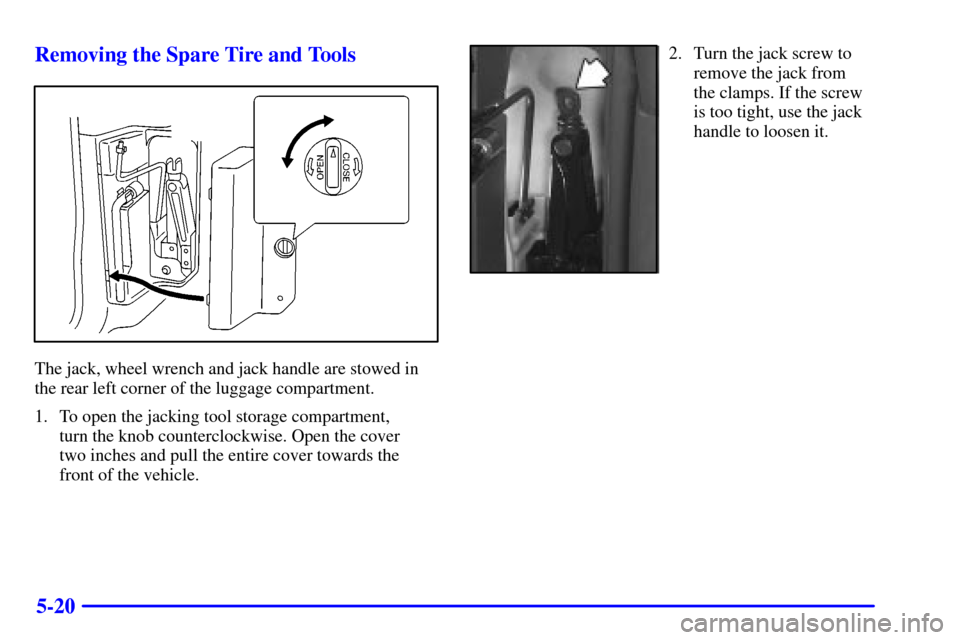
The jack, wheel wrench and jack handle are stowed in
the rear left corner of the luggage compartment.
1. To open the jacking tool storage compartment,
turn the knob counterclockwise. Open the cover
two inches and pull the entire cover towards the
front of the vehicle.
2. Turn the jack screw to
remove the jack from
the clamps. If the screw
is too tight, use the jack
handle to loosen it.
Page 235 of 390

5-21
The tools you'll be using include the jack (A), jack
handle (B) and wheel wrench (C).The spare tire is mounted on your tailgate. Your vehicle
may be equipped with either a soft, vinyl cover or a
hard cover.
3. To remove the hard
cover from the spare
tire, insert your key into
the wheel lock and pull
the wheel lock off.
Hard Cover