automatic transmission CHEVROLET TRACKER 2003 2.G Owner's Manual
[x] Cancel search | Manufacturer: CHEVROLET, Model Year: 2003, Model line: TRACKER, Model: CHEVROLET TRACKER 2003 2.GPages: 372, PDF Size: 2.65 MB
Page 239 of 372

Automatic Transmission Fluid
When to Check and Change
A good time to check your automatic transmission ¯uid
level is when the engine oil is changed.
Change both the ¯uid and ®lter every 15,000 miles
(25 000 km) if the vehicle is mainly driven under one or
more of these conditions:
·In heavy city traffic where the outside temperature
regularly reaches 90ÉF (32ÉC) or higher.
·In hilly or mountainous terrain.
·When doing frequent trailer towing.
·Uses such as found in taxi, police or delivery
service.
If you do not use your vehicle under any of these
conditions, change the ¯uid and ®lter every
100,000 miles (166 000 km).
See
Maintenance Requirements on page 6-2.
How to Check
Because this operation can be a little difficult, you may
choose to have this done at the dealership service
department.
If you do it yourself, be sure to follow all the instructions
here, or you could get a false reading on the dipstick.
Notice:Too much or too little ¯uid can damage
your transmission. Too much can mean that some
of the ¯uid could come out and fall on hot engine
part or exhaust system parts, starting a ®re.
Too little ¯uid could cause the transmission to
overheat. Be sure to get an accurate reading if you
check your transmission ¯uid.
Wait at least 30 minutes before checking the
transmission ¯uid level if you have been driving:
·When outside temperatures are above 90ÉF (32ÉC).
·At high speed for quite a while.
·In heavy traffic ± especially in hot weather.
·While pulling a trailer.
To get the right reading, the ¯uid should be at normal
operating temperature, which is 180ÉF to 200ÉF
(82ÉC to 93ÉC).
5-23
Page 240 of 372
Get the vehicle warmed up by driving about 15 miles
(24 km) when outside temperatures are above 50ÉF
(10ÉC). If it's colder than 50ÉF (10ÉC), drive the vehicle
in DRIVE (D) until the engine temperature gage
moves and then remains steady for 10 minutes.
A cold ¯uid check can be made after the vehicle has
been sitting for eight hours or more with the engine off,
but this is used only as a reference. Let the engine
run at idle for ®ve minutes if outside temperatures are
50ÉF (10ÉC) or more. If it's colder than 50ÉF (10ÉC), you
may have to idle the engine longer. Should the ¯uid
level be low during this cold check, you
mustcheck the
¯uid hot before adding ¯uid. Checking the ¯uid hot
will give you a more accurate reading of the ¯uid level.
Checking the Fluid Level
Prepare your vehicle as follows:
·Park your vehicle on a level place. Keep the engine
running.
·With the parking brake applied, place the shift lever
in PARK (P).
·With your foot on the brake pedal, move the shift
lever through each gear range, pausing for about
three seconds in each range. Then, position the shift
lever in PARK (P).
·Let the engine run at idle for three minutes or more.Then, without shutting off the engine, follow these steps:
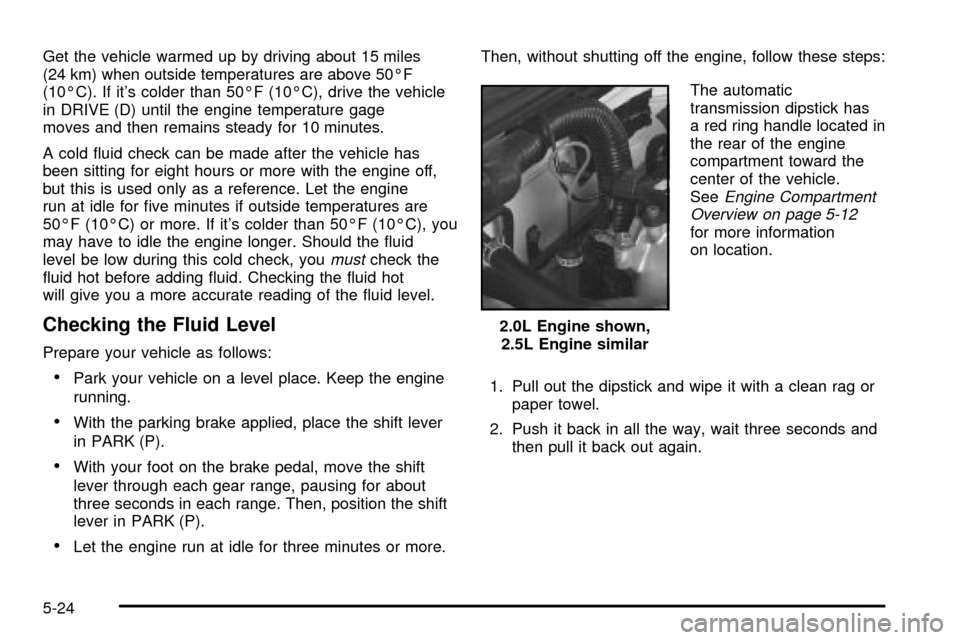
The automatic
transmission dipstick has
a red ring handle located in
the rear of the engine
compartment toward the
center of the vehicle.
See
Engine Compartment
Overview on page 5-12
for more information
on location.
1. Pull out the dipstick and wipe it with a clean rag or
paper towel.
2. Push it back in all the way, wait three seconds and
then pull it back out again. 2.0L Engine shown,
2.5L Engine similar
5-24
Page 241 of 372
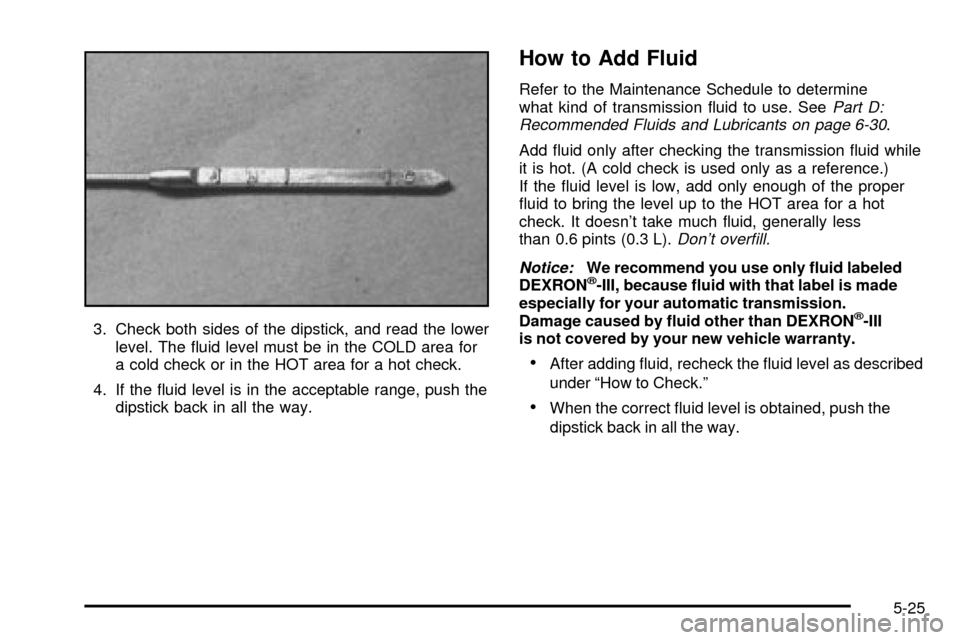
3. Check both sides of the dipstick, and read the lower
level. The ¯uid level must be in the COLD area for
a cold check or in the HOT area for a hot check.
4. If the ¯uid level is in the acceptable range, push the
dipstick back in all the way.
How to Add Fluid
Refer to the Maintenance Schedule to determine
what kind of transmission ¯uid to use. SeePart D:
Recommended Fluids and Lubricants on page 6-30.
Add ¯uid only after checking the transmission ¯uid while
it is hot. (A cold check is used only as a reference.)
If the ¯uid level is low, add only enough of the proper
¯uid to bring the level up to the HOT area for a hot
check. It doesn't take much ¯uid, generally less
than 0.6 pints (0.3 L).
Don't over®ll.
Notice:
We recommend you use only ¯uid labeled
DEXRONž-III, because ¯uid with that label is made
especially for your automatic transmission.
Damage caused by ¯uid other than DEXRON
ž-III
is not covered by your new vehicle warranty.
·After adding ¯uid, recheck the ¯uid level as described
under ªHow to Check.º
·When the correct ¯uid level is obtained, push the
dipstick back in all the way.
5-25
Page 263 of 372
1. Check the other vehicle. It must have a 12-volt
battery with a negative ground system.
Notice:If the other vehicle's system is not a 12-volt
system with a negative ground, both vehicles can
be damaged. Only use vehicles with 12-volt systems
with negative grounds to jump start your vehicle.
2. Get the vehicles close enough so the jumper cables
can reach, but be sure the vehicles aren't touching
each other. If they are, it could cause a ground
connection you don't want. You wouldn't be able to
start your vehicle, and the bad grounding could
damage the electrical systems.
To avoid the possibility of the vehicles rolling, set
the parking brake ®rmly on both vehicles involved in
the jump start procedure. Put an automatic
transmission in PARK (P) or a manual transmission
in NEUTRAL before setting the parking brake.
Notice:If you leave your radio or other accessories
on during the jump starting procedure, they could
be damaged. The repairs would not be covered
by your warranty. Always turn off your radio and
other accessories when jump starting your vehicle.3. Turn off the ignition on both vehicles. Unplug
unnecessary accessories plugged into the cigarette
lighter. Turn off the radio and all lamps that aren't
needed. This will help reduce sparks and help save
both batteries. And it could save your radio!
4. Open the hoods and locate the batteries. Find the
positive (+) and negative (-) terminal locations on
each battery. See
Engine Compartment Overview
on page 5-12for more information on battery
location.
{CAUTION:
If your vehicle has air conditioning, the
auxiliary electric fan under the hood can start
up even when the engine is not running and
can injure you. Keep hands, clothing and tools
away from any underhood electric fan.
5-47
Page 283 of 372
Changing a Flat Tire
If a tire goes ¯at, avoid further tire and wheel damage
by driving slowly to a level place. Turn on your
hazard warning ¯ashers.
{CAUTION:
Changing a tire can cause an injury. The
vehicle can slip off the jack and roll over you
or other people. You and they could be badly
injured. Find a level place to change your tire.
To help prevent the vehicle from moving:
1. Set the parking brake ®rmly.
2. Put an automatic transmission shift lever
in PARK (P), or shift a manual transmission
to FIRST (1) or REVERSE (R).
3. If you have a four-wheel-drive vehicle,
be sure the transfer case is in a drive
gear ± not in NEUTRAL.
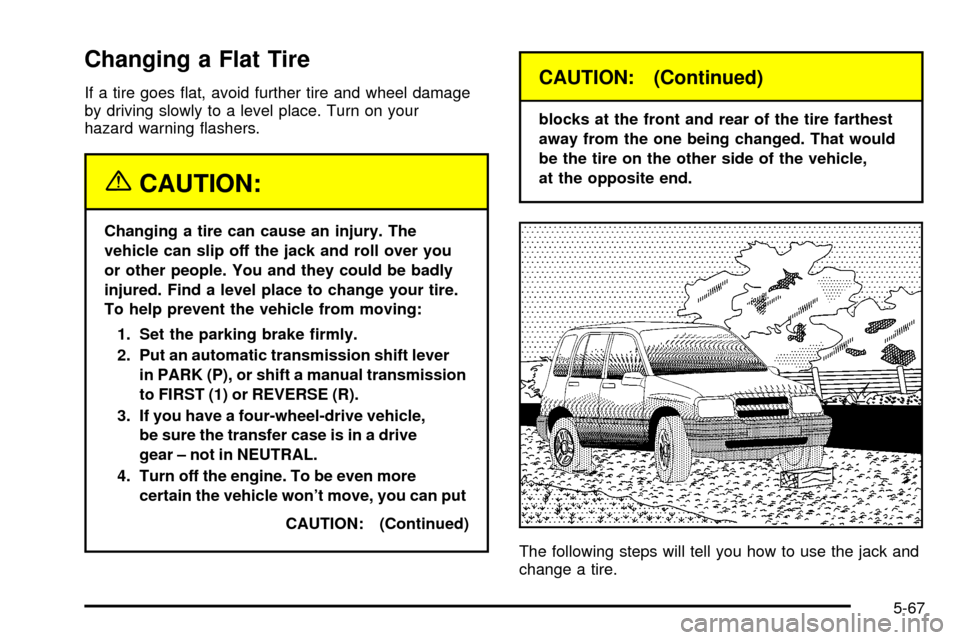
4. Turn off the engine. To be even more
certain the vehicle won't move, you can put
CAUTION: (Continued)
CAUTION: (Continued)
blocks at the front and rear of the tire farthest
away from the one being changed. That would
be the tire on the other side of the vehicle,
at the opposite end.
The following steps will tell you how to use the jack and
change a tire.
5-67
Page 309 of 372
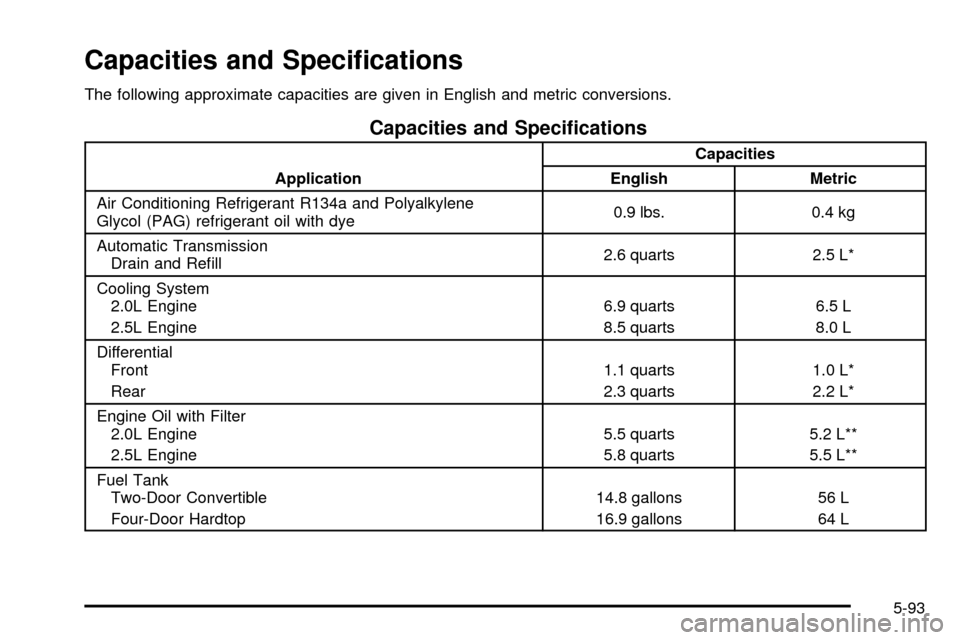
Capacities and Speci®cations
The following approximate capacities are given in English and metric conversions.
Capacities and Speci®cations
ApplicationCapacities
English Metric
Air Conditioning Refrigerant R134a and Polyalkylene
Glycol (PAG) refrigerant oil with dye0.9 lbs. 0.4 kg
Automatic Transmission
Drain and Re®ll2.6 quarts 2.5 L*
Cooling System
2.0L Engine
2.5L Engine6.9 quarts
8.5 quarts6.5 L
8.0 L
Differential
Front
Rear1.1 quarts
2.3 quarts1.0 L*
2.2 L*
Engine Oil with Filter
2.0L Engine
2.5L Engine5.5 quarts
5.8 quarts5.2 L**
5.5 L**
Fuel Tank
Two-Door Convertible
Four-Door Hardtop14.8 gallons
16.9 gallons56 L
64 L
5-93
Page 310 of 372
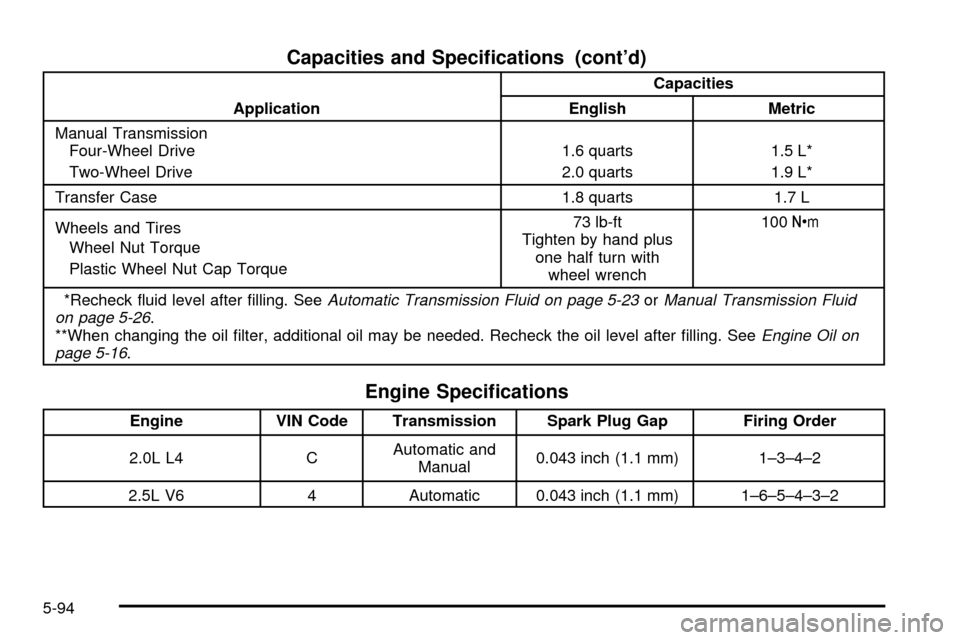
Capacities and Speci®cations (cont'd)
ApplicationCapacities
English Metric
Manual Transmission
Four-Wheel Drive
Two-Wheel Drive1.6 quarts
2.0 quarts1.5 L*
1.9 L*
Transfer Case 1.8 quarts 1.7 L
Wheels and Tires
Wheel Nut Torque
Plastic Wheel Nut Cap Torque73 lb-ft
Tighten by hand plus
one half turn with
wheel wrench100Y
*Recheck ¯uid level after ®lling. See
Automatic Transmission Fluid on page 5-23orManual Transmission Fluid
on page 5-26.
**When changing the oil ®lter, additional oil may be needed. Recheck the oil level after ®lling. SeeEngine Oil on
page 5-16.
Engine Speci®cations
Engine VIN Code Transmission Spark Plug Gap Firing Order
2.0L L4 CAutomatic and
Manual0.043 inch (1.1 mm) 1±3±4±2
2.5L V6 4 Automatic 0.043 inch (1.1 mm) 1±6±5±4±3±2
5-94
Page 317 of 372

Selecting the Right Schedule
First you'll need to decide which of the two schedules is
right for your vehicle. Here's how to decide which
schedule to follow:
Short Trip/City De®nition
Follow the Short Trip/City Scheduled Maintenance if any
one of these conditions is true for your vehicle:
·Most trips are less than 5 miles (8 km). This is
particularly important when outside temperatures
are below freezing.
·Most trips include extensive idling (such as frequent
driving in stop-and-go traffic).
·You frequently tow a trailer or use a carrier on top
of your vehicle.
·If the vehicle is used for delivery service, police,
taxi or other commercial application.
One of the reasons you should follow this schedule if
you operate your vehicle under any of these conditions
is that these conditions cause engine oil to break
down sooner.
Short Trip/City Intervals
Every 3,000 Miles (5 000 km):Engine Oil and Filter
Change (or 3 months, whichever occurs ®rst).
Every 6,000 Miles (10 000 km):Passenger
Compartment Air Filter Inspection (If Equipped).
Tire Rotation.
Every 15,000 Miles (25 000 km):Engine Air Cleaner
Filter Inspection. Automatic Transmission Service
(severe conditions only). Manual Transmission Fluid
Change. Transfer Case Fluid Change. Differential Fluid
Change. Propeller Shafts and U-Joints Inspection
(or every 15 months, whichever occurs ®rst).
Every 30,000 Miles (50 000 km):Engine Air Cleaner
Filter Replacement. Air Filter Replacement (If Equipped).
Ignition Coil Plug Cap Inspection (or every 30 months,
whichever occurs ®rst). Engine Accessory Drive Belt
Inspection (or every 30 months, whichever occurs ®rst).
Cooling System Service (or every 30 months, whichever
occurs ®rst). Fuel Tank, Cap, and Lines Inspection.
Fuel Filter Replacement (or every 30 months, whichever
occurs ®rst).
6-5
Page 318 of 372

Every 45,000 Miles (75 000 km):Automatic
Transmission Fluid Hose Inspection (or every
45 months, whichever occurs ®rst).
Every 60,000 Miles (100 000 km):Fuel Tank Cap
Gasket Replacement. Emission System Hoses
Inspection. Brake Fluid Service. Spark Plug
Replacement.
Every 100,000 Miles (166 000 km):Automatic
Transmission Service (normal conditions).
Every 120 000 Miles (200 000 km):Evaporative
Emissions Canister and Air Suction Filter Replacement
(or every 120 months, whichever occurs ®rst). Engine
Accessory Drive Belt Replacement (or every
120 months, whichever occurs ®rst).
These intervals only summarize maintenance services.
Be sure to follow the complete scheduled maintenance
on the following pages.
Long Trip/Highway De®nition
Follow this scheduled maintenanceonlyif none of
the conditions from the Short Trip/City Scheduled
Maintenance are true. Do not use this schedule if the
vehicle is used for trailer towing, driven in a dusty area
or used off paved roads. Use the Short Trip/City
schedule for these conditions.
Driving a vehicle with a fully warmed engine under
highway conditions will cause engine oil to break down
slower.
Long Trip/Highway Intervals
Every 7,500 Miles (12 500 km):Engine Oil and Filter
Change (or every 7.5 months, whichever occurs ®rst).
Tire Rotation.
Every 15,000 Miles (25 000 km):Engine Air Cleaner
Filter Inspection. Automatic Transmission Service
(severe conditions only). Passenger Compartment
Air Filter Inspection (If Equipped). Propeller Shafts and
U-Joints Inspection (or every 15 months, whichever
occurs ®rst).
6-6
Page 319 of 372

Every 30,000 Miles (50 000 km):Engine Accessory
Drive Belt Inspection (or every 30 months, whichever
occurs ®rst). Cooling System Service (or every
30 months, whichever occurs ®rst). Fuel Tank, Cap and
Lines Inspection. Engine Air Cleaner Filter Replacement.
Passenger Compartment Air Filter Replacement
(If Equipped). Ignition Coil Plug Cap Inspection (or every
30 months, whichever occurs ®rst). Manual Transmission
Fluid Change. Transfer Case Fluid Change. Differential
Fluid Change. Fuel Filter Replacement (or every
30 months, whichever occurs ®rst).
Every 45,000 Miles (75 000 km):Automatic
Transmission Fluid Hose Inspection (or every
45 months, whichever occurs ®rst).
Every 60,000 Miles (100 000 km):Fuel Tank Cap
Gasket Replacement. Emission System Hoses
Inspection. Spark Plug Replacement. Brake Fluid
Service.
Every 100,000 Miles (166 000 km):Automatic
Transmission Service (normal conditions).
Every 120,000 Miles (200 000 km):Evaporative
Emissions Canister and Air Suction Filter Replacement
(or every 120 months, whichever occurs ®rst).
These intervals only summarize maintenance services.
Be sure to follow the complete scheduled maintenance
on the following pages.
Short Trip/City Scheduled
Maintenance
The services shown in this schedule up to 100,000 miles
(166 000 km) should be repeated after 100,000 miles
(166 000 km) at the same intervals for the life of
this vehicle. The service shown at 120,000 miles
(200 000 km) should be repeated at the same interval
after 120,000 miles (200 000 km) for the life of this
vehicle.
See
Part B: Owner Checks and Services on page 6-24andPart C: Periodic MaintenanceInspections on
page 6-28.
Footnotes
²The U.S. Environmental Protection Agency or the
California Air Resources Board has determined that the
failure to perform this maintenance item will not nullify
the emission warranty or limit recall liability prior to
the completion of the vehicle's useful life. We, however,
urge that all recommended maintenance services be
performed at the indicated intervals and the
maintenance be recorded.
+A good time to check your brakes is during tire
rotation. See Brake System Inspection on page 6-29.
6-7