wheel CHEVROLET TRACKER 2003 2.G Owner's Manual
[x] Cancel search | Manufacturer: CHEVROLET, Model Year: 2003, Model line: TRACKER, Model: CHEVROLET TRACKER 2003 2.GPages: 372, PDF Size: 2.65 MB
Page 115 of 372

The main components of your instrument panel are the following:
A. Side Defroster Outlets. See
Outlet Adjustment on
page 3-21.
B. Air Outlets. See
Outlet Adjustment on page 3-21.
C. Turn Signal/Multifunction Lever. See
Turn
Signal/Multifunction Lever on page 3-5.
D. Instrument Panel Cluster. See
Instrument Panel
Cluster on page 3-25.
E. Windshield Wipers Lever. See ªWindshield Wipersº
under
Turn Signal/Multifunction Lever on page 3-5.
F. Hazard Button. See
Hazard Warning Flashers
on page 3-4.
G. Rear Window Defogger Button (If Equipped).
See ªRear Window Defoggerº under
Climate Control
System on page 3-18.
H. Cruise Control Button (If Equipped). See ªCruise
Controlº under
Turn Signal/Multifunction Lever
on page 3-5.
I. Climate Controls. See
Climate Control System on
page 3-18.
J. Rear Window Washer/Wiper Button (If Equipped).
See ªRear Window Washer/Wiperº under
Turn
Signal/Multifunction Lever on page 3-5.
K. Coinholder (If Equipped). See
Coinholder(s) on
page 2-35.L. Outside Power Mirrors (If Equipped). See
Outside
Power Mirrors on page 2-34.
M. Instrument Panel Brightness Thumbwheel.
See ªInstrument Panel Brightnessº under
Interior
Lamps on page 3-15.
N. Hood Release. See
Hood Release on page 5-10.
O. Instrument Panel Fuse Block. See ªInstrument Panel
Fuse Blockº under
Fuses and Circuit Breakers on
page 5-89.
P. Ignition Switch. See
Ignition Positions on page 2-15.
Q. Cigarette Lighter/Accessory Power Outlet
(If Equipped). See
Accessory Power Outlets on
page 3-17.
R. Power Mode Selector Button (If Equipped).
See ªPower Modeº under
Automatic Transmission
Operation on page 2-19.
S. Shift Lever. See
Shifting Into Park (P) on page 2-28.
T. Ashtray. See
Ashtrays and Cigarette Lighter on
page 3-17.
U. Audio System (If Equipped). See
Audio System(s)
on page 3-37.
V. Vent Shut-off Thumbwheel. See
Outlet Adjustment
on page 3-21.
3-3
Page 116 of 372
Hazard Warning Flashers
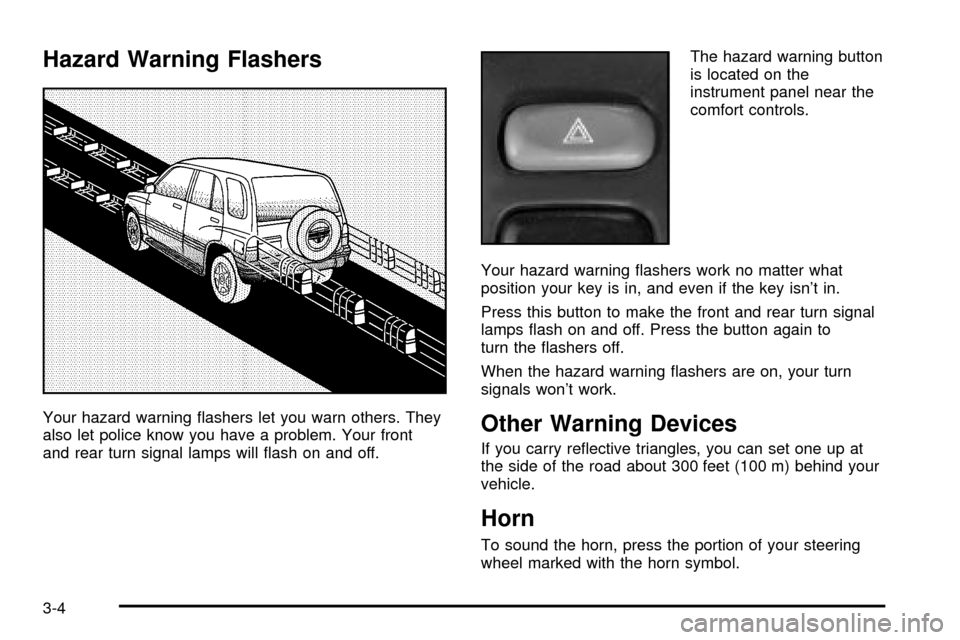
Your hazard warning ¯ashers let you warn others. They
also let police know you have a problem. Your front
and rear turn signal lamps will ¯ash on and off.The hazard warning button
is located on the
instrument panel near the
comfort controls.
Your hazard warning ¯ashers work no matter what
position your key is in, and even if the key isn't in.
Press this button to make the front and rear turn signal
lamps ¯ash on and off. Press the button again to
turn the ¯ashers off.
When the hazard warning ¯ashers are on, your turn
signals won't work.Other Warning Devices
If you carry re¯ective triangles, you can set one up at
the side of the road about 300 feet (100 m) behind your
vehicle.
Horn
To sound the horn, press the portion of your steering
wheel marked with the horn symbol.
3-4
Page 117 of 372
Tilt Wheel
If your vehicle has a tilt wheel, you can adjust the
steering wheel before you drive. You can raise it to the
highest level to give your legs more room when you
exit and enter your vehicle.
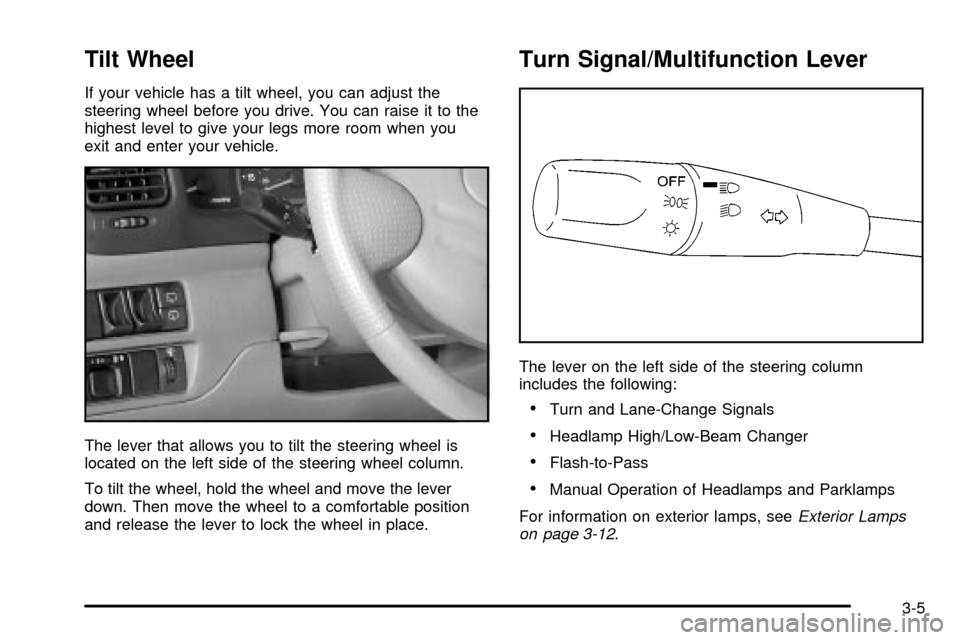
The lever that allows you to tilt the steering wheel is
located on the left side of the steering wheel column.
To tilt the wheel, hold the wheel and move the lever
down. Then move the wheel to a comfortable position
and release the lever to lock the wheel in place.
Turn Signal/Multifunction Lever
The lever on the left side of the steering column
includes the following:
·Turn and Lane-Change Signals
·Headlamp High/Low-Beam Changer
·Flash-to-Pass
·Manual Operation of Headlamps and Parklamps
For information on exterior lamps, see
Exterior Lamps
on page 3-12.
3-5
Page 119 of 372

Windshield Wipers
Use this lever located on the right side of the steering
wheel to operate the windshield wipers and washers.
OFF:Move the lever to OFF to turn off the windshield
wipers.
INT (Intermittent):Move the stalk to INT (Intermittent)
then turn the inner band and choose the delay you
want. Turn the inner band up for longer intervals
between wiper cycles. Turn the band down for shorter
intervals.LO (Low Speed):For steady wiping at low speed,
move the stalk down to LO.
HI (High Speed):For higher speed wiping, move the
stalk down further to HI.
L:Move the lever all the way down to this position
for a single wiping cycle. Hold it there until the
windshield wipers start; then let go. The windshield
wipers will stop after one wipe. If you want more wipes,
hold the band at this position longer.
Remember that damaged wiper blades may prevent you
from seeing well enough to drive safely. To avoid
damage, be sure to clear ice and snow from the wiper
blades before using them. If they're frozen to the
windshield, carefully loosen or thaw them. If your blades
do become damaged, get new blades or blade inserts.
Heavy snow or ice can overload your wipers.
A circuit breaker will stop them until the motor cools.
Clear away snow or ice to prevent an overload.
3-7
Page 121 of 372

Cruise Control
If your vehicle has cruise control, you can maintain a
speed of about 25 mph (40 km/h) or more without
keeping your foot on the accelerator. This can really
help on long trips. Cruise control will not set at speeds
below about 25 mph (40 km/h).
{CAUTION:
·Cruise control can be dangerous where
you can not drive safely at a steady speed.
So, do not use your cruise control on
winding roads or in heavy traffic.
·Cruise control can be dangerous on
slippery roads. On such roads, fast
changes in tire traction can cause
needless wheel spinning, and you could
lose control. Do not use cruise control on
slippery roads.
Setting Cruise Control
1. Press the CRUISE
ON/OFF button located
on the instrument panel
to turn the system on.
The indicator light in the
button will come on.
Wait at least one
second after turning
the system on before
setting a speed.
Once the CRUISE ON/OFF switch is turned on,
it will come on each time you start your vehicle until
you manually turn if off.
3-9
Page 127 of 372
Interior Lamps
Instrument Panel Brightness
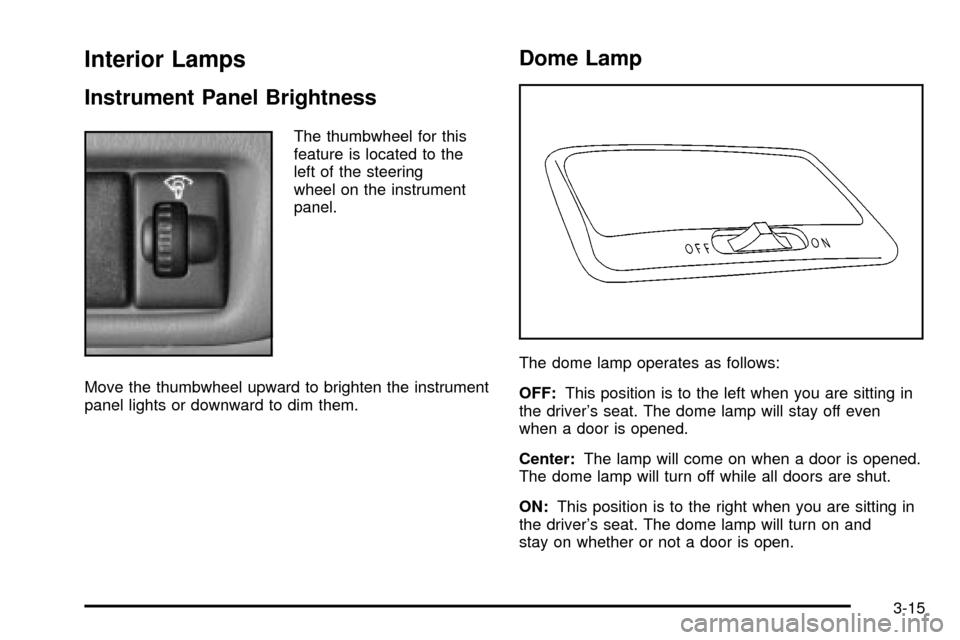
The thumbwheel for this
feature is located to the
left of the steering
wheel on the instrument
panel.
Move the thumbwheel upward to brighten the instrument
panel lights or downward to dim them.
Dome Lamp
The dome lamp operates as follows:
OFF:This position is to the left when you are sitting in
the driver's seat. The dome lamp will stay off even
when a door is opened.
Center:The lamp will come on when a door is opened.
The dome lamp will turn off while all doors are shut.
ON:This position is to the right when you are sitting in
the driver's seat. The dome lamp will turn on and
stay on whether or not a door is open.
3-15
Page 147 of 372

·Sometimes when the engine is idling at a stop, the
light may blink on and off. This is normal.
·If you make a hard stop, the light may come on for
a moment. This is normal.
{CAUTION:
Do not keep driving if the oil pressure is low.
If you do, your engine can become so hot that
it catches ®re. You or others could be burned.
Check your oil as soon as possible and have
your vehicle serviced.
Notice:Damage to your engine from neglected oil
problems can be costly and is not covered by
your warranty.
Overdrive Off Light
This light comes on when
the automatic four-speed
transmission, if equipped,
has been converted to the
three-speed mode and the
overdrive is turned off.
This light also comes on as a check for about ®ve
seconds when the ignition key is turned to ON or
START.
Four-Wheel-Drive Light
If you have four-wheel
drive, this light comes on
when the ignition switch
is on and the transfer case
lever is in one of the
four-wheel drive positions.
See
Four-Wheel Drive on page 5-53.
3-35
Page 157 of 372

Your Driving, the Road, and Your Vehicle..........4-2
Driver Behavior..............................................4-2
Driving Environment........................................4-2
Vehicle Design...............................................4-3
Defensive Driving...........................................4-3
Drunken Driving.............................................4-4
Control of a Vehicle........................................4-7
Braking.........................................................4-7
Steering......................................................4-11
Off-Road Recovery.......................................4-13
Passing.......................................................4-13
Loss of Control.............................................4-15
Off-Road Driving with Your
Four-Wheel-Drive Vehicle...........................4-16
Driving at Night............................................4-30Driving in Rain and on Wet Roads..................4-32
City Driving..................................................4-35
Freeway Driving...........................................4-36
Before Leaving on a Long Trip.......................4-37
Highway Hypnosis........................................4-38
Hill and Mountain Roads................................4-38
Winter Driving..............................................4-40
If You Are Stuck: In Sand, Mud,
Ice or Snow..............................................4-44
Towing..........................................................4-47
Towing Your Vehicle.....................................4-47
Recreational Vehicle Towing...........................4-47
Loading Your Vehicle....................................4-51
Towing a Trailer...........................................4-53
Section 4 Driving Your Vehicle
4-1
Page 159 of 372

Vehicle Design
According to the U.S. Department of Transportation,
utility vehicles have a signi®cantly higher rollover rate
than other types of vehicles. Utility vehicles do have
higher ground clearance and a narrower track or
shorter wheelbase than passenger cars, to make them
more capable for off-road driving. Speci®c design
characteristics like these give the driver a better view
of the road, but also give utility vehicles a higher
center of gravity than other types of vehicles.
This means that you should not expect a utility vehicle to
handle the same way a vehicle with a lower center of
gravity, like a car, would in similar situations.
But driver behavior factors are far more often the cause
of a utility vehicle rollover than are environmental or
vehicle factors. Safe driver behavior and understanding
the environment in which you will be driving can help
avoid a rollover crash in any type of vehicle, including
utility vehicles.
Defensive Driving
The best advice anyone can give about driving is:
Drive defensively.
Please start with a very important safety device in your
vehicle: Buckle up. See
Safety Belts: They Are for
Everyone on page 1-11.
Defensive driving really means ªbe ready for anything.º
On city streets, rural roads or freeways, it means
ªalways expect the unexpected.º
Assume that pedestrians or other drivers are going to
be careless and make mistakes. Anticipate what
they might do. Be ready for their mistakes.
Rear-end collisions are about the most preventable of
accidents. Yet they are common. Allow enough following
distance. It is the best defensive driving maneuver,
in both city and rural driving. You never know when the
vehicle in front of you is going to brake or turn suddenly.
Defensive driving requires that a driver concentrate on
the driving task. Anything that distracts from the
driving task Ð such as concentrating on a cellular
telephone call, reading, or reaching for something on
the ¯oor Ð makes proper defensive driving more difficult
and can even cause a collision, with resulting injury.
Ask a passenger to help do things like this, or pull off the
road in a safe place to do them yourself. These simple
defensive driving techniques could save your life.
4-3
Page 165 of 372
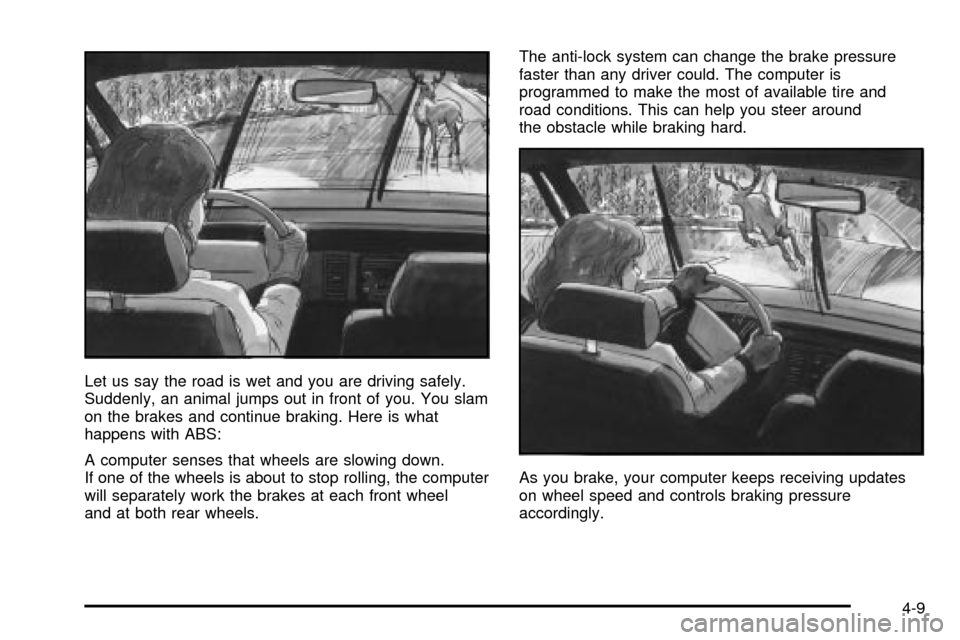
Let us say the road is wet and you are driving safely.
Suddenly, an animal jumps out in front of you. You slam
on the brakes and continue braking. Here is what
happens with ABS:
A computer senses that wheels are slowing down.
If one of the wheels is about to stop rolling, the computer
will separately work the brakes at each front wheel
and at both rear wheels.The anti-lock system can change the brake pressure
faster than any driver could. The computer is
programmed to make the most of available tire and
road conditions. This can help you steer around
the obstacle while braking hard.
As you brake, your computer keeps receiving updates
on wheel speed and controls braking pressure
accordingly.
4-9