brake light CHEVROLET TRACKER 2004 2.G User Guide
[x] Cancel search | Manufacturer: CHEVROLET, Model Year: 2004, Model line: TRACKER, Model: CHEVROLET TRACKER 2004 2.GPages: 374, PDF Size: 2.57 MB
Page 172 of 374
Driving Downhill
When off-roading takes you downhill, you will want to
consider a number of things:
·How steep is the downhill? Will I be able to maintain
vehicle control?
·What is the surface like? Smooth? Rough?
Slippery? Hard-packed dirt? Gravel?
·Are there any hidden surface obstacles? Ruts?
Logs? Boulders?
·What is at the bottom of the hill? Is there a
hidden creek bank or even a river bottom with
large rocks?If you decide you can go down a hill safely, then try to
keep your vehicle headed straight down, and use a
low gear. This way, engine drag can help your brakes
and they will not have to do all the work. Descend
slowly, keeping your vehicle under control at all times.
{CAUTION:
Heavy braking when going down a hill can
cause your brakes to overheat and fade. This
could cause loss of control and a serious
accident. Apply the brakes lightly when
descending a hill and use a low gear to keep
vehicle speed under control.
4-24
Page 181 of 374
Driving too fast through large water puddles or even
going through some car washes can cause problems,
too. The water may affect your brakes. Try to avoid
puddles. But if you can not, try to slow down before you
hit them.
{CAUTION:
Wet brakes can cause accidents. They will not
work as well in a quick stop and may cause
pulling to one side. You could lose control of
the vehicle.
After driving through a large puddle of water
or a car wash, apply your brake pedal lightly
until your brakes work normally.
Hydroplaning
Hydroplaning is dangerous. So much water can build up
under your tires that they can actually ride on the
water. This can happen if the road is wet enough and
you are going fast enough. When your vehicle is
hydroplaning, it has little or no contact with the road.
Hydroplaning does not happen often. But it can if your
tires do not have much tread or if the pressure in
one or more is low. It can happen if a lot of water is
standing on the road. If you can see re¯ections
from trees, telephone poles or other vehicles, and
raindrops ªdimpleº the water's surface, there could be
hydroplaning.
Hydroplaning usually happens at higher speeds. There
just is not a hard and fast rule about hydroplaning.
The best advice is to slow down when it is raining.
Driving Through Deep Standing Water
Notice:If you drive too quickly through deep
puddles or standing water, water can come in
through your engine's air intake and badly damage
your engine. Never drive through water that is
slightly lower than the underbody of your vehicle. If
you can not avoid deep puddles or standing
water, drive through them very slowly.
4-33
Page 196 of 374

Dinghy Towing
To tow your vehicle from the front (four-wheel-drive
only), do the following:
Notice:If you tow a two-wheel-drive vehicle with all
four wheels on the ground, the transmission
could be damaged. The repairs would not be
covered by your warranty. Do not tow a
two-wheel-drive vehicle with all four wheels on the
ground.
Follow these steps:
1. Set the parking brake.
2. Shift your automatic transmission into PARK (P), or
your manual transmission to SECOND (2).
3. With the ignition key in the ON position, move the
transfer case to NEUTRAL and make sure the
4WD light on the instrument panel cluster is off.
See
Four-Wheel Drive on page 5-49.
4. Turn the ignition key to ACC.
5. Release the parking brake.
4-48
Page 198 of 374
Dolly Towing
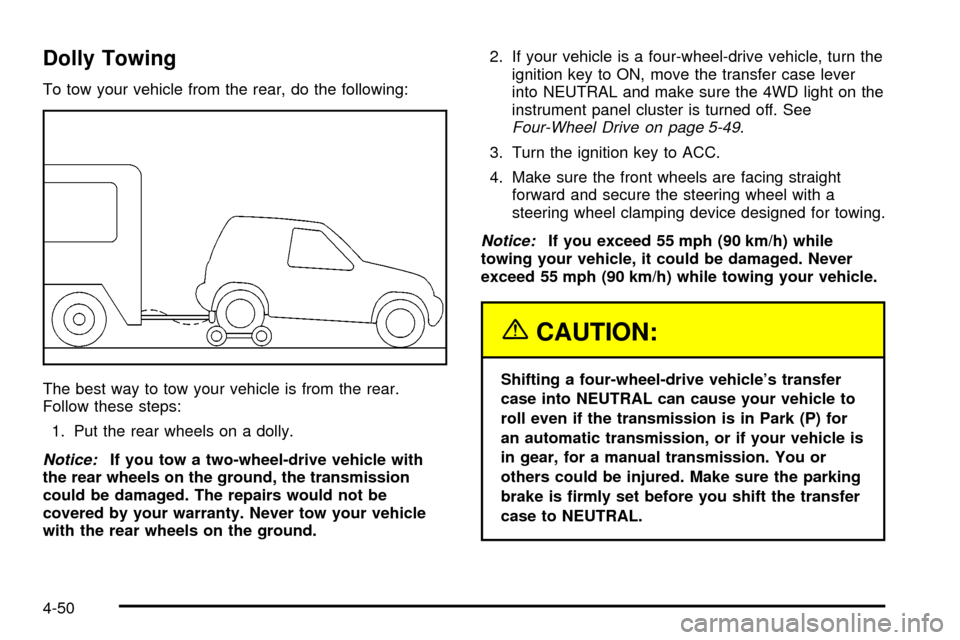
To tow your vehicle from the rear, do the following:
The best way to tow your vehicle is from the rear.
Follow these steps:
1. Put the rear wheels on a dolly.
Notice:If you tow a two-wheel-drive vehicle with
the rear wheels on the ground, the transmission
could be damaged. The repairs would not be
covered by your warranty. Never tow your vehicle
with the rear wheels on the ground.2. If your vehicle is a four-wheel-drive vehicle, turn the
ignition key to ON, move the transfer case lever
into NEUTRAL and make sure the 4WD light on the
instrument panel cluster is turned off. See
Four-Wheel Drive on page 5-49.
3. Turn the ignition key to ACC.
4. Make sure the front wheels are facing straight
forward and secure the steering wheel with a
steering wheel clamping device designed for towing.
Notice:If you exceed 55 mph (90 km/h) while
towing your vehicle, it could be damaged. Never
exceed 55 mph (90 km/h) while towing your vehicle.
{CAUTION:
Shifting a four-wheel-drive vehicle's transfer
case into NEUTRAL can cause your vehicle to
roll even if the transmission is in Park (P) for
an automatic transmission, or if your vehicle is
in gear, for a manual transmission. You or
others could be injured. Make sure the parking
brake is ®rmly set before you shift the transfer
case to NEUTRAL.
4-50
Page 208 of 374

Hitches
It's important to have the correct hitch equipment.
Crosswinds, large trucks going by and rough roads are
a few reasons why you'll need the right hitch. Here
are some rules to follow:
·If you make holes in the body of your vehicle, be
sure to seal them when you remove the trailering
equipment. If you don't seal them, dirt, water,
and even deadly carbon monoxide (CO) from your
exhaust can get into your vehicle. See
Engine
Exhaust on page 2-29.
Your vehicle is readily designed to accept a trailer hitch.
The frame rail ends already have holes and weld
nuts in place to accept the four bolts needed to attach
the hitch bar.
To help simplify setting up your trailer lights, there is a
trailer wiring connector located behind the left rear
trim panel. If needed, your dealer can provide help in
removing the trim panel and accessing this wiring
connector.
Your vehicle's trailer wiring has separate turn signal and
brake light circuits, which means you will most likely
need to purchase a converter to operate conventional
trailer lights.
Safety Chains
You should always attach chains between your vehicle
and your trailer. Cross the safety chains under the
tongue of the trailer to help prevent the tongue from
contacting the road if it becomes separated from
the hitch. Instructions about safety chains may be
provided by the hitch manufacturer or by the trailer
manufacturer. Follow the manufacturer's
recommendation for attaching safety chains and do not
attach them to the bumper. Always leave just enough
slack so you can turn with your rig. Never allow
safety chains to drag on the ground.
Trailer Brakes
If your trailer weighs more than 1,000 lbs. (450 kg)
loaded, then it needs its own surge brakes. Tapping into
your vehicle's brake system is not recommended.
4-60
Page 225 of 374

A. Engine Compartment Fuse Block. See ªEngine
Compartment Fuse Blockº underFuses and Circuit
Breakers on page 5-94.
B. Engine Air Cleaner/Filter. See
Engine Air
Cleaner/Filter on page 5-18.
C. Battery. See
Battery on page 5-42.
D. Radiator Pressure Cap. See
Radiator Pressure Cap
on page 5-28.
E. Engine Oil Fill Cap. See
Engine Oil on page 5-13.
F. Automatic Transmission Dipstick. See
Automatic
Transmission Fluid on page 5-20.
G. Engine Oil Dipstick. See
Engine Oil on page 5-13.
H. Power Steering Fluid Reservoir. See
Power Steering
Fluid on page 5-37.
I. Brake Master Cylinder Reservoir. See
Brakes on
page 5-39.
J. Coolant Recovery Tank. See
Engine Coolant on
page 5-25.
K. Windshield Washer Reservoir. See
Windshield
Washer Fluid on page 5-37.
Engine Oil
If the engine oil pressure
light appears on the
instrument cluster, it
means you need to check
your engine oil level
right away.
For more information, see
Oil Pressure Light on
page 3-36.
You should check your engine oil level regularly; this is
an added reminder.
5-13
Page 253 of 374
Brake Wear
Your vehicle has front disc brakes and rear drum
brakes.
Disc brake pads have built-in wear indicators that make
a high-pitched warning sound when the brake pads
are worn and new pads are needed. The sound
may come and go or be heard all the time your vehicle
is moving (except when you are pushing on the
brake pedal ®rmly).
{CAUTION:
The brake wear warning sound means that
soon your brakes will not work well. That
could lead to an accident. When you hear the
brake wear warning sound, have your vehicle
serviced.
Notice:Continuing to drive with worn-out brake
pads could result in costly brake repair.
Some driving conditions or climates may cause a brake
squeal when the brakes are ®rst applied or lightly
applied. This does not mean something is wrong with
your brakes.Properly torqued wheel nuts are necessary to help
prevent brake pulsation. When tires are rotated, inspect
brake pads for wear and evenly tighten wheel nuts in
the proper sequence to GM torque speci®cations.
Your rear drum brakes do not have wear indicators, but
if you ever hear a rear brake rubbing noise, have the
rear brake linings inspected immediately. Also, the rear
brake drums should be removed and inspected each
time the tires are removed for rotation or changing.
When you have the front brake pads replaced, have the
rear brakes inspected, too.
Brake linings should always be replaced as complete
axle sets.
See
Brake System Inspection on page 6-29.
Brake Pedal Travel
See your dealer if the brake pedal does not return to
normal height, or if there is a rapid increase in
pedal travel. This could be a sign of brake trouble.
Brake Adjustment
Every time you make a brake stop, your disc brakes
adjust for wear.
5-41
Page 255 of 374
Jump Starting
If your battery has run down, you may want to use
another vehicle and some jumper cables to start your
vehicle. Be sure to follow the steps below to do it safely.
{CAUTION:
Batteries can hurt you. They can be dangerous
because:
·They contain acid that can burn you.
·They contain gas that can explode or
ignite.
·They contain enough electricity to
burn you.
If you do not follow these steps exactly, some
or all of these things can hurt you.
Notice:Ignoring these steps could result in costly
damage to your vehicle that would not be covered
by your warranty.
Trying to start your vehicle by pushing or pulling it
will not work, and it could damage your vehicle.
1. Check the other vehicle. It must have a 12-volt
battery with a negative ground system.
Notice:If the other vehicle's system is not a 12-volt
system with a negative ground, both vehicles can
be damaged. Only use vehicles with 12-volt systems
with negative grounds to jump start your vehicle.
2. Get the vehicles close enough so the jumper cables
can reach, but be sure the vehicles aren't touching
each other. If they are, it could cause a ground
connection you don't want. You wouldn't be able to
start your vehicle, and the bad grounding could
damage the electrical systems.
To avoid the possibility of the vehicles rolling, set
the parking brake ®rmly on both vehicles involved in
the jump start procedure. Put an automatic
transmission in PARK (P) or a manual transmission
in NEUTRAL before setting the parking brake.
Notice:If you leave your radio or other accessories
on during the jump starting procedure, they could
be damaged. The repairs would not be covered
by your warranty. Always turn off your radio and
other accessories when jump starting your vehicle.
3. Turn off the ignition on both vehicles. Unplug
unnecessary accessories plugged into the cigarette
lighter. Turn off the radio and all lamps that aren't
needed. This will help reduce sparks and help save
both batteries. And it could save your radio!
5-43
Page 272 of 374

(A) Light Truck (LT-Metric) Tire:The United States
version of a metric tire sizing system. The letter ªLTº as
the ®rst two characters in the tire size means a light
truck tire engineered to standards set by the U. S. Tire
and Rim Association.
(B) Tire Width:The three-digit number indicates the
tire section width in millimeters from sidewall to sidewall.
(C) Aspect Ratio:A two-digit number that indicates
the tire height-to-width measurements. For example, if
the tire size aspect ratio is ª75,º as shown in item ªCº of
the illustration, it would mean that the tire's sidewall is
75% as high as it is wide.(D) Construction Code:A letter code is used to
indicate the type of ply construction in the tire. The
letter ªRº means radial ply construction; the letter ªDº
means diagonal or bias ply construction; and the
letter ªBº means belted-bias ply construction.
(E) Rim Diameter:Diameter of the wheel in inches.
(F) Service Description:The service description
indicates the load range and speed rating of a tire. The
load index can range from 1 to 279. Speed ratings
range from ªAº to ªZº. The light truck tire size example
above shows dual or single tire con®gurations.Tire Terminology and De®nitions
Air Pressure:The amount of air inside the tire pressing
outward on each square inch of the tire. Air pressure
is expressed in pounds per square inch (psi) or
kilopascal (kPa).
Accessory Weight:This means the combined weight
of optional accessories. Some examples of optional
accessories are, automatic transmission, power steering,
power brakes, power windows, power seats, and air
conditioning.
Aspect Ratio:The relationship of a tire's height to its
width. Light Truck (LT-Metric) Tire
5-60
Page 307 of 374
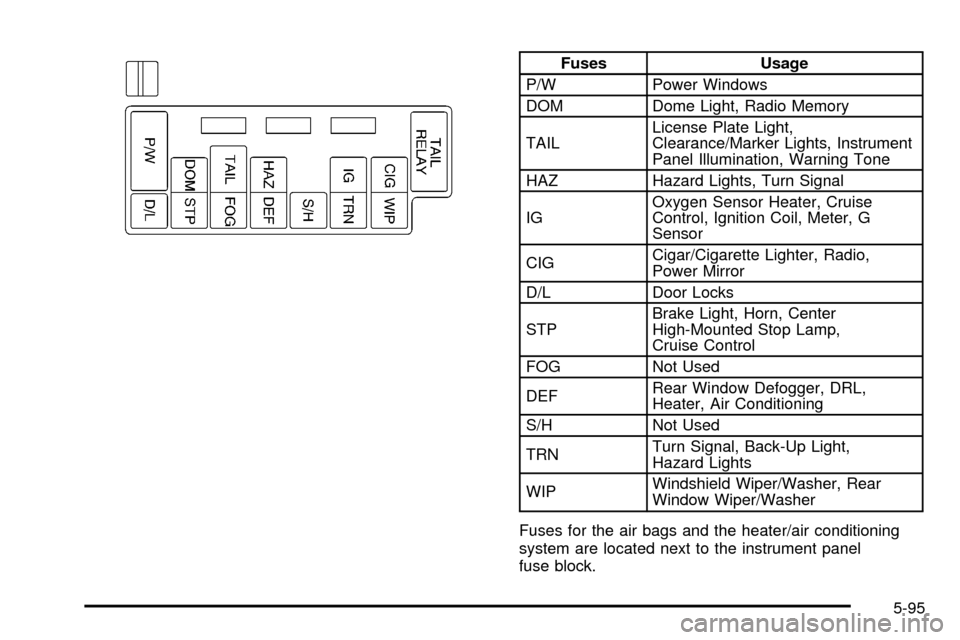
Fuses Usage
P/W Power Windows
DOM Dome Light, Radio Memory
TAILLicense Plate Light,
Clearance/Marker Lights, Instrument
Panel Illumination, Warning Tone
HAZ Hazard Lights, Turn Signal
IGOxygen Sensor Heater, Cruise
Control, Ignition Coil, Meter, G
Sensor
CIGCigar/Cigarette Lighter, Radio,
Power Mirror
D/L Door Locks
STPBrake Light, Horn, Center
High-Mounted Stop Lamp,
Cruise Control
FOG Not Used
DEFRear Window Defogger, DRL,
Heater, Air Conditioning
S/H Not Used
TRNTurn Signal, Back-Up Light,
Hazard Lights
WIPWindshield Wiper/Washer, Rear
Window Wiper/Washer
Fuses for the air bags and the heater/air conditioning
system are located next to the instrument panel
fuse block.
5-95