change wheel CHEVROLET TRACKER 2004 2.G User Guide
[x] Cancel search | Manufacturer: CHEVROLET, Model Year: 2004, Model line: TRACKER, Model: CHEVROLET TRACKER 2004 2.GPages: 374, PDF Size: 2.57 MB
Page 261 of 374
Four-Wheel Drive
Most lubricant checks in this section also apply to
four-wheel-drive vehicles. However, they have
two additional systems that need lubrication.
Transfer Case
When to Check and Change Lubricant
Refer to the Maintenance Schedule to determine how
often to check the lubricant and when to change it. See
Part A: Scheduled Maintenance Services on page 6-4.
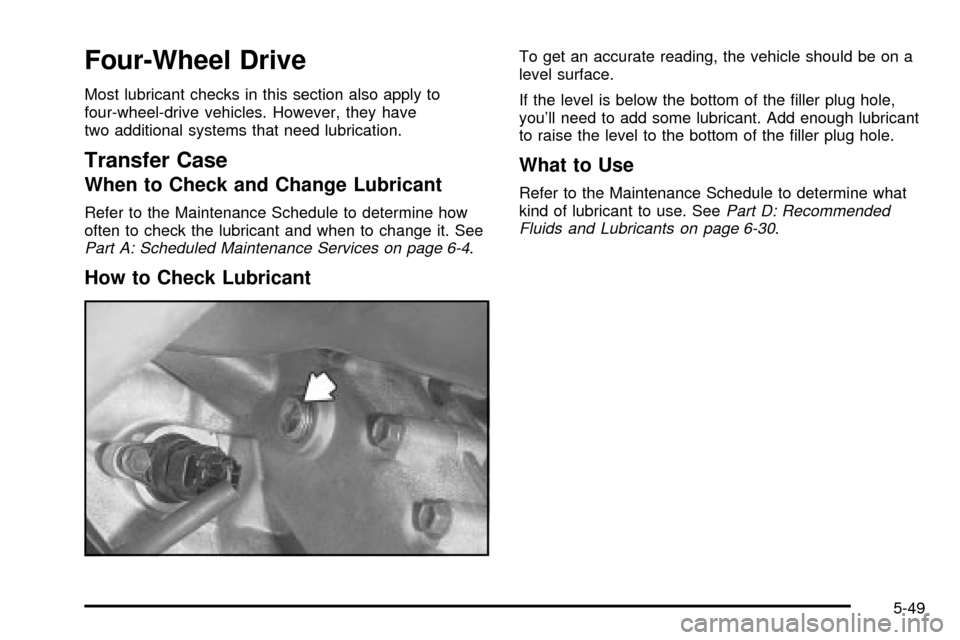
How to Check Lubricant
To get an accurate reading, the vehicle should be on a
level surface.
If the level is below the bottom of the ®ller plug hole,
you'll need to add some lubricant. Add enough lubricant
to raise the level to the bottom of the ®ller plug hole.
What to Use
Refer to the Maintenance Schedule to determine what
kind of lubricant to use. SeePart D: Recommended
Fluids and Lubricants on page 6-30.
5-49
Page 277 of 374
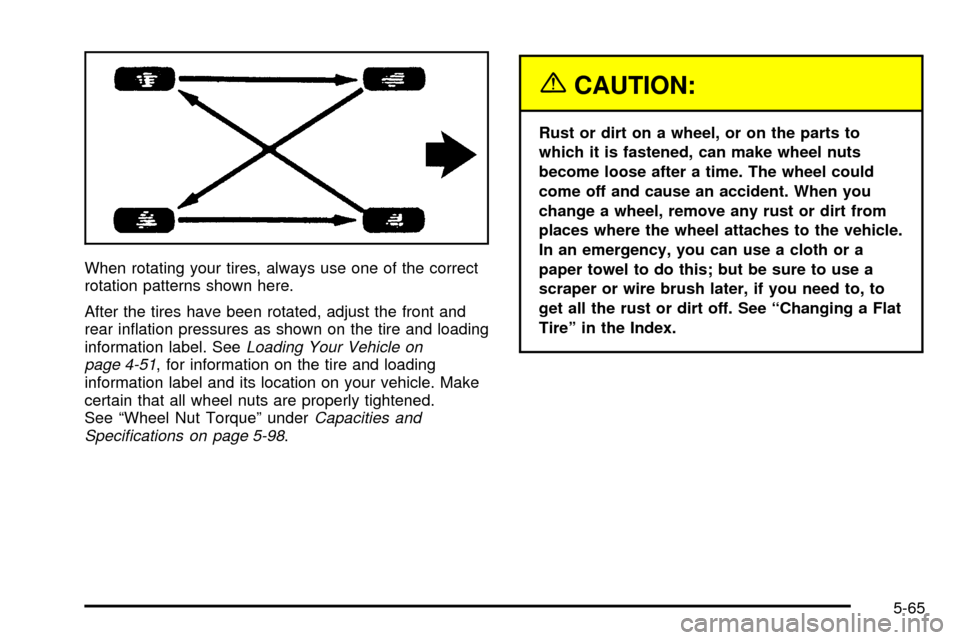
When rotating your tires, always use one of the correct
rotation patterns shown here.
After the tires have been rotated, adjust the front and
rear in¯ation pressures as shown on the tire and loading
information label. See
Loading Your Vehicle on
page 4-51, for information on the tire and loading
information label and its location on your vehicle. Make
certain that all wheel nuts are properly tightened.
See ªWheel Nut Torqueº under
Capacities and
Speci®cations on page 5-98.
{CAUTION:
Rust or dirt on a wheel, or on the parts to
which it is fastened, can make wheel nuts
become loose after a time. The wheel could
come off and cause an accident. When you
change a wheel, remove any rust or dirt from
places where the wheel attaches to the vehicle.
In an emergency, you can use a cloth or a
paper towel to do this; but be sure to use a
scraper or wire brush later, if you need to, to
get all the rust or dirt off. See ªChanging a Flat
Tireº in the Index.
5-65
Page 284 of 374
If a Tire Goes Flat
It's unusual for a tire to ªblowoutº while you're driving,
especially if you maintain your tires properly. If air goes
out of a tire, it's much more likely to leak out slowly.
But if you should ever have a ªblowout,º here are a few
tips about what to expect and what to do:
If a front tire fails, the ¯at tire will create a drag that
pulls the vehicle toward that side. Take your foot off the
accelerator pedal and grip the steering wheel ®rmly.
Steer to maintain lane position, and then gently brake to
a stop well out of the traffic lane.
A rear blowout, particularly on a curve, acts much like a
skid and may require the same correction you'd use
in a skid. In any rear blowout, remove your foot from the
accelerator pedal. Get the vehicle under control by
steering the way you want the vehicle to go. It may be
very bumpy and noisy, but you can still steer. Gently
brake to a stop, well off the road if possible.{CAUTION:
Lifting a vehicle and getting under it to do
maintenance or repairs is dangerous without
the appropriate safety equipment and training.
The jack provided with your vehicle is
designed only for changing a ¯at tire. If it is
used for anything else, you or others could be
badly injured or killed if the vehicle slips off
the jack. Use the jack provided with your
vehicle only for changing a ¯at tire.
If a tire goes ¯at, the next part shows how to use your
jacking equipment to change a ¯at tire safely.
Changing a Flat Tire
If a tire goes ¯at, avoid further tire and wheel damage
by driving slowly to a level place. Turn on your
hazard warning ¯ashers.
5-72
Page 285 of 374
{CAUTION:
Changing a tire can be dangerous. The vehicle
can slip off the jack and roll over or fall on you
or other people. You and they could be badly
injured or even killed. Find a level place to
change your tire. To help prevent the vehicle
from moving:
1. Set the parking brake ®rmly.
2. Put an automatic transmission shift lever
in PARK (P), or shift a manual
transmission to FIRST (1) or
REVERSE (R).
3. If you have a four-wheel-drive vehicle,
be sure the transfer case is in a drive
gear Ð not in NEUTRAL.
4. Turn off the engine and do not restart
while the vehicle is raised.
5. Do not allow passengers to remain in the
vehicle.
CAUTION: (Continued)
CAUTION: (Continued)
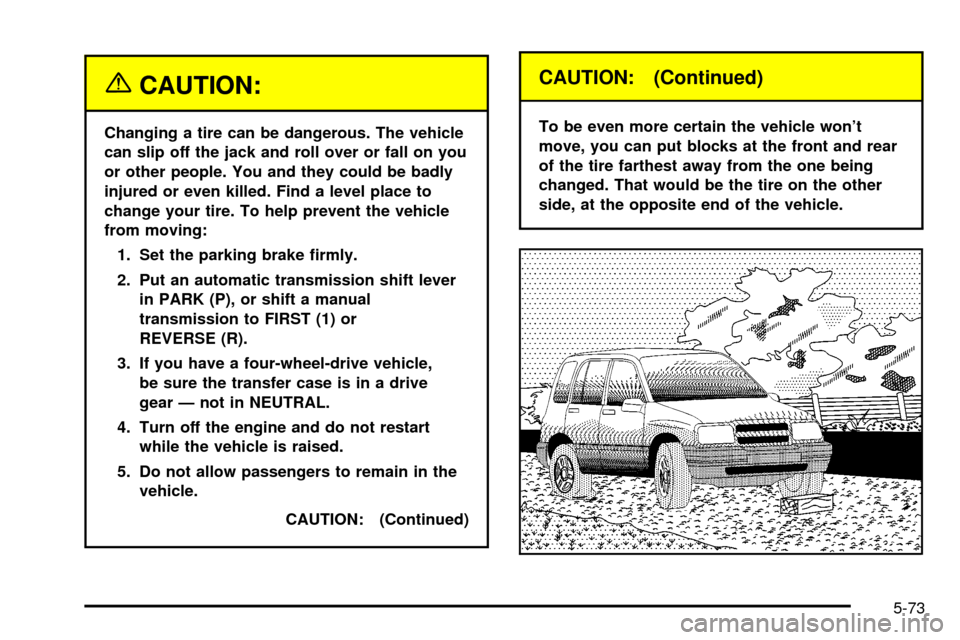
To be even more certain the vehicle won't
move, you can put blocks at the front and rear
of the tire farthest away from the one being
changed. That would be the tire on the other
side, at the opposite end of the vehicle.
5-73
Page 286 of 374
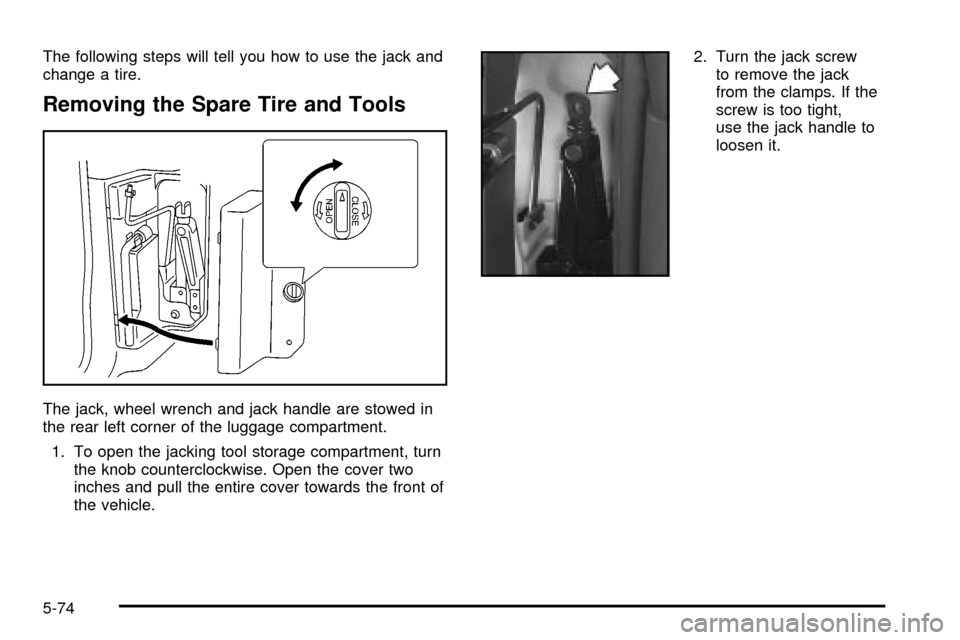
The following steps will tell you how to use the jack and
change a tire.
Removing the Spare Tire and Tools
The jack, wheel wrench and jack handle are stowed in
the rear left corner of the luggage compartment.
1. To open the jacking tool storage compartment, turn
the knob counterclockwise. Open the cover two
inches and pull the entire cover towards the front of
the vehicle.2. Turn the jack screw
to remove the jack
from the clamps. If the
screw is too tight,
use the jack handle to
loosen it.
5-74
Page 293 of 374
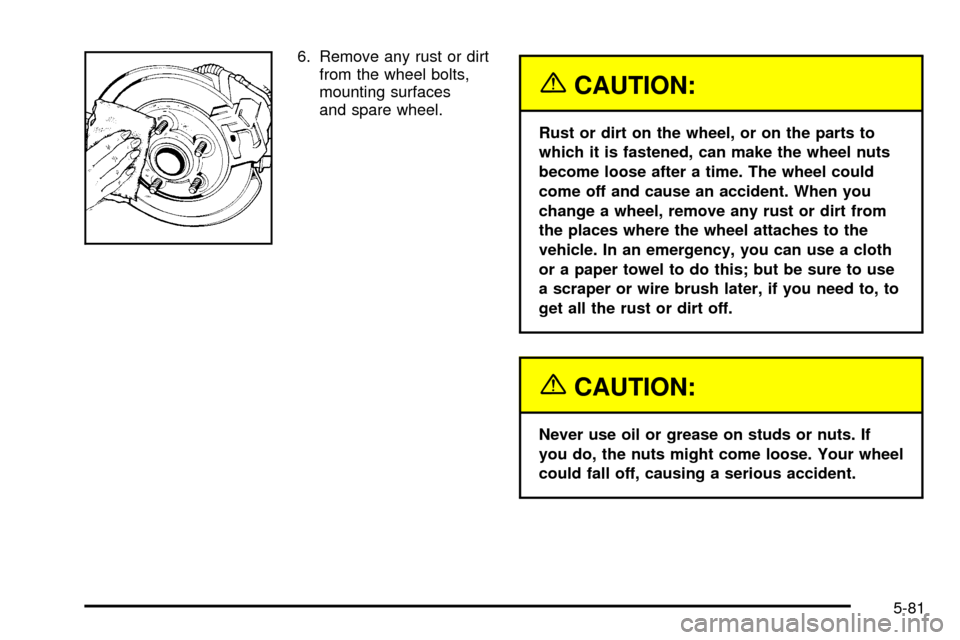
6. Remove any rust or dirt
from the wheel bolts,
mounting surfaces
and spare wheel.
{CAUTION:
Rust or dirt on the wheel, or on the parts to
which it is fastened, can make the wheel nuts
become loose after a time. The wheel could
come off and cause an accident. When you
change a wheel, remove any rust or dirt from
the places where the wheel attaches to the
vehicle. In an emergency, you can use a cloth
or a paper towel to do this; but be sure to use
a scraper or wire brush later, if you need to, to
get all the rust or dirt off.
{CAUTION:
Never use oil or grease on studs or nuts. If
you do, the nuts might come loose. Your wheel
could fall off, causing a serious accident.
5-81
Page 343 of 374

Throttle System Inspection
Inspect the throttle system for interference or binding,
and for damaged or missing parts. Replace parts
as needed. Replace any components that have high
effort or excessive wear. Do not lubricate accelerator
and cruise control cables.
Rear Axle and Front Axle
(Four-Wheel-Drive) Service
Check the gear lubricant level and add if needed. SeeRear Axle on page 5-48andFour-Wheel Drive on
page 5-49. A ¯uid loss may indicate a problem. Check
the system(s), and repair the system(s) if needed. Refer
to
Part A: Scheduled Maintenance Services on
page 6-4to determine when to change the lubricant.
Brake System Inspection
Inspect the complete system. Inspect brake lines and
hoses for proper hook-up, binding, leaks, cracks,
cha®ng, etc. Inspect disc brake pads for wear and rotors
for surface condition. Also inspect drum brake linings
for wear and cracks. Inspect other brake parts, including
drums, wheel cylinders, calipers, parking brake, etc.
Check parking brake adjustment. You may need to have
your brakes inspected more often if your driving
habits or conditions result in frequent braking.
6-29
Page 373 of 374

Tires (cont.)
Wheel Replacement.....................................5-70
When It Is Time for New Tires......................5-66
To Use the Engine Coolant Heater....................2-15
Top Strap......................................................1-39
Top Strap Anchor Location...............................1-41
Torque Lock...................................................2-26
Total Weight on Your Vehicle's Tires..................4-59
Towing
Recreational Vehicle.....................................4-47
Towing a Trailer..........................................4-57
Your Vehicle...............................................4-47
Trailer Brakes.................................................4-60
Transfer Case........................................2-22, 5-49
Transmission
Fluid, Automatic...........................................5-20
Fluid, Manual..............................................5-23
Transmission Operation, Automatic....................2-16
Transmission Operation, Manual........................2-20
Transmission, Transaxle, Transfer Case Unit
Repair Manual............................................7-11
Transportation Options...................................... 7-7
Traveling to Remote Areas...............................4-18
Trip Odometer................................................3-28
Turn and Lane-Change Signals.......................... 3-6
Turn Signal/Multifunction Lever........................... 3-6
Turn Signals When Towing a Trailer..................4-62U
Underbody Flushing Service.............................6-27
Understanding Radio Reception........................3-45
Uniform Tire Quality Grading............................5-68
United States ± Customer Assistance.................. 7-4
Used Replacement Wheels..............................5-71
Using Cleaner on Fabric..................................5-86
Using the Rear Door Security Lock..................... 2-8
Using the Recovery Hooks...............................4-45
V
Vehicle
Control........................................................ 4-7
Damage Warnings........................................... iv
Design......................................................... 4-3
Loading......................................................4-51
Parking Your...............................................2-28
Symbols......................................................... iv
Vehicle Data Collection and Event Data
Records....................................................... 7-9
Vehicle Identi®cation
Number (VIN).............................................5-93
Service Parts Identi®cation Label...................5-93
Vehicle Storage..............................................5-42
Ventilation Adjustment......................................3-22
Visor Vanity Mirror..........................................2-11
Visors...........................................................2-11
13
Page 374 of 374

W
Warning Lights, Gages and Indicators................3-26
Warnings
Hazard Warning Flashers............................... 3-4
Other Warning Devices.................................. 3-5
Safety and Symbols......................................... iii
Vehicle Damage.............................................. iv
Washing Your Vehicle......................................5-89
Weatherstrip Lubrication...................................6-25
Weight of the Trailer........................................4-58
Weight of the Trailer Tongue.............................4-59
What Kind of Engine Oil to Use........................5-15
What to Do with Used Oil................................5-17
What to Use..................................5-25, 5-37, 5-48
Wheels
Alignment and Tire Balance..........................5-69
Replacement...............................................5-70
When to Add Engine Oil..................................5-14
When to Change Engine Oil.............................5-17
When to Check..............................................5-63
When to Check and Change....................5-20, 5-23
When to Check and Change Lubricant...............5-48When to Check and What to Use.....................5-24
When to Check Power Steering Fluid................5-37
When to Inspect the Engine Air Cleaner/Filter.....5-18
When You Are Ready to Leave After Parking on
a Hill.........................................................4-64
Where to Put the Restraint...............................1-38
Why Safety Belts Work....................................1-10
Window Lock.................................................2-11
Windows.......................................................2-10
Manual......................................................2-11
Power........................................................2-11
Windshield Washer........................................... 3-8
Fluid..........................................................5-37
Windshield Washer Fluid Level Check................6-24
Windshield Wipers............................................ 3-7
Winter Driving................................................4-40
Wiper Blade Check.........................................6-25
Y
Your Driving, the Road, and Your Vehicle............. 4-2
Your Vehicle and the Environment....................... 6-2
14