door lock CHEVROLET TRACKER 2004 2.G User Guide
[x] Cancel search | Manufacturer: CHEVROLET, Model Year: 2004, Model line: TRACKER, Model: CHEVROLET TRACKER 2004 2.GPages: 374, PDF Size: 2.57 MB
Page 77 of 374
Manual Windows
Use the window crank to open and close each window.
Power Windows
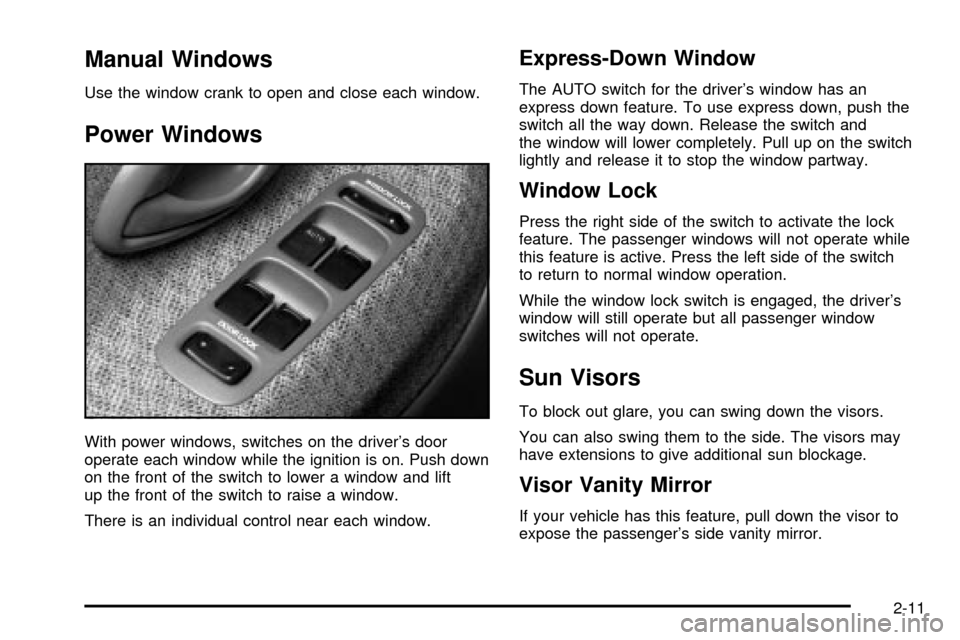
With power windows, switches on the driver's door
operate each window while the ignition is on. Push down
on the front of the switch to lower a window and lift
up the front of the switch to raise a window.
There is an individual control near each window.
Express-Down Window
The AUTO switch for the driver's window has an
express down feature. To use express down, push the
switch all the way down. Release the switch and
the window will lower completely. Pull up on the switch
lightly and release it to stop the window partway.
Window Lock
Press the right side of the switch to activate the lock
feature. The passenger windows will not operate while
this feature is active. Press the left side of the switch
to return to normal window operation.
While the window lock switch is engaged, the driver's
window will still operate but all passenger window
switches will not operate.
Sun Visors
To block out glare, you can swing down the visors.
You can also swing them to the side. The visors may
have extensions to give additional sun blockage.
Visor Vanity Mirror
If your vehicle has this feature, pull down the visor to
expose the passenger's side vanity mirror.
2-11
Page 79 of 374

{CAUTION:
On manual transmission vehicles, turning the
key to LOCK will lock the steering column and
result in a loss of ability to steer the vehicle.
This could cause a collision. If you need to
turn the engine off while the vehicle is moving,
turn the key only to ACC. Do not push the key
in while the vehicle is moving.
Notice:Using a tool to force the key from the
ignition switch could cause damage or break the
key. Use the correct key and turn the key only with
your hand. Make sure the key is all the way in. If
it is, turn the steering wheel left and right while you
turn the key hard. If none of this works, then
your vehicle needs service.ACC (ACCESSORY) (B):This is the position in which
you can operate your electrical accessories or items
plugged into the accessory power outlets. It also unlocks
the steering wheel and ignition. Use this position if
your vehicle must be pushed or towed.
ON (C):This is the position that the switch returns to
after you start your engine and release the switch.
The switch stays in ON while the engine is running. But
even while the engine is not running, you can use
ON to operate your electrical accessories and to display
some instrument panel cluster warning and indicator
lights.
START (D):This is the position that starts the engine.
When the engine starts, release the key. The ignition
switch will return to ON for normal driving.
When the engine is not running, ACC and ON allow you
to operate your electrical accessories, such as the
radio or items plugged into the accessory power outlets.
A warning tone will sound if you open the driver's
door while the ignition is in ACC or LOCK and the key
is in the ignition.
2-13
Page 99 of 374
Outside Convex Mirror
Your passenger's side mirror is convex. A convex
mirror's surface is curved so you can see more from the
driver's seat.
{CAUTION:
A convex mirror can make things (like other
vehicles) look farther away than they really are.
If you cut too sharply into the right lane, you
could hit a vehicle on your right. Check your
inside mirror or glance over your shoulder
before changing lanes.
Storage Areas
Glove Box
Use your key to lock and unlock the glove box. To open
the glove box, pull the latch toward you.
The glove box may have a two-position detent for
opening the door. Lower the door to the ®rst detent for
access to the glove box. Pull it to the next detent
for further access.
Cupholder(s)
Two cupholders are on the center console next to the
parking brake lever.
Coinholder(s)
Your instrument panel may have two coinholders
located to the left of the steering wheel.
2-33
Page 119 of 374

Entry Lighting
If your vehicle has remote keyless entry, it is equipped
with an entry lighting feature that controls your dome
lamp (and cargo lamp, if equipped). For the dome lamp
to operate as described below, the switch must be in
the middle position.
Your interior lamps will come on and stay on for a set
time whenever you press the UNLOCK button on
the remote keyless entry transmitter.
If you open any door, the lamps will stay on while the
door is open, then turn off automatically about 40
seconds after the last door is closed. If you press the
UNLOCK button on the remote keyless entry transmitter
and don't open a door, the lamps will come on and
then turn off after about 40 seconds.
The lamps will turn off immediately if you turn the
ignition key to ON. When the ignition is on, the entry
lighting feature is inactive. The interior lamps will come
on only if they are turned on by the dome lamp
switch or one of the doors is opened.
When you press the LOCK button on the remote
keyless entry transmitter, the interior lamps will come on
for about three seconds, and then shut off.
Reading Lamps
Your vehicle's inside rearview mirror may have reading
lamps.
Push the buttons on the bottom of the mirror to turn the
reading lamps on and off.
Cargo Lamp
Your vehicle may have a cargo lamp. The cargo lamp
comes on when any door is opened, and goes off when
all doors are shut.
3-17
Page 121 of 374

Ashtrays and Cigarette Lighter
If your vehicle has a cigarette lighter, to use it the
ignition key must be in ON or ACC. Push the lighter in
all the way and let go. When it's ready, it will pop
back out by itself.
Pull the door to open the ashtray. To remove it, press
down on the tab and pull the ashtray out. To reinstall the
ashtray, push it in until the tab latches.
If your vehicle has a rear ashtray, it is located on the
back of the center console. Push on the left side of the
ashtray. The ashtray will turn clockwise for usage.
To remove the rear ashtray, press down on the tab and
pull it out.
Notice:If you put papers or other ¯ammable items
in the ashtray, hot cigarettes or other smoking
materials could ignite them and possibly damage
your vehicle. Never put ¯ammable items in the
ashtray.
Climate Controls
Climate Control System
With this system you can control the heating, cooling
and ventilation for your vehicle.
3-19
Page 200 of 374

The Tire and Loading Information label shows the
seating capacity and the total weight your vehicle can
properly carry. This weight is called the vehicle capacity
weight. If your vehicle has the Tire and Loading
Information label, Example 1, the label is attached to
the center pillar, near the driver's door latch. If your
vehicle has the Tire-Loading Information label,
Example 2, the label is on the driver's door lock pillar.
The Tire and Loading Information label also gives
you the size and recommended in¯ation pressure for
the factory-installed, original equipment tires on
your vehicle. For more information on tires and in¯ation
see
Tires on page 5-55andIn¯ation - Tire Pressure
on page 5-63.
There is also important loading information on the
Certi®cation label. It tells you the Gross Vehicle
Weight Rating (GVWR) and the Gross Axle Weight
Rating (GAWR) for the front and rear axle; see
ªCerti®cation Labelº later in this section. Example 2
4-52
Page 203 of 374
Loading Your Vehicle
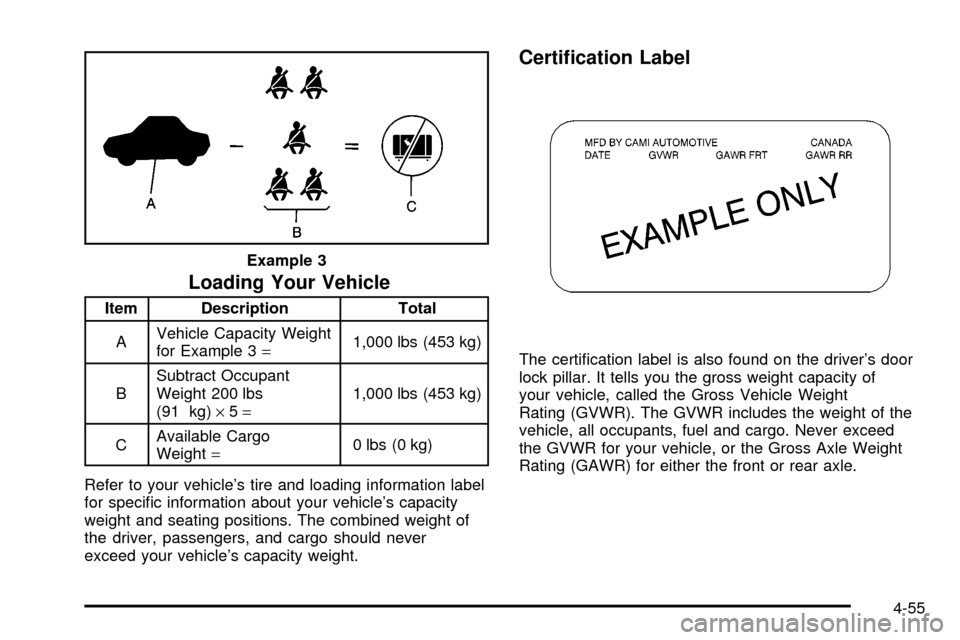
Item Description Total
AVehicle Capacity Weight
for Example 3=1,000 lbs (453 kg)
BSubtract Occupant
Weight 200 lbs
(91 kg)´5=1,000 lbs (453 kg)
CAvailable Cargo
Weight=0 lbs (0 kg)
Refer to your vehicle's tire and loading information label
for speci®c information about your vehicle's capacity
weight and seating positions. The combined weight of
the driver, passengers, and cargo should never
exceed your vehicle's capacity weight.
Certi®cation Label
The certi®cation label is also found on the driver's door
lock pillar. It tells you the gross weight capacity of
your vehicle, called the Gross Vehicle Weight
Rating (GVWR). The GVWR includes the weight of the
vehicle, all occupants, fuel and cargo. Never exceed
the GVWR for your vehicle, or the Gross Axle Weight
Rating (GAWR) for either the front or rear axle. Example 3
4-55
Page 307 of 374
Fuses Usage
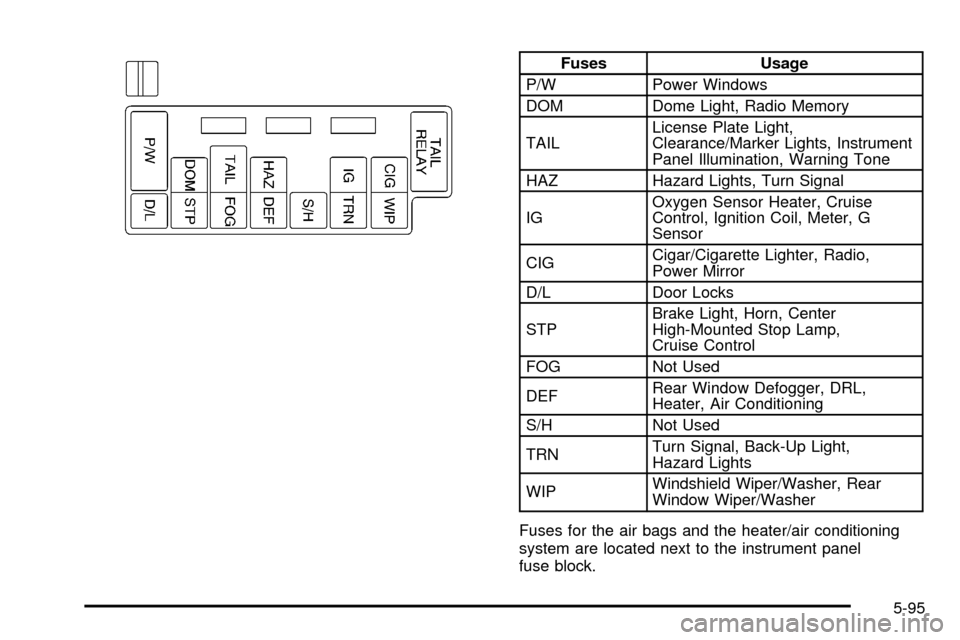
P/W Power Windows
DOM Dome Light, Radio Memory
TAILLicense Plate Light,
Clearance/Marker Lights, Instrument
Panel Illumination, Warning Tone
HAZ Hazard Lights, Turn Signal
IGOxygen Sensor Heater, Cruise
Control, Ignition Coil, Meter, G
Sensor
CIGCigar/Cigarette Lighter, Radio,
Power Mirror
D/L Door Locks
STPBrake Light, Horn, Center
High-Mounted Stop Lamp,
Cruise Control
FOG Not Used
DEFRear Window Defogger, DRL,
Heater, Air Conditioning
S/H Not Used
TRNTurn Signal, Back-Up Light,
Hazard Lights
WIPWindshield Wiper/Washer, Rear
Window Wiper/Washer
Fuses for the air bags and the heater/air conditioning
system are located next to the instrument panel
fuse block.
5-95
Page 339 of 374

At Least Twice a Year
Restraint System Check
Make sure the safety belt reminder light and all your
belts, buckles, latch plates, retractors and anchorages
are working properly. Look for any other loose or
damaged safety belt system parts. If you see anything
that might keep a safety belt system from doing its
job, have it repaired. Have any torn or frayed safety belts
replaced.
Also look for any opened or broken air bag coverings,
and have them repaired or replaced. (The air bag
system does not need regular maintenance.)
Wiper Blade Check
Inspect wiper blades for wear or cracking. Replace
blade inserts that appear worn or damaged or that
streak or miss areas of the windshield. Also see
Cleaning the Outside of Your Vehicle on page 5-89.
Weatherstrip Lubrication
Silicone grease on weatherstrips will make them last
longer, seal better, and not stick or squeak. Apply
silicone grease with a clean cloth. During very cold,
damp weather more frequent application may be
required. See
Part D: Recommended Fluids and
Lubricants on page 6-30.
Fluid Level Check
Check the transfer case, axle differential(s) and
automatic or manual transmission ¯uid levels and add
as needed. See
Rear Axle on page 5-48,Four-Wheel
Drive on page 5-49, andAutomatic Transmission
Fluid on page 5-20orManual Transmission Fluid on
page 5-23. Check for leaks. A ¯uid loss in these systems
could indicate a problem. Have the system inspected
and repaired at once.
At Least Once a Year
Key Lock Cylinders Service
Lubricate the key lock cylinders with the lubricant
speci®ed in Part D.
Body Lubrication Service
Lubricate all body door hinges. Also lubricate all hinges
and latches, including those for the hood, rear
compartment, glove box door, console door and folding
seat hardware. Part D tells you what to use. More
frequent lubrication may be required when exposed to a
corrosive environment.
6-25
Page 345 of 374

Usage Fluid/Lubricant
Key Lock
CylindersMulti-Purpose
Lubricant, Superlube
(GM Part No. U.S. 12346241, in
Canada 10953474).
Manual
Transmission Shift
LinkageChassis Lubricant
(GM Part No. U.S. 12377985, in
Canada 88901242) or lubricant
meeting requirements of
NLGI #2, Category LB or GC-LB.
Clutch Linkage
Pivot PointsChassis Lubricant
(GM Part No. U.S. 12377985, in
Canada 88901242) or lubricant
meeting requirements of
NLGI #2, Category LB or GC-LB.
Floor Shift LinkageLubriplate Lubricant Aerosol
(GM Part No. U.S. 12346293, in
Canada 992723) or lubricant
meeting requirements of NLGI #2
Category LB or GC-LB.Usage Fluid/Lubricant
Chassis
LubricationChassis Lubricant
(GM Part No. U.S. 12377985, in
Canada 88901242) or lubricant
meeting requirements of
NLGI #2, Category LB or GC-LB.
Rear Axle (All)
and Front Axle
(Four-Wheel Drive)Axle Lubricant
(GM Part No. U.S. 12345977, in
Canada 10953482) or
SAE 80W-90 GL-5 gear lubricant.
Hood Latch
Assembly,
Secondary Latch,
Pivots, Spring
Anchor and
Release PawlLubriplate Lubricant Aerosol
(GM Part No. U.S. 12346293, in
Canada 992723) or lubricant
meeting requirements of
NLGI #2, Category LB or GC-LB.
Hood and Door
HingesMulti-Purpose
Lubricant, Superlube
(GM Part No. U.S. 12346241, in
Canada 10953474).
Weatherstrip
ConditioningDielectric Silicone Grease
(GM Part No. U.S. 12345579, in
Canada 992887).
6-31