lock CHEVROLET TRACKER 2004 2.G Manual PDF
[x] Cancel search | Manufacturer: CHEVROLET, Model Year: 2004, Model line: TRACKER, Model: CHEVROLET TRACKER 2004 2.GPages: 374, PDF Size: 2.57 MB
Page 306 of 374
Fuses and Circuit Breakers
The wiring circuits in your vehicle are protected from
short circuits by fuses, circuit breakers and thermal links
in the wiring itself. This greatly reduces the chance of
®res caused by electrical problems.
Look at the metallic band inside the fuse. If the band is
broken or melted, replace the fuse. Be sure you
replace a bad fuse with a new one of the correct size.
If you ever have a problem on the road and don't have a
spare fuse, you can borrow one. Just pick some
feature of your vehicle that you can get along
without Ð like the radio or cigarette lighter Ð and use
its fuse, if it is the size you need. Replace it as soon as
you can.
Before replacing a fuse, turn every vehicle electrical
switch off.
There are two fuse blocks in your vehicle: the instrument
panel fuse block and the engine compartment fuse
block.
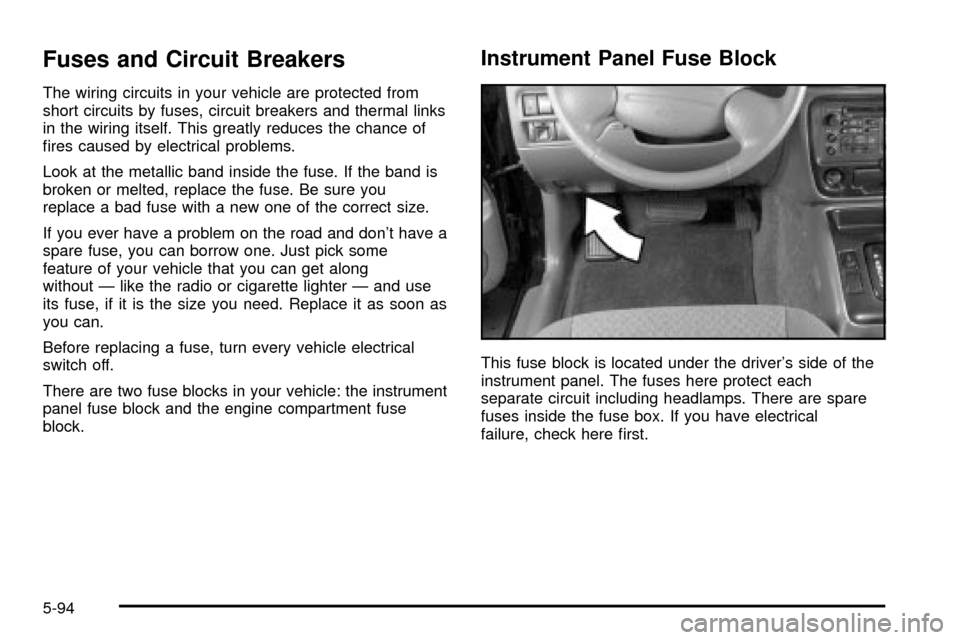
Instrument Panel Fuse Block
This fuse block is located under the driver's side of the
instrument panel. The fuses here protect each
separate circuit including headlamps. There are spare
fuses inside the fuse box. If you have electrical
failure, check here ®rst.
5-94
Page 307 of 374
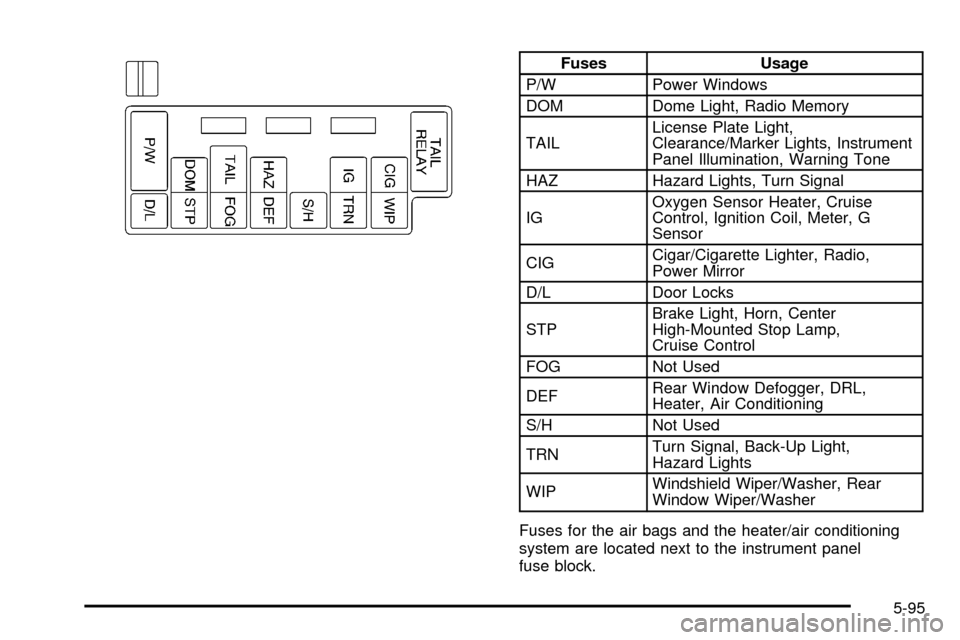
Fuses Usage
P/W Power Windows
DOM Dome Light, Radio Memory
TAILLicense Plate Light,
Clearance/Marker Lights, Instrument
Panel Illumination, Warning Tone
HAZ Hazard Lights, Turn Signal
IGOxygen Sensor Heater, Cruise
Control, Ignition Coil, Meter, G
Sensor
CIGCigar/Cigarette Lighter, Radio,
Power Mirror
D/L Door Locks
STPBrake Light, Horn, Center
High-Mounted Stop Lamp,
Cruise Control
FOG Not Used
DEFRear Window Defogger, DRL,
Heater, Air Conditioning
S/H Not Used
TRNTurn Signal, Back-Up Light,
Hazard Lights
WIPWindshield Wiper/Washer, Rear
Window Wiper/Washer
Fuses for the air bags and the heater/air conditioning
system are located next to the instrument panel
fuse block.
5-95
Page 308 of 374
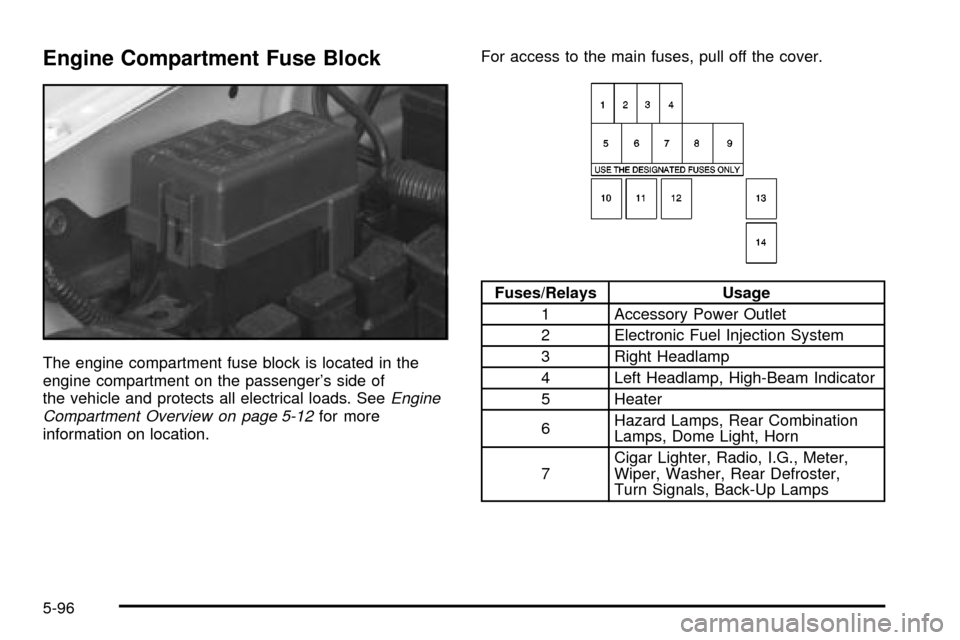
Engine Compartment Fuse Block
The engine compartment fuse block is located in the
engine compartment on the passenger's side of
the vehicle and protects all electrical loads. See
Engine
Compartment Overview on page 5-12for more
information on location.For access to the main fuses, pull off the cover.
Fuses/Relays Usage
1 Accessory Power Outlet
2 Electronic Fuel Injection System
3 Right Headlamp
4 Left Headlamp, High-Beam Indicator
5 Heater
6Hazard Lamps, Rear Combination
Lamps, Dome Light, Horn
7Cigar Lighter, Radio, I.G., Meter,
Wiper, Washer, Rear Defroster,
Turn Signals, Back-Up Lamps
5-96
Page 309 of 374
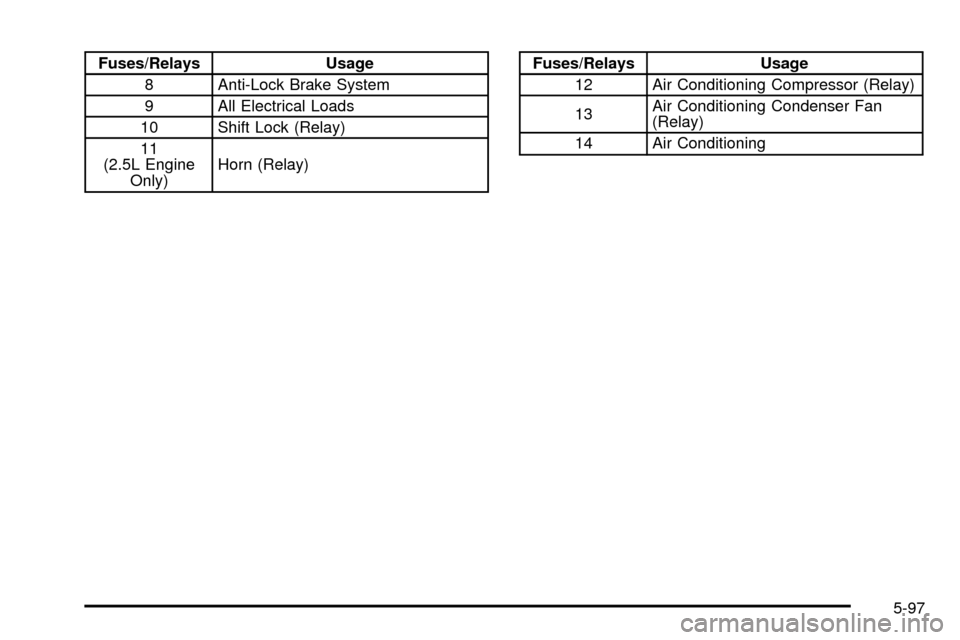
Fuses/Relays Usage
8 Anti-Lock Brake System
9 All Electrical Loads
10 Shift Lock (Relay)
11
(2.5L Engine
Only)Horn (Relay)Fuses/Relays Usage
12 Air Conditioning Compressor (Relay)
13Air Conditioning Condenser Fan
(Relay)
14 Air Conditioning
5-97
Page 339 of 374

At Least Twice a Year
Restraint System Check
Make sure the safety belt reminder light and all your
belts, buckles, latch plates, retractors and anchorages
are working properly. Look for any other loose or
damaged safety belt system parts. If you see anything
that might keep a safety belt system from doing its
job, have it repaired. Have any torn or frayed safety belts
replaced.
Also look for any opened or broken air bag coverings,
and have them repaired or replaced. (The air bag
system does not need regular maintenance.)
Wiper Blade Check
Inspect wiper blades for wear or cracking. Replace
blade inserts that appear worn or damaged or that
streak or miss areas of the windshield. Also see
Cleaning the Outside of Your Vehicle on page 5-89.
Weatherstrip Lubrication
Silicone grease on weatherstrips will make them last
longer, seal better, and not stick or squeak. Apply
silicone grease with a clean cloth. During very cold,
damp weather more frequent application may be
required. See
Part D: Recommended Fluids and
Lubricants on page 6-30.
Fluid Level Check
Check the transfer case, axle differential(s) and
automatic or manual transmission ¯uid levels and add
as needed. See
Rear Axle on page 5-48,Four-Wheel
Drive on page 5-49, andAutomatic Transmission
Fluid on page 5-20orManual Transmission Fluid on
page 5-23. Check for leaks. A ¯uid loss in these systems
could indicate a problem. Have the system inspected
and repaired at once.
At Least Once a Year
Key Lock Cylinders Service
Lubricate the key lock cylinders with the lubricant
speci®ed in Part D.
Body Lubrication Service
Lubricate all body door hinges. Also lubricate all hinges
and latches, including those for the hood, rear
compartment, glove box door, console door and folding
seat hardware. Part D tells you what to use. More
frequent lubrication may be required when exposed to a
corrosive environment.
6-25
Page 340 of 374

Starter Switch Check
{CAUTION:
When you are doing this inspection, the
vehicle could move suddenly. If the vehicle
moves, you or others could be injured.
1. Before you start, be sure you have enough room
around the vehicle.
2. Firmly apply both the parking brake and the regular
brake. See
Parking Brake on page 2-24if
necessary.
Do not use the accelerator pedal, and be ready to
turn off the engine immediately if it starts.
3. On automatic transmission vehicles, try to start the
engine in each gear. The starter should work only
in PARK (P) or NEUTRAL (N). If the starter works in
any other position, your vehicle needs service.
On manual transmission vehicles, put the shift lever
in NEUTRAL (N), push the clutch down halfway and
try to start the engine. The starter should work only
when the clutch is pushed down all the way to the
¯oor. If the starter works when the clutch is not
pushed all the way down, your vehicle needs service.
Automatic Transmission Shift Lock
Control System Check
{CAUTION:
When you are doing this inspection, the
vehicle could move suddenly. If the vehicle
moves, you or others could be injured.
1. Before you start, be sure you have enough room
around the vehicle. It should be parked on a level
surface.
2. Firmly apply the parking brake. See
Parking Brake
on page 2-24if necessary.
Be ready to apply the regular brake immediately if
the vehicle begins to move.
3. With the engine off, turn the key to the ON position,
but do not start the engine. Without applying the
regular brake, try to move the shift lever out
of PARK (P) with normal effort. If the shift lever
moves out of PARK (P), your vehicle needs service.
6-26
Page 341 of 374
Ignition Transmission Lock Check
While parked, and with the parking brake set, try to turn
the ignition key to LOCK in each shift lever position.
·With an automatic transmission, the key should turn
to LOCK only when the shift lever is in PARK (P).
·With a manual transmission, the key should turn to
LOCK only if you push the key in farther, while
turning it towards LOCK.
On all vehicles, the key should come out only in LOCK.
Parking Brake and Automatic
Transmission Park (P) Mechanism
Check
{CAUTION:
When you are doing this check, your vehicle
could begin to move. You or others could be
injured and property could be damaged. Make
sure there is room in front of your vehicle in
case it begins to roll. Be ready to apply the
regular brake at once should the vehicle begin
to move.Park on a fairly steep hill, with the vehicle facing
downhill. Keeping your foot on the regular brake, set the
parking brake.
·To check the parking brake's holding ability: With
the engine running and transmission in
NEUTRAL (N), slowly remove foot pressure from
the regular brake pedal. Do this until the vehicle is
held by the parking brake only.
·To check the PARK (P) mechanism's holding ability:
With the engine running, shift to PARK (P). Then
release the parking brake followed by the regular
brake.
If your vehicle is four-wheel drive, be sure the
transfer case is not in NEUTRAL.
Underbody Flushing Service
At least every spring, use plain water to ¯ush any
corrosive materials from the underbody. Take care to
clean thoroughly any areas where mud and other debris
can collect.
6-27
Page 345 of 374

Usage Fluid/Lubricant
Key Lock
CylindersMulti-Purpose
Lubricant, Superlube
(GM Part No. U.S. 12346241, in
Canada 10953474).
Manual
Transmission Shift
LinkageChassis Lubricant
(GM Part No. U.S. 12377985, in
Canada 88901242) or lubricant
meeting requirements of
NLGI #2, Category LB or GC-LB.
Clutch Linkage
Pivot PointsChassis Lubricant
(GM Part No. U.S. 12377985, in
Canada 88901242) or lubricant
meeting requirements of
NLGI #2, Category LB or GC-LB.
Floor Shift LinkageLubriplate Lubricant Aerosol
(GM Part No. U.S. 12346293, in
Canada 992723) or lubricant
meeting requirements of NLGI #2
Category LB or GC-LB.Usage Fluid/Lubricant
Chassis
LubricationChassis Lubricant
(GM Part No. U.S. 12377985, in
Canada 88901242) or lubricant
meeting requirements of
NLGI #2, Category LB or GC-LB.
Rear Axle (All)
and Front Axle
(Four-Wheel Drive)Axle Lubricant
(GM Part No. U.S. 12345977, in
Canada 10953482) or
SAE 80W-90 GL-5 gear lubricant.
Hood Latch
Assembly,
Secondary Latch,
Pivots, Spring
Anchor and
Release PawlLubriplate Lubricant Aerosol
(GM Part No. U.S. 12346293, in
Canada 992723) or lubricant
meeting requirements of
NLGI #2, Category LB or GC-LB.
Hood and Door
HingesMulti-Purpose
Lubricant, Superlube
(GM Part No. U.S. 12346241, in
Canada 10953474).
Weatherstrip
ConditioningDielectric Silicone Grease
(GM Part No. U.S. 12345579, in
Canada 992887).
6-31
Page 353 of 374

GM Mobility Program for Persons
with Disabilities
This program, available to
quali®ed applicants, can
reimburse you up to
$1,000 toward eligible
aftermarket driver or
passenger adaptive
equipment you may
require for your vehicle
(hand controls,
wheelchair/scooter
lifts, etc.).
This program can also provide you with free resource
information, such as area driver assessment centers and
mobility equipment installers. The offer is available for
a limited period of time from the date of vehicle
purchase/lease. For more details, or to determine your
vehicle's eligibility, see your GM dealer or call the
GM Mobility Assistance Center at 1-800-323-9935. Text
telephone (TTY) users, call 1-800-833-9935.
GM of Canada also has a Mobility Program. Call
1-800-GM-DRIVE (463-7483) for details. All TTY users
call 1-800-263-3830.
Roadside Assistance Program
Security While You Travel
1-800-CHEV-USA (243-8872)
As the proud owner of a new Chevrolet vehicle, you are
automatically enrolled in the Chevrolet Roadside
Assistance program. This value-added service is
intended to provide you with peace of mind as you drive
in the city or travel the open road. Chevrolet's Roadside
Assistance toll-free number is staffed by courteous
and capable Roadside Assistance Representatives who
are available 24 hours a day, 365 days a year.
We will provide the following services during the
Bumper-to-Bumper warranty period, at no expense
to you:
·Fuel Delivery:Delivery of enough fuel
($5 maximum) for the customer to get to the
nearest service station.
·Lock-out Service (identi®cation required):
Replacement keys or locksmith service will
be covered at no charge if you are unable to gain
entry into your vehicle. Delivery of the replacement
key will be covered within 10 miles.
7-5
Page 357 of 374

Vehicle Data Collection and Event
Data Records
Your vehicle, like other modern motor vehicles, has a
number of sophisticated computer systems that monitor
and control several aspects of the vehicle's performance.
Your vehicle uses on-board vehicle computers to monitor
emission control components to optimize fuel economy,
to monitor conditions for airbag deployment and, if so
equipped, to provide anti-lock braking and to help the
driver control the vehicle in difficult driving situations.
Some information may be stored during regular
operations to facilitate repair of detected malfunctions;
other information is stored only in a crash or near crash
event by computer systems commonly called event data
recorders (EDR).
In a crash or near crash event, computer systems, such
as the Airbag Sensing and Diagnostic Module (SDM)
in your vehicle may record information about the
condition of the vehicle and how it was operated, such
as engine speed, brake applications, throttle position,
vehicle speed, seat belt usage, airbag readiness, airbag
performance data, and the severity of a collision. This
information has been used to improve vehicle crash
performance and may be used to improve crash
performance of future vehicles and driving safety. Unlike
the data recorders on many airplanes, these on-board
systems do not record sounds, such as conversation of
vehicle occupants.To read this information, special equipment is needed
and access to the vehicle or the SDM is required.
GM will not access information about a crash event or
share it with others other than·with the consent of the vehicle owner or, if the
vehicle is leased, with the consent of the lessee,
·in response to an official request of police or similar
government office,
·as part of GM's defense of litigation through the
discovery process, or
·as required by law.
In addition, once GM collects or receives data, GM may
·use the data for GM research needs,
·make it available for research where appropriate
con®dentiality is to be maintained and need is
shown, or
·share summary data which is not tied to a speci®c
vehicle with non-GM organizations for research
purposes.
Others, such as law enforcement, may have access to
the special equipment that can read the information
if they have access to the vehicle or SDM.
If your vehicle is equipped with OnStar, please check
the OnStar subscription service agreement or manual for
information on its operations and data collection.
7-9