ABS CHEVROLET TRACKER 2004 2.G Owners Manual
[x] Cancel search | Manufacturer: CHEVROLET, Model Year: 2004, Model line: TRACKER, Model: CHEVROLET TRACKER 2004 2.GPages: 374, PDF Size: 2.57 MB
Page 127 of 374

3. Install the lower ®lter by dropping it down into
the slot.
The grooves on the two ®lters must be lined up with
each other as well as with the ventilation housing
in order to install the ®lters properly. The tabs on the
®lters should face outward towards you and
should be at the top of the ®lters. The arrows on the
®lters should point to the driver's side of the
vehicle.
4. Then line up the grooves of the second ®lter
with the lower one and slide it in on top of the
lower one.
5. Reverse the steps to remove the air ®lters and then
install new ones.
If you choose not to replace the ®lter after you remove
it, driving your vehicle without one will not cause
damage. However, the air will no longer be ®ltered.
3-25
Page 156 of 374
If you keep pace with the traffic and allow realistic
following distances, you will eliminate a lot of
unnecessary braking. That means better braking and
longer brake life.
If your engine ever stops while you are driving, brake
normally but do not pump your brakes. If you do,
the pedal may get harder to push down. If your engine
stops, you will still have some power brake assist.
But you will use it when you brake. Once the power
assist is used up, it may take longer to stop and
the brake pedal will be harder to push.
Anti-lock Brake System (ABS)
Your vehicle may have anti-lock brakes. ABS is an
advanced electronic braking system that will help
prevent a braking skid.
If your vehicle has anti-lock
brakes, this warning light
on the instrument panel will
come on brie¯y when
you start your vehicle.
When you start your engine, or when you begin to drive
away, your anti-lock brake system will check itself.You may hear a momentary motor or clicking noise while
this test is going on, and you may even notice that your
brake pedal moves or pulses a little. This is normal.
If there is a problem with the anti-lock brake system, the
anti-lock brake system warning light will stay on. See
Anti-Lock Brake System Warning Light on page 3-31.
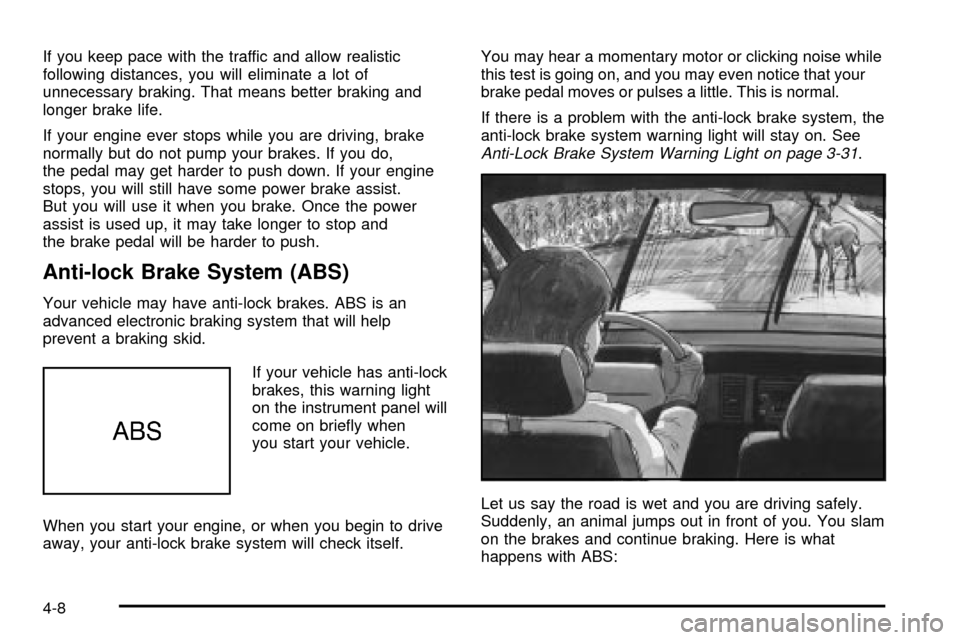
Let us say the road is wet and you are driving safely.
Suddenly, an animal jumps out in front of you. You slam
on the brakes and continue braking. Here is what
happens with ABS:
4-8
Page 211 of 374

Parking on Hills
{CAUTION:
You really should not park your vehicle, with a
trailer attached, on a hill. If something goes
wrong, your rig could start to move. People
can be injured, and both your vehicle and the
trailer can be damaged.
But if you ever have to park your rig on a hill, here's
how to do it:
1. Apply your regular brakes, but don't shift into
PARK (P) yet, or into gear for a manual
transmission.
2. Have someone place chocks under the trailer
wheels.
3. When the wheel chocks are in place, release the
regular brakes until the chocks absorb the load.
4. Reapply the regular brakes. Then apply your
parking brake, and then shift to PARK (P), or
REVERSE (R) for a manual transmission.5. If you have a four-wheel-drive vehicle, be sure the
transfer case is in a drive gear Ð not in NEUTRAL.
6. Release the regular brakes.{CAUTION:
It can be dangerous to get out of your vehicle
if the shift lever is not fully in PARK (P) with
the parking brake ®rmly set. Your vehicle
can roll.
If you have left the engine running, the vehicle
can move suddenly. You or others could be
injured. To be sure your vehicle will not move,
even when you are on fairly level ground, use
the steps that follow.
Always put the shift lever fully in PARK (P)
with the parking brake ®rmly set.
If the transfer case on four-wheel-drive
vehicles is in NEUTRAL, your vehicle will be
free to roll, even if your shift lever is in
PARK (P). So, be sure the transfer case is in a
drive gear Ð not in NEUTRAL.
4-63
Page 296 of 374

Storing a Flat or Spare Tire and Tools
{CAUTION:
Storing a jack, a tire, or other equipment in the
passenger compartment of the vehicle could
cause injury. In a sudden stop or collision,
loose equipment could strike someone. Store
all these in the proper place.1. Store your vehicle's ¯at or spare tire by mounting it
on the tailgate.
Notice:Ensure that the wheel balance weight is on
the lower left section of the tire in order to allow
proper installation of the spare wheel cover.
2. Put the top two wheel nuts back on with the wheel
wrench.
3. Put the spare tire cover back on, if equipped. Using
the wheel wrench, put the wheel cover nut back on.
4. Put the spare wheel lock back on, if equipped and
lock it.
5. Put the jack, jack handle and wheel wrench back
into the storage area.
To stow the jack, place it in the storage bracket and
turn the shaft clockwise until the jack is securely held in
place. Reinstall the trim cover by inserting the cover
tabs into the slots. Push the cover closed and turn the
knob clockwise to secure the cover.
5-84
Page 361 of 374

A
About Driving Your Vehicle................................. 0-2
Accessory Power Outlets.................................3-18
Adding Washer Fluid.......................................5-38
Additional Program Information........................... 7-8
Additives, Fuel................................................. 5-6
Add-On Electrical Equipment............................5-93
Adjusting the Speakers (Balance/Fade)..............3-42
After Off-Road Driving.....................................4-30
Air Bag
Readiness Light..........................................3-29
Air Bag System, Supplemental Restraint
System (SRS).............................................1-52
Air Cleaner/Filter, Engine.................................5-18
Airbag Sensing and Diagnostic Module (SDM)...... 7-9
AM ...............................................................3-45
Antenna, Fixed Mast.......................................3-45
Anti-lock Brake System (ABS)............................ 4-8
Anti-Lock Brake System Warning Light...............3-31
Appearance Care............................................5-85
Care of Safety Belts....................................5-88
Chemical Paint Spotting...............................5-91
Cleaning the Inside of Your Vehicle................5-86
Cleaning the Outside of Your Vehicle..............5-89
Finish Damage............................................5-91
Sheet Metal Damage...................................5-91Appearance Care (cont.)
Underbody Maintenance...............................5-91
Vehicle Care/Appearance Materials................5-92
Weatherstrips..............................................5-88
Approaching a Hill..........................................4-20
Ashtrays........................................................3-19
Audio System(s).............................................3-39
Care of Your CD Player...............................3-45
Care of Your CDs........................................3-45
Fixed Mast Antenna.....................................3-45
Radio with CD............................................3-40
Setting the Time..........................................3-39
Understanding Radio Reception.....................3-45
Automatic Headlamp System............................3-15
Automatic Transmission...................................2-14
Fluid..........................................................5-20
Operation...................................................2-16
Automatic Transmission Shift Lock Control
System Check.............................................6-26
B
Backing Up....................................................4-61
Battery..........................................................5-42
Battery Replacement......................................... 2-5
Before Leaving on a Long Trip.........................4-36
Before You Go Off-Roading..............................4-16
Body Lubrication Service..................................6-25
1