spare tire CHEVROLET TRACKER 2004 2.G Owners Manual
[x] Cancel search | Manufacturer: CHEVROLET, Model Year: 2004, Model line: TRACKER, Model: CHEVROLET TRACKER 2004 2.GPages: 374, PDF Size: 2.57 MB
Page 164 of 374

Off-Road Driving with Your
Four-Wheel-Drive Vehicle
This off-road guide is for vehicles that have four-wheel
drive.
Also, see
Braking on page 4-7.
If your vehicle does not have four-wheel drive, you
should not drive off-road unless you are on a level,
solid surface.
Off-road driving can be great fun. But it does have
some de®nite hazards. The greatest of these is
the terrain itself.
ªOff-roadingº means you have left the great North
American road system behind. Traffic lanes are not
marked. Curves are not banked. There are no
road signs. Surfaces can be slippery, rough, uphill or
downhill. In short, you have gone right back to nature.
Off-road driving involves some new skills. And that
is why it is very important that you read this guide. You
will ®nd many driving tips and suggestions. These
will help make your off-road driving safer and more
enjoyable.
Before You Go Off-Roading
There are some things to do before you go out. For
example, be sure to have all necessary maintenance
and service work done. Check to make sure all
underbody shields (if so equipped) are properly
attached. Be sure you read all the information about
your four-wheel-drive vehicle in this manual. Is
there enough fuel? Is the spare tire fully in¯ated? Are
the ¯uid levels up where they should be? What are the
local laws that apply to off-roading where you will be
driving? If you do not know, you should check with law
enforcement people in the area. Will you be on
someone's private land? If so, be sure to get the
necessary permission.
Loading Your Vehicle for Off-Road
Driving
There are some important things to remember about
how to load your vehicle.
·The heaviest things should be on the load ¯oor and
forward of your rear axle. Put heavier items as far
forward as you can.
·Be sure the load is secured properly, so driving on
the off-road terrain does not toss things around.
4-16
Page 275 of 374

Vehicle Placard:A label permanently attached to a
vehicle showing the original equipment tire size
and recommended in¯ation pressure. See
Loading Your
Vehicle on page 4-51.
In¯ation - Tire Pressure
The tire and loading information label, shows the correct
in¯ation pressures for your tires when they're cold.
ªColdº means your vehicle has been sitting for at least
three hours or driven no more than 1 mile (1.6 km). See
Loading Your Vehicle on page 4-51, for the location
of your vehicle's tire and loading information label.
Notice:Don't let anyone tell you that underin¯ation
or overin¯ation is all right. It's not. If your tires
don't have enough air (underin¯ation), you can get
the following:
·Too much ¯exing
·Too much heat
·Tire overloading
·Bad wear
·Bad handling
·Bad fuel economyIf your tires have too much air (overin¯ation), you
can get the following:
·Unusual wear
·Bad handling
·Rough ride
·Needless damage from road hazards
When to Check
Check your tires once a month or more.
Also, check the tire pressure of the spare tire.
5-63
Page 280 of 374

Uniform Tire Quality Grading
Quality grades can be found where applicable on the
tire sidewall between tread shoulder and maximum
section width. For example:
Treadwear 200 Traction AA Temperature A
The following information relates to the system
developed by the United States National Highway
Traffic Safety Administration, which grades tires by
treadwear, traction and temperature performance. (This
applies only to vehicles sold in the United States.)
The grades are molded on the sidewalls of most
passenger car tires. The Uniform Tire Quality Grading
system does not apply to deep tread, winter-type
snow tires, space-saver or temporary use spare tires,
tires with nominal rim diameters of 10 to 12 inches
(25 to 30 cm), or to some limited-production tires.
While the tires available on General Motors passenger
cars and light trucks may vary with respect to these
grades, they must also conform to federal safety
requirements and additional General Motors Tire
Performance Criteria (TPC) standards.
Treadwear
The treadwear grade is a comparative rating based on
the wear rate of the tire when tested under controlled
conditions on a speci®ed government test course.
For example, a tire graded 150 would wear one and
a half (1.5) times as well on the government course as
a tire graded 100. The relative performance of tires
depends upon the actual conditions of their use,
however, and may depart signi®cantly from the norm
due to variations in driving habits, service practices and
differences in road characteristics and climate.
Traction ± AA, A, B, C
The traction grades, from highest to lowest, are AA, A,
B, and C. Those grades represent the tire's ability
to stop on wet pavement as measured under controlled
conditions on speci®ed government test surfaces of
asphalt and concrete. A tire marked C may have poor
traction performance. Warning: The traction grade
assigned to this tire is based on straight-ahead braking
traction tests, and does not include acceleration,
cornering, hydroplaning, or peak traction characteristics.
5-68
Page 286 of 374

The following steps will tell you how to use the jack and
change a tire.
Removing the Spare Tire and Tools
The jack, wheel wrench and jack handle are stowed in
the rear left corner of the luggage compartment.
1. To open the jacking tool storage compartment, turn
the knob counterclockwise. Open the cover two
inches and pull the entire cover towards the front of
the vehicle.2. Turn the jack screw
to remove the jack
from the clamps. If the
screw is too tight,
use the jack handle to
loosen it.
5-74
Page 287 of 374
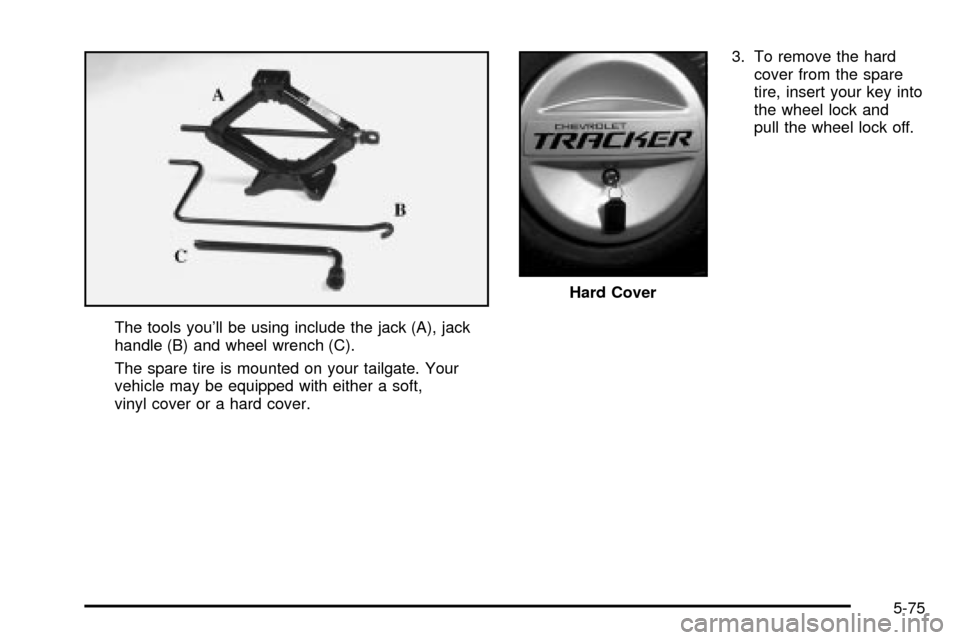
The tools you'll be using include the jack (A), jack
handle (B) and wheel wrench (C).
The spare tire is mounted on your tailgate. Your
vehicle may be equipped with either a soft,
vinyl cover or a hard cover.3. To remove the hard
cover from the spare
tire, insert your key into
the wheel lock and
pull the wheel lock off.
Hard Cover
5-75
Page 288 of 374
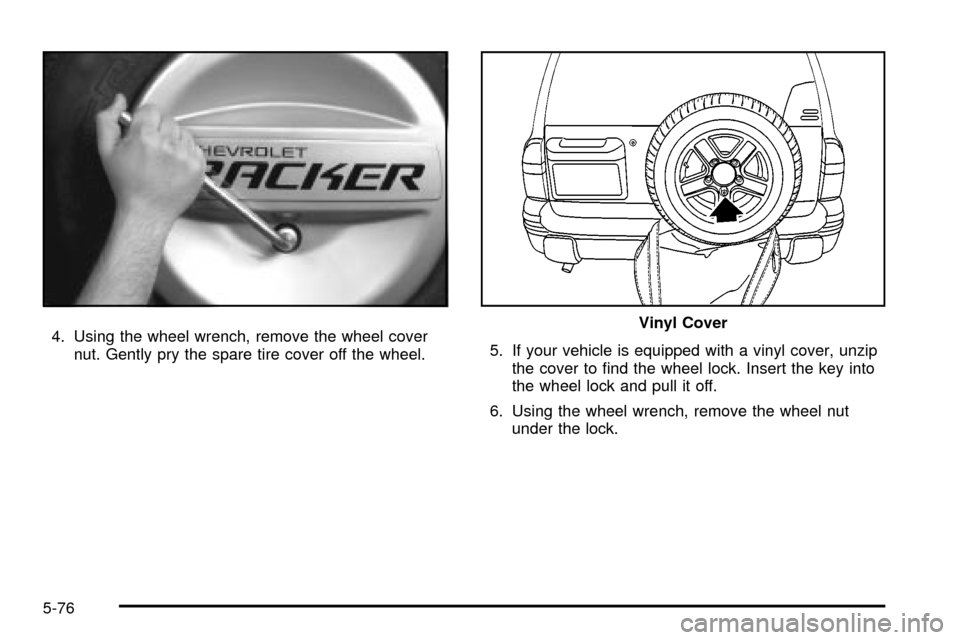
4. Using the wheel wrench, remove the wheel cover
nut. Gently pry the spare tire cover off the wheel.5. If your vehicle is equipped with a vinyl cover, unzip
the cover to ®nd the wheel lock. Insert the key into
the wheel lock and pull it off.
6. Using the wheel wrench, remove the wheel nut
under the lock.Vinyl Cover
5-76
Page 289 of 374
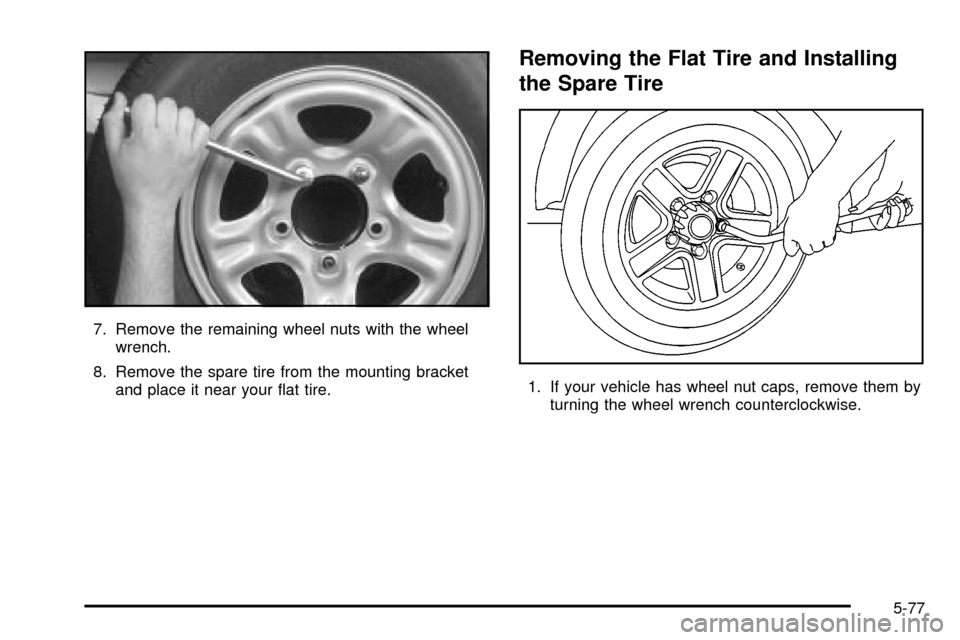
7. Remove the remaining wheel nuts with the wheel
wrench.
8. Remove the spare tire from the mounting bracket
and place it near your ¯at tire.
Removing the Flat Tire and Installing
the Spare Tire
1. If your vehicle has wheel nut caps, remove them by
turning the wheel wrench counterclockwise.
5-77
Page 292 of 374

4. Raise the vehicle by turning the jack handle
clockwise. Raise the vehicle far enough off the
ground so there is enough room for the spare tire to
®t underneath the wheel well.5. Remove all the wheel
nuts and take off the
¯at tire.
5-80
Page 296 of 374

Storing a Flat or Spare Tire and Tools
{CAUTION:
Storing a jack, a tire, or other equipment in the
passenger compartment of the vehicle could
cause injury. In a sudden stop or collision,
loose equipment could strike someone. Store
all these in the proper place.1. Store your vehicle's ¯at or spare tire by mounting it
on the tailgate.
Notice:Ensure that the wheel balance weight is on
the lower left section of the tire in order to allow
proper installation of the spare wheel cover.
2. Put the top two wheel nuts back on with the wheel
wrench.
3. Put the spare tire cover back on, if equipped. Using
the wheel wrench, put the wheel cover nut back on.
4. Put the spare wheel lock back on, if equipped and
lock it.
5. Put the jack, jack handle and wheel wrench back
into the storage area.
To stow the jack, place it in the storage bracket and
turn the shaft clockwise until the jack is securely held in
place. Reinstall the trim cover by inserting the cover
tabs into the slots. Push the cover closed and turn the
knob clockwise to secure the cover.
5-84
Page 338 of 374

Part B: Owner Checks and Services
Listed in this part are owner checks and services
which should be performed at the intervals speci®ed to
help ensure the safety, dependability and emission
control performance of your vehicle.
Be sure any necessary repairs are completed at once.
Whenever any ¯uids or lubricants are added to your
vehicle, make sure they are the proper ones, as shown
in Part D.
At Each Fuel Fill
It is important for you or a service station attendant to
perform these underhood checks at each fuel ®ll.
Engine Oil Level Check
Check the engine oil level and add the proper oil if
necessary. SeeEngine Oil on page 5-13for further
details.
Engine Coolant Level Check
Check the engine coolant level and add the proper
coolant mixture if necessary. SeeEngine Coolant on
page 5-25for further details.
Windshield Washer Fluid Level Check
Check the windshield washer ¯uid level in the windshield
washer tank and add the proper ¯uid if necessary.
See
Windshield Washer Fluid on page 5-37for further
details.
Hood Latch Operation Check
Pull the primary hood latch release handle inside the
vehicle. The secondary latch should keep the hood from
opening all the way when the primary latch is released.
Make sure the hood closes ®rmly. See
Hood Release
on page 5-10for further details.
At Least Once a Month
Tire In¯ation Check
Visually inspect your tires and make sure tires are
in¯ated to the correct pressures. Do not forget to check
your spare tire. See
Tires on page 5-55for further
details.
6-24