check engine light CHEVROLET TRAIL BLAZER 2007 1.G User Guide
[x] Cancel search | Manufacturer: CHEVROLET, Model Year: 2007, Model line: TRAIL BLAZER, Model: CHEVROLET TRAIL BLAZER 2007 1.GPages: 574, PDF Size: 2.94 MB
Page 226 of 574
ENGINE COOLANT HOT/ENGINE
OVERHEATED
Notice:If you drive your vehicle while the
engine is overheating, severe engine damage
may occur. If an overheat warning appears
on the instrument panel cluster and/or
DIC, stop the vehicle as soon as possible.
Do not increase the engine speed above
normal idling speed. SeeEngine Overheating
on page 418for more information.
This message displays and a chime sounds if the
cooling system temperature gets hot. SeeEngine
Overheating on page 418for the proper course of
action. This message clears when the coolant
temperature drops to a safe operating temperature.
FUEL LEVEL LOW
This message displays and a chime sounds if the
fuel level is low in the vehicle’s fuel tank. Refuel as
soon as possible. Press any of the DIC buttons, or
the trip stem, to acknowledge this message and
clear it from the DIC display. SeeLow Fuel Warning
Light on page 219,Filling the Tank on page 391,
andFuel on page 388for more information.
ICE POSSIBLE
This message may display if the outside
temperature reaches a level where ice could form
on the roadway. If the temperature rises to a safe
level, the message clears. This message clears
itself after 10 seconds, or you can press any of the
DIC buttons, or the trip stem, to acknowledge this
message and clear it from the DIC display.
KEY FOB # BATTERY LOW
This message displays if a Remote Keyless
Entry (RKE) transmitter battery is low. Replace
the battery in the transmitter. See “Battery
Replacement” underRemote Keyless Entry (RKE)
System Operation on page 96. Press any of the
DIC buttons, or the trip stem, to acknowledge
this message and clear it from the DIC display.
LEFT REAR DOOR AJAR
This message displays and a chime sounds if the
driver’s side rear door is not fully closed. Stop and
turn off the vehicle, check the door for obstructions,
and close the door again. Check to see if the
message still appears on the DIC. Press any of the
DIC buttons, or the trip stem, to acknowledge this
message and clear it from the DIC display.
226
Page 228 of 574
SERVICE AIR BAG
This message displays if there is a problem with
the airbag system. Have your dealer/retailer
inspect the system for problems. SeeAirbag
Readiness Light on page 202andAirbag System
on page 69for more information. Press any of
the DIC buttons, or the trip stem, to acknowledge
this message and clear it from the DIC display.
SERVICE BRAKE SYSTEM
This message displays if a problem occurs with
the brake system. If this message appears, stop
as soon as possible and turn off the vehicle.
Restart the vehicle and check for the message
on the DIC display. If the message is still
displayed, or appears again when you begin
driving, the brake system needs service.
See your dealer/retailer.
SERVICE CHARGING SYS (System)
This message displays if there is a problem with the
battery charging system. Under certain conditions,
the charging system light may also turn on in the
instrument panel cluster. SeeCharging System
Light on page 206. The battery will not be charging
at an optimal rate and the vehicle will lose the ability
to enter the fuel economy mode. The vehicle is safe
to drive, however you should have the electrical
system checked by your dealer/retailer. Press any
of the DIC buttons, or the trip stem, to acknowledge
this message and clear it from the DIC display.
SERVICE STABILITRAK
If this message displays, it means there may be
a problem with the StabiliTrak®system. If this
message appears, try to reset the system by
performing the following: stop; turn off the engine;
then start the engine again. If this message still
comes on, it means there is a problem. You should
see your dealer/retailer for service. The vehicle is
safe to drive, however, you do not have the benet
of StabiliTrak
®, so reduce your speed and drive
accordingly. Press any of the DIC buttons, or the
trip stem, to acknowledge this message and clear it
from the DIC display.
228
Page 311 of 574
If you keep pace with the traffic and allow realistic
following distances, you will eliminate a lot of
unnecessary braking. That means better braking
and longer brake life.
If your vehicle’s engine ever stops while you are
driving, brake normally but do not pump the
brakes. If you do, the pedal may get harder to
push down. If the engine stops, you will still have
some power brake assist. But you will use it
when you brake. Once the power assist is used
up, it may take longer to stop and the brake pedal
will be harder to push.
Adding non-GM accessories can affect your
vehicle’s performance. SeeAccessories and
Modications on page 386.Anti-Lock Brake System (ABS)
Your vehicle has the Anti-Lock Brake
System (ABS), an advanced electronic braking
system that will help prevent a braking skid.
When you start the engine and begin to drive
away, ABS will check itself. You might hear
a momentary motor or clicking noise while this
test is going on. This is normal.
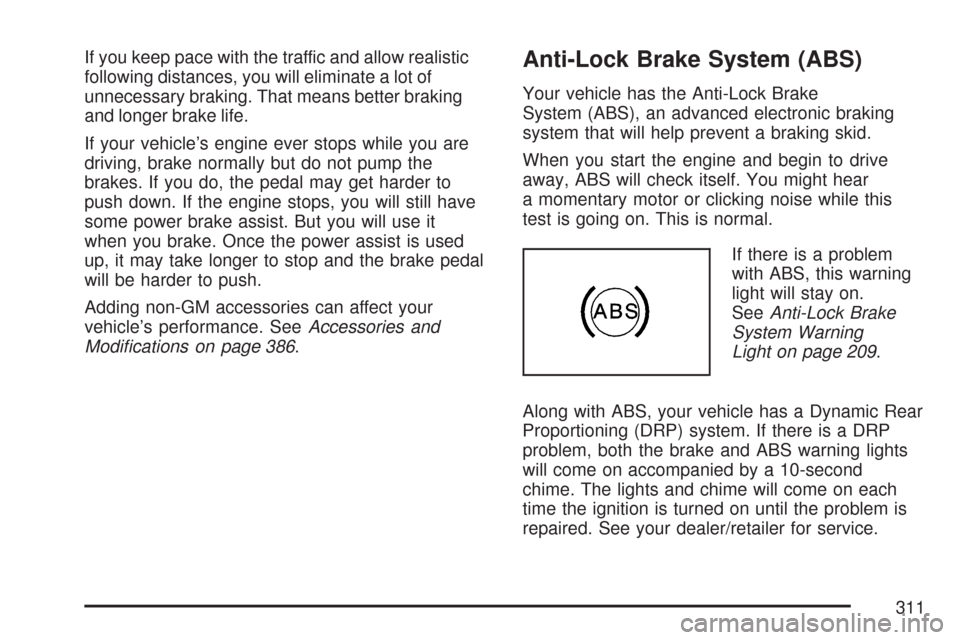
If there is a problem
with ABS, this warning
light will stay on.
SeeAnti-Lock Brake
System Warning
Light on page 209.
Along with ABS, your vehicle has a Dynamic Rear
Proportioning (DRP) system. If there is a DRP
problem, both the brake and ABS warning lights
will come on accompanied by a 10-second
chime. The lights and chime will come on each
time the ignition is turned on until the problem is
repaired. See your dealer/retailer for service.
311
Page 353 of 574
{CAUTION:
Snow can trap exhaust gases under
your vehicle. This can cause deadly
CO (carbon monoxide) gas to get inside.
CO could overcome you and kill you. You
cannot see it or smell it, so you might not
know it is in your vehicle. Clear away
snow from around the base of your
vehicle, especially any that is blocking the
exhaust pipe. And check around again
from time to time to be sure snow does
not collect there.
Open a window just a little on the side of
the vehicle that is away from the wind.
This will help keep CO out.Run your engine only as long as you must.
This saves fuel. When you run the engine, make it
go a little faster than just idle. That is, push the
accelerator slightly. This uses less fuel for the heat
that you get and it keeps the battery charged.
You will need a well-charged battery to restart the
vehicle, and possibly for signaling later on with
your headlamps. Let the heater run for a while.
Then, shut the engine off and close the window
almost all the way to preserve the heat. Start
the engine again and repeat this only when you
feel really uncomfortable from the cold. But do it as
little as possible. Preserve the fuel as long as
you can. To help keep warm, you can get out of
the vehicle and do some fairly vigorous exercises
every half hour or so until help comes.
353
Page 408 of 574
Engine Oil Life System
When to Change Engine Oil
Your vehicle has a computer system that lets you
know when to change the engine oil and lter.
This is based on engine revolutions and engine
temperature, and not on mileage. Based on driving
conditions, the mileage at which an oil change
will be indicated can vary considerably. For the oil
life system to work properly, you must reset the
system every time the oil is changed.
When the system has calculated that oil life
has been diminished, it will indicate that an
oil change is necessary. A change engine oil
light will come on, and, if your vehicle has a
Driver Information Center (DIC), a CHANGE
ENGINE OIL message will come. SeeChange
Engine Oil Light on page 216andDIC
Warnings and Messages on page 224.Change your oil as soon as possible within the
next 600 miles (1 000 km). It is possible that, if you
are driving under the best conditions, the oil life
system may not indicate that an oil change is
necessary for over a year. However, the engine oil
and lter must be changed at least once a year
and at this time the system must be reset.
Your dealer has GM-trained people who will
perform this work using genuine GM parts and
reset the system. It is also important to check the
oil regularly and keep it at the proper level.
If the system is ever reset accidentally, you must
change your oil at 3,000 miles (5 000 km)
since the last oil change. Remember to reset the
oil life system whenever the oil is changed.
408
Page 414 of 574
How to Add Automatic
Transmission Fluid
Refer to the Maintenance Schedule to determine
what kind of transmission uid to use. See
Recommended Fluids and Lubricants on page 529.
Add uid only after checking the transmission
uid while it is hot. A cold check is used only as
a reference. If the uid level is low, add only
enough of the proper uid to bring the level up to
the HOT area for a hot check. It does not take
much uid, generally less than one pint (0.5 L).
Do not overll.
Notice:Use of the incorrect automatic
transmission uid may damage your vehicle,
and the damages may not be covered by
your warranty. Always use the automatic
transmission uid listed inRecommended
Fluids and Lubricants on page 529.
After adding uid, recheck the uid level as
described under “How to Check Automatic
Transmission Fluid,” earlier in this section.
When the correct uid level is obtained, push
the dipstick back in all the way; then ip the
handle down to lock the dipstick in place.
Engine Coolant
The cooling system in your vehicle is lled with
DEX-COOL®engine coolant. This coolant is
designed to remain in your vehicle for ve years or
150,000 miles (240 000 km), whichever occurs
rst, if you add only DEX-COOL
®extended
life coolant.
The following explains your cooling system and
how to add coolant when it is low. If you have
a problem with engine overheating, seeEngine
Overheating on page 418.
A 50/50 mixture of clean, drinkable water and
DEX-COOL
®coolant will:
Give freezing protection down to
−34°F (−37°C).
Give boiling protection up to 265°F (129°C).
Protect against rust and corrosion.
Help keep the proper engine temperature.
Let the warning lights and gages work as
they should.
414
Page 519 of 574
When you go to your GM Goodwrench®dealer for
your service needs, you will know that GM-trained
and supported service technicians will perform
the work using genuine GM parts.
If you want to purchase service information, see
Service Publications Ordering Information on
page 554.
Owner Checks and Services on page 525tells you
what should be checked, when to check it, and
what you can easily do to help keep your vehicle in
good condition.
The proper replacement parts, uids, and
lubricants to use are listed inRecommended
Fluids and Lubricants on page 529andNormal
Maintenance Replacement Parts on page 532.
When your vehicle is serviced, make sure these
are used. All parts should be replaced and all
necessary repairs done before you or anyone else
drives the vehicle. We recommend the use of
genuine GM parts.Scheduled Maintenance
When the change engine oil light or CHANGE
ENGINE OIL DIC message comes on, it means
that service is required for your vehicle. See
Change Engine Oil Light on page 216orDIC
Warnings and Messages on page 224. Have your
vehicle serviced as soon as possible within the
next 600 miles (1 000 km). It is possible that, if you
are driving under the best conditions, the engine
oil life system may not indicate that vehicle service
is necessary for over a year. However, your
engine oil and lter must be changed at least once
a year and at this time the system must be
reset. Your dealer/retailer has trained service
technicians who will perform this work using
genuine parts and reset the system.
If the engine oil life system is ever reset
accidentally, you must service your vehicle within
3,000 miles (5 000 km) since your last service.
Remember to reset the oil life system whenever
the oil is changed. SeeEngine Oil Life System on
page 408for information on the Engine Oil Life
System and resetting the system.
519
Page 520 of 574
When the change engine oil light or CHANGE
ENGINE OIL DIC message appears, certain
services, checks, and inspections are required.
Required services are described in the following
for “MaintenanceI” and “MaintenanceII.”
Generally, it is recommended that your rst service
be MaintenanceI, your second service be
MaintenanceII, and that you alternate
MaintenanceIand MaintenanceIIthereafter.
However, in some cases, MaintenanceIImay be
required more often.MaintenanceI— Use MaintenanceIif the light
or message comes on within 10 months since
the vehicle was purchased or MaintenanceIIwas
performed.
MaintenanceII— Use MaintenanceIIif the
previous service performed was MaintenanceI.
Always use MaintenanceIIwhenever the light
or message comes on 10 months or more since
the last service or if the light or message has
not come on at all for one year.
520
Page 524 of 574
(e)Make sure the safety belt reminder light and all
your belts, buckles, latch plates, retractors, and
anchorages are working properly. Look for
any other loose or damaged safety belt system
parts. If you see anything that might keep a safety
belt system from doing its job, have it repaired.
Have any torn or frayed safety belts replaced. Also
look for any opened or broken airbag coverings,
and have them repaired or replaced. The
airbag system does not need regular maintenance.
(f)Lubricate all key lock cylinders, hood latch
assembly, secondary latch, pivots, spring anchor,
release pawl, rear compartment hinges, outer
liftgate handle pivot points, rear door detent link,
roller mechanism, liftgate handle pivot points, latch
bolt, fuel door hinge, cargo door hinge, locks,
and folding seat hardware. More frequent
lubrication may be required when exposed to a
corrosive environment. Applying silicone grease on
weatherstrips with a clean cloth will make them
last longer, seal better, and not stick or squeak.
(g)Inspect hoses for cracks, chang, leaks, kinks,
and proper installation.(h)Change automatic transmission uid and lter
if the vehicle is mainly driven under one or
more of these conditions:
In heavy city traffic where the outside
temperature regularly reaches 90°F
(32°C) or higher.
In hilly or mountainous terrain.
When doing frequent trailer towing.
Uses such as found in taxi, police, or delivery
service.
(i)Drain, ush, and rell cooling system. This
service can be complex; you should have
your dealer/retailer perform this service. See
Engine Coolant on page 414 for what to use.
Inspect hoses. Clean radiator, condenser, pressure
cap, and ller neck. Pressure test the cooling
system and pressure cap.
(j)A uid loss in any vehicle system could indicate
a problem. Have the system inspected and repaired
and the uid level checked. Add uid if needed.
(k)If you drive regularly under dusty conditions,
inspect the lter at each engine oil change.
(l)Visually inspect belt for fraying, excessive
cracks, or obvious damage. Replace belt if
necessary.
524
Page 561 of 574
C
Calibration........................133, 135, 138, 140
California Fuel............................................. 389
California Proposition 65 Warning................ 386
Canadian Owners........................................... 3
Capacities and Specications...................... 513
Carbon Monoxide..............104, 130, 350, 368
Care of
Safety Belts............................................. 495
Your CD and DVD Player........................ 302
Your CDs and DVDs................................ 302
Cargo Cover............................................... 164
Cargo Tie Downs........................................ 165
CD, MP3 ..................................................... 274
Center Console Storage Area...................... 161
Chains, Tire................................................. 472
Charging System Light................................ 206
Check
Engine Light............................................ 212
Gages Warning Light............................... 218
Check Gas Cap Light.................................. 219
Checking Things Under the Hood................ 394
Chemical Paint Spotting.............................. 499
Child Restraints
Child Restraint Systems............................. 48
Infants and Young Children........................ 44Child Restraints (cont.)
Lower Anchors and Tethers for Children..... 53
Older Children........................................... 41
Securing a Child Restraint in a Rear
Outside Seat Position............................. 61
Securing a Child Restraint in the Center
Rear Seat Position ................................. 64
Securing a Child Restraint in the Right
Front Seat Position ................................. 64
Where to Put the Restraint........................ 52
Chime Level Adjustment.............................. 303
Cigarette Lighter.......................................... 187
Cleaning
Aluminum Wheels.................................... 498
Exterior Lamps/Lenses............................. 496
Fabric/Carpet........................................... 493
Finish Care.............................................. 496
Inside of Your Vehicle.............................. 491
Instrument Panel, Vinyl, and Other
Plastic Surfaces.................................... 494
Leather.................................................... 494
Tires........................................................ 498
Underbody Maintenance........................... 499
Washing Your Vehicle.............................. 495
Weatherstrips........................................... 495
Windshield, Backglass, and
Wiper Blades........................................ 497
561