remote start CHEVROLET TRAIL BLAZER 2007 1.G User Guide
[x] Cancel search | Manufacturer: CHEVROLET, Model Year: 2007, Model line: TRAIL BLAZER, Model: CHEVROLET TRAIL BLAZER 2007 1.GPages: 574, PDF Size: 2.94 MB
Page 401 of 574
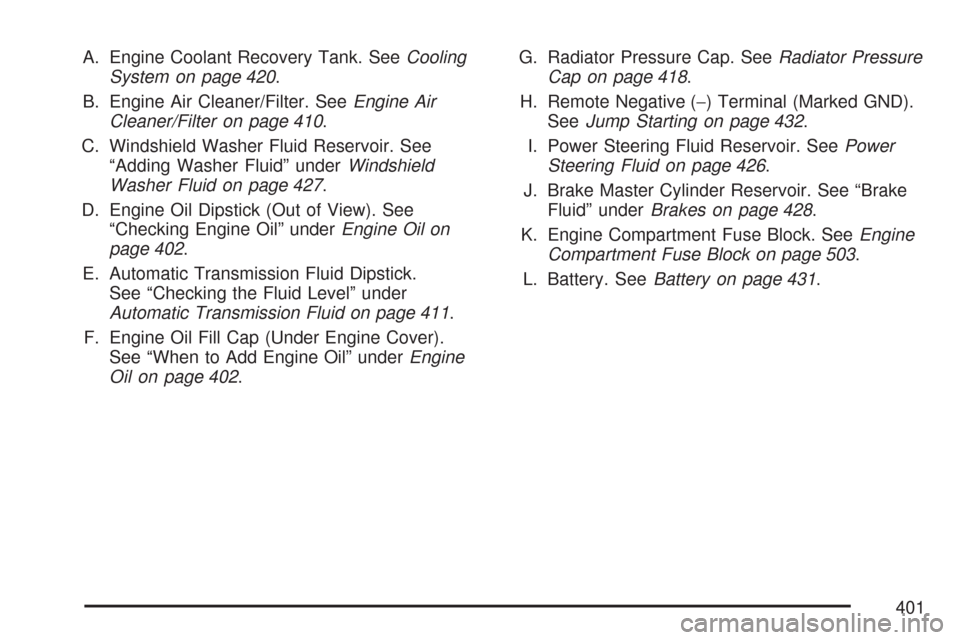
A. Engine Coolant Recovery Tank. SeeCooling
System on page 420.
B. Engine Air Cleaner/Filter. SeeEngine Air
Cleaner/Filter on page 410.
C. Windshield Washer Fluid Reservoir. See
“Adding Washer Fluid” underWindshield
Washer Fluid on page 427.
D. Engine Oil Dipstick (Out of View). See
“Checking Engine Oil” underEngine Oil on
page 402.
E. Automatic Transmission Fluid Dipstick.
See “Checking the Fluid Level” under
Automatic Transmission Fluid on page 411.
F. Engine Oil Fill Cap (Under Engine Cover).
See “When to Add Engine Oil” underEngine
Oil on page 402.G. Radiator Pressure Cap. SeeRadiator Pressure
Cap on page 418.
H. Remote Negative (−) Terminal (Marked GND).
SeeJump Starting on page 432.
I. Power Steering Fluid Reservoir. SeePower
Steering Fluid on page 426.
J. Brake Master Cylinder Reservoir. See “Brake
Fluid” underBrakes on page 428.
K. Engine Compartment Fuse Block. SeeEngine
Compartment Fuse Block on page 503.
L. Battery. SeeBattery on page 431.
401
Page 434 of 574
4. Open both hoods and locate the batteries.
Find the positive (+) and negative (−)
terminals on each battery. Your vehicle has a
remote negative (−) jump starting terminal.
You should always use this remote terminal
instead of the terminal on the battery.
The remote negative (−) terminal is located
on the front engine lift bracket on vehicles
with the 4.2L L6 engine or the engine
accessory drive bracket for vehicles with
the 5.3L or 6.0L V8 engines, and is marked
GND (Ground). SeeEngine Compartment
Overview on page 396for more information
on location.
{CAUTION:
Using a match near a battery can cause
battery gas to explode. People have been
hurt doing this, and some have been
blinded. Use a ashlight if you need
more light.
Be sure the battery has enough water.
You do not need to add water to the battery
installed in your new vehicle. But if a
battery has ller caps, be sure the right
amount of uid is there. If it is low, add
water to take care of that rst. If you do not,
explosive gas could be present.
Battery uid contains acid that can burn
you. Do not get it on you. If you accidentally
get it in your eyes or on your skin, ush the
place with water and get medical help
immediately.
434
Page 436 of 574
8. Now connect the black negative (−) cable to
the negative (−) terminal of the good battery.
Use a remote negative (−) terminal if the
vehicle has one.
Do not let the other end touch anything until
the next step. The other end of the
negative (−) cable does not go to the dead
battery. It goes to a heavy, unpainted
metal engine part or to the remote negative (−)
terminal on the vehicle with the dead battery.
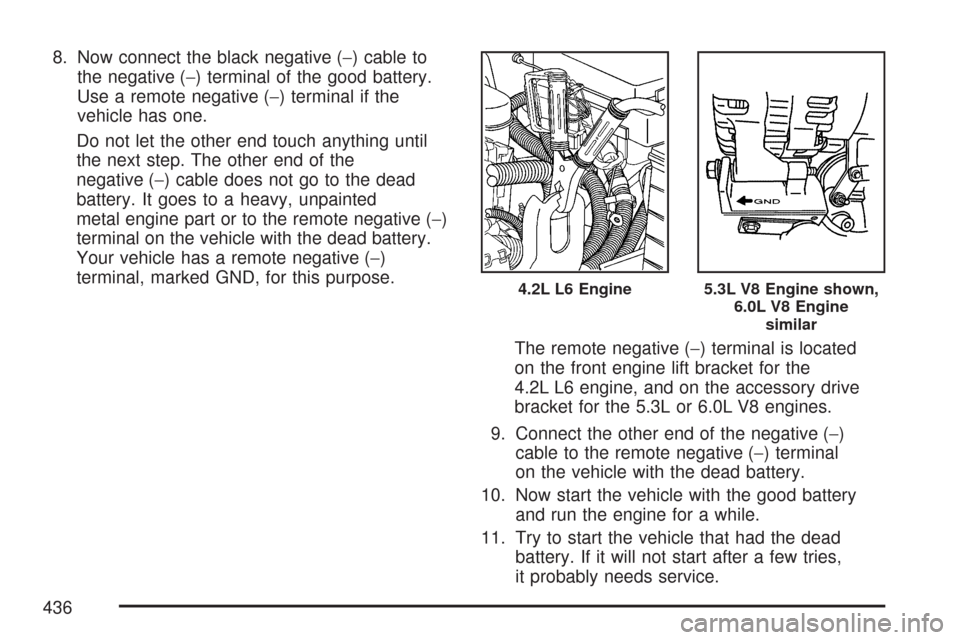
Your vehicle has a remote negative (−)
terminal, marked GND, for this purpose.
The remote negative (−) terminal is located
on the front engine lift bracket for the
4.2L L6 engine, and on the accessory drive
bracket for the 5.3L or 6.0L V8 engines.
9. Connect the other end of the negative (−)
cable to the remote negative (−) terminal
on the vehicle with the dead battery.
10. Now start the vehicle with the good battery
and run the engine for a while.
11. Try to start the vehicle that had the dead
battery. If it will not start after a few tries,
it probably needs service.
4.2L L6 Engine5.3L V8 Engine shown,
6.0L V8 Engine
similar
436
Page 557 of 574
OnStar
If your vehicle has OnStar®and you subscribe to
the OnStar®services, please refer to the
OnStar®Terms and Conditions for information on
data collection and use. See alsoOnStar®
System on page 145for more information.
Navigation System
If your vehicle has anavigation system,use of
the system may result in the storage of
destinations, addresses, telephone numbers,
and other trip information.Please refer to
the navigation system operating manual for
information on stored data and for deletion
instructions.
Radio Frequency
Identication (RFID)
RFIDtechnology is used in some vehicles for
functions such as tire pressure monitoring
and ignition system security, as well as in
connection with conveniences such as key fobs
for remote door locking/unlocking and starting, and
in-vehicle transmitters for garage door openers.
RFID technology in GM vehicles does not
use or record personal information or link with any
other GM system containing personal information.
557